
CHROMOSOME nomenclature
Dr. Nagabhushan C M
Assistant Professor,
Dept. Of Studies in Zoology,
Vijayanagara Sri Krishnadevaraya University,
Ballari, Karnataka
nagabhushancm@vskub.ac.in
Chromosomes are the thread like structures of NA and
proteins found in the nucleus of most of the living
organisms carrying genetic information in the form of
GENES
The definition
CHROMA=COLOUR
SOMA= BODY
E. STRASBURGER (1875) DISCOVERED THREAD-LIKE STRUCTURES
APPEARED DURING CELL DIVISION.
WALDEYER COINED THIS TERM (1888).
THE DETAILED CHROMOSOME IS SEEN IN THE METAPHASE WITH
SUITABLE DYES.
IN ALL EUKARYOTIC ORGANISMS DEFINITE NUMBER OF
CHROMOSOMES WITH DEFINITE SIZE AND DEFINIT SHAPE.
Chromosome
CHROMA=COLOUR
SOMA= BODY
E. STRASBURGER (1875) Discovered Thread-like Structures Appeared
During Cell Division.
The detailed chromosome is seen in the METAPHASE with suitable dyes.
IN ALL EUKARYOTIC ORGANISMS DEFINITE NUMBER OF
CHROMOSOMES WITH DEFINITE SIZE AND DEFINITE SHAPE.
DIPLOID IN SOMATIC CELLS; HAPLOID IN GAMETES.
Chromosome
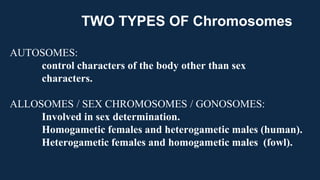
AUTOSOMES:
control characters of the body other than sex
characters.
ALLOSOMES / SEX CHROMOSOMES / GONOSOMES:
Involved in sex determination.
Homogametic females and heterogametic males (human).
Heterogametic females and homogametic males (fowl).
TWO TYPES OF Chromosomes
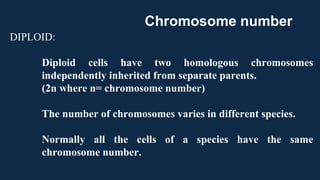
DIPLOID:
Diploid cells have two homologous chromosomes
independently inherited from separate parents.
(2n where n= chromosome number)
The number of chromosomes varies in different species.
Normally all the cells of a species have the same
chromosome number.
Chromosome number
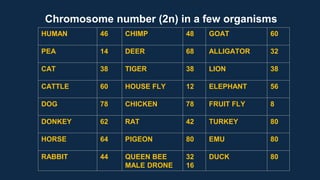
HUMAN 46 CHIMP 48 GOAT 60
PEA 14 DEER 68 ALLIGATOR 32
CAT 38 TIGER 38 LION 38
CATTLE 60 HOUSE FLY 12 ELEPHANT 56
DOG 78 CHICKEN 78 FRUIT FLY 8
DONKEY 62 RAT 42 TURKEY 80
HORSE 64 PIGEON 80 EMU 80
RABBIT 44 QUEEN BEE
MALE DRONE
32
16
DUCK 80
Chromosome number (2n) in a few organisms
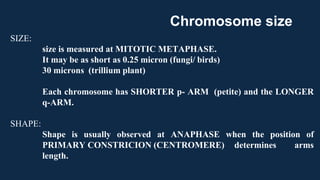
SIZE:
size is measured at MITOTIC METAPHASE.
It may be as short as 0.25 micron (fungi/ birds)
30 microns (trillium plant)
Each chromosome has SHORTER p- ARM (petite) and the LONGER
q-ARM.
SHAPE:
Shape is usually observed at ANAPHASE when the position of
PRIMARY CONSTRICION (CENTROMERE) determines arms
length.
Chromosome size
MORPHOLOGY:
MITOTIC METAPHASE is suitable stage for morphological studies.
The chromosome morphology CHANGES during cell division.
The chromosomes are THIN, COILED, ELASTIC, THREAD-LIKE
during interphase.
BUT during MITOSIS chromosomes become HIGHLY CONDENSED.
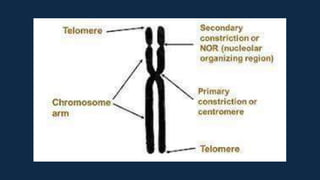
Chromosome structure
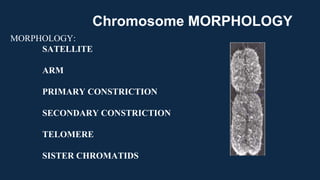
MORPHOLOGY:
SATELLITE
ARM
PRIMARY CONSTRICTION
SECONDARY CONSTRICTION
TELOMERE
SISTER CHROMATIDS
Chromosome MORPHOLOGY
CHROMATID:
each metaphase chromosome appears to be divided into two identical
parts called CHROMATIDS.
Both the chromatids are joined together at CENTROMERE.
The chromatids SEPARATE from chromosome during MITOTIC ANAPHASE
AND ANAPHASE OF MEIOSIS-II.
2 chromatids are produced through the replication of a single chromatid during
S PHASE of INTERPHASE = sister chromatids.
Chromosome MORPHOLOGY
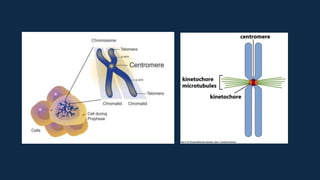
CENTROMERE:
Centromere at the primary constriction is the landmark for the
identification of the chromosome.
Centromere divides chromosome into TWO ARMS p and q.
Chromosome MORPHOLOGY
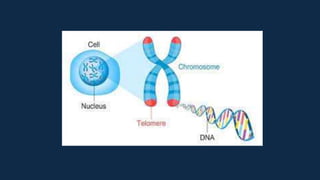
TELOMERE:
the ends of a chromosome are TELOMERES.
they are highly stable and telomeres of different chromosomes DONOT
FUSE.
keeps the chromosomes from making contact with any membranes.
the telomeric regions have repeated sequences of T AND G bases.
Chromosome MORPHOLOGY
SECONDARY CONSTRICTION:
ONE or many constrictions other than PRIMARY CONSTRICTION are
secondary constrictions.
Chromosome MORPHOLOGY
SATELLITE:
THE chromosome region between the SECONDARY CONSTRICTION and
nearest TELOMERE is called SATELLITE, and the chromosome that possess
this region are called SAT CHROMOSOMES.
It is a SMALL CHROMOSOMAL SEGMENT separated from the main body
of the chromosome.
Chromosome MORPHOLOGY
TYPES:
BASED ON THE NUMBER OF CENTROMERES AND ITS POSITION.
ACENTRIC
MONO CENTRIC
DI CENTRIC
POLYCENTRIC
ACROCENTRIC
TELOCENTRIC
SUB META CENTRIC
META CENTRIC
Chromosome MORPHOLOGY
Tightly packed chromosome,
Intensely stained region of the chromosome,
Consists of genetically inactive satellite sequences,
Both centromeres and telomeres are heterochromatic.
heterochromatin
Lightly packed form, rich in gene concentration.
Often under active transcription.
It is found both in eukaryotes and prokaryotes.
euchromatin
1. Current opinion in cell biology
2. National human genome research institute.
3. Chromosome condensation and decondensation during mitosis by Wolfram Antonyn and Heinz
Neumann, Elsevier, science direct Journal.
4. Topperlearning.com
5. Chromosome organisation and dynamics during interphase mitosis by Choon-Lin-Tiang, Yan He,
Wojciench P.Pawlowski, Dept of genetics, Cornwell university, Ithaca, New York.
Acknowledgement and references
thank you

Chromosomal nomenclature

  • 1.
    CHROMOSOME nomenclature Dr. NagabhushanC M Assistant Professor, Dept. Of Studies in Zoology, Vijayanagara Sri Krishnadevaraya University, Ballari, Karnataka nagabhushancm@vskub.ac.in
  • 2.
    Chromosomes are thethread like structures of NA and proteins found in the nucleus of most of the living organisms carrying genetic information in the form of GENES The definition
  • 3.
    CHROMA=COLOUR SOMA= BODY E. STRASBURGER(1875) DISCOVERED THREAD-LIKE STRUCTURES APPEARED DURING CELL DIVISION. WALDEYER COINED THIS TERM (1888). THE DETAILED CHROMOSOME IS SEEN IN THE METAPHASE WITH SUITABLE DYES. IN ALL EUKARYOTIC ORGANISMS DEFINITE NUMBER OF CHROMOSOMES WITH DEFINITE SIZE AND DEFINIT SHAPE. Chromosome
  • 4.
    CHROMA=COLOUR SOMA= BODY E. STRASBURGER(1875) Discovered Thread-like Structures Appeared During Cell Division. The detailed chromosome is seen in the METAPHASE with suitable dyes. IN ALL EUKARYOTIC ORGANISMS DEFINITE NUMBER OF CHROMOSOMES WITH DEFINITE SIZE AND DEFINITE SHAPE. DIPLOID IN SOMATIC CELLS; HAPLOID IN GAMETES. Chromosome
  • 5.
    AUTOSOMES: control characters ofthe body other than sex characters. ALLOSOMES / SEX CHROMOSOMES / GONOSOMES: Involved in sex determination. Homogametic females and heterogametic males (human). Heterogametic females and homogametic males (fowl). TWO TYPES OF Chromosomes
  • 6.
    DIPLOID: Diploid cells havetwo homologous chromosomes independently inherited from separate parents. (2n where n= chromosome number) The number of chromosomes varies in different species. Normally all the cells of a species have the same chromosome number. Chromosome number
  • 7.
    HUMAN 46 CHIMP48 GOAT 60 PEA 14 DEER 68 ALLIGATOR 32 CAT 38 TIGER 38 LION 38 CATTLE 60 HOUSE FLY 12 ELEPHANT 56 DOG 78 CHICKEN 78 FRUIT FLY 8 DONKEY 62 RAT 42 TURKEY 80 HORSE 64 PIGEON 80 EMU 80 RABBIT 44 QUEEN BEE MALE DRONE 32 16 DUCK 80 Chromosome number (2n) in a few organisms
  • 8.
    SIZE: size is measuredat MITOTIC METAPHASE. It may be as short as 0.25 micron (fungi/ birds) 30 microns (trillium plant) Each chromosome has SHORTER p- ARM (petite) and the LONGER q-ARM. SHAPE: Shape is usually observed at ANAPHASE when the position of PRIMARY CONSTRICION (CENTROMERE) determines arms length. Chromosome size
  • 9.
    MORPHOLOGY: MITOTIC METAPHASE issuitable stage for morphological studies. The chromosome morphology CHANGES during cell division. The chromosomes are THIN, COILED, ELASTIC, THREAD-LIKE during interphase. BUT during MITOSIS chromosomes become HIGHLY CONDENSED. Chromosome structure
  • 10.
  • 11.
    CHROMATID: each metaphase chromosomeappears to be divided into two identical parts called CHROMATIDS. Both the chromatids are joined together at CENTROMERE. The chromatids SEPARATE from chromosome during MITOTIC ANAPHASE AND ANAPHASE OF MEIOSIS-II. 2 chromatids are produced through the replication of a single chromatid during S PHASE of INTERPHASE = sister chromatids. Chromosome MORPHOLOGY
  • 12.
    CENTROMERE: Centromere at theprimary constriction is the landmark for the identification of the chromosome. Centromere divides chromosome into TWO ARMS p and q. Chromosome MORPHOLOGY
  • 14.
    TELOMERE: the ends ofa chromosome are TELOMERES. they are highly stable and telomeres of different chromosomes DONOT FUSE. keeps the chromosomes from making contact with any membranes. the telomeric regions have repeated sequences of T AND G bases. Chromosome MORPHOLOGY
  • 16.
    SECONDARY CONSTRICTION: ONE ormany constrictions other than PRIMARY CONSTRICTION are secondary constrictions. Chromosome MORPHOLOGY
  • 18.
    SATELLITE: THE chromosome regionbetween the SECONDARY CONSTRICTION and nearest TELOMERE is called SATELLITE, and the chromosome that possess this region are called SAT CHROMOSOMES. It is a SMALL CHROMOSOMAL SEGMENT separated from the main body of the chromosome. Chromosome MORPHOLOGY
  • 19.
    TYPES: BASED ON THENUMBER OF CENTROMERES AND ITS POSITION. ACENTRIC MONO CENTRIC DI CENTRIC POLYCENTRIC ACROCENTRIC TELOCENTRIC SUB META CENTRIC META CENTRIC Chromosome MORPHOLOGY
  • 20.
    Tightly packed chromosome, Intenselystained region of the chromosome, Consists of genetically inactive satellite sequences, Both centromeres and telomeres are heterochromatic. heterochromatin
  • 21.
    Lightly packed form,rich in gene concentration. Often under active transcription. It is found both in eukaryotes and prokaryotes. euchromatin
  • 22.
    1. Current opinionin cell biology 2. National human genome research institute. 3. Chromosome condensation and decondensation during mitosis by Wolfram Antonyn and Heinz Neumann, Elsevier, science direct Journal. 4. Topperlearning.com 5. Chromosome organisation and dynamics during interphase mitosis by Choon-Lin-Tiang, Yan He, Wojciench P.Pawlowski, Dept of genetics, Cornwell university, Ithaca, New York. Acknowledgement and references
  • 23.