Physiological time and Real time
PHYSIOLOGICAL TIME
• Small animals large animals
CLOCK TIME cannot have same meaning for ALL.
shrew HR=1000
elephant HR = 30
Time and frequency:
high frequency of small heart MEANS duration of HB is small
[duration of HB increases in
proportion to body mass raised
to the power 0.25]
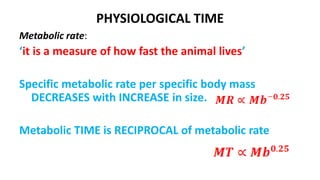
PHYSIOLOGICAL TIME
Metabolic rate:
‘it is a measure of how fast the animal lives’
Specific metabolic rate per specific body mass
DECREASES with INCREASE in size.
Metabolic TIME is RECIPROCAL of metabolic rate
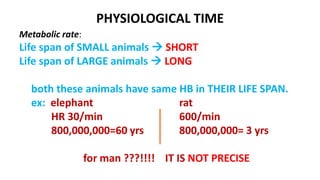
PHYSIOLOGICAL TIME
Metabolic rate:
Life span of SMALL animals  SHORT
Life span of LARGE animals  LONG
both these animals have same HB in THEIR LIFE SPAN.
ex: elephant rat
HR 30/min 600/min
800,000,000=60 yrs 800,000,000= 3 yrs
for man ???!!!! IT IS NOT PRECISE
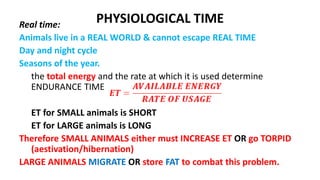
PHYSIOLOGICAL TIME
Real time:
Animals live in a REAL WORLD & cannot escape REAL TIME
Day and night cycle
Seasons of the year.
the total energy and the rate at which it is used determine
ENDURANCE TIME
ET for SMALL animals is SHORT
ET for LARGE animals is LONG
Therefore SMALL ANIMALS either must INCREASE ET OR go TORPID
(aestivation/hibernation)
LARGE ANIMALS MIGRATE OR store FAT to combat this problem.
EFFECTS OF HIGH ALTITUDE
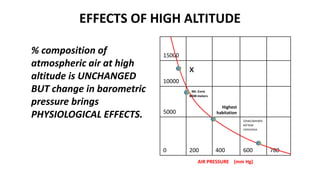
% composition of
atmospheric air at high
altitude is UNCHANGED
BUT change in barometric
pressure brings
PHYSIOLOGICAL EFFECTS.
15000
10000
x
5000
Mt. Evrst
8848 meters
Highest
habitation
0 200 400
Unacclamatis
ed lose
conscious
600 760
AIR PRESSURE (mm Hg)
EFFECTS OF HIGH ALTITUDE
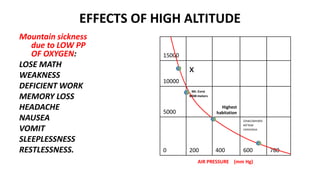
Mountain sickness
due to LOW PP
OF OXYGEN:
LOSE MATH
WEAKNESS
DEFICIENT WORK
MEMORY LOSS
HEADACHE
NAUSEA
VOMIT
SLEEPLESSNESS
RESTLESSNESS.
15000
10000
x
5000
Mt. Evrst
8848 meters
Highest
habitation
0 200 400
Unacclamatis
ed lose
conscious
600 760
AIR PRESSURE (mm Hg)
EFFECTS OF HIGH ALTITUDE
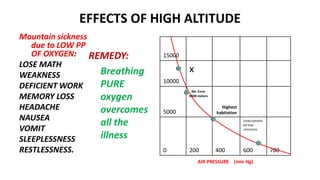
Mountain sickness
due to LOW PP
OF OXYGEN:
LOSE MATH
WEAKNESS
DEFICIENT WORK
MEMORY LOSS
HEADACHE
NAUSEA
VOMIT
SLEEPLESSNESS
RESTLESSNESS.
15000
10000
x
5000
Mt. Evrst
8848 meters
Highest
habitation
0 200 400
Unacclamatis
ed lose
conscious
600 760
AIR PRESSURE (mm Hg)
REMEDY:
Breathing
PURE
oxygen
overcomes
all the
illness
EFFECTS OF HIGH ALTITUDE
The adequate supply of OXYGEN to the TISSUES depends upon:
(each of these steps are affected during acclimatization)
VENTILATION OF THE LUNGS,
DIFFUSION FROM LUNGS-BLOOD,
TRANSPORT OF OXYGEN IN THE BLOOD,
DIFFUSION OF OXYGEN FROM BLOOD TO TISSUES,
TISSUE UTILIZATION OF OXYGEN.
The immediate response achieved is
TV, pH, alkaline blood, facilitated diffusion, Hb, RBCs
Therefore
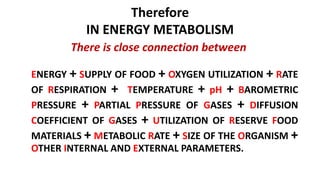
IN ENERGY METABOLISM
There is close connection between
ENERGY + SUPPLY OF FOOD + OXYGEN UTILIZATION + RATE
OF RESPIRATION + TEMPERATURE + pH + BAROMETRIC
PRESSURE + PARTIAL PRESSURE OF GASES + DIFFUSION
COEFFICIENT OF GASES + UTILIZATION OF RESERVE FOOD
MATERIALS + METABOLIC RATE + SIZE OF THE ORGANISM +
OTHER INTERNAL AND EXTERNAL PARAMETERS.
Thank you
Dr. Nagabhushan CM,
Assistant Professor, Dept. of Studies in Zoology, VSK University, Ballari, Karnataka, India.

Physiological time

  • 1.
  • 2.
    PHYSIOLOGICAL TIME • Smallanimals large animals CLOCK TIME cannot have same meaning for ALL. shrew HR=1000 elephant HR = 30 Time and frequency: high frequency of small heart MEANS duration of HB is small [duration of HB increases in proportion to body mass raised to the power 0.25]
  • 3.
    PHYSIOLOGICAL TIME Metabolic rate: ‘itis a measure of how fast the animal lives’ Specific metabolic rate per specific body mass DECREASES with INCREASE in size. Metabolic TIME is RECIPROCAL of metabolic rate
  • 4.
    PHYSIOLOGICAL TIME Metabolic rate: Lifespan of SMALL animals  SHORT Life span of LARGE animals  LONG both these animals have same HB in THEIR LIFE SPAN. ex: elephant rat HR 30/min 600/min 800,000,000=60 yrs 800,000,000= 3 yrs for man ???!!!! IT IS NOT PRECISE
  • 5.
    PHYSIOLOGICAL TIME Real time: Animalslive in a REAL WORLD & cannot escape REAL TIME Day and night cycle Seasons of the year. the total energy and the rate at which it is used determine ENDURANCE TIME ET for SMALL animals is SHORT ET for LARGE animals is LONG Therefore SMALL ANIMALS either must INCREASE ET OR go TORPID (aestivation/hibernation) LARGE ANIMALS MIGRATE OR store FAT to combat this problem.
  • 6.
    EFFECTS OF HIGHALTITUDE % composition of atmospheric air at high altitude is UNCHANGED BUT change in barometric pressure brings PHYSIOLOGICAL EFFECTS. 15000 10000 x 5000 Mt. Evrst 8848 meters Highest habitation 0 200 400 Unacclamatis ed lose conscious 600 760 AIR PRESSURE (mm Hg)
  • 7.
    EFFECTS OF HIGHALTITUDE Mountain sickness due to LOW PP OF OXYGEN: LOSE MATH WEAKNESS DEFICIENT WORK MEMORY LOSS HEADACHE NAUSEA VOMIT SLEEPLESSNESS RESTLESSNESS. 15000 10000 x 5000 Mt. Evrst 8848 meters Highest habitation 0 200 400 Unacclamatis ed lose conscious 600 760 AIR PRESSURE (mm Hg)
  • 8.
    EFFECTS OF HIGHALTITUDE Mountain sickness due to LOW PP OF OXYGEN: LOSE MATH WEAKNESS DEFICIENT WORK MEMORY LOSS HEADACHE NAUSEA VOMIT SLEEPLESSNESS RESTLESSNESS. 15000 10000 x 5000 Mt. Evrst 8848 meters Highest habitation 0 200 400 Unacclamatis ed lose conscious 600 760 AIR PRESSURE (mm Hg) REMEDY: Breathing PURE oxygen overcomes all the illness
  • 9.
    EFFECTS OF HIGHALTITUDE The adequate supply of OXYGEN to the TISSUES depends upon: (each of these steps are affected during acclimatization) VENTILATION OF THE LUNGS, DIFFUSION FROM LUNGS-BLOOD, TRANSPORT OF OXYGEN IN THE BLOOD, DIFFUSION OF OXYGEN FROM BLOOD TO TISSUES, TISSUE UTILIZATION OF OXYGEN. The immediate response achieved is TV, pH, alkaline blood, facilitated diffusion, Hb, RBCs
  • 10.
    Therefore IN ENERGY METABOLISM Thereis close connection between ENERGY + SUPPLY OF FOOD + OXYGEN UTILIZATION + RATE OF RESPIRATION + TEMPERATURE + pH + BAROMETRIC PRESSURE + PARTIAL PRESSURE OF GASES + DIFFUSION COEFFICIENT OF GASES + UTILIZATION OF RESERVE FOOD MATERIALS + METABOLIC RATE + SIZE OF THE ORGANISM + OTHER INTERNAL AND EXTERNAL PARAMETERS.
  • 11.
    Thank you Dr. NagabhushanCM, Assistant Professor, Dept. of Studies in Zoology, VSK University, Ballari, Karnataka, India.