



Assistant Professor, VSK University, Ballari
9880121090
nagabhushancm@vskub.ac.in
VIJAYANAGARA SRIKRISHNADEVARAYA UNIVERSITY, BALLARI
DEPARTMENT OF STUDIES IN ZOOLOGY
What ?
• In ecology, it is an animal behaviour of mass
movement of animals from one place to another.
• The purposes for migration varies accordingly with
the types of animals.
• Migratory behaviour of fish is a regular
phenomenon. Their journey is purposed mainly for
feeding and breeding (reproduction).
dr. nagabhushan charantimath
Types of fish migration based on needs
• Alimentary or Feeding migration: migration for search of
feeding ground. It occur when food resources get exhausted.
• Gametic or spwaning migration: it occur during breeding
season in search for the suitable spawning ground.
• Climatic or seasonal migration: migration in search for
suitable climatic condition.
• Osmo-regulatory migration: migration for water and
electrolytes balance from sea to fresh water and vice-versa.
• Juvenile migration: it is larval migration from spawning
ground to the feeding habitats of their parent.
dr. nagabhushan charantimath
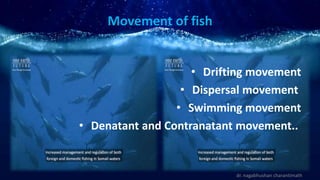
Movement of fish
• Drifting movement
• Dispersal movement
• Swimming movement
• Denatant and Contranatant movement..
dr. nagabhushan charantimath
• Drifting movement:
It is a passive movement of fish along with water currents
• Dispersal movement:
a random locomotory movement of fish from a uniform
habitat to diverse direction
• Swimming movement:
an orientated movement of fish either toward or away from
the source of stimulus
• Denatant and Contra-natant movement: (active)
denatant movement is swimming with the water current
while contra-natant is against water current.
dr. nagabhushan charantimath
Types of fish migration
• The migration of some fish is a regular journey and is
truly an innate animal behaviour. Fish migration
are classified into following types:
• 1. diadromous : catadromous & anadromous
• 2. potamodromous
• 3. oceanodromous
• 4. latitudinal 5. vertical 6. Shoreward
dr. nagabhushan charantimath
diadromous : catadromous & anadromous
• migration of fish between sea and fresh water.
• most of the fishes are restricted to either fresh water or
sea water.
• changes in habitat may causes osmotic imbalance in
those fishes.
• However some fishes regularly migrate between sea and
fresh water and have perfect osmotic balance, they are
the true migratory fish.
• This migration is of two types:
dr. nagabhushan charantimath
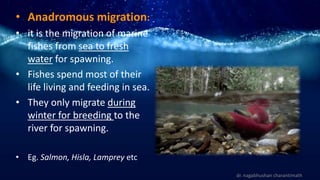
• Anadromous migration:
• it is the migration of marine
fishes from sea to fresh
water for spawning.
• Fishes spend most of their
life living and feeding in sea.
• They only migrate during
winter for breeding to the
river for spawning.
• Eg. Salmon, Hisla, Lamprey etc
dr. nagabhushan charantimath
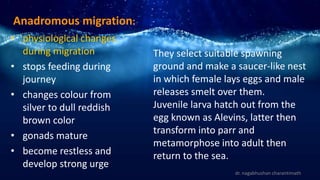
• physiological changes
during migration
• stops feeding during
journey
• changes colour from
silver to dull reddish
brown color
• gonads mature
• become restless and
develop strong urge
Anadromous migration:
They select suitable spawning
ground and make a saucer-like nest
in which female lays eggs and male
releases smelt over them.
Juvenile larva hatch out from the
egg known as Alevins, latter then
transform into parr and
metamorphose into adult then
return to the sea.
dr. nagabhushan charantimath
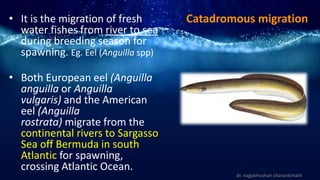
• It is the migration of fresh
water fishes from river to sea
during breeding season for
spawning. Eg. Eel (Anguilla spp)
• Both European eel (Anguilla
anguilla or Anguilla
vulgaris) and the American
eel (Anguilla
rostrata) migrate from the
continental rivers to Sargasso
Sea off Bermuda in south
Atlantic for spawning,
crossing Atlantic Ocean.
dr. nagabhushan charantimath
Catadromous migration
catadromous
migration
physiological changes during migration
-- deposit large amount of fat in their bodies which serves as
reserve food during the journey
– Colour changes from yellow to metallic silvery grey.
– Digestive tract shrinks and stops feeding
– Eyes get enlarged and vision sharpens.
-- Other sensory organs also become sensitive.
– Skin serves respiratory organ.
– Gonads get matured and enlarged.
dr. nagabhushan charantimath
The lay eggs in suitable spawning ground and are fertilized by males. After spawning
they die. The larva hatch out and develop into young eel and finally return to river.
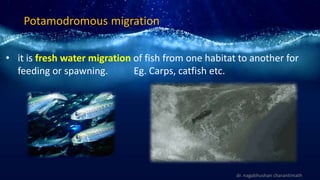
Potamodromous migration
• it is fresh water migration of fish from one habitat to another for
feeding or spawning. Eg. Carps, catfish etc.
dr. nagabhushan charantimath
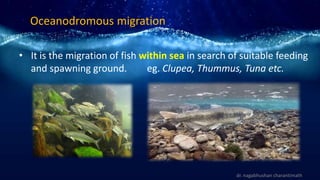
Oceanodromous migration
• It is the migration of fish within sea in search of suitable feeding
and spawning ground. eg. Clupea, Thummus, Tuna etc.
dr. nagabhushan charantimath
Latitudinal migration
• it is the migration of fish from north to south and vice-versa.
• It is a climatic migration.
Eg. Sward fish migrate north in spring and south in autumn.
dr. nagabhushan charantimath
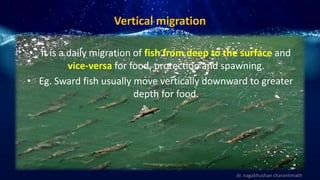
Vertical migration
dr. nagabhushan charantimath
• it is a daily migration of fish from deep to the surface and
vice-versa for food, protection and spawning.
• Eg. Sward fish usually move vertically downward to greater
depth for food.
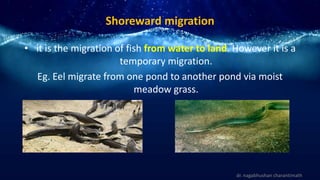
Shoreward migration
• it is the migration of fish from water to land. However it is a
temporary migration.
Eg. Eel migrate from one pond to another pond via moist
meadow grass.
dr. nagabhushan charantimath
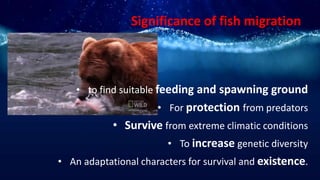
Significance of fish migration
• to find suitable feeding and spawning ground
• For protection from predators
• Survive from extreme climatic conditions
• To increase genetic diversity
• An adaptational characters for survival and existence.
And the Problem of navigation
How fishes find
their way in huge
expanses of sea
and reach their
destinations
which lie
thousands of
kilometres away
has been a
mystery.
Eels can also migrate to Sargasso Sea using
similar odour maps but how leptocephali find
their way back to the river mouths, crossing
vast stretches of Atlantic Sea is a mystery.
It is believed that they orient by the positions of
stars and moon in the night sky and sun in
daytime to find the direction of
swimming. However, it has been experimentally
proven by A.S. Hasler that salmons are guided by
the odour of their parent stream during return
journey.
Do human beings also migrate ?
Think about it
UNIT TEST –I
IN THE NEXT CLASS
Thank you
Dr. Nagabhushan C M,
Assistant Professor, VSK University, Ballari
9880121090
nagabhushancm@vskub.ac.in

Migration in Fish

  • 1.
    Assistant Professor, VSKUniversity, Ballari 9880121090 nagabhushancm@vskub.ac.in VIJAYANAGARA SRIKRISHNADEVARAYA UNIVERSITY, BALLARI DEPARTMENT OF STUDIES IN ZOOLOGY
  • 2.
    What ? • Inecology, it is an animal behaviour of mass movement of animals from one place to another. • The purposes for migration varies accordingly with the types of animals. • Migratory behaviour of fish is a regular phenomenon. Their journey is purposed mainly for feeding and breeding (reproduction). dr. nagabhushan charantimath
  • 3.
    Types of fishmigration based on needs • Alimentary or Feeding migration: migration for search of feeding ground. It occur when food resources get exhausted. • Gametic or spwaning migration: it occur during breeding season in search for the suitable spawning ground. • Climatic or seasonal migration: migration in search for suitable climatic condition. • Osmo-regulatory migration: migration for water and electrolytes balance from sea to fresh water and vice-versa. • Juvenile migration: it is larval migration from spawning ground to the feeding habitats of their parent. dr. nagabhushan charantimath
  • 4.
    Movement of fish •Drifting movement • Dispersal movement • Swimming movement • Denatant and Contranatant movement.. dr. nagabhushan charantimath
  • 5.
    • Drifting movement: Itis a passive movement of fish along with water currents • Dispersal movement: a random locomotory movement of fish from a uniform habitat to diverse direction • Swimming movement: an orientated movement of fish either toward or away from the source of stimulus • Denatant and Contra-natant movement: (active) denatant movement is swimming with the water current while contra-natant is against water current. dr. nagabhushan charantimath
  • 6.
    Types of fishmigration • The migration of some fish is a regular journey and is truly an innate animal behaviour. Fish migration are classified into following types: • 1. diadromous : catadromous & anadromous • 2. potamodromous • 3. oceanodromous • 4. latitudinal 5. vertical 6. Shoreward dr. nagabhushan charantimath
  • 7.
    diadromous : catadromous& anadromous • migration of fish between sea and fresh water. • most of the fishes are restricted to either fresh water or sea water. • changes in habitat may causes osmotic imbalance in those fishes. • However some fishes regularly migrate between sea and fresh water and have perfect osmotic balance, they are the true migratory fish. • This migration is of two types: dr. nagabhushan charantimath
  • 8.
    • Anadromous migration: •it is the migration of marine fishes from sea to fresh water for spawning. • Fishes spend most of their life living and feeding in sea. • They only migrate during winter for breeding to the river for spawning. • Eg. Salmon, Hisla, Lamprey etc dr. nagabhushan charantimath
  • 9.
    • physiological changes duringmigration • stops feeding during journey • changes colour from silver to dull reddish brown color • gonads mature • become restless and develop strong urge Anadromous migration: They select suitable spawning ground and make a saucer-like nest in which female lays eggs and male releases smelt over them. Juvenile larva hatch out from the egg known as Alevins, latter then transform into parr and metamorphose into adult then return to the sea. dr. nagabhushan charantimath
  • 10.
    • It isthe migration of fresh water fishes from river to sea during breeding season for spawning. Eg. Eel (Anguilla spp) • Both European eel (Anguilla anguilla or Anguilla vulgaris) and the American eel (Anguilla rostrata) migrate from the continental rivers to Sargasso Sea off Bermuda in south Atlantic for spawning, crossing Atlantic Ocean. dr. nagabhushan charantimath Catadromous migration
  • 11.
    catadromous migration physiological changes duringmigration -- deposit large amount of fat in their bodies which serves as reserve food during the journey – Colour changes from yellow to metallic silvery grey. – Digestive tract shrinks and stops feeding – Eyes get enlarged and vision sharpens. -- Other sensory organs also become sensitive. – Skin serves respiratory organ. – Gonads get matured and enlarged. dr. nagabhushan charantimath The lay eggs in suitable spawning ground and are fertilized by males. After spawning they die. The larva hatch out and develop into young eel and finally return to river.
  • 12.
    Potamodromous migration • itis fresh water migration of fish from one habitat to another for feeding or spawning. Eg. Carps, catfish etc. dr. nagabhushan charantimath
  • 13.
    Oceanodromous migration • Itis the migration of fish within sea in search of suitable feeding and spawning ground. eg. Clupea, Thummus, Tuna etc. dr. nagabhushan charantimath
  • 14.
    Latitudinal migration • itis the migration of fish from north to south and vice-versa. • It is a climatic migration. Eg. Sward fish migrate north in spring and south in autumn. dr. nagabhushan charantimath
  • 15.
    Vertical migration dr. nagabhushancharantimath • it is a daily migration of fish from deep to the surface and vice-versa for food, protection and spawning. • Eg. Sward fish usually move vertically downward to greater depth for food.
  • 16.
    Shoreward migration • itis the migration of fish from water to land. However it is a temporary migration. Eg. Eel migrate from one pond to another pond via moist meadow grass. dr. nagabhushan charantimath
  • 17.
    Significance of fishmigration • to find suitable feeding and spawning ground • For protection from predators • Survive from extreme climatic conditions • To increase genetic diversity • An adaptational characters for survival and existence.
  • 18.
    And the Problemof navigation How fishes find their way in huge expanses of sea and reach their destinations which lie thousands of kilometres away has been a mystery. Eels can also migrate to Sargasso Sea using similar odour maps but how leptocephali find their way back to the river mouths, crossing vast stretches of Atlantic Sea is a mystery. It is believed that they orient by the positions of stars and moon in the night sky and sun in daytime to find the direction of swimming. However, it has been experimentally proven by A.S. Hasler that salmons are guided by the odour of their parent stream during return journey.
  • 19.
    Do human beingsalso migrate ? Think about it
  • 20.
    UNIT TEST –I INTHE NEXT CLASS
  • 21.
    Thank you Dr. NagabhushanC M, Assistant Professor, VSK University, Ballari 9880121090 nagabhushancm@vskub.ac.in