10/04/24
10/04/24 1
1
10/04/24
10/04/24 2
2
I.
I. Introduction
Introduction
II.
II. Classification of chromatographic methods
Classification of chromatographic methods
III.
III. Principle of chromatography
Principle of chromatography
IV.
IV. High performance liquid chromatography (HPLC)
High performance liquid chromatography (HPLC)
V.
V. Gas chromatography (GC)
Gas chromatography (GC)
VI.
VI. Thin layer chromatography (TLC)
Thin layer chromatography (TLC)
10/04/24
10/04/24 3
3
Definition:
Definition:
Chromatography is defined as a
procedure by which solutes are
separated
separated by dynamic differential
by dynamic differential
migration process in a system consisting
of two or more phases, one of which
moves continuously in a given direction
and in which the individual substances
exhibit different mobilities by reason of
differences in
differences in adsorption, partition,
adsorption, partition,
solubility, vapor pressure, molecular size, or
10/04/24
10/04/24 4
4
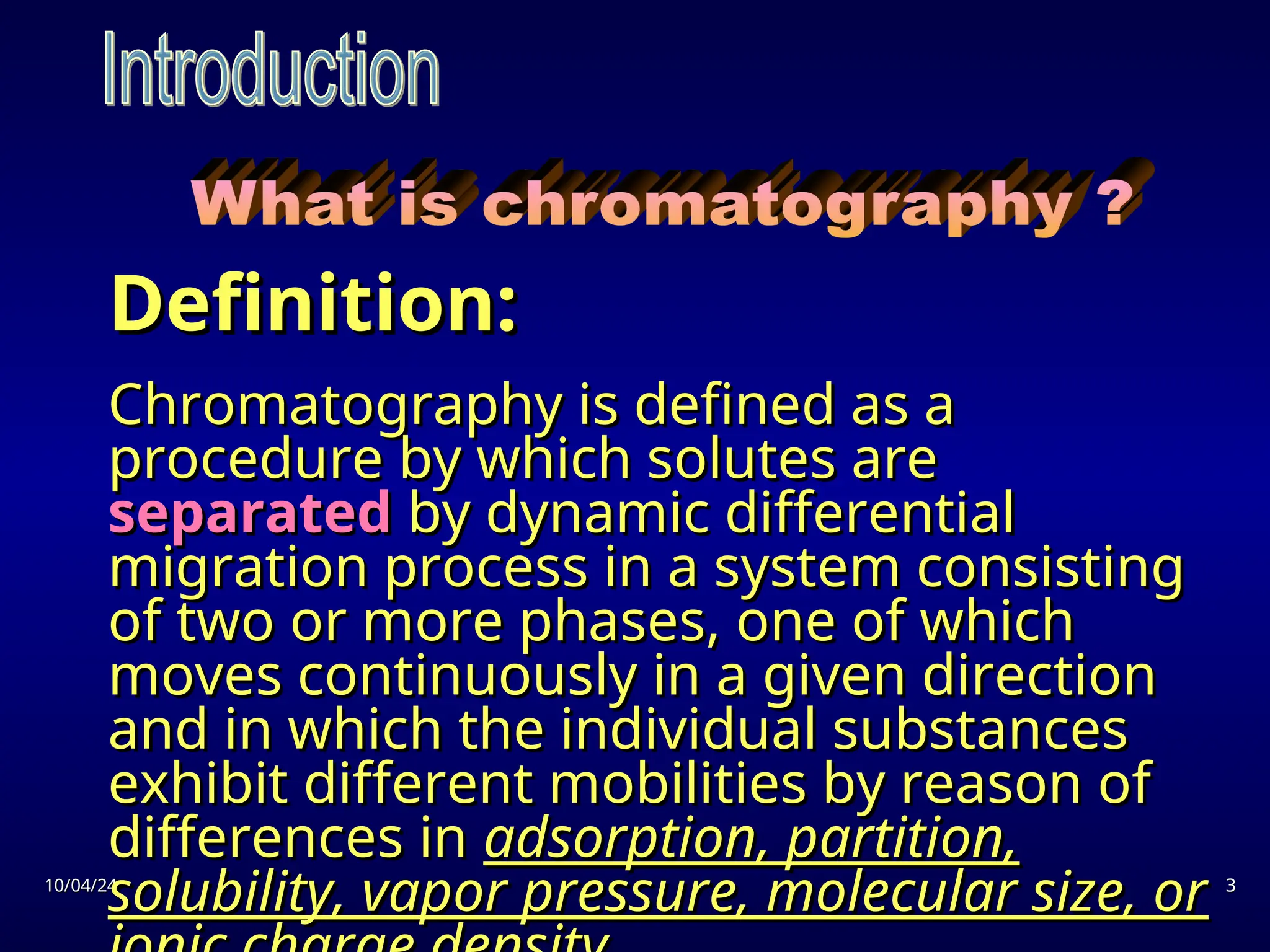
Mobile Phase
Mobile Phase:
:
The Phase that travels through the
column (gas or liquid) – transport
sample through the column.
Stationary Phase
Stationary Phase:
:
Immiscible solid or liquid phase
that fixed in place in the column or
on a solid support – retain analytes
within the column.
within the column.
Band or Zone
Band or Zone:
:
-Area across which analyte is
Area across which analyte is
distributed on column
-Zones of different analytes
Zones of different analytes
gradually separate as bands
progress down column
10/04/24
10/04/24 5
5
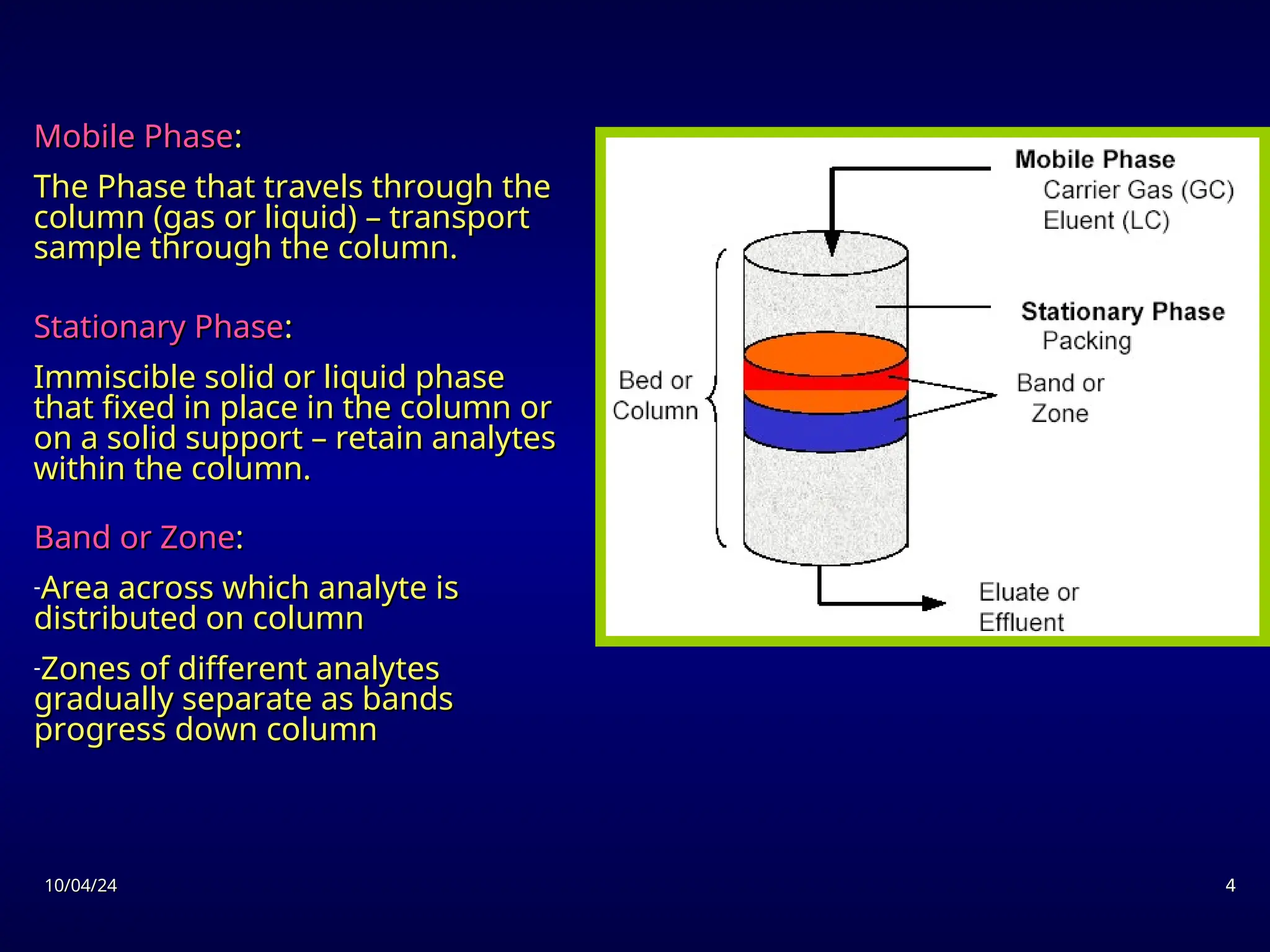
Sample
Sample
Mobile phase
Mobile phase
(eluant)
(eluant)
Stationary Phase
Stationary Phase
Detection method
Detection method
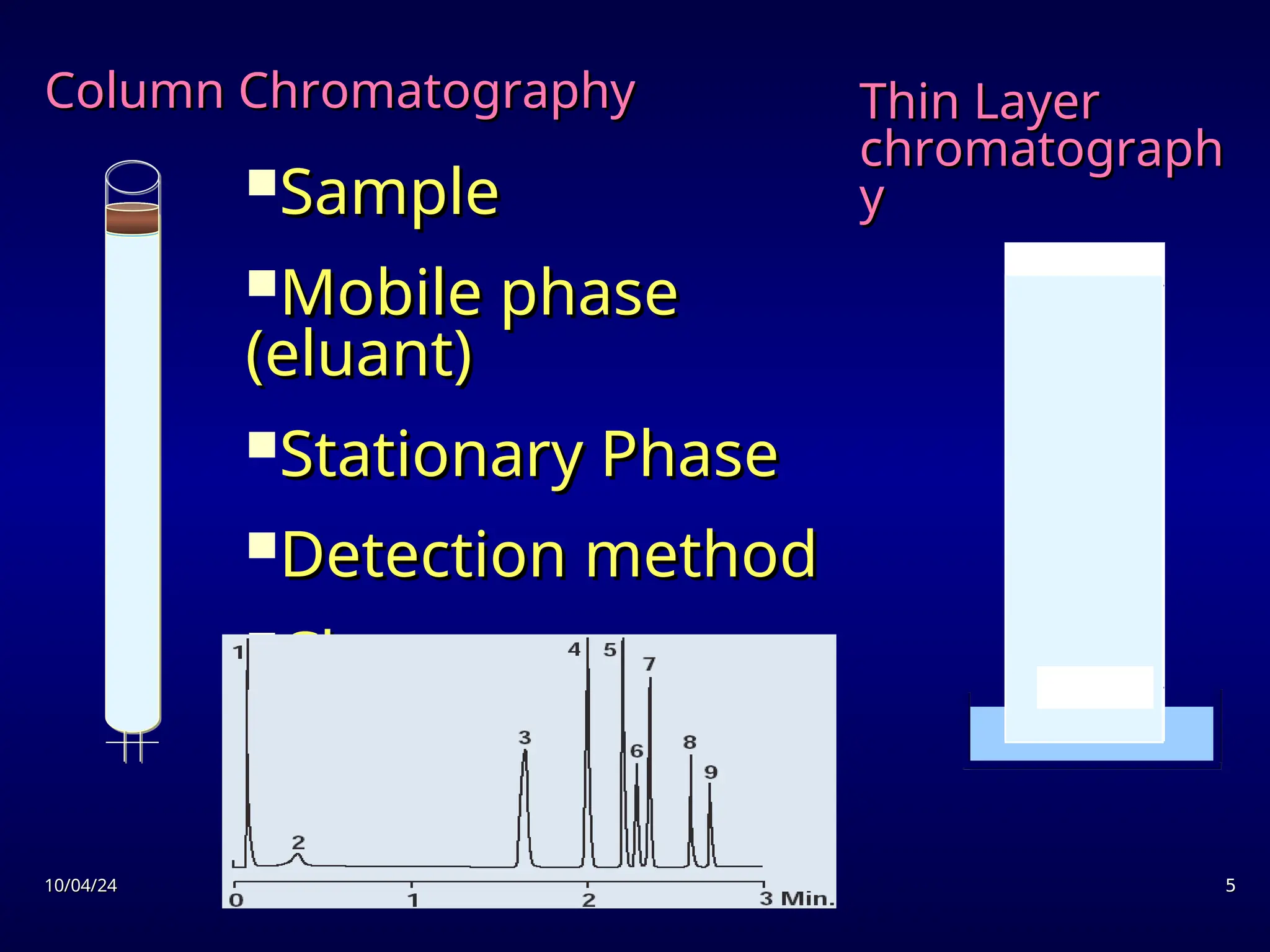
Chromatogram
Chromatogram
Thin Layer
Thin Layer
chromatograph
chromatograph
y
y
Column Chromatography
10/04/24
10/04/24 6
6
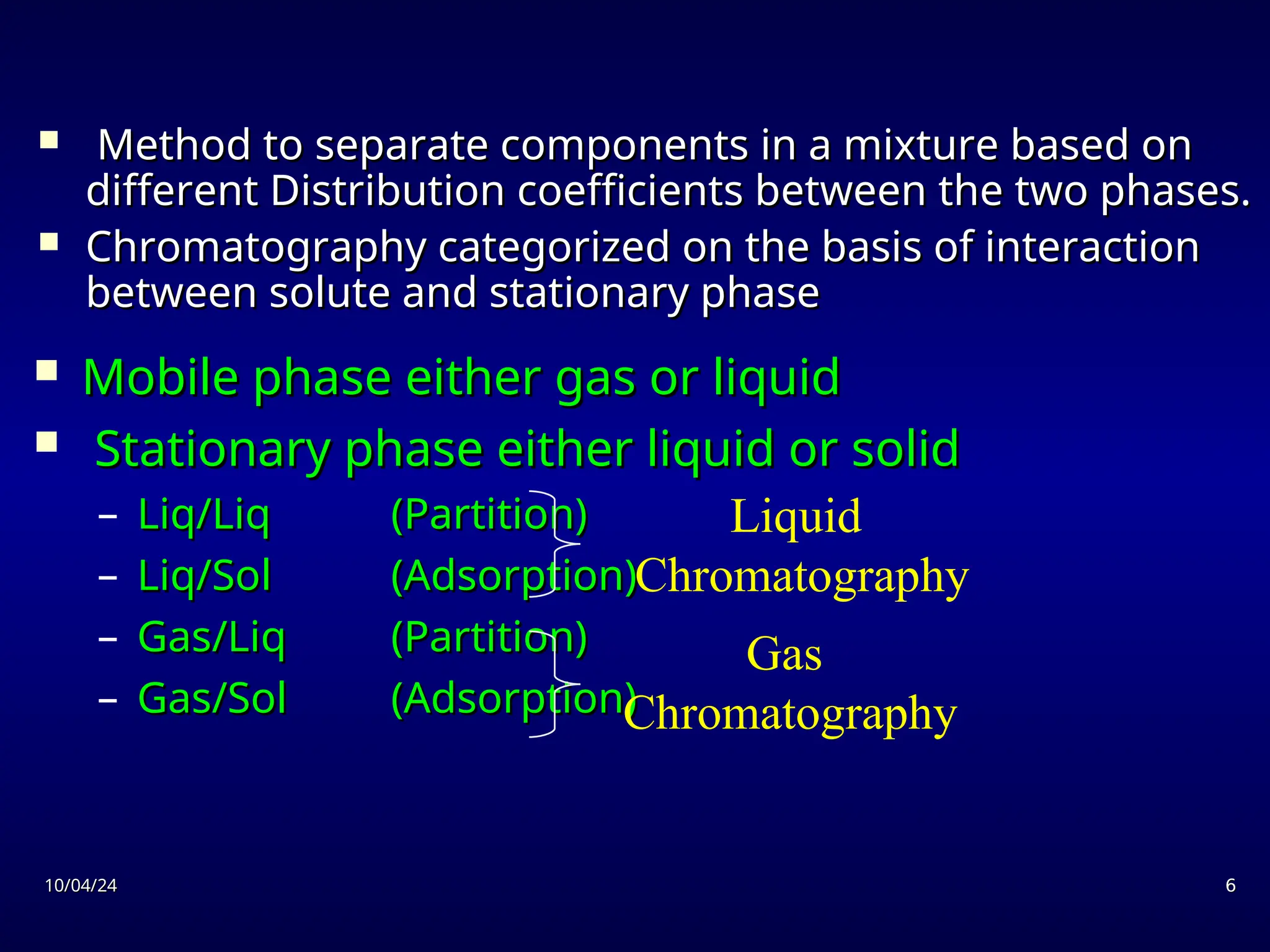
 Method to separate components in a mixture based on
Method to separate components in a mixture based on
different Distribution coefficients between the two phases.
 Chromatography categorized on the basis of interaction
Chromatography categorized on the basis of interaction
between solute and stationary phase
 Mobile phase either gas or liquid
Mobile phase either gas or liquid
 Stationary phase either liquid or solid
Stationary phase either liquid or solid
– Liq/Liq
Liq/Liq (Partition)
(Partition)
– Liq/Sol
Liq/Sol (Adsorption)
(Adsorption)
– Gas/Liq
Gas/Liq (Partition)
(Partition)
– Gas/Sol
Gas/Sol (Adsorption)
(Adsorption)
Gas
Chromatography
Liquid
Chromatography
10/04/24
10/04/24 7
7
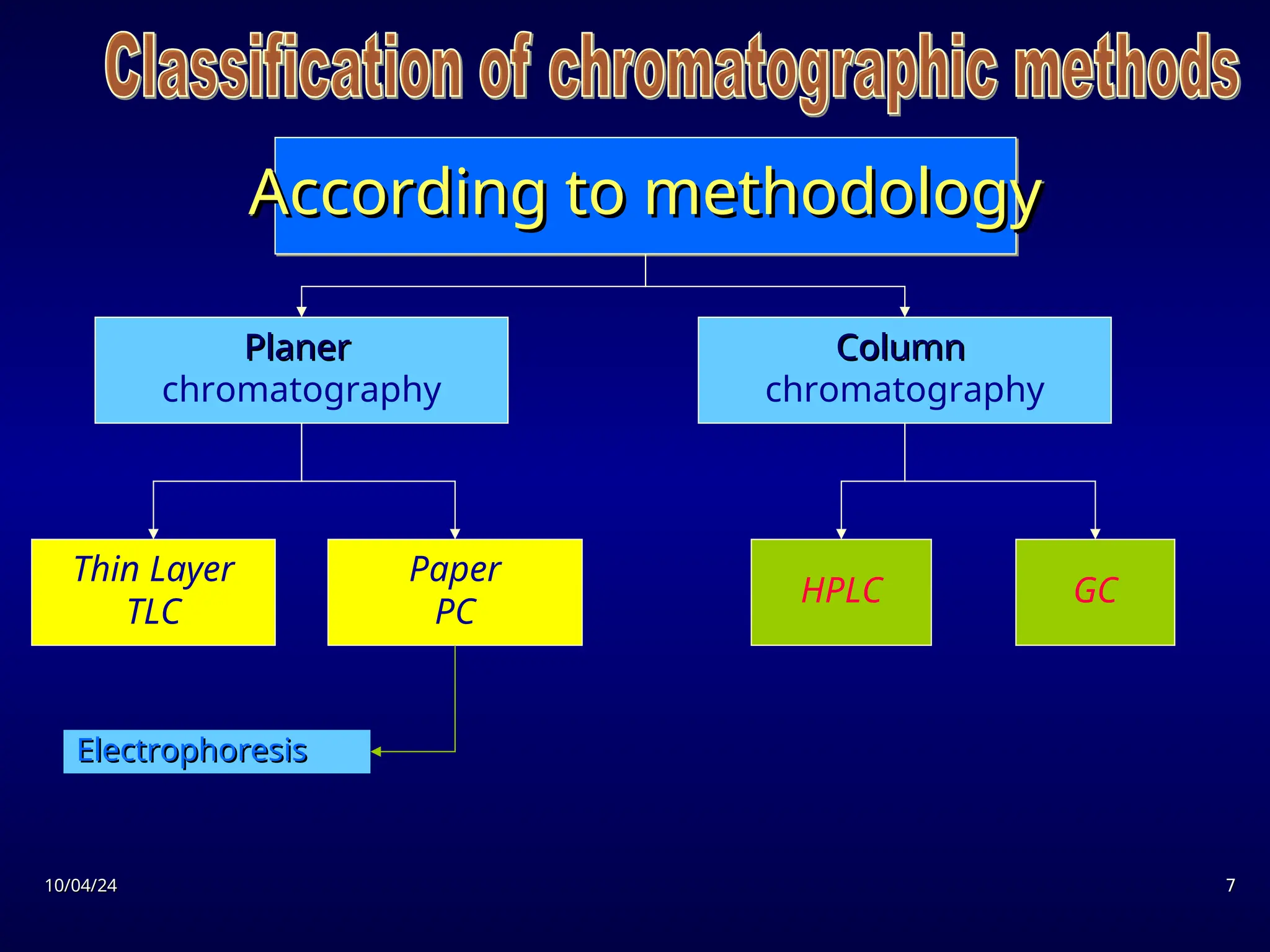
According to methodology
Planer
Planer
chromatography
Column
Column
chromatography
Thin Layer
TLC
Paper
PC
HPLC GC
Electrophoresis
Electrophoresis
10/04/24
10/04/24 8
8
Sampl
Sampl
e
e Mobile
Mobile
time
time
Response
Response
A
A
B
B
Figure
Figure:
:
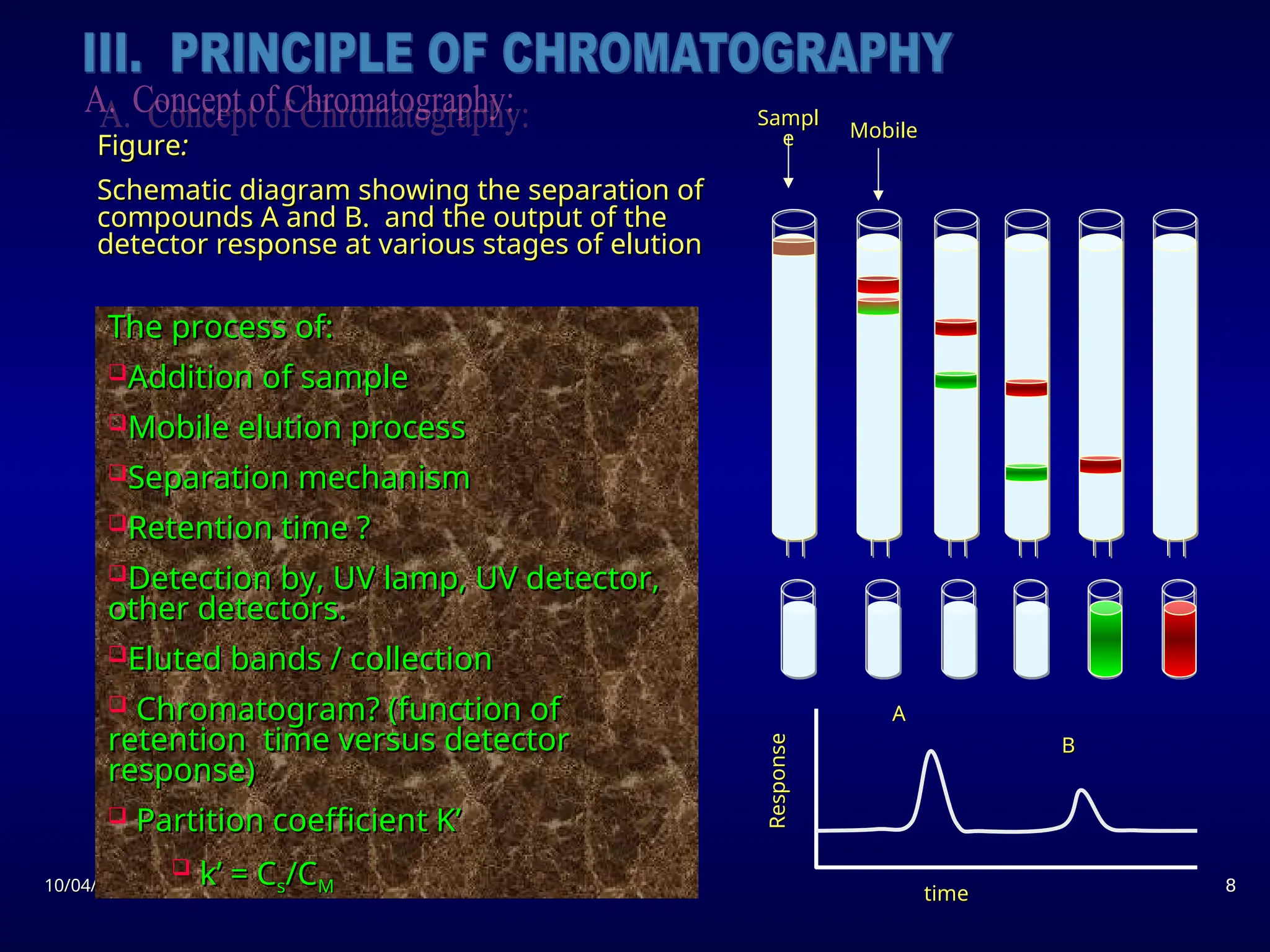
Schematic diagram showing the separation of
compounds A and B. and the output of the
detector response at various stages of elution
The process of:
The process of:
Addition of sample
Addition of sample
Mobile elution process
Mobile elution process
Separation mechanism
Separation mechanism
Retention time ?
Retention time ?
Detection by, UV lamp, UV detector,
Detection by, UV lamp, UV detector,
other detectors.
other detectors.
Eluted bands / collection
Eluted bands / collection
 Chromatogram? (function of
Chromatogram? (function of
retention time versus detector
response)
response)
 Partition coefficient K’
Partition coefficient K’

k’ = C
k’ = Cs
s/C
/CM
M
10/04/24
10/04/24 9
9
10/04/24
10/04/24 10
10
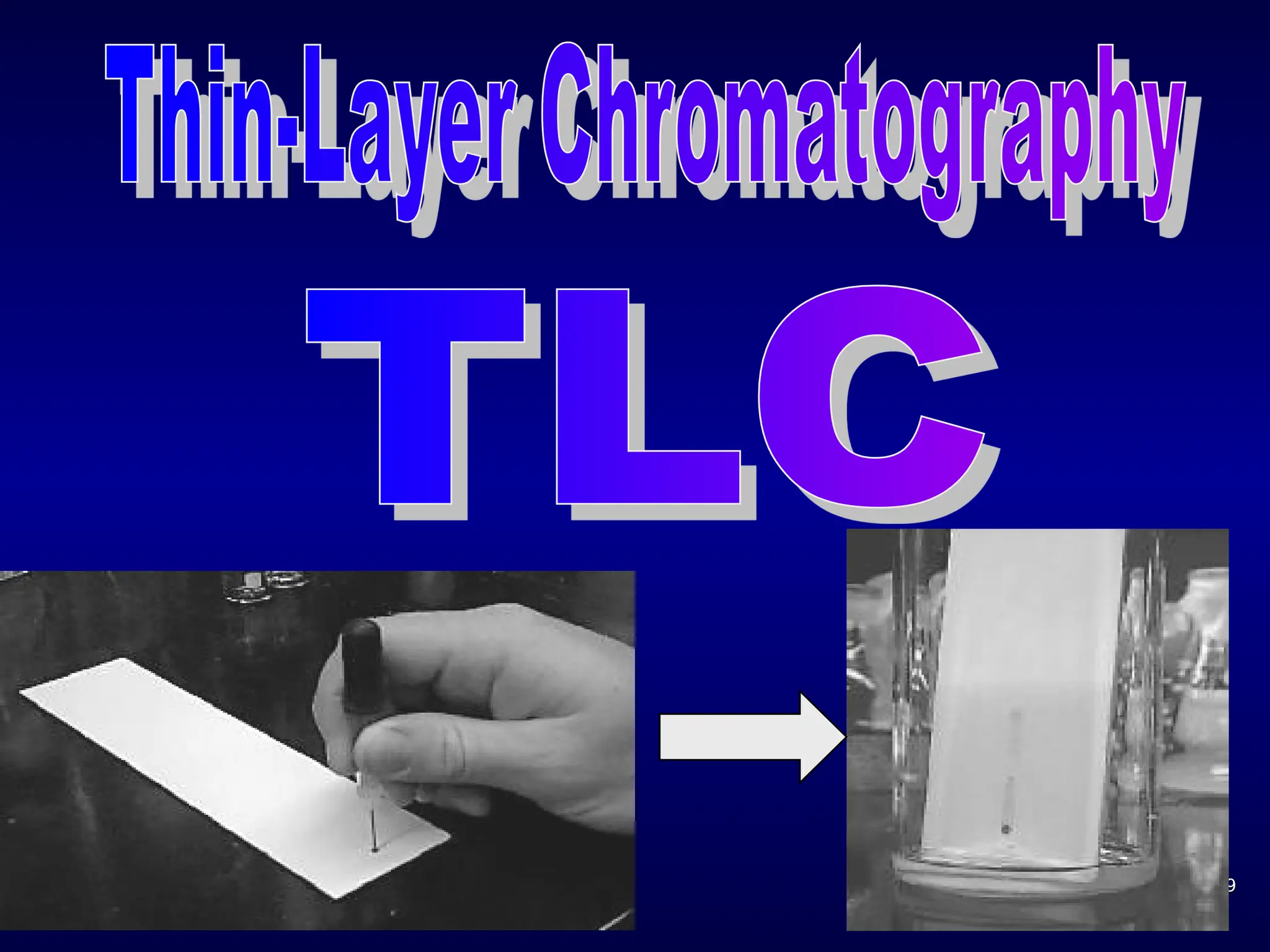
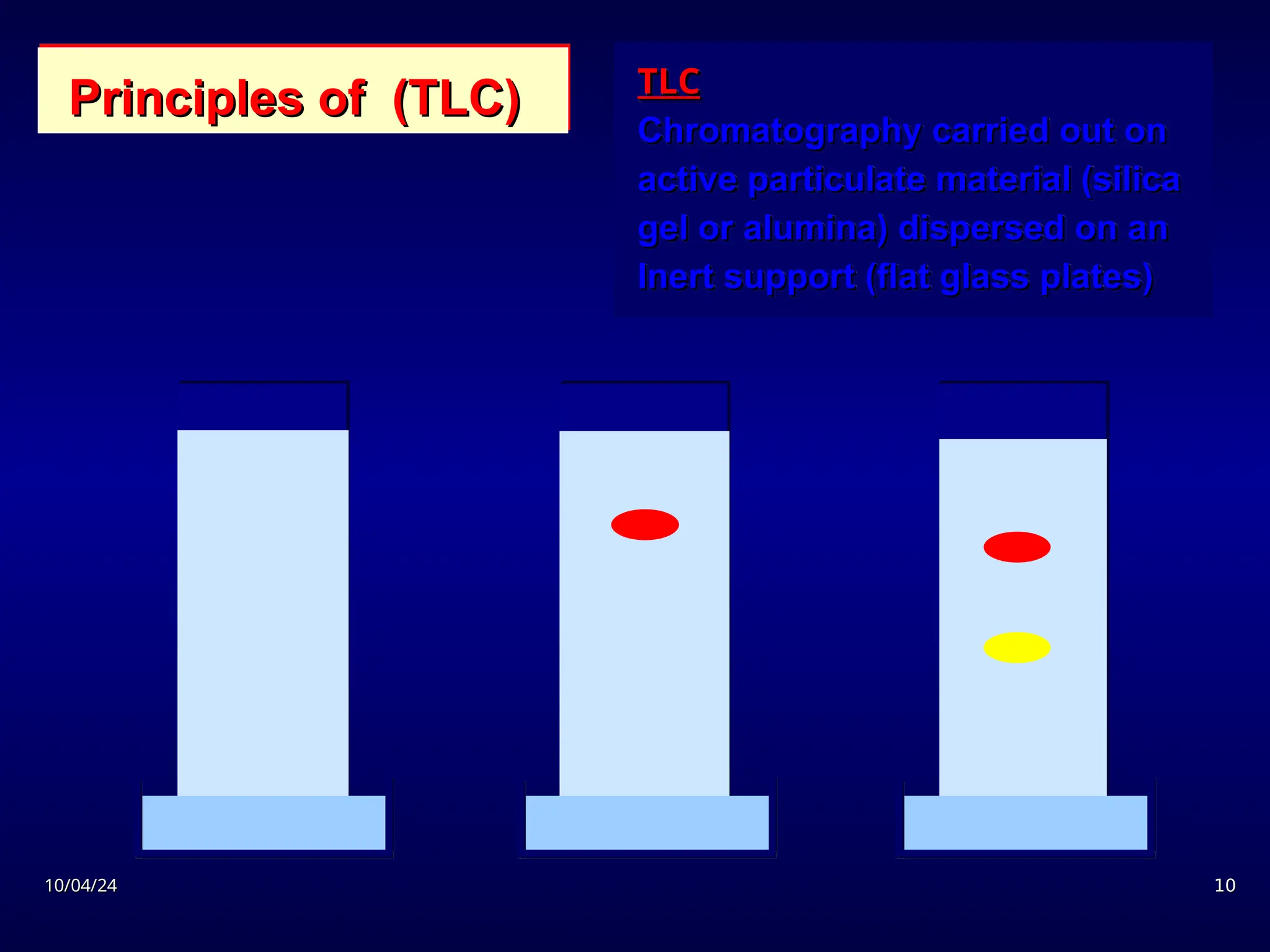
Principles of (TLC)
Principles of (TLC) TLC
TLC
Chromatography carried out on
active particulate material (silica
gel or alumina) dispersed on an
Inert support (flat glass plates)
10/04/24
10/04/24 11
11
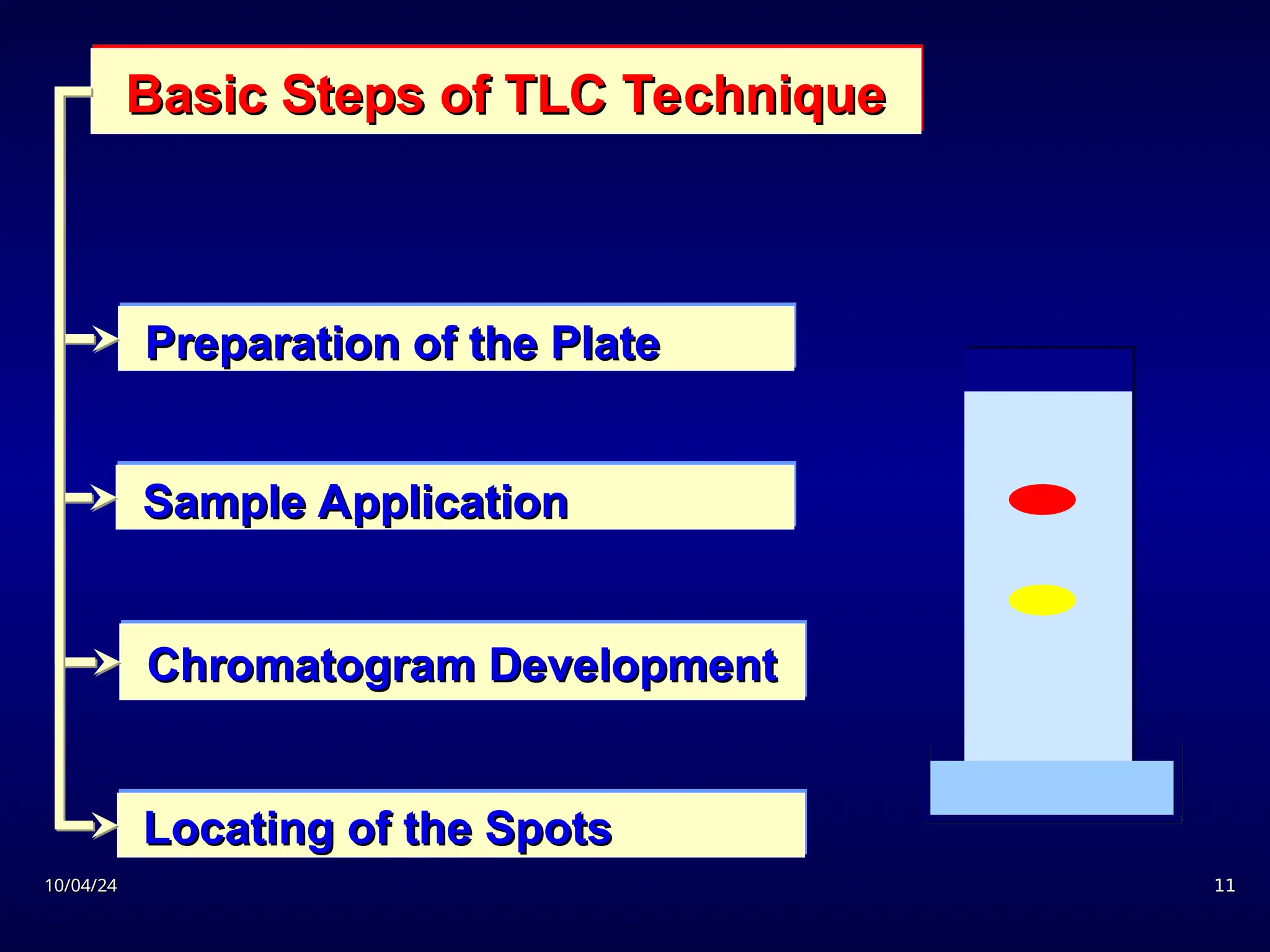
Basic Steps of TLC Technique
Preparation of the Plate
Sample Application
Sample Application
Chromatogram Development
Locating of the Spots
10/04/24
10/04/24 12
12
Slurry of the active material is uniformly
Slurry of the active material is uniformly
spread over the plate by means of a
commercially available spreader.
Air-drying overnight, or oven-drying at
Air-drying overnight, or oven-drying at
80-90
80-90 
C for about 30 minutes.
C for about 30 minutes.
Ready to use thin layers (pre-coated plates)
Ready to use thin layers (pre-coated plates)
are commercially available.
Preparation of the Plate
10/04/24
10/04/24 13
13
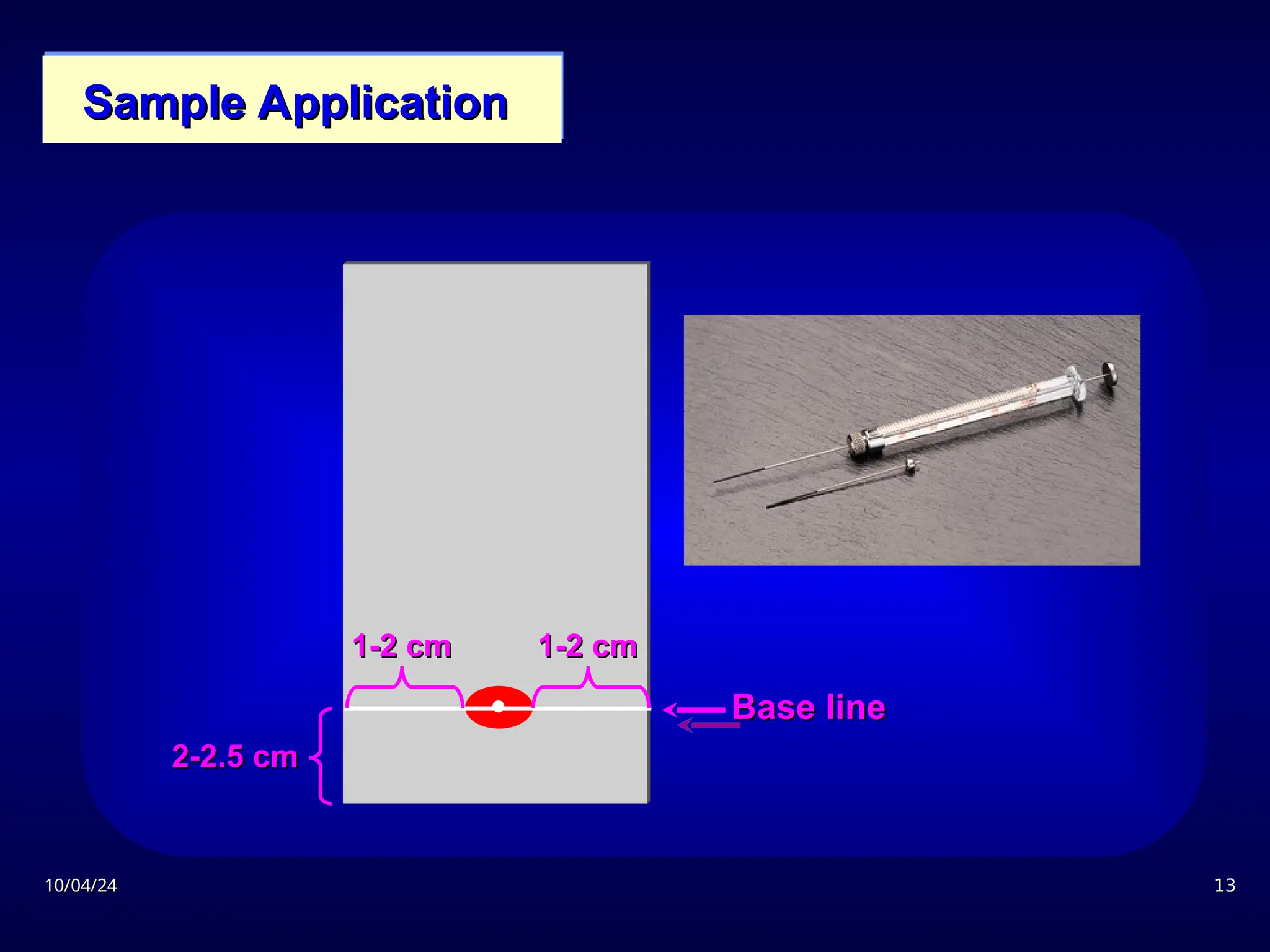
Sample Application
Sample Application
1-2 cm
1-2 cm 1-2 cm
1-2 cm
2-2.5 cm
2-2.5 cm
 Base line
Base line
10/04/24
10/04/24 14
14
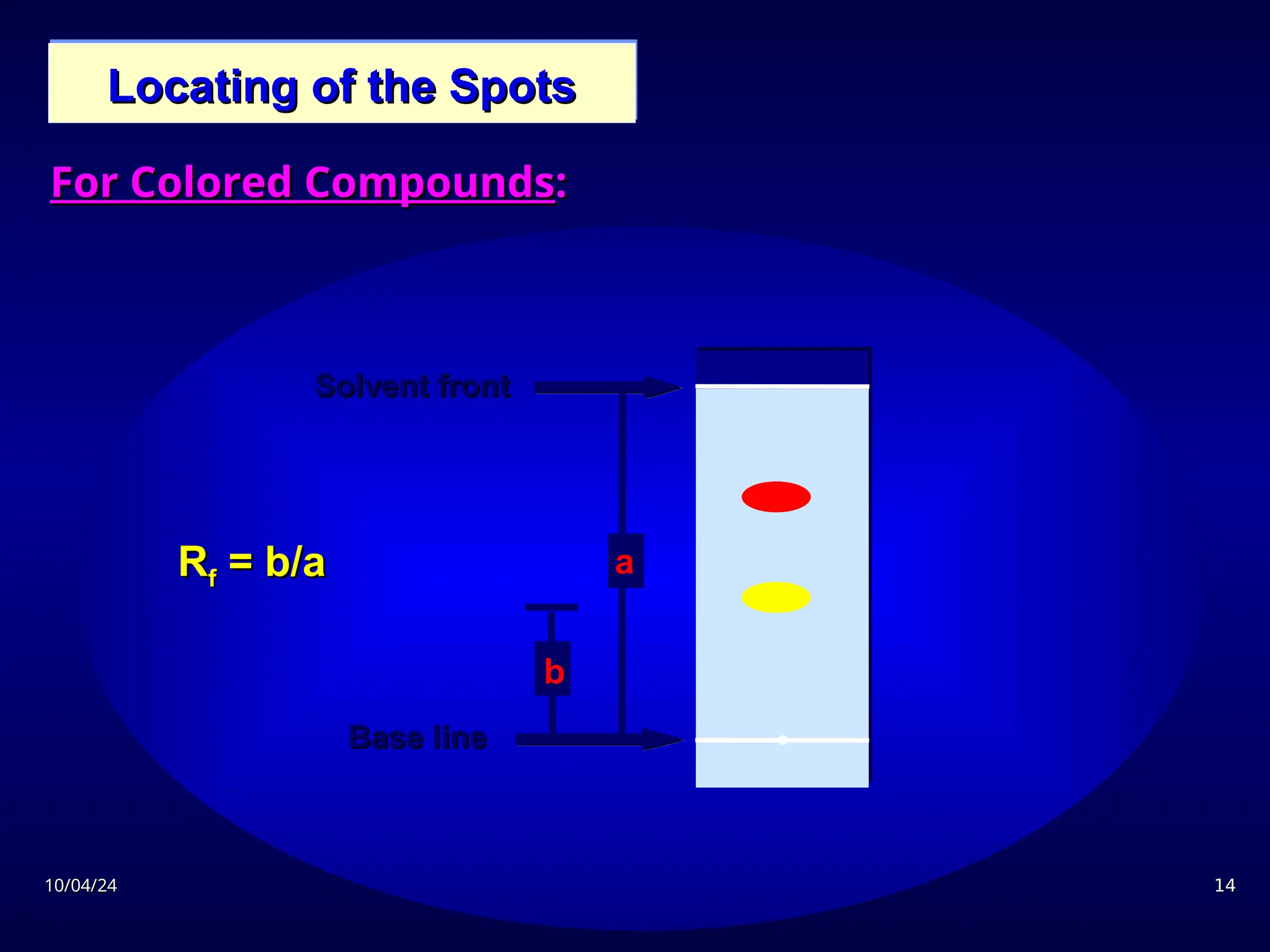
Locating of the Spots

Base line
Base line
Solvent front
Solvent front
R
Rf
f = b/a
= b/a a
b
For Colored Compounds
For Colored Compounds:
:
10/04/24
10/04/24 15
15
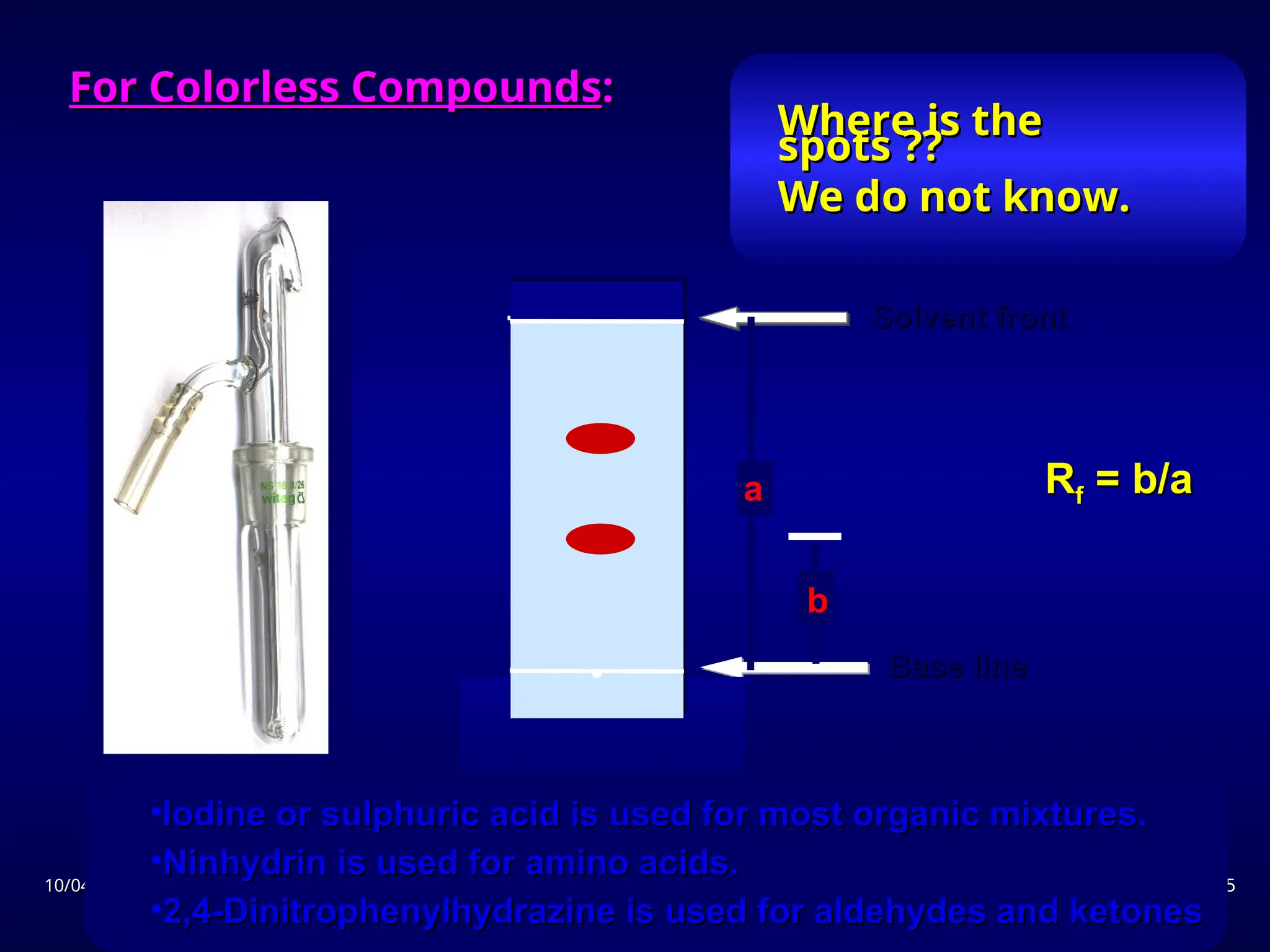
Base line
Base line



Solvent front
Solvent front
a
Where is the
Where is the
spots ??
spots ??
We do not know.
We do not know.
•Iodine or sulphuric acid is used for most organic mixtures.
Iodine or sulphuric acid is used for most organic mixtures.
•Ninhydrin is used for amino acids.
Ninhydrin is used for amino acids.
•2,4-Dinitrophenylhydrazine is used for aldehydes and ketones
2,4-Dinitrophenylhydrazine is used for aldehydes and ketones
b
R
Rf
f = b/a
= b/a
For Colorless Compounds
For Colorless Compounds:
:
10/04/24
10/04/24 16
16

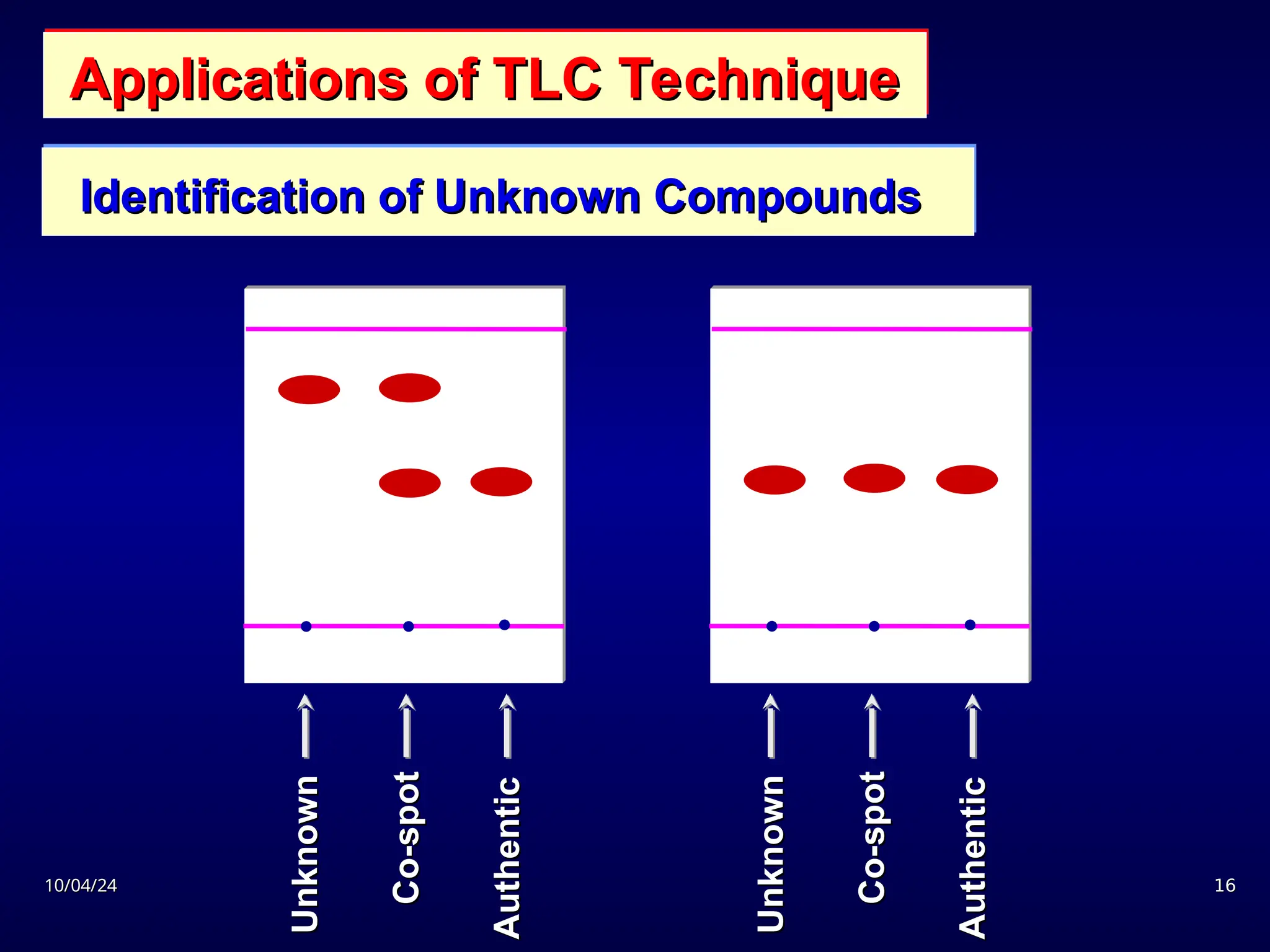
Unknown
Unknown
Authentic
Authentic

Co-spot
Co-spot

Applications of TLC Technique
Identification of Unknown Compounds

Unknown
Unknown
Authentic
Authentic

Co-spot
Co-spot

10/04/24
10/04/24 17
17
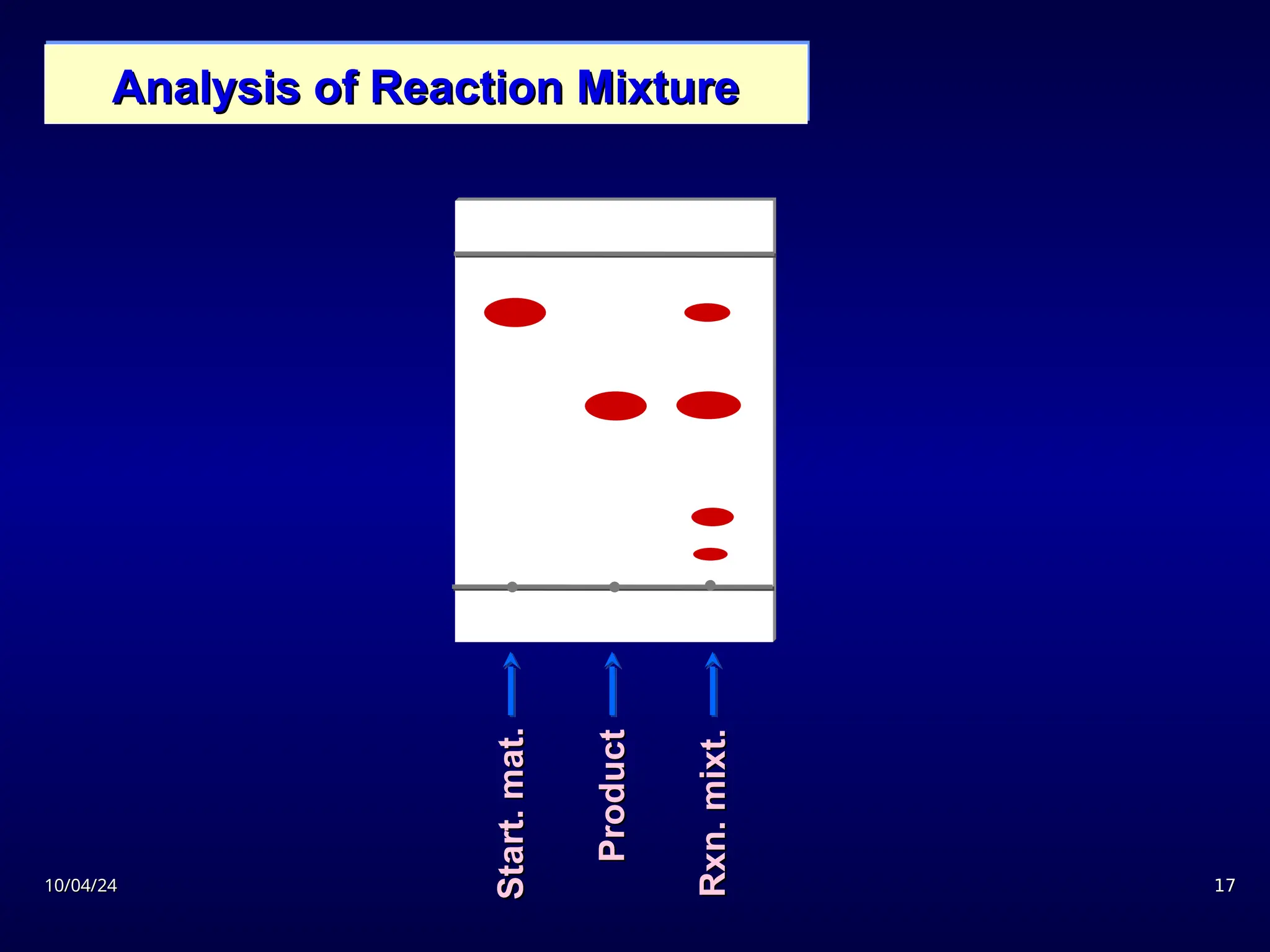
Analysis of Reaction Mixture

Start.
mat.
Start.
mat.
Rxn.
mixt.
Rxn.
mixt.

Product
Product

10/04/24
10/04/24 18
18
Chromatogram Development

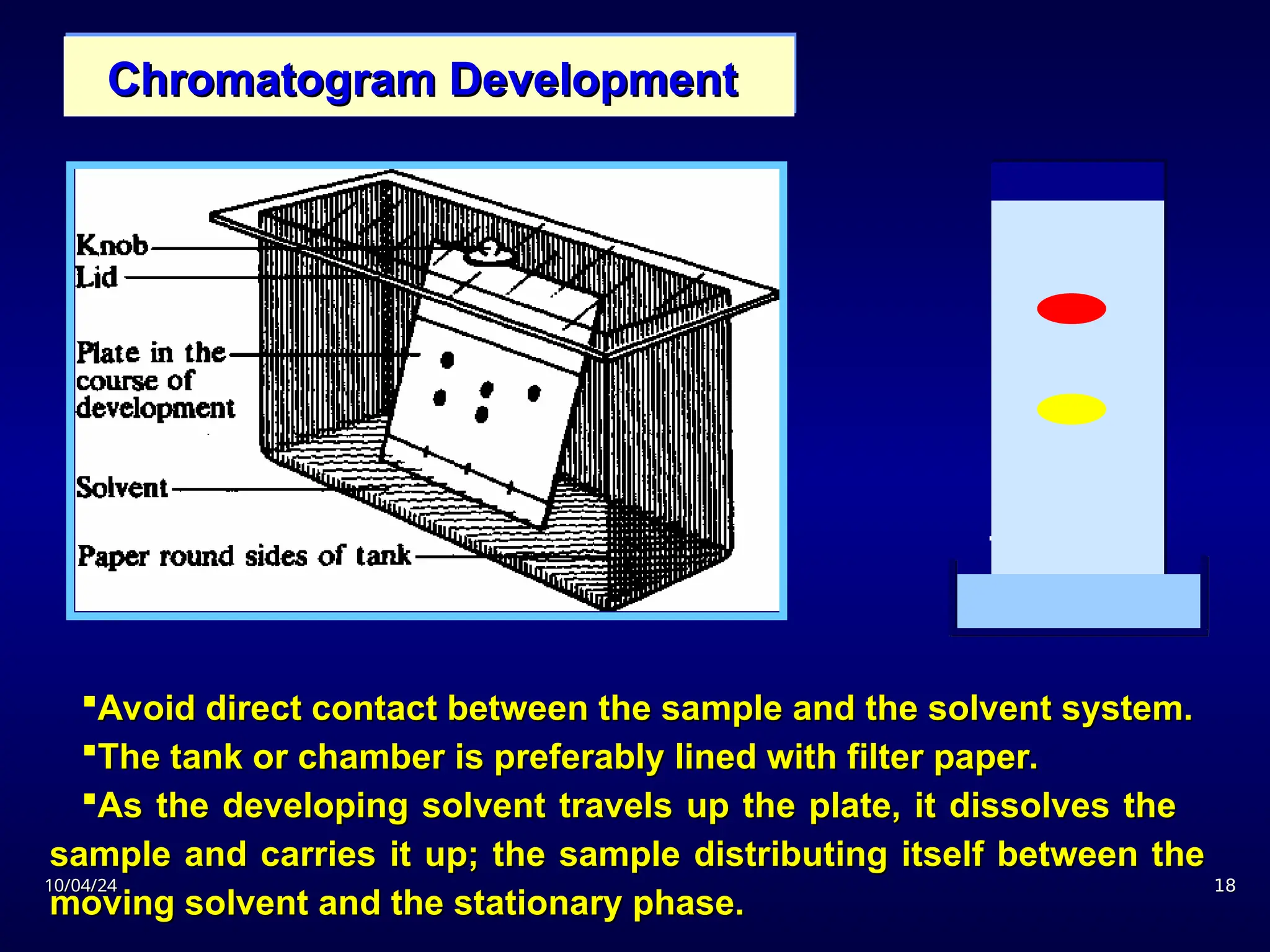
Avoid direct contact between the sample and the solvent system.
Avoid direct contact between the sample and the solvent system.
The tank or chamber is preferably lined with filter paper.
The tank or chamber is preferably lined with filter paper.
As the developing solvent travels up the plate, it dissolves the
As the developing solvent travels up the plate, it dissolves the
sample and carries it up; the sample distributing itself between the
moving solvent and the stationary phase.
10/04/24
10/04/24 19
19
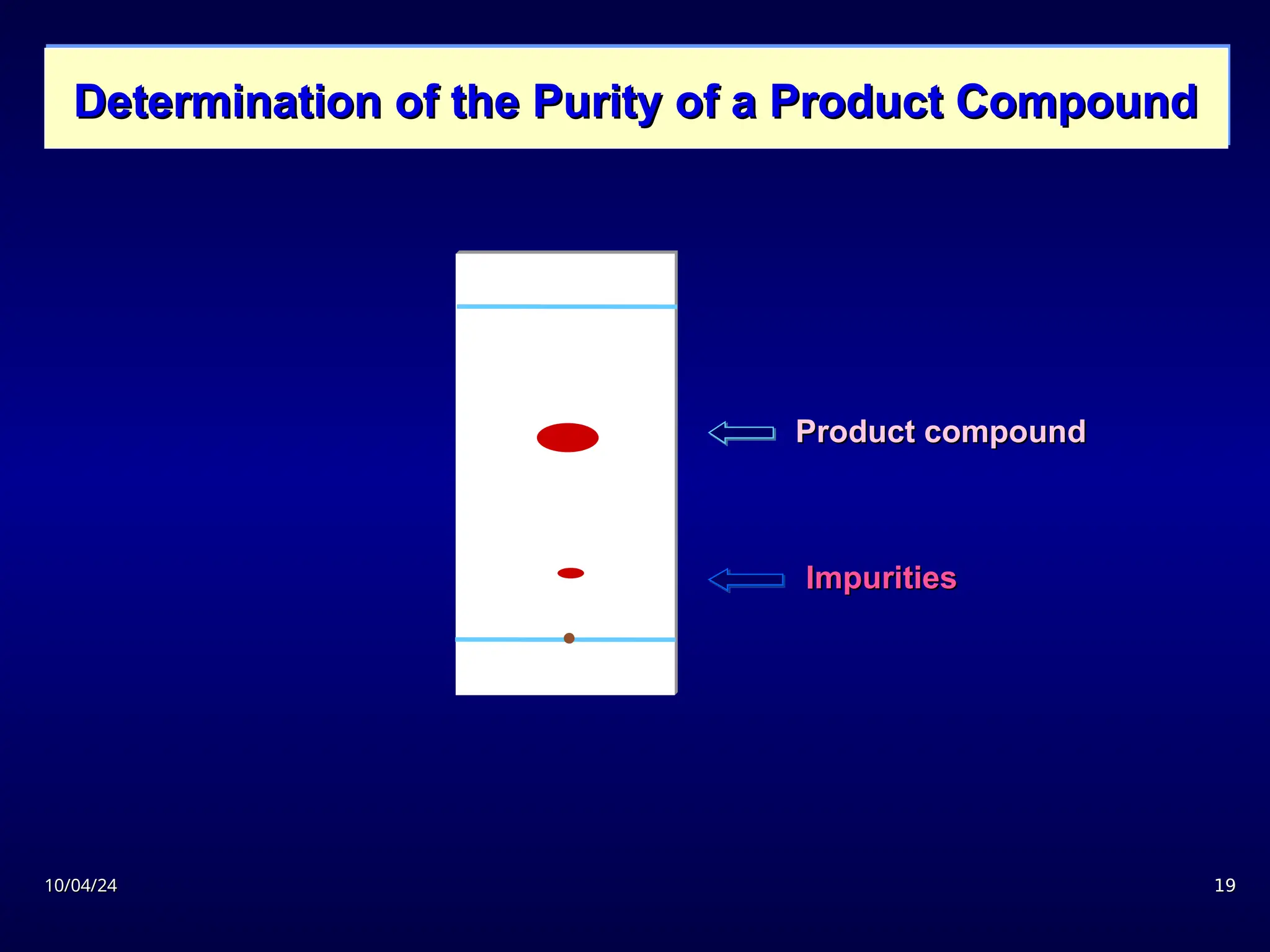
Determination of the Purity of a Product Compound

Impurities
Impurities
Product compound
Product compound
10/04/24
10/04/24 20
20
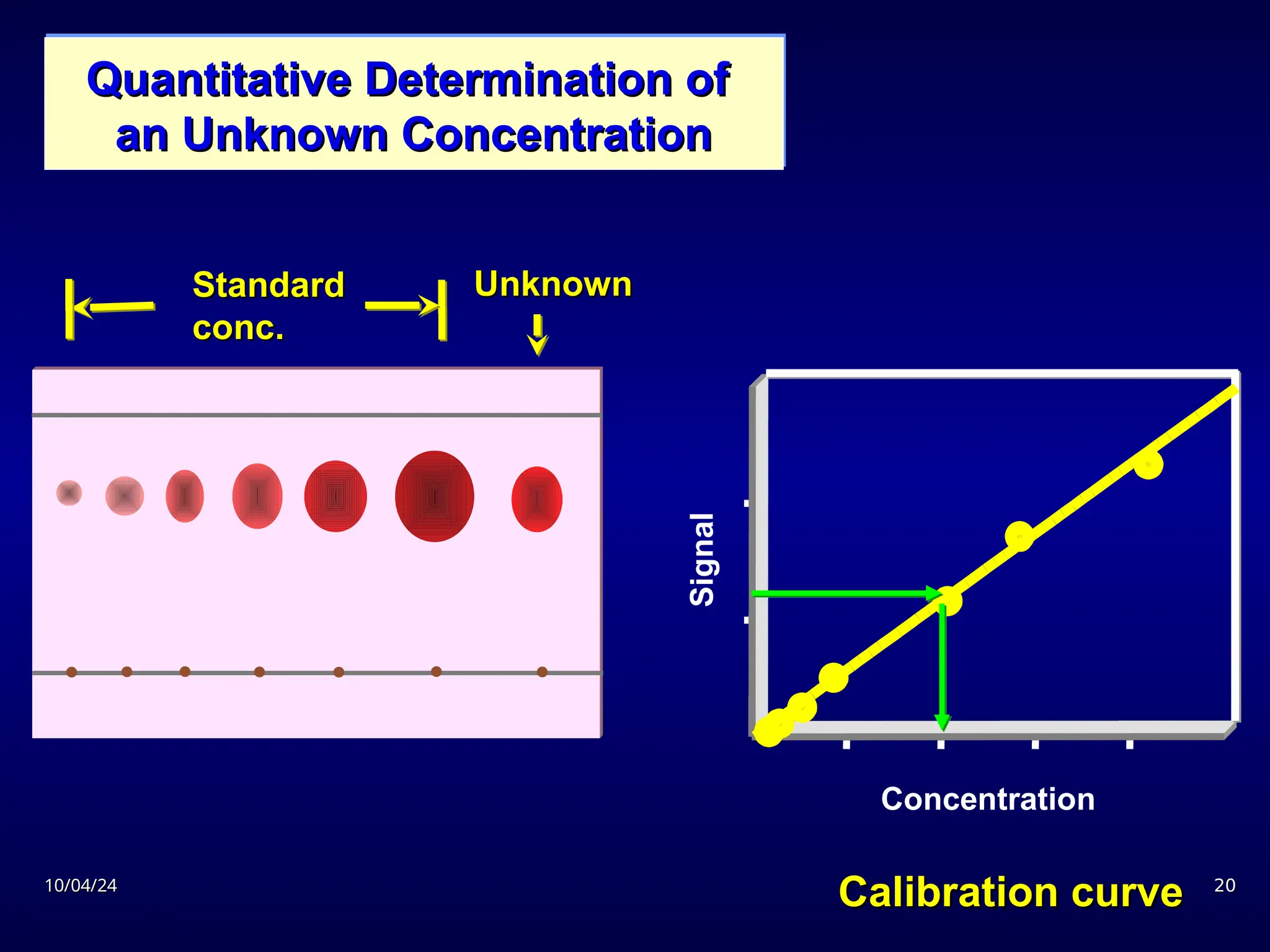
Quantitative Determination of
an Unknown Concentration
Unknown
Unknown
  
 
 
Standard
Standard
conc.
conc.
Concentration
Signal
Calibration curve
Calibration curve
10/04/24
10/04/24 21
21
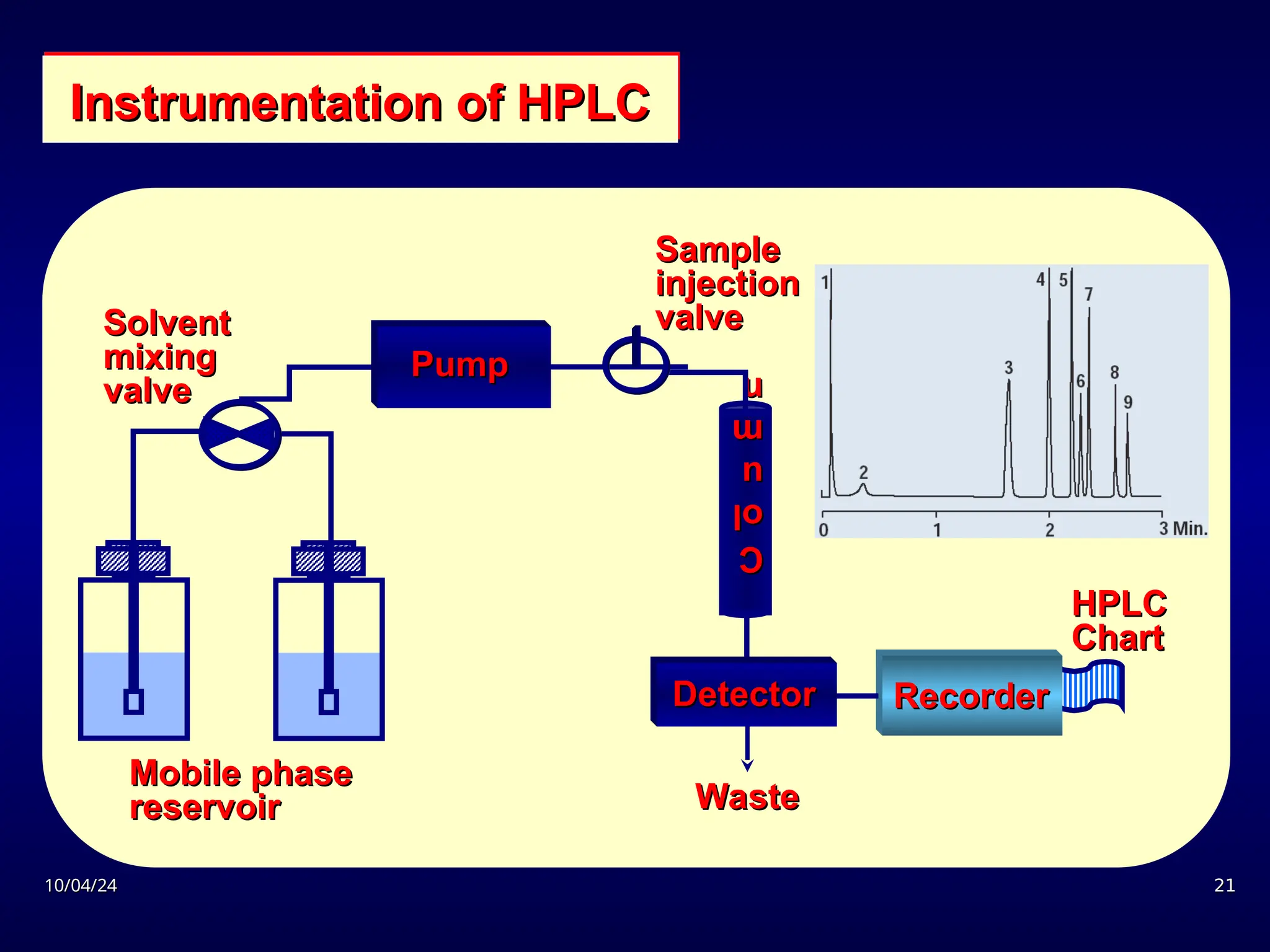
Instrumentation of HPLC
Mobile phase
Mobile phase
reservoir
reservoir
Solvent
Solvent
mixing
mixing
valve
valve
Pump
Pump
HPLC
HPLC
Chart
Chart
C
C
ol
ol
u
u
m
m
n
n
Sample
Sample
injection
injection
valve
valve
Recorder
Recorder
Waste
Waste
Detector
Detector
10/04/24
10/04/24 22
22
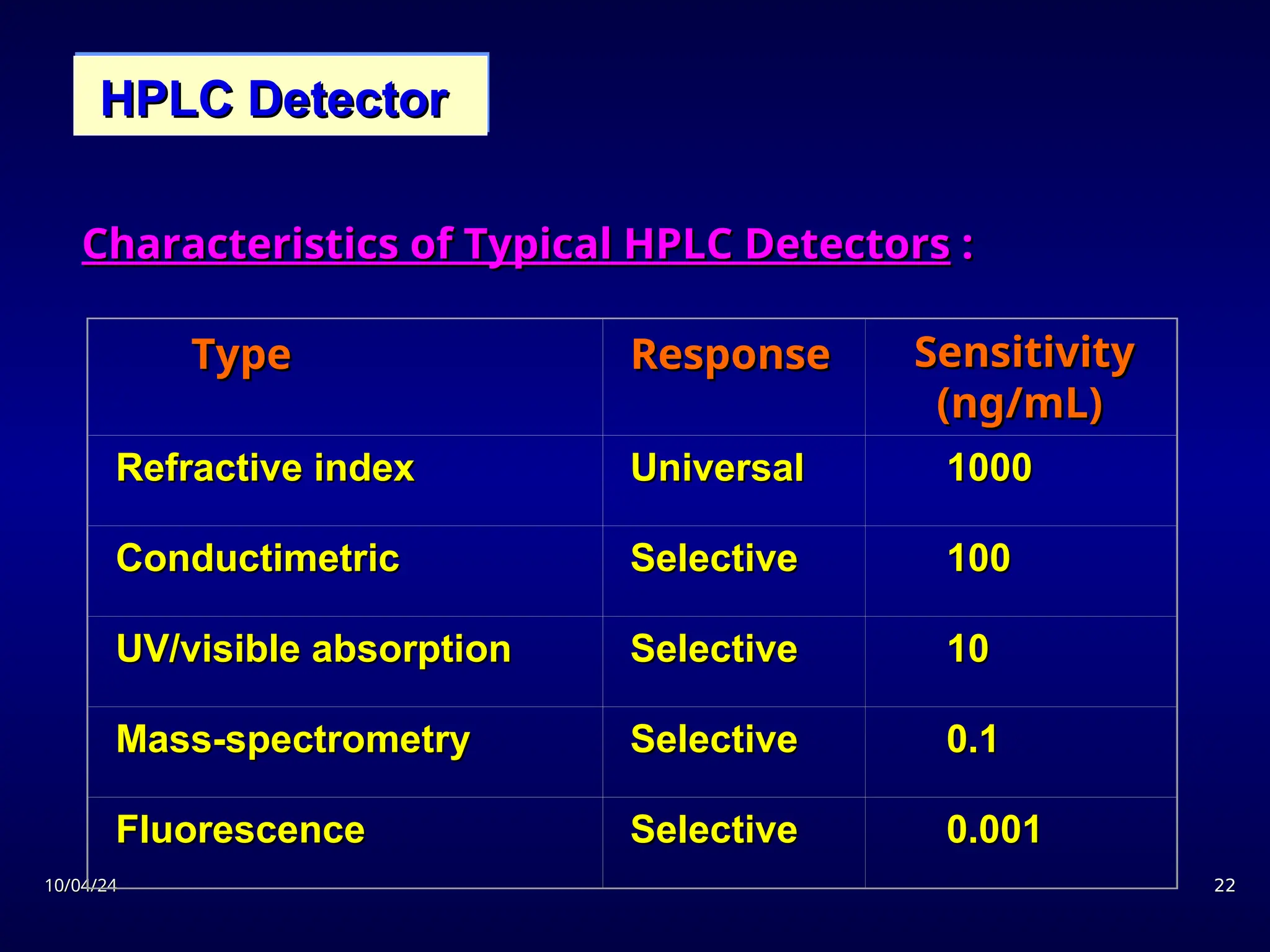
Type
Type Response
Response Sensitivity
Sensitivity
(ng/mL)
(ng/mL)
Refractive index
Refractive index Universal
Universal 1000
1000
Conductimetric
Conductimetric Selective
Selective 100
100
UV/visible absorption
UV/visible absorption Selective
Selective 10
10
Mass-spectrometry
Mass-spectrometry Selective
Selective 0.1
0.1
Fluorescence
Fluorescence Selective
Selective 0.001
0.001
HPLC Detector
HPLC Detector
Characteristics of Typical HPLC Detectors
Characteristics of Typical HPLC Detectors :
:
10/04/24
10/04/24 23
23
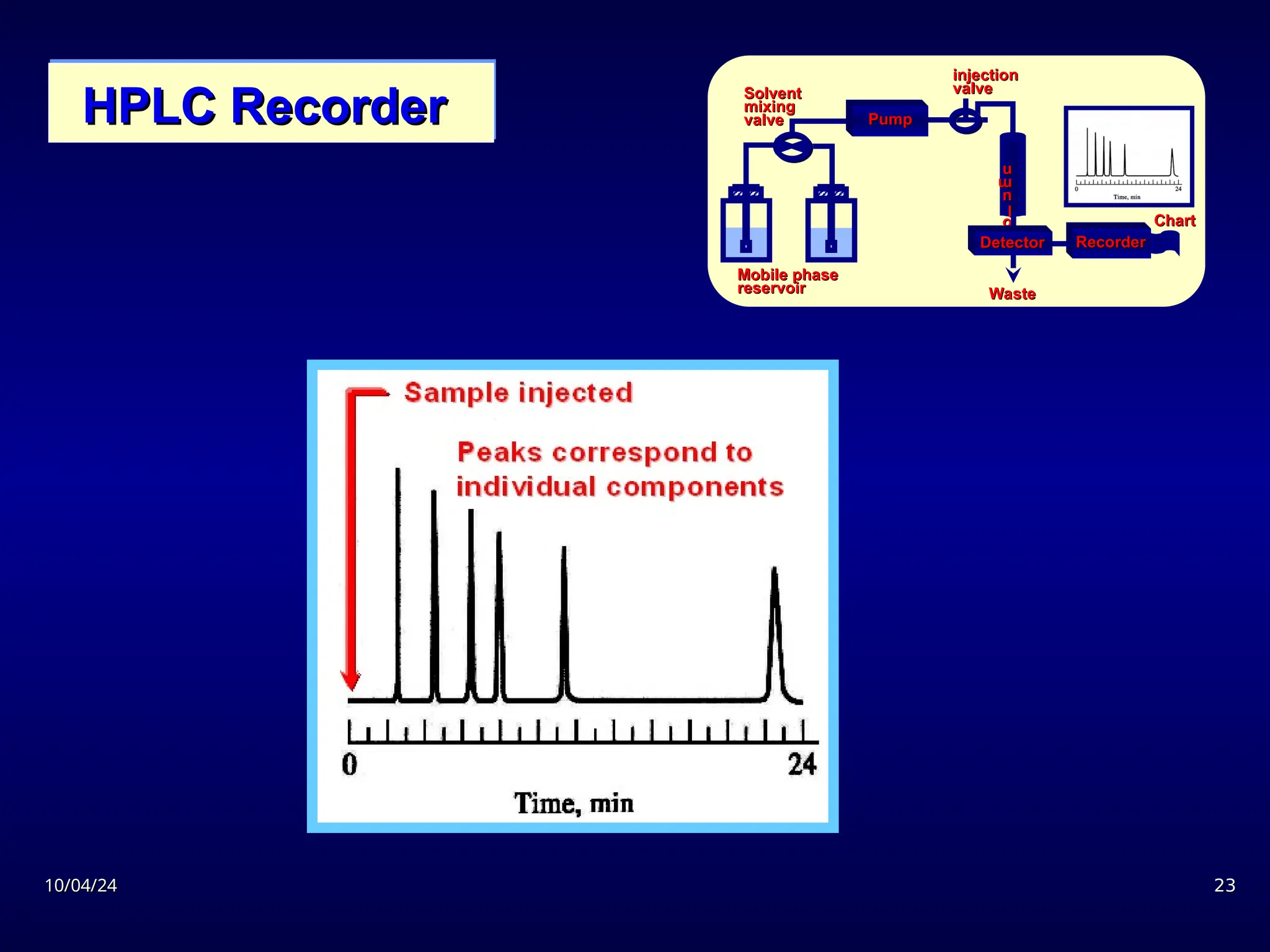
HPLC Recorder
HPLC Recorder
Mobile phase
Mobile phase
reservoir
reservoir
Solvent
Solvent
mixing
mixing
valve
valve Pump
Pump
Chart
Chart
C
C
o
o
l
l
u
u
m
m
n
n
injection
injection
valve
valve
Recorder
Recorder
Detector
Detector
Waste
Waste
10/04/24
10/04/24 24
24
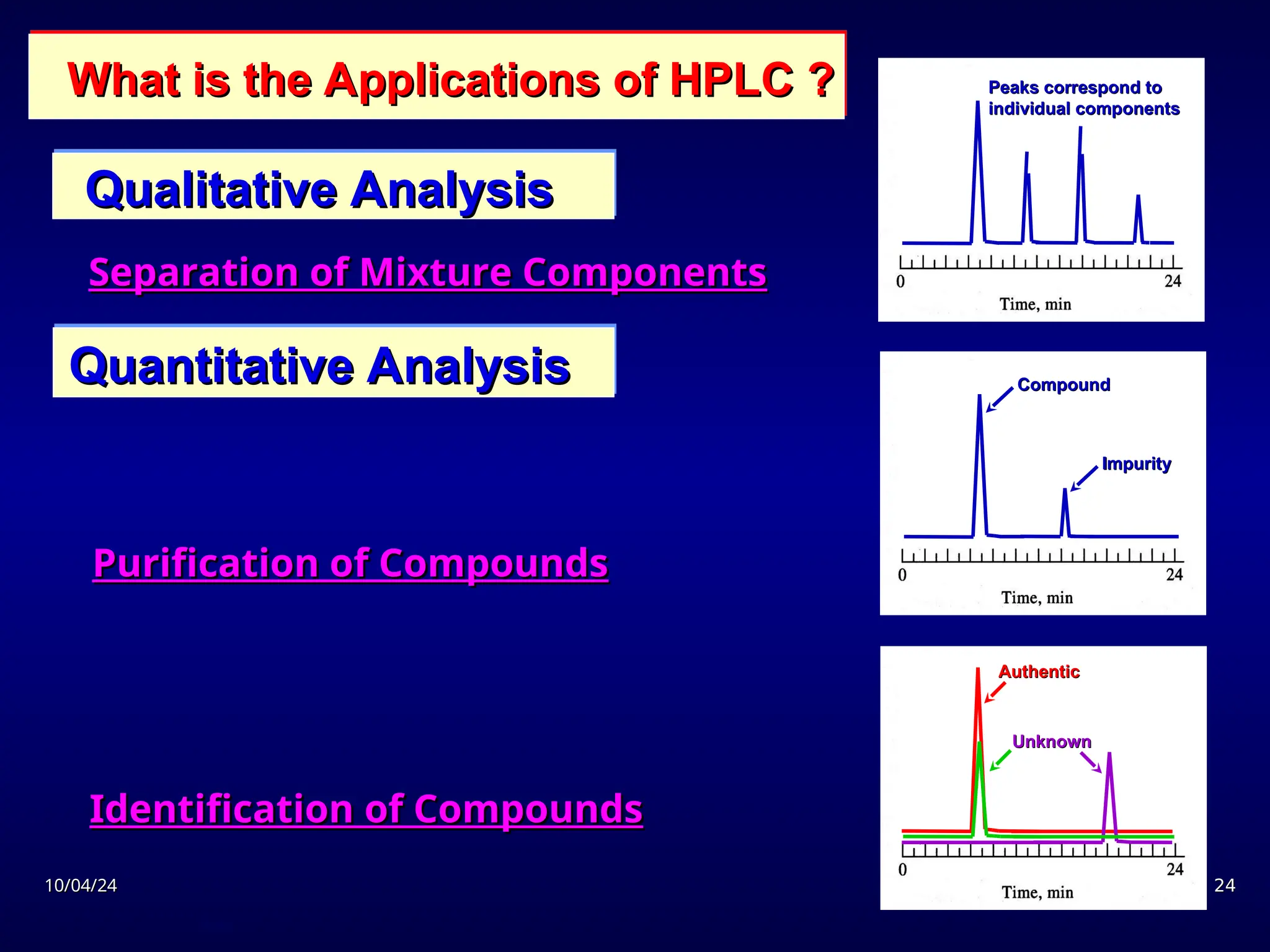
What is the Applications of HPLC ?
Qualitative Analysis
Quantitative Analysis
Purification of Compounds
Identification of Compounds
Separation of Mixture Components
Peaks correspond to
Peaks correspond to
individual components
Compound
Compound
Impurity
Impurity
Authentic
Authentic
Unknown
Unknown
10/04/24
10/04/24 25
25
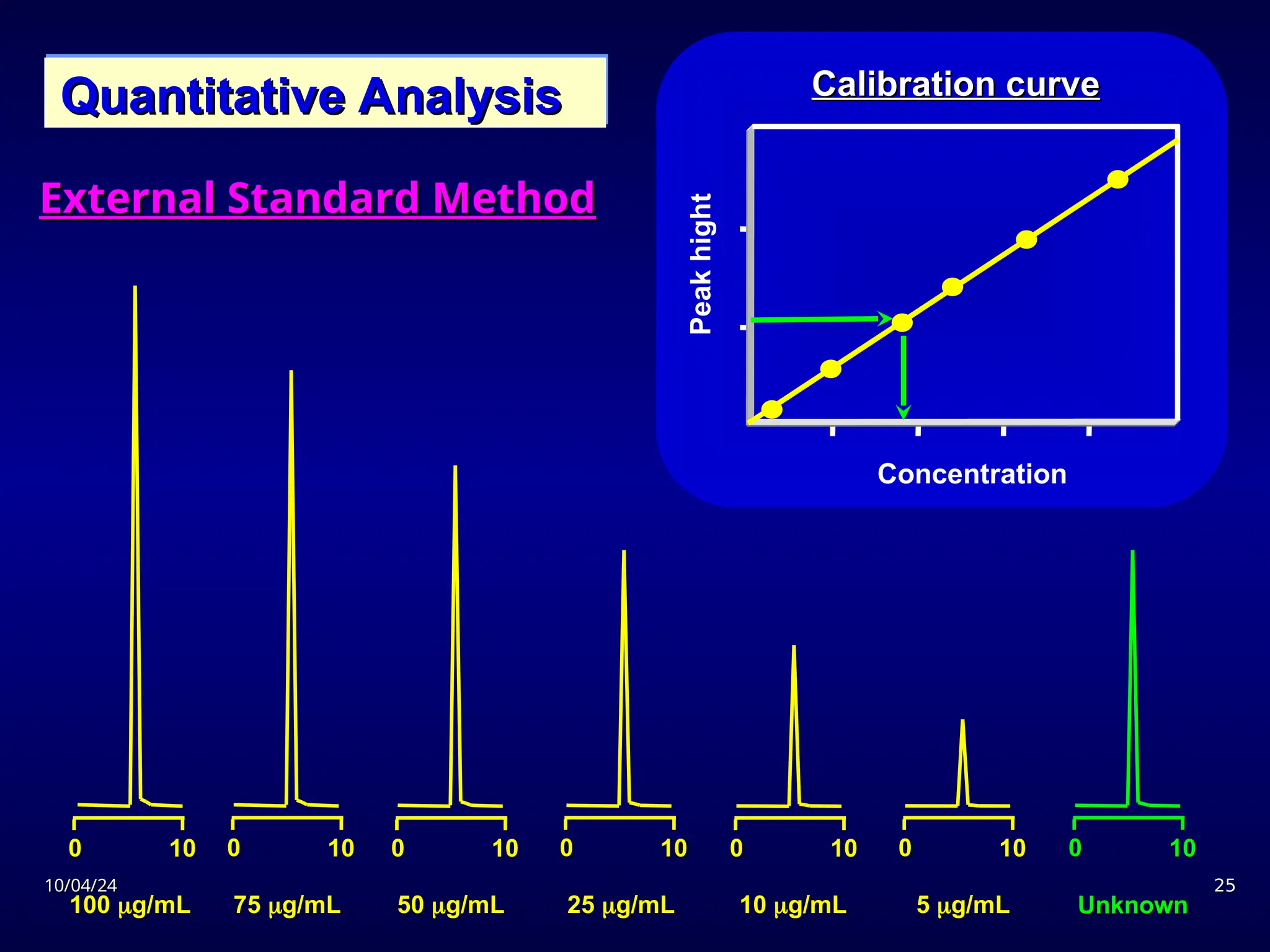
Quantitative Analysis
0
0 10
10
5
5 
g/mL
g/mL
0
0 10
10
10
10 
g/mL
g/mL
0
0 10
10
25
25 
g/mL
g/mL
0
0 10
10
50
50 
g/mL
g/mL
0
0 10
10
75
75 
g/mL
g/mL
0
0 10
10
100
100 
g/mL
g/mL
0
0 10
10
Unknown
Unknown
Concentration
Peak
hight
Calibration curve
Calibration curve
External Standard Method
10/04/24
10/04/24 26
26
G
G
C
C
10/04/24
10/04/24 27
27
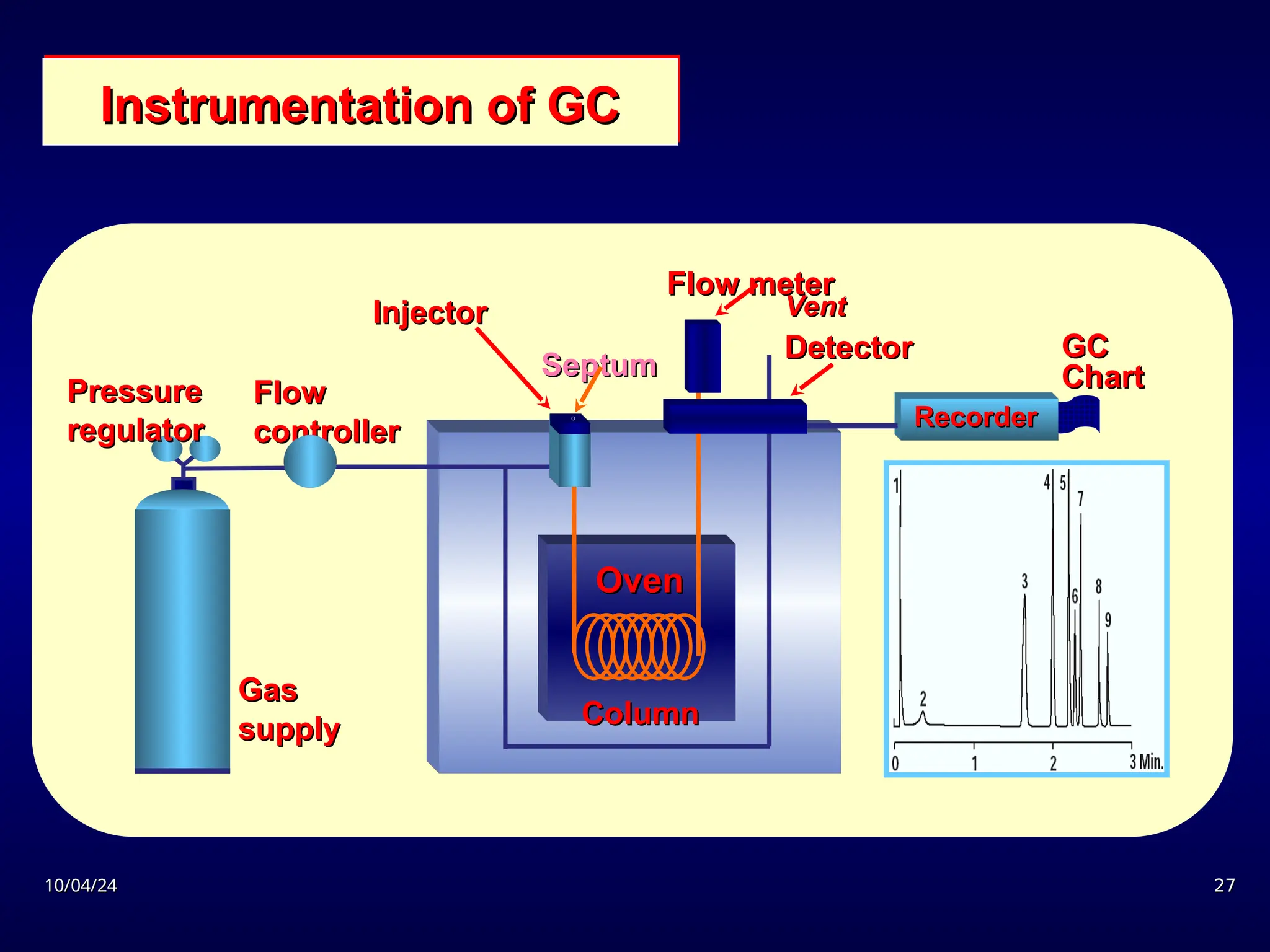
Instrumentation of GC
Flow meter
Flow meter
Gas
Gas
supply
supply
Pressure
Pressure
regulator
regulator
Flow
Flow
controller
controller
Septum
Septum
Vent
Vent
Detector
Detector
Oven
Oven
Column
Column
Injector
Injector
GC
GC
Chart
Chart
Recorder
Recorder

10/04/24
10/04/24 28
28
GC Column
GC Column
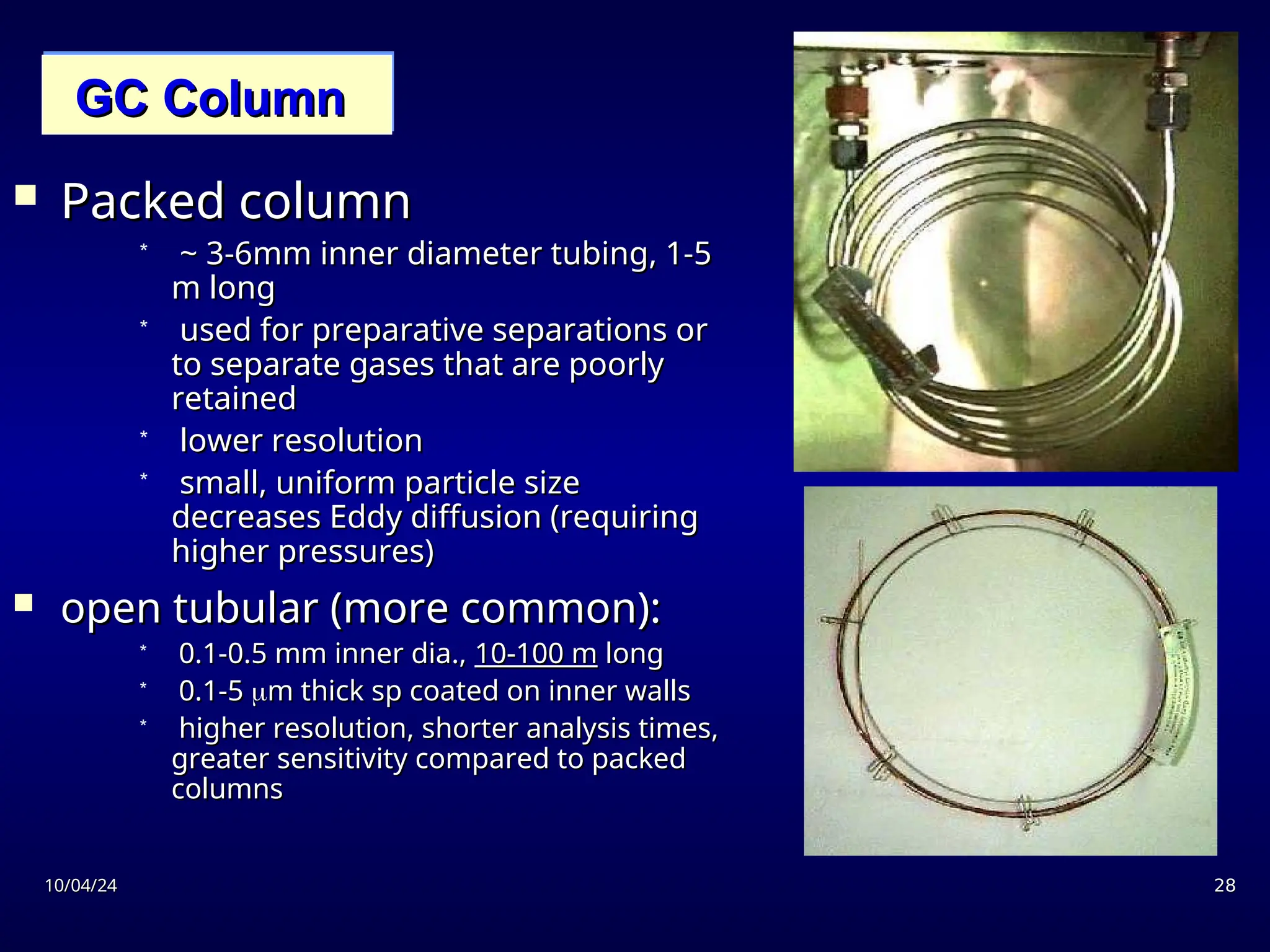
 Packed column
Packed column
* ~ 3-6mm inner diameter tubing, 1-5
~ 3-6mm inner diameter tubing, 1-5
m long
m long
* used for preparative separations or
used for preparative separations or
to separate gases that are poorly
retained
retained
* lower resolution
lower resolution
* small, uniform particle size
small, uniform particle size
decreases Eddy diffusion (requiring
higher pressures)
higher pressures)
 open tubular (more common):
open tubular (more common):
* 0.1-0.5 mm inner dia.,
0.1-0.5 mm inner dia., 10-100 m
10-100 m long
long
* 0.1-5
0.1-5 
m thick sp coated on inner walls
m thick sp coated on inner walls
* higher resolution, shorter analysis times,
higher resolution, shorter analysis times,
greater sensitivity compared to packed
columns
columns
10/04/24
10/04/24 29
29
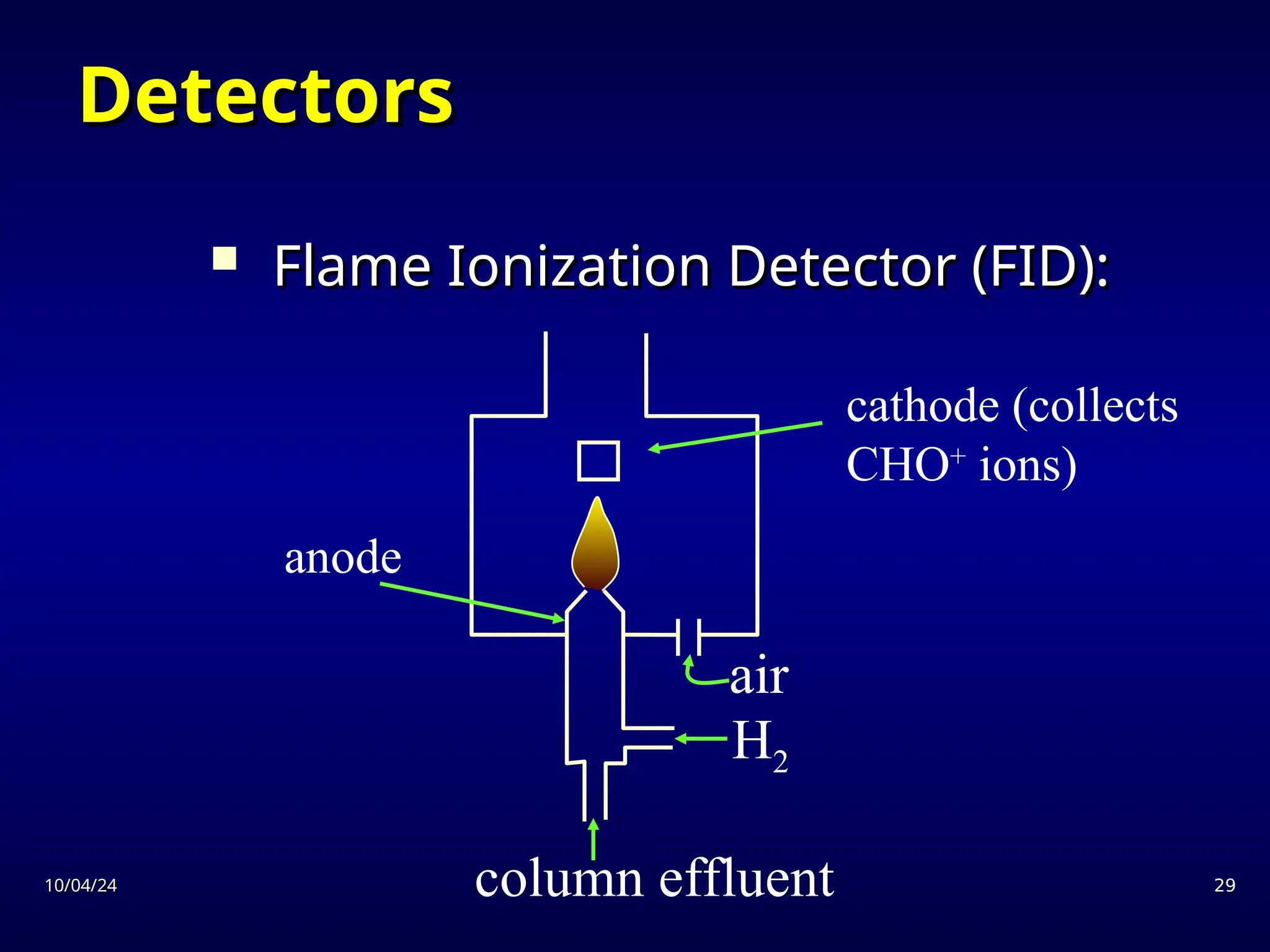
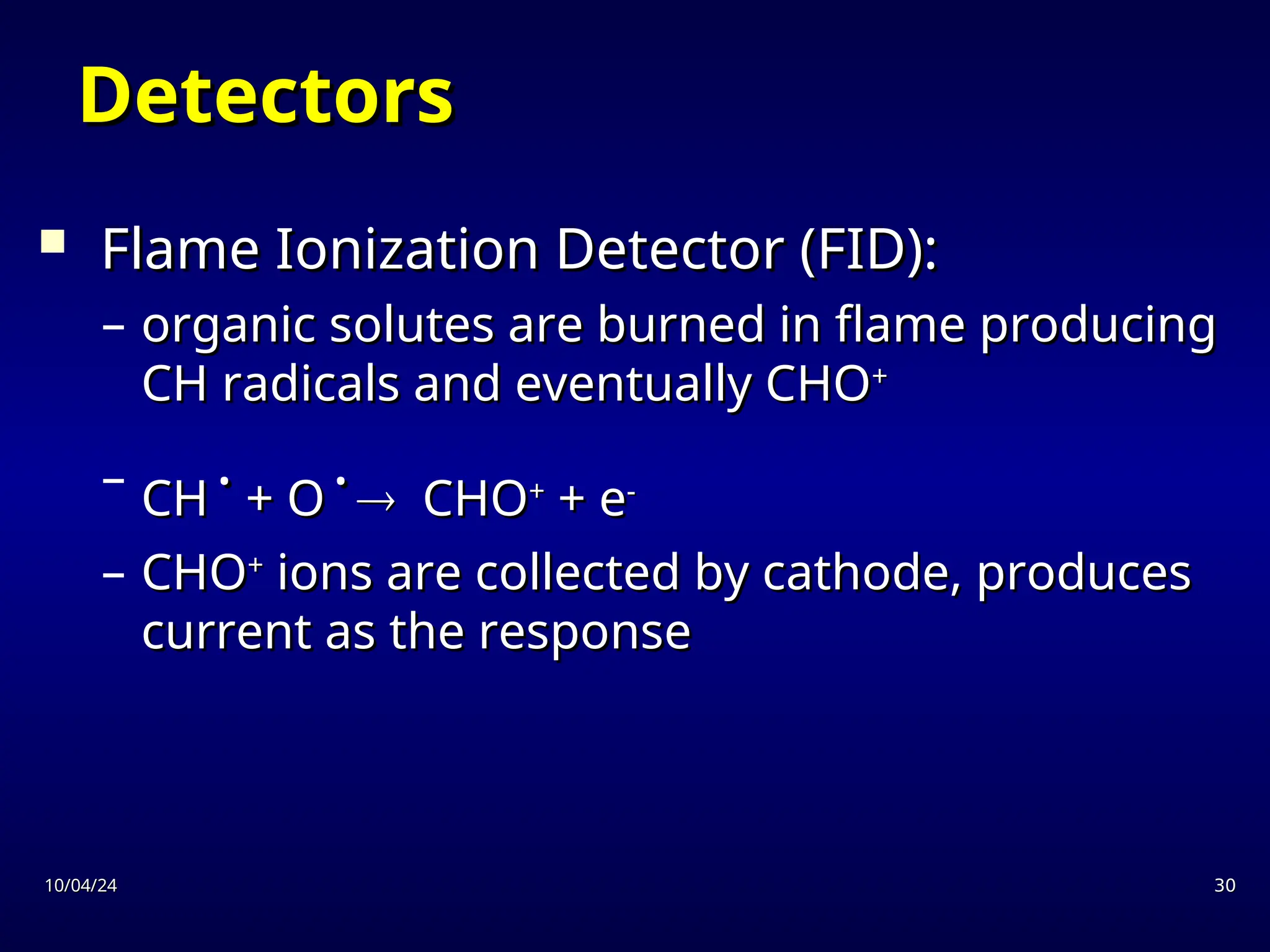
 Flame Ionization Detector (FID):
Flame Ionization Detector (FID):
column effluent
H2
air
cathode (collects
CHO+
ions)
anode
Detectors
Detectors
10/04/24
10/04/24 30
30
Detectors
Detectors
 Flame Ionization Detector (FID):
Flame Ionization Detector (FID):
– organic solutes are burned in flame producing
organic solutes are burned in flame producing
CH radicals and eventually CHO
CH radicals and eventually CHO+
+
– CH
CH
.
.
+ O
+ O
.
.

 CHO
CHO+
+
+ e
+ e-
-
– CHO
CHO+
+
ions are collected by cathode, produces
current as the response
10/04/24
10/04/24 31
31
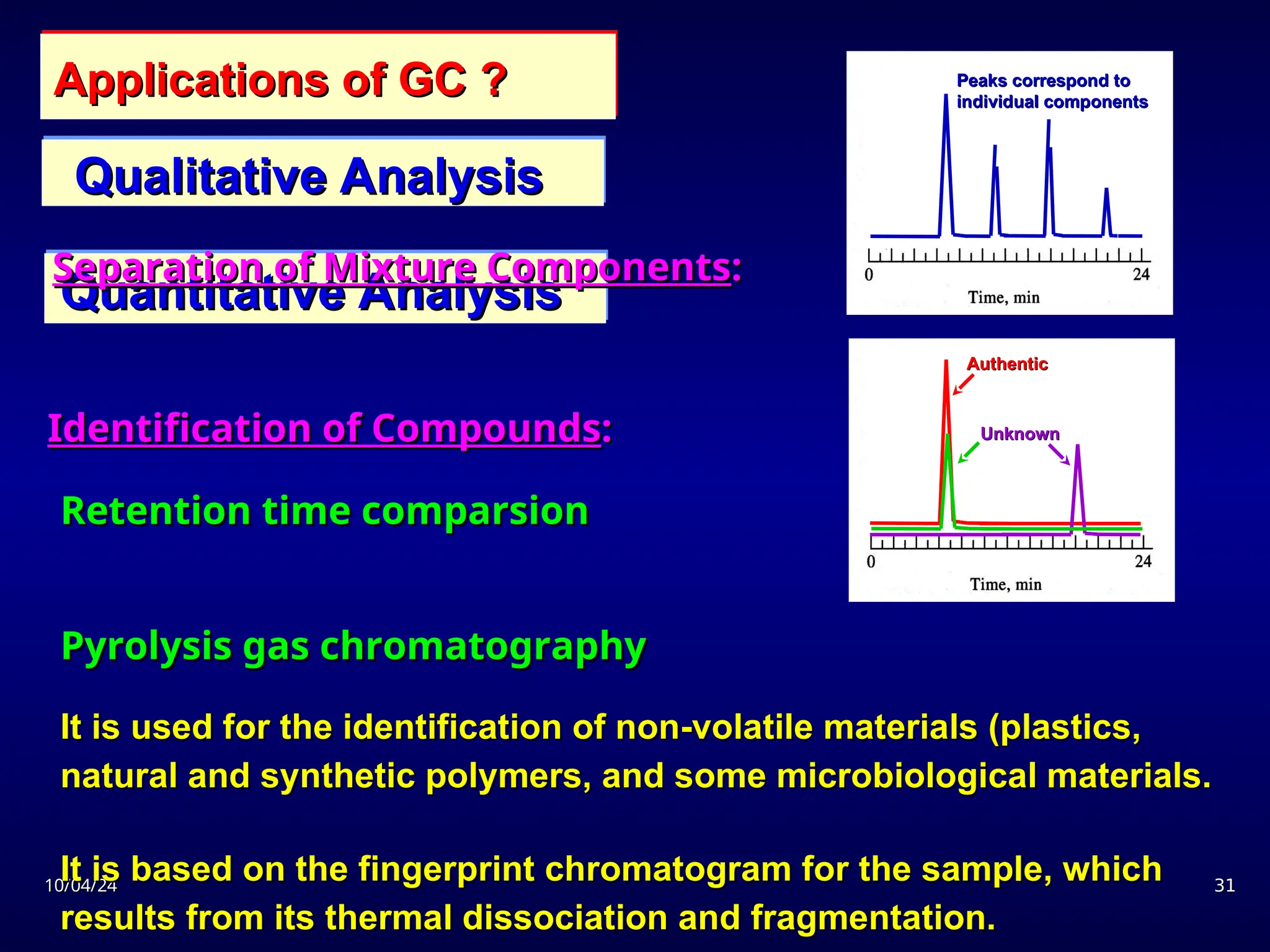
Applications of GC ?
Qualitative Analysis
Quantitative Analysis
Identification of Compounds
Identification of Compounds:
:
Peaks correspond to
Peaks correspond to
individual components
Separation of Mixture Components
Separation of Mixture Components:
:
Authentic
Authentic
Unknown
Unknown
Retention time comparsion
Pyrolysis gas chromatography
It is used for the identification of non-volatile materials (plastics,
natural and synthetic polymers, and some microbiological materials.
It is based on the fingerprint chromatogram for the sample, which
results from its thermal dissociation and fragmentation.
10/04/24
10/04/24 32
32
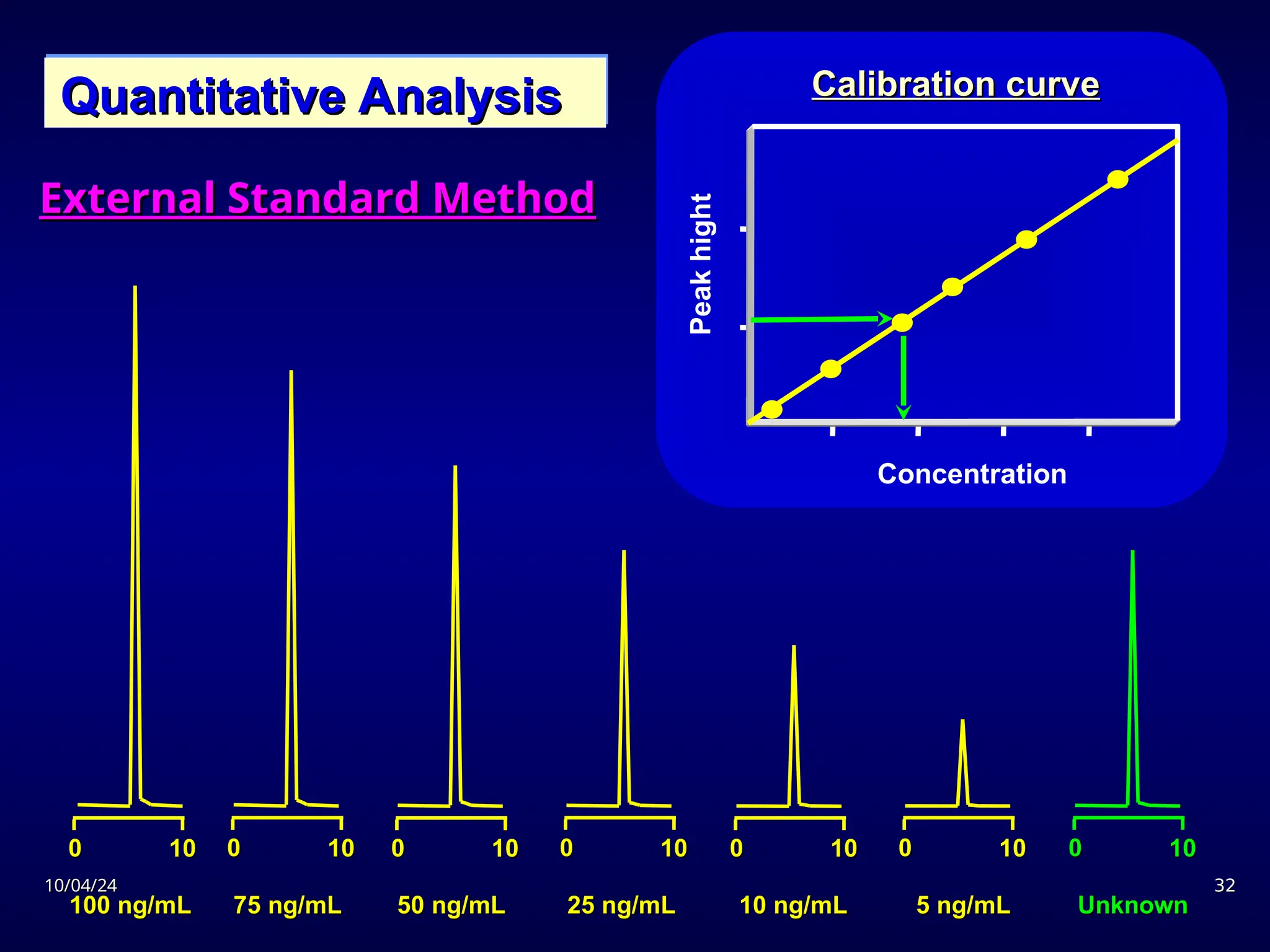
Quantitative Analysis
0
0 10
10
5 ng/mL
5 ng/mL
0
0 10
10
10 ng/mL
10 ng/mL
0
0 10
10
25 ng/mL
25 ng/mL
0
0 10
10
50 ng/mL
50 ng/mL
0
0 10
10
75 ng/mL
75 ng/mL
0
0 10
10
100 ng/mL
100 ng/mL
0
0 10
10
Unknown
Unknown
Concentration
Peak
hight
Calibration curve
Calibration curve
External Standard Method
10/04/24
10/04/24 33
33
Food Analysis
Food Analysis
Analysis of foods is concerned with confirm the presence
and determination the quantities of the analytes (lipids,
proteins, carbohydrates, preservatives, flavours, colorants,
and also vitamins, steroids, and pesticide residues).
Drug Analysis
Drug Analysis
GC is widely applied to identification of the active
components, possible impurities as well as the metabolites.
Aspects of GC Applications
Aspects of GC Applications:
:
10/04/24
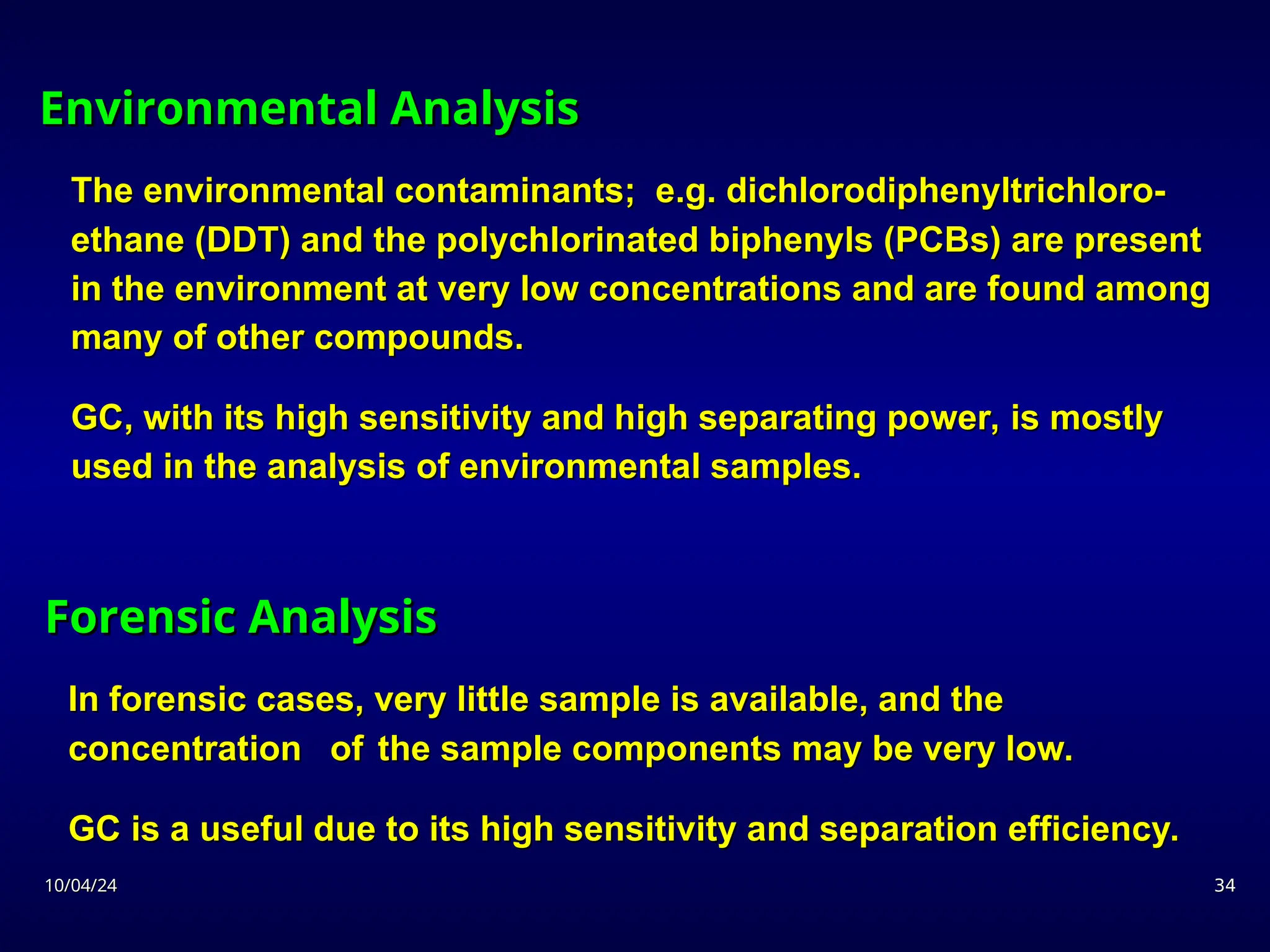
10/04/24 34
34
Forensic Analysis
Forensic Analysis
In forensic cases, very little sample is available, and the
concentration
concentration of
of the sample components may be very low.
the sample components may be very low.
GC is a useful due to its high sensitivity and separation efficiency.
Environmental Analysis
The environmental contaminants; e.g. dichlorodiphenyltrichloro-
ethane (DDT) and the polychlorinated biphenyls (PCBs) are present
in the environment at very low concentrations and are found among
many of other compounds.
GC, with its high sensitivity and high separating power, is mostly
used in the analysis of environmental samples.
10/04/24
10/04/24 35
35

Chromatography.ppt...seminar on instrumental analy

  • 1.
  • 2.
    10/04/24 10/04/24 2 2 I. I. Introduction Introduction II. II.Classification of chromatographic methods Classification of chromatographic methods III. III. Principle of chromatography Principle of chromatography IV. IV. High performance liquid chromatography (HPLC) High performance liquid chromatography (HPLC) V. V. Gas chromatography (GC) Gas chromatography (GC) VI. VI. Thin layer chromatography (TLC) Thin layer chromatography (TLC)
  • 3.
    10/04/24 10/04/24 3 3 Definition: Definition: Chromatography isdefined as a Chromatography is defined as a procedure by which solutes are procedure by which solutes are separated separated by dynamic differential by dynamic differential migration process in a system consisting migration process in a system consisting of two or more phases, one of which of two or more phases, one of which moves continuously in a given direction moves continuously in a given direction and in which the individual substances and in which the individual substances exhibit different mobilities by reason of exhibit different mobilities by reason of differences in differences in adsorption, partition, adsorption, partition, solubility, vapor pressure, molecular size, or solubility, vapor pressure, molecular size, or
  • 4.
    10/04/24 10/04/24 4 4 Mobile Phase MobilePhase: : The Phase that travels through the The Phase that travels through the column (gas or liquid) – transport column (gas or liquid) – transport sample through the column. sample through the column. Stationary Phase Stationary Phase: : Immiscible solid or liquid phase Immiscible solid or liquid phase that fixed in place in the column or that fixed in place in the column or on a solid support – retain analytes on a solid support – retain analytes within the column. within the column. Band or Zone Band or Zone: : -Area across which analyte is Area across which analyte is distributed on column distributed on column -Zones of different analytes Zones of different analytes gradually separate as bands gradually separate as bands progress down column progress down column
  • 5.
    10/04/24 10/04/24 5 5 Sample Sample Mobile phase Mobilephase (eluant) (eluant) Stationary Phase Stationary Phase Detection method Detection method Chromatogram Chromatogram Thin Layer Thin Layer chromatograph chromatograph y y Column Chromatography Column Chromatography
  • 6.
    10/04/24 10/04/24 6 6  Methodto separate components in a mixture based on Method to separate components in a mixture based on different Distribution coefficients between the two phases. different Distribution coefficients between the two phases.  Chromatography categorized on the basis of interaction Chromatography categorized on the basis of interaction between solute and stationary phase between solute and stationary phase  Mobile phase either gas or liquid Mobile phase either gas or liquid  Stationary phase either liquid or solid Stationary phase either liquid or solid – Liq/Liq Liq/Liq (Partition) (Partition) – Liq/Sol Liq/Sol (Adsorption) (Adsorption) – Gas/Liq Gas/Liq (Partition) (Partition) – Gas/Sol Gas/Sol (Adsorption) (Adsorption) Gas Chromatography Liquid Chromatography
  • 7.
    10/04/24 10/04/24 7 7 According tomethodology According to methodology Planer Planer chromatography Column Column chromatography Thin Layer TLC Paper PC HPLC GC Electrophoresis Electrophoresis
  • 8.
    10/04/24 10/04/24 8 8 Sampl Sampl e e Mobile Mobile time time Response Response A A B B Figure Figure: : Schematicdiagram showing the separation of Schematic diagram showing the separation of compounds A and B. and the output of the compounds A and B. and the output of the detector response at various stages of elution detector response at various stages of elution The process of: The process of: Addition of sample Addition of sample Mobile elution process Mobile elution process Separation mechanism Separation mechanism Retention time ? Retention time ? Detection by, UV lamp, UV detector, Detection by, UV lamp, UV detector, other detectors. other detectors. Eluted bands / collection Eluted bands / collection  Chromatogram? (function of Chromatogram? (function of retention time versus detector retention time versus detector response) response)  Partition coefficient K’ Partition coefficient K’  k’ = C k’ = Cs s/C /CM M
  • 9.
  • 10.
    10/04/24 10/04/24 10 10 Principles of(TLC) Principles of (TLC) TLC TLC Chromatography carried out on Chromatography carried out on active particulate material (silica active particulate material (silica gel or alumina) dispersed on an gel or alumina) dispersed on an Inert support (flat glass plates) Inert support (flat glass plates)
  • 11.
    10/04/24 10/04/24 11 11 Basic Stepsof TLC Technique Basic Steps of TLC Technique Preparation of the Plate Preparation of the Plate Sample Application Sample Application Chromatogram Development Chromatogram Development Locating of the Spots Locating of the Spots
  • 12.
    10/04/24 10/04/24 12 12 Slurry ofthe active material is uniformly Slurry of the active material is uniformly spread over the plate by means of a spread over the plate by means of a commercially available spreader. commercially available spreader. Air-drying overnight, or oven-drying at Air-drying overnight, or oven-drying at 80-90 80-90  C for about 30 minutes. C for about 30 minutes. Ready to use thin layers (pre-coated plates) Ready to use thin layers (pre-coated plates) are commercially available. are commercially available. Preparation of the Plate Preparation of the Plate
  • 13.
    10/04/24 10/04/24 13 13 Sample Application SampleApplication 1-2 cm 1-2 cm 1-2 cm 1-2 cm 2-2.5 cm 2-2.5 cm  Base line Base line
  • 14.
    10/04/24 10/04/24 14 14 Locating ofthe Spots Locating of the Spots  Base line Base line Solvent front Solvent front R Rf f = b/a = b/a a b For Colored Compounds For Colored Compounds: :
  • 15.
    10/04/24 10/04/24 15 15 Base line Baseline    Solvent front Solvent front a Where is the Where is the spots ?? spots ?? We do not know. We do not know. •Iodine or sulphuric acid is used for most organic mixtures. Iodine or sulphuric acid is used for most organic mixtures. •Ninhydrin is used for amino acids. Ninhydrin is used for amino acids. •2,4-Dinitrophenylhydrazine is used for aldehydes and ketones 2,4-Dinitrophenylhydrazine is used for aldehydes and ketones b R Rf f = b/a = b/a For Colorless Compounds For Colorless Compounds: :
  • 16.
    10/04/24 10/04/24 16 16  Unknown Unknown Authentic Authentic  Co-spot Co-spot  Applications ofTLC Technique Applications of TLC Technique Identification of Unknown Compounds Identification of Unknown Compounds  Unknown Unknown Authentic Authentic  Co-spot Co-spot 
  • 17.
    10/04/24 10/04/24 17 17 Analysis ofReaction Mixture Analysis of Reaction Mixture  Start. mat. Start. mat. Rxn. mixt. Rxn. mixt.  Product Product 
  • 18.
    10/04/24 10/04/24 18 18 Chromatogram Development ChromatogramDevelopment  Avoid direct contact between the sample and the solvent system. Avoid direct contact between the sample and the solvent system. The tank or chamber is preferably lined with filter paper. The tank or chamber is preferably lined with filter paper. As the developing solvent travels up the plate, it dissolves the As the developing solvent travels up the plate, it dissolves the sample and carries it up; the sample distributing itself between the sample and carries it up; the sample distributing itself between the moving solvent and the stationary phase. moving solvent and the stationary phase.
  • 19.
    10/04/24 10/04/24 19 19 Determination ofthe Purity of a Product Compound Determination of the Purity of a Product Compound  Impurities Impurities Product compound Product compound
  • 20.
    10/04/24 10/04/24 20 20 Quantitative Determinationof Quantitative Determination of an Unknown Concentration an Unknown Concentration Unknown Unknown        Standard Standard conc. conc. Concentration Signal Calibration curve Calibration curve
  • 21.
    10/04/24 10/04/24 21 21 Instrumentation ofHPLC Instrumentation of HPLC Mobile phase Mobile phase reservoir reservoir Solvent Solvent mixing mixing valve valve Pump Pump HPLC HPLC Chart Chart C C ol ol u u m m n n Sample Sample injection injection valve valve Recorder Recorder Waste Waste Detector Detector
  • 22.
    10/04/24 10/04/24 22 22 Type Type Response ResponseSensitivity Sensitivity (ng/mL) (ng/mL) Refractive index Refractive index Universal Universal 1000 1000 Conductimetric Conductimetric Selective Selective 100 100 UV/visible absorption UV/visible absorption Selective Selective 10 10 Mass-spectrometry Mass-spectrometry Selective Selective 0.1 0.1 Fluorescence Fluorescence Selective Selective 0.001 0.001 HPLC Detector HPLC Detector Characteristics of Typical HPLC Detectors Characteristics of Typical HPLC Detectors : :
  • 23.
    10/04/24 10/04/24 23 23 HPLC Recorder HPLCRecorder Mobile phase Mobile phase reservoir reservoir Solvent Solvent mixing mixing valve valve Pump Pump Chart Chart C C o o l l u u m m n n injection injection valve valve Recorder Recorder Detector Detector Waste Waste
  • 24.
    10/04/24 10/04/24 24 24 What isthe Applications of HPLC ? What is the Applications of HPLC ? Qualitative Analysis Qualitative Analysis Quantitative Analysis Quantitative Analysis Purification of Compounds Purification of Compounds Identification of Compounds Identification of Compounds Separation of Mixture Components Separation of Mixture Components Peaks correspond to Peaks correspond to individual components individual components Compound Compound Impurity Impurity Authentic Authentic Unknown Unknown
  • 25.
    10/04/24 10/04/24 25 25 Quantitative Analysis QuantitativeAnalysis 0 0 10 10 5 5  g/mL g/mL 0 0 10 10 10 10  g/mL g/mL 0 0 10 10 25 25  g/mL g/mL 0 0 10 10 50 50  g/mL g/mL 0 0 10 10 75 75  g/mL g/mL 0 0 10 10 100 100  g/mL g/mL 0 0 10 10 Unknown Unknown Concentration Peak hight Calibration curve Calibration curve External Standard Method External Standard Method
  • 26.
  • 27.
    10/04/24 10/04/24 27 27 Instrumentation ofGC Instrumentation of GC Flow meter Flow meter Gas Gas supply supply Pressure Pressure regulator regulator Flow Flow controller controller Septum Septum Vent Vent Detector Detector Oven Oven Column Column Injector Injector GC GC Chart Chart Recorder Recorder 
  • 28.
    10/04/24 10/04/24 28 28 GC Column GCColumn  Packed column Packed column * ~ 3-6mm inner diameter tubing, 1-5 ~ 3-6mm inner diameter tubing, 1-5 m long m long * used for preparative separations or used for preparative separations or to separate gases that are poorly to separate gases that are poorly retained retained * lower resolution lower resolution * small, uniform particle size small, uniform particle size decreases Eddy diffusion (requiring decreases Eddy diffusion (requiring higher pressures) higher pressures)  open tubular (more common): open tubular (more common): * 0.1-0.5 mm inner dia., 0.1-0.5 mm inner dia., 10-100 m 10-100 m long long * 0.1-5 0.1-5  m thick sp coated on inner walls m thick sp coated on inner walls * higher resolution, shorter analysis times, higher resolution, shorter analysis times, greater sensitivity compared to packed greater sensitivity compared to packed columns columns
  • 29.
    10/04/24 10/04/24 29 29  FlameIonization Detector (FID): Flame Ionization Detector (FID): column effluent H2 air cathode (collects CHO+ ions) anode Detectors Detectors
  • 30.
    10/04/24 10/04/24 30 30 Detectors Detectors  FlameIonization Detector (FID): Flame Ionization Detector (FID): – organic solutes are burned in flame producing organic solutes are burned in flame producing CH radicals and eventually CHO CH radicals and eventually CHO+ + – CH CH . . + O + O . .   CHO CHO+ + + e + e- - – CHO CHO+ + ions are collected by cathode, produces ions are collected by cathode, produces current as the response current as the response
  • 31.
    10/04/24 10/04/24 31 31 Applications ofGC ? Applications of GC ? Qualitative Analysis Qualitative Analysis Quantitative Analysis Quantitative Analysis Identification of Compounds Identification of Compounds: : Peaks correspond to Peaks correspond to individual components individual components Separation of Mixture Components Separation of Mixture Components: : Authentic Authentic Unknown Unknown Retention time comparsion Retention time comparsion Pyrolysis gas chromatography Pyrolysis gas chromatography It is used for the identification of non-volatile materials (plastics, It is used for the identification of non-volatile materials (plastics, natural and synthetic polymers, and some microbiological materials. natural and synthetic polymers, and some microbiological materials. It is based on the fingerprint chromatogram for the sample, which It is based on the fingerprint chromatogram for the sample, which results from its thermal dissociation and fragmentation. results from its thermal dissociation and fragmentation.
  • 32.
    10/04/24 10/04/24 32 32 Quantitative Analysis QuantitativeAnalysis 0 0 10 10 5 ng/mL 5 ng/mL 0 0 10 10 10 ng/mL 10 ng/mL 0 0 10 10 25 ng/mL 25 ng/mL 0 0 10 10 50 ng/mL 50 ng/mL 0 0 10 10 75 ng/mL 75 ng/mL 0 0 10 10 100 ng/mL 100 ng/mL 0 0 10 10 Unknown Unknown Concentration Peak hight Calibration curve Calibration curve External Standard Method External Standard Method
  • 33.
    10/04/24 10/04/24 33 33 Food Analysis FoodAnalysis Analysis of foods is concerned with confirm the presence Analysis of foods is concerned with confirm the presence and determination the quantities of the analytes (lipids, and determination the quantities of the analytes (lipids, proteins, carbohydrates, preservatives, flavours, colorants, proteins, carbohydrates, preservatives, flavours, colorants, and also vitamins, steroids, and pesticide residues). and also vitamins, steroids, and pesticide residues). Drug Analysis Drug Analysis GC is widely applied to identification of the active GC is widely applied to identification of the active components, possible impurities as well as the metabolites. components, possible impurities as well as the metabolites. Aspects of GC Applications Aspects of GC Applications: :
  • 34.
    10/04/24 10/04/24 34 34 Forensic Analysis ForensicAnalysis In forensic cases, very little sample is available, and the In forensic cases, very little sample is available, and the concentration concentration of of the sample components may be very low. the sample components may be very low. GC is a useful due to its high sensitivity and separation efficiency. GC is a useful due to its high sensitivity and separation efficiency. Environmental Analysis Environmental Analysis The environmental contaminants; e.g. dichlorodiphenyltrichloro- The environmental contaminants; e.g. dichlorodiphenyltrichloro- ethane (DDT) and the polychlorinated biphenyls (PCBs) are present ethane (DDT) and the polychlorinated biphenyls (PCBs) are present in the environment at very low concentrations and are found among in the environment at very low concentrations and are found among many of other compounds. many of other compounds. GC, with its high sensitivity and high separating power, is mostly GC, with its high sensitivity and high separating power, is mostly used in the analysis of environmental samples. used in the analysis of environmental samples.
  • 35.