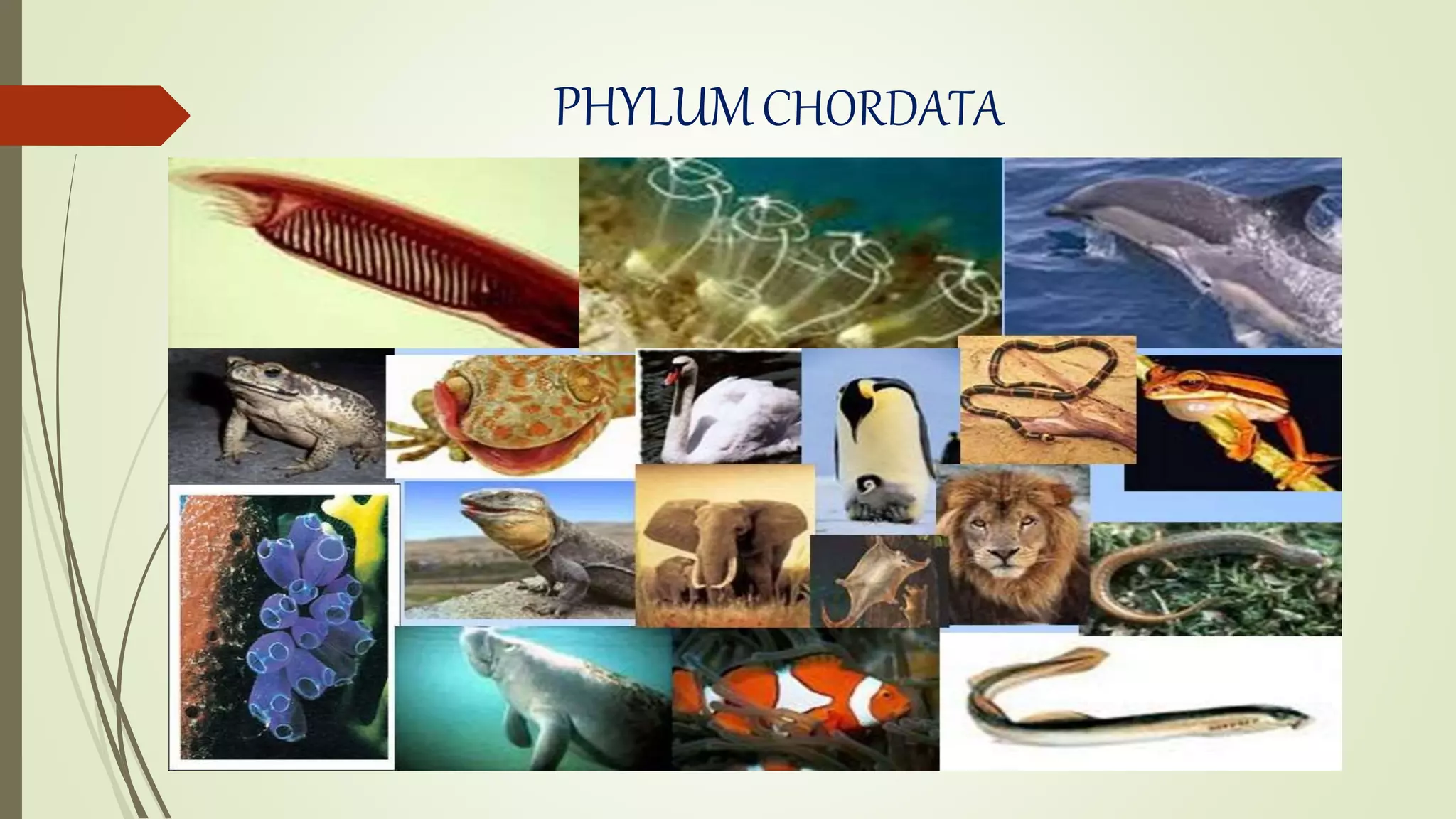


PHYLUMCHORDATA
Presented By
Group – 07
 Imran Hossen - ASH1819017M
 Mita Mahmuda - BKH1819015F
 Wahida Nusrat - MUH1819037F
 Aysha Subrin Ifti - BKH1819044F
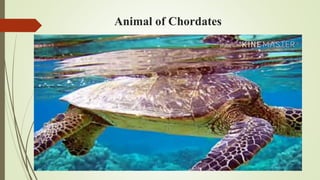
Animal of Chordates
Chordata
The last major group of the animal
kingdom is known as phylum
Chordata. Created by Balfour in
1880.
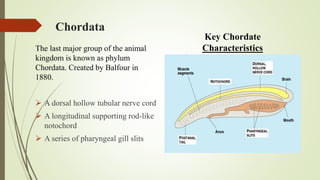
 A dorsal hollow tubular nerve cord
 A longitudinal supporting rod-like
notochord
 A series of pharyngeal gill slits
Key Chordate
Characteristics
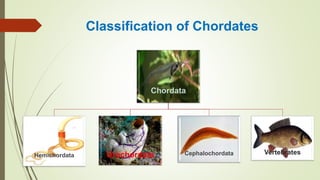
Classification of Chordates
Chordata
Hemichordata Urochordata Cephalochordata Vertebrates
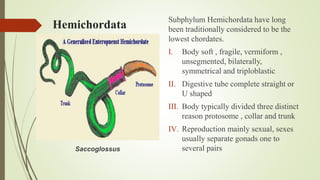
Hemichordata
Subphylum Hemichordata have long
been traditionally considered to be the
lowest chordates.
I. Body soft , fragile, vermiform ,
unsegmented, bilaterally,
symmetrical and triploblastic
II. Digestive tube complete straight or
U shaped
III. Body typically divided three distinct
reason protosome , collar and trunk
IV. Reproduction mainly sexual, sexes
usually separate gonads one to
several pairsSaccoglossus
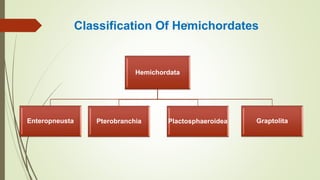
Classification Of Hemichordates
Hemichordata
Enteropneusta Pterobranchia Plactosphaeroidea Graptolita
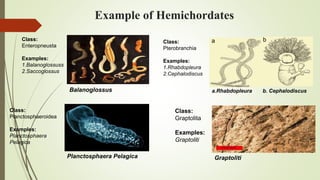
Example of Hemichordates
Balanoglossus a.Rhabdopleura b. Cephalodiscus
a b
Planctosphaera Pelagica Graptoliti
Class:
Pterobranchia
Examples:
1.Rhabdopleura
2.Cephalodiscus
Class:
Enteropneusta
Examples:
1.Balanoglossuss
2.Saccoglossus
Class:
Planctosphaeroidea
Examples:
Planctosphaera
Pelagica
Class:
Graptolita
Examples:
Graptoliti
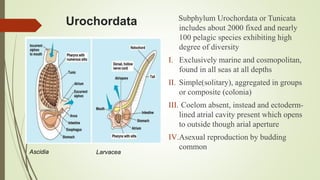
Urochordata Subphylum Urochordata or Tunicata
includes about 2000 fixed and nearly
100 pelagic species exhibiting high
degree of diversity
I. Exclusively marine and cosmopolitan,
found in all seas at all depths
II. Simple(solitary), aggregated in groups
or composite (colonia)
III. Coelom absent, instead and ectoderm-
lined atrial cavity present which opens
to outside though arial aperture
IV.Asexual reproduction by budding
common
Ascidia Larvacea
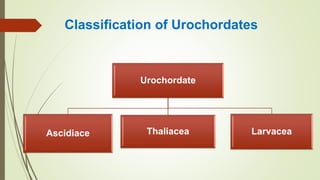
Classification of Urochordates
Urochordate
Ascidiace Thaliacea Larvacea
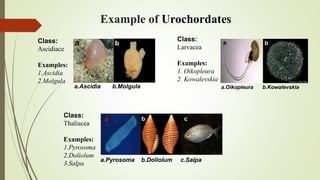
Example of Urochordates
a b a b
a b c
a.Ascidia b.Molgula a.Oikopleura b.Kowalevskia
a.Pyrosoma b.Doliolum c.Salpa
Class:
Ascidiace
Examples:
1.Ascidia
2.Molgula
Class:
Larvacea
Examples:
1. Oikopleura
2. Kowalevskia
Class:
Thaliacea
Examples:
1.Pyrosoma
2.Doliolum
3.Salpa
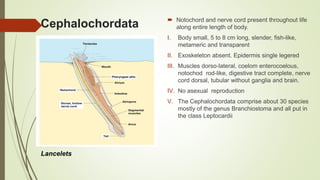
Cephalochordata  Notochord and nerve cord present throughout life
along entire length of body.
I. Body small, 5 to 8 cm long, slender, fish-like,
metameric and transparent
II. Exoskeleton absent. Epidermis single legered
III. Muscles dorso-lateral, coelom enterocoelous,
notochod rod-like, digestive tract complete, nerve
cord dorsal, tubular without ganglia and brain.
IV. No asexual reproduction
V. The Cephalochordata comprise about 30 species
mostly of the genus Branchiostoma and all put in
the class Leptocardii
Lancelets
Importance of Chordates
As human and cattle food
Using as manure
Oils
Fish glue
Medicine and disease control
Scientific studies
Referance:
 Vertebrates- R.L. Kotpl
 www.wikipedia.org
 www.ucmp.berkeley.edu
 www.animaldiversity.org
 www.untamedscience.com
Any Question ??
Thank You
Chordata

Chordata

  • 1.
  • 2.
    Presented By Group –07  Imran Hossen - ASH1819017M  Mita Mahmuda - BKH1819015F  Wahida Nusrat - MUH1819037F  Aysha Subrin Ifti - BKH1819044F
  • 3.
  • 4.
    Chordata The last majorgroup of the animal kingdom is known as phylum Chordata. Created by Balfour in 1880.  A dorsal hollow tubular nerve cord  A longitudinal supporting rod-like notochord  A series of pharyngeal gill slits Key Chordate Characteristics
  • 5.
    Classification of Chordates Chordata HemichordataUrochordata Cephalochordata Vertebrates
  • 6.
    Hemichordata Subphylum Hemichordata havelong been traditionally considered to be the lowest chordates. I. Body soft , fragile, vermiform , unsegmented, bilaterally, symmetrical and triploblastic II. Digestive tube complete straight or U shaped III. Body typically divided three distinct reason protosome , collar and trunk IV. Reproduction mainly sexual, sexes usually separate gonads one to several pairsSaccoglossus
  • 7.
    Classification Of Hemichordates Hemichordata EnteropneustaPterobranchia Plactosphaeroidea Graptolita
  • 8.
    Example of Hemichordates Balanoglossusa.Rhabdopleura b. Cephalodiscus a b Planctosphaera Pelagica Graptoliti Class: Pterobranchia Examples: 1.Rhabdopleura 2.Cephalodiscus Class: Enteropneusta Examples: 1.Balanoglossuss 2.Saccoglossus Class: Planctosphaeroidea Examples: Planctosphaera Pelagica Class: Graptolita Examples: Graptoliti
  • 9.
    Urochordata Subphylum Urochordataor Tunicata includes about 2000 fixed and nearly 100 pelagic species exhibiting high degree of diversity I. Exclusively marine and cosmopolitan, found in all seas at all depths II. Simple(solitary), aggregated in groups or composite (colonia) III. Coelom absent, instead and ectoderm- lined atrial cavity present which opens to outside though arial aperture IV.Asexual reproduction by budding common Ascidia Larvacea
  • 10.
  • 11.
    Example of Urochordates ab a b a b c a.Ascidia b.Molgula a.Oikopleura b.Kowalevskia a.Pyrosoma b.Doliolum c.Salpa Class: Ascidiace Examples: 1.Ascidia 2.Molgula Class: Larvacea Examples: 1. Oikopleura 2. Kowalevskia Class: Thaliacea Examples: 1.Pyrosoma 2.Doliolum 3.Salpa
  • 12.
    Cephalochordata  Notochordand nerve cord present throughout life along entire length of body. I. Body small, 5 to 8 cm long, slender, fish-like, metameric and transparent II. Exoskeleton absent. Epidermis single legered III. Muscles dorso-lateral, coelom enterocoelous, notochod rod-like, digestive tract complete, nerve cord dorsal, tubular without ganglia and brain. IV. No asexual reproduction V. The Cephalochordata comprise about 30 species mostly of the genus Branchiostoma and all put in the class Leptocardii Lancelets
  • 13.
    Importance of Chordates Ashuman and cattle food Using as manure Oils Fish glue Medicine and disease control Scientific studies
  • 14.
    Referance:  Vertebrates- R.L.Kotpl  www.wikipedia.org  www.ucmp.berkeley.edu  www.animaldiversity.org  www.untamedscience.com
  • 15.
  • 16.