Protochordates 
“The first chordates”
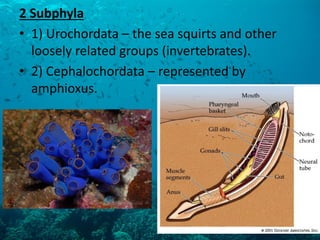
2 Subphyla 
•1) Urochordata – the sea squirts and other loosely related groups (invertebrates). 
•2) Cephalochordata – represented by amphioxus.
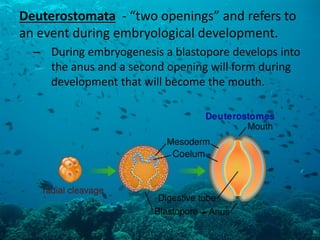
Deuterostomata - “two openings” and refers to an event during embryological development. 
–During embryogenesis a blastopore develops into the anus and a second opening will form during development that will become the mouth.
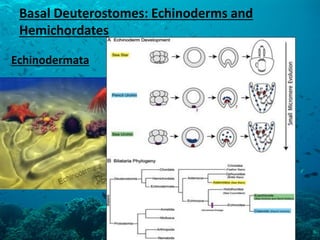
Basal Deuterostomes: Echinoderms and Hemichordates Echinodermata
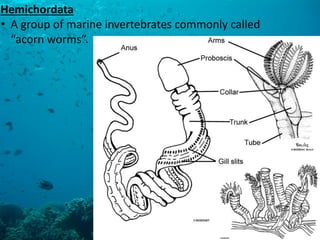
Hemichordata 
•A group of marine invertebrates commonly called “acorn worms”.
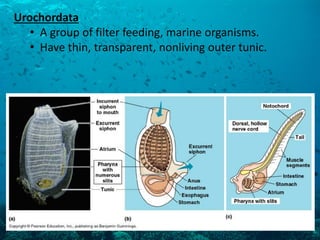
Urochordata 
•A group of filter feeding, marine organisms. 
•Have thin, transparent, nonliving outer tunic.
Three classes of Urochordates 
–Ascidians 
–Larvaceans 
–Thaliaceans 
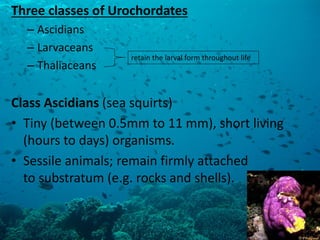
Class Ascidians (sea squirts) 
•Tiny (between 0.5mm to 11 mm), short living (hours to days) organisms. 
•Sessile animals; remain firmly attached to substratum (e.g. rocks and shells). 
retain the larval form throughout life
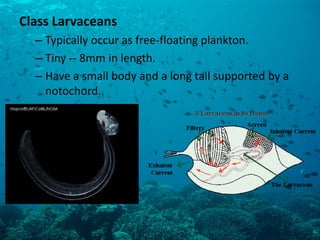
Class Larvaceans 
–Typically occur as free-floating plankton. 
–Tiny -- 8mm in length. 
–Have a small body and a long tail supported by a notochord.
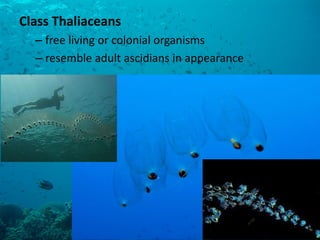
Class Thaliaceans 
–free living or colonial organisms 
–resemble adult ascidians in appearance
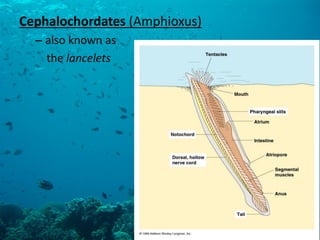
Cephalochordates (Amphioxus) 
–also known as 
the lancelets
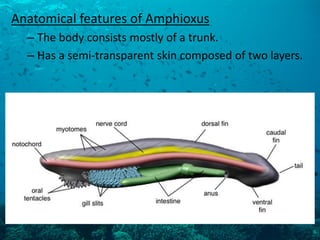
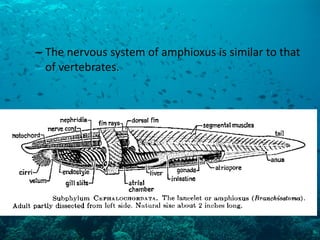
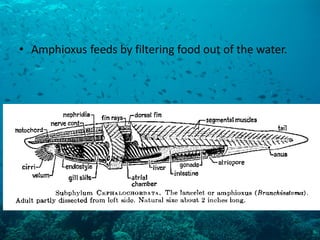
Anatomical features of Amphioxus 
–The body consists mostly of a trunk. 
–Has a semi-transparent skin composed of two layers.
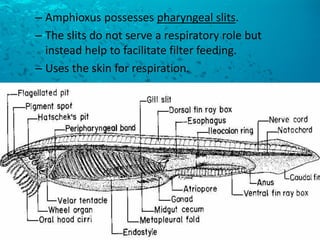
–Amphioxus possesses pharyngeal slits. 
–The slits do not serve a respiratory role but instead help to facilitate filter feeding. 
–Uses the skin for respiration.
–The nervous system of amphioxus is similar to that of vertebrates.
•Amphioxus feeds by filtering food out of the water.
•The coelom is reduced in adult amphioxus.
•Amphioxus circulation differs significantly from that of vertebrates.
•Cephalochordates lack an organized kidney.
•In mature amphioxus, the gonads will be prominent and will bulge into the atrium.
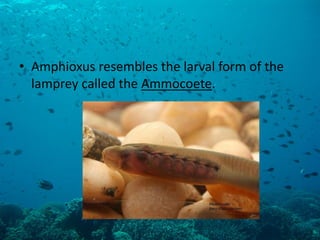
•Amphioxus resembles the larval form of the lamprey called the Ammocoete.
•Like amphioxus ammocoetes have a dorsal, hollow nerve cord and a brain.
•Ammocoete trunks also display myomeres. 
•Both organisms are filter feeders. 
•Ammocoetes have a vascular arrangement that is more reminiscent of vertebrates but, like amphioxus, it lacks a heart. 
•Ammocoetes have a kidney (although it is primitive).

Protochordates