Stella Maris Polytechnic University
Mother Pattern College of Health Sciences
UN Drive
Monrovia, Liberia
Topic: Lophophodata
Course: Invertebrate Zoology 201
Submitted to: Mr. Othello Zomonway
Submitted by: Group 1(0NE)
Date: March 31, 2022
LEARNING OBJECTIVES
 Evolution of Rotifera
 Overview of Phylum Rotifera
 General Characteristics
 Habitat and Habit
 Morphology
 Mode of nutrition and movement
 Reproduction
 Life cycle of Rotifers
 Ecological and economic importance
Objectives of this work
 By the end of this presentation, students will be able to:
 Define and discuss the term rotifera
 Discuss the types of reproduction in these organisms
 Classify rotifera
 Discuss the impacts of these organisms both
 Economically and ecologically
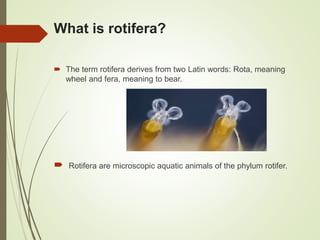
What is rotifera?
 The term rotifera derives from two Latin words: Rota, meaning
wheel and fera, meaning to bear.
 Rotifera are microscopic aquatic animals of the phylum rotifer.
Overview of Rotifers
 Rotifers are multicellular animals with body cavities lined by
mesoderm.
 These organisms have specialized organs systems and a
complete digestive tract that includes both mouth and anus.
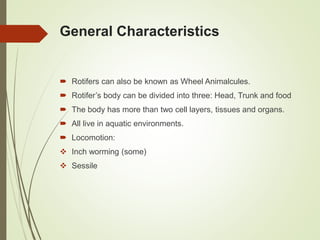
Evolution of Rotifera
 Phylogenetic
 Natural Selection
General Characteristics
 Rotifers can also be known as Wheel Animalcules.
 Rotifer’s body can be divided into three: Head, Trunk and food
 The body has more than two cell layers, tissues and organs.
 All live in aquatic environments.
 Locomotion:
 Inch worming (some)
 Sessile
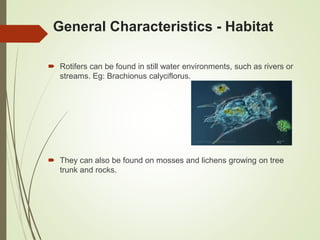
General Characteristics - Habitat
 Rotifers can be found in still water environments, such as rivers or
streams. Eg: Brachionus calyciflorus.
 They can also be found on mosses and lichens growing on tree
trunk and rocks.
General Morphology
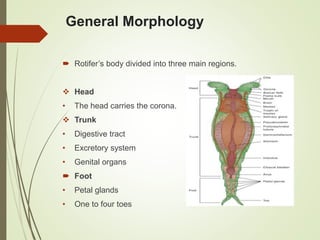
 Rotifer’s body divided into three main regions.
 Head
• The head carries the corona.
 Trunk
• Digestive tract
• Excretory system
• Genital organs
 Foot
• Petal glands
• One to four toes
Nervous System
 Bilobed brain dorsal to mastax
 They have sensory structures
 0ne to five photosensitive eyespot maybe on
the head
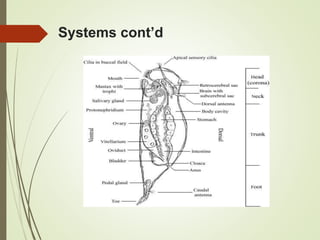
Excretory system
 Flame cells perform excretion
 A short ciliated intestine extends posteriorly and becomes a
cloaca bladder, which receives water from the protonephridia
and eggs from the ovaries as well as digestive wastes.
 The cloaca bladder opens to the outside via an anus.
Muscular System
 Support and Protection
 The cuticle supports the Rotifera as do the muscles
 Pseudocoelom also offers support
 The muscles act as a hydrostatic skeleton
 The muscles also serve to retract the corona in some
species.
Systems cont’d
Mode of Nutrition
 Most rotifers are omnivores and some species are carnivorous.
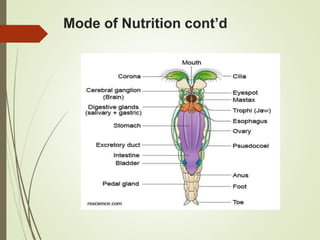
 Their digestive tract : mouth pharynx, oesophagus , stomach
,intestine , cloaca bladder , and digestive gland.
 The whirling water movement produced by beating of the cilia
helps in feeding of rotifer.
 Digestion take place in the stomach and absorption in the
stomach and intestine.
 Rotifer diet includes the following :Bacteria ,Algae , protozoans
and particles eaten are 10 micrometers or less.
Mode of Nutrition cont’d
Locomotion
 Ciliary activity on the corona.
 Most are motile and quite swimmers and
crawlers.
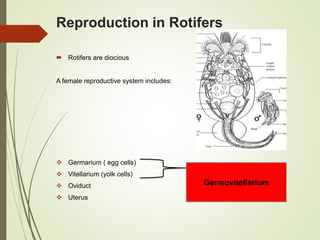
Reproduction in Rotifers
 Rotifers are diocious
A female reproductive system includes:
 Germarium ( egg cells)
 Vitellarium (yolk cells)
 Oviduct
 Uterus
Germovitellarium
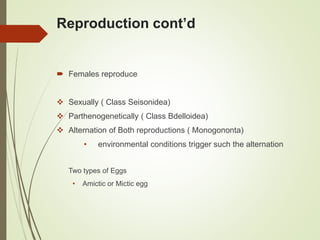
Reproduction cont’d
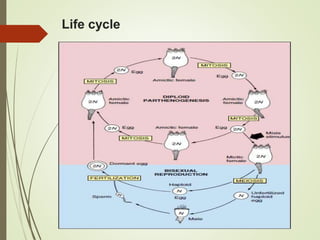
 Females reproduce
 Sexually ( Class Seisonidea)
 Parthenogenetically ( Class Bdelloidea)
 Alternation of Both reproductions ( Monogononta)
• environmental conditions trigger such the alternation
Two types of Eggs
• Amictic or Mictic egg
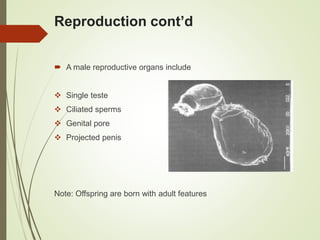
Reproduction cont’d
 A male reproductive organs include
 Single teste
 Ciliated sperms
 Genital pore
 Projected penis
Note: Offspring are born with adult features
Life cycle
Classification of Rotifera
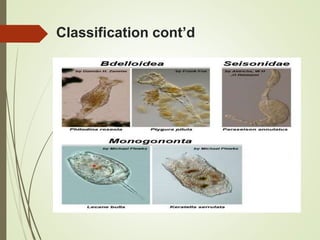
 The phylum Rotifera has been divided into three
main classes:
 Seisonidae e.g. Paraseison annulatus
 Monogononta e.g. Lecane bulla, Keratella
serrulata
 Bdelloidea e.g. Ptygura pilula, Philodina roseola
Classification cont’d
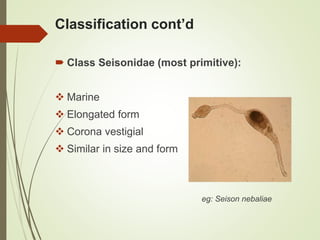
 Class Seisonidae (most primitive):
 Marine
 Elongated form
 Corona vestigial
 Similar in size and form
eg: Seison nebaliae
Classification cont’d
 It has a single genus: Seison
 Epizoic on gills of the crustacean
 Seisonidae: females produce haploid eggs
that must be fertilized and develop into
either males or females.
Classification cont’d
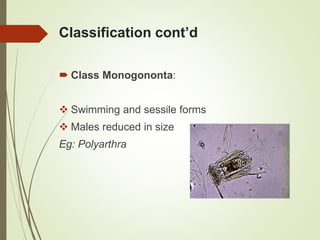
 Class Monogononta:
 Swimming and sessile forms
 Males reduced in size
Eg: Polyarthra
Classification cont’d
 Monogononta: females produce two kinds of
eggs;
 Amictic eggs
 Mictic eggs
Classification cont’d
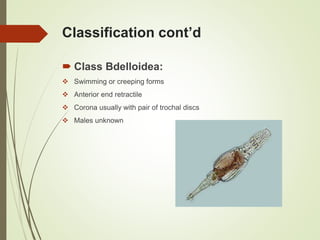
 Class Bdelloidea:
 Swimming or creeping forms
 Anterior end retractile
 Corona usually with pair of trochal discs
 Males unknown
Classification cont’d
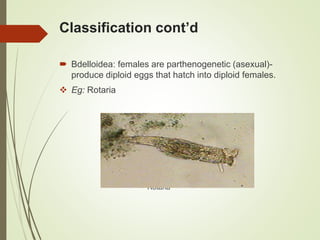
 Bdelloidea: females are parthenogenetic (asexual)-
produce diploid eggs that hatch into diploid females.
 Eg: Rotaria
Rotaria
Rotifer’s Ecology
 Rotifers are cosmopolitan
 Most Rotifers can live on the bottom of
freshwater lakes or ponds, however a few are
marine and some are terrestrial.
 Most Rotifers eat plankton.
 Some Rotifers are parasitic.
 Some Rotifers are epizoic.
Economic Importance
 Rotifers in the wild have little significance to
humans.
 They may have some economic significance,
however, because many species are cultured
as a food source for aquariums and cultured
filter-feeding invertebrates and fish fry.
Economic Importance cont’d
 They also may be used as biological pollution indicators. Eg:
Filinia longiseta, heavy pollution
Ecological Importance
 There are three important roles of Rotifers in society:
 Feed on algae species
 Serve as important species
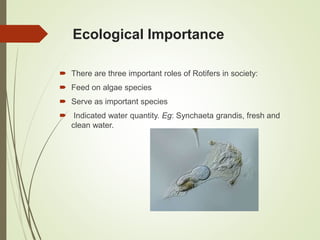
 Indicated water quantity. Eg: Synchaeta grandis, fresh and
clean water.
Rotifera

Rotifera

  • 1.
    Stella Maris PolytechnicUniversity Mother Pattern College of Health Sciences UN Drive Monrovia, Liberia Topic: Lophophodata Course: Invertebrate Zoology 201 Submitted to: Mr. Othello Zomonway Submitted by: Group 1(0NE) Date: March 31, 2022
  • 2.
    LEARNING OBJECTIVES  Evolutionof Rotifera  Overview of Phylum Rotifera  General Characteristics  Habitat and Habit  Morphology  Mode of nutrition and movement  Reproduction  Life cycle of Rotifers  Ecological and economic importance
  • 3.
    Objectives of thiswork  By the end of this presentation, students will be able to:  Define and discuss the term rotifera  Discuss the types of reproduction in these organisms  Classify rotifera  Discuss the impacts of these organisms both  Economically and ecologically
  • 4.
    What is rotifera? The term rotifera derives from two Latin words: Rota, meaning wheel and fera, meaning to bear.  Rotifera are microscopic aquatic animals of the phylum rotifer.
  • 5.
    Overview of Rotifers Rotifers are multicellular animals with body cavities lined by mesoderm.  These organisms have specialized organs systems and a complete digestive tract that includes both mouth and anus.
  • 6.
    Evolution of Rotifera Phylogenetic  Natural Selection
  • 7.
    General Characteristics  Rotiferscan also be known as Wheel Animalcules.  Rotifer’s body can be divided into three: Head, Trunk and food  The body has more than two cell layers, tissues and organs.  All live in aquatic environments.  Locomotion:  Inch worming (some)  Sessile
  • 8.
    General Characteristics -Habitat  Rotifers can be found in still water environments, such as rivers or streams. Eg: Brachionus calyciflorus.  They can also be found on mosses and lichens growing on tree trunk and rocks.
  • 9.
    General Morphology  Rotifer’sbody divided into three main regions.  Head • The head carries the corona.  Trunk • Digestive tract • Excretory system • Genital organs  Foot • Petal glands • One to four toes
  • 10.
    Nervous System  Bilobedbrain dorsal to mastax  They have sensory structures  0ne to five photosensitive eyespot maybe on the head
  • 11.
    Excretory system  Flamecells perform excretion  A short ciliated intestine extends posteriorly and becomes a cloaca bladder, which receives water from the protonephridia and eggs from the ovaries as well as digestive wastes.  The cloaca bladder opens to the outside via an anus.
  • 12.
    Muscular System  Supportand Protection  The cuticle supports the Rotifera as do the muscles  Pseudocoelom also offers support  The muscles act as a hydrostatic skeleton  The muscles also serve to retract the corona in some species.
  • 13.
  • 14.
    Mode of Nutrition Most rotifers are omnivores and some species are carnivorous.  Their digestive tract : mouth pharynx, oesophagus , stomach ,intestine , cloaca bladder , and digestive gland.  The whirling water movement produced by beating of the cilia helps in feeding of rotifer.  Digestion take place in the stomach and absorption in the stomach and intestine.  Rotifer diet includes the following :Bacteria ,Algae , protozoans and particles eaten are 10 micrometers or less.
  • 15.
  • 16.
    Locomotion  Ciliary activityon the corona.  Most are motile and quite swimmers and crawlers.
  • 17.
    Reproduction in Rotifers Rotifers are diocious A female reproductive system includes:  Germarium ( egg cells)  Vitellarium (yolk cells)  Oviduct  Uterus Germovitellarium
  • 18.
    Reproduction cont’d  Femalesreproduce  Sexually ( Class Seisonidea)  Parthenogenetically ( Class Bdelloidea)  Alternation of Both reproductions ( Monogononta) • environmental conditions trigger such the alternation Two types of Eggs • Amictic or Mictic egg
  • 19.
    Reproduction cont’d  Amale reproductive organs include  Single teste  Ciliated sperms  Genital pore  Projected penis Note: Offspring are born with adult features
  • 20.
  • 21.
    Classification of Rotifera The phylum Rotifera has been divided into three main classes:  Seisonidae e.g. Paraseison annulatus  Monogononta e.g. Lecane bulla, Keratella serrulata  Bdelloidea e.g. Ptygura pilula, Philodina roseola
  • 22.
  • 23.
    Classification cont’d  ClassSeisonidae (most primitive):  Marine  Elongated form  Corona vestigial  Similar in size and form eg: Seison nebaliae
  • 24.
    Classification cont’d  Ithas a single genus: Seison  Epizoic on gills of the crustacean  Seisonidae: females produce haploid eggs that must be fertilized and develop into either males or females.
  • 25.
    Classification cont’d  ClassMonogononta:  Swimming and sessile forms  Males reduced in size Eg: Polyarthra
  • 26.
    Classification cont’d  Monogononta:females produce two kinds of eggs;  Amictic eggs  Mictic eggs
  • 27.
    Classification cont’d  ClassBdelloidea:  Swimming or creeping forms  Anterior end retractile  Corona usually with pair of trochal discs  Males unknown
  • 28.
    Classification cont’d  Bdelloidea:females are parthenogenetic (asexual)- produce diploid eggs that hatch into diploid females.  Eg: Rotaria Rotaria
  • 29.
    Rotifer’s Ecology  Rotifersare cosmopolitan  Most Rotifers can live on the bottom of freshwater lakes or ponds, however a few are marine and some are terrestrial.  Most Rotifers eat plankton.  Some Rotifers are parasitic.  Some Rotifers are epizoic.
  • 30.
    Economic Importance  Rotifersin the wild have little significance to humans.  They may have some economic significance, however, because many species are cultured as a food source for aquariums and cultured filter-feeding invertebrates and fish fry.
  • 31.
    Economic Importance cont’d They also may be used as biological pollution indicators. Eg: Filinia longiseta, heavy pollution
  • 32.
    Ecological Importance  Thereare three important roles of Rotifers in society:  Feed on algae species  Serve as important species  Indicated water quantity. Eg: Synchaeta grandis, fresh and clean water.