WEEK 6-7: PHYLUMCHORDATA: INTRODUCTION
Derived from the Latin word chorda,
meaning “cord”, “string”.
They can be aquatic, terrestrial,
amphibious, and aerial.
They are bilaterally symmetric.
They are also triplobastic.
They have a true body cavity
(eucoelomatic).
4.
WEEK 6-7: PHYLUMCHORDATA: INTRODUCTION
They primarily reproduces sexually, with
fertilization being either external or internal.
Some tunicates can reproduce asexually through
budding.
Development varies:
o oviparous
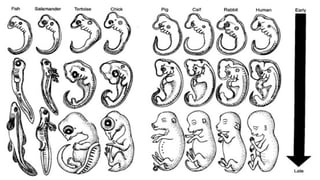
o ovoviviparous
o viviparous
5.
WEEK 6-7: PHYLUMCHORDATA: INTRODUCTION
And like echinoderms, chordates are
deuterostome.
They also have a complete digestive
system.
They also have cephalization.
They have a closed circulatory system.
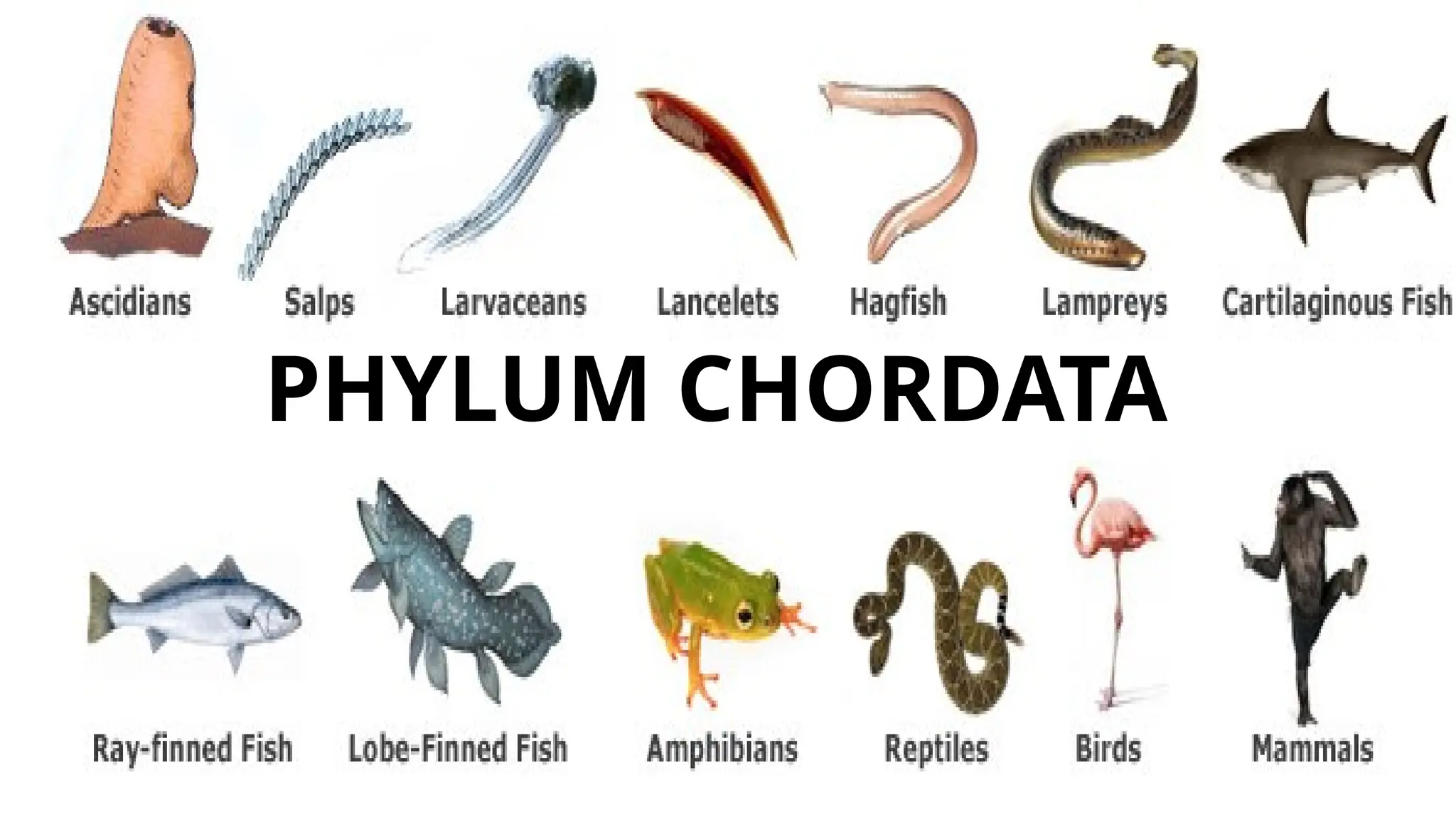
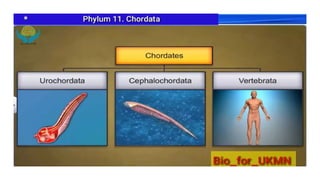
They are classified into three subphyla:
oUrochordata (tunicates)
oCephalochordata (lancelets)
oVertebrata (vertebrates).
WEEK 6-7: PHYLUMCHORDATA: CHARACTERISTICS
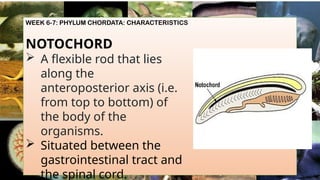
NOTOCHORD
A flexible rod that lies
along the
anteroposterior axis (i.e.
from top to bottom) of
the body of the
organisms.
Situated between the
gastrointestinal tract and
the spinal cord.
9.
WEEK 6-7: PHYLUMCHORDATA: CHARACTERISTICS
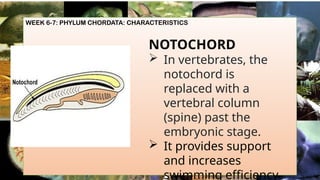
NOTOCHORD
In vertebrates, the
notochord is
replaced with a
vertebral column
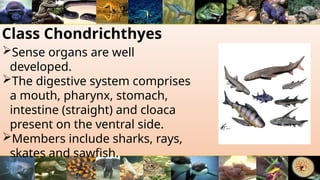
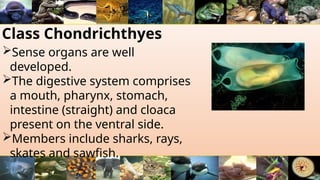
(spine) past the
embryonic stage.
It provides support
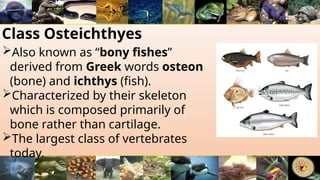
and increases
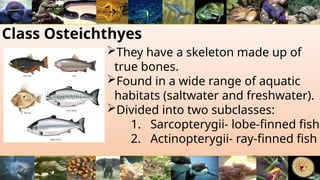
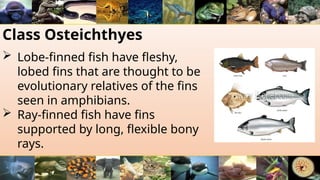
swimming efficiency
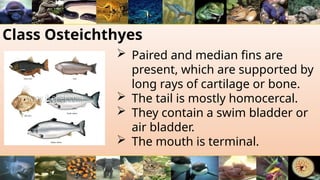
10.
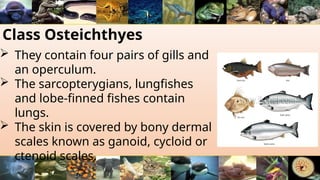
WEEK 6-7: PHYLUMCHORDATA: CHARACTERISTICS
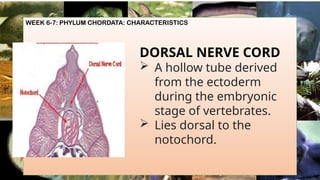
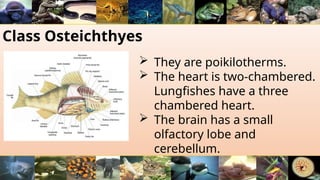
DORSAL NERVE CORD
A hollow tube derived
from the ectoderm
during the embryonic
stage of vertebrates.
Lies dorsal to the
notochord.
11.
WEEK 6-7: PHYLUMCHORDATA: CHARACTERISTICS
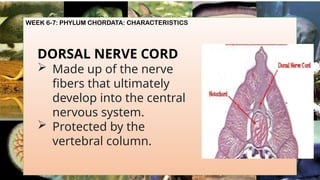
DORSAL NERVE CORD
Made up of the nerve
fibers that ultimately
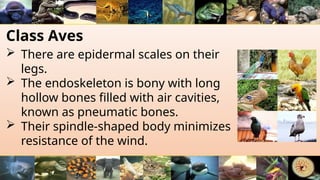
develop into the central
nervous system.
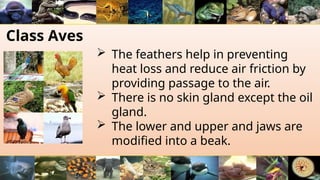
Protected by the
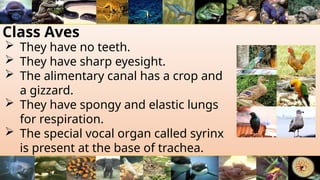
vertebral column.
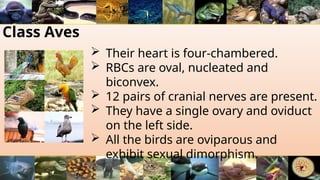
12.
WEEK 6-7: PHYLUMCHORDATA: CHARACTERISTICS
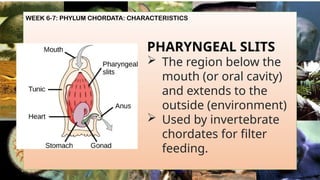
PHARYNGEAL SLITS
The region below the
mouth (or oral cavity)
and extends to the
outside (environment)
Used by invertebrate
chordates for filter
feeding.
13.
WEEK 6-7: PHYLUMCHORDATA: CHARACTERISTICS
PHARYNGEAL SLITS
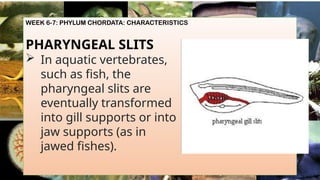
In aquatic vertebrates,
such as fish, the
pharyngeal slits are
eventually transformed
into gill supports or into
jaw supports (as in
jawed fishes).
14.
WEEK 6-7: PHYLUMCHORDATA: CHARACTERISTICS
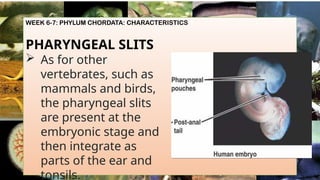
PHARYNGEAL SLITS
As for other
vertebrates, such as
mammals and birds,
the pharyngeal slits
are present at the
embryonic stage and
then integrate as
parts of the ear and
tonsils.
15.
WEEK 6-7: PHYLUMCHORDATA: CHARACTERISTICS
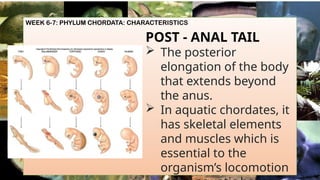
POST - ANAL TAIL
The posterior
elongation of the body
that extends beyond
the anus.
In aquatic chordates, it
has skeletal elements
and muscles which is
essential to the
organism’s locomotion
16.
WEEK 6-7: PHYLUMCHORDATA: CHARACTERISTICS
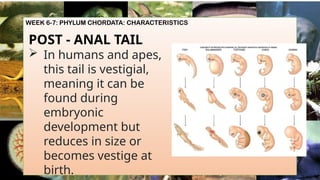
POST - ANAL TAIL
In humans and apes,
this tail is vestigial,
meaning it can be
found during
embryonic
development but
reduces in size or
becomes vestige at
birth.
17.
WEEK 6-7: PHYLUMCHORDATA: KEY POINTS
The notochord provides skeletal support, gives the
phylum its name, and develops into the vertebral
column in vertebrates.
The dorsal hollow nerve cord develops into the
central nervous system: the brain and spine.
Pharyngeal slits are openings in the pharynx that
develop into gill arches in bony fish and into the
jaw and inner ear in terrestrial animals.
The post-anal tail is a skeletal extension of the
posterior end of the body, being absent in humans
and apes, although present during embryonic
Let’s start atthe very beginning . . .
• Phylum Chordata is divided into three
subphyla:
-Subphylum Urochordata
-Subphylum Cephalochordata
-Subphylum Vertebrata
20.
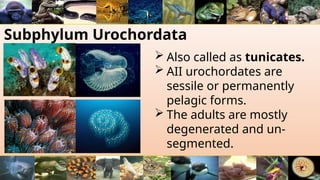
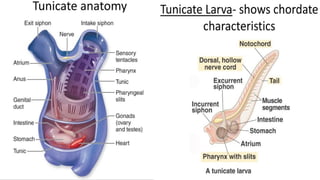
Subphylum Urochordata
Alsocalled as tunicates.
AII urochordates are
sessile or permanently
pelagic forms.
The adults are mostly
degenerated and un-
segmented.
21.
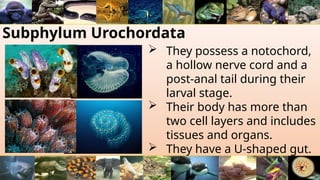
Subphylum Urochordata
Theypossess a notochord,
a hollow nerve cord and a
post-anal tail during their
larval stage.
Their body has more than
two cell layers and includes
tissues and organs.
They have a U-shaped gut.
22.
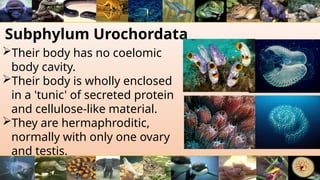
Subphylum Urochordata
Their bodyhas no coelomic
body cavity.
Their body is wholly enclosed
in a 'tunic' of secreted protein
and cellulose-like material.
They are hermaphroditic,
normally with only one ovary
and testis.
23.
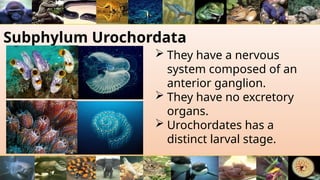
Subphylum Urochordata
Theyhave a nervous
system composed of an
anterior ganglion.
They have no excretory
organs.
Urochordates has a
distinct larval stage.
24.
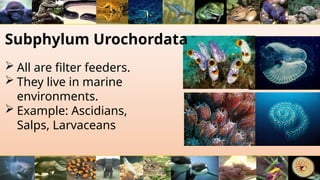
Subphylum Urochordata
Allare filter feeders.
They live in marine
environments.
Example: Ascidians,
Salps, Larvaceans
25.
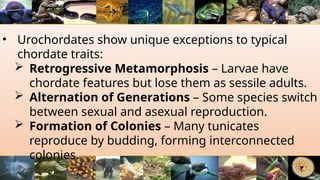
• Urochordates showunique exceptions to typical
chordate traits:
Retrogressive Metamorphosis – Larvae have
chordate features but lose them as sessile adults.
Alternation of Generations – Some species switch
between sexual and asexual reproduction.
Formation of Colonies – Many tunicates
reproduce by budding, forming interconnected
colonies.
27.
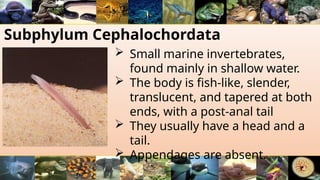
Subphylum Cephalochordata
Smallmarine invertebrates,
found mainly in shallow water.
The body is fish-like, slender,
translucent, and tapered at both
ends, with a post-anal tail
They usually have a head and a
tail.
Appendages are absent.
28.
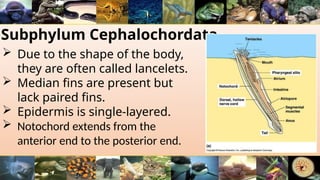
Subphylum Cephalochordata
Dueto the shape of the body,
they are often called lancelets.
Median fins are present but
lack paired fins.
Epidermis is single-layered.
Notochord extends from the
anterior end to the posterior end.
29.
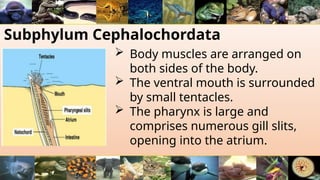
Subphylum Cephalochordata
Bodymuscles are arranged on
both sides of the body.
The ventral mouth is surrounded
by small tentacles.
The pharynx is large and
comprises numerous gill slits,
opening into the atrium.
30.
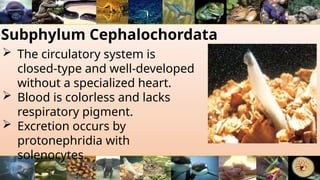
Subphylum Cephalochordata
Thecirculatory system is
closed-type and well-developed
without a specialized heart.
Blood is colorless and lacks
respiratory pigment.
Excretion occurs by
protonephridia with
solenocytes.
31.
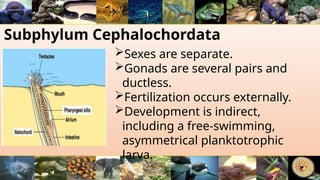
Subphylum Cephalochordata
Sexes areseparate.
Gonads are several pairs and
ductless.
Fertilization occurs externally.
Development is indirect,
including a free-swimming,
asymmetrical planktotrophic
larva.
RECALL:
What are thecharacteristics of
Subphylum Urochordata?
How about Subphylum
Cephalochordata?
How are they different from each
other?
34.
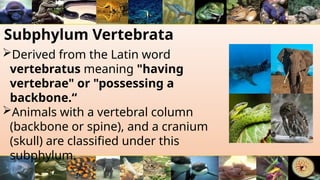
Subphylum Vertebrata
Derived fromthe Latin word
vertebratus meaning "having
vertebrae" or "possessing a
backbone.“
Animals with a vertebral column
(backbone or spine), and a cranium
(skull) are classified under this
subphylum.
35.
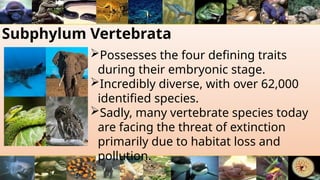
Subphylum Vertebrata
Possesses thefour defining traits
during their embryonic stage.
Incredibly diverse, with over 62,000
identified species.
Sadly, many vertebrate species today
are facing the threat of extinction
primarily due to habitat loss and
pollution.
36.
Subphylum Vertebrata
A vertebrateis an animal that has all of
the following characteristic features at
some point in its life:
- A stiff rod running through the
length of the animal
- A bundle of nerves run above the
vertebral column the alimentary canal
exists below it.
37.
Subphylum Vertebrata
A vertebrateis an animal that has all of
the following characteristic features at
some point in its life:
- The mouth is present at the anterior
portion of the animals or right below it.
- The alimentary canal ends in the anus,
which opens to the exterior.
- The tail extends after the anus.
38.
Subphylum Vertebrata
Vertebrates reproducesexually, and
almost all of them have separate male
and female sexes.
Generally, aquatic species have external
fertilization, whereas terrestrial species
have internal fertilization.
39.
Subphylum Vertebrata
Three reproductivestages:
Ovipary – development of an embryo outside
the mother’s body
Ovovivipary – development of an embryo inside
the mother’s body until it hatches
Vivipary – development and nourishment of an
embryo within the mother’s body
40.
SEVEN CLASSIFICATIONS OFVERTEBRATA
1. Class Mammalia
(Mammals)
2. Class Aves (Birds)
3. Class Reptilia
(Reptiles)
4. Class Amphibia
(Amphibians)
5. Class Osteichthyes
(Bony Fishes)
6. Class Chondrichthyes
(Cartilaginous Fishes)
7. Class Agnatha (Jawless
Fishes)
41.
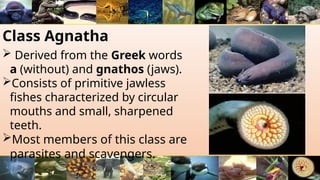
Class Agnatha
Derivedfrom the Greek words
a (without) and gnathos (jaws).
Consists of primitive jawless
fishes characterized by circular
mouths and small, sharpened
teeth.
Most members of this class are
parasites and scavengers.
42.
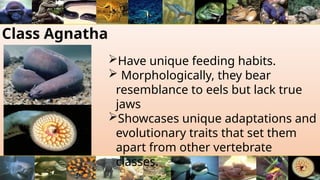
Class Agnatha
Have uniquefeeding habits.
Morphologically, they bear
resemblance to eels but lack true
jaws
Showcases unique adaptations and
evolutionary traits that set them
apart from other vertebrate
classes.
43.
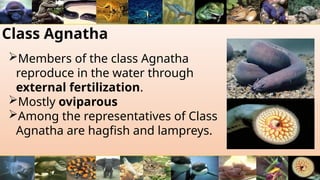
Class Agnatha
Members ofthe class Agnatha
reproduce in the water through
external fertilization.
Mostly oviparous
Among the representatives of Class
Agnatha are hagfish and lampreys.
44.
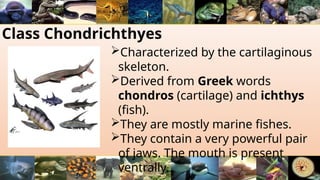
Class Chondrichthyes
Characterized bythe cartilaginous
skeleton.
Derived from Greek words
chondros (cartilage) and ichthys
(fish).
They are mostly marine fishes.
They contain a very powerful pair
of jaws. The mouth is present
ventrally.
45.
Class Chondrichthyes
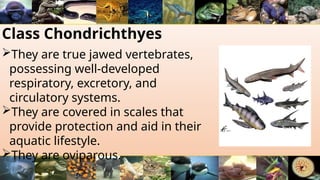
They aretrue jawed vertebrates,
possessing well-developed
respiratory, excretory, and
circulatory systems.
They are covered in scales that
provide protection and aid in their
aquatic lifestyle.
They are oviparous.
46.
Class Chondrichthyes
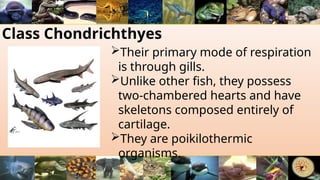
Their primarymode of respiration
is through gills.
Unlike other fish, they possess
two-chambered hearts and have
skeletons composed entirely of
cartilage.
They are poikilothermic
organisms.
47.
Class Chondrichthyes
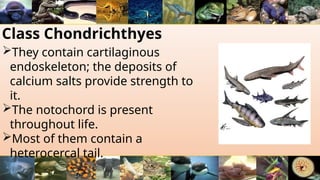
They containcartilaginous
endoskeleton; the deposits of
calcium salts provide strength to
it.
The notochord is present
throughout life.
Most of them contain a
heterocercal tail.
48.
Class Chondrichthyes
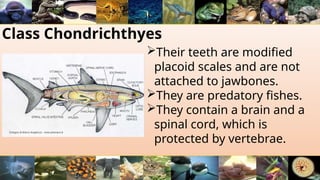
Their teethare modified
placoid scales and are not
attached to jawbones.
They are predatory fishes.
They contain a brain and a
spinal cord, which is
protected by vertebrae.
49.
Class Chondrichthyes
Sense organsare well
developed.
The digestive system comprises
a mouth, pharynx, stomach,
intestine (straight) and cloaca
present on the ventral side.
Members include sharks, rays,
skates and sawfish.
50.
Class Chondrichthyes
Sense organsare well
developed.
The digestive system comprises
a mouth, pharynx, stomach,
intestine (straight) and cloaca
present on the ventral side.
Members include sharks, rays,
skates and sawfish.
51.
Class Osteichthyes
Also knownas “bony fishes”
derived from Greek words osteon
(bone) and ichthys (fish).
Characterized by their skeleton
which is composed primarily of
bone rather than cartilage.
The largest class of vertebrates
today.
52.
Class Osteichthyes
They havea skeleton made up of
true bones.
Found in a wide range of aquatic
habitats (saltwater and freshwater).
Divided into two subclasses:
1. Sarcopterygii- lobe-finned fish
2. Actinopterygii- ray-finned fish
53.
Class Osteichthyes
Lobe-finnedfish have fleshy,
lobed fins that are thought to be
evolutionary relatives of the fins
seen in amphibians.
Ray-finned fish have fins
supported by long, flexible bony
rays.
54.
Class Osteichthyes
Pairedand median fins are
present, which are supported by
long rays of cartilage or bone.
The tail is mostly homocercal.
They contain a swim bladder or
air bladder.
The mouth is terminal.
55.
Class Osteichthyes
Theycontain four pairs of gills and
an operculum.
The sarcopterygians, lungfishes
and lobe-finned fishes contain
lungs.
The skin is covered by bony dermal
scales known as ganoid, cycloid or
ctenoid scales.
56.
Class Osteichthyes
Theyare poikilotherms.
The heart is two-chambered.
Lungfishes have a three
chambered heart.
The brain has a small
olfactory lobe and
cerebellum.
57.
Class Osteichthyes
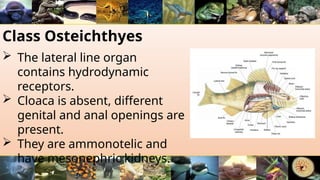
Thelateral line organ
contains hydrodynamic
receptors.
Cloaca is absent, different
genital and anal openings are
present.
They are ammonotelic and
have mesonephric kidneys.
58.
Class Osteichthyes
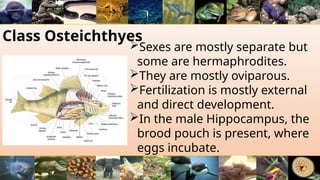
Sexes aremostly separate but
some are hermaphrodites.
They are mostly oviparous.
Fertilization is mostly external
and direct development.
In the male Hippocampus, the
brood pouch is present, where
eggs incubate.
59.
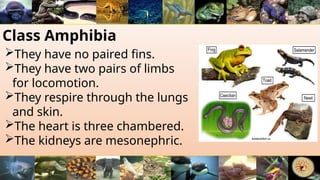
Class Amphibia
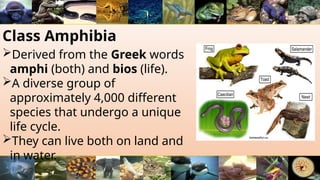
Derived fromthe Greek words
amphi (both) and bios (life).
A diverse group of
approximately 4,000 different
species that undergo a unique
life cycle.
They can live both on land and
in water.
60.
Class Amphibia
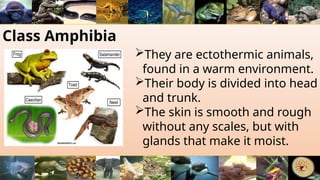
They areectothermic animals,
found in a warm environment.
Their body is divided into head
and trunk.
The skin is smooth and rough
without any scales, but with
glands that make it moist.
61.
Class Amphibia
They haveno paired fins.
They have two pairs of limbs
for locomotion.
They respire through the lungs
and skin.
The heart is three chambered.
The kidneys are mesonephric.
62.
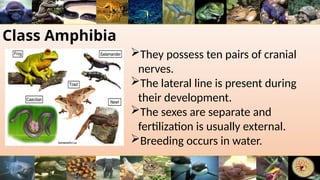
Class Amphibia
They possessten pairs of cranial
nerves.
The lateral line is present during
their development.
The sexes are separate and
fertilization is usually external.
Breeding occurs in water.
63.
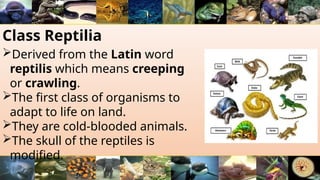
Class Reptilia
Derived fromthe Latin word
reptilis which means creeping
or crawling.
The first class of organisms to
adapt to life on land.
They are cold-blooded animals.
The skull of the reptiles is
modified.
64.
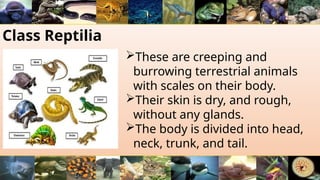
Class Reptilia
These arecreeping and
burrowing terrestrial animals
with scales on their body.
Their skin is dry, and rough,
without any glands.
The body is divided into head,
neck, trunk, and tail.
65.
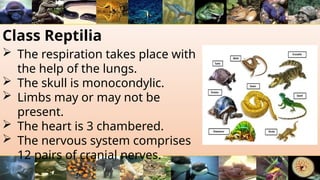
Class Reptilia
Therespiration takes place with
the help of the lungs.
The skull is monocondylic.
Limbs may or may not be
present.
The heart is 3 chambered.
The nervous system comprises
12 pairs of cranial nerves.
66.
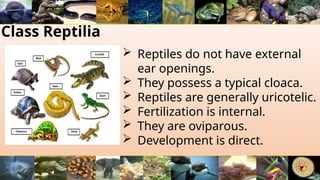
Class Reptilia
Reptilesdo not have external
ear openings.
They possess a typical cloaca.
Reptiles are generally uricotelic.
Fertilization is internal.
They are oviparous.
Development is direct.
67.
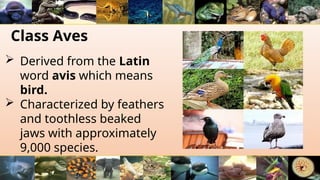
Class Aves
Derivedfrom the Latin
word avis which means
bird.
Characterized by feathers
and toothless beaked
jaws with approximately
9,000 species.
68.
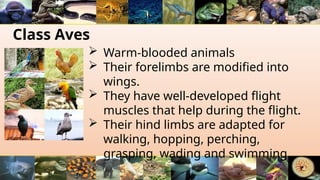
Class Aves
Warm-bloodedanimals
Their forelimbs are modified into
wings.
They have well-developed flight
muscles that help during the flight.
Their hind limbs are adapted for
walking, hopping, perching,
grasping, wading and swimming.
69.
Class Aves
Thereare epidermal scales on their
legs.
The endoskeleton is bony with long
hollow bones filled with air cavities,
known as pneumatic bones.
Their spindle-shaped body minimizes
resistance of the wind.
70.
Class Aves
Thefeathers help in preventing
heat loss and reduce air friction by
providing passage to the air.
There is no skin gland except the oil
gland.
The lower and upper and jaws are
modified into a beak.
71.
Class Aves
Theyhave no teeth.
They have sharp eyesight.
The alimentary canal has a crop and
a gizzard.
They have spongy and elastic lungs
for respiration.
The special vocal organ called syrinx
is present at the base of trachea.
72.
Class Aves
Theirheart is four-chambered.
RBCs are oval, nucleated and
biconvex.
12 pairs of cranial nerves are present.
They have a single ovary and oviduct
on the left side.
All the birds are oviparous and
exhibit sexual dimorphism.
75.
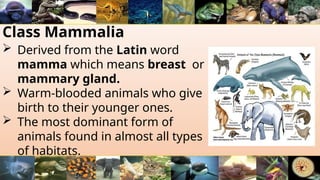
Class Mammalia
Derivedfrom the Latin word
mamma which means breast or
mammary gland.
Warm-blooded animals who give
birth to their younger ones.
The most dominant form of
animals found in almost all types
of habitats.
76.
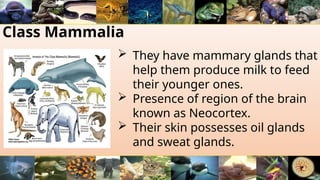
Class Mammalia
Theyhave mammary glands that
help them produce milk to feed
their younger ones.
Presence of region of the brain
known as Neocortex.
Their skin possesses oil glands
and sweat glands.
77.
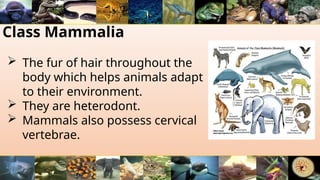
Class Mammalia
Thefur of hair throughout the
body which helps animals adapt
to their environment.
They are heterodont.
Mammals also possess cervical
vertebrae.
78.
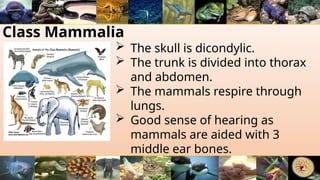
Class Mammalia
Theskull is dicondylic.
The trunk is divided into thorax
and abdomen.
The mammals respire through
lungs.
Good sense of hearing as
mammals are aided with 3
middle ear bones.
79.
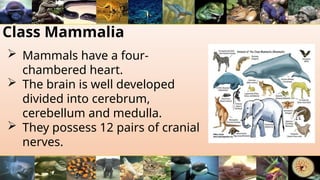
Class Mammalia
Mammalshave a four-
chambered heart.
The brain is well developed
divided into cerebrum,
cerebellum and medulla.
They possess 12 pairs of cranial
nerves.
80.
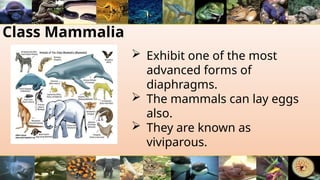
Class Mammalia
Exhibitone of the most
advanced forms of
diaphragms.
The mammals can lay eggs
also.
They are known as
viviparous.
In vertebrates, theheart structure varies. Which
class is correctly matched with its heart
chambers?
Fish – Three-chambered heart
Amphibians – Four-chambered heart
Birds – Four-chambered heart
Reptiles – Two-chambered heart
88.
What is themain function of the notochord in
chordates?
Aids in digestion
Provides skeletal support
Produces red blood cells
Helps in respiration
89.
Which reproductive strategyinvolves the
development of an embryo inside the mother’s
body and with direct nourishment and care from
her?
Ovipary
Ovovivipary
Vivipary
Asexual reproduction
90.
Which vertebrate classincludes organisms with a
two-chambered heart and gills for respiration?
Amphibia
Mammalia
Reptilia
Osteichthyes
91.
Which class ofvertebrates is known for having
lightweight skeleton and the ability to fly?
Mammalia
Reptilia
Aves
Amphibia
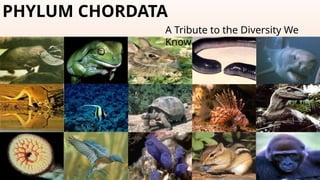
#3 Phylum Chordata inhabits diverse environments: aquatic (fish, whales), terrestrial (mammals, reptiles), amphibious (frogs, salamanders), and aerial (birds, bats). They adapt to oceans, forests, deserts, and polar regions.
Chordates are triploblastic because their embryos develop from three germ layers:
Ectoderm – Forms the skin, nervous system, and sense organs.
Mesoderm – Develops into muscles, bones, the circulatory system, and internal organs.
Endoderm – Forms the digestive tract, liver, pancreas, and respiratory system.
This triploblastic structure allows for the development of complex organs and body systems, making chordates more advanced than diploblastic animals (which have only two germ layers).
#4 external (in fish and amphibians)
internal (in reptiles, birds, and mammals).
oviparous (egg-laying),
ovoviviparous (eggs hatch inside the body), and
viviparous (live birth in mammals).
#5 As unlikely as it seems, based on embryological evidence, the echinoderms appear to be the most likely ancestors to the early chordates.
Primitive stemmed echinoderms are thought to have shifted from arm-feeding to filter-feeding acquiring a body plan similar to urochordates.
Deuterostome - an animal whose embryonic development follows a specific pattern where the anus forms before the mouth. This group includes echinoderms (like starfish) and chordates (like humans). It contrasts with protostomes, where the mouth forms first.
Protostome animals include:
Arthropods (e.g., insects, spiders, crabs)
Mollusks (e.g., snails, clams, octopuses)
Annelids (e.g., earthworms, leeches)
Nematodes (e.g., roundworms)
Platyhelminthes (e.g., flatworms)
Deuterostomes include:
Echinoderms (e.g., starfish, sea urchins, sea cucumbers)
Chordates (e.g., fish, amphibians, reptiles, birds, mammals, including humans)
Hemichordates (e.g., acorn worms)
A complete digestive system in chordates means they have a one-way digestive tract with a distinct mouth and anus. This allows for efficient digestion, absorption, and waste elimination. Food moves in a single direction, passing through specialized organs like the esophagus, stomach, intestines, and anus for better nutrient processing.
Cephalization - the concentration of nerve tissue and sensory organs at the front (head) of an organism, allowing better coordination and response to stimuli. It is common in bilaterally symmetrical animals.
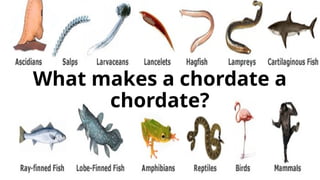
#6 Do you have any idea what makes a chordate a chordate?
Okay, very good!
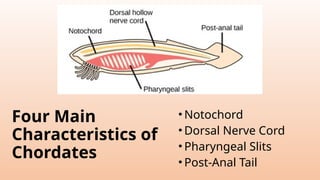
So, there are four structural characteristics set chordates apart from all other phyla.
#7 These attributes are always found in the larval forms or early embryo (although they may be absent in the adult) of every chordates..
Let’s tackle them one-by-one. First, we’ll talk about…
#8 These are flexible, rod-shaped mesodermal structures in all chordate embryos and the adult stages of some chordate species. It is situated between the gastrointestinal tract and the spinal cord, which offers flexible axial muscle attachment as well as stiff skeletal support..
The notochord is mainly composed of fibrous connective tissues.
For those animals in which it persists into the adult form, the notochord provides support (it acts like our backbone) and increases swimming efficiency.
In animals like ourselves, bony strictures called vertebrae develop near the notochord and eventually replace it during embryogenesis
The notochord lies in between the nerve code and the digestive tube. It is primarily involved in signaling and, in vertebrates, it also has a key role in coordinating growth and development. In particular, the vertebrate notochord induces neural tube development. The developmental process is referred to as notogenesis.
#9 primarily involved in signaling and, in vertebrates, it also has a key role in coordinating growth and development.
During the embryonic development of vertebrates, the notochord appears, which promotes the growth of neural tubes and acts as a support for the growing embryo
The notochord is, in fact, where the chordates derived their name. This flexible and rod-shaped structure may appear at some stage during chordate development or may persist through adulthood. The chordates that have a notochord persisting in their entire lifetime use it as skeletal support.
#10 The source of the dorsal hollow nerve cord is the ectoderm which develops into a hollow tube. It is situated dorsally to the notochord in chordates. Contrarily, the neurological system of protostome animal phyla is distinguished by solid nerve cords either ventrally or lateral to the gut. The brain and spinal cord, which make up the central nervous system in vertebrates, rise from the neural tube.
The dorsal hollow nerve cord is a hollow tube derived from the ectoderm during the embryonic stage of vertebrates.
It lies dorsal to the notochord. Thus, it may be seen at the top of the notochord in chordates.
This tube is made up of the nerve fibers that ultimately develop into the central nervous system where the brain and the spinal cord are the main constituents. The dorsal hollow nerve cord is protected by the vertebral column.
#11 Contrarily, the neurological system of protostome animal phyla is distinguished by solid nerve cords either ventrally or lateral to the gut.
The brain and spinal cord, which make up the central nervous system in vertebrates, rise from the neural tube.
Where the brain and the spinal cord are the main constituents.
The nerve cord, though, is not an exclusive feature of chordates. It is also present in other animal phyla. In other animals, it is located either ventral or laterally as opposed to that of chordates that lie dorsal to the notochord.
#12 The openings in the pharynx, i.e. the region below the mouth (or oral cavity) and extends to the outside (environment) are called the pharyngeal slits. These slits are used by invertebrate chordates for filter feeding. Water enters into the mouth, filtering food particles as the water exits through the pharyngeal slits. In aquatic vertebrates, such as fish, the pharyngeal slits are eventually transformed into gill supports or into jaw supports (as in jawed fishes). As for other vertebrates, such as mammals and birds, the pharyngeal slits are present at the embryonic stage and then integrate as parts of the ear and tonsils.
The pharynx, or the area right behind the mouth, has openings called pharyngeal slits that reach out into the surrounding space. They allow water sucked into the mouth while feeding to be expelled in aquatic species. The pharyngeal slits are adapted into gill supports in fish with vertebrates and jaw supports in fish with jaws. These slits in tetrapods have undergone significant modification to become parts of the ear, thymus glands, and tonsils.
#13 The openings in the pharynx, i.e. the region below the mouth (or oral cavity) and extends to the outside (environment) are called the pharyngeal slits. These slits are used by invertebrate chordates for filter feeding. Water enters into the mouth, filtering food particles as the water exits through the pharyngeal slits. In aquatic vertebrates, such as fish, the pharyngeal slits are eventually transformed into gill supports or into jaw supports (as in jawed fishes). As for other vertebrates, such as mammals and birds, the pharyngeal slits are present at the embryonic stage and then integrate as parts of the ear and tonsils.
The pharynx, or the area right behind the mouth, has openings called pharyngeal slits that reach out into the surrounding space. They allow water sucked into the mouth while feeding to be expelled in aquatic species. The pharyngeal slits are adapted into gill supports in fish with vertebrates and jaw supports in fish with jaws. These slits in tetrapods have undergone significant modification to become parts of the ear, thymus glands, and tonsils.
#14 The openings in the pharynx, i.e. the region below the mouth (or oral cavity) and extends to the outside (environment) are called the pharyngeal slits. These slits are used by invertebrate chordates for filter feeding. Water enters into the mouth, filtering food particles as the water exits through the pharyngeal slits. In aquatic vertebrates, such as fish, the pharyngeal slits are eventually transformed into gill supports or into jaw supports (as in jawed fishes). As for other vertebrates, such as mammals and birds, the pharyngeal slits are present at the embryonic stage and then integrate as parts of the ear and tonsils.
The pharynx, or the area right behind the mouth, has openings called pharyngeal slits that reach out into the surrounding space. They allow water sucked into the mouth while feeding to be expelled in aquatic species. The pharyngeal slits are adapted into gill supports in fish with vertebrates and jaw supports in fish with jaws. These slits in tetrapods have undergone significant modification to become parts of the ear, thymus glands, and tonsils.
#15 A posterior extension of the body that extends past the anus is known as the post-anal tail. The tails serve as a source of propulsion in aquatic species like fish. Locomotion, by definition, refers to the capacity of an organism to move from one place to another. Running, swimming, jumping, flying, and hopping are some of the examples of locomotion seen in animals.
#16 In terrestrial chordates, the tail is used for balance and signaling. The tail aids balance, courtship, and warning of impending danger in several terrestrial species. In humans, the post-anal tail has been reduced to a vestigial coccyx that aids in sitting balance.
#17 These characteristics are only present during embryonic development in some chordates.
#20 Sessile - Permanently attached or fixed, not free-moving
Pelagic – refers to organisms and ecosystems that are associated with the open ocean / inhabiting the open sea and returning to the shore only to breed.
Blood vascular system is open. Heart is simple, tubular and ventral, enclosed in a pericardial cavity. The heart is unusual because it periodically reverses the direction in which it pumps blood. Blood contains cells but not erythrocytes.
#21 The notochord is confined to the tail region in the larval stage. For this characteristic feature, the name of the group is given Urochordata. Other features — a dorsal hollow nerve cord, pharyngeal slits and a post-anal tail are found in the larval stage. They retain only pharyngeal (branchial) slits in the adult.
#22 The coelom is not recognisable.
The body is enveloped by flexible tunic or test. Hence commonly known as tunicates. The material of the tunic is unique because it contains cellulose, a plant materials.
Fertilization is cross and external and takes place in sea water. Asexual reproduction accomplishes by the formation of buds. Development occurs through a free- swimming tadpole larva.
#23 Respiration performs by gaseous exchange across the tunic or the pharyngeal slits.
A ganglion is a cluster of nerve cell bodies (neurons) found outside the central nervous system (CNS). It acts as a processing center for nerve signals.
#24 The proximal alimentary canal in urochordates and cephalochordates is enlarged into a spacious pharynx, which helps in filter feeding. Water enters, food particles are trapped by gill slits, and excess water is expelled, allowing these organisms to efficiently gather nutrients.
A filter feeder is an organism that obtains food by straining tiny particles (such as plankton, algae, or organic debris) from water. These organisms use specialized structures to trap and consume food while filtering out unwanted materials.
#25 Retro: For example: the ascidians - Free-swimming larvae have a notochord and nerve cord, but adults lose them and become sessile.
Alt: For example: Salp - Alternates between asexual (budding chains) and sexual (solitary individuals) stages.
Form: for example: star tunicate - forms colonial structures where individuals share a common outer covering and circulatory system.
#26 Blood vascular system is open. Heart is simple, tubular and ventral, enclosed in a pericardial cavity. The heart is unusual because it periodically reverses the direction in which it pumps blood. Blood contains cells but not erythrocytes.
#27 The body is fish-like, slender, translucent, and tapered at both ends, with a post-anal tail that is useful for burrowing and swimming.
#28 Body- wall shows one- cell thick, non-ciliated epidermis, dermis, connective tissue, striated muscle and parietal peritoneum.
The rod-like notochord extends from the tip of the tail to the region beyond the brain. Hence, this group is named Cephalochordata.
Dorsal, caudal and ventral fins are present.
#29 Body muscles are arranged on both sides of the body. These are V-shaped and called myotomes or myomeres.
#30 Presence of a dorsal hollow nerve cord, without brain and ganglia. The nerve cord runs dorsally to the notochord and opens to the exterior through an anterior neuropore.
Cephalochordates excrete waste using protonephridia, which contain solenocytes—specialized cells with flagella that filter metabolic waste from body fluids. This system helps in excretion and osmoregulation in their marine environment. 😊
Osmoregulation - the process of maintaining water and salt balance within an organism to ensure proper cell function.
#31 Cephalochordates reproduce by releasing their eggs and sperm into the water, where they are fertilized externally. The fertilized eggs develop into free-swimming larvae that drift in the water for up to 200 days, feeding on plankton and other suspended matter, before settling down as adults.
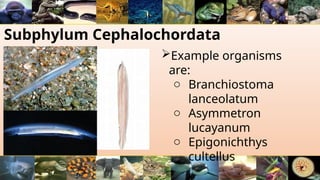
#32 Branchiostoma lanceolatum – Common lancelet found in shallow marine waters.
Asymmetron lucayanum – A lancelet species living in tropical and subtropical waters.
Epigonichthys cultellus – Another cephalochordate similar to Branchiostoma.
#33 Urochordata (Tunicates): Have a notochord and nerve cord only in the larval stage. Adults are sessile, sac-like, and filter-feed using siphons. They have an open circulatory system and are mostly hermaphroditic.
Cephalochordata (Lancelets): Retain the notochord and nerve cord throughout life. They are small, fish-like, free-living, and burrow in sand. They have a closed circulatory system and separate sexes.
In short, urochordates are more simplified and sessile as adults, while cephalochordates retain chordate features and remain mobile.
#34 The development of vertebrates from a common ancestor is estimated to have occurred around 600 million years ago, and evidence of true vertebrates first appeared about 525 million years ago.
#35 All vertebrates, like other chordates, possess four defining traits during their embryonic stage. These traits include a notochord, which is a flexible rod-like structure providing support; a dorsal hollow nerve cord, running along the back and serving as the main nervous system component; a post-anal tail, extending beyond the anus; and pharyngeal slits, which are gill-like structures found in the throat region. While some invertebrates also possess these traits and are classified as chordates, there are specific characteristics that set vertebrates apart from invertebrate chordates.
Vertebrates are incredibly diverse, with over 62,000 identified species. However, this represents only a small fraction of the total number of vertebrates that have existed throughout history. Dinosaurs, for instance, were a remarkable group of extinct vertebrates that dominated terrestrial life for approximately 150 million years during the Mesozoic era. Although the exact cause of their extinction remains uncertain, their fossilized skeletal remains have provided valuable insights into their anatomy.
Sadly, many vertebrate species today are facing the threat of extinction primarily due to habitat loss and pollution. The International Union for the Conservation of Nature (IUCN) classifies over 6,000 vertebrate species as threatened. Among the classes, amphibians and mammals are particularly vulnerable, with 29 percent of all amphibians and 21 percent of all mammals considered threatened. To address this crisis, global efforts are being made to protect endangered species and their habitats. The Biodiversity Action Plan, for example, is an international program ratified by 188 countries, aiming to safeguard species and their ecosystems.
1. Philippine Eagle (Pithecophaga jefferyi)
Status: Critically Endangered
Threats: Deforestation and habitat destruction have significantly reduced their numbers.
Notes: Recognized as the national bird of the Philippines, it is one of the world's largest eagles.
2. Tamaraw (Bubalus mindorensis)
Status: Critically Endangered
Threats: Habitat loss and hunting have led to a drastic decline in their population.
Notes: This small buffalo is endemic to Mindoro Island.
3. Philippine Crocodile (Crocodylus mindorensis)
Status: Critically Endangered
Threats: Illegal fishing practices and habitat destruction are primary concerns.
Notes: One of the most endangered crocodile species globally.
4. Walden's Hornbill (Rhabdotorrhinus waldeni)
Status: Critically Endangered
Threats: Deforestation and hunting have severely impacted their numbers.
Notes: Found in the Western Visayas, particularly on Panay and Negros islands.
5. Philippine Forest Turtle (Siebenrockiella leytensis)
Status: Critically Endangered
Threats: Illegal pet trade and habitat loss are major threats.
Notes: This freshwater turtle is native to Palawan.
Vertebrates are a diverse and recognizable group of animals that possess a vertebral column and/or notochord. They have a long evolutionary history, branching off into various lineages that include dinosaurs and the vast array of species we see today. However, the survival of many vertebrate species is currently at risk, and conservation efforts are crucial to prevent further extinctions and protect the Earth’s biodiversity.
#36 It could either be the vertebral column and/or notochord
Humans and all other vertebrates possess a notochord as an embryo and it eventually develops into the vertebral column.
A bundle of nerves run above the vertebral column
The alimentary canal (also called the digestive tract) is the continuous tube in an organism's body through which food passes, gets digested, and waste is eliminated. It starts at the mouth and ends at the anus.
#37 The alimentary canal is the digestive tract responsible for food intake, digestion, absorption, and waste elimination. It includes the mouth, pharynx, esophagus, stomach, intestines, and anus. In vertebrates, it is well-developed for different diets, while in urochordates and cephalochordates, it is adapted for filter feeding.
#38 Recall that sexual reproduction is the joining of gametes during fertilization, producing genetically variable offspring.
#39 Three reproductive strategies:
✓ Ovipary - This occurs in most amphibians and reptiles and in all birds.
✓ Ovovivipary - The mother provides no nourishment to the developing embryo inside the egg. This occurs in some species of fish and reptiles.
✓ Vivipary - Birth may be followed by a period of parental care of the offspring. This reproductive strategy occurs in almost all mammals.
#41 They have a jawless, circular mouth with rows of small sharp which aid in holding and feeding on other fishes.
These fishes, including the hagfish and lampreys, are often scavengers and parasites.
They belong to a degenerate and modified lineage of primitive vertebrates known as Cyclostomata, derived from their circular mouth structure.
#42 In their adult stage, they feed on other fish and exhibit parasitic behavior.
Agnathans (jawless fish) lack jaws and use specialized feeding methods:
Hagfish (Myxini) – Scavengers that feed on dead animals by burrowing into carcasses using rasping mouthparts.
Lampreys (Petromyzontida) – Some are parasitic, attaching to fish and sucking blood, while others are filter feeders as larvae.
Their feeding adaptations include suction feeding, rasping tongues, and knot-tying for leverage.
The absence of true jaws in these jawless fishes distinguishes them and highlights their specialized feeding mechanisms and ecological roles in aquatic ecosystems.
#43 Meaning that females lay eggs that are later fertilized by males
Lampreys, in particular, hatch in freshwater and spend a significant portion of their lives in this environment. While some lampreys undertake migratory journeys to the sea, they must return to freshwater for reproduction. Lampreys possess a sucker-like mouth without a jaw, which they use to attach themselves to other fish for feeding.
Did you know? The hagfish (Myxini) is the only organism classified under Phylum Chordata solely because it has a cranium (skull). It lacks a vertebral column (backbone), unlike other vertebrates.It has a cartilaginous cranium, which protects its brain. It retains chordate features like the notochord, dorsal nerve cord, and pharyngeal slits, but lacks true vertebrae.
1. Class Agnatha (Jawless Fish)
These fish lack jaws, scales, and paired fins. They have a cartilaginous skeleton and are mostly scavengers or parasites.
Examples in the Philippines:
Hagfish (Eptatretus spp.) – Found in deep waters, scavenging on dead fish.
Lamprey (Lethenteron spp.) – Rare in the Philippines but sometimes found in river systems.
#45 Oviparous, meaning they reproduce by laying eggs
The skin is covered by minute tooth-like structures called placoid scales.
#46 They contain 5-7 pairs of gills. Gaseous exchange occurs through the water current that passes over the gills.
They lack air bladders so they swim actively to avoid sinking.
The heart is two-chambered, contains one auricle and one ventricle.
giving them a flexible and lightweight structure.
They are poikilothermic organisms, meaning they are unable to regulate their own body temperature and rely on their surrounding environment.
The unique characteristics of Class Chondrichthyes, such as their cartilaginous skeletons, diverse species, remarkable lifespans, and specific physiological adaptations, contribute to their success and survival in marine environments.
#47 Endoskeleton - an internal skeleton that provides support and protection to an organism’s body. It is found in vertebrates and some invertebrates.
Heterocercal tail - a type of caudal (tail) fin where the upper lobe is larger than the lower lobe.
#48 They are embedded in the tissue. Old teeth fall and are continuously replaced by the new teeth formed behind it.
They feed on other fishes, crustaceans and molluscs. They filter food particles like planktons from the water current that passes through the mouth, pharynx and gills.
#49 They have the ability to detect their prey electrically. Sharks contain electroreceptors on their head, which can sense the electric current generated by the movement of their prey. It also helps them in navigation.
Cloaca (a common opening in some animals for the digestive, urinary, and reproductive systems.) - has a dual function in females and also acts as a reproductive organ apart from excretion.
Whale sharks are the second largest vertebrate and the largest fish. Some whale sharks measure up to 15 m in length.
2. Class Chondrichthyes (Cartilaginous Fish)
These fish have cartilage-based skeletons, paired fins, and exposed gill slits. Includes sharks, rays, and skates.
Examples in the Philippines:
Whale Shark (Rhincodon typus) – The world's largest fish, seen in Donsol, Oslob, and Tubbataha Reef.
Great Hammerhead Shark (Sphyrna mokarran) – Found in deep Philippine waters.
Blacktip Reef Shark (Carcharhinus melanopterus) – Common in coral reefs.
Manta Ray (Mobula birostris) – Large ray found in Ticao Pass, Cebu, and Palawan.
Stingrays (Himantura spp.) – Common in coastal waters.
#50 They have the ability to detect their prey electrically. Sharks contain electroreceptors on their head, which can sense the electric current generated by the movement of their prey. It also helps them in navigation.
Cloaca (a common opening in some animals for the digestive, urinary, and reproductive systems.) - has a dual function in females and also acts as a reproductive organ apart from excretion.
Whale sharks are the second largest vertebrate and the largest fish. Some whale sharks measure up to 15 m in length.
2. Class Chondrichthyes (Cartilaginous Fish)
These fish have cartilage-based skeletons, paired fins, and exposed gill slits. Includes sharks, rays, and skates.
Examples in the Philippines:
Whale Shark (Rhincodon typus) – The world's largest fish, seen in Donsol, Oslob, and Tubbataha Reef.
Great Hammerhead Shark (Sphyrna mokarran) – Found in deep Philippine waters.
Blacktip Reef Shark (Carcharhinus melanopterus) – Common in coral reefs.
Manta Ray (Mobula birostris) – Large ray found in Ticao Pass, Cebu, and Palawan.
Stingrays (Himantura spp.) – Common in coastal waters.
#51 The largest class of vertebrates and encompasses approximately 20,000 species. Unlike cartilaginous fish such as sharks, bony fish have skeletons composed of bones.
#52 Providing a sturdy framework for their bodies.
This skeletal structure offers support, protection, and serves as an attachment point for muscles.
They have adapted to diverse ecosystems, such as oceans, rivers, lakes, and estuaries.
#53 The arrangement and structure of these rays vary across different species and play a crucial role in fish locomotion and maneuverability.
#54 Fleshy lobed fins are present in sarcopterygians. These types of fins are supported by bones having joints. These are adapted to live at the bottom of the sea.
which provides buoyancy to them and prevents sinking. The swim bladder also facilitates gaseous exchange.
Terminal mouth means that the mouth is located at the front (tip) of the head, at the midpoint.
#55 Operculum – a protective covering of a bony flap that protects their gills.
#56 Poikilotherms means cold blooded meaning they lack the capacity to regulate their internal body temperature.
Some of the larger marine fishes like tuna, swordfish, etc. show some level of endothermy.
Two chambered heart contains one auricle and one ventricle.
Three chambered heart contains two auricles and one ventricle
There are ten pairs of cranial nerves present.
#57 The lateral line organ contains hydrodynamic receptors. The sensory unit is called neuromasts. It helps in sensing vibration, water pressure, navigation and locating their prey.
Cloaca is absent, different genital and anal openings are present.
Ammonotelic - excrete ammonia as their primary nitrogenous waste
Mesonephric kidneys - an intermediate type of kidney found in fish and amphibians, responsible for filtering waste from the blood.
Sexes are mostly separate but some are hermaphrodites. They are mostly oviparous and lay a huge amount of eggs.
Fertilization is mostly external and direct development.
In the male Hippocampus, the brood pouch is present, where eggs incubate.
#58 They lay a huge amounts of eggs.
In the male Hippocampus, the brood pouch is present, where eggs incubate.
Class Osteichthyes (Bony Fish)
The largest class of fish, characterized by a bony skeleton, swim bladder, and scales. Includes freshwater and marine species.
Examples in the Philippines:
Bangus (Milkfish) (Chanos chanos) – The national fish of the Philippines.
Lapu-Lapu (Grouper) (Epinephelus spp.) – Found in reefs, an important commercial fish.
Tilapia (Oreochromis spp.) – Commonly farmed freshwater fish.
Maya-Maya (Red Snapper) (Lutjanus campechanus) – Popular in Philippine cuisine.
Tuna (Thunnus spp.) – Major fishery species, including Yellowfin Tuna (Thunnus albacares).
Dilis (Anchovy) (Stolephorus spp.) – Small schooling fish used for dried fish production.
Would you like more details on any of these fish? 😊
#59 Spending their larval or juvenile stages in water and their adult lives on land.
Aquatic Larval Stage: Amphibians typically begin their life cycle in water, where they hatch from eggs and undergo a larval stage. During this stage, they possess gills for respiration and live in an aquatic environment. While amphibians start their lives in water, they undergo metamorphosis, transforming into adults capable of living on land. However, they must return to the water for mating and egg-laying.
#60 Ectothermic animals (cold-blooded animals) rely on external sources (Sun and surroundings) of heat to regulate their body temperature.
The tail may or may not be present.
Moist Skin: Most adult amphibians have moist skin, which plays a crucial role in gas exchange since their lungs are relatively small and inefficient. Through their skin, they can exchange oxygen and carbon dioxide with the environment.
#61 Unpaired fins might be present.
Limbs and Bone Girdles: Amphibians possess limbs with bone girdles, enabling them to walk and navigate on land. These limbs are adaptations for terrestrial locomotion.
Gills might be present externally in some adults.
The excretory material includes ammonia and urea.
#62 However, in salamanders, the fertilization is internal.
Development is indirect with metamorphosis.
The copulatory organs are absent in males - means that male amphibians do not have specialized reproductive organs, such as a penis or claspers, for internal fertilization. Instead, most amphibians use external fertilization, where sperm and eggs meet outside the body.
#63 These were the first class of organisms to adapt to life on land. They are believed to have evolved from the amphibians millions of years ago. There are about 10000 different species of reptiles on earth. They are cold-blooded animals belonging to the phylum Chordata of Animal kingdom.
They are cold-blooded animals found in most of the warmer regions of the world.
Cold-Blooded: Reptiles are ectothermic or cold-blooded animals. This means their body temperature is regulated by their external environment. They rely on external heat sources, such as basking in the sun, to raise their body temperature.
The skull of the reptiles is modified that gives the reptiles an efficient and powerful jaw action. The modification also makes the skull light.
#64 Body Covering: Reptiles have bodies covered by scutes or scales, which provide protection and help prevent water loss. In some cases, reptiles can shed their epidermal scales as they grow.
Body Division: The body of a reptile is typically divided into four sections: the head, neck, trunk, and tail. Each section serves specific functions and contributes to the reptile’s overall anatomy.
#65 Skin and Respiration: Reptile skin is rough, dry, and lacks glands. They do not possess sweat glands like mammals. Respiration in reptiles is achieved through lungs, allowing for efficient gas exchange.
Skull Structure: Reptiles have skulls with a single condyle, which articulates with the vertebral column. This characteristic distinguishes them from mammals, which typically have a double condyle.
Condyle - a smooth, rounded bony structure found at the end of some bones, typically where they form a joint with another bone.
If they have limbs, they are two pairs of pentadactyl limbs, each bearing claws. Snakes do not have limbs.
Pentadactyl - a five-digit limb structure found in tetrapod vertebrates (amphibians, reptiles, birds, and mammals).
Heart Structure: While reptiles generally have three-chambered hearts, crocodiles are an exception with four-chambered hearts, allowing for more efficient circulation.
#66 Tympanum represents ear
Auditory Functions: Unlike mammals, reptiles lack external pinnae (ear flaps). Instead, they rely on the tympanum, a membrane-covered structure, for auditory functions.
Uricotelic - animals are those that excrete nitrogenous waste primarily in the form of uric acid.
They mostly excrete nitrogenous wastes as uric acid.
And the eggs are very yolky.
Direct development in reptiles means that they hatch or are born as miniature versions of the adult, without going through a larval stage or metamorphosis.
#67 a group of endothermic vertebrates, characterized by feathers, toothless beaked jaws, the laying of hard-shelled eggs, a high metabolic rate, a four-chambered heart, and a strong yet lightweight skeleton.
Feathered Covering: Feathers are a defining feature of birds. They provide insulation, aid in flight, and offer various forms of display and communication. Feathers are unique to birds and are formed from specialized structures called follicles.
#68 Warm-Bloodedness: Birds are warm-blooded creatures, capable of regulating their body temperature internally. This endothermic adaptation allows them to maintain a constant and optimal body temperature for their metabolic needs.
Well-Developed Flight Muscles: Birds have well-developed flight muscles, particularly the pectoral muscles responsible for wing movement. These powerful muscles enable birds to generate the necessary force for sustained flight.
Adapted Hind Limbs: Bird’s hind limbs have evolved to fulfill various functions, including walking, hopping, perching, grasping branches, wading, and swimming. The structure and flexibility of their legs allow for diverse terrestrial and aquatic locomotion.
#69 Epidermal Scales and Legs: The legs of birds are covered in epidermal scales, similar to reptiles. These scales provide protection and assist in gripping surfaces such as branches or perches.
Pneumatic Bones: Birds have a unique skeletal system characterized by lightweight, hollow bones filled with air cavities. These pneumatic bones contribute to their overall lightweight body structure, facilitating flight.
Streamlined Body: Birds have a spindle-shaped body, which reduces wind resistance during flight, enabling efficient movement through the air. This aerodynamic shape contributes to their agility and speed.
#70 Flight: Birds possess the remarkable ability to fly, making them the only group of vertebrates capable of sustained, powered flight. Their wings, formed from modified forelimbs, provide the necessary lift and propulsion for aerial locomotion.
Oil Gland: Birds possess an oil gland, also known as the uropygial gland, which produces a specialized oil used for preening and maintaining the condition of their feathers.
Beak and Toothless Mouth: Birds have toothless beaks, which have evolved from modified jaws. The beak is used for various functions, including feeding, preening feathers, and manipulating objects in their environment.
#71 The crops help in softening food, and the gizzard helps in crushing the food.
Pigeons and other seed-eating birds lack a gall bladder.
#72 The eggs have four embryonic membranes- amnion, chorion, allantois, and yolk sac.
Oviduct – fallopian tube
Courtship, Parental Care, and Nest Construction: Birds exhibit complex behaviors such as courtship rituals, parental care, nest construction, and territorial defense. These social and reproductive behaviors contribute to their successful survival and breeding strategies.
#76 Mammary Glands and Lactation: One of the defining features of mammals is the presence of mammary glands, specialized structures that produce milk to nourish their young. This adaptation allows mammals to provide their offspring with essential nutrients during the early stages of life.
Neurological Advancements: Mammals possess a neocortex, the region of the brain responsible for higher cognitive functions. This development contributes to their advanced sensory perception, learning abilities, and complex behaviors.
Oil glands – sebaceous glands
Sweat glands – sudoriferous glands
#77 Heterodont Dentition: Mammals exhibit heterodont dentition, meaning they have different types of teeth specialized for various functions, such as incisors, canines, premolars, and molars.
Skin and Fur: Mammalian skin contains oil glands (sebaceous glands) and sweat glands (sudoriferous glands). Additionally, most mammals are covered in fur or hair, which provides insulation, protection, and aids in adapting to different environments.
The cervical vertebrae are the bones in the neck region of the vertebral column (spine).
#78 A dicondylic skull is a skull that has two occipital condyles (rounded bony projections) at the base, which connect the skull to the first cervical vertebra (atlas).
Limbs and External Pinna: Mammals have functional limbs, with variations in structure depending on their specific adaptations. Additionally, most mammals possess external pinnae, commonly known as ears, which aid in auditory perception.
#79 The sinus venous and renal portal system are absent.
Four-Chambered Hearts and Warm-Bloodedness: Mammals have four-chambered hearts, which allow for efficient oxygenation and circulation throughout their bodies. They are also warm-blooded creatures, meaning they have the ability to regulate their body temperature internally, regardless of the external environment.
Wide Range of Habitats: Mammals are highly adaptable and can be found in almost all habitats across the globe. From terrestrial environments to aquatic habitats, mammals have successfully colonized diverse ecosystems.
#80 Internal Fertilization: Mammals typically undergo internal fertilization, with the male’s sperm fertilizing the female’s eggs within the body. This internal reproductive process is a distinguishing feature of mammals.
Varied Reproductive Strategies: While most mammals give birth to live young, there are exceptions. For example, the Echidna, a type of monotreme mammal, lays eggs. This demonstrates the diversity in reproductive strategies within the mammalian class.
#81 DID YOU KNOW?
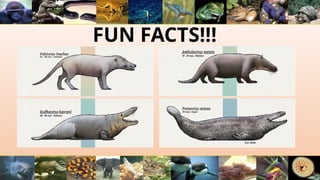
Whales Used to Walk! 🐋🚶♂️
Millions of years ago, ancestors of whales had legs and lived on land! They slowly adapted to life in the ocean, losing their limbs over time.
#82 DID YOU KNOW?
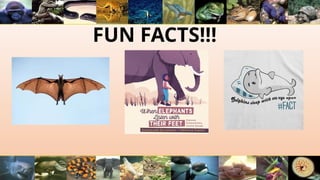
Bats Are the Only Flying Mammals! 🦇
While some mammals glide (like flying squirrels), bats are the only mammals capable of true flight.
Elephants Can "Hear" with Their Feet! 🐘👂
Elephants can detect vibrations in the ground using their feet, helping them sense danger or distant herds.
Dolphins Sleep with One Eye Open! 🐬👀
They shut down only half of their brain at a time while sleeping, so they can stay alert and breathe!
#83 DID YOU KNOW?
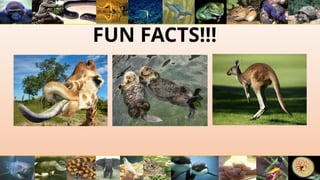
A Giraffe's Tongue Is Super Long! 🦒👅
A giraffe's tongue can be up to 50 cm (20 inches) long and is dark blue or purple to protect it from sunburn.
Otters Hold Hands While They Sleep! 🦦🤝
Sea otters float on their backs and hold hands with each other to keep from drifting apart while they sleep.
Kangaroos Can’t Walk Backward! 🦘❌
Because of their muscular tails and body structure, kangaroos can only move forward and can’t walk backward.
#84 DID YOU KNOW?
Sloths Are So Slow, Algae Grows on Them! 🦥🌿
Sloths move so little that green algae grow on their fur, helping them blend into trees and avoid predators.
Polar Bears Have Black Skin! 🐻❄️⚫
Even though their fur looks white, their skin is actually black to absorb and retain heat in the freezing Arctic.
Cows Have Best Friends! 🐄❤️
Studies show that cows form strong bonds and get stressed when separated from their best friends.
#85 DID YOU KNOW?
Tigers Have Striped Skin! 🐅⚡
A tiger’s stripes aren’t just on its fur—if you shave a tiger, its skin would still have the same stripe pattern!
Dogs Can Smell Your Feelings! 🐶👃
Dogs can detect human emotions like happiness and sadness through scent changes in sweat and breath.
Beavers Have Orange Teeth! 🦫🦷
Their teeth contain iron, making them super strong and giving them a natural orange color.









![Polymer [ बहुलक ] Chemistry Notes PDF - Irfanullah Mehar - JJ Sir Chemistry.pdf](https://cdn.slidesharecdn.com/ss_thumbnails/polymerchemistrynotespdf-irfanullahmehar-jjsirchemistry-260210172118-3f9b37f7-thumbnail.jpg?width=640&height=640&fit=bounds)


