Chloroplasts
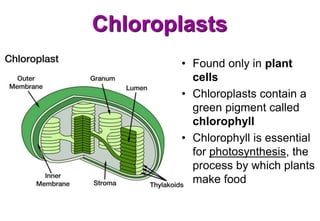
• Found only in plant
cells
• Chloroplasts contain a
green pigment called
chlorophyll
• Chlorophyll is essential
for photosynthesis, the
process by which plants
make food
Chloroplasts
Chloroplast
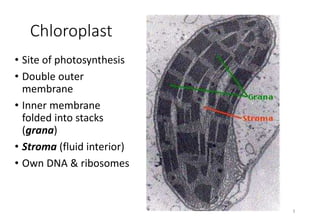
• Site of photosynthesis
• Double outer
membrane
• Inner membrane
folded into stacks
(grana)
• Stroma (fluid interior)
• Own DNA & ribosomes
3
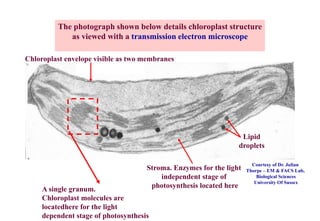
The photograph shown below details chloroplast structure
as viewed with a transmission electron microscope
Courtesy of Dr. Julian
Thorpe – EM & FACS Lab,
Biological Sciences
University Of Sussex
A single granum.
Chloroplast molecules are
locatedhere for the light
dependent stage of photosynthesis
Chloroplast envelope visible as two membranes
Stroma. Enzymes for the light
independent stage of
photosynthesis located here
Lipid
droplets
Chloroplasts
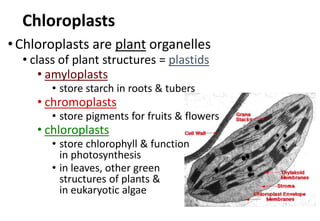
•Chloroplasts are plant organelles
• class of plant structures = plastids
• amyloplasts
• store starch in roots & tubers
• chromoplasts
• store pigments for fruits & flowers
• chloroplasts
• store chlorophyll & function
in photosynthesis
• in leaves, other green
structures of plants &
in eukaryotic algae
Chloroplasts
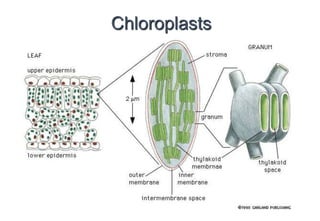
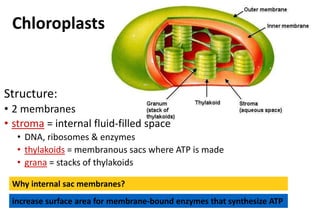
Structure:
• 2 membranes
• stroma = internal fluid-filled space
• DNA, ribosomes & enzymes
• thylakoids = membranous sacs where ATP is made
• grana = stacks of thylakoids
Why internal sac membranes?
increase surface area for membrane-bound enzymes that synthesize ATP
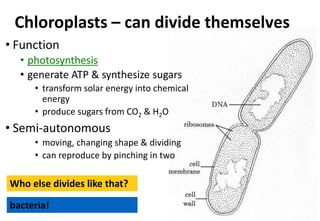
Chloroplasts – can divide themselves
• Function
• photosynthesis
• generate ATP & synthesize sugars
• transform solar energy into chemical
energy
• produce sugars from CO2 & H2O
• Semi-autonomous
• moving, changing shape & dividing
• can reproduce by pinching in two
Who else divides like that?
bacteria!
Mitochondria & Chloroplasts are different
• Organelles not part of endomembrane system
• Grow & reproduce
• semi-autonomous organelles
• Proteins primarily from free ribosomes in cytosol & a few
from their own ribosomes
• Own circular chromosome
• directs synthesis of proteins produced by own internal
ribosomes
• ribosomes like bacterial ribosomes
Who else has a circular chromosome not bound
within a nucleus?
bacteria
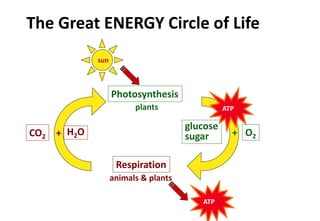
The Great ENERGY Circle of Life
sun
ATP
Photosynthesis
Respiration
O2
glucose
sugarCO2
H2O+ +
plants
animals & plants
ATP
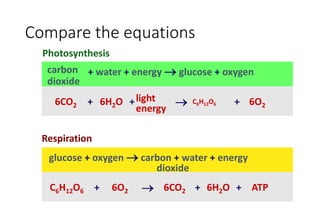
glucose + oxygen  carbon + water + energy
dioxide
C6H12O6 6O2 6CO2 6H2O ATP+ + +
+ water + energy  glucose + oxygencarbon
dioxide
6CO2 6H2O C6H12O6 6O2
light
energy
+ ++
Compare the equations
Photosynthesis
Respiration
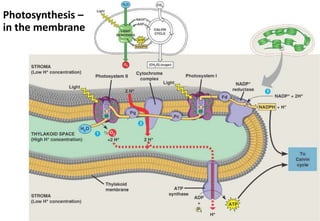
Photosynthesis –
in the membrane

Chloroplast

  • 1.
    Chloroplasts • Found onlyin plant cells • Chloroplasts contain a green pigment called chlorophyll • Chlorophyll is essential for photosynthesis, the process by which plants make food
  • 2.
  • 3.
    Chloroplast • Site ofphotosynthesis • Double outer membrane • Inner membrane folded into stacks (grana) • Stroma (fluid interior) • Own DNA & ribosomes 3
  • 4.
    The photograph shownbelow details chloroplast structure as viewed with a transmission electron microscope Courtesy of Dr. Julian Thorpe – EM & FACS Lab, Biological Sciences University Of Sussex A single granum. Chloroplast molecules are locatedhere for the light dependent stage of photosynthesis Chloroplast envelope visible as two membranes Stroma. Enzymes for the light independent stage of photosynthesis located here Lipid droplets
  • 5.
    Chloroplasts •Chloroplasts are plantorganelles • class of plant structures = plastids • amyloplasts • store starch in roots & tubers • chromoplasts • store pigments for fruits & flowers • chloroplasts • store chlorophyll & function in photosynthesis • in leaves, other green structures of plants & in eukaryotic algae
  • 6.
    Chloroplasts Structure: • 2 membranes •stroma = internal fluid-filled space • DNA, ribosomes & enzymes • thylakoids = membranous sacs where ATP is made • grana = stacks of thylakoids Why internal sac membranes? increase surface area for membrane-bound enzymes that synthesize ATP
  • 7.
    Chloroplasts – candivide themselves • Function • photosynthesis • generate ATP & synthesize sugars • transform solar energy into chemical energy • produce sugars from CO2 & H2O • Semi-autonomous • moving, changing shape & dividing • can reproduce by pinching in two Who else divides like that? bacteria!
  • 8.
    Mitochondria & Chloroplastsare different • Organelles not part of endomembrane system • Grow & reproduce • semi-autonomous organelles • Proteins primarily from free ribosomes in cytosol & a few from their own ribosomes • Own circular chromosome • directs synthesis of proteins produced by own internal ribosomes • ribosomes like bacterial ribosomes Who else has a circular chromosome not bound within a nucleus? bacteria
  • 9.
    The Great ENERGYCircle of Life sun ATP Photosynthesis Respiration O2 glucose sugarCO2 H2O+ + plants animals & plants ATP
  • 10.
    glucose + oxygen carbon + water + energy dioxide C6H12O6 6O2 6CO2 6H2O ATP+ + + + water + energy  glucose + oxygencarbon dioxide 6CO2 6H2O C6H12O6 6O2 light energy + ++ Compare the equations Photosynthesis Respiration
  • 11.