MITOCHONDRIA AND CHLOROPLAST
NAME – DEBJIT PARUI
STREAM – MSC BIOTECHNOLOGY
ROLL NO-14000214
MITOCHONDRIA
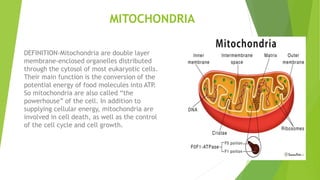
DEFINITION-Mitochondria are double layer
membrane-enclosed organelles distributed
through the cytosol of most eukaryotic cells.
Their main function is the conversion of the
potential energy of food molecules into ATP.
So mitochondria are also called “the
powerhouse” of the cell. In addition to
supplying cellular energy, mitochondria are
involved in cell death, as well as the control
of the cell cycle and cell growth.
HISTORY OF MITOCHONDRIA
 Richard Altmannin 1894, established them as cell organelles and called them
"bioblasts".
 The term "mitochondria" was coined by Carl Benda in 1898.
 Leonor Michaelis discovered Janus green can be used as a supravital stain for
mitochondria in 1900.
 In 1913 particles from extracts of guinea-pig liver were linked to respiration
by Otto Heinrich Warburg, which he called "grana".
 The first high resolution micrographs appeared in 1952, replacing the Janus
Green stains .
 The popular term "powerhouse of the cell" was coined by Philip Siekevitz in
1957
MORPHOLOGY
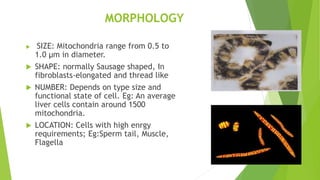
 SIZE: Mitochondria range from 0.5 to
1.0 μm in diameter.
 SHAPE: normally Sausage shaped, In
fibroblasts-elongated and thread like
 NUMBER: Depends on type size and
functional state of cell. Eg: An average
liver cells contain around 1500
mitochondria.
 LOCATION: Cells with high enrgy
requirements; Eg:Sperm tail, Muscle,
Flagella
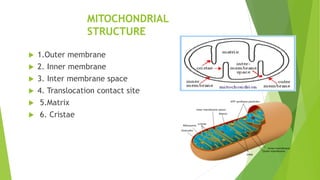
MITOCHONDRIAL
STRUCTURE
 1.Outer membrane
 2. Inner membrane
 3. Inter membrane space
 4. Translocation contact site
 5.Matrix
 6. Cristae
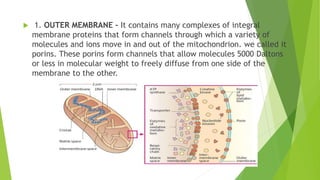
 1. OUTER MEMBRANE – It contains many complexes of integral
membrane proteins that form channels through which a variety of
molecules and ions move in and out of the mitochondrion. we called it
porins. These porins form channels that allow molecules 5000 Daltons
or less in molecular weight to freely diffuse from one side of the
membrane to the other.
2.INNER MEMBRANE
 The inner membrane, which encloses the matrix space, is folded to form
cristae. The area of the inner membrane is about five times as great as
the outer membrane.
 This membrane is richly endowed with cardiolipin, a phospholipid that
possesses four, rather than the usual two, fatty acyl chains. The presence
of this phospholipid in high concentration makes the inner membrane
nearly impermeable to ions, electrons, and protons.
 The inner membrane has a very high protein-to-phospholipid ratio (about
4:1 by weight).
 Impermeable to most charged molecules.
3. INTER MEMBRANE SPACE – It contains several enzymes that use the ATP that passes out of the matrix
to phosphorylate other nucleotides.
4. TRANSLOCATION CONTACT SITE
 TOM(Translocon of the outer membrane)
 TIM(Translocon of the inner membrane)
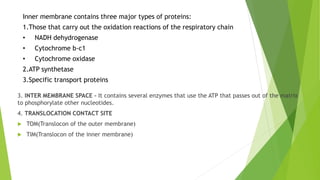
Inner membrane contains three major types of proteins:
1.Those that carry out the oxidation reactions of the respiratory chain
• NADH dehydrogenase
• Cytochrome b-c1
• Cytochrome oxidase
2.ATP synthetase
3.Specific transport proteins
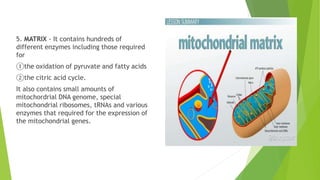
5. MATRIX - It contains hundreds of
different enzymes including those required
for
①the oxidation of pyruvate and fatty acids
②the citric acid cycle.
It also contains small amounts of
mitochordrial DNA genome, special
mitochondrial ribosomes, tRNAs and various
enzymes that required for the expression of
the mitochondrial genes.
THE MITOCHONDRIAL
GENOME
 The human mitochondrion contains 5-10 identical molecules of DNA. Mitochondrial
DNA(mtDNA) are circular, double-stranded structures of molecules in higher
eukaryotes. They encode their own mRNA, rRNA and ribosomal proteins, tRNAs and a
few mitochondrial proteins.
 Each mitochondrion consists of 16’569 base pairs carrying the information for 37
genes.
 but only 13 of these code for polypeptides, the remainder being the 2 ribosomal
subunits and 22 types of transfer RNA.
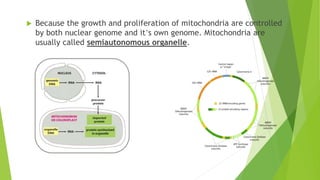
 However, most of the proteins in the mitochondrion are encoded in nucleus by
nuclear DNA, synthesized in cytosol, and subsequently transported into the
mitochondrion.
 Because the growth and proliferation of mitochondria are controlled
by both nuclear genome and it’s own genome. Mitochondria are
usually called semiautonomous organelle.
CHLOROPLAST
DEFINTION -The word chloroplast is derived from the
Greek words chloros, which means green, and plastes,
which means “the one who forms”.
 Chloroplasts are a type of membrane-bound plastids
that contain a network of membranes embedded
into a liquid matrix and harbor the photosynthetic
pigment called chlorophyll.
 Chloroplasts can be found in the cells of the
mesophyll in plant leaves.
 There are usually 30-40 per mesophyll cells.
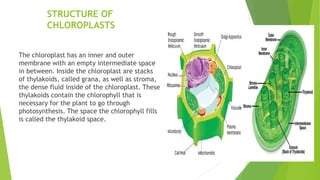
STRUCTURE OF
CHLOROPLASTS
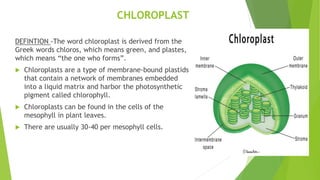
The chloroplast has an inner and outer
membrane with an empty intermediate space
in between. Inside the chloroplast are stacks
of thylakoids, called grana, as well as stroma,
the dense fluid inside of the chloroplast. These
thylakoids contain the chlorophyll that is
necessary for the plant to go through
photosynthesis. The space the chlorophyll fills
is called the thylakoid space.
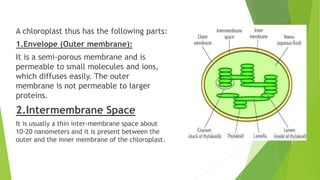
A chloroplast thus has the following parts:
1.Envelope (Outer membrane):
It is a semi-porous membrane and is
permeable to small molecules and ions,
which diffuses easily. The outer
membrane is not permeable to larger
proteins.
2.Intermembrane Space
It is usually a thin inter-membrane space about
10-20 nanometers and it is present between the
outer and the inner membrane of the chloroplast.
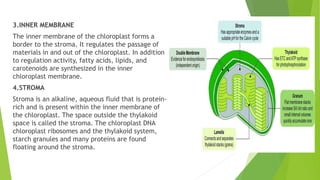
3.INNER MEMBRANE
The inner membrane of the chloroplast forms a
border to the stroma. It regulates the passage of
materials in and out of the chloroplast. In addition
to regulation activity, fatty acids, lipids, and
carotenoids are synthesized in the inner
chloroplast membrane.
4.STROMA
Stroma is an alkaline, aqueous fluid that is protein-
rich and is present within the inner membrane of
the chloroplast. The space outside the thylakoid
space is called the stroma. The chloroplast DNA
chloroplast ribosomes and the thylakoid system,
starch granules and many proteins are found
floating around the stroma.
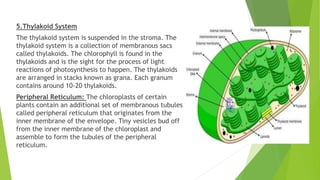
5.Thylakoid System
The thylakoid system is suspended in the stroma. The
thylakoid system is a collection of membranous sacs
called thylakoids. The chlorophyll is found in the
thylakoids and is the sight for the process of light
reactions of photosynthesis to happen. The thylakoids
are arranged in stacks known as grana. Each granum
contains around 10-20 thylakoids.
Peripheral Reticulum: The chloroplasts of certain
plants contain an additional set of membranous tubules
called peripheral reticulum that originates from the
inner membrane of the envelope. Tiny vesicles bud off
from the inner membrane of the chloroplast and
assemble to form the tubules of the peripheral
reticulum.
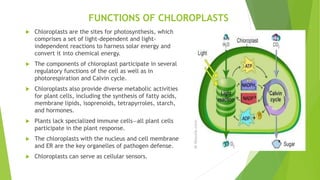
FUNCTIONS OF CHLOROPLASTS
 Chloroplasts are the sites for photosynthesis, which
comprises a set of light-dependent and light-
independent reactions to harness solar energy and
convert it into chemical energy.
 The components of chloroplast participate in several
regulatory functions of the cell as well as in
photorespiration and Calvin cycle.
 Chloroplasts also provide diverse metabolic activities
for plant cells, including the synthesis of fatty acids,
membrane lipids, isoprenoids, tetrapyrroles, starch,
and hormones.
 Plants lack specialized immune cells—all plant cells
participate in the plant response.
 The chloroplasts with the nucleus and cell membrane
and ER are the key organelles of pathogen defense.
 Chloroplasts can serve as cellular sensors.

Mitochondria Choloropast - Debjit Parui

  • 1.
    MITOCHONDRIA AND CHLOROPLAST NAME– DEBJIT PARUI STREAM – MSC BIOTECHNOLOGY ROLL NO-14000214
  • 2.
    MITOCHONDRIA DEFINITION-Mitochondria are doublelayer membrane-enclosed organelles distributed through the cytosol of most eukaryotic cells. Their main function is the conversion of the potential energy of food molecules into ATP. So mitochondria are also called “the powerhouse” of the cell. In addition to supplying cellular energy, mitochondria are involved in cell death, as well as the control of the cell cycle and cell growth.
  • 3.
    HISTORY OF MITOCHONDRIA Richard Altmannin 1894, established them as cell organelles and called them "bioblasts".  The term "mitochondria" was coined by Carl Benda in 1898.  Leonor Michaelis discovered Janus green can be used as a supravital stain for mitochondria in 1900.  In 1913 particles from extracts of guinea-pig liver were linked to respiration by Otto Heinrich Warburg, which he called "grana".  The first high resolution micrographs appeared in 1952, replacing the Janus Green stains .  The popular term "powerhouse of the cell" was coined by Philip Siekevitz in 1957
  • 4.
    MORPHOLOGY  SIZE: Mitochondriarange from 0.5 to 1.0 μm in diameter.  SHAPE: normally Sausage shaped, In fibroblasts-elongated and thread like  NUMBER: Depends on type size and functional state of cell. Eg: An average liver cells contain around 1500 mitochondria.  LOCATION: Cells with high enrgy requirements; Eg:Sperm tail, Muscle, Flagella
  • 5.
    MITOCHONDRIAL STRUCTURE  1.Outer membrane 2. Inner membrane  3. Inter membrane space  4. Translocation contact site  5.Matrix  6. Cristae
  • 6.
     1. OUTERMEMBRANE – It contains many complexes of integral membrane proteins that form channels through which a variety of molecules and ions move in and out of the mitochondrion. we called it porins. These porins form channels that allow molecules 5000 Daltons or less in molecular weight to freely diffuse from one side of the membrane to the other.
  • 7.
    2.INNER MEMBRANE  Theinner membrane, which encloses the matrix space, is folded to form cristae. The area of the inner membrane is about five times as great as the outer membrane.  This membrane is richly endowed with cardiolipin, a phospholipid that possesses four, rather than the usual two, fatty acyl chains. The presence of this phospholipid in high concentration makes the inner membrane nearly impermeable to ions, electrons, and protons.  The inner membrane has a very high protein-to-phospholipid ratio (about 4:1 by weight).  Impermeable to most charged molecules.
  • 8.
    3. INTER MEMBRANESPACE – It contains several enzymes that use the ATP that passes out of the matrix to phosphorylate other nucleotides. 4. TRANSLOCATION CONTACT SITE  TOM(Translocon of the outer membrane)  TIM(Translocon of the inner membrane) Inner membrane contains three major types of proteins: 1.Those that carry out the oxidation reactions of the respiratory chain • NADH dehydrogenase • Cytochrome b-c1 • Cytochrome oxidase 2.ATP synthetase 3.Specific transport proteins
  • 9.
    5. MATRIX -It contains hundreds of different enzymes including those required for ①the oxidation of pyruvate and fatty acids ②the citric acid cycle. It also contains small amounts of mitochordrial DNA genome, special mitochondrial ribosomes, tRNAs and various enzymes that required for the expression of the mitochondrial genes.
  • 10.
    THE MITOCHONDRIAL GENOME  Thehuman mitochondrion contains 5-10 identical molecules of DNA. Mitochondrial DNA(mtDNA) are circular, double-stranded structures of molecules in higher eukaryotes. They encode their own mRNA, rRNA and ribosomal proteins, tRNAs and a few mitochondrial proteins.  Each mitochondrion consists of 16’569 base pairs carrying the information for 37 genes.  but only 13 of these code for polypeptides, the remainder being the 2 ribosomal subunits and 22 types of transfer RNA.  However, most of the proteins in the mitochondrion are encoded in nucleus by nuclear DNA, synthesized in cytosol, and subsequently transported into the mitochondrion.
  • 11.
     Because thegrowth and proliferation of mitochondria are controlled by both nuclear genome and it’s own genome. Mitochondria are usually called semiautonomous organelle.
  • 12.
    CHLOROPLAST DEFINTION -The wordchloroplast is derived from the Greek words chloros, which means green, and plastes, which means “the one who forms”.  Chloroplasts are a type of membrane-bound plastids that contain a network of membranes embedded into a liquid matrix and harbor the photosynthetic pigment called chlorophyll.  Chloroplasts can be found in the cells of the mesophyll in plant leaves.  There are usually 30-40 per mesophyll cells.
  • 13.
    STRUCTURE OF CHLOROPLASTS The chloroplasthas an inner and outer membrane with an empty intermediate space in between. Inside the chloroplast are stacks of thylakoids, called grana, as well as stroma, the dense fluid inside of the chloroplast. These thylakoids contain the chlorophyll that is necessary for the plant to go through photosynthesis. The space the chlorophyll fills is called the thylakoid space.
  • 14.
    A chloroplast thushas the following parts: 1.Envelope (Outer membrane): It is a semi-porous membrane and is permeable to small molecules and ions, which diffuses easily. The outer membrane is not permeable to larger proteins. 2.Intermembrane Space It is usually a thin inter-membrane space about 10-20 nanometers and it is present between the outer and the inner membrane of the chloroplast.
  • 15.
    3.INNER MEMBRANE The innermembrane of the chloroplast forms a border to the stroma. It regulates the passage of materials in and out of the chloroplast. In addition to regulation activity, fatty acids, lipids, and carotenoids are synthesized in the inner chloroplast membrane. 4.STROMA Stroma is an alkaline, aqueous fluid that is protein- rich and is present within the inner membrane of the chloroplast. The space outside the thylakoid space is called the stroma. The chloroplast DNA chloroplast ribosomes and the thylakoid system, starch granules and many proteins are found floating around the stroma.
  • 16.
    5.Thylakoid System The thylakoidsystem is suspended in the stroma. The thylakoid system is a collection of membranous sacs called thylakoids. The chlorophyll is found in the thylakoids and is the sight for the process of light reactions of photosynthesis to happen. The thylakoids are arranged in stacks known as grana. Each granum contains around 10-20 thylakoids. Peripheral Reticulum: The chloroplasts of certain plants contain an additional set of membranous tubules called peripheral reticulum that originates from the inner membrane of the envelope. Tiny vesicles bud off from the inner membrane of the chloroplast and assemble to form the tubules of the peripheral reticulum.
  • 17.
    FUNCTIONS OF CHLOROPLASTS Chloroplasts are the sites for photosynthesis, which comprises a set of light-dependent and light- independent reactions to harness solar energy and convert it into chemical energy.  The components of chloroplast participate in several regulatory functions of the cell as well as in photorespiration and Calvin cycle.  Chloroplasts also provide diverse metabolic activities for plant cells, including the synthesis of fatty acids, membrane lipids, isoprenoids, tetrapyrroles, starch, and hormones.  Plants lack specialized immune cells—all plant cells participate in the plant response.  The chloroplasts with the nucleus and cell membrane and ER are the key organelles of pathogen defense.  Chloroplasts can serve as cellular sensors.