Life cycle ofchlamydomonas
Submitted by: Submitted To:
A.Daisy Beula Dr. B.Ambika
Reg no: 25352. Assistant professor
I MSc Microbiology Department of Microbiology
Sri paramakalyani college. Sri paramakalyani college
Alwarkuruchi. Aalwarkuruchi
Introduction
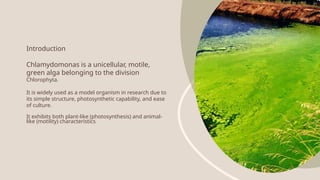
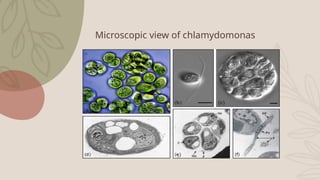
Chlamydomonas is aunicellular, motile,
green alga belonging to the division
Chlorophyta.
It is widely used as a model organism in research due to
its simple structure, photosynthetic capability, and ease
of culture.
It exhibits both plant-like (photosynthesis) and animal-
like (motility) characteristics.
Distribution
Found worldwide infreshwater, damp soil, snow, and
marine habitats.
Common in stagnant ponds, lakes, and slow-moving
streams rich in organic matter.
Some species are found in extreme environments like
snowfields (red snow phenomenon caused by
Chlamydomonas nivalis).
5
Morphology
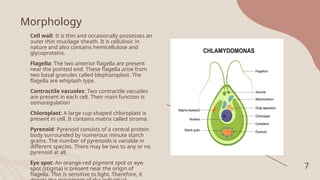
Cell wall: Itis thin and occasionally possesses an
outer thin mucilage sheath. It is cellulosic in
nature and also contains hemicellulose and
glycoproteins.
Flagella: The two anterior flagella are present
near the pointed end. These flagella arise from
two basal granules called blepharoplast. The
flagella are whiplash type.
Contractile vacuoles: Two contractile vacuoles
are present in each cell. Their main function is
osmoregulation
Chloroplast: A large cup-shaped chloroplast is
present in cell. It contains matrix called stroma.
Pyrenoid: Pyrenoid consists of a central protein
body surrounded by numerous minute starch
grains. The number of pyrenoids is variable in
different species. There may be two to any or no
pyrenoid at all.
Eye spot: An orange-red pigment spot or eye-
spot (stigma) is present near the origin of
flagella. This is sensitive to light. Therefore, it
7
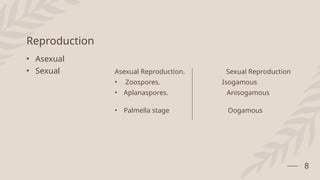
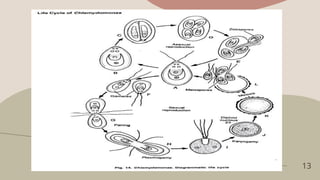
Asexual Reproduction
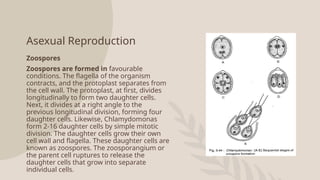
Zoospores
Zoospores areformed in favourable
conditions. The flagella of the organism
contracts, and the protoplast separates from
the cell wall. The protoplast, at first, divides
longitudinally to form two daughter cells.
Next, it divides at a right angle to the
previous longitudinal division, forming four
daughter cells. Likewise, Chlamydomonas
form 2-16 daughter cells by simple mitotic
division. The daughter cells grow their own
cell wall and flagella. These daughter cells are
known as zoospores. The zoosporangium or
the parent cell ruptures to release the
daughter cells that grow into separate
individual cells.
10.
Aplanospores
Aplanospores are formedin Chlamydomonas in unfavourable
conditions. The parent cell loses flagella, and the protoplast
separates from the cell wall. The protoplast divides into 2-16
daughter protoplasts that do not have flagella. They secrete a thin
layer around the protoplast and are known as aplanospores. On
arrival of favourable conditions, either the aplanospore may
germinate or convert into zoospores.
Hypnospores
Hypnospores are formed in unfavourable conditions by secreting
thick walls around the protoplast. The spores germinate into separate
individuals on the arrival of favourable conditions.
10
11.
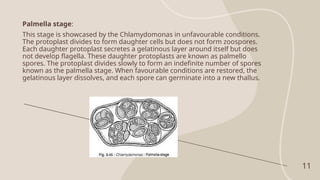
Palmella stage:
This stageis showcased by the Chlamydomonas in unfavourable conditions.
The protoplast divides to form daughter cells but does not form zoospores.
Each daughter protoplast secretes a gelatinous layer around itself but does
not develop flagella. These daughter protoplasts are known as palmello
spores. The protoplast divides slowly to form an indefinite number of spores
known as the palmella stage. When favourable conditions are restored, the
gelatinous layer dissolves, and each spore can germinate into a new thallus.
11
12.
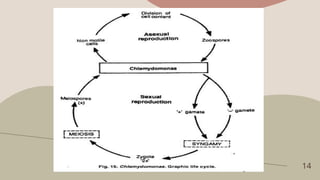
Sexual Reproduction
Isogamy:
The gametesare naked, motile and equal in size. It occurs in reinhardi.
Anisogamy:
The gametes are motile but different in size. The female cell produces four larger
Themale cell produces eight smaller microgametes. It occurs in C. monocia, C.
braunii etc.
Oogamy:
The gametes are different both in size and shape. It occurs in corcifera and C.
oogonium. The female cell functions as oogonium.lt produces a large macrogamete
or egg. The male cell functions as antherozoid. It produces 8, 16 or 32 small spherical
biflagellate microgametes or sperms. 12
15
Economic Importance
Research model:Widely used in genetics, photosynthesis, flagellar
movement, and biofuel research.
Biofuel production: Some species produce lipids convertible into biodiesel.
Biofertilizer: Improves soil nutrient content.
Food source: Protein-rich; can be used in animal feed.
Water quality indicator: Presence indicates organic matter and nutrient
levels.
Snow coloration: C. nivalis causes “watermelon snow,” important in climate
studies.
16.
16
Reference
1. Prescott, Harley,and Klein’s Microbiology – Sections on
algae and green algae.
2. Bold, H.C. & Wynne, M.J. (1985). Introduction to the
Algae: Structure and Reproduction. Prentice-Hall, Inc.
• 3. Lee, R.E. (2008). Phycology (4th
Edition). Cambridge
University Press.
• https://www.researchgate.net