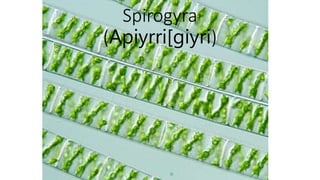
Spirogyra
(Apiyrri[giyri)
vg)<krN
• sZ(OT - vnAp(t
• up sZ(OT - ap&Op)
• (vBig - kli[ri[fiyTi
• Up(vBig - kli[ri[fiys)
• gi[#i - z)³n)m)T[Ãs
• k&L - z)³n)m)T[s)
• upk&L - Apiyri[giyr)D)
• pÔt) - Apiyrri[giyri
(nvisAYin
• 289 Species found around the world
• 94 species reported from India
• Occurs on surface of fresh water places – rivers, ponds, lakes, water
falls etc
• Thallus is fiber like structure
• Possess viscous liquid on surface, hence called “Pond silk”
• Presence of O2 helps thallus to float
s&kiy rcni
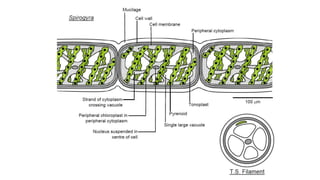
• Multicelluar, unbranched, tubular in shape, 1 mm in Ø.
• Thallus ends are similar, no differentiation of front and end
• Some sp. Possess Holdfast {Ayi(pt ki[P}
• Physiologically unicellular – each cell carries its own function
Cell Structure:-
• Cell wall – bilayered, absence of pits or ornamentation
• Outer:- Pectin, Pecto Pectin helps become slimy, provides protection
from pest, insects or degradation
• Inner:- single microfibril
• Inter cellular:- tricellular wall +nt, cellulose-pectose-cellulosepossess
middle lamella, some possess single layer, disc like structure, Colligate
helps to develop H shaped disc
Jvrs
• Possess Cytoplasm, Nucleus, Chloroplast, Golgi complex, ER,
Mitochondria, microbodies & large Vacuole
• Outer: - cytoplast near cell wall
• Inner:- Large Vacuole +nt around nucleus, Single microfibril joins
both cytoplast
• Nucleus:- 1-16, spirally arranged, anticlock wise, 4-12 thylakoids per
chloroplast, microbodies stores starch and protein.
• Growth:- All cell except holdfast helps
ki[P(vBijn
• Nucleus at first divides by mitosis, moves at ends, central wall develops,
cellulose deposition helps wall formation
• Reproduction:-
• Vegetative:-
• i) Fragmentation – breaking of thallus by insects, fishes etc/ wall
breakdown by temp, acidic water/ cell wall degradation/ H disc seperation
• ii) Asexual – Aplanospore {aclb)ÔN&}
• Some sp. Shows this type, motile spores absent, cytoplast gets dehydrated
and becomes jelly, during favorable conditions germinates.
Sexual Reproduction
• Male and female thallus are present, monoscious or dioscious,
produces spores. Fusion may be 2 types:-
• 1. Scalariform (Ladder type) Conjugation – si[pinvt` s>y&³mn
• 2. Lateral Conjugation – piÅv)< s>y&³mn
1. Scalariform (Ladder type) Conjugation –
si[pinvt` s>y&³mn
• 1. Maturation Phase – p(rp±v avAYi
• During winter or summer, Male/ female Thalli arrange side by side,
cytoplasm gets concentrated, Papili emerge from the cells, both papili fuse,
possess catalase & cellulose, develops bridge.
• 2. Gametic Union Phase - jºy&ai[n) s>(mln avAYi
• Concentrated Cytoplasm develops like gamate, transfers gamate to the other,
via the papili bridge, forms zygote, nucleus 2n, male cell becomes empty.
• 3. Zygospore Contraction Phase – y&³mb)ÔN&ni) s>ki[cn avAYi
• Dehydrated zygote becomes globular, initially green turns reddish, chloroplast
degrades, starch and oil droplets +nt, turns transparent after maturation, 3
layered, outer – pectin, cellulose, Middle – yellowish, possess spyroline &
inner – cellulosic.
2. Lateral Conjugation – piÅv)< s>y&³mn
• Nearby cells acts as Male and female thalli, develops papili, 2 types
observed:-
• 1. Indirect Lateral Conjugation – pri[x piÅv)<y
• 2. Direct Lateral Conjugation – pRyx piÅv)<y
• One cell becomes large acts as Female Gamete, smaller cell develops
papili on adjacent wall and transfers its cytoplasm to adjoining cells,
Zygote forms
Maturation & Germination of Zygospores
• Zygote (2n), liberated by fragmentation, resting 4-7
months, after proper environment Condition,
becomes active, meiosis occurs, 3 degenerate one
remain active, breaks open outer membrane, absorb
water, germination tube, nucleus divides, 2 cells
formed, one develops holdfast cell, other continue to
divide and develops thallus.
Parthenogenesis – as>yi[g) jnn
• Some times the gamets directly develops Zygote.
• Without fusion of male and female gamets
Economic Importance of Algae
• Part of Food Chain
• As Food
• As Fooder
• In Agriculture
• Origin of Petroleum produts
• Limestone formation
• In Sewage Treatment Plants
• Fish Culture
• Recreational purposes
• Space travel
• Water supplies
• Medicine – Goiter, Stomach disorder, Antibiotics, Blood coagulant, Vermifuge etc
• In Industry – Agar, Alginic acid, Kelp industry, Diatomite, Carrageenin, Iodine, Glue

Spirogyra.pptx

  • 1.
  • 2.
    vg)<krN • sZ(OT -vnAp(t • up sZ(OT - ap&Op) • (vBig - kli[ri[fiyTi • Up(vBig - kli[ri[fiys) • gi[#i - z)³n)m)T[Ãs • k&L - z)³n)m)T[s) • upk&L - Apiyri[giyr)D) • pÔt) - Apiyrri[giyri
  • 3.
    (nvisAYin • 289 Speciesfound around the world • 94 species reported from India • Occurs on surface of fresh water places – rivers, ponds, lakes, water falls etc • Thallus is fiber like structure • Possess viscous liquid on surface, hence called “Pond silk” • Presence of O2 helps thallus to float
  • 5.
    s&kiy rcni • Multicelluar,unbranched, tubular in shape, 1 mm in Ø. • Thallus ends are similar, no differentiation of front and end • Some sp. Possess Holdfast {Ayi(pt ki[P} • Physiologically unicellular – each cell carries its own function Cell Structure:- • Cell wall – bilayered, absence of pits or ornamentation • Outer:- Pectin, Pecto Pectin helps become slimy, provides protection from pest, insects or degradation • Inner:- single microfibril • Inter cellular:- tricellular wall +nt, cellulose-pectose-cellulosepossess middle lamella, some possess single layer, disc like structure, Colligate helps to develop H shaped disc
  • 6.
    Jvrs • Possess Cytoplasm,Nucleus, Chloroplast, Golgi complex, ER, Mitochondria, microbodies & large Vacuole • Outer: - cytoplast near cell wall • Inner:- Large Vacuole +nt around nucleus, Single microfibril joins both cytoplast • Nucleus:- 1-16, spirally arranged, anticlock wise, 4-12 thylakoids per chloroplast, microbodies stores starch and protein. • Growth:- All cell except holdfast helps
  • 7.
    ki[P(vBijn • Nucleus atfirst divides by mitosis, moves at ends, central wall develops, cellulose deposition helps wall formation • Reproduction:- • Vegetative:- • i) Fragmentation – breaking of thallus by insects, fishes etc/ wall breakdown by temp, acidic water/ cell wall degradation/ H disc seperation • ii) Asexual – Aplanospore {aclb)ÔN&} • Some sp. Shows this type, motile spores absent, cytoplast gets dehydrated and becomes jelly, during favorable conditions germinates.
  • 9.
    Sexual Reproduction • Maleand female thallus are present, monoscious or dioscious, produces spores. Fusion may be 2 types:- • 1. Scalariform (Ladder type) Conjugation – si[pinvt` s>y&³mn • 2. Lateral Conjugation – piÅv)< s>y&³mn
  • 10.
    1. Scalariform (Laddertype) Conjugation – si[pinvt` s>y&³mn • 1. Maturation Phase – p(rp±v avAYi • During winter or summer, Male/ female Thalli arrange side by side, cytoplasm gets concentrated, Papili emerge from the cells, both papili fuse, possess catalase & cellulose, develops bridge. • 2. Gametic Union Phase - jºy&ai[n) s>(mln avAYi • Concentrated Cytoplasm develops like gamate, transfers gamate to the other, via the papili bridge, forms zygote, nucleus 2n, male cell becomes empty. • 3. Zygospore Contraction Phase – y&³mb)ÔN&ni) s>ki[cn avAYi • Dehydrated zygote becomes globular, initially green turns reddish, chloroplast degrades, starch and oil droplets +nt, turns transparent after maturation, 3 layered, outer – pectin, cellulose, Middle – yellowish, possess spyroline & inner – cellulosic.
  • 12.
    2. Lateral Conjugation– piÅv)< s>y&³mn • Nearby cells acts as Male and female thalli, develops papili, 2 types observed:- • 1. Indirect Lateral Conjugation – pri[x piÅv)<y • 2. Direct Lateral Conjugation – pRyx piÅv)<y • One cell becomes large acts as Female Gamete, smaller cell develops papili on adjacent wall and transfers its cytoplasm to adjoining cells, Zygote forms
  • 13.
    Maturation & Germinationof Zygospores • Zygote (2n), liberated by fragmentation, resting 4-7 months, after proper environment Condition, becomes active, meiosis occurs, 3 degenerate one remain active, breaks open outer membrane, absorb water, germination tube, nucleus divides, 2 cells formed, one develops holdfast cell, other continue to divide and develops thallus.
  • 15.
    Parthenogenesis – as>yi[g)jnn • Some times the gamets directly develops Zygote. • Without fusion of male and female gamets
  • 20.
    Economic Importance ofAlgae • Part of Food Chain • As Food • As Fooder • In Agriculture • Origin of Petroleum produts • Limestone formation • In Sewage Treatment Plants • Fish Culture • Recreational purposes • Space travel • Water supplies • Medicine – Goiter, Stomach disorder, Antibiotics, Blood coagulant, Vermifuge etc • In Industry – Agar, Alginic acid, Kelp industry, Diatomite, Carrageenin, Iodine, Glue