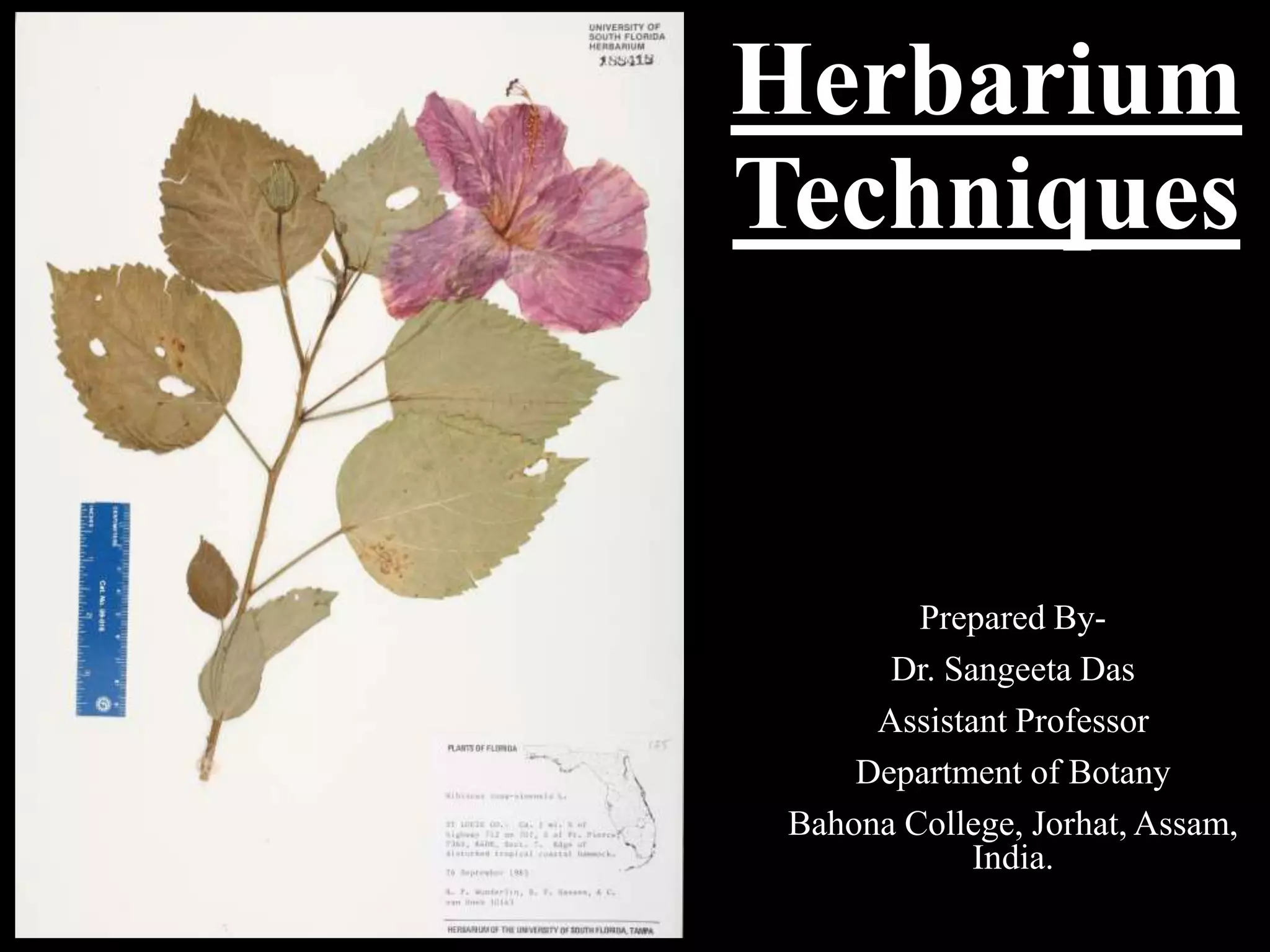
Herbarium
Techniques
Prepared By-
Dr. Sangeeta Das
Assistant Professor
Department of Botany
Bahona College, Jorhat, Assam,
India.
History of Herbarium
The art of herbarium was initiated
by an Italian taxonomist Luca
Ghini (1490-1556), who collected
plants, dried and affixed them on
paper with gum, in the form of
herbarium specimens.
He had a collection of about 300
specimens in 1551.
History of Herbarium
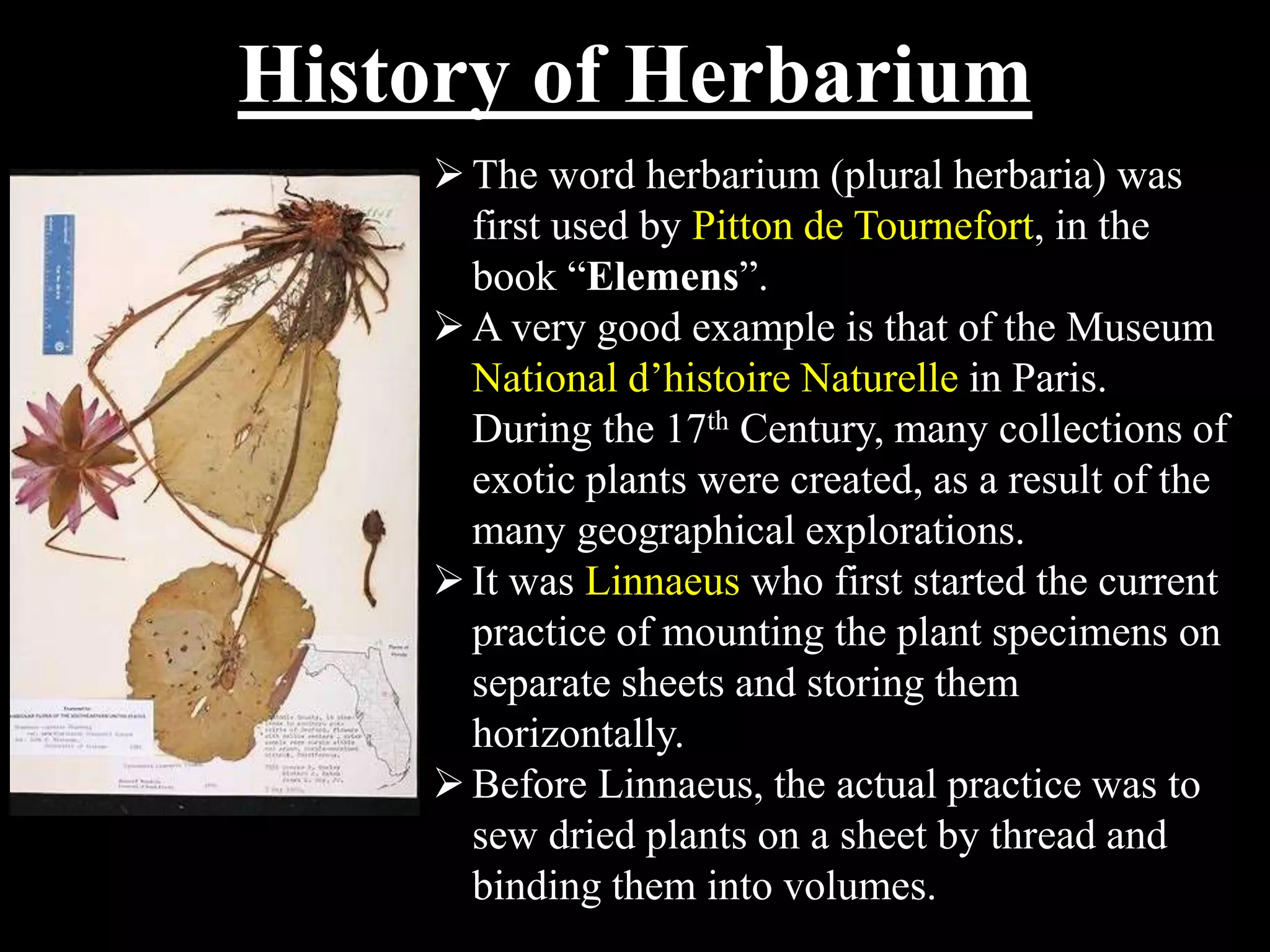
The word herbarium (plural herbaria) was
first used by Pitton de Tournefort, in the
book “Elemens”.
A very good example is that of the Museum
National d’histoire Naturelle in Paris.
During the 17th Century, many collections of
exotic plants were created, as a result of the
many geographical explorations.
It was Linnaeus who first started the current
practice of mounting the plant specimens on
separate sheets and storing them
horizontally.
Before Linnaeus, the actual practice was to
sew dried plants on a sheet by thread and
binding them into volumes.
Definition
According to Fosberg (1946), a modern herbarium
is a "great filling system for information about
plants, both primary in the form of actual specimens
of the plants and secondary in the form of published
information, pictures and recorded notes".
According to Radford (1986), a modern herbarium
"is a research, training, and service institution that
serves as a reference centre, documentation facility,
and data storehouse".
A Modern Herbarium
A modern herbaria is thus a collection of dried and
pressed plant arranged according to a classification
system and available for study or reference,
mounted on herbarium sheets.
Modern herbaria are utilized as reference centers
for identification of plants by the botanists doing
research work in taxonomy, ecology, agriculture,
pharmacy, etc.
Modern herbaria are the documentation centers.
Geneticists, chemists, pharmacists, etc. use the
modern herbaria as a data storehouse. They store
data on ecology, habitat, distribution of plants, etc.
Methods of Herbarium Preparation
The preparation of a herbarium involves:
(i) Field visits and specimen collection,
(ii) Pressing and Drying,
(iii) Mounting on a herbarium sheet,
(iv) Preservation,
(v) Labelling and
(vi) Proper storage.
(i) Field visits and specimen collection
Field visits are necessary to obtain information at every
stage of growth and reproduction of a plant species.
To avoid damage during transportation and preservation at
least 5-G specimens of a plant should by collected.
The collected specimens are transported in a vasculum
(specimen box), specimen must be tagged with a field
number and necessary information should be recorded in a
field note book.
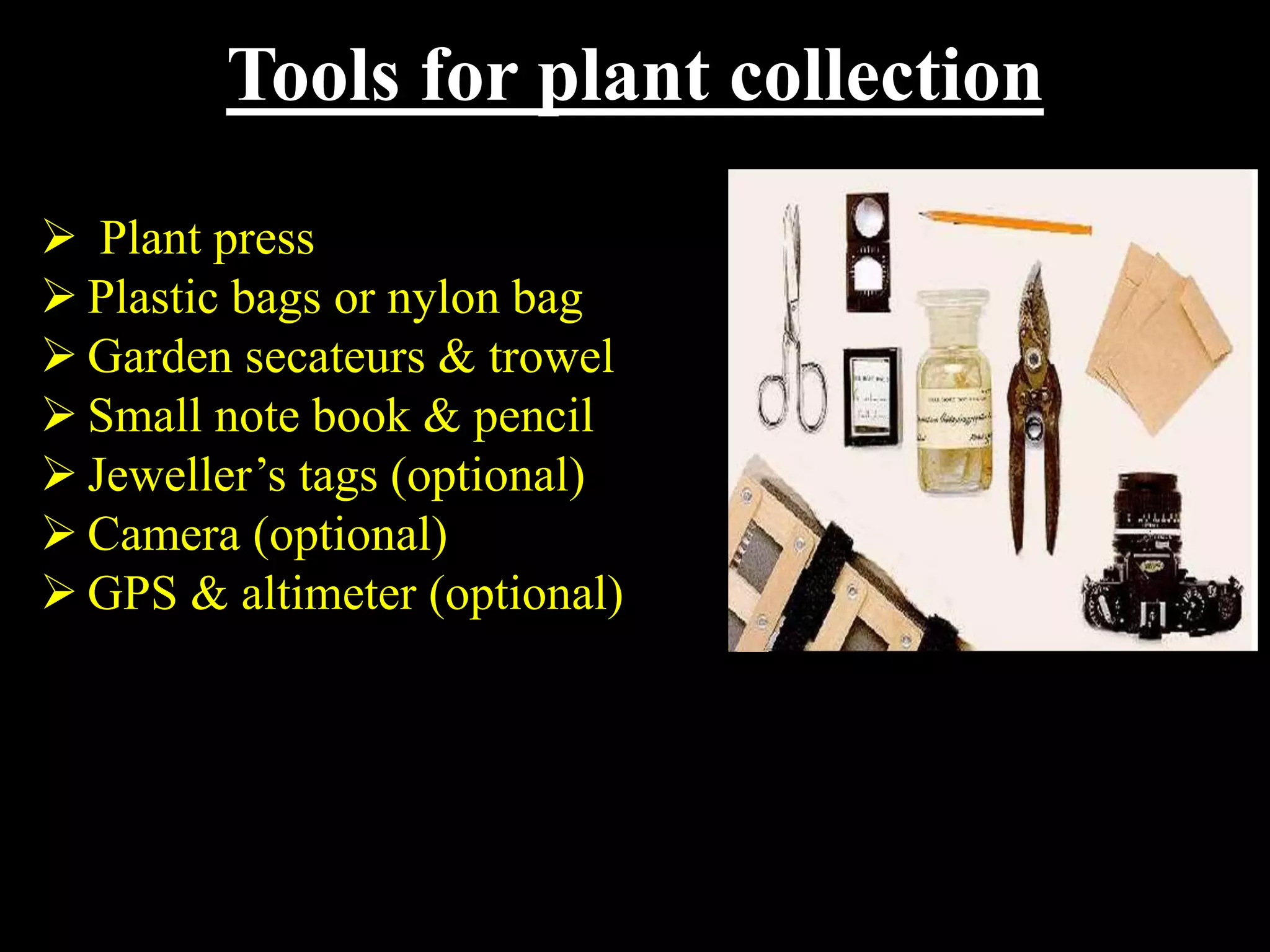
Tools for plant collection
 Plant press
 Plastic bags or nylon bag
 Garden secateurs & trowel
 Small note book & pencil
 Jeweller’s tags (optional)
 Camera (optional)
 GPS & altimeter (optional)
(ii) Pressing and Drying
The specimens are spread out between the folds of
old newspapers or blotting sheets avoiding
overlapping of parts.
The larger specimen may be folded in ‘N’ or’ W’
shapes.
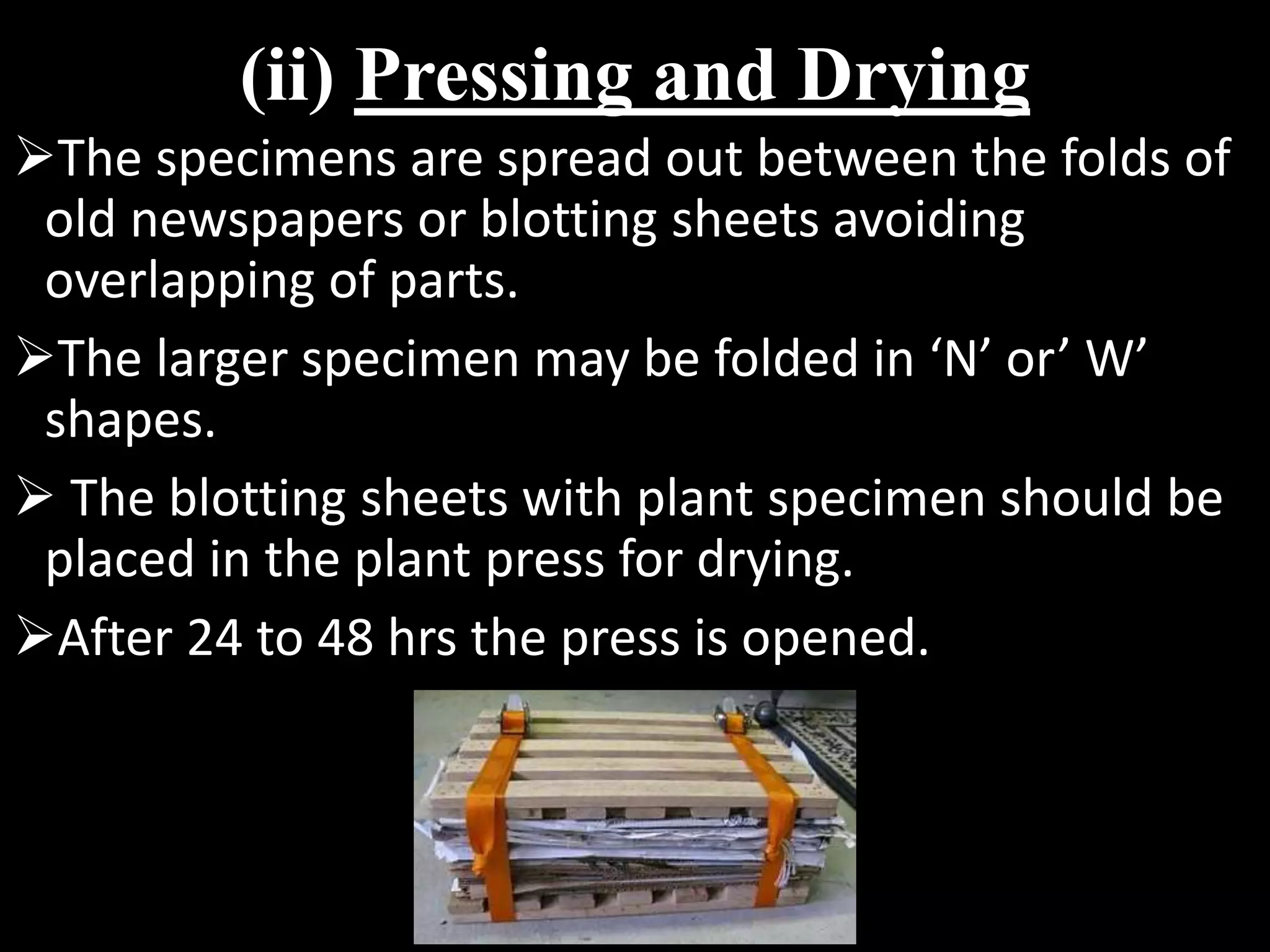
 The blotting sheets with plant specimen should be
placed in the plant press for drying.
After 24 to 48 hrs the press is opened.
(iii) Mounting
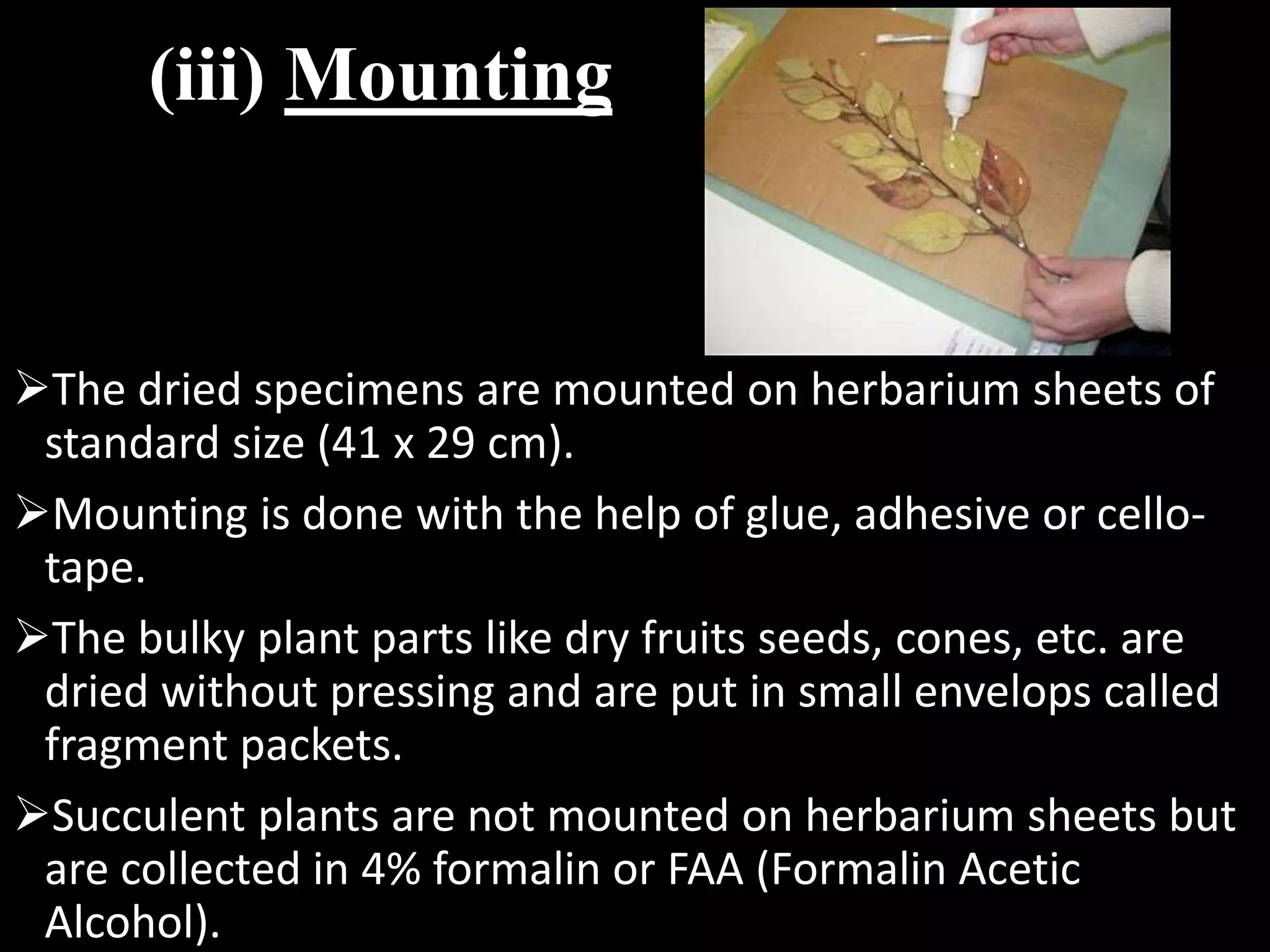
The dried specimens are mounted on herbarium sheets of
standard size (41 x 29 cm).
Mounting is done with the help of glue, adhesive or cello-
tape.
The bulky plant parts like dry fruits seeds, cones, etc. are
dried without pressing and are put in small envelops called
fragment packets.
Succulent plants are not mounted on herbarium sheets but
are collected in 4% formalin or FAA (Formalin Acetic
Alcohol).
(iv) Preservation
The mounted specimens are sprayed with
fungicides like 2% solution of mercuric
chloride.
(V) Labelling
A label is pasted or printed on the lower right
hand corner.
The label should indicate the information
about the locality, altitude, habit, date and
time of collection, name of collector, common
name, complete scientific name, etc.
(Vi) Storage:
Properly dried, pressed and identified plant
specimens are placed in thin paper folds
(specimen covers) which are arranged
according to a well known system of
classification.
In India, Bentham and Hooker’s system of
classification is used for this purpose.
Type specimens are generally stored in
separate and safe places.
Functions of Herbarium:
1.Plant specimens are permanently stored in herbaria.
Thus, they are the major sources of information
about plants and vegetation.
2.Preserved specimens of herbaria are used in almost
all types of taxonomic research.
3.A picture of all species of a genus, or all the genera
of a family may be gathered only in the herbarium.
4.The classification of the world's flora is based
mainly on the herbarium material.
5.List of the endangered species of any region may
be prepared only by herbarium specimens.
Functions of Herbarium:
6. Limited individual collections are identified only with the
help of herbaria.
7. Monographs of genera or families are prepared only by the
herbarium specimens.
8. Our knowledge of the distribution of plants, evolution, and
several taxonomic problems, etc. is based mainly on the
herbarium specimens.
9. Big herbaria provide training to young students in
herbarium practices.
10. Exact area, region or location of the occurrence of
important plants may be gathered from the herbarium
specimens.
11. Herbaria preserve type specimens, and thus serve as a
repository.
Major Herbaria of the World:
Major Herbaria of India:
Herbarium Techniques

Herbarium Techniques

  • 1.
    Herbarium Techniques Prepared By- Dr. SangeetaDas Assistant Professor Department of Botany Bahona College, Jorhat, Assam, India.
  • 2.
    History of Herbarium Theart of herbarium was initiated by an Italian taxonomist Luca Ghini (1490-1556), who collected plants, dried and affixed them on paper with gum, in the form of herbarium specimens. He had a collection of about 300 specimens in 1551.
  • 3.
    History of Herbarium Theword herbarium (plural herbaria) was first used by Pitton de Tournefort, in the book “Elemens”. A very good example is that of the Museum National d’histoire Naturelle in Paris. During the 17th Century, many collections of exotic plants were created, as a result of the many geographical explorations. It was Linnaeus who first started the current practice of mounting the plant specimens on separate sheets and storing them horizontally. Before Linnaeus, the actual practice was to sew dried plants on a sheet by thread and binding them into volumes.
  • 4.
    Definition According to Fosberg(1946), a modern herbarium is a "great filling system for information about plants, both primary in the form of actual specimens of the plants and secondary in the form of published information, pictures and recorded notes". According to Radford (1986), a modern herbarium "is a research, training, and service institution that serves as a reference centre, documentation facility, and data storehouse".
  • 5.
    A Modern Herbarium Amodern herbaria is thus a collection of dried and pressed plant arranged according to a classification system and available for study or reference, mounted on herbarium sheets. Modern herbaria are utilized as reference centers for identification of plants by the botanists doing research work in taxonomy, ecology, agriculture, pharmacy, etc. Modern herbaria are the documentation centers. Geneticists, chemists, pharmacists, etc. use the modern herbaria as a data storehouse. They store data on ecology, habitat, distribution of plants, etc.
  • 6.
    Methods of HerbariumPreparation The preparation of a herbarium involves: (i) Field visits and specimen collection, (ii) Pressing and Drying, (iii) Mounting on a herbarium sheet, (iv) Preservation, (v) Labelling and (vi) Proper storage.
  • 7.
    (i) Field visitsand specimen collection Field visits are necessary to obtain information at every stage of growth and reproduction of a plant species. To avoid damage during transportation and preservation at least 5-G specimens of a plant should by collected. The collected specimens are transported in a vasculum (specimen box), specimen must be tagged with a field number and necessary information should be recorded in a field note book.
  • 8.
    Tools for plantcollection  Plant press  Plastic bags or nylon bag  Garden secateurs & trowel  Small note book & pencil  Jeweller’s tags (optional)  Camera (optional)  GPS & altimeter (optional)
  • 9.
    (ii) Pressing andDrying The specimens are spread out between the folds of old newspapers or blotting sheets avoiding overlapping of parts. The larger specimen may be folded in ‘N’ or’ W’ shapes.  The blotting sheets with plant specimen should be placed in the plant press for drying. After 24 to 48 hrs the press is opened.
  • 10.
    (iii) Mounting The driedspecimens are mounted on herbarium sheets of standard size (41 x 29 cm). Mounting is done with the help of glue, adhesive or cello- tape. The bulky plant parts like dry fruits seeds, cones, etc. are dried without pressing and are put in small envelops called fragment packets. Succulent plants are not mounted on herbarium sheets but are collected in 4% formalin or FAA (Formalin Acetic Alcohol).
  • 11.
    (iv) Preservation The mountedspecimens are sprayed with fungicides like 2% solution of mercuric chloride.
  • 12.
    (V) Labelling A labelis pasted or printed on the lower right hand corner. The label should indicate the information about the locality, altitude, habit, date and time of collection, name of collector, common name, complete scientific name, etc.
  • 13.
    (Vi) Storage: Properly dried,pressed and identified plant specimens are placed in thin paper folds (specimen covers) which are arranged according to a well known system of classification. In India, Bentham and Hooker’s system of classification is used for this purpose. Type specimens are generally stored in separate and safe places.
  • 14.
    Functions of Herbarium: 1.Plantspecimens are permanently stored in herbaria. Thus, they are the major sources of information about plants and vegetation. 2.Preserved specimens of herbaria are used in almost all types of taxonomic research. 3.A picture of all species of a genus, or all the genera of a family may be gathered only in the herbarium. 4.The classification of the world's flora is based mainly on the herbarium material. 5.List of the endangered species of any region may be prepared only by herbarium specimens.
  • 15.
    Functions of Herbarium: 6.Limited individual collections are identified only with the help of herbaria. 7. Monographs of genera or families are prepared only by the herbarium specimens. 8. Our knowledge of the distribution of plants, evolution, and several taxonomic problems, etc. is based mainly on the herbarium specimens. 9. Big herbaria provide training to young students in herbarium practices. 10. Exact area, region or location of the occurrence of important plants may be gathered from the herbarium specimens. 11. Herbaria preserve type specimens, and thus serve as a repository.
  • 16.
  • 17.

Editor's Notes

  • #5 It includes "diverse collections of flowering plants, gymnosperms, ferns, mosses, liverworts, lichens, fungi, algae, and fossils." It also contains "microscope slides, photographs, photomicrographs, wood specimens, camera lucida drawings, field notebooks, diaries, letters, unpublished reports, manuscripts, reprints, and botanical illustrations" according to Radford (1986).