MADE BY: MANSI
YADAV
BSC MEDICAL FIRST
YEAR…
INDEX
SYSTEMATIC POSITION
OCCURRENCE
ORGANISATION
CELL STRUCTURE
REPRODUCTION
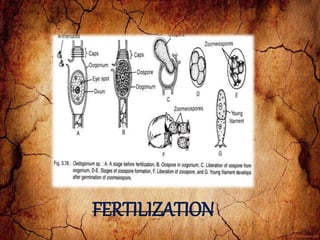
FERTILIZATION
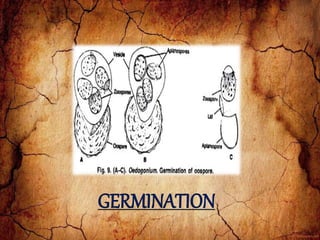
GERMINATION
LIFE CYCLE
KINGDOM: Plantae
DIVISION: Chlorophyta
CLASS: Chlorophyceae
ORDER: Oedogoniales
FAMILY: Oedogoniaceae
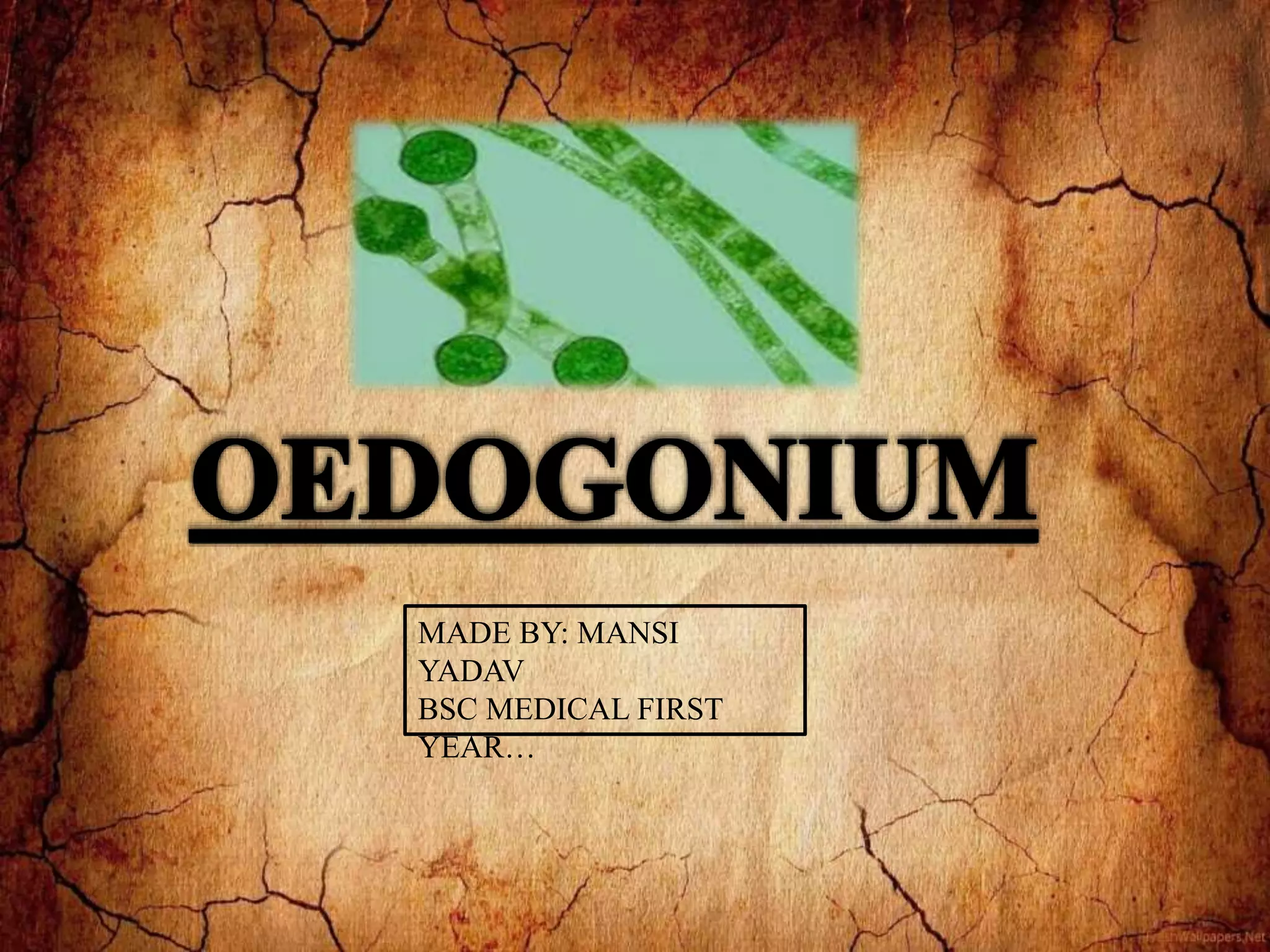
GENUS: Oedogonium
OCCURRENCE
It is a common freshwater filamentous
unbranched alga and is found attached
with the different substrates like
stones, wood, leaves of aquatic plants.
In the young stage filaments are
attached to the substratum with the
help of basal holdfast which later may
become free. Few species are terrestrial
like O.terrestre .
THALLUS
The thallus is made of green,
multicellular, un-branched filaments.
The filament is made of three types of
cells:
(i)The lower-most basal cell or
holdfast.
(ii)The intercalary cells.
(iii)The upper-most apical cell.
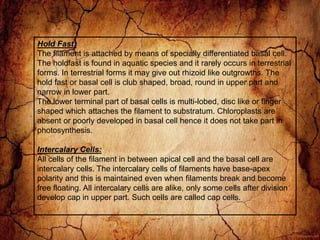
Hold Fast:
The filament is attached by means of specially differentiated basal cell.
The holdfast is found in aquatic species and it rarely occurs in terrestrial
forms. In terrestrial forms it may give out rhizoid like outgrowths. The
hold fast or basal cell is club shaped, broad, round in upper part and
narrow in lower part.
The lower terminal part of basal cells is multi-lobed, disc like or finger
shaped which attaches the filament to substratum. Chloroplasts are
absent or poorly developed in basal cell hence it does not take part in
photosynthesis.
Intercalary Cells:
All cells of the filament in between apical cell and the basal cell are
intercalary cells. The intercalary cells of filaments have base-apex
polarity and this is maintained even when filaments break and become
free floating. All intercalary cells are alike, only some cells after division
develop cap in upper part. Such cells are called cap cells.
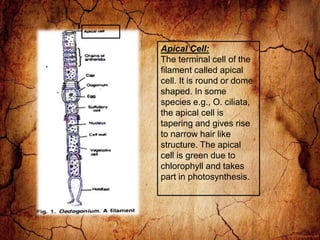
Apical Cell:
The terminal cell of the
filament called apical
cell. It is round or dome
shaped. In some
species e.g., O. ciliata,
the apical cell is
tapering and gives rise
to narrow hair like
structure. The apical
cell is green due to
chlorophyll and takes
part in photosynthesis.
Cell Structure
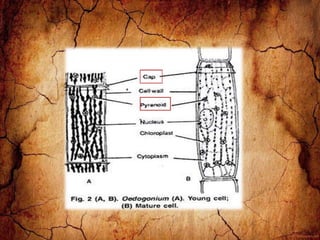
 The cells are elongated and cylindrical. The cell
wall is generally thick, rough and rigid. It is made
up of three concentric layers, the inner cellulose,
middle pectose and the outer layer is chitinous in
nature. The protoplasm consists of thin plasma
membrane, cytoplasm, central vacuole, reticulate
chloroplast and the nucleus.
• The center of the cell is occupied by a large
central vacuole which contains the cell sap. The
cell sap contains excretions, secretions and
inorganic compounds. The protoplast occurs as
thin layer between the central vacuole and the
inner cell wall.
• The chloroplast is characteristically reticulate,
extending or covering the whole cell and encircling
the protoplast. The strands of reticulum may be
broad or narrow depending upon the species. In most
of the cases the strands are parallel to the long axis
of the cell. Many pyrenoids are present at the
intersections of the reticulum, Pyrenoids are covered
with starch plates.
• There is single large nucleus, it is biscuit shaped or
biconvex and lies in the center of cell, internal to
the chloroplast. The nucleus possesses 1-2 nucleoli,
and thread like or elongated chromosomes. The cell
also contains mitochondria, Golgi bodies, endoplasmic
reticulum and the other cell organelles.
Growth:
The growth of Oedogonium filaments takes place by
cell division in intercalary cells but sometimes the
apical cell also divides and takes part in the
elongation of filaments.
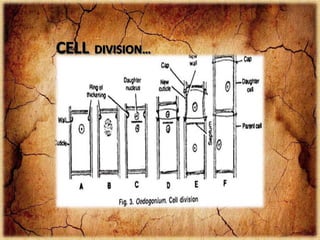
Cell Division:
We know that when a cell divides into two
daughter cells, two separate processes are involved,
one is cell division and the other is cell elongation
including the cell walls. In cell division the
protoplasm divides, the first sign of which is the
division of nucleus.
In cell elongation the cell elongates gradually and
uniformly. The method of cell division and growth
of cell wall is unique and peculiar in Oedogonium.
The cell wall does not elongate in the usual way.
The reproduction in Oedogonium takes
place by vegetative, asexual and sexual
methods.
(A) Fragmentation:
• Oedogonium filament breaks into many small fragments
which have capability to grow into complete filaments
under favorable conditions.
• Fragmentation takes place due to any of the following
reasons:
(a) Accidental breaking of the filaments.
(b) Dying or dehydration of intercalary cells.
(c) Disintegration of intercalary cells due to conversion in
sporangia.
(d) Mechanical injury to the filament.
(e) Change in the environmental conditions.
(i) Vegetative Reproduction:
Vegetative reproduction takes place by fragmentation and
akinete formation.
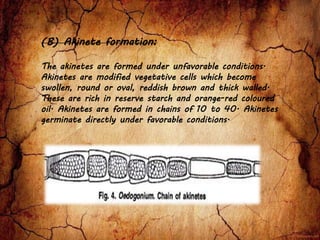
(B) Akinete formation:
The akinetes are formed under unfavorable conditions.
Akinetes are modified vegetative cells which become
swollen, round or oval, reddish brown and thick walled.
These are rich in reserve starch and orange-red coloured
oil. Akinetes are formed in chains of 10 to 40. Akinetes
germinate directly under favorable conditions.
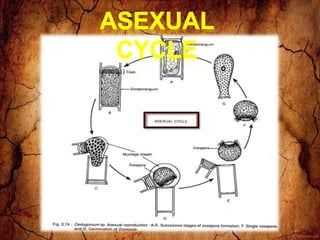
Zoospore formation usually occurs in cap cell. In this
process the whole content of the cell gradually
metamorphoses in to a single pear-shaped zoospore having
a hyaline area at the apex. Surrounding the hyaline area,
a ring of flagella develops in the zoospore. Such zoospores
are called stephanokont zoospores. The zoospore is
liberated enveloped in a hyaline sheath from the parent
cell through a hole in cell wall. The vesicle soon disappears
and the zoospore swim freely for some time and attaches
to the substratum by their anterior end. Thereafter, the
flagella are withdrawn and the zoospore elongates
considerably. The attached end differentiates into
holdfast subsequently grow into a new filament.
(ii) Asexual reproduction:
Asexual reproduction takes place by formation of
multiflagellate zoospores.
• Oogamous type
• Some species are monoecious while others are
dioecious.
• In dioecious species two different categories
are found:
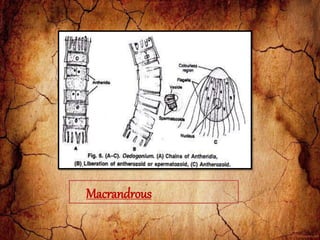
(i) macrandrous
type with antheridia produced on normal
filament..
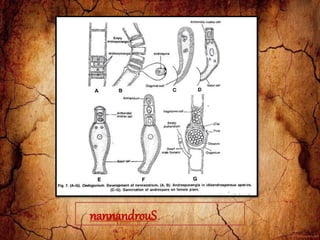
(ii) nannandrous type in which
antheridia are produced on dwarf male filament
i.e., nannandrium…
• In monoeciuous
species, antheridia are formed in a series by
vegetative cells.
• Protoplasm of each antheridium forms two
multiflagellate antherozoids.
Sexual reproduction
• Oogonia are formed by the division of oogonial
mother cell into lower supporting cell or suffultory
cell and upper oogonium.
• Oogonium after development enlarges into oval or
rounded ball-like structure.
• A small colorless area appears at one side of the
oogonium through which antherozoids enter into
the oogoium and reaches up to the egg.
• After fertilization, zygote develops into the
oospore. Oospore secretes the thick wall around it
and undergoes a period of rest.
• It later divides mitotically into four haploid
zoospores.
• In dioecious macrandrous species, out of four, two
zoospores form male filament and two form the
female filament.
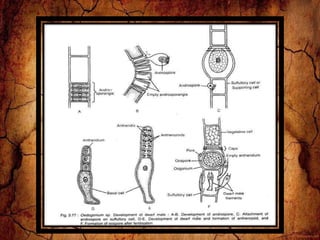
• In nannandrous types, the dwarf
male filaments are produced from a
special type of zoospores called
androspores which are formed in
the androsporangium.
• Androspores are of size between
zoospores and antherozoids.
• Usually the androsporangia are
produced on the filaments bearing
oogonia and such filaments are
called gynandrosporous type.
• In some species, the
androsporangia are formed on
different filaments which are called
idioandrosprorous type.
The oogonial mother cell of O. donnellii
produces a pheromone called circein which
affects the behavior and development of the
androspore of O. donnellii. Androspores after
liberation from androsporangium get attached
to the oogonial wall and germinate to form the 2
to 3 celled dwarf male filaments which bear the
antheridia. Each antheridium forms two
multiflagellated antherozoids which escape
from the antheridium and enter into the
oogonium through the aperture. Further process
of development and germination are similar to
the macrandrous species. If the androspores
are subjected to the nitrogen-rich environment
it forms a vegetative male thallus that cannot
be distinguished from the one which originally
released the androspore.
Macrandrous
nannandrouS
FERTILIZATION
GERMINATION
LIFE
CYCLE
Macrandrous Forms
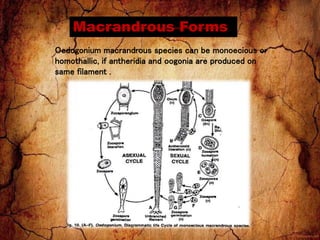
Oedogonium macrandrous species can be monoecious or
homothallic, if antheridia and oogonia are produced on
same filament .
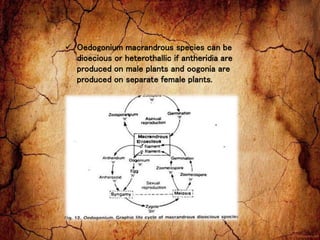
 Oedogonium macrandrous species can be
dioecious or heterothallic if antheridia are
produced on male plants and oogonia are
produced on separate female plants.
Nannandrous Forms
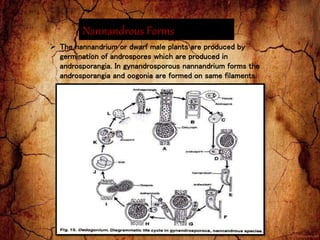
 The nannandrium or dwarf male plants are produced by
germination of androspores which are produced in
androsporangia. In gynandrosporous nannandrium forms the
androsporangia and oogonia are formed on same filaments.
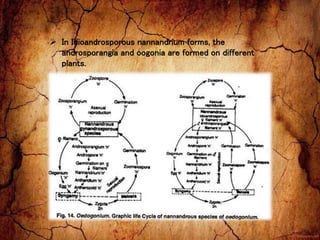
 In Idioandrosporous nannandrium forms, the
androsporangia and oogonia are formed on different
plants.
https://www.toppr.com/guides/biology/cell-
the-unit-of-life/oedogonium-importance-
and-life-cycle/
https://www.britannica.com/scienc
e/Oedogonium
http://www.brainkart.com/article/O
edogonium---Algae_32868/
https://en.wikipedia.org/wiki/Oedogonium
Oedogonium

Oedogonium

  • 1.
    MADE BY: MANSI YADAV BSCMEDICAL FIRST YEAR…
  • 2.
  • 3.
    KINGDOM: Plantae DIVISION: Chlorophyta CLASS:Chlorophyceae ORDER: Oedogoniales FAMILY: Oedogoniaceae GENUS: Oedogonium
  • 4.
    OCCURRENCE It is acommon freshwater filamentous unbranched alga and is found attached with the different substrates like stones, wood, leaves of aquatic plants. In the young stage filaments are attached to the substratum with the help of basal holdfast which later may become free. Few species are terrestrial like O.terrestre .
  • 6.
    THALLUS The thallus ismade of green, multicellular, un-branched filaments. The filament is made of three types of cells: (i)The lower-most basal cell or holdfast. (ii)The intercalary cells. (iii)The upper-most apical cell.
  • 7.
    Hold Fast: The filamentis attached by means of specially differentiated basal cell. The holdfast is found in aquatic species and it rarely occurs in terrestrial forms. In terrestrial forms it may give out rhizoid like outgrowths. The hold fast or basal cell is club shaped, broad, round in upper part and narrow in lower part. The lower terminal part of basal cells is multi-lobed, disc like or finger shaped which attaches the filament to substratum. Chloroplasts are absent or poorly developed in basal cell hence it does not take part in photosynthesis. Intercalary Cells: All cells of the filament in between apical cell and the basal cell are intercalary cells. The intercalary cells of filaments have base-apex polarity and this is maintained even when filaments break and become free floating. All intercalary cells are alike, only some cells after division develop cap in upper part. Such cells are called cap cells.
  • 8.
    Apical Cell: The terminalcell of the filament called apical cell. It is round or dome shaped. In some species e.g., O. ciliata, the apical cell is tapering and gives rise to narrow hair like structure. The apical cell is green due to chlorophyll and takes part in photosynthesis.
  • 9.
    Cell Structure  Thecells are elongated and cylindrical. The cell wall is generally thick, rough and rigid. It is made up of three concentric layers, the inner cellulose, middle pectose and the outer layer is chitinous in nature. The protoplasm consists of thin plasma membrane, cytoplasm, central vacuole, reticulate chloroplast and the nucleus. • The center of the cell is occupied by a large central vacuole which contains the cell sap. The cell sap contains excretions, secretions and inorganic compounds. The protoplast occurs as thin layer between the central vacuole and the inner cell wall.
  • 10.
    • The chloroplastis characteristically reticulate, extending or covering the whole cell and encircling the protoplast. The strands of reticulum may be broad or narrow depending upon the species. In most of the cases the strands are parallel to the long axis of the cell. Many pyrenoids are present at the intersections of the reticulum, Pyrenoids are covered with starch plates. • There is single large nucleus, it is biscuit shaped or biconvex and lies in the center of cell, internal to the chloroplast. The nucleus possesses 1-2 nucleoli, and thread like or elongated chromosomes. The cell also contains mitochondria, Golgi bodies, endoplasmic reticulum and the other cell organelles.
  • 12.
    Growth: The growth ofOedogonium filaments takes place by cell division in intercalary cells but sometimes the apical cell also divides and takes part in the elongation of filaments. Cell Division: We know that when a cell divides into two daughter cells, two separate processes are involved, one is cell division and the other is cell elongation including the cell walls. In cell division the protoplasm divides, the first sign of which is the division of nucleus. In cell elongation the cell elongates gradually and uniformly. The method of cell division and growth of cell wall is unique and peculiar in Oedogonium. The cell wall does not elongate in the usual way.
  • 14.
    The reproduction inOedogonium takes place by vegetative, asexual and sexual methods.
  • 15.
    (A) Fragmentation: • Oedogoniumfilament breaks into many small fragments which have capability to grow into complete filaments under favorable conditions. • Fragmentation takes place due to any of the following reasons: (a) Accidental breaking of the filaments. (b) Dying or dehydration of intercalary cells. (c) Disintegration of intercalary cells due to conversion in sporangia. (d) Mechanical injury to the filament. (e) Change in the environmental conditions. (i) Vegetative Reproduction: Vegetative reproduction takes place by fragmentation and akinete formation.
  • 16.
    (B) Akinete formation: Theakinetes are formed under unfavorable conditions. Akinetes are modified vegetative cells which become swollen, round or oval, reddish brown and thick walled. These are rich in reserve starch and orange-red coloured oil. Akinetes are formed in chains of 10 to 40. Akinetes germinate directly under favorable conditions.
  • 17.
    Zoospore formation usuallyoccurs in cap cell. In this process the whole content of the cell gradually metamorphoses in to a single pear-shaped zoospore having a hyaline area at the apex. Surrounding the hyaline area, a ring of flagella develops in the zoospore. Such zoospores are called stephanokont zoospores. The zoospore is liberated enveloped in a hyaline sheath from the parent cell through a hole in cell wall. The vesicle soon disappears and the zoospore swim freely for some time and attaches to the substratum by their anterior end. Thereafter, the flagella are withdrawn and the zoospore elongates considerably. The attached end differentiates into holdfast subsequently grow into a new filament. (ii) Asexual reproduction: Asexual reproduction takes place by formation of multiflagellate zoospores.
  • 19.
    • Oogamous type •Some species are monoecious while others are dioecious. • In dioecious species two different categories are found: (i) macrandrous type with antheridia produced on normal filament.. (ii) nannandrous type in which antheridia are produced on dwarf male filament i.e., nannandrium… • In monoeciuous species, antheridia are formed in a series by vegetative cells. • Protoplasm of each antheridium forms two multiflagellate antherozoids. Sexual reproduction
  • 20.
    • Oogonia areformed by the division of oogonial mother cell into lower supporting cell or suffultory cell and upper oogonium. • Oogonium after development enlarges into oval or rounded ball-like structure. • A small colorless area appears at one side of the oogonium through which antherozoids enter into the oogoium and reaches up to the egg. • After fertilization, zygote develops into the oospore. Oospore secretes the thick wall around it and undergoes a period of rest. • It later divides mitotically into four haploid zoospores. • In dioecious macrandrous species, out of four, two zoospores form male filament and two form the female filament.
  • 21.
    • In nannandroustypes, the dwarf male filaments are produced from a special type of zoospores called androspores which are formed in the androsporangium. • Androspores are of size between zoospores and antherozoids. • Usually the androsporangia are produced on the filaments bearing oogonia and such filaments are called gynandrosporous type. • In some species, the androsporangia are formed on different filaments which are called idioandrosprorous type.
  • 22.
    The oogonial mothercell of O. donnellii produces a pheromone called circein which affects the behavior and development of the androspore of O. donnellii. Androspores after liberation from androsporangium get attached to the oogonial wall and germinate to form the 2 to 3 celled dwarf male filaments which bear the antheridia. Each antheridium forms two multiflagellated antherozoids which escape from the antheridium and enter into the oogonium through the aperture. Further process of development and germination are similar to the macrandrous species. If the androspores are subjected to the nitrogen-rich environment it forms a vegetative male thallus that cannot be distinguished from the one which originally released the androspore.

  • 23.
  • 24.
  • 26.
  • 27.
  • 28.
  • 29.
    Macrandrous Forms Oedogonium macrandrousspecies can be monoecious or homothallic, if antheridia and oogonia are produced on same filament .
  • 30.
     Oedogonium macrandrousspecies can be dioecious or heterothallic if antheridia are produced on male plants and oogonia are produced on separate female plants.
  • 31.
    Nannandrous Forms  Thenannandrium or dwarf male plants are produced by germination of androspores which are produced in androsporangia. In gynandrosporous nannandrium forms the androsporangia and oogonia are formed on same filaments.
  • 32.
     In Idioandrosporousnannandrium forms, the androsporangia and oogonia are formed on different plants.
  • 33.