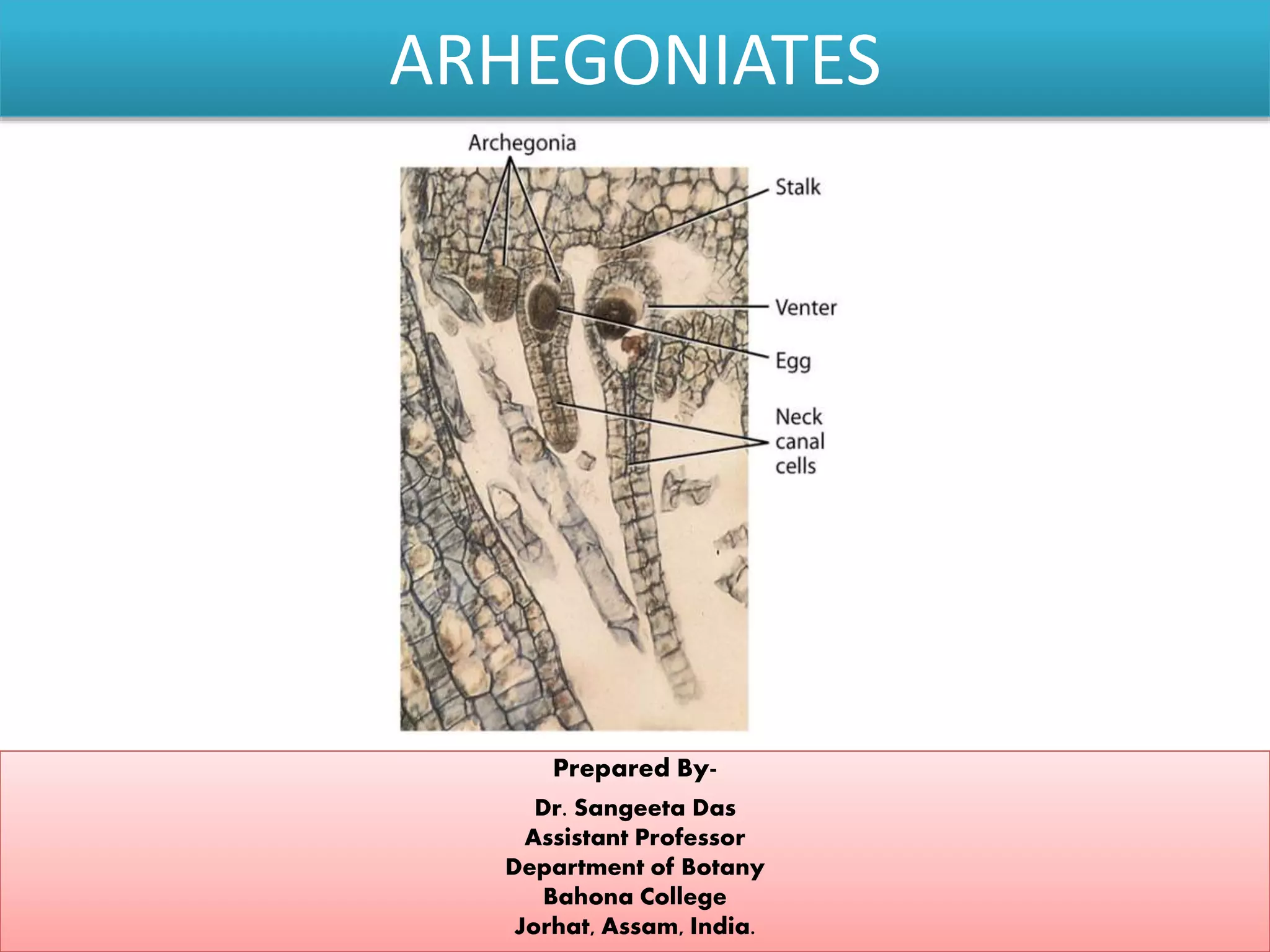

ARHEGONIATES
Prepared By-
Dr. Sangeeta Das
Assistant Professor
Department of Botany
Bahona College
Jorhat, Assam, India.
WHAT ARE ARCHEGONIATES?
They are plants having archegonia as
female reproductive part.
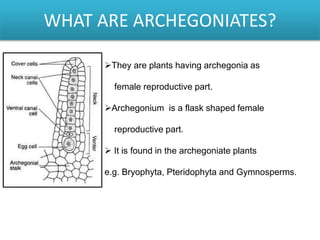
Archegonium is a flask shaped female
reproductive part.
 It is found in the archegoniate plants
e.g. Bryophyta, Pteridophyta and Gymnosperms.
What is an archegonium?
A mature archegonium is a flask
shaped structure, without neck
canal cells and with an egg
(oosphere) in its venter.
At the top of the neck of the
archegonium there are four
cover cells, which become
separated from the
archegonium, as soon as the
gelatinization of the venter and
neck canal cells is over.
Unifying Characteristics of Archegoniates
1. The archegoniates seem to have originated from a
monophyletic group of aquatic green algae.
2. Presence of Female sexual organs are called
archegonium and the male sexual organs are
called antheridium.
3. The presence of Chloroplasts containing
chlorophyll a, b and carotene.
4. The presence of multicellular gametophytic and
sporophytic generation.
Unifying Characteristics of Archegoniates
5. Heteromorphic alternation of generation.
6. Provides protection to their embryo
7. Male gametes are flagellated and motile in
bryophytes, pteridophytes, (Cycadales,
Ginkgoales) while the female gamete (egg) is
non-motile.
8. Water is needed for fertilization in
Bryophytes and Pteridophytes but not in
Gymnosperms.
Unifying Characteristics of Archegoniates
9. In gymnosperms, pollen grains germinate to form a
pollen tube (siphonogamy) which is not dependent
on external fluid water to reach the archegonial
neck.
10.Differentiated tissues with thickened cell walls
(collenchyma) and lignified walls (sclerenchyma) to
support the erect habit.
11.Efficient spore dispersal mechanism.
12.The archegoniates evolved several adaptive
strategies to survive on land.
The transition from water to land
There are lots of evidences regarding the evolution
of land plants from the aquatic environment.
The first multicellular organisms that lived in the
water are green algae which are considered to be
the ancestors of land plants.
This transition from water to land habit was made
possible due the following adaptations that
occurred in those plants.
1. Body support
Supportive structures developed to withstand the
forces of gravity.
Such as Rigid cell walls, different types of
supportive tissues (e.g., woody tissues, branch
cells, etc.).
However, the mosses lack these tissues, and are
thus limited to land habit.
This type of support is found in the ferns, although
it is very primitive.
In the conifers and flowering plants, the most well-
developed adaptations of this nature are observed.
Adaptations...
2. Transport of materials
 Another challenge to transform from water to land form.
 In aquatic forms, transport occurs directly from the
surrounding environment.
 But land plants must absorb water and other materials from
the soil.
 Thus, they need to develop conducting vessels to transport
materials from the soil to the plant as well as from the leaves
to the different parts of the plant.
 It also led to the evolution of differentiation of plant parts,
such as, evolution of leaf cells having ability to create food via
photosynthesis; root cells to transport nutrients from the soil;
the cuticle, stomata, phloem, xylem etc. are also developed
to regulate the water inside the plant, etc.
Adaptations...
3. Fertilization
 A third challenge is to bring sex cells together.
 In water, sperm are able to swim directly to eggs.
 However, on land, this is possible only in moist condition as
seen in mosses and ferns.
 Land plants show alternation of generations and the
sporophytic generation produces spores inside microscopic
gametophytes.
 The male gametophytes, which form non-swimming sperm,
develop within pollen grains. The female gametophytes,
which produce eggs, develop on scales (in conifers) or within
ovaries (in flowering plants).
 Pollen is adapted to use wind to transport sperm to eggs,
which replaces the need for water in those plants.
Adaptations...
4. Development and dispersal of the embryo
 A fourth challenge.
 In aquatic environments, a fertilized egg can develop into an
embryo without facing the problem of dehydration.
 In addition, the embryo can receive water and nutrients
directly from the surrounding environment. Whereas, in land
plants, an embryo and exists in an environment where water
and nutrients exist in the ground and thus can dry out
rapidly.
 This problem is mitigated as the seeds enclose an embryo in a
moist environment, and the tissues within seeds provide food
for a developing embryo.
 Finally, seeds represent a way of dispersing the young of
plants away from water as well as away from the parent
plant. The seed plants include the conifers and flowering
plants.
Adaptations...
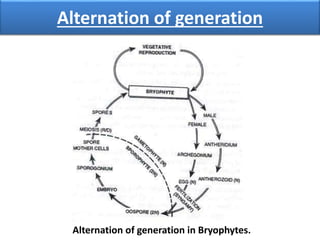
Alternation of generation
Alternation of generation in Bryophytes.
1. The life cycle of bryophytes shows regular alternation
of gametophytic and sporophytic generations.
2. The haploid phase (n) is the gametophyte or sexual
generation.
3. It bears the sexual reproductive organs, which forms
gametes, i.e. antherozoids and eggs gametic union a
zygote is formed which develops into a sporophyte
(2n) deploid phase.
4. Sporophyte forms spores, which always germinate to
form gametophytes
5. During the formation of spores, the spore mother cells
divide meiotically and haploid spores are formed.
Alternation of Generation in Bryophytes..
6. The production of the spores is the beginning of
the gametophytic or haploid phase
7. The spores germinate and form gametophytic or
haploid phase
8. The spores germinate and produce gametophytes,
which bear sex organs
9. Ultimately, the gametic union takes place and
zygote is resulted. It is diploid (2n).
10.This is the beginning of the sporophytic or diploid
phase.
Alternation of Generation in Bryophytes..
11.Here the two generations are morphologically
different, the type of alternation of generations is
called heteromophic
12.The gametophytic generation is conspicuous and
longer-lived phase of life-cycle in comparison to that
of sporophyte generation
13.In bryophytes, the gametophyte is quite independent
whereas the sporophyte is dependent somehow or
other on the gametophyte for its nutrition
14.The gametophyte produces sporophyte and
sporophyte to the gametophyte and thus there is
regular alternation of generations
Alternation of Generation in Bryophytes..
Alternation of Generation in Pteridophytes..
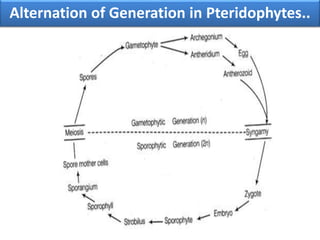
1. In Pteridophytes, the haploid phase (n) is
gametophytic generation or sexual phase.
2. It bears reproductive organs -antheridia and
archegonia.
3. The Antheridia and archegonia produces flagellate
antherozoids and egg respectively.
4. Gametophyte may be monoecious as in
homosporous sp. / dioecious in heterosporous sp.
5. The Gametophyte is independent in Pteris and
dependent in Selaginella.
Alternation of Generation in Pteridophytes..
6. Diploid phase (2n) or sporophytic stage forms from
zygote after fertilization
7. Meiosis in SMC (spore mother cell) forms non-
motile haploid spore, which germinate to form
gametophyte again.
8. This cycle continues with alternation between
gametophye and sporophyte.
9. All spore formed may be of one type i.e.
homosporous species (Lycopodium, Dryopteris).
10.Spores formed may be of two types i. e.
heterosporous species (Selaginella, Marsilea).
Alternation of Generation in Pteridophytes..
10.Microspores/male spores developed in male
sporangia germinate to form male gametophyte.
11.Megaspores/female spore developed in
megasporangia germinate to form female
gametophyte.
12.Sporophyte is dominant phase in life cycle.
13.It is independent of the gametophyte (prothallus)
and grows to a much greater size.
14.Sporophytes are differentiated into stems, leaves
and roots and shows well developed conducting
tissues.
Alternation of Generation in Pteridophytes..
Alternation of Generation in Gymnosperms..
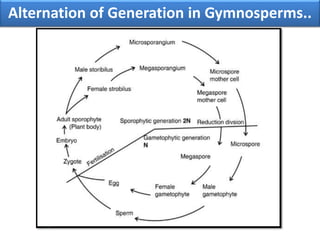
1. The dominant phase in the life cycle is the diploid
(sporophyte) stage.
2. The gametophytes are very small and cannot exist
independent of the parent plant.
3. The reproductive structures of the sporophyte
(cones), produce two different kinds of haploid
spores: microspores (male) and megaspores
(female).
4. This phenomenon of sexually differentiated spores
is called heterospory.
Alternation of Generation in Gymnosperms..
5. These spores give rise to similarly sexually
differentiated gametophytes, which in turn
produce gametes.
6. Fertilization occurs when a male and female
gamete join to form a zygote resulting an embryo
sac.
7. Resulting embryo, encased in a seed coating,
become sporophyte.
Alternation of Generation in Gymnosperms..
THANK YOU

Archegoniates

  • 1.
    ARHEGONIATES Prepared By- Dr. SangeetaDas Assistant Professor Department of Botany Bahona College Jorhat, Assam, India.
  • 2.
    WHAT ARE ARCHEGONIATES? Theyare plants having archegonia as female reproductive part. Archegonium is a flask shaped female reproductive part.  It is found in the archegoniate plants e.g. Bryophyta, Pteridophyta and Gymnosperms.
  • 3.
    What is anarchegonium? A mature archegonium is a flask shaped structure, without neck canal cells and with an egg (oosphere) in its venter. At the top of the neck of the archegonium there are four cover cells, which become separated from the archegonium, as soon as the gelatinization of the venter and neck canal cells is over.
  • 4.
    Unifying Characteristics ofArchegoniates 1. The archegoniates seem to have originated from a monophyletic group of aquatic green algae. 2. Presence of Female sexual organs are called archegonium and the male sexual organs are called antheridium. 3. The presence of Chloroplasts containing chlorophyll a, b and carotene. 4. The presence of multicellular gametophytic and sporophytic generation.
  • 5.
    Unifying Characteristics ofArchegoniates 5. Heteromorphic alternation of generation. 6. Provides protection to their embryo 7. Male gametes are flagellated and motile in bryophytes, pteridophytes, (Cycadales, Ginkgoales) while the female gamete (egg) is non-motile. 8. Water is needed for fertilization in Bryophytes and Pteridophytes but not in Gymnosperms.
  • 6.
    Unifying Characteristics ofArchegoniates 9. In gymnosperms, pollen grains germinate to form a pollen tube (siphonogamy) which is not dependent on external fluid water to reach the archegonial neck. 10.Differentiated tissues with thickened cell walls (collenchyma) and lignified walls (sclerenchyma) to support the erect habit. 11.Efficient spore dispersal mechanism. 12.The archegoniates evolved several adaptive strategies to survive on land.
  • 7.
    The transition fromwater to land There are lots of evidences regarding the evolution of land plants from the aquatic environment. The first multicellular organisms that lived in the water are green algae which are considered to be the ancestors of land plants. This transition from water to land habit was made possible due the following adaptations that occurred in those plants.
  • 8.
    1. Body support Supportivestructures developed to withstand the forces of gravity. Such as Rigid cell walls, different types of supportive tissues (e.g., woody tissues, branch cells, etc.). However, the mosses lack these tissues, and are thus limited to land habit. This type of support is found in the ferns, although it is very primitive. In the conifers and flowering plants, the most well- developed adaptations of this nature are observed. Adaptations...
  • 9.
    2. Transport ofmaterials  Another challenge to transform from water to land form.  In aquatic forms, transport occurs directly from the surrounding environment.  But land plants must absorb water and other materials from the soil.  Thus, they need to develop conducting vessels to transport materials from the soil to the plant as well as from the leaves to the different parts of the plant.  It also led to the evolution of differentiation of plant parts, such as, evolution of leaf cells having ability to create food via photosynthesis; root cells to transport nutrients from the soil; the cuticle, stomata, phloem, xylem etc. are also developed to regulate the water inside the plant, etc. Adaptations...
  • 10.
    3. Fertilization  Athird challenge is to bring sex cells together.  In water, sperm are able to swim directly to eggs.  However, on land, this is possible only in moist condition as seen in mosses and ferns.  Land plants show alternation of generations and the sporophytic generation produces spores inside microscopic gametophytes.  The male gametophytes, which form non-swimming sperm, develop within pollen grains. The female gametophytes, which produce eggs, develop on scales (in conifers) or within ovaries (in flowering plants).  Pollen is adapted to use wind to transport sperm to eggs, which replaces the need for water in those plants. Adaptations...
  • 11.
    4. Development anddispersal of the embryo  A fourth challenge.  In aquatic environments, a fertilized egg can develop into an embryo without facing the problem of dehydration.  In addition, the embryo can receive water and nutrients directly from the surrounding environment. Whereas, in land plants, an embryo and exists in an environment where water and nutrients exist in the ground and thus can dry out rapidly.  This problem is mitigated as the seeds enclose an embryo in a moist environment, and the tissues within seeds provide food for a developing embryo.  Finally, seeds represent a way of dispersing the young of plants away from water as well as away from the parent plant. The seed plants include the conifers and flowering plants. Adaptations...
  • 12.
    Alternation of generation Alternationof generation in Bryophytes.
  • 13.
    1. The lifecycle of bryophytes shows regular alternation of gametophytic and sporophytic generations. 2. The haploid phase (n) is the gametophyte or sexual generation. 3. It bears the sexual reproductive organs, which forms gametes, i.e. antherozoids and eggs gametic union a zygote is formed which develops into a sporophyte (2n) deploid phase. 4. Sporophyte forms spores, which always germinate to form gametophytes 5. During the formation of spores, the spore mother cells divide meiotically and haploid spores are formed. Alternation of Generation in Bryophytes..
  • 14.
    6. The productionof the spores is the beginning of the gametophytic or haploid phase 7. The spores germinate and form gametophytic or haploid phase 8. The spores germinate and produce gametophytes, which bear sex organs 9. Ultimately, the gametic union takes place and zygote is resulted. It is diploid (2n). 10.This is the beginning of the sporophytic or diploid phase. Alternation of Generation in Bryophytes..
  • 15.
    11.Here the twogenerations are morphologically different, the type of alternation of generations is called heteromophic 12.The gametophytic generation is conspicuous and longer-lived phase of life-cycle in comparison to that of sporophyte generation 13.In bryophytes, the gametophyte is quite independent whereas the sporophyte is dependent somehow or other on the gametophyte for its nutrition 14.The gametophyte produces sporophyte and sporophyte to the gametophyte and thus there is regular alternation of generations Alternation of Generation in Bryophytes..
  • 16.
    Alternation of Generationin Pteridophytes..
  • 17.
    1. In Pteridophytes,the haploid phase (n) is gametophytic generation or sexual phase. 2. It bears reproductive organs -antheridia and archegonia. 3. The Antheridia and archegonia produces flagellate antherozoids and egg respectively. 4. Gametophyte may be monoecious as in homosporous sp. / dioecious in heterosporous sp. 5. The Gametophyte is independent in Pteris and dependent in Selaginella. Alternation of Generation in Pteridophytes..
  • 18.
    6. Diploid phase(2n) or sporophytic stage forms from zygote after fertilization 7. Meiosis in SMC (spore mother cell) forms non- motile haploid spore, which germinate to form gametophyte again. 8. This cycle continues with alternation between gametophye and sporophyte. 9. All spore formed may be of one type i.e. homosporous species (Lycopodium, Dryopteris). 10.Spores formed may be of two types i. e. heterosporous species (Selaginella, Marsilea). Alternation of Generation in Pteridophytes..
  • 19.
    10.Microspores/male spores developedin male sporangia germinate to form male gametophyte. 11.Megaspores/female spore developed in megasporangia germinate to form female gametophyte. 12.Sporophyte is dominant phase in life cycle. 13.It is independent of the gametophyte (prothallus) and grows to a much greater size. 14.Sporophytes are differentiated into stems, leaves and roots and shows well developed conducting tissues. Alternation of Generation in Pteridophytes..
  • 20.
    Alternation of Generationin Gymnosperms..
  • 21.
    1. The dominantphase in the life cycle is the diploid (sporophyte) stage. 2. The gametophytes are very small and cannot exist independent of the parent plant. 3. The reproductive structures of the sporophyte (cones), produce two different kinds of haploid spores: microspores (male) and megaspores (female). 4. This phenomenon of sexually differentiated spores is called heterospory. Alternation of Generation in Gymnosperms..
  • 22.
    5. These sporesgive rise to similarly sexually differentiated gametophytes, which in turn produce gametes. 6. Fertilization occurs when a male and female gamete join to form a zygote resulting an embryo sac. 7. Resulting embryo, encased in a seed coating, become sporophyte. Alternation of Generation in Gymnosperms..
  • 23.