R. Mariyakannan
M. Sc., Microbiology
Bharathidasan University
Trichy-24
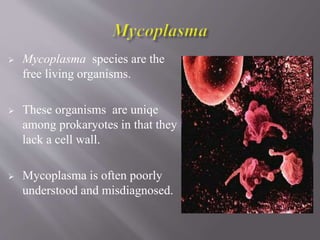
 Mycoplasma species are the
free living organisms.
 These organisms are uniqe
among prokaryotes in that they
lack a cell wall.
 Mycoplasma is often poorly
understood and misdiagnosed.
 Mycoplasma is spread very much like the common
cold, through respiratory droplets by coughing and
sneezing or by direct contact with objects soiled by
these .
 Transmission is thought to require prolonged close
contact with an infected person. Mycoplasma
infection can occur at any age.
 The name Mycoplasma, from the Greek mykes
(fungus) and plasma (formed) was proposed in the
1950s, replasing the term.
 Refering organisms similar to the causative agent of
 Pleuro Pneumonia Like Organisms (PPLO).
 Contagious Bovine Pleuro Pneumonia (CBPP).
 Prokaryotic microbes.
 Size of 150-250 nm.
 Lack of a cell wall membrane.
 Sterol containing cell membrane.
 Fastidious growth requirements.
 Fried egg (or) mulberry colonies on agar.
 However, the term mycoplasma has been frequently
used to denote any species included in the class
Mollicutes).
 The common characteristics are the complete lack
of a bacterial cell wall, osmotic fragility, colony
shape and filterability through 450-nm pore
diameter membrane filters.
 Mycoplasma can be cultured on liquid or solid
medium.
 Growths optimally at 35 to 37˚c.
 Medium of growth should be enriched with 20%
horse or human serum.
 The colonies as fried egg appearance.
 Scientists have isolated at least 17 species of
Mycoplasma from humans,
 Four types of organisms are responsible for most
clinically significant infections that may come to the
attention of practicing physicians.
 Mycoplasma pneumoniae,
 Mycoplasma hominis,
 Mycoplasma genitalium, and
 Ureaplasma species.
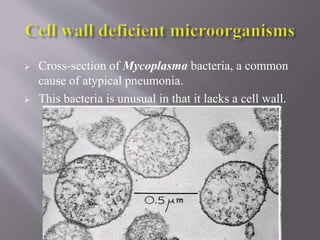
 Cross-section of Mycoplasma bacteria, a common
cause of atypical pneumonia.
 This bacteria is unusual in that it lacks a cell wall.
 The disease is world wide, found in all age groups.
 Trasmission by drop let infection of nasopharyngeal
secretions.
 Spread is associated with close contact of infected
person.
 Important infection in military personal.
 Even the persons recovered from infection will harbor
the pathogens for 2 months or more.
 Often symptoms are so mild that the infection is not
recognised. In the early stages of the illness,
 Mycoplasma can appear similar to a cold or the flu.
 It may lead to a persistent cough and fatigue that can
last for months.
Typical symptoms include:
 Headaches
 Fever
 Sore throat
 Fatigue
 Lethargy
 Dry cough
Mycoplasma may lead to:
 Bronchitis
 Wheezing
 Pneumonia
 Ear infections
 Sinusitis
 Mycoplasma can be difficult to diagnose, as it mimics
the symptoms of other bacterial and viral infections,
such as the common cold.
 Diagnosis is often made by medical examination and
may require a blood test and or chest x-ray.
 It does not test for the bacteria itself.
 Interpretation of results can be difficult as it combines
two types of antibodies, one that rises acutely with the
illness IgM and IgG that remains positive for year sand
indicates prior exposure .
 Colonization of infants by genital Mycoplasma
species
 Usually occurs during passage through an infected
birth canal, and genital mycoplasmal organisms
 Have been isolated from the upper respiratory tract
in 15% of infants.
 Colonization usually does not persist beyond 2
years.
 Major infections are produced by M.hominis and
M.urealyticum
 Ureaplasma urealyticum, a common commensals of
the urogenital tract of sexually mature humans
 Is gaining recognition as an important opportunistic
pathogen during pregnancy.
 Urethritis
 Pyelonephritis
 Pelvic inflammatory disease
 Endometritis or chorioamnionitis
 Infectious arthritis
 Surgical wound infections
 Neonatal pneumonia
 Neonatal meningitis
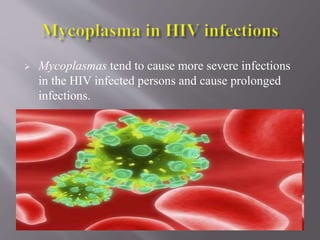
 Mycoplasmas tend to cause more severe infections
in the HIV infected persons and cause prolonged
infections.
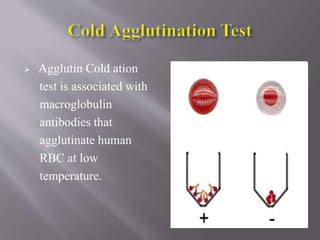
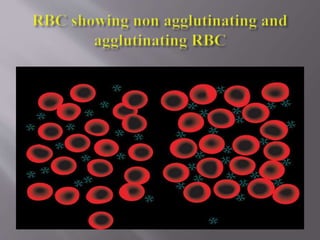
 Agglutin Cold ation
test is associated with
macroglobulin
antibodies that
agglutinate human
RBC at low
temperature.
 The serial dilutions of patients
serum are mixed with an equal
volume of 0.2% washed
human blood group erythrocytes
at low temperature.
 The clumping is observed at
40˚c overnight.
 However the clumping is
dissociated at 37˚c
 A titer of 1:32 is
suggestive.
 A raised titer in paired serum sample is more suggestive of
infection.
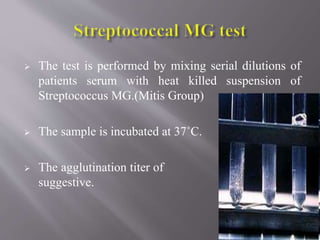
 The test is performed by mixing serial dilutions of
patients serum with heat killed suspension of
Streptococcus MG.(Mitis Group)
 The sample is incubated at 37˚C.
 The agglutination titer of 1:20
suggestive.
 Penicillin,
 Ampicillin,
 Cefotaxime,
 Erythromycin,
 Clindamycin,
 Chloramphenicol and
 Tetracycline.
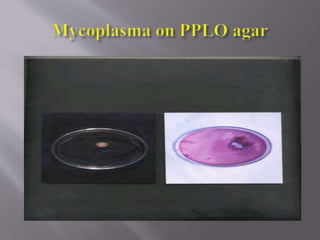
 For isolation swabs from
throat or respiratory
secretions inoculated not
Mycoplasma medium
 The growth is slow and
takes 1 – 3 weeks
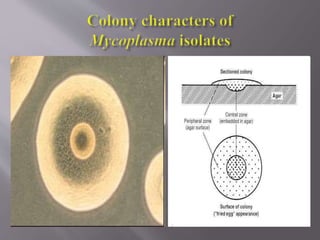
 The colonies appear as
fried egg, with central
opaque granular area
surrounded by flat
translucent peripheral
zone
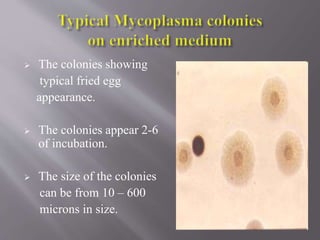
 The colonies showing
typical fried egg
appearance.
 The colonies appear 2-6 days
of incubation.
 The size of the colonies
can be from 10 – 600
microns in size.
 The metabolism of
Mycoplasma are
fermentative.
 Most species utilize
glucose or arginine
 Urea is hydrolyzed by
Ureaplasma only
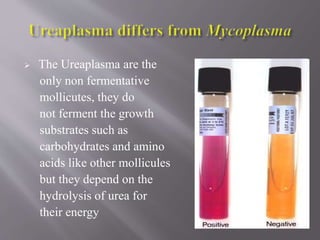
 The Ureaplasma are the
only non fermentative
mollicutes, they do
not ferment the growth
substrates such as
carbohydrates and amino
acids like other mollicules
but they depend on the
hydrolysis of urea for
their energy
 Exclusion from childcare, school or work is not
necessary.
 No vaccine is available at present. Effective
antibiotic treatment is available, although most
people recover completely without it.
 Antibiotics may speed recovery, but appear not to
reduce the period for which a personisable to
transmit infection.
 There is no medical evidence that suggests
antibiotic treatment effectively treats the tiredness
that can linger with an infection.
 Erythromycin (M. pneumoniae and
Ureaplasma spp.)
 Tetracyclines,
 Clindamycin, (M. hominis)
 Levofloxacin,
 Doxycycline,
 Gentamycin.
 As with any respiratory tract infection, it is
important to cover your mouth and nose when
coughing and sneezing.
 Use tissues when coughing, sneezing or wiping the
nose, and dispose of these appropriately.
 It is recommended that good hand washing
procedures are followed.
Mycoplasma Infection

Mycoplasma Infection

  • 1.
    R. Mariyakannan M. Sc.,Microbiology Bharathidasan University Trichy-24
  • 2.
     Mycoplasma speciesare the free living organisms.  These organisms are uniqe among prokaryotes in that they lack a cell wall.  Mycoplasma is often poorly understood and misdiagnosed.
  • 3.
     Mycoplasma isspread very much like the common cold, through respiratory droplets by coughing and sneezing or by direct contact with objects soiled by these .  Transmission is thought to require prolonged close contact with an infected person. Mycoplasma infection can occur at any age.
  • 5.
     The nameMycoplasma, from the Greek mykes (fungus) and plasma (formed) was proposed in the 1950s, replasing the term.  Refering organisms similar to the causative agent of  Pleuro Pneumonia Like Organisms (PPLO).  Contagious Bovine Pleuro Pneumonia (CBPP).
  • 6.
     Prokaryotic microbes. Size of 150-250 nm.  Lack of a cell wall membrane.  Sterol containing cell membrane.  Fastidious growth requirements.  Fried egg (or) mulberry colonies on agar.
  • 7.
     However, theterm mycoplasma has been frequently used to denote any species included in the class Mollicutes).  The common characteristics are the complete lack of a bacterial cell wall, osmotic fragility, colony shape and filterability through 450-nm pore diameter membrane filters.
  • 8.
     Mycoplasma canbe cultured on liquid or solid medium.  Growths optimally at 35 to 37˚c.  Medium of growth should be enriched with 20% horse or human serum.  The colonies as fried egg appearance.
  • 9.
     Scientists haveisolated at least 17 species of Mycoplasma from humans,  Four types of organisms are responsible for most clinically significant infections that may come to the attention of practicing physicians.
  • 10.
     Mycoplasma pneumoniae, Mycoplasma hominis,  Mycoplasma genitalium, and  Ureaplasma species.
  • 11.
     Cross-section ofMycoplasma bacteria, a common cause of atypical pneumonia.  This bacteria is unusual in that it lacks a cell wall.
  • 12.
     The diseaseis world wide, found in all age groups.  Trasmission by drop let infection of nasopharyngeal secretions.  Spread is associated with close contact of infected person.  Important infection in military personal.  Even the persons recovered from infection will harbor the pathogens for 2 months or more.
  • 13.
     Often symptomsare so mild that the infection is not recognised. In the early stages of the illness,  Mycoplasma can appear similar to a cold or the flu.  It may lead to a persistent cough and fatigue that can last for months.
  • 14.
    Typical symptoms include: Headaches  Fever  Sore throat  Fatigue  Lethargy  Dry cough
  • 15.
    Mycoplasma may leadto:  Bronchitis  Wheezing  Pneumonia  Ear infections  Sinusitis
  • 16.
     Mycoplasma canbe difficult to diagnose, as it mimics the symptoms of other bacterial and viral infections, such as the common cold.  Diagnosis is often made by medical examination and may require a blood test and or chest x-ray.  It does not test for the bacteria itself.  Interpretation of results can be difficult as it combines two types of antibodies, one that rises acutely with the illness IgM and IgG that remains positive for year sand indicates prior exposure .
  • 17.
     Colonization ofinfants by genital Mycoplasma species  Usually occurs during passage through an infected birth canal, and genital mycoplasmal organisms  Have been isolated from the upper respiratory tract in 15% of infants.  Colonization usually does not persist beyond 2 years.
  • 18.
     Major infectionsare produced by M.hominis and M.urealyticum  Ureaplasma urealyticum, a common commensals of the urogenital tract of sexually mature humans  Is gaining recognition as an important opportunistic pathogen during pregnancy.
  • 19.
     Urethritis  Pyelonephritis Pelvic inflammatory disease  Endometritis or chorioamnionitis  Infectious arthritis  Surgical wound infections  Neonatal pneumonia  Neonatal meningitis
  • 20.
     Mycoplasmas tendto cause more severe infections in the HIV infected persons and cause prolonged infections.
  • 21.
     Agglutin Coldation test is associated with macroglobulin antibodies that agglutinate human RBC at low temperature.
  • 22.
     The serialdilutions of patients serum are mixed with an equal volume of 0.2% washed human blood group erythrocytes at low temperature.  The clumping is observed at 40˚c overnight.  However the clumping is dissociated at 37˚c  A titer of 1:32 is suggestive.  A raised titer in paired serum sample is more suggestive of infection.
  • 24.
     The testis performed by mixing serial dilutions of patients serum with heat killed suspension of Streptococcus MG.(Mitis Group)  The sample is incubated at 37˚C.  The agglutination titer of 1:20 suggestive.
  • 25.
     Penicillin,  Ampicillin, Cefotaxime,  Erythromycin,  Clindamycin,  Chloramphenicol and  Tetracycline.
  • 26.
     For isolationswabs from throat or respiratory secretions inoculated not Mycoplasma medium  The growth is slow and takes 1 – 3 weeks  The colonies appear as fried egg, with central opaque granular area surrounded by flat translucent peripheral zone
  • 28.
     The coloniesshowing typical fried egg appearance.  The colonies appear 2-6 days of incubation.  The size of the colonies can be from 10 – 600 microns in size.
  • 30.
     The metabolismof Mycoplasma are fermentative.  Most species utilize glucose or arginine  Urea is hydrolyzed by Ureaplasma only
  • 31.
     The Ureaplasmaare the only non fermentative mollicutes, they do not ferment the growth substrates such as carbohydrates and amino acids like other mollicules but they depend on the hydrolysis of urea for their energy
  • 32.
     Exclusion fromchildcare, school or work is not necessary.  No vaccine is available at present. Effective antibiotic treatment is available, although most people recover completely without it.  Antibiotics may speed recovery, but appear not to reduce the period for which a personisable to transmit infection.  There is no medical evidence that suggests antibiotic treatment effectively treats the tiredness that can linger with an infection.
  • 33.
     Erythromycin (M.pneumoniae and Ureaplasma spp.)  Tetracyclines,  Clindamycin, (M. hominis)  Levofloxacin,  Doxycycline,  Gentamycin.
  • 34.
     As withany respiratory tract infection, it is important to cover your mouth and nose when coughing and sneezing.  Use tissues when coughing, sneezing or wiping the nose, and dispose of these appropriately.  It is recommended that good hand washing procedures are followed.