HUMAN CHLAMYDIASIS
RK KARNA
INTRODUCTION
• Chlamydiasis is a disease caused by intracellular obligate bacterium
namely
 Chlamydia trachomatis
Chlamydophila pneumoniae
Chlamydophila psittaci
The different infections caused by these organisms in humans is
collectively called human chlamydiasis.
CLASSIFICATION
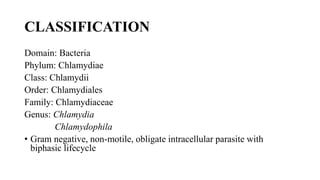
Domain: Bacteria
Phylum: Chlamydiae
Class: Chlamydii
Order: Chlamydiales
Family: Chlamydiaceae
Genus: Chlamydia
Chlamydophila
• Gram negative, non-motile, obligate intracellular parasite with
biphasic lifecycle
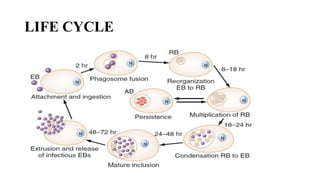
MORPHOLOGICAL FORMS
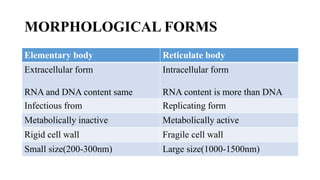
Elementary body Reticulate body
Extracellular form
RNA and DNA content same
Intracellular form
RNA content is more than DNA
Infectious from Replicating form
Metabolically inactive Metabolically active
Rigid cell wall Fragile cell wall
Small size(200-300nm) Large size(1000-1500nm)
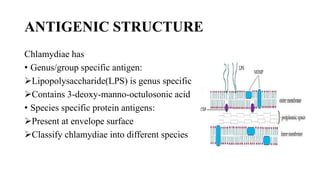
ANTIGENIC STRUCTURE
Chlamydiae has
• Genus/group specific antigen:
Lipopolysaccharide(LPS) is genus specific
Contains 3-deoxy-manno-octulosonic acid
• Species specific protein antigens:
Present at envelope surface
Classify chlamydiae into different species
Contd…
• Serovar specific antigens:
Major outer membrane proteins(MOMP)
• Other antigens like
Cysteine rich proteins
Heat shock proteins
Polymorphic membrane protein
Inclusion membrane proteins
LIFE CYCLE
Chlamydia trachomatis
• Primarily a human pathogen
• Comprises three biovars
Trachoma biovar
Lymphogranuloma venereum(LGV) biovar
Mouse pneumonitis biovar
• Serotyping:
based on major outer membrane protein(MOMP)
19 serovars affecting humans have been identified
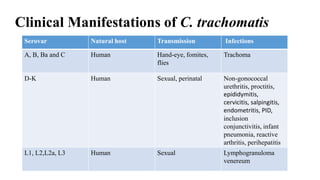
Serovar Natural host Transmission Infections
A, B, Ba and C Human Hand-eye, fomites,
flies
Trachoma
D-K Human Sexual, perinatal Non-gonococcal
urethritis, proctitis,
epididymitis,
cervicitis, salpingitis,
endometritis, PID,
inclusion
conjunctivitis, infant
pneumonia, reactive
arthritis, perihepatitis
L1, L2,L2a, L3 Human Sexual Lymphogranuloma
venereum
Clinical Manifestations of C. trachomatis
TRACHOMA
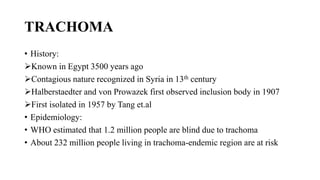
• History:
Known in Egypt 3500 years ago
Contagious nature recognized in Syria in 13th century
Halberstaedter and von Prowazek first observed inclusion body in 1907
First isolated in 1957 by Tang et.al
• Epidemiology:
• WHO estimated that 1.2 million people are blind due to trachoma
• About 232 million people living in trachoma-endemic region are at risk
Contd…
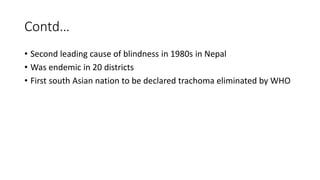
• Second leading cause of blindness in 1980s in Nepal
• Was endemic in 20 districts
• First south Asian nation to be declared trachoma eliminated by WHO
Contd…
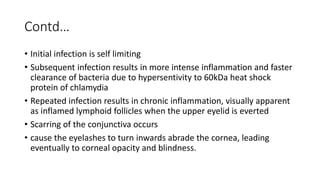
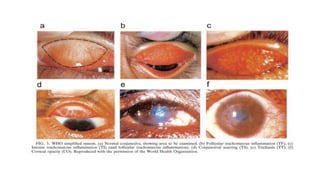
• Initial infection is self limiting
• Subsequent infection results in more intense inflammation and faster
clearance of bacteria due to hypersentivity to 60kDa heat shock
protein of chlamydia
• Repeated infection results in chronic inflammation, visually apparent
as inflamed lymphoid follicles when the upper eyelid is everted
• Scarring of the conjunctiva occurs
• cause the eyelashes to turn inwards abrade the cornea, leading
eventually to corneal opacity and blindness.
LYMPHOGRANULOMA VENEREUM(LGV)
• First stage: painless papule develops on penis or vulva after IP of
3days to 6 weeks
• Second stage:
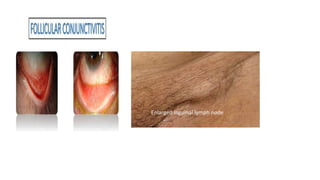
inguinal lymph nodes in groin becomes enlarged, tender and soft
Fever, headache, myalgia
• Third stage:
rectal stricture
elephantiasis of vulva or scrotum
LGV-Epidemiology
• Commonly found in areas of the Caribbean, Central America,
Southeast Asia, and Africa
• In 2014, 1416 cases reported in 21 European country
• Evaluation of 5554 rectal samples showed LGV in 2.3% samples
• 2-10% of genital diseases
NONGONOCOCCAL URETHRITIS
• Incubation period: 7-10 days
• Mucopurulent discharge is followed by dysuria and urethral irritation
• Postgonococcal urethritis may develop after 2-3 weeks of recovery
from GU
• Responsible for 30-50% cases of NGU
INCLUSION CONJUNCTIVITIS
1. Opthalmia neonatarum:
• Approximately 60–70% of infants born through infected birth canal
acquire the infection.
IP 6-21 days
Mucopurulent discharge
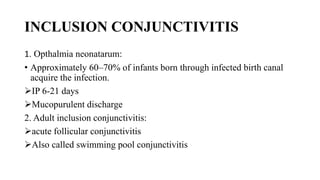
2. Adult inclusion conjunctivitis:
acute follicular conjunctivitis
Also called swimming pool conjunctivitis
Enlarged inguinal lymph node
INFANT PNEUMONIA
• 11-20% born to infected mothers develop pneumonia
• Around half of them show history of conjunctivitis
• Symptomatic after 8weeks of age
• nasal obstruction or discharge or both
• Tachypnea
• cough
Chlamydophila psitacci
• Morange applied the term psittacosis (Greek parrot) in 1892
• Common in birds and animals
• Psittacine birds: cockatiels, parakeets, parrots, and macaws
• Nonpsittacine birds: pigeons, doves, and mynah
• 10 genotypes based on OmpA
• Mode of transmission:
Inhalation of aerosols with infective discharge or dust
Direct contact with infected birds
Bite of infected bird
Contd…
• From 1988 to 2003, 935 cases in the United States reported to the
CDC
• 70% of these cases associated with exposure to birds
• 5% to 8% carrier rate among birds
• Causes psittacosis
• Incubation period: 5-19 days
Clinical manifestations
• Common symptoms include:
Fever, headache, chills
Malaise, myalgia
Non-productive cough, dyspnea
• Complications include:
Pericarditis, Endocarditis, Myocarditis
 Hepatomegaly, Splenomegaly
Chlamydophila pneumoniae
• First isolated during trachoma studies in 1960s
• Similar isolate obtained from respiratory tract of college student with
pneumonia
• Named TWAR agents after first two isolates TW-183 and AR-39
• Single serotype isolated so far
• 5-10% of community acquired pneumonia
• Transmission through droplets and contaminated fomites
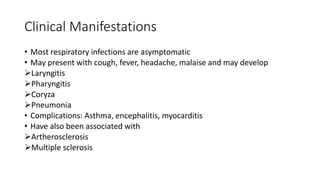
Clinical Manifestations
• Most respiratory infections are asymptomatic
• May present with cough, fever, headache, malaise and may develop
Laryngitis
Pharyngitis
Coryza
Pneumonia
• Complications: Asthma, encephalitis, myocarditis
• Have also been associated with
Artherosclerosis
Multiple sclerosis
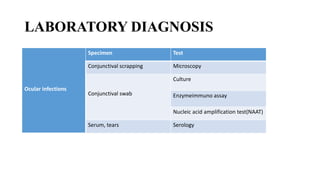
LABORATORY DIAGNOSIS
Ocular infections
Specimen Test
Conjunctival scrapping Microscopy
Conjunctival swab
Culture
Enzymeimmuno assay
Nucleic acid amplification test(NAAT)
Serum, tears Serology
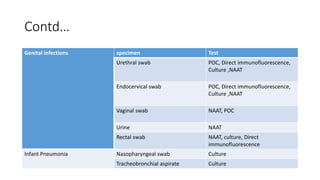
Contd…
Genital infections specimen Test
Urethral swab POC, Direct immunofluorescence,
Culture ,NAAT
Endocervical swab POC, Direct immunofluorescence,
Culture ,NAAT
Vaginal swab NAAT, POC
Urine NAAT
Rectal swab NAAT, culture, Direct
immunofluorescence
Infant Pneumonia Nasopharyngeal swab Culture
Tracheobronchial aspirate Culture
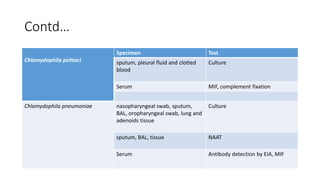
Contd…
Chlamydophila psittaci
Specimen Test
sputum, pleural fluid and clotted
blood
Culture
Serum MIF, complement fixation
Chlamydophila pneumoniae nasopharyngeal swab, sputum,
BAL, oropharyngeal swab, lung and
adenoids tissue
Culture
sputum, BAL, tissue NAAT
Serum Antibody detection by EIA, MIF
Contd…
1)Microscopy:
Giemsa, Casteneda, Machiavello, Gimenez or Lugols iodine can be
used
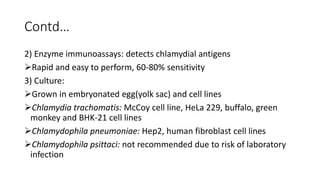
Inclusion bodies can be detected in cytoplasm namely:
• Halberstaedter-Prowazek in trachoma
• Miyagawa corpuscle in LGV
Direct immunofluorescence can also be used
Inclusion body in
giemsa stain
Inclusion body in iodine
Contd…
2) Enzyme immunoassays: detects chlamydial antigens
Rapid and easy to perform, 60-80% sensitivity
3) Culture:
Grown in embryonated egg(yolk sac) and cell lines
Chlamydia trachomatis: McCoy cell line, HeLa 229, buffalo, green
monkey and BHK-21 cell lines
Chlamydophila pneumoniae: Hep2, human fibroblast cell lines
Chlamydophila psittaci: not recommended due to risk of laboratory
infection
Contd…
4)Serology:
a)Complement fixation test:
uses group specific LPS antigen
Titre of ≥1:64 considered significant
5)Microimmunofluorescence(MIF):
Uses species specific and serovar specific MOMP
Can detect IgM and IgG separately
Single titre of ≥1:512 is significant
Fourfold rise after 2-3 weeks more significant
Contd…
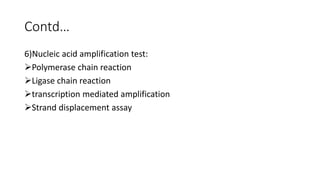
6)Nucleic acid amplification test:
Polymerase chain reaction
Ligase chain reaction
transcription mediated amplification
Strand displacement assay
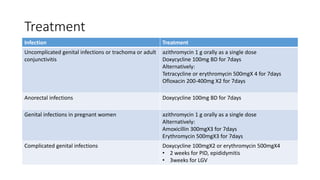
Treatment
Infection Treatment
Uncomplicated genital infections or trachoma or adult
conjunctivitis
azithromycin 1 g orally as a single dose
Doxycycline 100mg BD for 7days
Alternatively:
Tetracycline or erythromycin 500mgX 4 for 7days
Ofloxacin 200-400mg X2 for 7days
Anorectal infections Doxycycline 100mg BD for 7days
Genital infections in pregnant women azithromycin 1 g orally as a single dose
Alternatively:
Amoxicillin 300mgX3 for 7days
Erythromycin 500mgX3 for 7days
Complicated genital infections Doxycycline 100mgX2 or erythromycin 500mgX4
• 2 weeks for PID, epididymitis
• 3weeks for LGV
Contd…
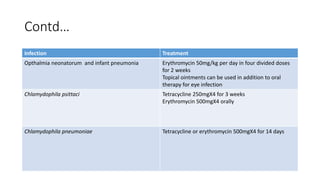
Infection Treatment
Opthalmia neonatorum and infant pneumonia Erythromycin 50mg/kg per day in four divided doses
for 2 weeks
Topical ointments can be used in addition to oral
therapy for eye infection
Chlamydophila psittaci Tetracycline 250mgX4 for 3 weeks
Erythromycin 500mgX4 orally
Chlamydophila pneumoniae Tetracycline or erythromycin 500mgX4 for 14 days
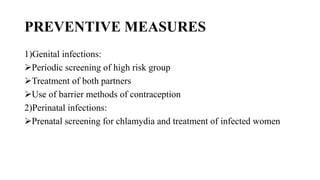
PREVENTIVE MEASURES
1)Genital infections:
Periodic screening of high risk group
Treatment of both partners
Use of barrier methods of contraception
2)Perinatal infections:
Prenatal screening for chlamydia and treatment of infected women
Contd…
3) Psittacosis
Treatment of infected birds
Imported birds be quarantined for 45 days and treat with
chlortetracycline
4) Trachoma: S-A-F-E strategy
Surgery for deformed eyelids
Periodic mass treatment with azithromycin
Face washing and hygiene
 Environmental improvements to control flies
THANK YOU!

Human Chlamydiasis infection PPT Presentation.pptx

  • 1.
  • 2.
    INTRODUCTION • Chlamydiasis isa disease caused by intracellular obligate bacterium namely  Chlamydia trachomatis Chlamydophila pneumoniae Chlamydophila psittaci The different infections caused by these organisms in humans is collectively called human chlamydiasis.
  • 3.
    CLASSIFICATION Domain: Bacteria Phylum: Chlamydiae Class:Chlamydii Order: Chlamydiales Family: Chlamydiaceae Genus: Chlamydia Chlamydophila • Gram negative, non-motile, obligate intracellular parasite with biphasic lifecycle
  • 4.
    MORPHOLOGICAL FORMS Elementary bodyReticulate body Extracellular form RNA and DNA content same Intracellular form RNA content is more than DNA Infectious from Replicating form Metabolically inactive Metabolically active Rigid cell wall Fragile cell wall Small size(200-300nm) Large size(1000-1500nm)
  • 5.
    ANTIGENIC STRUCTURE Chlamydiae has •Genus/group specific antigen: Lipopolysaccharide(LPS) is genus specific Contains 3-deoxy-manno-octulosonic acid • Species specific protein antigens: Present at envelope surface Classify chlamydiae into different species
  • 6.
    Contd… • Serovar specificantigens: Major outer membrane proteins(MOMP) • Other antigens like Cysteine rich proteins Heat shock proteins Polymorphic membrane protein Inclusion membrane proteins
  • 7.
  • 8.
    Chlamydia trachomatis • Primarilya human pathogen • Comprises three biovars Trachoma biovar Lymphogranuloma venereum(LGV) biovar Mouse pneumonitis biovar • Serotyping: based on major outer membrane protein(MOMP) 19 serovars affecting humans have been identified
  • 9.
    Serovar Natural hostTransmission Infections A, B, Ba and C Human Hand-eye, fomites, flies Trachoma D-K Human Sexual, perinatal Non-gonococcal urethritis, proctitis, epididymitis, cervicitis, salpingitis, endometritis, PID, inclusion conjunctivitis, infant pneumonia, reactive arthritis, perihepatitis L1, L2,L2a, L3 Human Sexual Lymphogranuloma venereum Clinical Manifestations of C. trachomatis
  • 10.
    TRACHOMA • History: Known inEgypt 3500 years ago Contagious nature recognized in Syria in 13th century Halberstaedter and von Prowazek first observed inclusion body in 1907 First isolated in 1957 by Tang et.al • Epidemiology: • WHO estimated that 1.2 million people are blind due to trachoma • About 232 million people living in trachoma-endemic region are at risk
  • 11.
    Contd… • Second leadingcause of blindness in 1980s in Nepal • Was endemic in 20 districts • First south Asian nation to be declared trachoma eliminated by WHO
  • 12.
    Contd… • Initial infectionis self limiting • Subsequent infection results in more intense inflammation and faster clearance of bacteria due to hypersentivity to 60kDa heat shock protein of chlamydia • Repeated infection results in chronic inflammation, visually apparent as inflamed lymphoid follicles when the upper eyelid is everted • Scarring of the conjunctiva occurs • cause the eyelashes to turn inwards abrade the cornea, leading eventually to corneal opacity and blindness.
  • 14.
    LYMPHOGRANULOMA VENEREUM(LGV) • Firststage: painless papule develops on penis or vulva after IP of 3days to 6 weeks • Second stage: inguinal lymph nodes in groin becomes enlarged, tender and soft Fever, headache, myalgia • Third stage: rectal stricture elephantiasis of vulva or scrotum
  • 15.
    LGV-Epidemiology • Commonly foundin areas of the Caribbean, Central America, Southeast Asia, and Africa • In 2014, 1416 cases reported in 21 European country • Evaluation of 5554 rectal samples showed LGV in 2.3% samples • 2-10% of genital diseases
  • 16.
    NONGONOCOCCAL URETHRITIS • Incubationperiod: 7-10 days • Mucopurulent discharge is followed by dysuria and urethral irritation • Postgonococcal urethritis may develop after 2-3 weeks of recovery from GU • Responsible for 30-50% cases of NGU
  • 17.
    INCLUSION CONJUNCTIVITIS 1. Opthalmianeonatarum: • Approximately 60–70% of infants born through infected birth canal acquire the infection. IP 6-21 days Mucopurulent discharge 2. Adult inclusion conjunctivitis: acute follicular conjunctivitis Also called swimming pool conjunctivitis
  • 18.
  • 19.
    INFANT PNEUMONIA • 11-20%born to infected mothers develop pneumonia • Around half of them show history of conjunctivitis • Symptomatic after 8weeks of age • nasal obstruction or discharge or both • Tachypnea • cough
  • 20.
    Chlamydophila psitacci • Morangeapplied the term psittacosis (Greek parrot) in 1892 • Common in birds and animals • Psittacine birds: cockatiels, parakeets, parrots, and macaws • Nonpsittacine birds: pigeons, doves, and mynah • 10 genotypes based on OmpA • Mode of transmission: Inhalation of aerosols with infective discharge or dust Direct contact with infected birds Bite of infected bird
  • 21.
    Contd… • From 1988to 2003, 935 cases in the United States reported to the CDC • 70% of these cases associated with exposure to birds • 5% to 8% carrier rate among birds • Causes psittacosis • Incubation period: 5-19 days
  • 23.
    Clinical manifestations • Commonsymptoms include: Fever, headache, chills Malaise, myalgia Non-productive cough, dyspnea • Complications include: Pericarditis, Endocarditis, Myocarditis  Hepatomegaly, Splenomegaly
  • 24.
    Chlamydophila pneumoniae • Firstisolated during trachoma studies in 1960s • Similar isolate obtained from respiratory tract of college student with pneumonia • Named TWAR agents after first two isolates TW-183 and AR-39 • Single serotype isolated so far • 5-10% of community acquired pneumonia • Transmission through droplets and contaminated fomites
  • 25.
    Clinical Manifestations • Mostrespiratory infections are asymptomatic • May present with cough, fever, headache, malaise and may develop Laryngitis Pharyngitis Coryza Pneumonia • Complications: Asthma, encephalitis, myocarditis • Have also been associated with Artherosclerosis Multiple sclerosis
  • 26.
    LABORATORY DIAGNOSIS Ocular infections SpecimenTest Conjunctival scrapping Microscopy Conjunctival swab Culture Enzymeimmuno assay Nucleic acid amplification test(NAAT) Serum, tears Serology
  • 27.
    Contd… Genital infections specimenTest Urethral swab POC, Direct immunofluorescence, Culture ,NAAT Endocervical swab POC, Direct immunofluorescence, Culture ,NAAT Vaginal swab NAAT, POC Urine NAAT Rectal swab NAAT, culture, Direct immunofluorescence Infant Pneumonia Nasopharyngeal swab Culture Tracheobronchial aspirate Culture
  • 28.
    Contd… Chlamydophila psittaci Specimen Test sputum,pleural fluid and clotted blood Culture Serum MIF, complement fixation Chlamydophila pneumoniae nasopharyngeal swab, sputum, BAL, oropharyngeal swab, lung and adenoids tissue Culture sputum, BAL, tissue NAAT Serum Antibody detection by EIA, MIF
  • 29.
    Contd… 1)Microscopy: Giemsa, Casteneda, Machiavello,Gimenez or Lugols iodine can be used Inclusion bodies can be detected in cytoplasm namely: • Halberstaedter-Prowazek in trachoma • Miyagawa corpuscle in LGV Direct immunofluorescence can also be used
  • 30.
    Inclusion body in giemsastain Inclusion body in iodine
  • 31.
    Contd… 2) Enzyme immunoassays:detects chlamydial antigens Rapid and easy to perform, 60-80% sensitivity 3) Culture: Grown in embryonated egg(yolk sac) and cell lines Chlamydia trachomatis: McCoy cell line, HeLa 229, buffalo, green monkey and BHK-21 cell lines Chlamydophila pneumoniae: Hep2, human fibroblast cell lines Chlamydophila psittaci: not recommended due to risk of laboratory infection
  • 32.
    Contd… 4)Serology: a)Complement fixation test: usesgroup specific LPS antigen Titre of ≥1:64 considered significant 5)Microimmunofluorescence(MIF): Uses species specific and serovar specific MOMP Can detect IgM and IgG separately Single titre of ≥1:512 is significant Fourfold rise after 2-3 weeks more significant
  • 33.
    Contd… 6)Nucleic acid amplificationtest: Polymerase chain reaction Ligase chain reaction transcription mediated amplification Strand displacement assay
  • 34.
    Treatment Infection Treatment Uncomplicated genitalinfections or trachoma or adult conjunctivitis azithromycin 1 g orally as a single dose Doxycycline 100mg BD for 7days Alternatively: Tetracycline or erythromycin 500mgX 4 for 7days Ofloxacin 200-400mg X2 for 7days Anorectal infections Doxycycline 100mg BD for 7days Genital infections in pregnant women azithromycin 1 g orally as a single dose Alternatively: Amoxicillin 300mgX3 for 7days Erythromycin 500mgX3 for 7days Complicated genital infections Doxycycline 100mgX2 or erythromycin 500mgX4 • 2 weeks for PID, epididymitis • 3weeks for LGV
  • 35.
    Contd… Infection Treatment Opthalmia neonatorumand infant pneumonia Erythromycin 50mg/kg per day in four divided doses for 2 weeks Topical ointments can be used in addition to oral therapy for eye infection Chlamydophila psittaci Tetracycline 250mgX4 for 3 weeks Erythromycin 500mgX4 orally Chlamydophila pneumoniae Tetracycline or erythromycin 500mgX4 for 14 days
  • 36.
    PREVENTIVE MEASURES 1)Genital infections: Periodicscreening of high risk group Treatment of both partners Use of barrier methods of contraception 2)Perinatal infections: Prenatal screening for chlamydia and treatment of infected women
  • 37.
    Contd… 3) Psittacosis Treatment ofinfected birds Imported birds be quarantined for 45 days and treat with chlortetracycline 4) Trachoma: S-A-F-E strategy Surgery for deformed eyelids Periodic mass treatment with azithromycin Face washing and hygiene  Environmental improvements to control flies
  • 38.

Editor's Notes

  • #3 Initially single genus Other spp are chlamydophila pecorum, felis, abortus, caviae
  • #6 Lps used in complement fixation test, induction of TNF-alpha and other cytokines
  • #7 Momp used in immunofluorescence test
  • #10 C.Trachomatis infections can be categorized clinically as classic ocular trachoma, perinatal infection, LGV and other oculogenital infections in adults
  • #11 2.2 million people visually impaired Treatment have been described in china in 27th century bc
  • #16 Uk, france, netherland, finland, malta, italy
  • #18 About 1 in 3 exposed develop inclusion conjunctivitis 10-30% inclusion-active trachoma 50%- adult IC, 90%- ON
  • #20  1 in 6 develop pneumonia Perinatally acquired C. trachomatis infection may persist in the nasopharynx, urogenital tract, or rectum for more than 2 years Consequently, differentiating infection acquired at birth from infection related to sexual abuse may be particularly difficult in younger children.
  • #21 Psitacosis- systemic infection that generally causes pneumonia Feces, fecal dust, nasal secretions
  • #25 isolated from nonhuman species, including a horse, koalas, bandicoots, and amphibians.