Dr Manoj Das
Ortho Resident
Institute Of Medicine TUTH, Nepal
An Approach To Limping Child
INTRODUCTION
• An uneven, jerky, or laborious gait, usually caused by pain, weakness, or
deformity.
• It is a common complaint in childhood, accounting for 4 per 1000 visits in
pediatric emergency department. [ Uptodate 2016]
• Limp can be caused by both benign and life-threatening conditions; the
management varies from reassurance to major surgery depending upon
the cause.
INTRODUCTION
Pathophysiology
• Three major factors cause a child to limp:
pain, weakness, and structural or mechanical
abnormalities of the spine, pelvis, and lower
extremities (Clark, 1997; deBoeck & Vorlat, 2003; Lawrence, 1998).
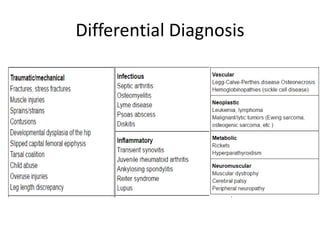
Differential Diagnosis
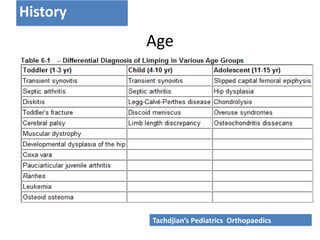
Age
Tachdjian’s Pediatrics Orthopaedics
History
History…
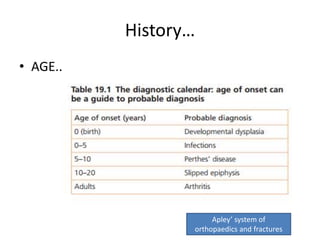
• AGE..
Apley’ system of
orthopaedics and fractures
History…
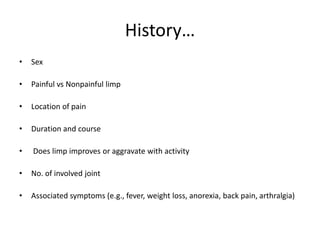
• Sex
• Painful vs Nonpainful limp
• Location of pain
• Duration and course
• Does limp improves or aggravate with activity
• No. of involved joint
• Associated symptoms (e.g., fever, weight loss, anorexia, back pain, arthralgia)
History…
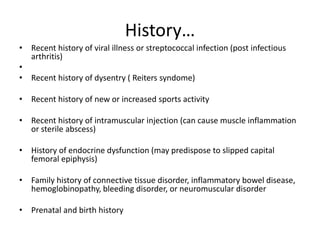
• Recent history of viral illness or streptococcal infection (post infectious
arthritis)
•
• Recent history of dysentry ( Reiters syndome)
• Recent history of new or increased sports activity
• Recent history of intramuscular injection (can cause muscle inflammation
or sterile abscess)
• History of endocrine dysfunction (may predispose to slipped capital
femoral epiphysis)
• Family history of connective tissue disorder, inflammatory bowel disease,
hemoglobinopathy, bleeding disorder, or neuromuscular disorder
• Prenatal and birth history
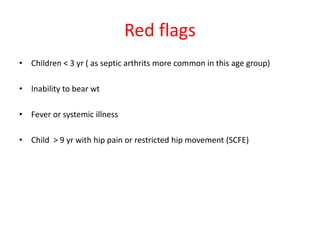
Red flags
• Children < 3 yr ( as septic arthrits more common in this age group)
• Inability to bear wt
• Fever or systemic illness
• Child > 9 yr with hip pain or restricted hip movement (SCFE)
PHYSICAL EXAMINATION
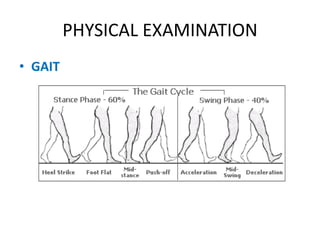
• GAIT
Normal gait variations in children
• The development of mature gait depends upon maturation of
C.N.S(postural ,labyrinthine and rightining reflexes )
• Normal variations of gait in children:-
-Toe walking is common up to 3 years
-In-toeing can be due to persisting femoral anteversion (this is most
common between ages 3-8 years)
-Internal tibial torsion is also common (knees point forwards but
feet point in)
-Metatarsus adductus resolve by the age of 6 years.
Normal gait variations in children…
-Bow legs (genu varus) are common from birth to early toddler-phase,
maximum at age 1 year, often with out-toeing. Most resolve by 18
months
-Knock knees (genu valgus) are common and associated with in-
toeing. Most resolve by the age of 7 years
-Flat feet are common. Most children have a flexible foot with a
normal arch on tiptoeing. Flat feet usually resolve by the age of 6
years
-Crooked toes. Most resolve with weight-bearing.
Normal gait variations in children…
 Toddler’s walking
-walks on wide base to avoid falling
-Reduced period of single limb support
-shorter step length
-Increased cadance
-more pelvic tilt
 The adult pattern of gait develops between 3-5 years of age.
PATHOLOGICAL GAIT
1. Muscle weakness:(source of
motion )
2. Deformities of bones and joints
(Articulated lever
3. Neurological disorders
“disturbed awareness of the need for
action and control of motion “
Antalgic Gait
• compensatory gait pattern adopted in order to remove or diminish
the discomfort caused by pain in the LL or pelvis
• Characteristic features:
– Decreased in duration of stance phase of the affected limb
– There is a lack of weight shift laterally over the stance limb and
also to keep weight off the involved limb
– Decrease in stance phase in affected side will result in a
decrease in swing phase of sound limb.
Trendelenburg Gait
1. Weak abductors
:poliomyelitis . muscular
dystrophies, motor neuron
disease
2. Defective fulcrum: Congenital
dislocaion of hip(CDH),
pathological dislocation of hip
3. Defective lever : Perthes
disease, Coxa vara.
Proximal Muscle Weakness Gait
- Increase lordosis
- Gower sign positive
Gluteus maximus gait(BACKWARD
LURCH)
• During midstance phase
ipsilateral hip must
maintain in extension to
prevent forward collapse
of trunk
• Trunk is thrust posteriorly
resulting in extension
lurch
Quadriceps gait
• Stabilizes knee by
- leaning on affected side
-Pressing over lower
thigh by ipsilateral hand and
finger
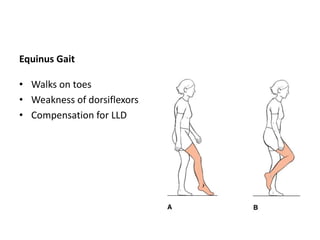
Equinus Gait
• Walks on toes
• Weakness of dorsiflexors
• Compensation for LLD
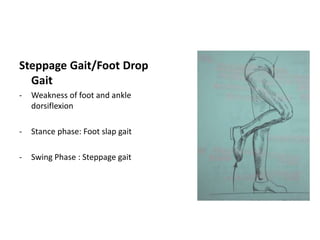
Steppage Gait/Foot Drop
Gait
- Weakness of foot and ankle
dorsiflexion
- Stance phase: Foot slap gait
- Swing Phase : Steppage gait
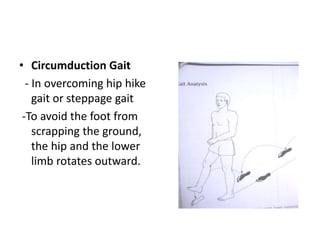
• Circumduction Gait
- In overcoming hip hike
gait or steppage gait
-To avoid the foot from
scrapping the ground,
the hip and the lower
limb rotates outward.
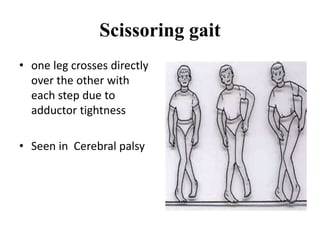
Scissoring gait
• one leg crosses directly
over the other with
each step due to
adductor tightness
• Seen in Cerebral palsy
Genu recurvatum gait
• In Paralysis of
hamstring muscles the
knee goes in for hyper
extension while
transmitting the weight
in mid stance phase.
• Seen in poliomyelitis
Short limb gait
• Shortening less than 1.5 cm compensated by
pelvic tilt, and shortening upto 5 cm
compensated by equinus.
• Shortening more than 5 cm the patient dips
his body on that side.
Physical Examination
Standing:
- back should be examined for scoliosis ,local tenderness, range
of motion.
-if there is pelvic tilt is present , it can be measured by placing
blocks under the shorter leg until the pelvis in level (horizontal)
-trendelenburg test
• Measurement of thigh and calf circumference should reveal atrophy
(more than 1 to 2 cm of difference between sides) in a patient with
any hip or knee condition that has limited function for more than
one to two months.
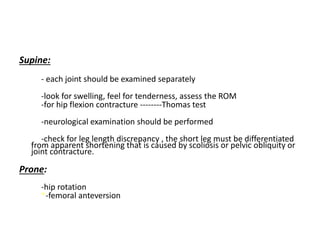
Supine:
- each joint should be examined separately
-look for swelling, feel for tenderness, assess the ROM
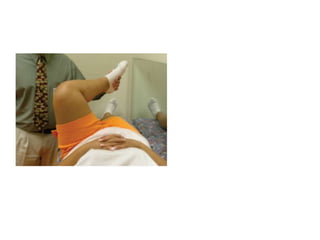
-for hip flexion contracture --------Thomas test
-neurological examination should be performed
-check for leg length discrepancy , the short leg must be differentiated
from apparent shortening that is caused by scoliosis or pelvic obliquity or
joint contracture.
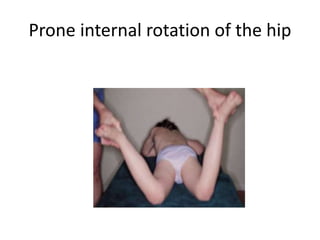
Prone:
-hip rotation
*-femoral anteversion
Asymmetric Abduction
Prone internal rotation of the hip
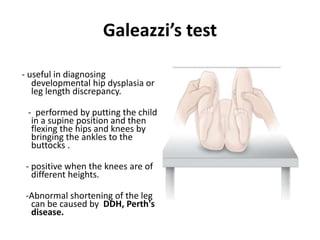
Galeazzi’s test
- useful in diagnosing
developmental hip dysplasia or
leg length discrepancy.
- performed by putting the child
in a supine position and then
flexing the hips and knees by
bringing the ankles to the
buttocks .
- positive when the knees are of
different heights.
-Abnormal shortening of the leg
can be caused by DDH, Perth's
disease.
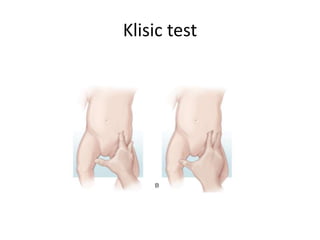
Klisic test
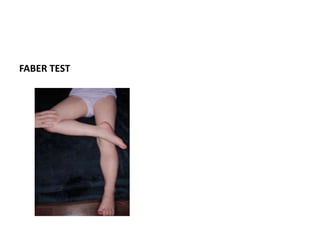
FABER TEST
Don,t forget!!!
Both intraabdominal pathology and testicular
torsion may present as limp
So always examine abdomen and testes in boys!
Investigations
Hematological
• CBC
• ESR, CRP
Kocher’s criteria for differentiating septic arthritis from transient synovitis
-Fever > 38.5 c
-Cannot bear wt
-ESR> 40 mm
-WBC > 12000/mm cu
Probability of septic arthritis
0= < 0.2%
1=3%
2= 40%
3= 93.1%
4= 99.6%
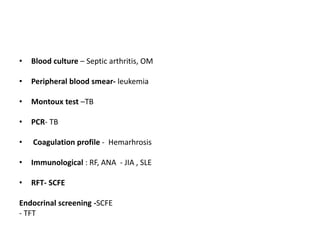
• Blood culture – Septic arthritis, OM
• Peripheral blood smear- leukemia
• Montoux test –TB
• PCR- TB
• Coagulation profile - Hemarhrosis
• Immunological : RF, ANA - JIA , SLE
• RFT- SCFE
Endocrinal screening -SCFE
- TFT
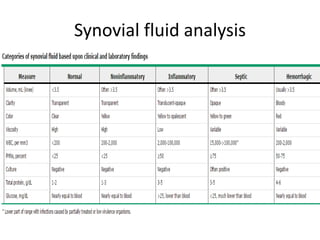
Synovial fluid analysis
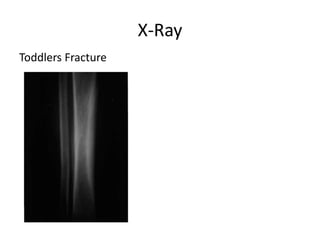
X-Ray
Toddlers Fracture
Sign of effusion :
- Widening of the joint space.
-Discrepancies greater than 1
mm indicate the presence
of fluid
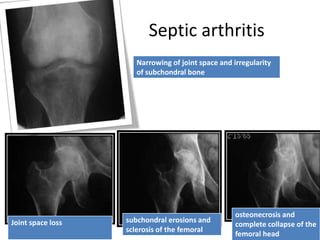
Septic arthritis
Narrowing of joint space and irregularity
of subchondral bone
Joint space loss subchondral erosions and
sclerosis of the femoral
osteonecrosis and
complete collapse of the
femoral head
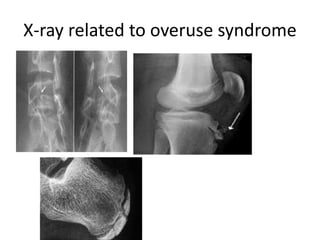
X-ray related to overuse syndrome
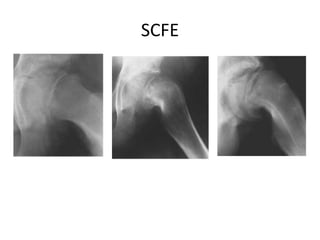
SCFE
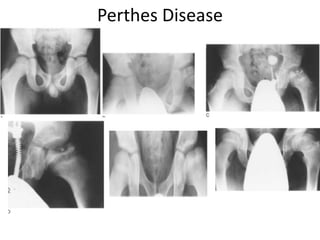
Perthes Disease
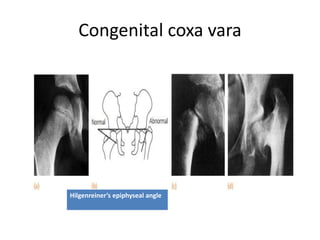
Congenital coxa vara
Hilgenreiner’s epiphyseal angle
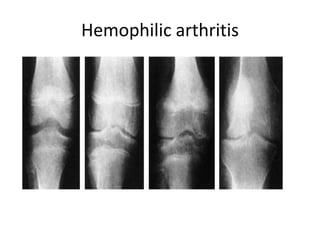
Hemophilic arthritis
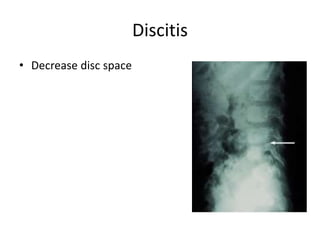
Discitis
• Decrease disc space
Ultrasonography
• Effusion
-Widening of space between capsule and bone of > 2mm indicates
effusion.
-Echo-free  transient synovitis
-Positively echogenic  septic arthritis
• useful in the detection of early slips by demonstrating joint
effusion and a “step” between the femoral neck and the epiphysis
created by slipping-SCFE
• Acute osteomyelitis- periosteal thickening , subpriosteal thickening
CT scan
• deep soft tissue infections of the Para
spinal and retroperitoneal regions
• Three dimensional images of shape
of femoral head and acetabulum in
perthes disease
• SCFE- confirm closure of the proximal
femoral physis. Provide three-
dimensional reconstructed CT images
used to assess the severity of residual
deformity of the upper
femur,[ especially when
reconstructive osteotomy is being
considered.
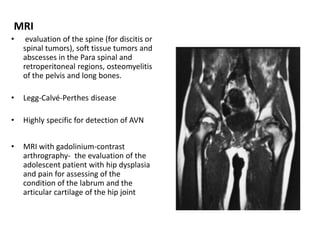
MRI
• evaluation of the spine (for discitis or
spinal tumors), soft tissue tumors and
abscesses in the Para spinal and
retroperitoneal regions, osteomyelitis
of the pelvis and long bones.
• Legg-Calvé-Perthes disease
• Highly specific for detection of AVN
• MRI with gadolinium-contrast
arthrography- the evaluation of the
adolescent patient with hip dysplasia
and pain for assessing of the
condition of the labrum and the
articular cartilage of the hip joint
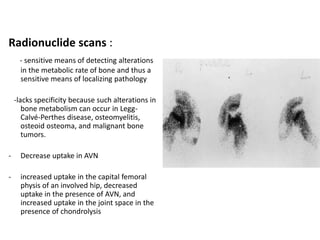
Radionuclide scans :
- sensitive means of detecting alterations
in the metabolic rate of bone and thus a
sensitive means of localizing pathology
-lacks specificity because such alterations in
bone metabolism can occur in Legg-
Calvé-Perthes disease, osteomyelitis,
osteoid osteoma, and malignant bone
tumors.
- Decrease uptake in AVN
- increased uptake in the capital femoral
physis of an involved hip, decreased
uptake in the presence of AVN, and
increased uptake in the joint space in the
presence of chondrolysis
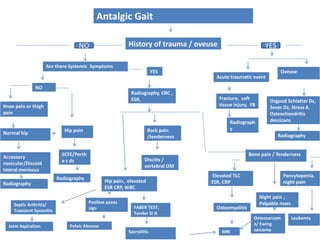
Antalgic Gait
History of trauma / oveuse YESNO
Acute traumatic event
Oveuse
Fracture, soft
tissue injury, FB
Osgood Schlatter Dz,
Sever Dz, Stress #,
Osteochondritis
dessicansRadiograph
y
Radiography
Are there Systemic Symptoms
NO
Knee pain or thigh
pain
Hip pain
Normal hip
Accessory
navicular/Discoid
lateral meniscus
Radiography
SCFE/Perth
e s dz
Radiography
YES
Radiography, CBC ,
ESR,
Back pain
/tenderness
Discitis /
vertebral OM
Hip pain, elevated
ESR CRP, WBC
Joint Aspiration Pelvic Abscess
Bone pain / Tenderness
Elevated TLC
ESR, CRP
Night pain ,
Palpable mass
Pancytopenia,
night pain
Osteomyelitis
MRI
Osteosarcom
a/ Ewing
sarcoma
Leukemia
Septic Arthritis/
Transient Synovitis
Positive psoas
sign FABER TEST,
Tender SI Jt
Sacroilitis
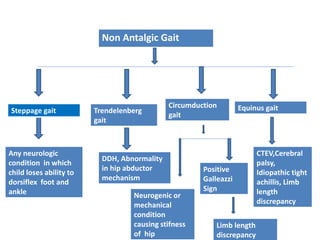
Non Antalgic Gait
Steppage gait
Any neurologic
condition in which
child loses ability to
dorsiflex foot and
ankle
Trendelenberg
gait
Circumduction
gait
Equinus gait
DDH, Abnormality
in hip abductor
mechanism
CTEV,Cerebral
palsy,
Idiopathic tight
achillis, Limb
length
discrepancy
Neurogenic or
mechanical
condition
causing stifness
of hip
Positive
Galleazzi
Sign
Limb length
discrepancy
TAKE HOME MESSAGE
• Acute limp in a child should be taken seriously as it can indicate serious
underlying pathology
• Age of child is important when considering the most likely aetiology
• If trauma has occurred there is lower threshold for performing x-rays in
children as fractures and dislocations are more common
• For atraumatic limp, red flags are age < 3 yr , inability to bear wt, systemic
illness, pain or restricted movement of hip
TAKE HOME MESSAGE…
• In children 3-9 who are well , have no fever , are able to bear wt,
and < 48 hr history of atraumatic limp transient synovitis is usually
the cause
• Suspect SCFE in children > 10 yr if there is reduced internal rotation
of hip and pain on extreme of movement
• Kocher’s criteria may be useful in distinguising transient synovitis
from septic arthritis
THANK YOU

An approach to limping child

  • 1.
    Dr Manoj Das OrthoResident Institute Of Medicine TUTH, Nepal An Approach To Limping Child
  • 2.
    INTRODUCTION • An uneven,jerky, or laborious gait, usually caused by pain, weakness, or deformity. • It is a common complaint in childhood, accounting for 4 per 1000 visits in pediatric emergency department. [ Uptodate 2016] • Limp can be caused by both benign and life-threatening conditions; the management varies from reassurance to major surgery depending upon the cause. INTRODUCTION
  • 3.
    Pathophysiology • Three majorfactors cause a child to limp: pain, weakness, and structural or mechanical abnormalities of the spine, pelvis, and lower extremities (Clark, 1997; deBoeck & Vorlat, 2003; Lawrence, 1998).
  • 4.
  • 5.
  • 6.
    History… • AGE.. Apley’ systemof orthopaedics and fractures
  • 7.
    History… • Sex • Painfulvs Nonpainful limp • Location of pain • Duration and course • Does limp improves or aggravate with activity • No. of involved joint • Associated symptoms (e.g., fever, weight loss, anorexia, back pain, arthralgia)
  • 8.
    History… • Recent historyof viral illness or streptococcal infection (post infectious arthritis) • • Recent history of dysentry ( Reiters syndome) • Recent history of new or increased sports activity • Recent history of intramuscular injection (can cause muscle inflammation or sterile abscess) • History of endocrine dysfunction (may predispose to slipped capital femoral epiphysis) • Family history of connective tissue disorder, inflammatory bowel disease, hemoglobinopathy, bleeding disorder, or neuromuscular disorder • Prenatal and birth history
  • 9.
    Red flags • Children< 3 yr ( as septic arthrits more common in this age group) • Inability to bear wt • Fever or systemic illness • Child > 9 yr with hip pain or restricted hip movement (SCFE)
  • 10.
  • 11.
    Normal gait variationsin children • The development of mature gait depends upon maturation of C.N.S(postural ,labyrinthine and rightining reflexes ) • Normal variations of gait in children:- -Toe walking is common up to 3 years -In-toeing can be due to persisting femoral anteversion (this is most common between ages 3-8 years) -Internal tibial torsion is also common (knees point forwards but feet point in) -Metatarsus adductus resolve by the age of 6 years.
  • 12.
    Normal gait variationsin children… -Bow legs (genu varus) are common from birth to early toddler-phase, maximum at age 1 year, often with out-toeing. Most resolve by 18 months -Knock knees (genu valgus) are common and associated with in- toeing. Most resolve by the age of 7 years -Flat feet are common. Most children have a flexible foot with a normal arch on tiptoeing. Flat feet usually resolve by the age of 6 years -Crooked toes. Most resolve with weight-bearing.
  • 13.
    Normal gait variationsin children…  Toddler’s walking -walks on wide base to avoid falling -Reduced period of single limb support -shorter step length -Increased cadance -more pelvic tilt  The adult pattern of gait develops between 3-5 years of age.
  • 14.
    PATHOLOGICAL GAIT 1. Muscleweakness:(source of motion ) 2. Deformities of bones and joints (Articulated lever 3. Neurological disorders “disturbed awareness of the need for action and control of motion “
  • 15.
    Antalgic Gait • compensatorygait pattern adopted in order to remove or diminish the discomfort caused by pain in the LL or pelvis • Characteristic features: – Decreased in duration of stance phase of the affected limb – There is a lack of weight shift laterally over the stance limb and also to keep weight off the involved limb – Decrease in stance phase in affected side will result in a decrease in swing phase of sound limb.
  • 16.
    Trendelenburg Gait 1. Weakabductors :poliomyelitis . muscular dystrophies, motor neuron disease 2. Defective fulcrum: Congenital dislocaion of hip(CDH), pathological dislocation of hip 3. Defective lever : Perthes disease, Coxa vara.
  • 17.
    Proximal Muscle WeaknessGait - Increase lordosis - Gower sign positive
  • 18.
    Gluteus maximus gait(BACKWARD LURCH) •During midstance phase ipsilateral hip must maintain in extension to prevent forward collapse of trunk • Trunk is thrust posteriorly resulting in extension lurch
  • 19.
    Quadriceps gait • Stabilizesknee by - leaning on affected side -Pressing over lower thigh by ipsilateral hand and finger
  • 20.
    Equinus Gait • Walkson toes • Weakness of dorsiflexors • Compensation for LLD
  • 21.
    Steppage Gait/Foot Drop Gait -Weakness of foot and ankle dorsiflexion - Stance phase: Foot slap gait - Swing Phase : Steppage gait
  • 22.
    • Circumduction Gait -In overcoming hip hike gait or steppage gait -To avoid the foot from scrapping the ground, the hip and the lower limb rotates outward.
  • 23.
    Scissoring gait • oneleg crosses directly over the other with each step due to adductor tightness • Seen in Cerebral palsy
  • 24.
    Genu recurvatum gait •In Paralysis of hamstring muscles the knee goes in for hyper extension while transmitting the weight in mid stance phase. • Seen in poliomyelitis
  • 25.
    Short limb gait •Shortening less than 1.5 cm compensated by pelvic tilt, and shortening upto 5 cm compensated by equinus. • Shortening more than 5 cm the patient dips his body on that side.
  • 26.
    Physical Examination Standing: - backshould be examined for scoliosis ,local tenderness, range of motion. -if there is pelvic tilt is present , it can be measured by placing blocks under the shorter leg until the pelvis in level (horizontal) -trendelenburg test • Measurement of thigh and calf circumference should reveal atrophy (more than 1 to 2 cm of difference between sides) in a patient with any hip or knee condition that has limited function for more than one to two months.
  • 27.
    Supine: - each jointshould be examined separately -look for swelling, feel for tenderness, assess the ROM -for hip flexion contracture --------Thomas test -neurological examination should be performed -check for leg length discrepancy , the short leg must be differentiated from apparent shortening that is caused by scoliosis or pelvic obliquity or joint contracture. Prone: -hip rotation *-femoral anteversion
  • 28.
  • 29.
  • 31.
    Galeazzi’s test - usefulin diagnosing developmental hip dysplasia or leg length discrepancy. - performed by putting the child in a supine position and then flexing the hips and knees by bringing the ankles to the buttocks . - positive when the knees are of different heights. -Abnormal shortening of the leg can be caused by DDH, Perth's disease.
  • 32.
  • 33.
  • 34.
    Don,t forget!!! Both intraabdominalpathology and testicular torsion may present as limp So always examine abdomen and testes in boys!
  • 35.
    Investigations Hematological • CBC • ESR,CRP Kocher’s criteria for differentiating septic arthritis from transient synovitis -Fever > 38.5 c -Cannot bear wt -ESR> 40 mm -WBC > 12000/mm cu Probability of septic arthritis 0= < 0.2% 1=3% 2= 40% 3= 93.1% 4= 99.6%
  • 36.
    • Blood culture– Septic arthritis, OM • Peripheral blood smear- leukemia • Montoux test –TB • PCR- TB • Coagulation profile - Hemarhrosis • Immunological : RF, ANA - JIA , SLE • RFT- SCFE Endocrinal screening -SCFE - TFT
  • 37.
  • 38.
  • 39.
    Sign of effusion: - Widening of the joint space. -Discrepancies greater than 1 mm indicate the presence of fluid
  • 40.
    Septic arthritis Narrowing ofjoint space and irregularity of subchondral bone Joint space loss subchondral erosions and sclerosis of the femoral osteonecrosis and complete collapse of the femoral head
  • 41.
    X-ray related tooveruse syndrome
  • 42.
  • 43.
  • 44.
  • 45.
  • 46.
  • 47.
    Ultrasonography • Effusion -Widening ofspace between capsule and bone of > 2mm indicates effusion. -Echo-free  transient synovitis -Positively echogenic  septic arthritis • useful in the detection of early slips by demonstrating joint effusion and a “step” between the femoral neck and the epiphysis created by slipping-SCFE • Acute osteomyelitis- periosteal thickening , subpriosteal thickening
  • 48.
    CT scan • deepsoft tissue infections of the Para spinal and retroperitoneal regions • Three dimensional images of shape of femoral head and acetabulum in perthes disease • SCFE- confirm closure of the proximal femoral physis. Provide three- dimensional reconstructed CT images used to assess the severity of residual deformity of the upper femur,[ especially when reconstructive osteotomy is being considered.
  • 49.
    MRI • evaluation ofthe spine (for discitis or spinal tumors), soft tissue tumors and abscesses in the Para spinal and retroperitoneal regions, osteomyelitis of the pelvis and long bones. • Legg-Calvé-Perthes disease • Highly specific for detection of AVN • MRI with gadolinium-contrast arthrography- the evaluation of the adolescent patient with hip dysplasia and pain for assessing of the condition of the labrum and the articular cartilage of the hip joint
  • 50.
    Radionuclide scans : -sensitive means of detecting alterations in the metabolic rate of bone and thus a sensitive means of localizing pathology -lacks specificity because such alterations in bone metabolism can occur in Legg- Calvé-Perthes disease, osteomyelitis, osteoid osteoma, and malignant bone tumors. - Decrease uptake in AVN - increased uptake in the capital femoral physis of an involved hip, decreased uptake in the presence of AVN, and increased uptake in the joint space in the presence of chondrolysis
  • 51.
    Antalgic Gait History oftrauma / oveuse YESNO Acute traumatic event Oveuse Fracture, soft tissue injury, FB Osgood Schlatter Dz, Sever Dz, Stress #, Osteochondritis dessicansRadiograph y Radiography Are there Systemic Symptoms NO Knee pain or thigh pain Hip pain Normal hip Accessory navicular/Discoid lateral meniscus Radiography SCFE/Perth e s dz Radiography YES Radiography, CBC , ESR, Back pain /tenderness Discitis / vertebral OM Hip pain, elevated ESR CRP, WBC Joint Aspiration Pelvic Abscess Bone pain / Tenderness Elevated TLC ESR, CRP Night pain , Palpable mass Pancytopenia, night pain Osteomyelitis MRI Osteosarcom a/ Ewing sarcoma Leukemia Septic Arthritis/ Transient Synovitis Positive psoas sign FABER TEST, Tender SI Jt Sacroilitis
  • 52.
    Non Antalgic Gait Steppagegait Any neurologic condition in which child loses ability to dorsiflex foot and ankle Trendelenberg gait Circumduction gait Equinus gait DDH, Abnormality in hip abductor mechanism CTEV,Cerebral palsy, Idiopathic tight achillis, Limb length discrepancy Neurogenic or mechanical condition causing stifness of hip Positive Galleazzi Sign Limb length discrepancy
  • 53.
    TAKE HOME MESSAGE •Acute limp in a child should be taken seriously as it can indicate serious underlying pathology • Age of child is important when considering the most likely aetiology • If trauma has occurred there is lower threshold for performing x-rays in children as fractures and dislocations are more common • For atraumatic limp, red flags are age < 3 yr , inability to bear wt, systemic illness, pain or restricted movement of hip
  • 54.
    TAKE HOME MESSAGE… •In children 3-9 who are well , have no fever , are able to bear wt, and < 48 hr history of atraumatic limp transient synovitis is usually the cause • Suspect SCFE in children > 10 yr if there is reduced internal rotation of hip and pain on extreme of movement • Kocher’s criteria may be useful in distinguising transient synovitis from septic arthritis
  • 55.

Editor's Notes

  • #29 Asymmetric abduction suggesting developmental dysplasia of the hip or any condition irritating the hip.
  • #30  is the most sensitive tEvery child lacking a clear explanation for a limp should be placed prone, with the knees flexed and the ankles falling away from the body () so the physician can look for a difference in internal rotation between the hips. It is important that the pelvis be kept flat on the table, or the difference in internal rotation between the two sides may not be appreciated.est for intra-articular hip pathology. In this test, any inflammation of the hip manifests as decreased internal rotation of the hip.
  • #31 Hip flexion and external rotation are limited. With flexion of the affected hip, the limb rotates externally.  
  • #33 . The examiner places the middle finger over the greater trochanter, and the index finger on the anterior superior iliac spine.A, With a normal hip, an imaginary line drawn between the two fingers points to the umbilicus.B, When the hip is dislocated, the trochanter is elevated and the line projects halfway between the umbilicus and the pubis.
  • #34 The FABER test is specific for sacroiliac joint pathology
  • #43 Radiographic appearance of slipped capital femoral epiphysis (SCFE) on presentation. A, Appearance of acute SCFE on a frog-leg lateral view. The displacement of the epiphysis is suggestive of a Salter-Harris type I fracture of the upper femoral physis. There are no secondary adaptive changes noted in the femoral neck. B, Frog-leg lateral radiographs in a patient with many months of thigh discomfort and a chronic slipped epiphysis. Adaptive changes in the femoral neck predominate, and the epiphysis is centered on the adapted femoral neck. C, Frog-leg lateral radiographs of a patient with acute-on-chronic SCFE. The patient had several months of vague thigh pain, with sudden, severe exacerbation of that pain. The acute displacement of the epiphysis is evident. Unlike in acute SCFE (see A), secondary adaptive remodeling changes are also present in the femoral neck, beyond which the epiphysis has acutely displaced.  
  • #44  Radiographic evolution of Legg-Calvé-Perthes disease, with onset in a boy at 10 years 11 months of age. Despite the late age of onset, the femoral head remodels well as the patient approaches skeletal maturity. A, Anteroposterior (AP) radiograph obtained at onset of the disorder shows increased density in the femoral head and apparent widening of the joint space (Waldenström's initial stage). B, AP radiograph obtained 9 months after onset shows the head entering the fragmentation stage. The central fragment remains dense and has collapsed relative to the lateral portion (lateral pillar) of the femoral head. The lateral pillar is lucent but has not collapsed, and the hip is classified as group B in the lateral pillar classification system. The joint space has widened further. C,AP radiograph obtained 17 months after onset shows early reossification of the femoral head (the healing stage). D, A closer view of the femoral head at 22 months after onset of disease. There is still widening of the joint space, and the acetabulum has a bicompartmental appearance. E, AP radiograph obtained 4 years after onset. The femoral head is healed and in the residual state. There is still widening of the joint space and incongruity of the head with the acetabulum.F, AP radiograph obtained 6 years after onset shows improved roundness of the femoral head and better joint congruity
  • #46 At first, there is blood in the joint but the surfaces are intact; (b) later the cartilage is attacked and the joint ‘space’ narrows; (c) bony erosions appear and eventually the joint becomes deformed and unstable; in (d) early subluxation is obvious.
  • #47 Lateral radiograph of the spine revealing decreased disc space (arrow) between L4 and L5. In a patient with a clinical picture of decreased spinal motion and elevated erythrocyte sedimentation rate, a diagnosis of diskitis may be made.
  • #50 accurate imaging modality for the early diagnosis of Legg-Calvé-Perthes disease and for visualizing the configuration of the femoral head and acetabulum
  • #51  Perthe s dz A technetium scan with pinhole collimation. The right hip (left) is normal. The anteroposterior view of the left hip (middle) shows lack of uptake in the lateral two thirds of the femoral head, and the frog-leg lateral view (right) shows lack of uptake anteriorl