APPROACH TO LIMPING
CHILD
Dr Saikumar
LIMP
• Limp is defined as, an uneven, jerky gait
caused by pain, weakness or deformity.
• Limp can be caused by both benign and
life threatening conditions
• Management varies from simple
reassurance to major surgery depending
upon the cause.
PATHOPHYSIOLOGY
• Three main factors cause a child to limp.
• Pain, weakness, structural or mechanical
abnormalities of the spine, pelvis and
lower extremities.
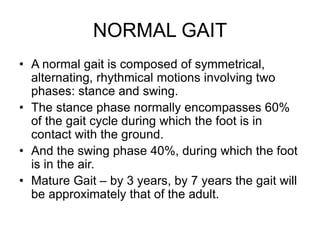
NORMAL GAIT
• A normal gait is composed of symmetrical,
alternating, rhythmical motions involving two
phases: stance and swing.
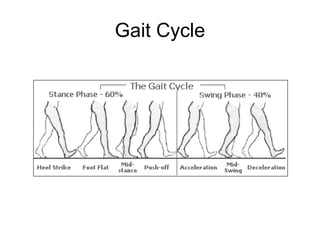
• The stance phase normally encompasses 60%
of the gait cycle during which the foot is in
contact with the ground.
• And the swing phase 40%, during which the foot
is in the air.
• Mature Gait – by 3 years, by 7 years the gait will
be approximately that of the adult.
Gait Cycle
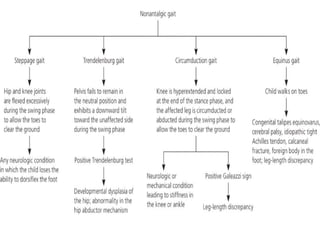
ABNORMAL GAIT
• Abnormal gait can be
• Antalgic or non antalgic
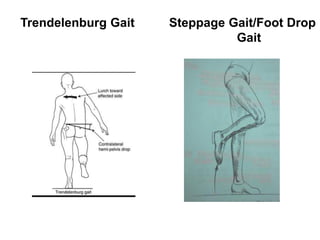
Trendelenburg Gait Steppage Gait/Foot Drop
Gait
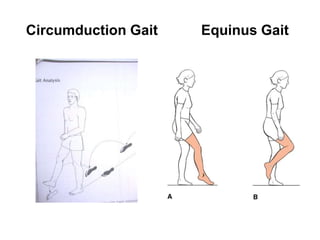
Circumduction Gait Equinus Gait
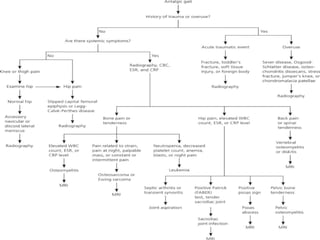
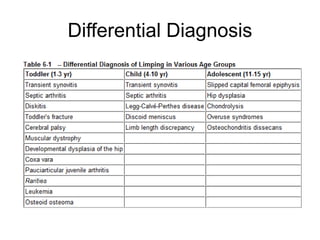
Differential Diagnosis
APPROACH
• History
• Examination
• Investigation
• Management
HISTORY
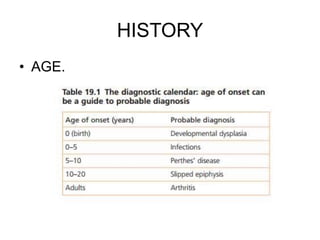
• AGE.
History
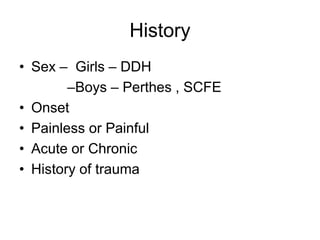
• Sex – Girls – DDH
–Boys – Perthes , SCFE
• Onset
• Painless or Painful
• Acute or Chronic
• History of trauma
History
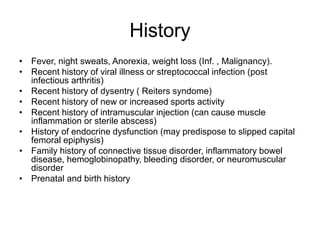
• Fever, night sweats, Anorexia, weight loss (Inf. , Malignancy).
• Recent history of viral illness or streptococcal infection (post
infectious arthritis)
• Recent history of dysentry ( Reiters syndome)
• Recent history of new or increased sports activity
• Recent history of intramuscular injection (can cause muscle
inflammation or sterile abscess)
• History of endocrine dysfunction (may predispose to slipped capital
femoral epiphysis)
• Family history of connective tissue disorder, inflammatory bowel
disease, hemoglobinopathy, bleeding disorder, or neuromuscular
disorder
• Prenatal and birth history
Physical Examination
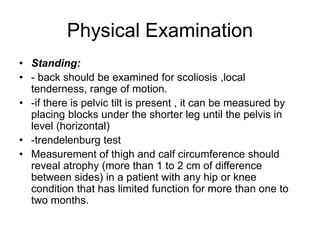
• Standing:
• - back should be examined for scoliosis ,local
tenderness, range of motion.
• -if there is pelvic tilt is present , it can be measured by
placing blocks under the shorter leg until the pelvis in
level (horizontal)
• -trendelenburg test
• Measurement of thigh and calf circumference should
reveal atrophy (more than 1 to 2 cm of difference
between sides) in a patient with any hip or knee
condition that has limited function for more than one to
two months.
Physical Examination
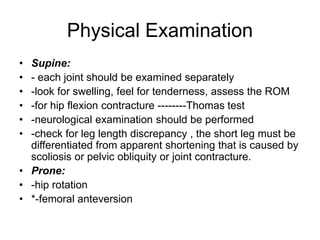
• Supine:
• - each joint should be examined separately
• -look for swelling, feel for tenderness, assess the ROM
• -for hip flexion contracture --------Thomas test
• -neurological examination should be performed
• -check for leg length discrepancy , the short leg must be
differentiated from apparent shortening that is caused by
scoliosis or pelvic obliquity or joint contracture.
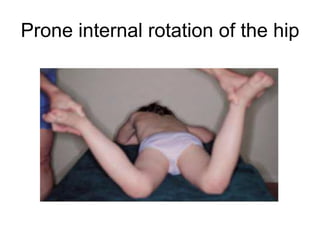
• Prone:
• -hip rotation
• *-femoral anteversion
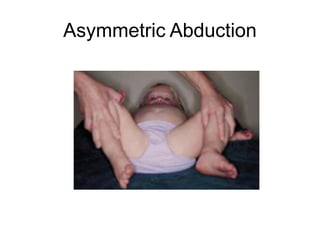
Asymmetric Abduction
Prone internal rotation of the hip
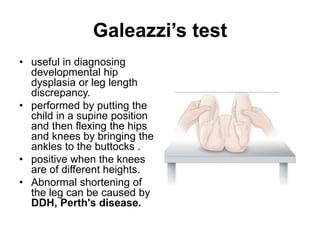
Galeazzi’s test
• useful in diagnosing
developmental hip
dysplasia or leg length
discrepancy.
• performed by putting the
child in a supine position
and then flexing the hips
and knees by bringing the
ankles to the buttocks .
• positive when the knees
are of different heights.
• Abnormal shortening of
the leg can be caused by
DDH, Perth's disease.
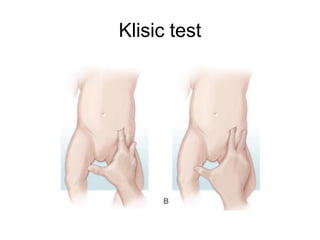
Klisic test
Don,t forget!!!
• Both intraabdominal pathology and
testicular torsion may present as limp
• So always examine abdomen and testes
in boys!
Investigations
• Hematological
• • CBC
• • ESR, CRP
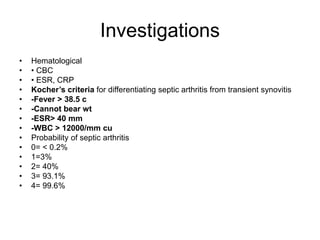
• Kocher’s criteria for differentiating septic arthritis from transient synovitis
• -Fever > 38.5 c
• -Cannot bear wt
• -ESR> 40 mm
• -WBC > 12000/mm cu
• Probability of septic arthritis
• 0= < 0.2%
• 1=3%
• 2= 40%
• 3= 93.1%
• 4= 99.6%
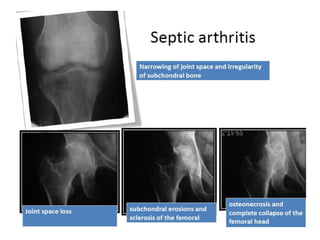
• Blood culture – Septic arthritis, OM
• Peripheral blood smear- leukemia
• Montoux test –TB
• PCR- TB
• Coagulation profile - Hemarthrosis
• Immunological : RF, ANA - JIA , SLE
• RFT- SCFE
• Endocrinal screening –SCFE
- TFT
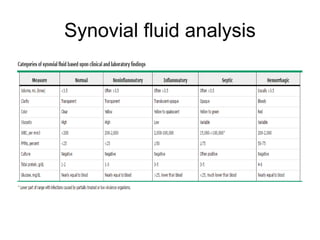
Synovial fluid analysis
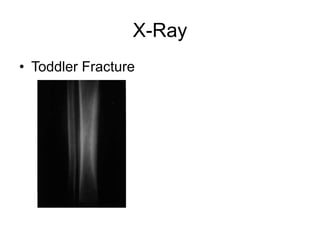
X-Ray
• Toddler Fracture
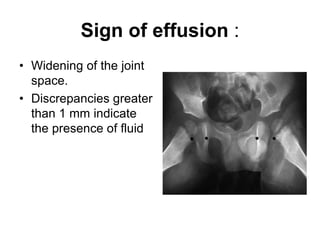
Sign of effusion :
• Widening of the joint
space.
• Discrepancies greater
than 1 mm indicate
the presence of fluid
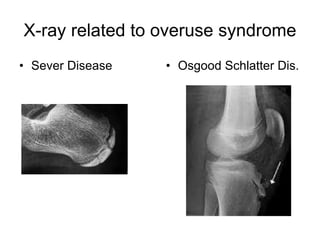
X-ray related to overuse syndrome
• Sever Disease • Osgood Schlatter Dis.
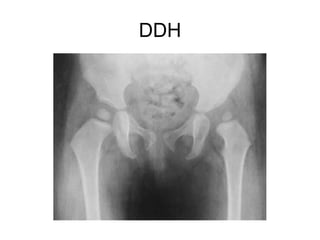
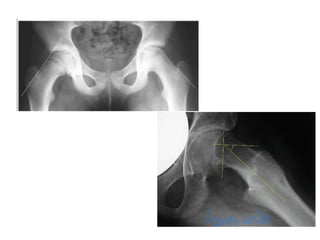
DDH
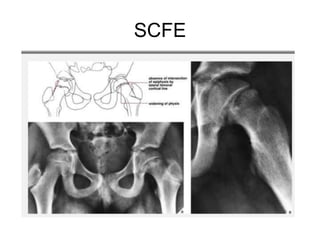
SCFE
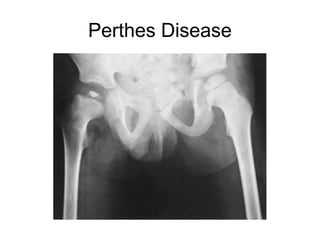
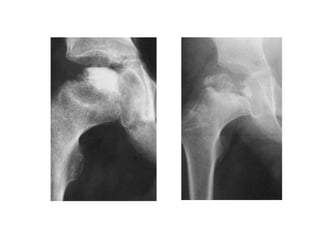
Perthes Disease
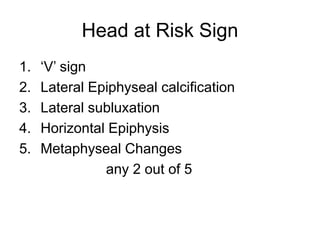
Head at Risk Sign
1. ‘V’ sign
2. Lateral Epiphyseal calcification
3. Lateral subluxation
4. Horizontal Epiphysis
5. Metaphyseal Changes
any 2 out of 5
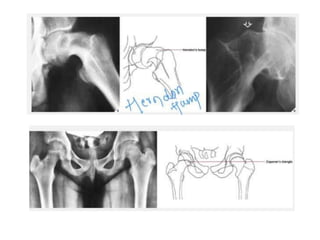
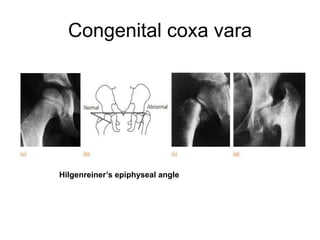
Congenital coxa vara
Hilgenreiner’s epiphyseal angle
Ultrasonography
• Effusion
• -Widening of space between capsule and bone
of > 2mm indicates effusion.
• -Echo-free transient synovitis
• -Positively echogenic septic arthritis
• useful in the detection of early slips by
demonstrating joint effusion and a “step”
between the femoral neck and the epiphysis
created by slipping-SCFE
• Acute osteomyelitis- periosteal thickening ,
subpriosteal thickening
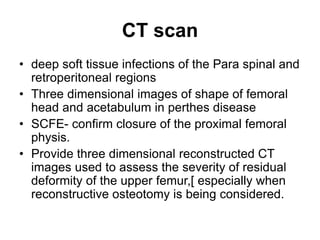
CT scan
• deep soft tissue infections of the Para spinal and
retroperitoneal regions
• Three dimensional images of shape of femoral
head and acetabulum in perthes disease
• SCFE- confirm closure of the proximal femoral
physis.
• Provide three dimensional reconstructed CT
images used to assess the severity of residual
deformity of the upper femur,[ especially when
reconstructive osteotomy is being considered.
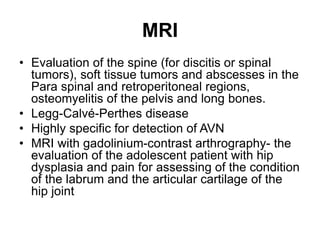
MRI
• Evaluation of the spine (for discitis or spinal
tumors), soft tissue tumors and abscesses in the
Para spinal and retroperitoneal regions,
osteomyelitis of the pelvis and long bones.
• Legg-Calvé-Perthes disease
• Highly specific for detection of AVN
• MRI with gadolinium-contrast arthrography- the
evaluation of the adolescent patient with hip
dysplasia and pain for assessing of the condition
of the labrum and the articular cartilage of the
hip joint
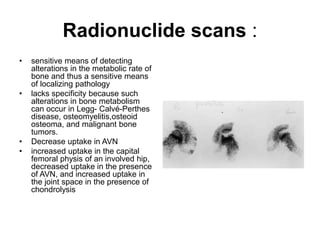
Radionuclide scans :
• sensitive means of detecting
alterations in the metabolic rate of
bone and thus a sensitive means
of localizing pathology
• lacks specificity because such
alterations in bone metabolism
can occur in Legg- Calvé-Perthes
disease, osteomyelitis,osteoid
osteoma, and malignant bone
tumors.
• Decrease uptake in AVN
• increased uptake in the capital
femoral physis of an involved hip,
decreased uptake in the presence
of AVN, and increased uptake in
the joint space in the presence of
chondrolysis

Approach to limping child converted

  • 1.
  • 2.
    LIMP • Limp isdefined as, an uneven, jerky gait caused by pain, weakness or deformity. • Limp can be caused by both benign and life threatening conditions • Management varies from simple reassurance to major surgery depending upon the cause.
  • 3.
    PATHOPHYSIOLOGY • Three mainfactors cause a child to limp. • Pain, weakness, structural or mechanical abnormalities of the spine, pelvis and lower extremities.
  • 4.
    NORMAL GAIT • Anormal gait is composed of symmetrical, alternating, rhythmical motions involving two phases: stance and swing. • The stance phase normally encompasses 60% of the gait cycle during which the foot is in contact with the ground. • And the swing phase 40%, during which the foot is in the air. • Mature Gait – by 3 years, by 7 years the gait will be approximately that of the adult.
  • 5.
  • 6.
    ABNORMAL GAIT • Abnormalgait can be • Antalgic or non antalgic
  • 9.
    Trendelenburg Gait SteppageGait/Foot Drop Gait
  • 10.
  • 11.
  • 12.
    APPROACH • History • Examination •Investigation • Management
  • 13.
  • 14.
    History • Sex –Girls – DDH –Boys – Perthes , SCFE • Onset • Painless or Painful • Acute or Chronic • History of trauma
  • 15.
    History • Fever, nightsweats, Anorexia, weight loss (Inf. , Malignancy). • Recent history of viral illness or streptococcal infection (post infectious arthritis) • Recent history of dysentry ( Reiters syndome) • Recent history of new or increased sports activity • Recent history of intramuscular injection (can cause muscle inflammation or sterile abscess) • History of endocrine dysfunction (may predispose to slipped capital femoral epiphysis) • Family history of connective tissue disorder, inflammatory bowel disease, hemoglobinopathy, bleeding disorder, or neuromuscular disorder • Prenatal and birth history
  • 16.
    Physical Examination • Standing: •- back should be examined for scoliosis ,local tenderness, range of motion. • -if there is pelvic tilt is present , it can be measured by placing blocks under the shorter leg until the pelvis in level (horizontal) • -trendelenburg test • Measurement of thigh and calf circumference should reveal atrophy (more than 1 to 2 cm of difference between sides) in a patient with any hip or knee condition that has limited function for more than one to two months.
  • 17.
    Physical Examination • Supine: •- each joint should be examined separately • -look for swelling, feel for tenderness, assess the ROM • -for hip flexion contracture --------Thomas test • -neurological examination should be performed • -check for leg length discrepancy , the short leg must be differentiated from apparent shortening that is caused by scoliosis or pelvic obliquity or joint contracture. • Prone: • -hip rotation • *-femoral anteversion
  • 18.
  • 19.
  • 20.
    Galeazzi’s test • usefulin diagnosing developmental hip dysplasia or leg length discrepancy. • performed by putting the child in a supine position and then flexing the hips and knees by bringing the ankles to the buttocks . • positive when the knees are of different heights. • Abnormal shortening of the leg can be caused by DDH, Perth's disease.
  • 21.
  • 22.
    Don,t forget!!! • Bothintraabdominal pathology and testicular torsion may present as limp • So always examine abdomen and testes in boys!
  • 23.
    Investigations • Hematological • •CBC • • ESR, CRP • Kocher’s criteria for differentiating septic arthritis from transient synovitis • -Fever > 38.5 c • -Cannot bear wt • -ESR> 40 mm • -WBC > 12000/mm cu • Probability of septic arthritis • 0= < 0.2% • 1=3% • 2= 40% • 3= 93.1% • 4= 99.6%
  • 24.
    • Blood culture– Septic arthritis, OM • Peripheral blood smear- leukemia • Montoux test –TB • PCR- TB • Coagulation profile - Hemarthrosis • Immunological : RF, ANA - JIA , SLE • RFT- SCFE • Endocrinal screening –SCFE - TFT
  • 25.
  • 26.
  • 27.
    Sign of effusion: • Widening of the joint space. • Discrepancies greater than 1 mm indicate the presence of fluid
  • 29.
    X-ray related tooveruse syndrome • Sever Disease • Osgood Schlatter Dis.
  • 30.
  • 31.
  • 34.
  • 36.
    Head at RiskSign 1. ‘V’ sign 2. Lateral Epiphyseal calcification 3. Lateral subluxation 4. Horizontal Epiphysis 5. Metaphyseal Changes any 2 out of 5
  • 37.
  • 38.
    Ultrasonography • Effusion • -Wideningof space between capsule and bone of > 2mm indicates effusion. • -Echo-free transient synovitis • -Positively echogenic septic arthritis • useful in the detection of early slips by demonstrating joint effusion and a “step” between the femoral neck and the epiphysis created by slipping-SCFE • Acute osteomyelitis- periosteal thickening , subpriosteal thickening
  • 39.
    CT scan • deepsoft tissue infections of the Para spinal and retroperitoneal regions • Three dimensional images of shape of femoral head and acetabulum in perthes disease • SCFE- confirm closure of the proximal femoral physis. • Provide three dimensional reconstructed CT images used to assess the severity of residual deformity of the upper femur,[ especially when reconstructive osteotomy is being considered.
  • 40.
    MRI • Evaluation ofthe spine (for discitis or spinal tumors), soft tissue tumors and abscesses in the Para spinal and retroperitoneal regions, osteomyelitis of the pelvis and long bones. • Legg-Calvé-Perthes disease • Highly specific for detection of AVN • MRI with gadolinium-contrast arthrography- the evaluation of the adolescent patient with hip dysplasia and pain for assessing of the condition of the labrum and the articular cartilage of the hip joint
  • 41.
    Radionuclide scans : •sensitive means of detecting alterations in the metabolic rate of bone and thus a sensitive means of localizing pathology • lacks specificity because such alterations in bone metabolism can occur in Legg- Calvé-Perthes disease, osteomyelitis,osteoid osteoma, and malignant bone tumors. • Decrease uptake in AVN • increased uptake in the capital femoral physis of an involved hip, decreased uptake in the presence of AVN, and increased uptake in the joint space in the presence of chondrolysis