AVASCULAR NECROSIS FEMUR HEAD
new experiments
Ramesh K Sen
MS, DNB Ortho, PhD
Professor, Department of Orthopedics

Postgraduate Institute of Medical Education and Research

CHANDIGARH, INDIA
AVASCULAR NECROSIS FEMUR
HEAD-EXPERIMENTS
Diagnostic experiments
• Medical management
•

•

Surgical salvage femur head

•

Surgical nonsalvage options
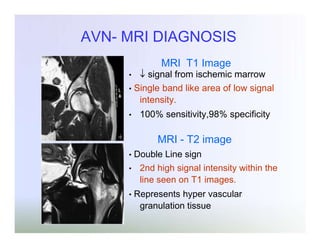
AVN- MRI DIAGNOSIS
MRI T1 Image

signal from ischemic marrow
• Single band like area of low signal
intensity.
•

•

100% sensitivity,98% specificity

MRI - T2 image
•
•

•

Double Line sign
2nd high signal intensity within the
line seen on T1 images.

Represents hyper vascular
granulation tissue
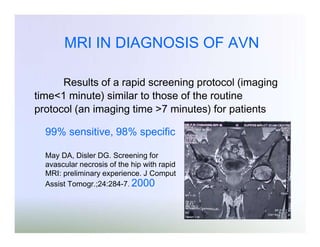
MRI IN DIAGNOSIS OF AVN
Results of a rapid screening protocol (imaging
time<1 minute) similar to those of the routine
protocol (an imaging time >7 minutes) for patients
99% sensitive, 98% specific
May DA, Disler DG. Screening for
avascular necrosis of the hip with rapid
MRI: preliminary experience. J Comput
Assist Tomogr.;24:284-7. 2000
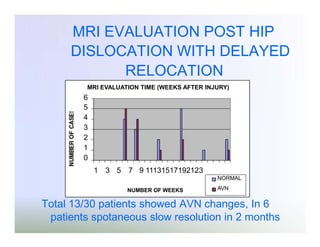
MRI EVALUATION POST HIP
DISLOCATION WITH DELAYED
RELOCATION
MRI EVALUATION TIME (WEEKS AFTER INJURY)

6
5
4
3
2
1
0
1

3 5

7 9 11131517192123
NORMAL
NUMBER OF WEEKS

AVN

Total 13/30 patients showed AVN changes, In 6
patients spotaneous slow resolution in 2 months
HOW EARLY AVN CAN BE
DIAGNOSED ON MRI ?
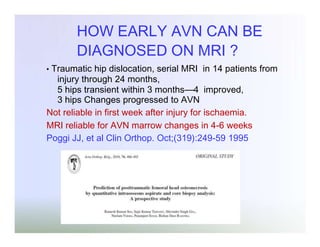
Traumatic hip dislocation, serial MRI in 14 patients from
injury through 24 months,
5 hips transient within 3 months—4 improved,
3 hips Changes progressed to AVN
Not reliable in first week after injury for ischaemia.
MRI reliable for AVN marrow changes in 4-6 weeks
Poggi JJ, et al Clin Orthop. Oct;(319):249-59 1995
•
ISOTOPE SCANNING OF AVN
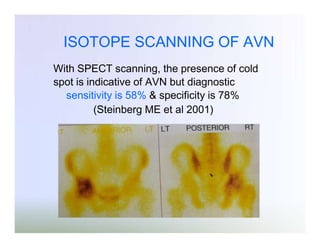
With SPECT scanning, the presence of cold
spot is indicative of AVN but diagnostic
sensitivity is 58% & specificity is 78%
(Steinberg ME et al 2001)
18

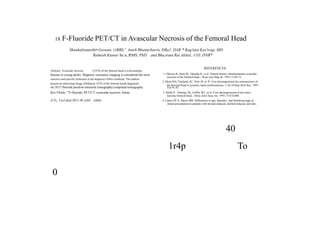
F-Fluoride PET/CT in Avascular Necrosis of the Femoral Head
Shankalzunnrtht• Gavana. t1BBS,'` Anish Bhattachurrn, DRa1. DAR * Rag/iata Kas!tvap, MD.
Ralnesh Ktanar Se n, RMS, PhD. and Bha,trant Rai Alittal.:11D. DNB*

Abstract: Avascular necrosis

REFERENCES

(AVN) of the femoral head is a devastating

disease in young adults. Magnetic resonance imaging is considered the most
sensitive and specific technique in the diagnosis of'this condition. The authors
present an interesting image of'bilateral AVN of the femoral heads diagnosed

on 1817-fluoride positron emission tomography/computed tomography.

1. Ohzono K, Saito M. Takaoka K, et al. Natural history ofnontraumatic avascular
necrosis of the femoral head../ Bone Join Stag Br. 1991;73:68-72.
2. Mont MA, Fairbank AC, Petri M, et W. Core decompression for osteonecrosis of
the femoral head in systemic lupus erythematosus. C lin Orthop Relit Rec. 1997;
334:91-97.

Kes Vlords: "'F-fluoride, PET/CT, avascular necrosis, femur

3. Smith S' Fehring TK, Griffin WL, et al. Core decompression of the osteonecrotic femoral head../ Bone Joint Surg Ant. 1995;77:674-680.

(CYi,, Vucl died 2013.38: e265 e266)

4. Castro FP Jr, Harris MB. Differences in age. laterality, and Steinberg stage at
initial presentation in patients with steroid-induced, alcohol-induced, and idio-

40
1r4p

0

To
Oper Tech Orthop 15:273-279 ©
2005

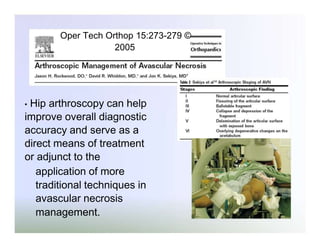
Hip arthroscopy can help
improve overall diagnostic
accuracy and serve as a
direct means of treatment
or adjunct to the
application of more
traditional techniques in
avascular necrosis
management.
•
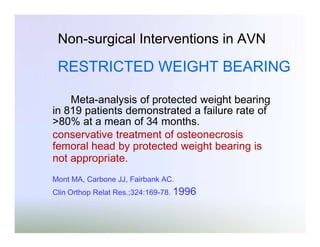
Non-surgical Interventions in AVN

RESTRICTED WEIGHT BEARING
Meta-analysis of protected weight bearing
in 819 patients demonstrated a failure rate of
>80% at a mean of 34 months.
conservative treatment of osteonecrosis
femoral head by protected weight bearing is
not appropriate.
Mont MA, Carbone JJ, Fairbank AC.
Clin Orthop Relat Res.;324:169-78. 1996
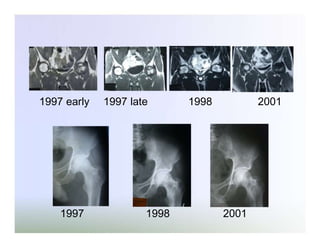
1997 early

1997

1997 late

1998

1998

2001

2001
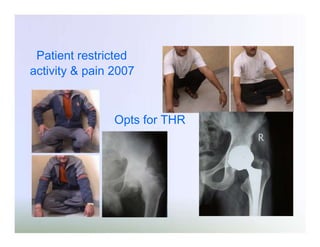
Patient restricted
activity & pain 2007

Opts for THR
AVASCULAR NECROSIS FEMUR
HEAD-EXPERIMENTS
Diagnostic experiments
• Medical management
•

•

Surgical salvage femur head

•

Surgical nonsalvage options
Non-surgical Interventions in AVN

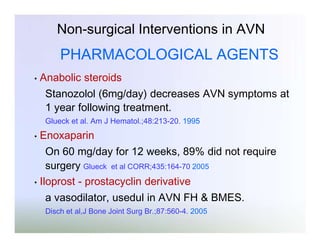
PHARMACOLOGICAL AGENTS
•

Anabolic steroids
Stanozolol (6mg/day) decreases AVN symptoms at
1 year following treatment.
Glueck et al. Am J Hematol.;48:213-20. 1995

•

Enoxaparin

On 60 mg/day for 12 weeks, 89% did not require
surgery Glueck et al CORR;435:164-70 2005
• Iloprost - prostacyclin derivative
a vasodilator, usedul in AVN FH & BMES.
Disch et al,J Bone Joint Surg Br.;87:560-4. 2005
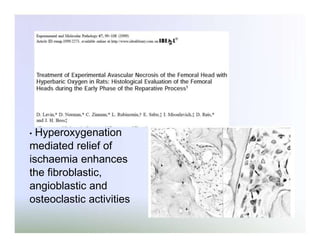
Hyperoxygenation
mediated relief of
ischaemia enhances
the fibroblastic,
angioblastic and
osteoclastic activities
•
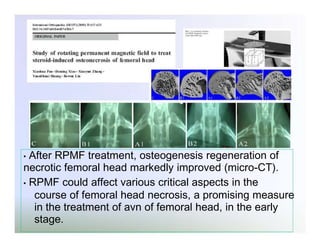
After RPMF treatment, osteogenesis regeneration of
necrotic femoral head markedly improved (micro-CT).
• RPMF could affect various critical aspects in the
course of femoral head necrosis, a promising measure
in the treatment of avn of femoral head, in the early
stage.
•
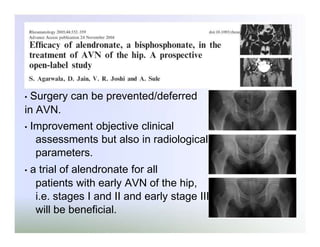
Surgery can be prevented/deferred
in AVN.
•

•

•

Improvement objective clinical
assessments but also in radiological
parameters.
a trial of alendronate for all
patients with early AVN of the hip,
i.e. stages I and II and early stage III
will be beneficial.
Non-surgical Interventions in AVN

BISPHOSPHONATES
Increased resorption contributes
to collapse of the femoral
head.

Experimental studies:

Alendronate Inhibits osteoclast
activity & thus curtail bone

resorption.

Tagil et al. in rats Acta Orthop Scand.; 75:756-61. 2004
Bowers et al. in canines. J Surg Orthop Adv.;13:210-6. 2004
Kimet al, in immature pigs. J B J S Am.;87:550-7, 2005.

Clinical studies:
Lai et al, J Bone Joint Surg Am.;87:2155-9. 2005
•

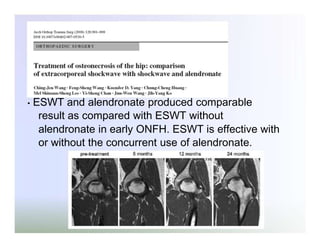
ESWT and alendronate produced comparable
result as compared with ESWT without
alendronate in early ONFH. ESWT is effective with
or without the concurrent use of alendronate.
AVASCULAR NECROSIS FEMUR
HEAD-EXPERIMENTS
Diagnostic experiments
• Medical management
•

•

Surgical salvage femur head

•

Surgical nonsalvage options

ARCO meeting Chicago March 2013
Surgical Interventions in AVN
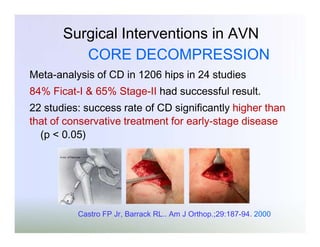
CORE DECOMPRESSION
Meta-analysis of CD in 1206 hips in 24 studies
84% Ficat-I & 65% Stage-II had successful result.

22 studies: success rate of CD significantly higher than
that of conservative treatment for early-stage disease
(p < 0.05)

Castro FP Jr, Barrack RL.. Am J Orthop.;29:187-94. 2000
CD USING PERCUTANEOUS
MULTIPLE SMALL-DIAMETER DRILLING
•

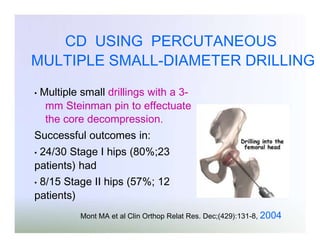
Multiple small drillings with a 3mm Steinman pin to effectuate
the core decompression.

Successful outcomes in:
24/30 Stage I hips (80%;23
patients) had
•

8/15 Stage II hips (57%; 12
patients)
•

Mont MA et al Clin Orthop Relat Res. Dec;(429):131-8, 2004
CORE DECOMPRESSION
WITH BMP
Partially purified human BMP combined with
allogeneic antigen-extracted autolyzed human
bone and introduced CD.
At a mean of 53 months, 14/17 hips showed a
clinical success, with HHS of >80 points and no
patient requiring conversion to a total hip
replacement.
Lieberman JR, Conduah A, Urist MR. Treatment of osteonecrosis of the
femoral head with core decompression and human bone morphogenetic
protein. Clin Orthop Relat Res.;429:139-45. 2004
GROWTH FACTORS & GENE THERAPY

•

vascular endothelial growth factor (VEGF)
stimulate angiogenesis and promotes healing.
use of a recombinant plasmid pCD-hVEGF165
mixed with collagen for the treatment of an
animal model of osteonecrosis
•

new bone was observed in the channel of the
drill hole and on the surface of the dead
trabeculae.
CORE DECOMPRESSION
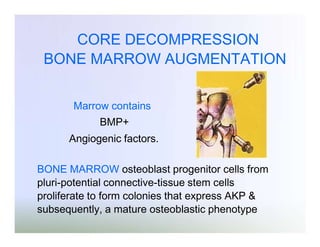
BONE MARROW AUGMENTATION
Marrow contains
BMP+
Angiogenic factors.
BONE MARROW osteoblast progenitor cells from
pluri-potential connective-tissue stem cells
proliferate to form colonies that express AKP &
subsequently, a mature osteoblastic phenotype
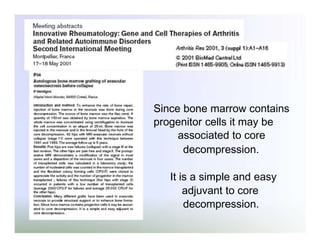
Since bone marrow contains
progenitor cells it may be
associated to core
decompression.
It is a simple and easy
adjuvant to core
decompression.
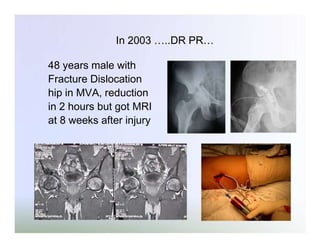
In 2003 …..DR PR…
48 years male with
Fracture Dislocation
hip in MVA, reduction
in 2 hours but got MRI
at 8 weeks after injury
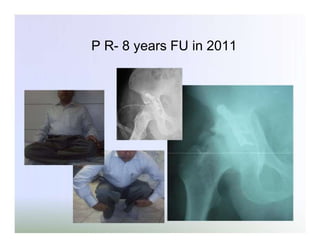
P R- 8 years FU in 2011
AUTOLOGUS BONE MARROW
GRAFTING OF AVN
•

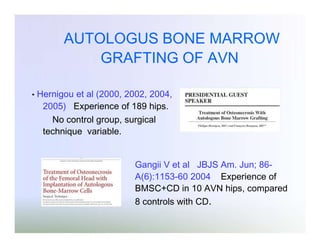
Hernigou et al (2000, 2002, 2004,
2005) Experience of 189 hips.
No control group, surgical
technique variable.

Gangii V et al JBJS Am. Jun; 86A(6):1153-60 2004 Experience of
BMSC+CD in 10 AVN hips, compared
8 controls with CD.
BONE MARROW STEM CELL CONC.
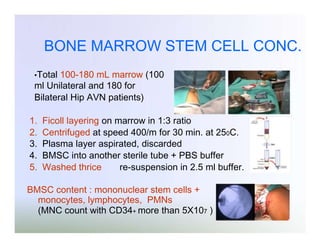
•Total

100-180 mL marrow (100
ml Unilateral and 180 for
Bilateral Hip AVN patients)
1.
2.
3.
4.
5.

Ficoll layering on marrow in 1:3 ratio
Centrifuged at speed 400/m for 30 min. at 250C.
Plasma layer aspirated, discarded
BMSC into another sterile tube + PBS buffer
Washed thrice
re-suspension in 2.5 ml buffer.

BMSC content : mononuclear stem cells +
monocytes, lymphocytes, PMNs
(MNC count with CD34+ more than 5X10⁷ )
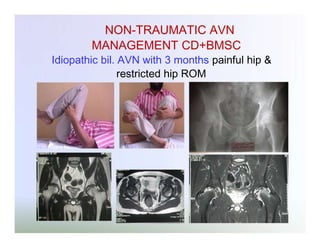
NON-TRAUMATIC AVN
MANAGEMENT CD+BMSC
Idiopathic bil. AVN with 3 months painful hip &
restricted hip ROM
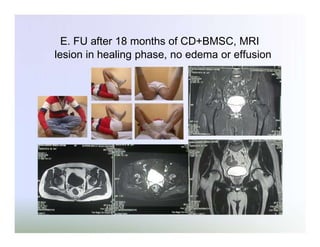
E. FU after 18 months of CD+BMSC, MRI
lesion in healing phase, no edema or effusion
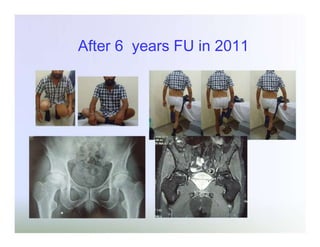
After 6 years FU in 2011
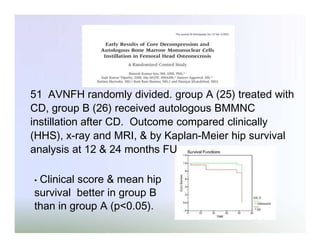
51 AVNFH randomly divided. group A (25) treated with
CD, group B (26) received autologous BMMNC
instillation after CD. Outcome compared clinically
(HHS), x-ray and MRI, & by Kaplan-Meier hip survival
analysis at 12 & 24 months FU
Clinical score & mean hip
survival better in group B
than in group A (p<0.05).
•
BMSC AFFECT AVN HIP ?
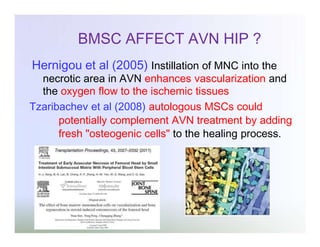
Hernigou et al (2005) Instillation of MNC into the

necrotic area in AVN enhances vascularization and
the oxygen flow to the ischemic tissues
Tzaribachev et al (2008) autologous MSCs could
potentially complement AVN treatment by adding
fresh "osteogenic cells" to the healing process.
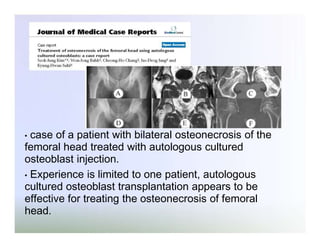
case of a patient with bilateral osteonecrosis of the
femoral head treated with autologous cultured
osteoblast injection.
• Experience is limited to one patient, autologous
cultured osteoblast transplantation appears to be
effective for treating the osteonecrosis of femoral
head.
•
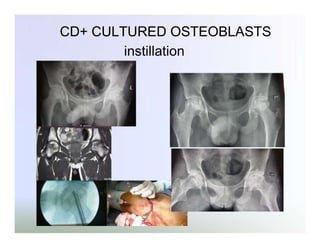
CD+ CULTURED OSTEOBLASTS
instillation
Biol Bloril.1 Grr•ro;:• 7i•rnn'yhnrt 14:

1081- 1087 (?O/)S) ) 0('M' .-l merica,, Society for Blood ,n

d .11rn•ro

7 rurr+pLiit

rti

;

i

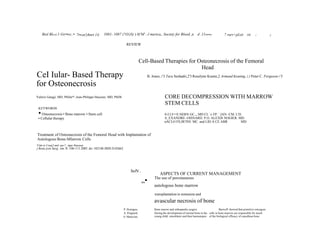
REVIEW

Cell-Based Therapies for Osteonecrosis of the Femoral
Head

CeI Iular- Based Therapy
for Osteonecrosis

B. Jones, 1'3 Tara Seshadri,2'3 Roselynn Krantz,2 Armand Keating, 2,3 Peter C. Ferguson 1'3

CORE DECOMPRESSION WITH MARROW
STEM CELLS

Valerie Gangji, MD, PhDa•*, Jean-Philippe Hauzeur, MD, PhDb

KEYWORDS

• Osteonecrosis • Bone marrow • Stem cell

0-I LI==E HERN GC.,, MD CL `e FP. `,IAN -CM. L'D.
A_EXANDRE -OISNARD. P.O. ALEXIS NOGIER. MD.
nACLO FlLIR?INl. MC. and LID A CE ABR
MD

• Cellular therapy

Treatment of Osteonecrosis of the Femoral Head with Implantation of
Autologous Bone-MIarrow Cells
V'ale:ie Craaj3 and :ear-?_:ippe Hauzeur

j Bone join Surg. Am. 8-.106-111.2005. do::102106 JBJS.D.02662

hoN .

ASPECTS OF CURRENT MANAGEMENT

„•

The use of percutaneous

autologous bone marrow
transplantation in nonunion and

avascular necrosis of bone
P. Hcmigou,
A. Poignard.
0. Manicom,

Bone marow and orthopaedic surgery
Burwell' showed that primitive ostcogcni.
During the development of normal bone in the cells in bone marrow are responsible for much
young child, osteoblasts and then haematopoi- of the biological efficacy of cancdloua bone
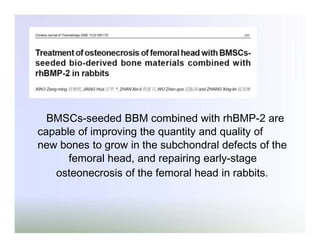
BMSCs-seeded BBM combined with rhBMP-2 are
capable of improving the quantity and quality of
new bones to grow in the subchondral defects of the
femoral head, and repairing early-stage
osteonecrosis of the femoral head in rabbits.
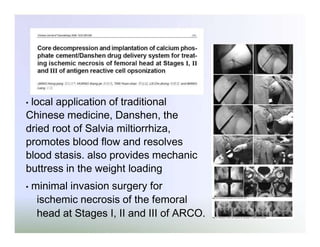
local application of traditional
Chinese medicine, Danshen, the
dried root of Salvia miltiorrhiza,
promotes blood flow and resolves
blood stasis. also provides mechanic
buttress in the weight loading
•

•

minimal invasion surgery for
ischemic necrosis of the femoral
head at Stages I, II and III of ARCO.
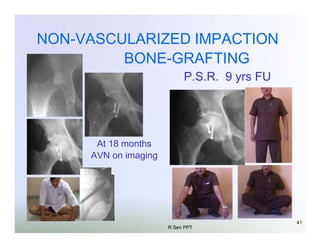
NON-VASCULARIZED IMPACTION
BONE-GRAFTING
P.S.R. 9 yrs FU

At 18 months
AVN on imaging

R Sen PPT

41
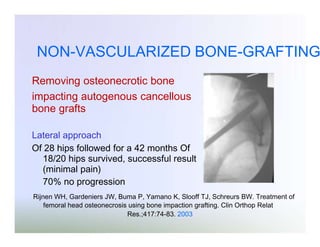
NON-VASCULARIZED BONE-GRAFTING
Removing osteonecrotic bone
impacting autogenous cancellous
bone grafts
Lateral approach
Of 28 hips followed for a 42 months Of
18/20 hips survived, successful result
(minimal pain)
70% no progression
Rijnen WH, Gardeniers JW, Buma P, Yamano K, Slooff TJ, Schreurs BW. Treatment of
femoral head osteonecrosis using bone impaction grafting. Clin Orthop Relat
Res.;417:74-83. 2003
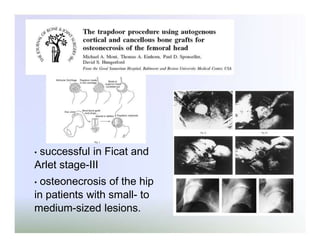
successful in Ficat and
Arlet stage-III
•

osteonecrosis of the hip
in patients with small- to
medium-sized lesions.
•
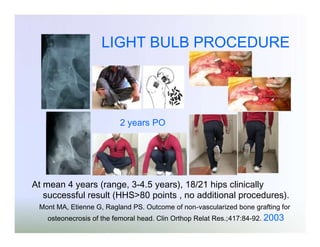
LIGHT BULB PROCEDURE

2 years PO

At mean 4 years (range, 3-4.5 years), 18/21 hips clinically
successful result (HHS>80 points , no additional procedures).
Mont MA, Etienne G, Ragland PS. Outcome of non-vascularized bone grafting for
osteonecrosis of the femoral head. Clin Orthop Relat Res.;417:84-92. 2003
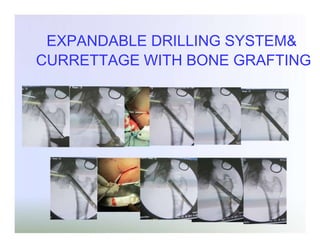
EXPANDABLE DRILLING SYSTEM&
CURRETTAGE WITH BONE GRAFTING
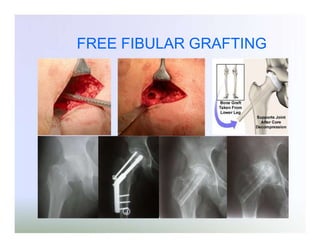
FREE FIBULAR GRAFTING
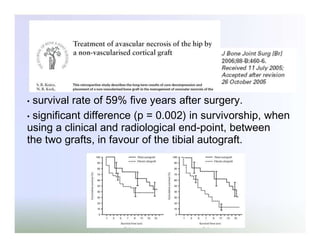
survival rate of 59% five years after surgery.
• significant difference (p = 0.002) in survivorship, when
using a clinical and radiological end-point, between
the two grafts, in favour of the tibial autograft.
•
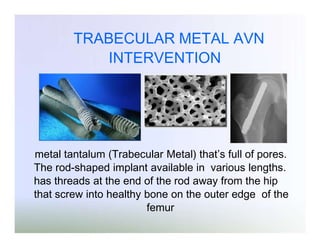
TRABECULAR METAL AVN
INTERVENTION

metal tantalum (Trabecular Metal) that’s full of pores.
The rod-shaped implant available in various lengths.
has threads at the end of the rod away from the hip
that screw into healthy bone on the outer edge of the
femur
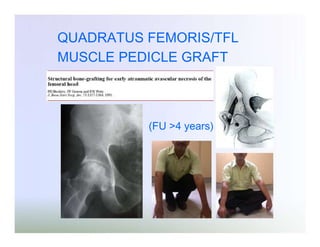
QUADRATUS FEMORIS/TFL
MUSCLE PEDICLE GRAFT

(FU >4 years)
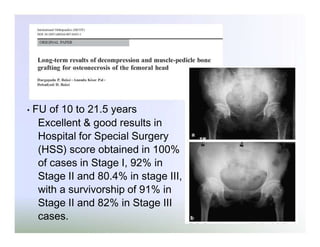
•

FU of 10 to 21.5 years
Excellent & good results in
Hospital for Special Surgery
(HSS) score obtained in 100%
of cases in Stage I, 92% in
Stage II and 80.4% in stage III,
with a survivorship of 91% in
Stage II and 82% in Stage III
cases.
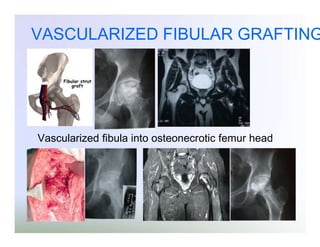
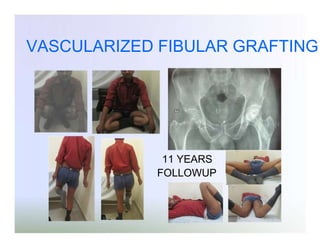
VASCULARIZED FIBULAR GRAFTING

Vascularized fibula into osteonecrotic femur head
VASCULARIZED FIBULAR GRAFTING

11 YEARS
FOLLOWUP
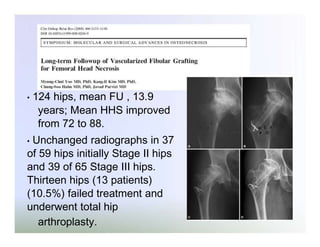
•

124 hips, mean FU , 13.9
years; Mean HHS improved
from 72 to 88.

Unchanged radiographs in 37
of 59 hips initially Stage II hips
and 39 of 65 Stage III hips.
Thirteen hips (13 patients)
(10.5%) failed treatment and
underwent total hip
arthroplasty.
•
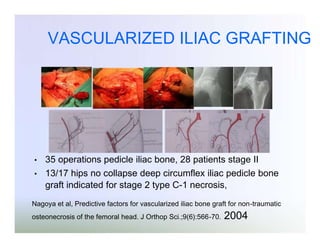
VASCULARIZED ILIAC GRAFTING

•
•

35 operations pedicle iliac bone, 28 patients stage II
13/17 hips no collapse deep circumflex iliac pedicle bone
graft indicated for stage 2 type C-1 necrosis,

Nagoya et al, Predictive factors for vascularized iliac bone graft for non-traumatic
osteonecrosis of the femoral head. J Orthop Sci.;9(6):566-70.

2004
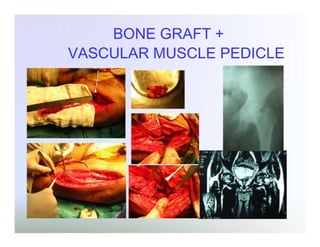
BONE GRAFT +
VASCULAR MUSCLE PEDICLE
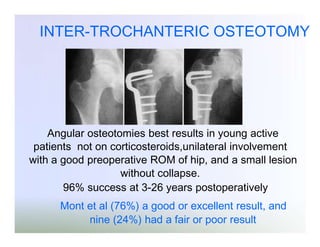
INTER-TROCHANTERIC OSTEOTOMY

Angular osteotomies best results in young active
patients not on corticosteroids,unilateral involvement
with a good preoperative ROM of hip, and a small lesion
without collapse.
96% success at 3-26 years postoperatively
Mont et al (76%) a good or excellent result, and
nine (24%) had a fair or poor result
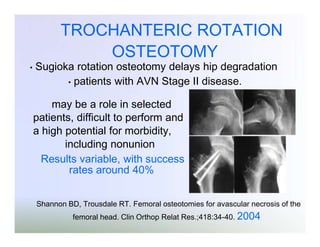
TROCHANTERIC ROTATION
OSTEOTOMY

•

Sugioka rotation osteotomy delays hip degradation
• patients with AVN Stage II disease.
may be a role in selected
patients, difficult to perform and
a high potential for morbidity,
including nonunion
Results variable, with success
rates around 40%

Shannon BD, Trousdale RT. Femoral osteotomies for avascular necrosis of the

femoral head. Clin Orthop Relat Res.;418:34-40. 2004
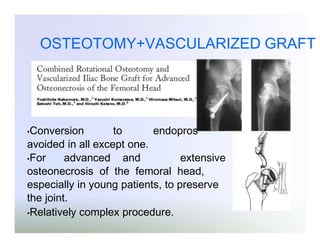
OSTEOTOMY+VASCULARIZED GRAFT

•Conversion

to
endopros
avoided in all except one.
•For
advanced and
extensive
osteonecrosis of the femoral head,
especially in young patients, to preserve
the joint.
•Relatively complex procedure.
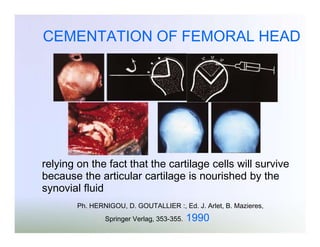
CEMENTATION OF FEMORAL HEAD

relying on the fact that the cartilage cells will survive
because the articular cartilage is nourished by the
synovial fluid
Ph. HERNIGOU, D. GOUTALLIER :, Ed. J. Arlet, B. Mazieres,
Springer Verlag, 353-355.

1990
CEMENTATION OF FEMORAL HEAD
Wood et al. treated 19 patients (20 hips) with open
reduction augmented with methyl methacrylate
cement and followed them for 6 months to 12
years.
3 patients had a conversion to a THR
The long-term results of this procedure are

unknown.

Wood ML, McDowell CM, Kerstetter TL, Kelley SS. Open reduction and cementation
for femoral head fracture secondary to avascular necrosis: preliminary report. Iowa
Orthop J. 2000;20:17-23.
AVASCULAR NECROSIS FEMUR
HEAD-EXPERIMENTS

•

Diagnostic experiments

•

Medical management

•

Surgical salvage femur head

•

Surgical non-salvage options
TOTAL HIP ARTHROPLASTY
AVN vs. OA as Etiology
Failure rate in AVN higher than OA group
(33%);
•

1, Bilateral Occurrence of the disease with
bilateral THA
2, Extensive bone necrosis
•

Femoral component loosening more
frequently in the ON (28%) than in the OA
group (5%).
TOTAL HIP ARTHROPLASTY
FOR OSTEONECROSIS
•

Meta-analysis
- Before 1990
•

83% survival

- After 1990
•

97% survival

•

Second generation cementing techniques

•

Proximally coated femoral stems
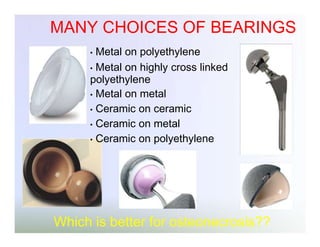
MANY CHOICES OF BEARINGS
Metal on polyethylene
• Metal on highly cross linked
polyethylene
• Metal on metal
• Ceramic on ceramic
• Ceramic on metal
• Ceramic on polyethylene
•

Which is better for osteonecrosis??
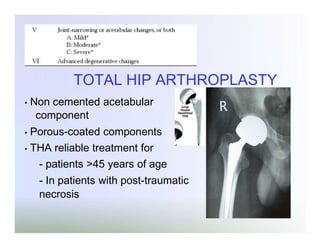
TOTAL HIP ARTHROPLASTY
•

Non cemented acetabular
component

•

Porous-coated components

•

THA reliable treatment for
- patients >45 years of age
- In patients with post-traumatic
necrosis
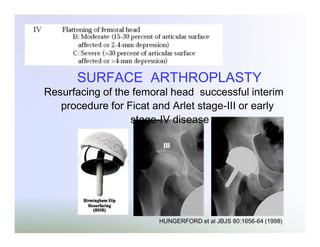
SURFACE ARTHROPLASTY

Resurfacing of the femoral head successful interim
procedure for Ficat and Arlet stage-III or early
stage-IV disease

HUNGERFORD et al JBJS 80:1656-64 (1998)
PREVENTION OF AVN
STATIN THERAPY
Patients on steroids on mean of 7.5 years
(minimum 5 years), also given lipid clearing agents
that reduce lipid levels.
Osteonecrosis in only 3 (1%) of 284 patients
who were taking high-dose corticosteroids + statin
drugs
Statins might offer protection against AVN
when corticosteroid treatment is necessary
Pritchett JW. CORR ;386:173-8 2001
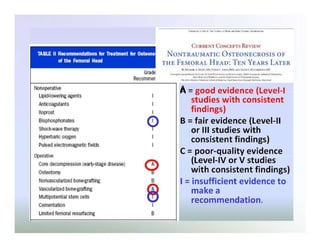
A
Thank You

Ramesh Sen AVN

  • 1.
    AVASCULAR NECROSIS FEMURHEAD new experiments Ramesh K Sen MS, DNB Ortho, PhD Professor, Department of Orthopedics Postgraduate Institute of Medical Education and Research CHANDIGARH, INDIA
  • 2.
    AVASCULAR NECROSIS FEMUR HEAD-EXPERIMENTS Diagnosticexperiments • Medical management • • Surgical salvage femur head • Surgical nonsalvage options
  • 3.
    AVN- MRI DIAGNOSIS MRIT1 Image signal from ischemic marrow • Single band like area of low signal intensity. • • 100% sensitivity,98% specificity MRI - T2 image • • • Double Line sign 2nd high signal intensity within the line seen on T1 images. Represents hyper vascular granulation tissue
  • 4.
    MRI IN DIAGNOSISOF AVN Results of a rapid screening protocol (imaging time<1 minute) similar to those of the routine protocol (an imaging time >7 minutes) for patients 99% sensitive, 98% specific May DA, Disler DG. Screening for avascular necrosis of the hip with rapid MRI: preliminary experience. J Comput Assist Tomogr.;24:284-7. 2000
  • 5.
    MRI EVALUATION POSTHIP DISLOCATION WITH DELAYED RELOCATION MRI EVALUATION TIME (WEEKS AFTER INJURY) 6 5 4 3 2 1 0 1 3 5 7 9 11131517192123 NORMAL NUMBER OF WEEKS AVN Total 13/30 patients showed AVN changes, In 6 patients spotaneous slow resolution in 2 months
  • 6.
    HOW EARLY AVNCAN BE DIAGNOSED ON MRI ? Traumatic hip dislocation, serial MRI in 14 patients from injury through 24 months, 5 hips transient within 3 months—4 improved, 3 hips Changes progressed to AVN Not reliable in first week after injury for ischaemia. MRI reliable for AVN marrow changes in 4-6 weeks Poggi JJ, et al Clin Orthop. Oct;(319):249-59 1995 •
  • 7.
    ISOTOPE SCANNING OFAVN With SPECT scanning, the presence of cold spot is indicative of AVN but diagnostic sensitivity is 58% & specificity is 78% (Steinberg ME et al 2001)
  • 8.
    18 F-Fluoride PET/CT inAvascular Necrosis of the Femoral Head Shankalzunnrtht• Gavana. t1BBS,'` Anish Bhattachurrn, DRa1. DAR * Rag/iata Kas!tvap, MD. Ralnesh Ktanar Se n, RMS, PhD. and Bha,trant Rai Alittal.:11D. DNB* Abstract: Avascular necrosis REFERENCES (AVN) of the femoral head is a devastating disease in young adults. Magnetic resonance imaging is considered the most sensitive and specific technique in the diagnosis of'this condition. The authors present an interesting image of'bilateral AVN of the femoral heads diagnosed on 1817-fluoride positron emission tomography/computed tomography. 1. Ohzono K, Saito M. Takaoka K, et al. Natural history ofnontraumatic avascular necrosis of the femoral head../ Bone Join Stag Br. 1991;73:68-72. 2. Mont MA, Fairbank AC, Petri M, et W. Core decompression for osteonecrosis of the femoral head in systemic lupus erythematosus. C lin Orthop Relit Rec. 1997; 334:91-97. Kes Vlords: "'F-fluoride, PET/CT, avascular necrosis, femur 3. Smith S' Fehring TK, Griffin WL, et al. Core decompression of the osteonecrotic femoral head../ Bone Joint Surg Ant. 1995;77:674-680. (CYi,, Vucl died 2013.38: e265 e266) 4. Castro FP Jr, Harris MB. Differences in age. laterality, and Steinberg stage at initial presentation in patients with steroid-induced, alcohol-induced, and idio- 40 1r4p 0 To
  • 9.
    Oper Tech Orthop15:273-279 © 2005 Hip arthroscopy can help improve overall diagnostic accuracy and serve as a direct means of treatment or adjunct to the application of more traditional techniques in avascular necrosis management. •
  • 10.
    Non-surgical Interventions inAVN RESTRICTED WEIGHT BEARING Meta-analysis of protected weight bearing in 819 patients demonstrated a failure rate of >80% at a mean of 34 months. conservative treatment of osteonecrosis femoral head by protected weight bearing is not appropriate. Mont MA, Carbone JJ, Fairbank AC. Clin Orthop Relat Res.;324:169-78. 1996
  • 11.
  • 12.
    Patient restricted activity &pain 2007 Opts for THR
  • 13.
    AVASCULAR NECROSIS FEMUR HEAD-EXPERIMENTS Diagnosticexperiments • Medical management • • Surgical salvage femur head • Surgical nonsalvage options
  • 14.
    Non-surgical Interventions inAVN PHARMACOLOGICAL AGENTS • Anabolic steroids Stanozolol (6mg/day) decreases AVN symptoms at 1 year following treatment. Glueck et al. Am J Hematol.;48:213-20. 1995 • Enoxaparin On 60 mg/day for 12 weeks, 89% did not require surgery Glueck et al CORR;435:164-70 2005 • Iloprost - prostacyclin derivative a vasodilator, usedul in AVN FH & BMES. Disch et al,J Bone Joint Surg Br.;87:560-4. 2005
  • 15.
    Hyperoxygenation mediated relief of ischaemiaenhances the fibroblastic, angioblastic and osteoclastic activities •
  • 16.
    After RPMF treatment,osteogenesis regeneration of necrotic femoral head markedly improved (micro-CT). • RPMF could affect various critical aspects in the course of femoral head necrosis, a promising measure in the treatment of avn of femoral head, in the early stage. •
  • 17.
    Surgery can beprevented/deferred in AVN. • • • Improvement objective clinical assessments but also in radiological parameters. a trial of alendronate for all patients with early AVN of the hip, i.e. stages I and II and early stage III will be beneficial.
  • 18.
    Non-surgical Interventions inAVN BISPHOSPHONATES Increased resorption contributes to collapse of the femoral head. Experimental studies: Alendronate Inhibits osteoclast activity & thus curtail bone resorption. Tagil et al. in rats Acta Orthop Scand.; 75:756-61. 2004 Bowers et al. in canines. J Surg Orthop Adv.;13:210-6. 2004 Kimet al, in immature pigs. J B J S Am.;87:550-7, 2005. Clinical studies: Lai et al, J Bone Joint Surg Am.;87:2155-9. 2005
  • 19.
    • ESWT and alendronateproduced comparable result as compared with ESWT without alendronate in early ONFH. ESWT is effective with or without the concurrent use of alendronate.
  • 20.
    AVASCULAR NECROSIS FEMUR HEAD-EXPERIMENTS Diagnosticexperiments • Medical management • • Surgical salvage femur head • Surgical nonsalvage options ARCO meeting Chicago March 2013
  • 21.
    Surgical Interventions inAVN CORE DECOMPRESSION Meta-analysis of CD in 1206 hips in 24 studies 84% Ficat-I & 65% Stage-II had successful result. 22 studies: success rate of CD significantly higher than that of conservative treatment for early-stage disease (p < 0.05) Castro FP Jr, Barrack RL.. Am J Orthop.;29:187-94. 2000
  • 22.
    CD USING PERCUTANEOUS MULTIPLESMALL-DIAMETER DRILLING • Multiple small drillings with a 3mm Steinman pin to effectuate the core decompression. Successful outcomes in: 24/30 Stage I hips (80%;23 patients) had • 8/15 Stage II hips (57%; 12 patients) • Mont MA et al Clin Orthop Relat Res. Dec;(429):131-8, 2004
  • 23.
    CORE DECOMPRESSION WITH BMP Partiallypurified human BMP combined with allogeneic antigen-extracted autolyzed human bone and introduced CD. At a mean of 53 months, 14/17 hips showed a clinical success, with HHS of >80 points and no patient requiring conversion to a total hip replacement. Lieberman JR, Conduah A, Urist MR. Treatment of osteonecrosis of the femoral head with core decompression and human bone morphogenetic protein. Clin Orthop Relat Res.;429:139-45. 2004
  • 24.
    GROWTH FACTORS &GENE THERAPY • vascular endothelial growth factor (VEGF) stimulate angiogenesis and promotes healing. use of a recombinant plasmid pCD-hVEGF165 mixed with collagen for the treatment of an animal model of osteonecrosis • new bone was observed in the channel of the drill hole and on the surface of the dead trabeculae.
  • 25.
    CORE DECOMPRESSION BONE MARROWAUGMENTATION Marrow contains BMP+ Angiogenic factors. BONE MARROW osteoblast progenitor cells from pluri-potential connective-tissue stem cells proliferate to form colonies that express AKP & subsequently, a mature osteoblastic phenotype
  • 26.
    Since bone marrowcontains progenitor cells it may be associated to core decompression. It is a simple and easy adjuvant to core decompression.
  • 27.
    In 2003 …..DRPR… 48 years male with Fracture Dislocation hip in MVA, reduction in 2 hours but got MRI at 8 weeks after injury
  • 28.
    P R- 8years FU in 2011
  • 29.
    AUTOLOGUS BONE MARROW GRAFTINGOF AVN • Hernigou et al (2000, 2002, 2004, 2005) Experience of 189 hips. No control group, surgical technique variable. Gangii V et al JBJS Am. Jun; 86A(6):1153-60 2004 Experience of BMSC+CD in 10 AVN hips, compared 8 controls with CD.
  • 30.
    BONE MARROW STEMCELL CONC. •Total 100-180 mL marrow (100 ml Unilateral and 180 for Bilateral Hip AVN patients) 1. 2. 3. 4. 5. Ficoll layering on marrow in 1:3 ratio Centrifuged at speed 400/m for 30 min. at 250C. Plasma layer aspirated, discarded BMSC into another sterile tube + PBS buffer Washed thrice re-suspension in 2.5 ml buffer. BMSC content : mononuclear stem cells + monocytes, lymphocytes, PMNs (MNC count with CD34+ more than 5X10⁷ )
  • 31.
    NON-TRAUMATIC AVN MANAGEMENT CD+BMSC Idiopathicbil. AVN with 3 months painful hip & restricted hip ROM
  • 32.
    E. FU after18 months of CD+BMSC, MRI lesion in healing phase, no edema or effusion
  • 33.
    After 6 yearsFU in 2011
  • 34.
    51 AVNFH randomlydivided. group A (25) treated with CD, group B (26) received autologous BMMNC instillation after CD. Outcome compared clinically (HHS), x-ray and MRI, & by Kaplan-Meier hip survival analysis at 12 & 24 months FU Clinical score & mean hip survival better in group B than in group A (p<0.05). •
  • 35.
    BMSC AFFECT AVNHIP ? Hernigou et al (2005) Instillation of MNC into the necrotic area in AVN enhances vascularization and the oxygen flow to the ischemic tissues Tzaribachev et al (2008) autologous MSCs could potentially complement AVN treatment by adding fresh "osteogenic cells" to the healing process.
  • 36.
    case of apatient with bilateral osteonecrosis of the femoral head treated with autologous cultured osteoblast injection. • Experience is limited to one patient, autologous cultured osteoblast transplantation appears to be effective for treating the osteonecrosis of femoral head. •
  • 37.
  • 38.
    Biol Bloril.1 Grr•ro;:•7i•rnn'yhnrt 14: 1081- 1087 (?O/)S) ) 0('M' .-l merica,, Society for Blood ,n d .11rn•ro 7 rurr+pLiit rti ; i REVIEW Cell-Based Therapies for Osteonecrosis of the Femoral Head CeI Iular- Based Therapy for Osteonecrosis B. Jones, 1'3 Tara Seshadri,2'3 Roselynn Krantz,2 Armand Keating, 2,3 Peter C. Ferguson 1'3 CORE DECOMPRESSION WITH MARROW STEM CELLS Valerie Gangji, MD, PhDa•*, Jean-Philippe Hauzeur, MD, PhDb KEYWORDS • Osteonecrosis • Bone marrow • Stem cell 0-I LI==E HERN GC.,, MD CL `e FP. `,IAN -CM. L'D. A_EXANDRE -OISNARD. P.O. ALEXIS NOGIER. MD. nACLO FlLIR?INl. MC. and LID A CE ABR MD • Cellular therapy Treatment of Osteonecrosis of the Femoral Head with Implantation of Autologous Bone-MIarrow Cells V'ale:ie Craaj3 and :ear-?_:ippe Hauzeur j Bone join Surg. Am. 8-.106-111.2005. do::102106 JBJS.D.02662 hoN . ASPECTS OF CURRENT MANAGEMENT „• The use of percutaneous autologous bone marrow transplantation in nonunion and avascular necrosis of bone P. Hcmigou, A. Poignard. 0. Manicom, Bone marow and orthopaedic surgery Burwell' showed that primitive ostcogcni. During the development of normal bone in the cells in bone marrow are responsible for much young child, osteoblasts and then haematopoi- of the biological efficacy of cancdloua bone
  • 39.
    BMSCs-seeded BBM combinedwith rhBMP-2 are capable of improving the quantity and quality of new bones to grow in the subchondral defects of the femoral head, and repairing early-stage osteonecrosis of the femoral head in rabbits.
  • 40.
    local application oftraditional Chinese medicine, Danshen, the dried root of Salvia miltiorrhiza, promotes blood flow and resolves blood stasis. also provides mechanic buttress in the weight loading • • minimal invasion surgery for ischemic necrosis of the femoral head at Stages I, II and III of ARCO.
  • 41.
    NON-VASCULARIZED IMPACTION BONE-GRAFTING P.S.R. 9yrs FU At 18 months AVN on imaging R Sen PPT 41
  • 42.
    NON-VASCULARIZED BONE-GRAFTING Removing osteonecroticbone impacting autogenous cancellous bone grafts Lateral approach Of 28 hips followed for a 42 months Of 18/20 hips survived, successful result (minimal pain) 70% no progression Rijnen WH, Gardeniers JW, Buma P, Yamano K, Slooff TJ, Schreurs BW. Treatment of femoral head osteonecrosis using bone impaction grafting. Clin Orthop Relat Res.;417:74-83. 2003
  • 43.
    successful in Ficatand Arlet stage-III • osteonecrosis of the hip in patients with small- to medium-sized lesions. •
  • 44.
    LIGHT BULB PROCEDURE 2years PO At mean 4 years (range, 3-4.5 years), 18/21 hips clinically successful result (HHS>80 points , no additional procedures). Mont MA, Etienne G, Ragland PS. Outcome of non-vascularized bone grafting for osteonecrosis of the femoral head. Clin Orthop Relat Res.;417:84-92. 2003
  • 45.
  • 46.
  • 47.
    survival rate of59% five years after surgery. • significant difference (p = 0.002) in survivorship, when using a clinical and radiological end-point, between the two grafts, in favour of the tibial autograft. •
  • 48.
    TRABECULAR METAL AVN INTERVENTION metaltantalum (Trabecular Metal) that’s full of pores. The rod-shaped implant available in various lengths. has threads at the end of the rod away from the hip that screw into healthy bone on the outer edge of the femur
  • 49.
  • 50.
    • FU of 10to 21.5 years Excellent & good results in Hospital for Special Surgery (HSS) score obtained in 100% of cases in Stage I, 92% in Stage II and 80.4% in stage III, with a survivorship of 91% in Stage II and 82% in Stage III cases.
  • 51.
    VASCULARIZED FIBULAR GRAFTING Vascularizedfibula into osteonecrotic femur head
  • 52.
  • 53.
    • 124 hips, meanFU , 13.9 years; Mean HHS improved from 72 to 88. Unchanged radiographs in 37 of 59 hips initially Stage II hips and 39 of 65 Stage III hips. Thirteen hips (13 patients) (10.5%) failed treatment and underwent total hip arthroplasty. •
  • 54.
    VASCULARIZED ILIAC GRAFTING • • 35operations pedicle iliac bone, 28 patients stage II 13/17 hips no collapse deep circumflex iliac pedicle bone graft indicated for stage 2 type C-1 necrosis, Nagoya et al, Predictive factors for vascularized iliac bone graft for non-traumatic osteonecrosis of the femoral head. J Orthop Sci.;9(6):566-70. 2004
  • 55.
    BONE GRAFT + VASCULARMUSCLE PEDICLE
  • 56.
    INTER-TROCHANTERIC OSTEOTOMY Angular osteotomiesbest results in young active patients not on corticosteroids,unilateral involvement with a good preoperative ROM of hip, and a small lesion without collapse. 96% success at 3-26 years postoperatively Mont et al (76%) a good or excellent result, and nine (24%) had a fair or poor result
  • 57.
    TROCHANTERIC ROTATION OSTEOTOMY • Sugioka rotationosteotomy delays hip degradation • patients with AVN Stage II disease. may be a role in selected patients, difficult to perform and a high potential for morbidity, including nonunion Results variable, with success rates around 40% Shannon BD, Trousdale RT. Femoral osteotomies for avascular necrosis of the femoral head. Clin Orthop Relat Res.;418:34-40. 2004
  • 58.
    OSTEOTOMY+VASCULARIZED GRAFT •Conversion to endopros avoided inall except one. •For advanced and extensive osteonecrosis of the femoral head, especially in young patients, to preserve the joint. •Relatively complex procedure.
  • 59.
    CEMENTATION OF FEMORALHEAD relying on the fact that the cartilage cells will survive because the articular cartilage is nourished by the synovial fluid Ph. HERNIGOU, D. GOUTALLIER :, Ed. J. Arlet, B. Mazieres, Springer Verlag, 353-355. 1990
  • 60.
    CEMENTATION OF FEMORALHEAD Wood et al. treated 19 patients (20 hips) with open reduction augmented with methyl methacrylate cement and followed them for 6 months to 12 years. 3 patients had a conversion to a THR The long-term results of this procedure are unknown. Wood ML, McDowell CM, Kerstetter TL, Kelley SS. Open reduction and cementation for femoral head fracture secondary to avascular necrosis: preliminary report. Iowa Orthop J. 2000;20:17-23.
  • 61.
    AVASCULAR NECROSIS FEMUR HEAD-EXPERIMENTS • Diagnosticexperiments • Medical management • Surgical salvage femur head • Surgical non-salvage options
  • 62.
    TOTAL HIP ARTHROPLASTY AVNvs. OA as Etiology Failure rate in AVN higher than OA group (33%); • 1, Bilateral Occurrence of the disease with bilateral THA 2, Extensive bone necrosis • Femoral component loosening more frequently in the ON (28%) than in the OA group (5%).
  • 63.
    TOTAL HIP ARTHROPLASTY FOROSTEONECROSIS • Meta-analysis - Before 1990 • 83% survival - After 1990 • 97% survival • Second generation cementing techniques • Proximally coated femoral stems
  • 64.
    MANY CHOICES OFBEARINGS Metal on polyethylene • Metal on highly cross linked polyethylene • Metal on metal • Ceramic on ceramic • Ceramic on metal • Ceramic on polyethylene • Which is better for osteonecrosis??
  • 65.
    TOTAL HIP ARTHROPLASTY • Noncemented acetabular component • Porous-coated components • THA reliable treatment for - patients >45 years of age - In patients with post-traumatic necrosis
  • 66.
    SURFACE ARTHROPLASTY Resurfacing ofthe femoral head successful interim procedure for Ficat and Arlet stage-III or early stage-IV disease HUNGERFORD et al JBJS 80:1656-64 (1998)
  • 67.
    PREVENTION OF AVN STATINTHERAPY Patients on steroids on mean of 7.5 years (minimum 5 years), also given lipid clearing agents that reduce lipid levels. Osteonecrosis in only 3 (1%) of 284 patients who were taking high-dose corticosteroids + statin drugs Statins might offer protection against AVN when corticosteroid treatment is necessary Pritchett JW. CORR ;386:173-8 2001
  • 68.
  • 69.