Cartilage
Regeneration: A
challenge in OA
KNEE
Dr Vaibhav Bagaria
MBBS MS FCPS

Arthroplasty & Sports Surgeon:
Visiting Arthroplasty Surgeon:

CARE hosp & ORIGYN, Nagpur
Apollo Hospital, Noida &
Columbia Asia Hospital, GZB
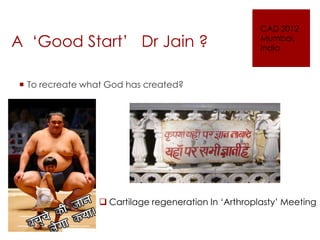
A ‘Good Start’ Dr Jain ?

CAD 2012
Mumbai,
India

 To recreate what God has created?

 Cartilage regeneration In ‘Arthroplasty’ Meeting
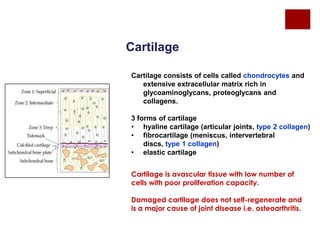
Cartilage
Cartilage consists of cells called chondrocytes and
extensive extracellular matrix rich in
glycoaminoglycans, proteoglycans and
collagens.
3 forms of cartilage
• hyaline cartilage (articular joints, type 2 collagen)
• fibrocartilage (meniscus, intervertebral
discs, type 1 collagen)
• elastic cartilage
Cartilage is avascular tissue with low number of
cells with poor proliferation capacity.
Damaged cartilage does not self-regenerate and
is a major cause of joint disease i.e. osteoarthritis.
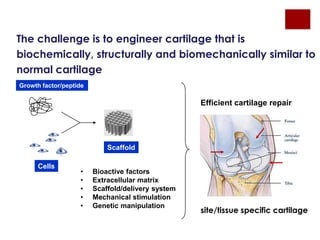
The challenge is to engineer cartilage that is
biochemically, structurally and biomechanically similar to
normal cartilage
Growth factor/peptide

Efficient cartilage repair

Scaffold
Cells

•
•
•
•
•

Bioactive factors
Extracellular matrix
Scaffold/delivery system
Mechanical stimulation
Genetic manipulation

site/tissue specific cartilage
OA KNEE
 Cartilage damage in osteoarthritis is widespread
and lesions are large
 Mechanical abnormalities -> cause localized
regions of dynamic loading stress

 local environment -> presence of signals which
promote inflammation, suppress cartilage matrix
synthesis and enhance matrix degradation.
 Paradoxically, endogenous stem-cell like
progenitor cells with chondrogenic potential
found which is not present in normal cartilage
Cellular based therapy
 Adult Chondrocyte

 Adult Mesenchymal Stem cell

 Human Embryonic Stem Cell

 Inducible Progenitor stem cell
Adult chondrocyte based
therapy
 A preventative strategy to repair articular
cartilage damage following acute injury
 Using cartilage grafts or implanted chondrocytes
to replace focally damaged lesions
 limited to repair of localized articular cartilage
injury in healthy and relatively young patients not
for the typical OA with more widespread
damage.
 OATS -> ACI -> MACI -> HACI (hyaluronan
scaffold) -> CCI ( characterized by
chondrogenic markers)
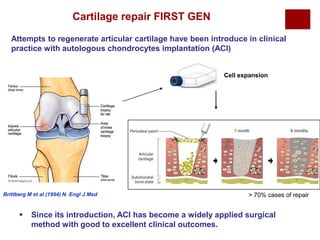
Cartilage repair FIRST GEN
Attempts to regenerate articular cartilage have been introduce in clinical
practice with autologous chondrocytes implantation (ACI)

Cell expansion

Brittberg M et al (1994) N. Engl J Med



> 70% cases of repair

Since its introduction, ACI has become a widely applied surgical
method with good to excellent clinical outcomes.
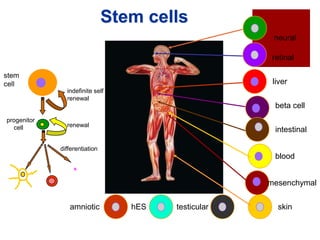
Stem cells
neural
retinal
stem
cellll

liver
indefinite self
renewal

beta cell
progenitorit
or cell

limited self
renewal

intestinal

differentiation

blood
mesenchymal
amniotic

hES

testicular

skin
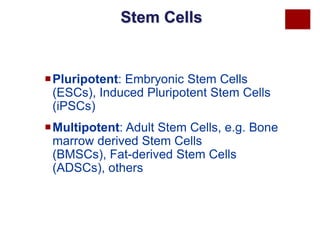
Stem Cells

Pluripotent: Embryonic Stem Cells
(ESCs), Induced Pluripotent Stem Cells
(iPSCs)
Multipotent: Adult Stem Cells, e.g. Bone
marrow derived Stem Cells
(BMSCs), Fat-derived Stem Cells
(ADSCs), others
Adult Mesenchymal stem
cell based therapy
 Mesenchymal Stem Cells (MSC) can be
obtained from bone marrow, synovium, fat, or
umbilical cord.
 Distinct potential for differentiation into the
chondrogenic lineage.
 Adipocyte-derived MSC have been suggested to
be most chondrogenic
 May be differentiated into chondrocytes using
growth factors such as (BMP) (IGF) (FGF], or using
scaffolds [40] which may release prochondrogenic signals such as TGF-β
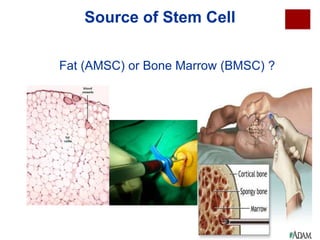
Source of Stem Cell
Fat (AMSC) or Bone Marrow (BMSC) ?
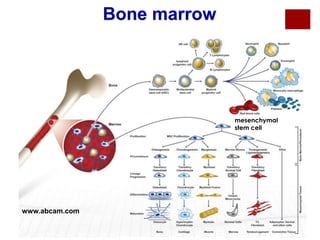
Bone marrow

mesenchymal
stem cell

www.abcam.com
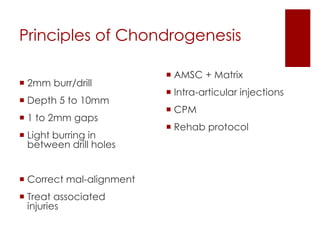
Principles of Chondrogenesis
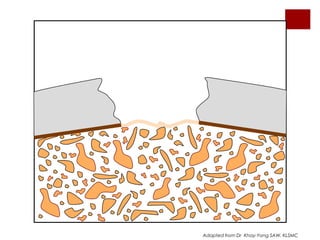
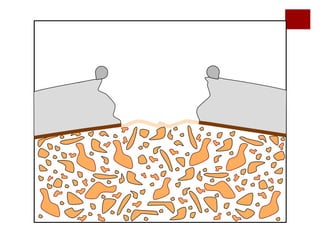
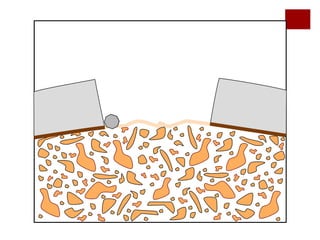
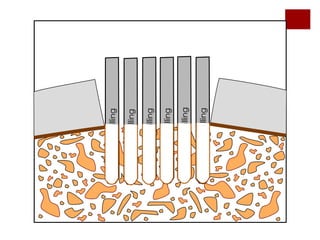
 2mm burr/drill
 Depth 5 to 10mm
 1 to 2mm gaps
 Light burring in
between drill holes
 Correct mal-alignment
 Treat associated
injuries

 AMSC + Matrix
 Intra-articular injections
 CPM
 Rehab protocol
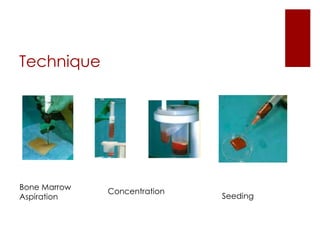
Technique

Bone Marrow
Aspiration

Concentration

Seeding
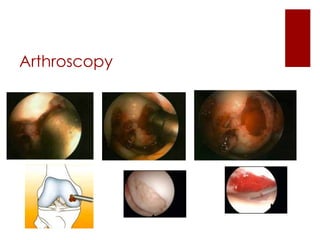
Arthroscopy
Adapted from Dr Khay-Yong SAW, KLSMC
Drilling

Drilling

Drilling

Drilling

Drilling

Drilling
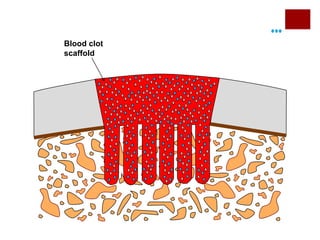
Blood clot
scaffold
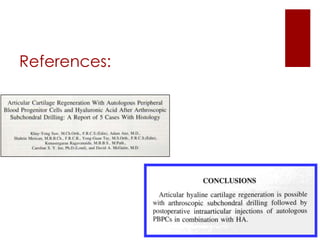
References:
hESC- Human Embryonic
Stem Cells
 Limitless no. of cell with chondrogenic potential.
 Protocols have been defied; most commonly
using BMP, involve an intermediate stage –
Embryoid body formation.
 Encouraging results in vivo in rat and other
animal models.
 Safety: ? Teratoma, Xenogenic contamination,
Immune rejection( caritlage immune privileged
site).
 Ethical issues loom large!
Gong G, Ferrari D, Dealy CN, Kosher RA (2010) Direct and
progressive differentiation of human embryonic stem cells

Toh WS, Lee EH, Guo XM, Chan JK, Yeow CH, et al. (2010)
Cartilage repair using hyaluronan hydrogel-encapsulated
human embryonic stem cell-derived chondrogenic cells.

into the chondrogenic lineage. J Cell Physiol 224: 664-671.

Biomaterials 31: 6968-6980.
iPSC – Inducible Progenitor
stem cells
 pluripotent stem cells derived from somatic cells
 a compelling alternative to allogenic cell
 readily available from sources such as adult skin
 can provide patient-specific cell-mediated
therapy
 Development of procedures to induce
pluripotency of the somatic cells, without
modification of the cellular genome
iPSC – Inducible Progenitor
stem cells
 standard methodology for induction of
pluripotency in iPSC involves viral transduction
using transcription factors including oncogenes
 insertional mutagenesis and increased risk of
tumor formation
 Methodology for generation of iPSC is rapidly
evolving, and reprogramming of adult somatic
cells is now being demonstrated which avoids
permanent transgene integration, using
excisable plasmids.
CONCLUSION
 Osteoarthritis is present in epidemic proportions in
this country and around the world
 Cell-based repair strategies are among the most
promising of the available approaches
 A critical barrier to success in cell-based articular
cartilage repair is identification of a readily
available exogenous source of cells with the
ability to seamlessly repair articular cartilage
damage and restore long-term joint function.
 Yet… the future is out there in these tiny little
invisible things…
We must welcome the Future,

remembering
that soon it will be the Past;
we must respect the Past,
remembering that once it was
all that was humanly possible.

Thanks !

Cartilage Repair using Stem cell & Orthobiologics

  • 1.
    Cartilage Regeneration: A challenge inOA KNEE Dr Vaibhav Bagaria MBBS MS FCPS Arthroplasty & Sports Surgeon: Visiting Arthroplasty Surgeon: CARE hosp & ORIGYN, Nagpur Apollo Hospital, Noida & Columbia Asia Hospital, GZB
  • 2.
    A ‘Good Start’Dr Jain ? CAD 2012 Mumbai, India  To recreate what God has created?  Cartilage regeneration In ‘Arthroplasty’ Meeting
  • 3.
    Cartilage Cartilage consists ofcells called chondrocytes and extensive extracellular matrix rich in glycoaminoglycans, proteoglycans and collagens. 3 forms of cartilage • hyaline cartilage (articular joints, type 2 collagen) • fibrocartilage (meniscus, intervertebral discs, type 1 collagen) • elastic cartilage Cartilage is avascular tissue with low number of cells with poor proliferation capacity. Damaged cartilage does not self-regenerate and is a major cause of joint disease i.e. osteoarthritis.
  • 4.
    The challenge isto engineer cartilage that is biochemically, structurally and biomechanically similar to normal cartilage Growth factor/peptide Efficient cartilage repair Scaffold Cells • • • • • Bioactive factors Extracellular matrix Scaffold/delivery system Mechanical stimulation Genetic manipulation site/tissue specific cartilage
  • 5.
    OA KNEE  Cartilagedamage in osteoarthritis is widespread and lesions are large  Mechanical abnormalities -> cause localized regions of dynamic loading stress  local environment -> presence of signals which promote inflammation, suppress cartilage matrix synthesis and enhance matrix degradation.  Paradoxically, endogenous stem-cell like progenitor cells with chondrogenic potential found which is not present in normal cartilage
  • 6.
    Cellular based therapy Adult Chondrocyte  Adult Mesenchymal Stem cell  Human Embryonic Stem Cell  Inducible Progenitor stem cell
  • 7.
    Adult chondrocyte based therapy A preventative strategy to repair articular cartilage damage following acute injury  Using cartilage grafts or implanted chondrocytes to replace focally damaged lesions  limited to repair of localized articular cartilage injury in healthy and relatively young patients not for the typical OA with more widespread damage.  OATS -> ACI -> MACI -> HACI (hyaluronan scaffold) -> CCI ( characterized by chondrogenic markers)
  • 8.
    Cartilage repair FIRSTGEN Attempts to regenerate articular cartilage have been introduce in clinical practice with autologous chondrocytes implantation (ACI) Cell expansion Brittberg M et al (1994) N. Engl J Med  > 70% cases of repair Since its introduction, ACI has become a widely applied surgical method with good to excellent clinical outcomes.
  • 9.
    Stem cells neural retinal stem cellll liver indefinite self renewal betacell progenitorit or cell limited self renewal intestinal differentiation blood mesenchymal amniotic hES testicular skin
  • 10.
    Stem Cells Pluripotent: EmbryonicStem Cells (ESCs), Induced Pluripotent Stem Cells (iPSCs) Multipotent: Adult Stem Cells, e.g. Bone marrow derived Stem Cells (BMSCs), Fat-derived Stem Cells (ADSCs), others
  • 11.
    Adult Mesenchymal stem cellbased therapy  Mesenchymal Stem Cells (MSC) can be obtained from bone marrow, synovium, fat, or umbilical cord.  Distinct potential for differentiation into the chondrogenic lineage.  Adipocyte-derived MSC have been suggested to be most chondrogenic  May be differentiated into chondrocytes using growth factors such as (BMP) (IGF) (FGF], or using scaffolds [40] which may release prochondrogenic signals such as TGF-β
  • 12.
    Source of StemCell Fat (AMSC) or Bone Marrow (BMSC) ?
  • 13.
  • 14.
    Principles of Chondrogenesis 2mm burr/drill  Depth 5 to 10mm  1 to 2mm gaps  Light burring in between drill holes  Correct mal-alignment  Treat associated injuries  AMSC + Matrix  Intra-articular injections  CPM  Rehab protocol
  • 15.
  • 16.
  • 17.
    Adapted from DrKhay-Yong SAW, KLSMC
  • 20.
  • 21.
  • 22.
  • 23.
    hESC- Human Embryonic StemCells  Limitless no. of cell with chondrogenic potential.  Protocols have been defied; most commonly using BMP, involve an intermediate stage – Embryoid body formation.  Encouraging results in vivo in rat and other animal models.  Safety: ? Teratoma, Xenogenic contamination, Immune rejection( caritlage immune privileged site).  Ethical issues loom large! Gong G, Ferrari D, Dealy CN, Kosher RA (2010) Direct and progressive differentiation of human embryonic stem cells Toh WS, Lee EH, Guo XM, Chan JK, Yeow CH, et al. (2010) Cartilage repair using hyaluronan hydrogel-encapsulated human embryonic stem cell-derived chondrogenic cells. into the chondrogenic lineage. J Cell Physiol 224: 664-671. Biomaterials 31: 6968-6980.
  • 24.
    iPSC – InducibleProgenitor stem cells  pluripotent stem cells derived from somatic cells  a compelling alternative to allogenic cell  readily available from sources such as adult skin  can provide patient-specific cell-mediated therapy  Development of procedures to induce pluripotency of the somatic cells, without modification of the cellular genome
  • 25.
    iPSC – InducibleProgenitor stem cells  standard methodology for induction of pluripotency in iPSC involves viral transduction using transcription factors including oncogenes  insertional mutagenesis and increased risk of tumor formation  Methodology for generation of iPSC is rapidly evolving, and reprogramming of adult somatic cells is now being demonstrated which avoids permanent transgene integration, using excisable plasmids.
  • 26.
    CONCLUSION  Osteoarthritis ispresent in epidemic proportions in this country and around the world  Cell-based repair strategies are among the most promising of the available approaches  A critical barrier to success in cell-based articular cartilage repair is identification of a readily available exogenous source of cells with the ability to seamlessly repair articular cartilage damage and restore long-term joint function.  Yet… the future is out there in these tiny little invisible things…
  • 27.
    We must welcomethe Future, remembering that soon it will be the Past; we must respect the Past, remembering that once it was all that was humanly possible. Thanks !

Editor's Notes

  • #15 These are the principles of chondrogenesis.