OSTEOMYELITISACUTE OSSTEOMYELITISCHRONIC OSTEOMYELITIS
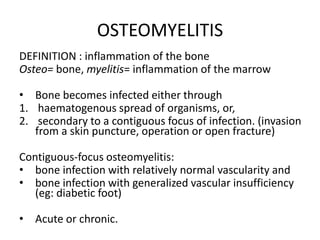
OSTEOMYELITISDEFINITION : inflammation of the boneOsteo= bone, myelitis= inflammation of the marrowBone becomes infected either throughhaematogenous spread of organisms, or, secondary to a contiguous focus of infection. (invasion from a skin puncture, operation or open fracture)Contiguous-focus osteomyelitis:bone infection with relatively normal vascularity and bone infection with generalized vascular insufficiency (eg: diabetic foot) Acute or chronic.
Anatomy of the bone
EPIDEMIOLOGYOsteomyelitis affects about 2 in 10,000 people.In childrenlong bones In adults vertebrae, feet, and the pelvisRisk factors are          recent trauma         diabetes          Hemodialysis        IV drug abuse         People who had splenectomy.
SOURCES OF INFECTIONSINFECTION OF ADJACENT JOINT/SOFT TISSUEEXTENSION TO THE BONEPENETRATING WOUND, OPEN FRACTURE, SURGERY TRAUMATIC AND IATROGHENIC IMPLANTATIONSKIN ABRASION, BOIL, SEPTIC TOOTH HEMATOGENOUS SPREAD OF ORGANISMIMPLANTED AT BONE
ACUTE HEMATOGENOUS OMPATHOGENESISBloodstream is invaded, perhaps from minor skin abrasion or boil or in the newborn from an infected umbilical cordIn adults  source of infection – arterial line or dirty needle and syringe
MICROBIAL INVASIONOrganism usually settles in the metaphysis possibly because of –   highly vascular hairpin arrangement of capillaries slows down the rate of blood flow (sluggish blood flow) has relatively fewer phagocytic cells than the physis or diaphysis thin cortex
Foci of osteomyelitisEpiphysisTerminal branches of metaphyseal artery form loops at growth plate and enter irregular afferent venous sinusoid. Blood flow slowed and turbulent, predispose to bacterial seeding plus, lining cell have little/no phagocytic action made it favourable for bacteria.Looped capillaryVenous sinusoidMetaphyseal artery
MICROBIAL INVASION1)TRIGGER ACUTE INFLAMMATIONVascular congestion
Fluid exudation
PMN leukocyte infiltrationINCREASE INTRAOSSEOUS PRESSURE intense pain and obstruction of blood flow
2)SUPPURATION(2ND DAY)Pus appears in the medulla and spread  along Volkmann’s canals  and elevate periosteum to forms a sub-periosteal abscess then spread along shaft• The pus can spread from here back into the bone, into an adjacent joint or into the soft tissues.Growth plateperiosteumIn infants, infxn often extends into epiphysis and thence into the joint. In older children the physis is a barrier to direct spread but where metaphysis is partly intracapsular (e.g. hip, shoulder, or elbow) pus may discharge through periosteum into the joint.
3)NECROSIS (END OF WEEK)Rising intraosseouspressure, vascular stasis, infective thrombosis and periostealstripping compromise the blood supply to the bone resulting in bone death and formation of a sequestrum.sequestrum4)NEW BONE FORMATIONAt 10-14 days new bone forms from the deep layer of the stripped periosteum. With time, new bone thickens to form involucrum enclosing infected tissue and sequestra.involucrumMedullary cavity
5)RESOLUTIONif infection is controlled and intraosseous pressure released, the bone will healIf infection persist, pus may discharge through perforation in involucrum and track by sinus to the skin surface. The condition is now established as a chronic osteomyelitis
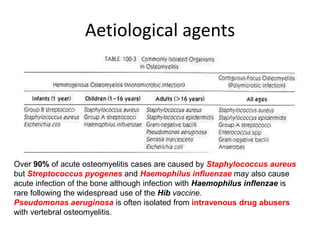
Over 90% of acute osteomyelitis cases are caused by Staphylococcus aureusbut Streptococcus pyogenesandHaemophilusinfluenzaemay also cause acute infection of the bone although infection with Haemophilusinflenzae is rare following the widespread use of the Hib vaccine. Pseudomonas aeruginosais often isolated from intravenous drug abusers with vertebral osteomyelitis.Aetiological agents
ACUTE HEMATOGENOUS OM
CLINICAL FEATURESIn child, presented withpain, malaise and fever
H/o preceding skin lesion, injury, sore throat
Limb is held still
Restricted joint movement
Local redness, swelling, warmth and edema- presence of pus
In infant,Fails to thrive, drowsy and irritable
h/o birth difficulties or umbilical artery cathetherization
Metaphyseal tenderness  and resistance to joint movement
Look for other sites – multiple infectionsIn adult, commonest site of hematogenous spread is spine – backache, mild fever
INVESTIGATIONBLOODFBC – leucocytosisESR AND CRP – elevated (CRP is a measurement of the acute phase response and is especially useful in monitoring the course of treatment of acute osteomyelitis because it normalizes much sooner than the ESR.)Blood C&SASPIRATION AND BIOPSY   aspiration of pus from subperiosteal abscess or the adjacent joint  send for bacteriological examination and sensitivity to antibiotics
IMAGING1)Plain Radiograph or tomography (changes may lag by 10-14 days) Early changes soft tissue swelling, blurring of fat plane and periosteal reaction Intermediate changes bone destruction (ill defined lytic lesion)CloacaOsteopeniaLate Changes Sequestrum formation Involucrum and bony sclerosis
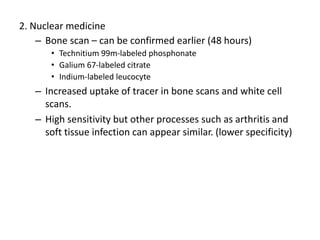
2. Nuclear medicineBone scan – can be confirmed earlier (48 hours)Technitium 99m-labeled phosphonateGalium 67-labeled citrateIndium-labeled leucocyteIncreased uptake of tracer in bone scans and white cell scans. High sensitivity but other processes such as arthritis and soft tissue infection can appear similar. (lower specificity)
Acute OsteomyelitisBone scanRadiograph of kneeIncreased uptake of radiopharmaceutical in the right femur just above the knee joint. Plain film reveals a large lytic area
Acute OsteomyelitisBone Scan of the footBone scans, both anterior (A) and lateral (B), showing the accumulation of radioactive tracer at the right ankle (arrow). This focal accumulation is characteristic of osteomyelitis.

Osteomyelitis

  • 1.
  • 2.
    OSTEOMYELITISDEFINITION : inflammationof the boneOsteo= bone, myelitis= inflammation of the marrowBone becomes infected either throughhaematogenous spread of organisms, or, secondary to a contiguous focus of infection. (invasion from a skin puncture, operation or open fracture)Contiguous-focus osteomyelitis:bone infection with relatively normal vascularity and bone infection with generalized vascular insufficiency (eg: diabetic foot) Acute or chronic.
  • 3.
  • 4.
    EPIDEMIOLOGYOsteomyelitis affects about2 in 10,000 people.In childrenlong bones In adults vertebrae, feet, and the pelvisRisk factors are  recent trauma  diabetes  Hemodialysis IV drug abuse  People who had splenectomy.
  • 5.
    SOURCES OF INFECTIONSINFECTIONOF ADJACENT JOINT/SOFT TISSUEEXTENSION TO THE BONEPENETRATING WOUND, OPEN FRACTURE, SURGERY TRAUMATIC AND IATROGHENIC IMPLANTATIONSKIN ABRASION, BOIL, SEPTIC TOOTH HEMATOGENOUS SPREAD OF ORGANISMIMPLANTED AT BONE
  • 6.
    ACUTE HEMATOGENOUS OMPATHOGENESISBloodstreamis invaded, perhaps from minor skin abrasion or boil or in the newborn from an infected umbilical cordIn adults  source of infection – arterial line or dirty needle and syringe
  • 7.
    MICROBIAL INVASIONOrganism usuallysettles in the metaphysis possibly because of –  highly vascular hairpin arrangement of capillaries slows down the rate of blood flow (sluggish blood flow) has relatively fewer phagocytic cells than the physis or diaphysis thin cortex
  • 8.
    Foci of osteomyelitisEpiphysisTerminalbranches of metaphyseal artery form loops at growth plate and enter irregular afferent venous sinusoid. Blood flow slowed and turbulent, predispose to bacterial seeding plus, lining cell have little/no phagocytic action made it favourable for bacteria.Looped capillaryVenous sinusoidMetaphyseal artery
  • 9.
    MICROBIAL INVASION1)TRIGGER ACUTEINFLAMMATIONVascular congestion
  • 10.
  • 11.
    PMN leukocyte infiltrationINCREASEINTRAOSSEOUS PRESSURE intense pain and obstruction of blood flow
  • 12.
    2)SUPPURATION(2ND DAY)Pus appearsin the medulla and spread along Volkmann’s canals and elevate periosteum to forms a sub-periosteal abscess then spread along shaft• The pus can spread from here back into the bone, into an adjacent joint or into the soft tissues.Growth plateperiosteumIn infants, infxn often extends into epiphysis and thence into the joint. In older children the physis is a barrier to direct spread but where metaphysis is partly intracapsular (e.g. hip, shoulder, or elbow) pus may discharge through periosteum into the joint.
  • 13.
    3)NECROSIS (END OFWEEK)Rising intraosseouspressure, vascular stasis, infective thrombosis and periostealstripping compromise the blood supply to the bone resulting in bone death and formation of a sequestrum.sequestrum4)NEW BONE FORMATIONAt 10-14 days new bone forms from the deep layer of the stripped periosteum. With time, new bone thickens to form involucrum enclosing infected tissue and sequestra.involucrumMedullary cavity
  • 14.
    5)RESOLUTIONif infection iscontrolled and intraosseous pressure released, the bone will healIf infection persist, pus may discharge through perforation in involucrum and track by sinus to the skin surface. The condition is now established as a chronic osteomyelitis
  • 15.
    Over 90% ofacute osteomyelitis cases are caused by Staphylococcus aureusbut Streptococcus pyogenesandHaemophilusinfluenzaemay also cause acute infection of the bone although infection with Haemophilusinflenzae is rare following the widespread use of the Hib vaccine. Pseudomonas aeruginosais often isolated from intravenous drug abusers with vertebral osteomyelitis.Aetiological agents
  • 16.
  • 17.
    CLINICAL FEATURESIn child,presented withpain, malaise and fever
  • 18.
    H/o preceding skinlesion, injury, sore throat
  • 19.
  • 20.
  • 21.
    Local redness, swelling,warmth and edema- presence of pus
  • 22.
    In infant,Fails tothrive, drowsy and irritable
  • 23.
    h/o birth difficultiesor umbilical artery cathetherization
  • 24.
    Metaphyseal tenderness and resistance to joint movement
  • 25.
    Look for othersites – multiple infectionsIn adult, commonest site of hematogenous spread is spine – backache, mild fever
  • 26.
    INVESTIGATIONBLOODFBC – leucocytosisESRAND CRP – elevated (CRP is a measurement of the acute phase response and is especially useful in monitoring the course of treatment of acute osteomyelitis because it normalizes much sooner than the ESR.)Blood C&SASPIRATION AND BIOPSY  aspiration of pus from subperiosteal abscess or the adjacent joint  send for bacteriological examination and sensitivity to antibiotics
  • 28.
    IMAGING1)Plain Radiograph ortomography (changes may lag by 10-14 days) Early changes soft tissue swelling, blurring of fat plane and periosteal reaction Intermediate changes bone destruction (ill defined lytic lesion)CloacaOsteopeniaLate Changes Sequestrum formation Involucrum and bony sclerosis
  • 30.
    2. Nuclear medicineBonescan – can be confirmed earlier (48 hours)Technitium 99m-labeled phosphonateGalium 67-labeled citrateIndium-labeled leucocyteIncreased uptake of tracer in bone scans and white cell scans. High sensitivity but other processes such as arthritis and soft tissue infection can appear similar. (lower specificity)
  • 31.
    Acute OsteomyelitisBone scanRadiographof kneeIncreased uptake of radiopharmaceutical in the right femur just above the knee joint. Plain film reveals a large lytic area
  • 32.
    Acute OsteomyelitisBone Scanof the footBone scans, both anterior (A) and lateral (B), showing the accumulation of radioactive tracer at the right ankle (arrow). This focal accumulation is characteristic of osteomyelitis.