

Parametric
tests- t test
Dr. Neha Deo
DESCRIPTIVE
INFERENTIAL
PREDICTIVE
Hypothesis is a tentative generalization, the validity
of which remains to be tested.
Hypothesis is a conjectural statement between two or
more variables.
The research or scientific hypothesis is a formal
affirmative statement predicting a single research
outcome, a tentative explanation of the
relationship between two or more variables.
Hypothesis guides the thinking process.
Hypothesis is a statement temporarily accepted
as true in the light of what is known at that
time.
Hypo + Thesis
So it is a lower level thesis. The thing might be
converted in to thesis.
• In experimental method it is must.
• In survey method when significance of
difference between two groups is to be tested.
• In correlation study to test whether the
correlation is significant or not.
• Sometimes in historical research also.
• But it is not compulsory in each & every
research.
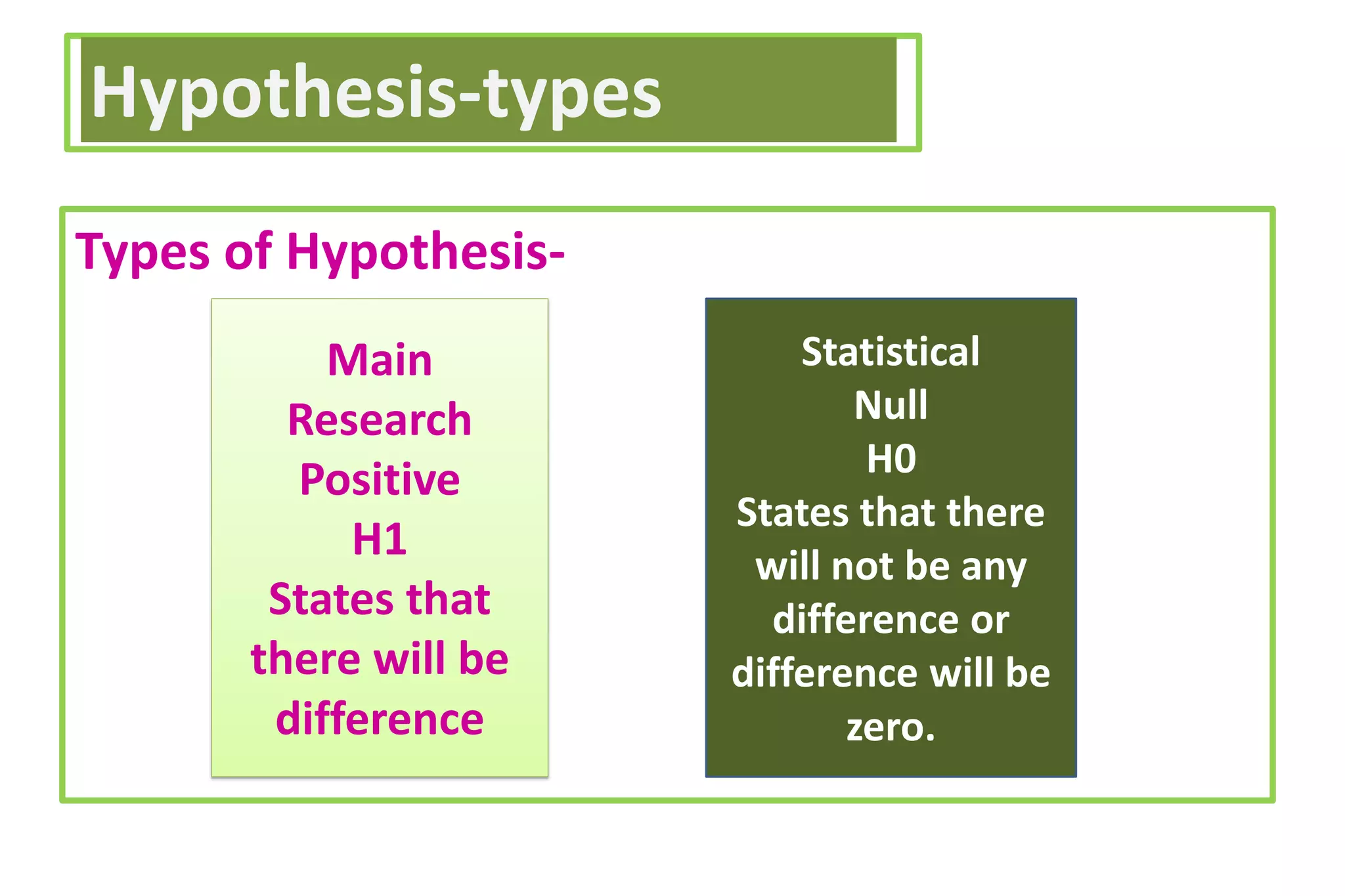
Types of Hypothesis-
Hypothesis-types
Main
Research
Positive
H1
States that
there will be
difference
Statistical
Null
H0
States that there
will not be any
difference or
difference will be
zero.
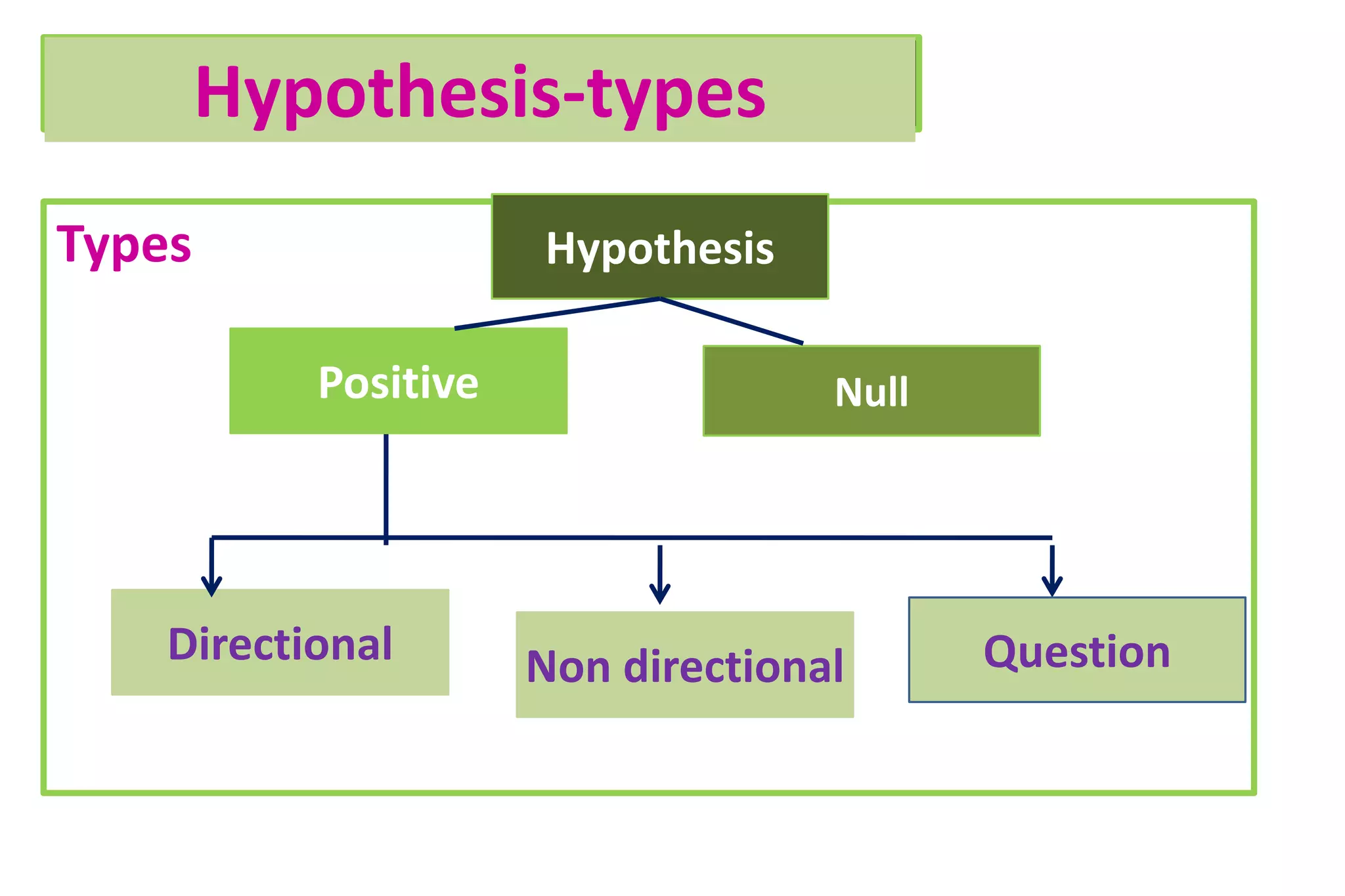
Types
Hypothesis-types
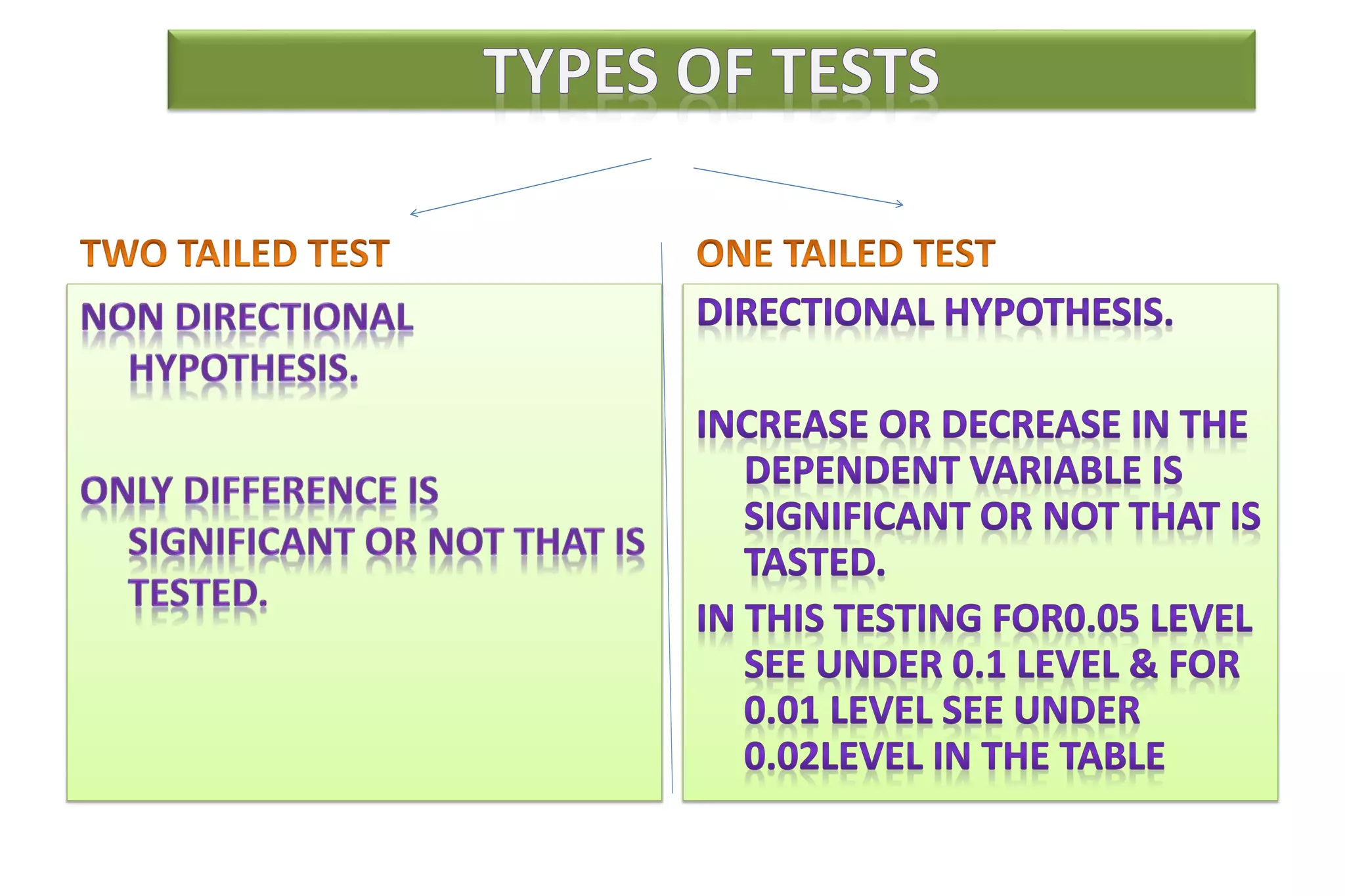
Directional
Null
Positive
Non directional Question
Hypothesis
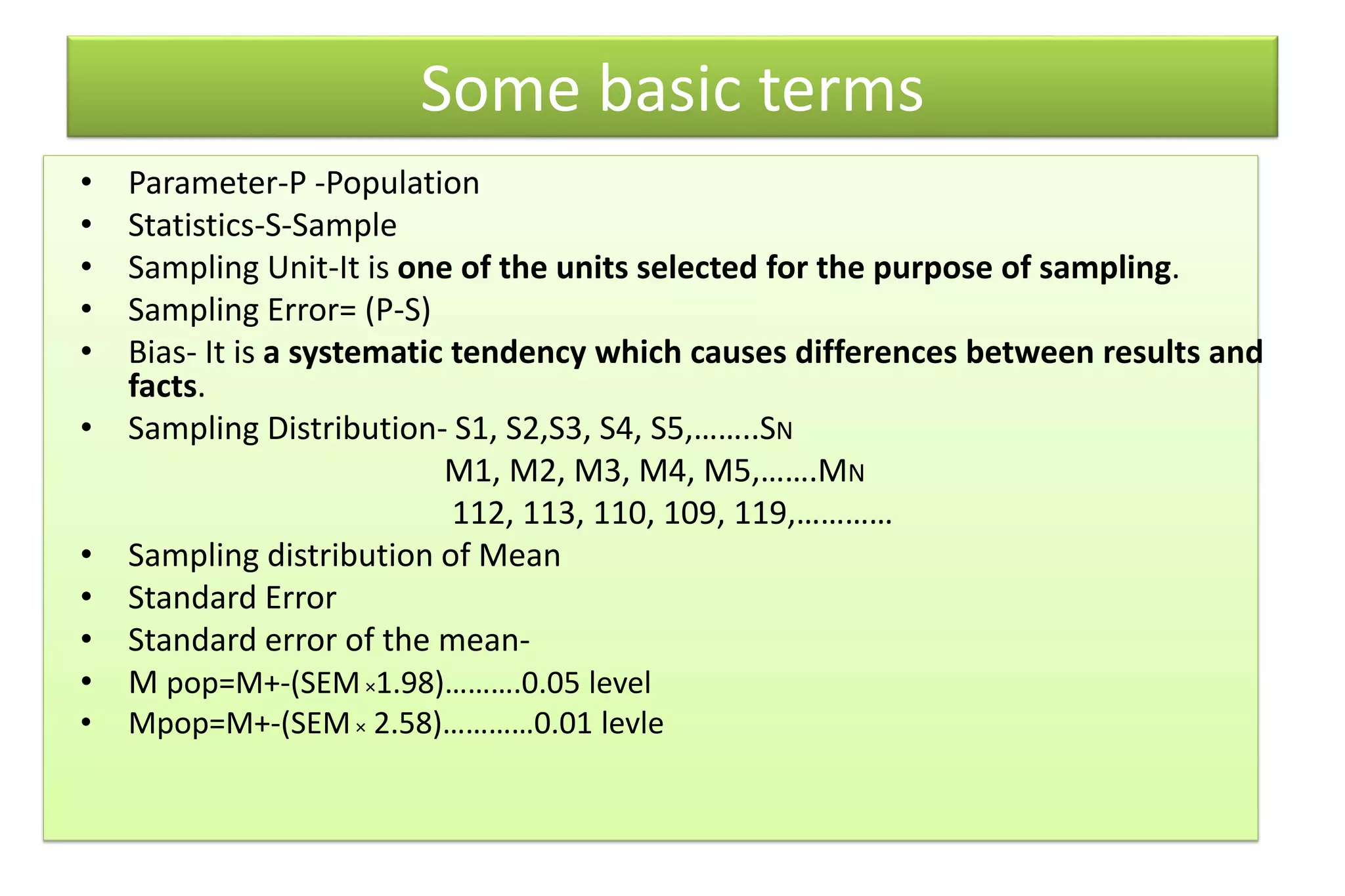
Some basic terms
• Parameter-P -Population
• Statistics-S-Sample
• Sampling Unit-It is one of the units selected for the purpose of sampling.
• Sampling Error= (P-S)
• Bias- It is a systematic tendency which causes differences between results and
facts.
• Sampling Distribution- S1, S2,S3, S4, S5,……..SN
M1, M2, M3, M4, M5,…….MN
112, 113, 110, 109, 119,…………
• Sampling distribution of Mean
• Standard Error
• Standard error of the mean-
• M pop=M+-(SEM×1.98)……….0.05 level
• Mpop=M+-(SEM× 2.58)…………0.01 levle
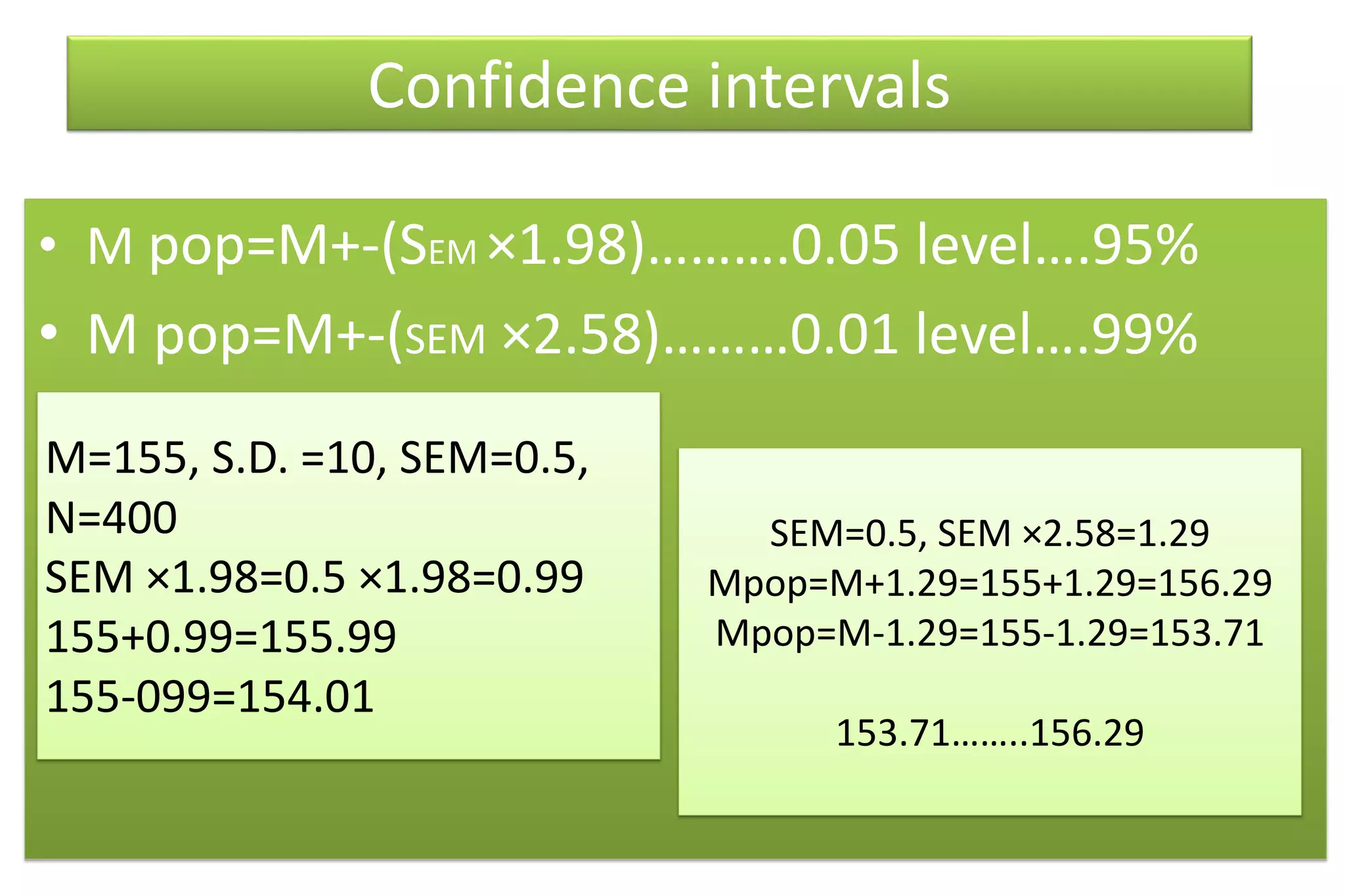
• M pop=M+-(SEM ×1.98)……….0.05 level….95%
• M pop=M+-(SEM ×2.58)………0.01 level….99%
Confidence intervals
SEM=0.5, SEM ×2.58=1.29
Mpop=M+1.29=155+1.29=156.29
Mpop=M-1.29=155-1.29=153.71
153.71……..156.29
M=155, S.D. =10, SEM=0.5,
N=400
SEM ×1.98=0.5 ×1.98=0.99
155+0.99=155.99
155-099=154.01
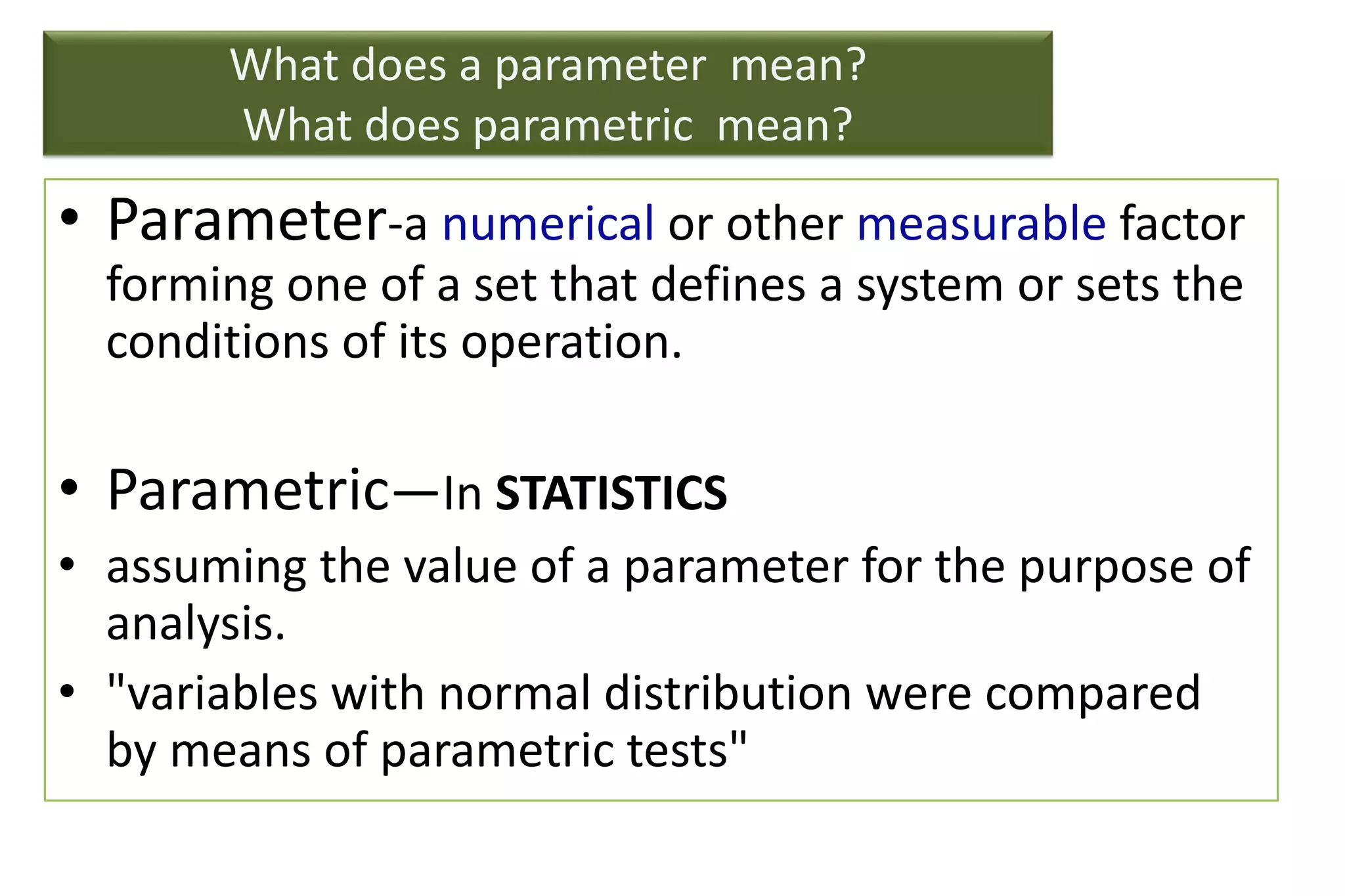
What does a parameter mean?
What does parametric mean?
• Parameter-a numerical or other measurable factor
forming one of a set that defines a system or sets the
conditions of its operation.
• Parametric—In STATISTICS
• assuming the value of a parameter for the purpose of
analysis.
• "variables with normal distribution were compared
by means of parametric tests"
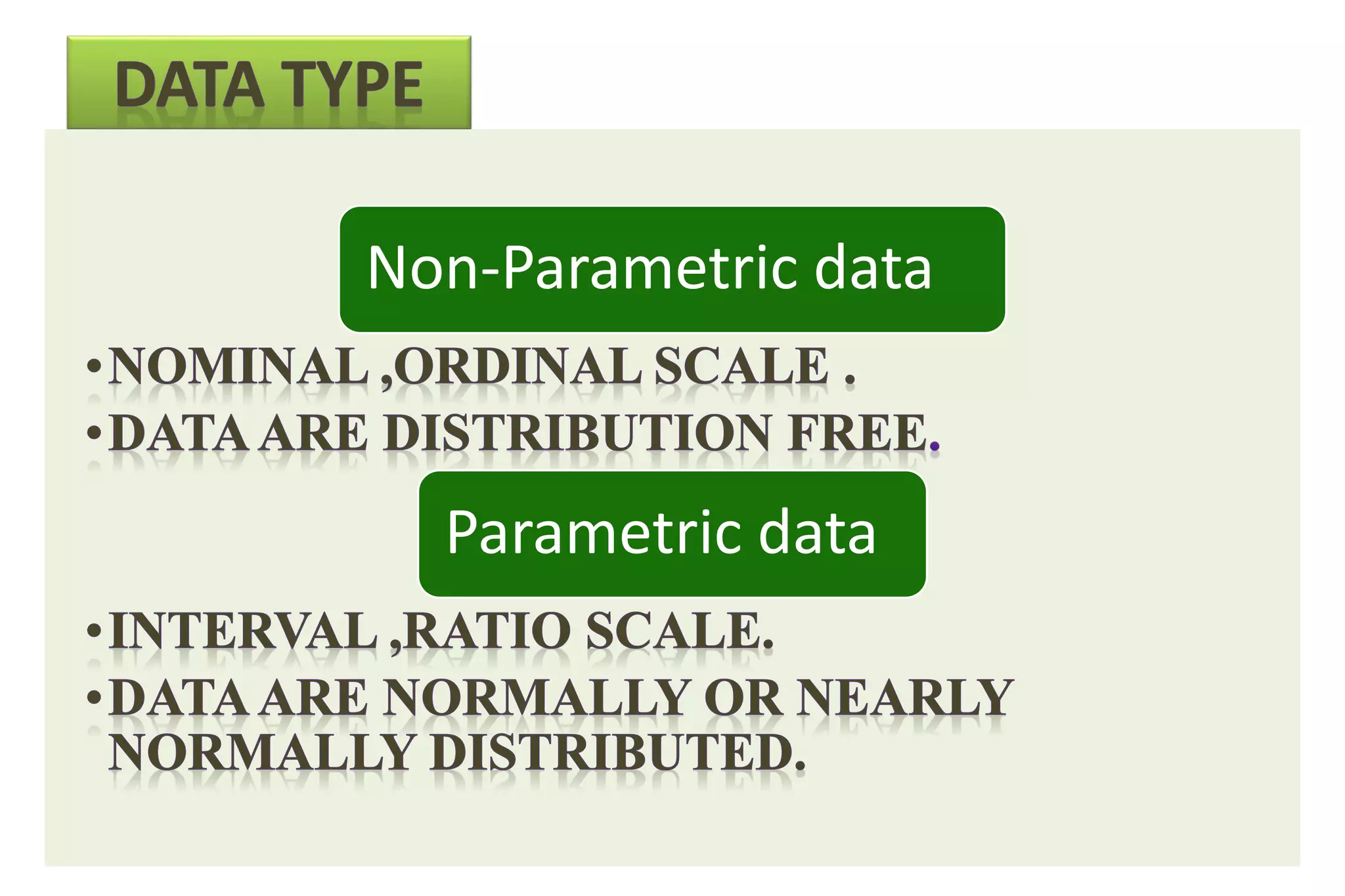
Non-Parametric data
Parametric data
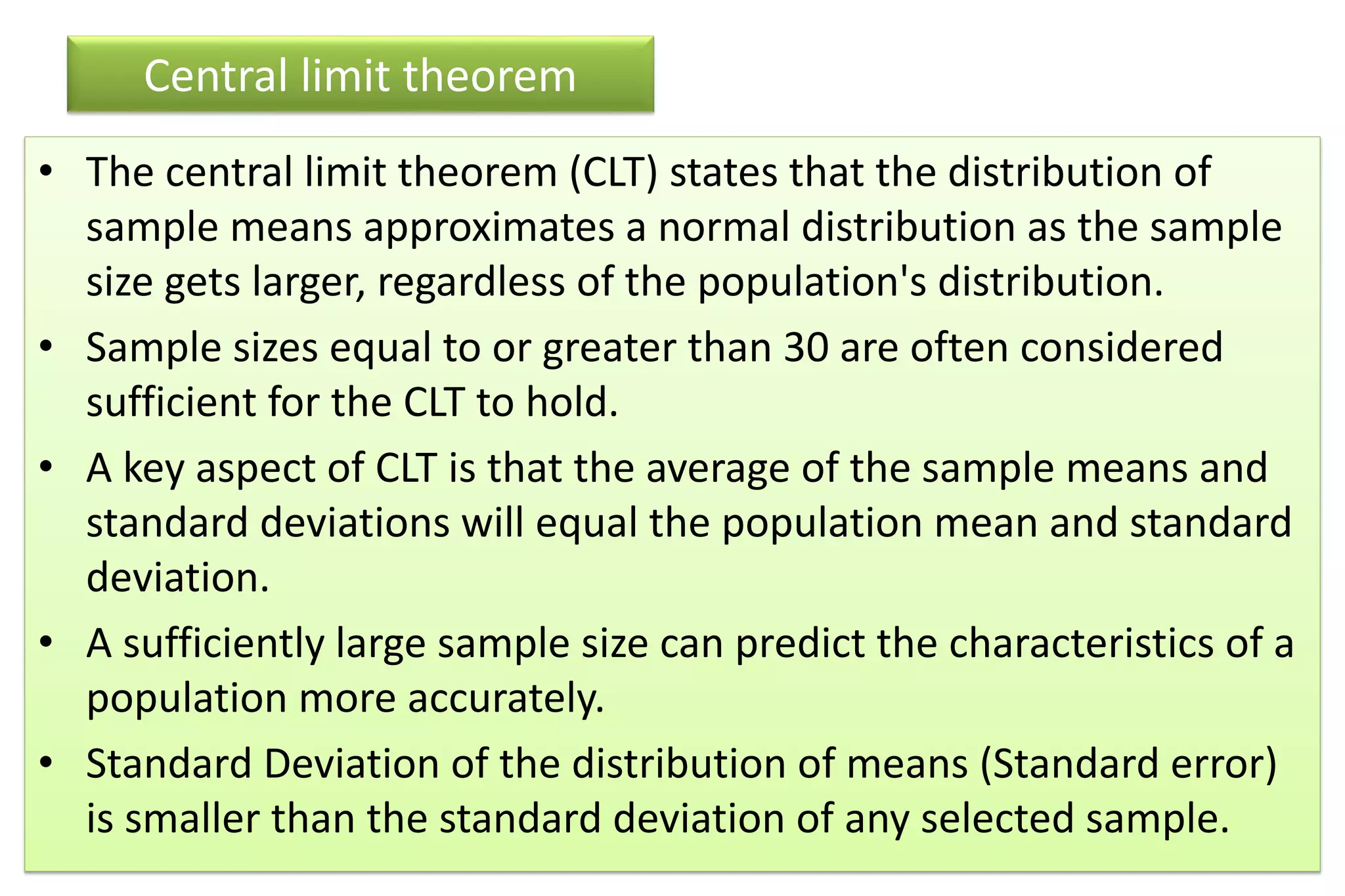
Central limit theorem
• The central limit theorem (CLT) states that the distribution of
sample means approximates a normal distribution as the sample
size gets larger, regardless of the population's distribution.
• Sample sizes equal to or greater than 30 are often considered
sufficient for the CLT to hold.
• A key aspect of CLT is that the average of the sample means and
standard deviations will equal the population mean and standard
deviation.
• A sufficiently large sample size can predict the characteristics of a
population more accurately.
• Standard Deviation of the distribution of means (Standard error)
is smaller than the standard deviation of any selected sample.
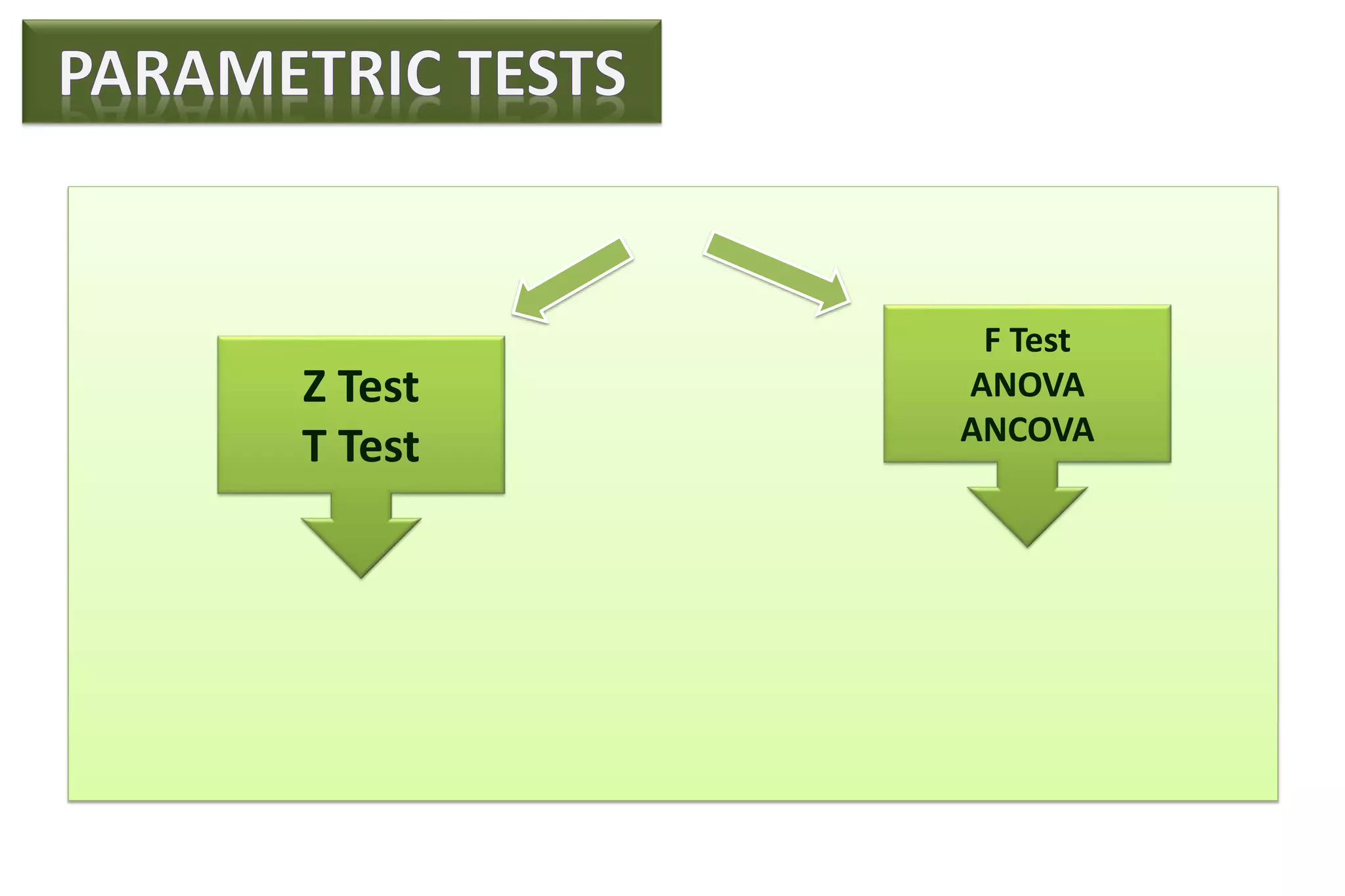
Z Test
T Test
F Test
ANOVA
ANCOVA
Student’s t distribution
In probability and statistics Student's t-distribution (or simply the t
distribution) is any member of a family of continuous probability
distributions that arise when estimating the mean of a normally distributed
population in
situations where the
sample size is small
and the
population's standard
deviation is unknown.
It was developed by
English statistician
William Sealy Gosset
under the pseudonym
"Student".
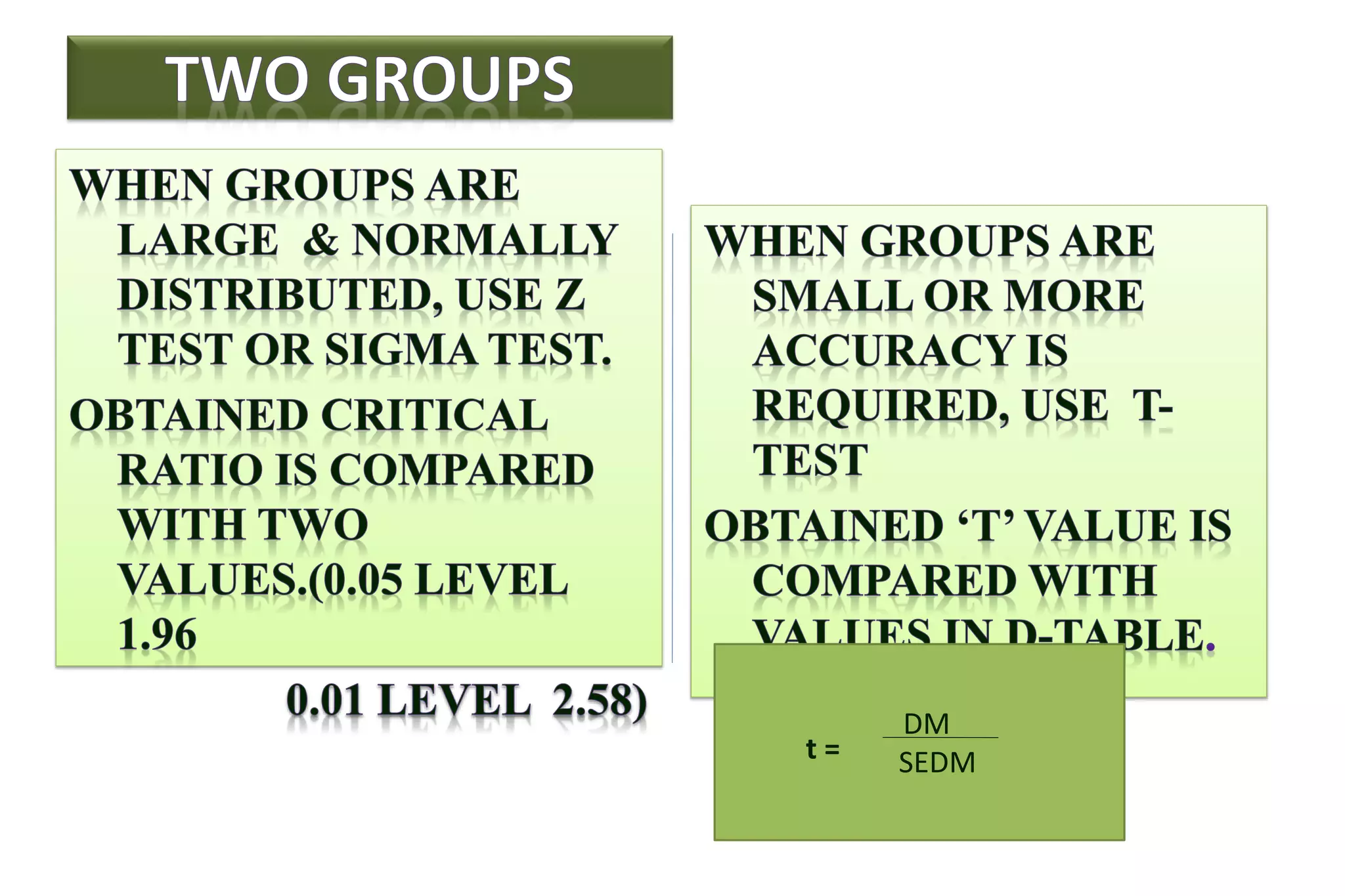
DM
SEDM
t =
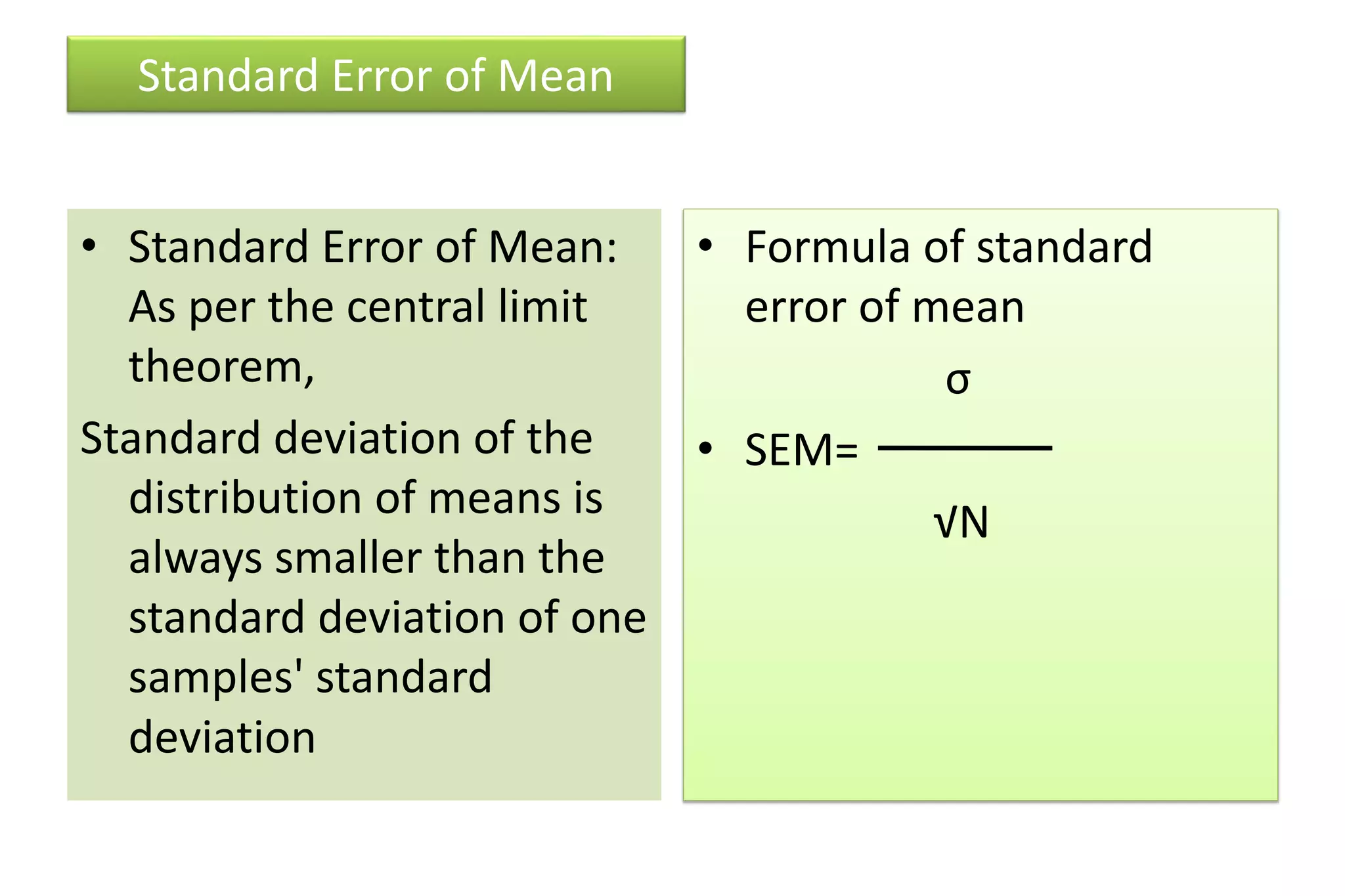
Standard Error of Mean
• Standard Error of Mean:
As per the central limit
theorem,
Standard deviation of the
distribution of means is
always smaller than the
standard deviation of one
samples' standard
deviation
• Formula of standard
error of mean
σ
• SEM=
√N
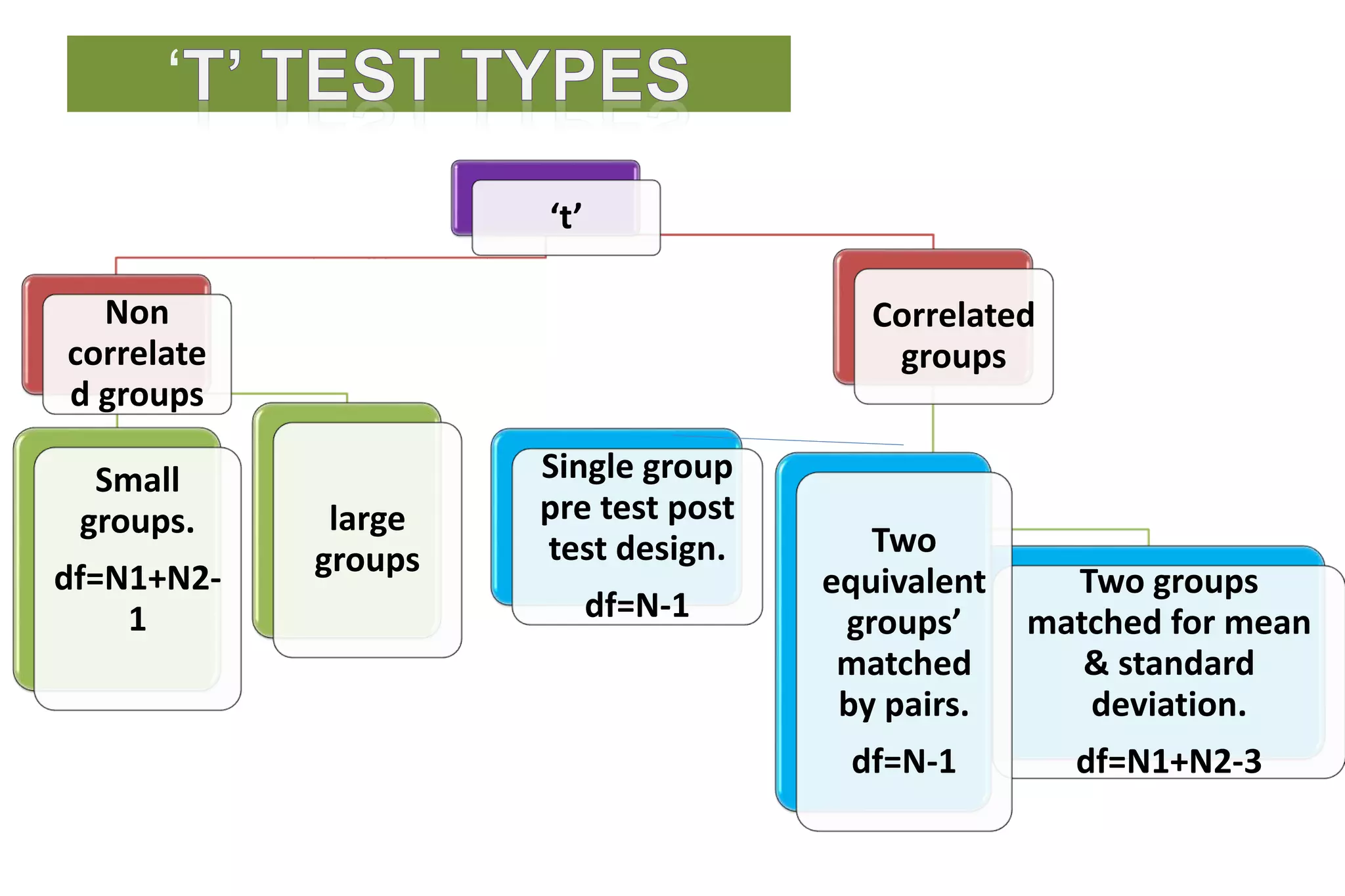
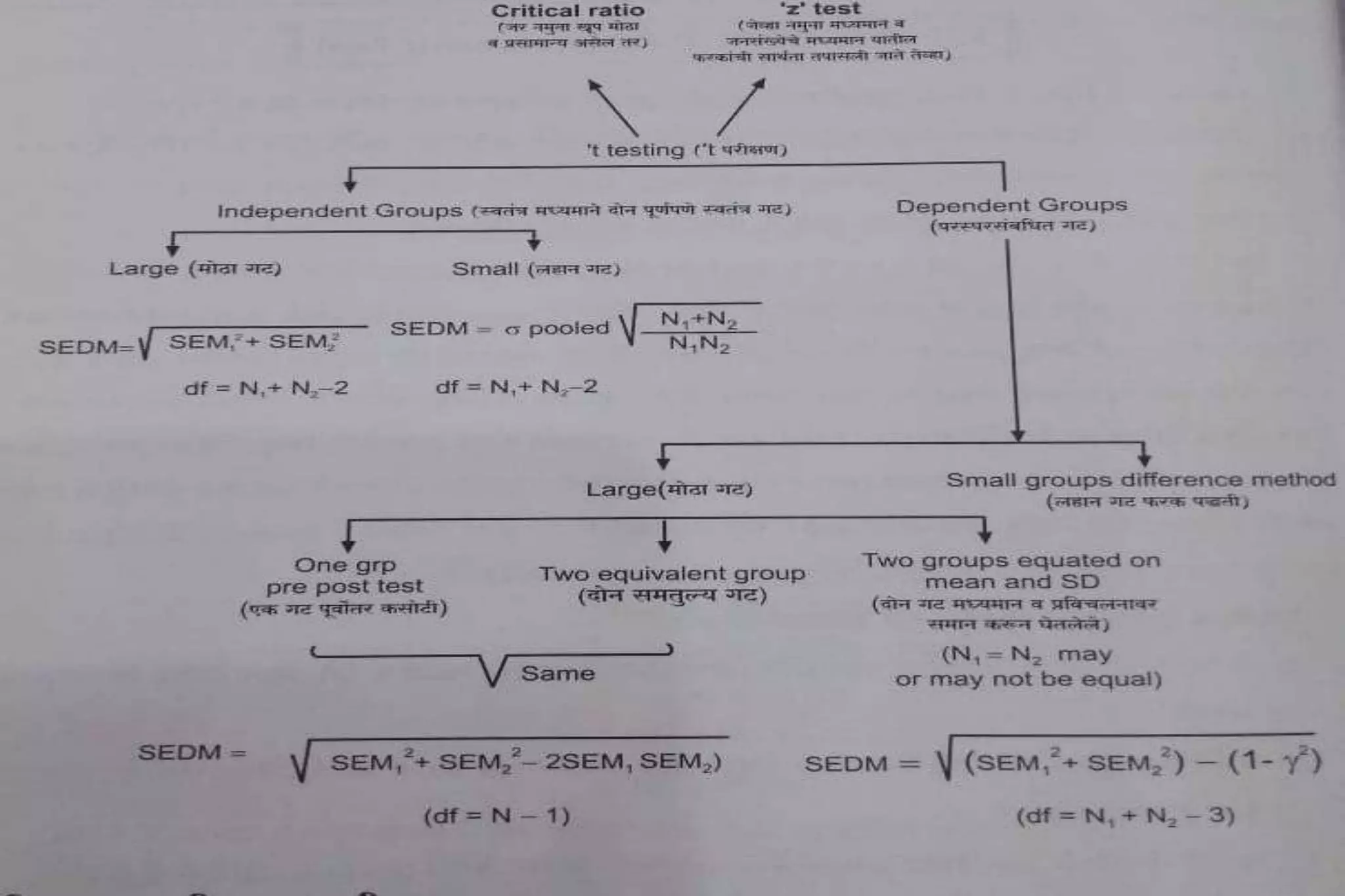
‘
‘t’
Non
correlate
d groups
Small
groups.
df=N1+N2-
1
large
groups
Correlated
groups
Two groups
matched for mean
& standard
deviation.
df=N1+N2-3
Single group
pre test post
test design.
df=N-1
Two
equivalent
groups’
matched
by pairs.
df=N-1
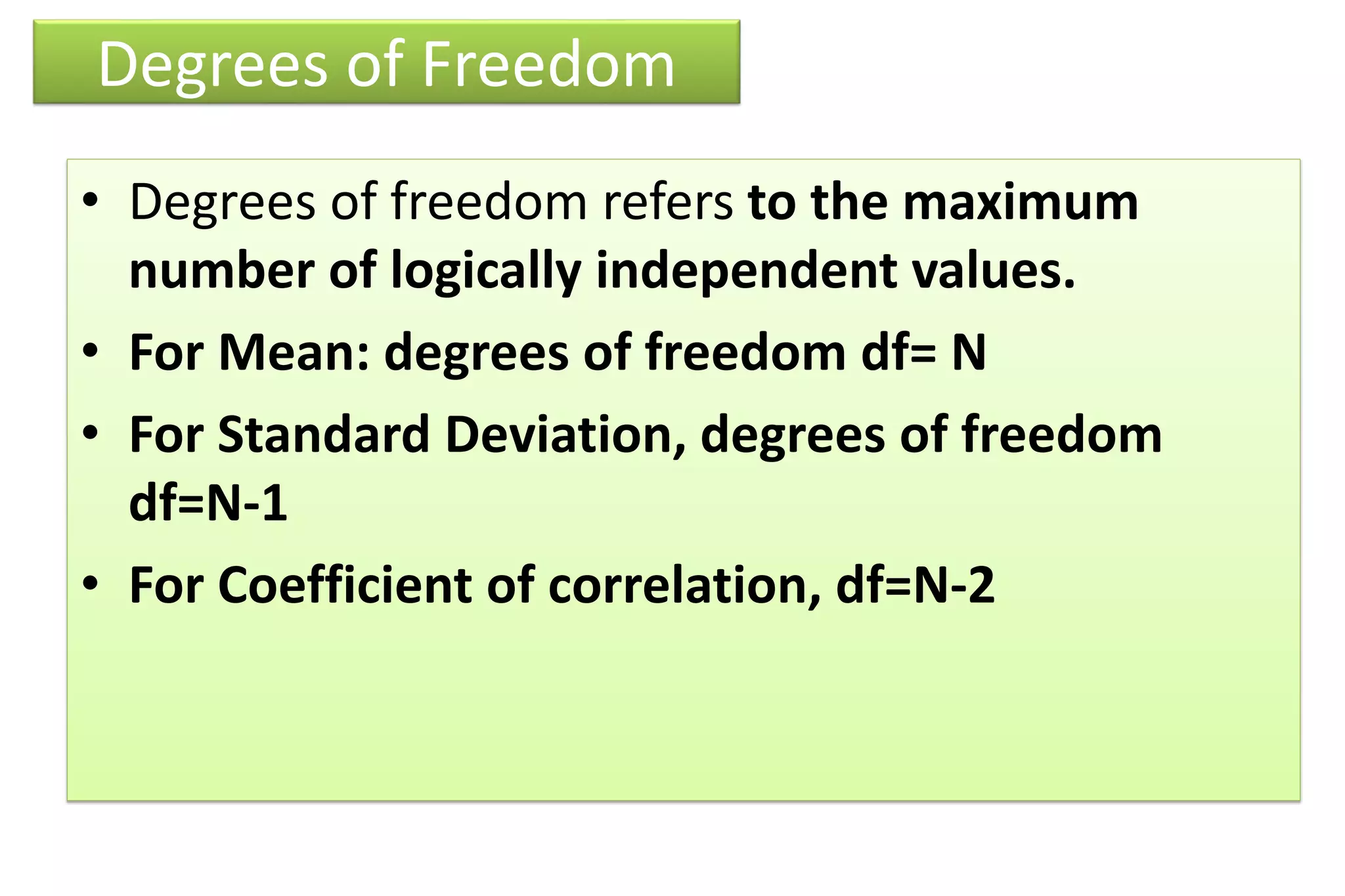
Degrees of Freedom
• Degrees of freedom refers to the maximum
number of logically independent values.
• For Mean: degrees of freedom df= N
• For Standard Deviation, degrees of freedom
df=N-1
• For Coefficient of correlation, df=N-2
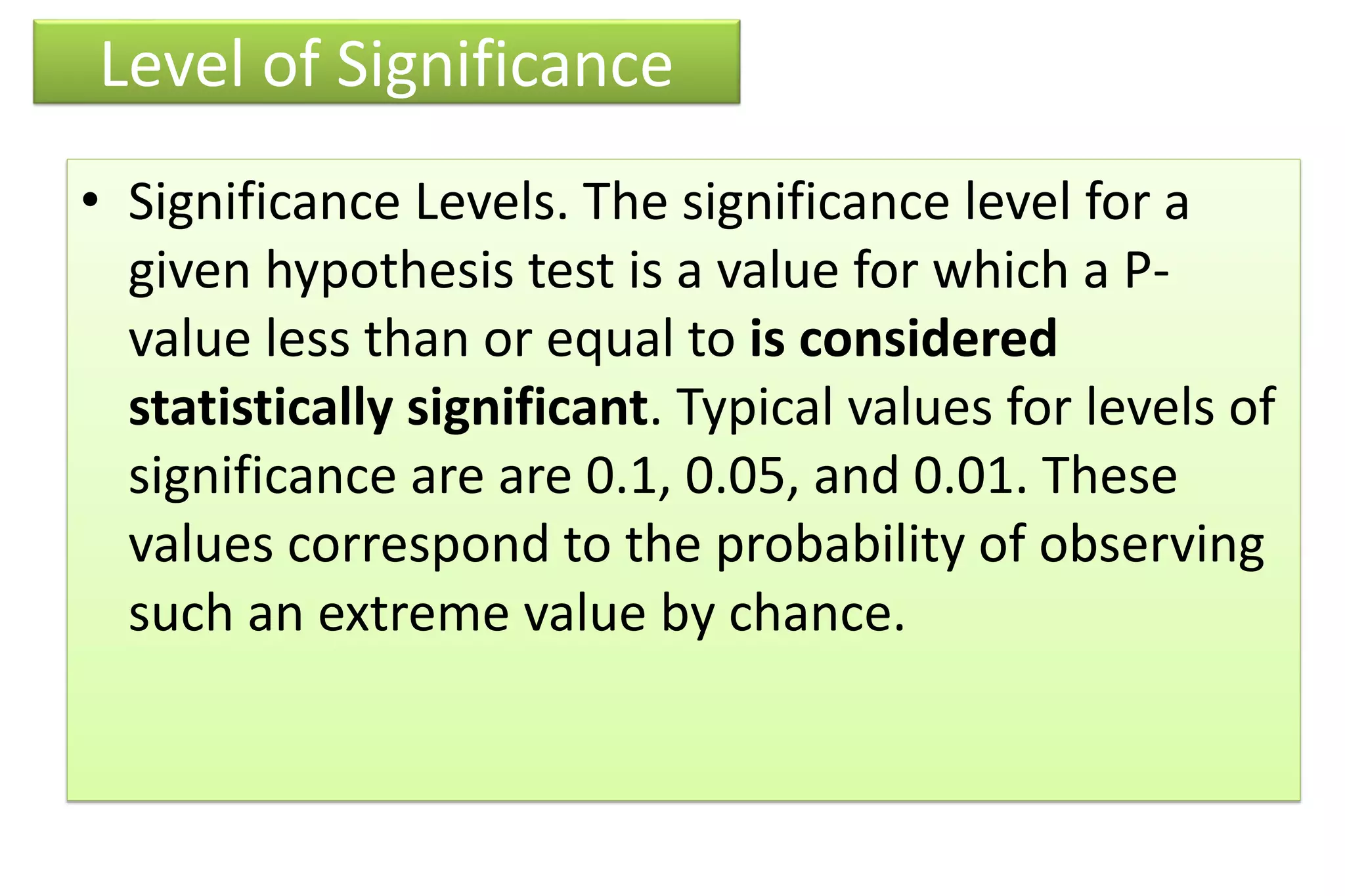
Level of Significance
• Significance Levels. The significance level for a
given hypothesis test is a value for which a P-
value less than or equal to is considered
statistically significant. Typical values for levels of
significance are are 0.1, 0.05, and 0.01. These
values correspond to the probability of observing
such an extreme value by chance.
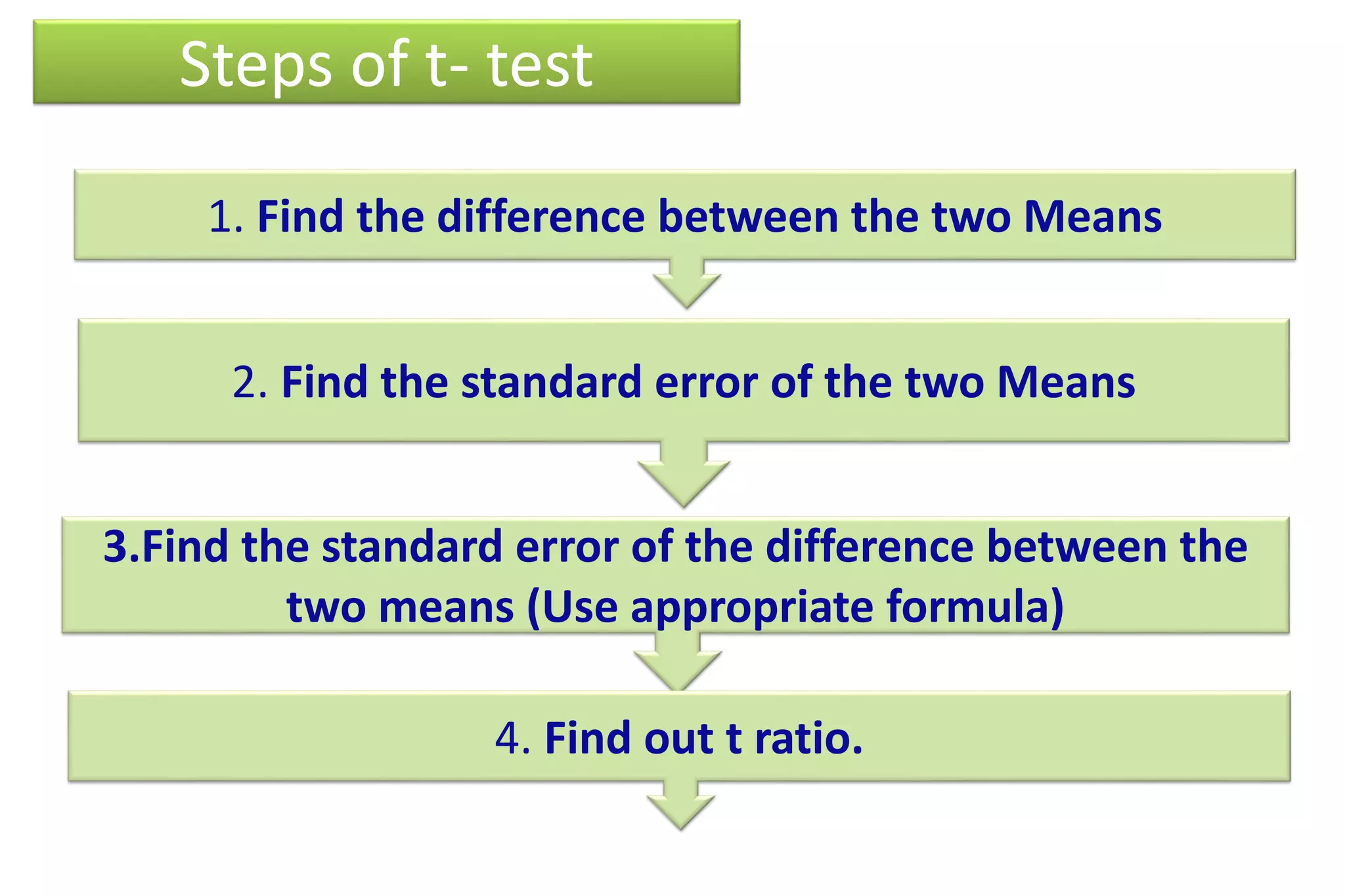
Steps of t- test
1. Find the difference between the two Means
2. Find the standard error of the two Means
3.Find the standard error of the difference between the
two means (Use appropriate formula)
4. Find out t ratio.
Steps of t- test
5. Find out degrees of freedom
6.Decide the level of significance: o.o1 or 0.05
7. Compare the obtained t-value with the table value –D
table
8.Take the Decision.(Reject or not to reject the null
hypothesis)
9.Write down the findings as per the decision taken..
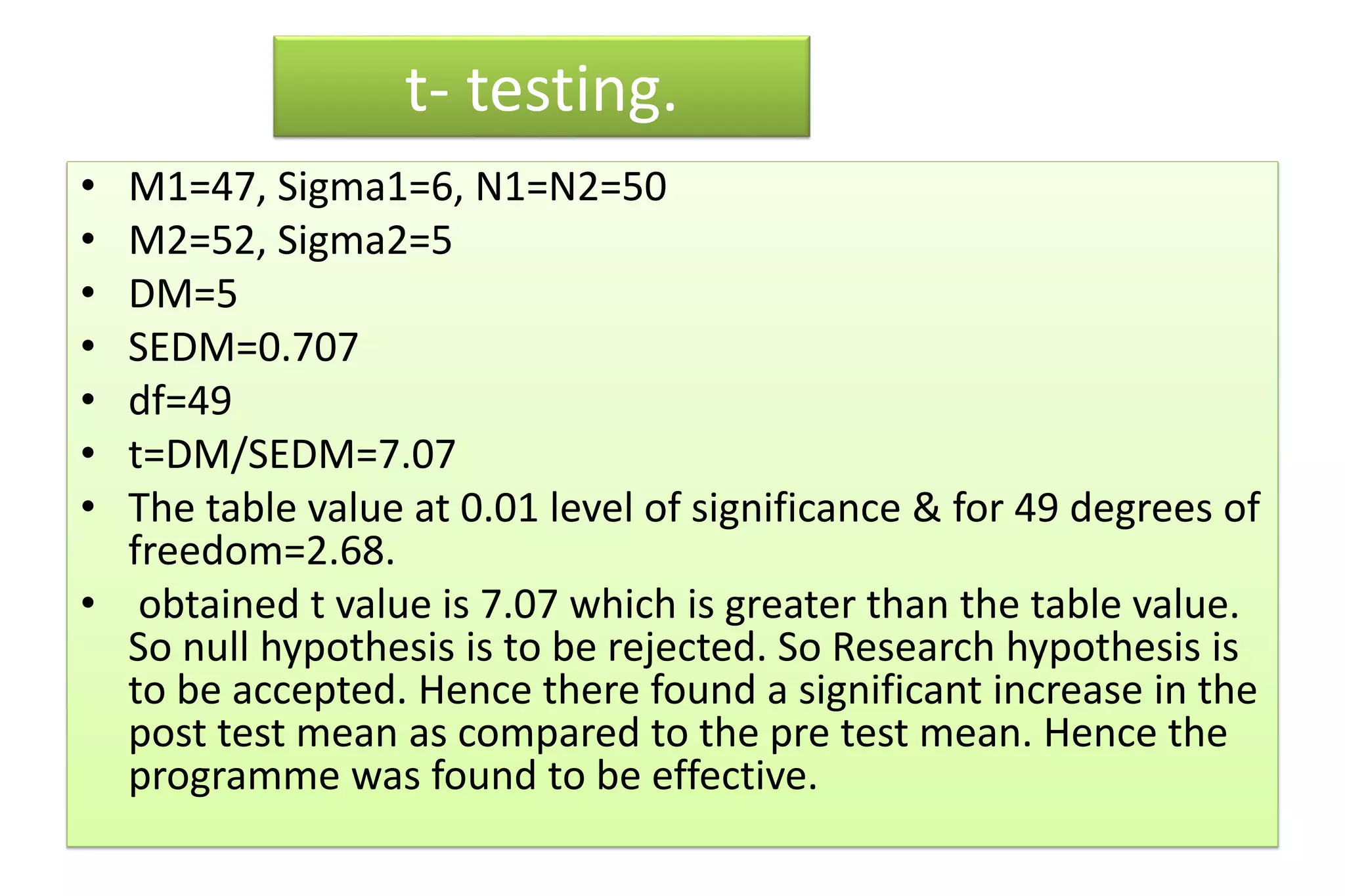
t- testing.
• M1=47, Sigma1=6, N1=N2=50
• M2=52, Sigma2=5
• DM=5
• SEDM=0.707
• df=49
• t=DM/SEDM=7.07
• The table value at 0.01 level of significance & for 49 degrees of
freedom=2.68.
• obtained t value is 7.07 which is greater than the table value.
So null hypothesis is to be rejected. So Research hypothesis is
to be accepted. Hence there found a significant increase in the
post test mean as compared to the pre test mean. Hence the
programme was found to be effective.
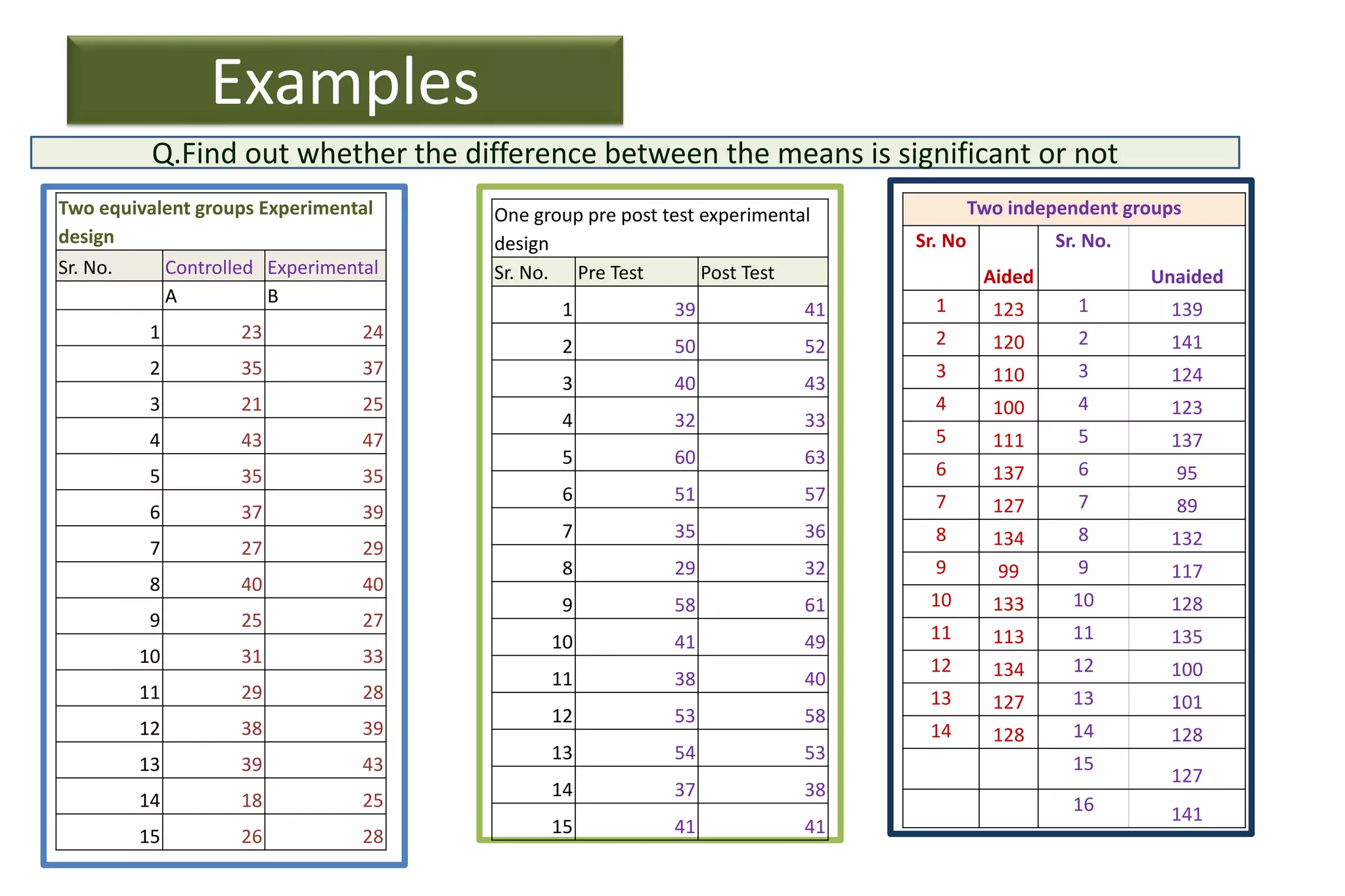
Examples
Two equivalent groups Experimental
design
Sr. No. Controlled Experimental
A B
1 23 24
2 35 37
3 21 25
4 43 47
5 35 35
6 37 39
7 27 29
8 40 40
9 25 27
10 31 33
11 29 28
12 38 39
13 39 43
14 18 25
15 26 28
One group pre post test experimental
design
Sr. No. Pre Test Post Test
1 39 41
2 50 52
3 40 43
4 32 33
5 60 63
6 51 57
7 35 36
8 29 32
9 58 61
10 41 49
11 38 40
12 53 58
13 54 53
14 37 38
15 41 41
Two independent groups
Sr. No
Aided
Sr. No.
Unaided
1 123 1 139
2 120 2 141
3 110 3 124
4 100 4 123
5 111 5 137
6 137 6 95
7 127 7 89
8 134 8 132
9 99 9 117
10 133 10 128
11 113 11 135
12 134 12 100
13 127 13 101
14 128 14 128
15
127
16 141
Q.Find out whether the difference between the means is significant or not
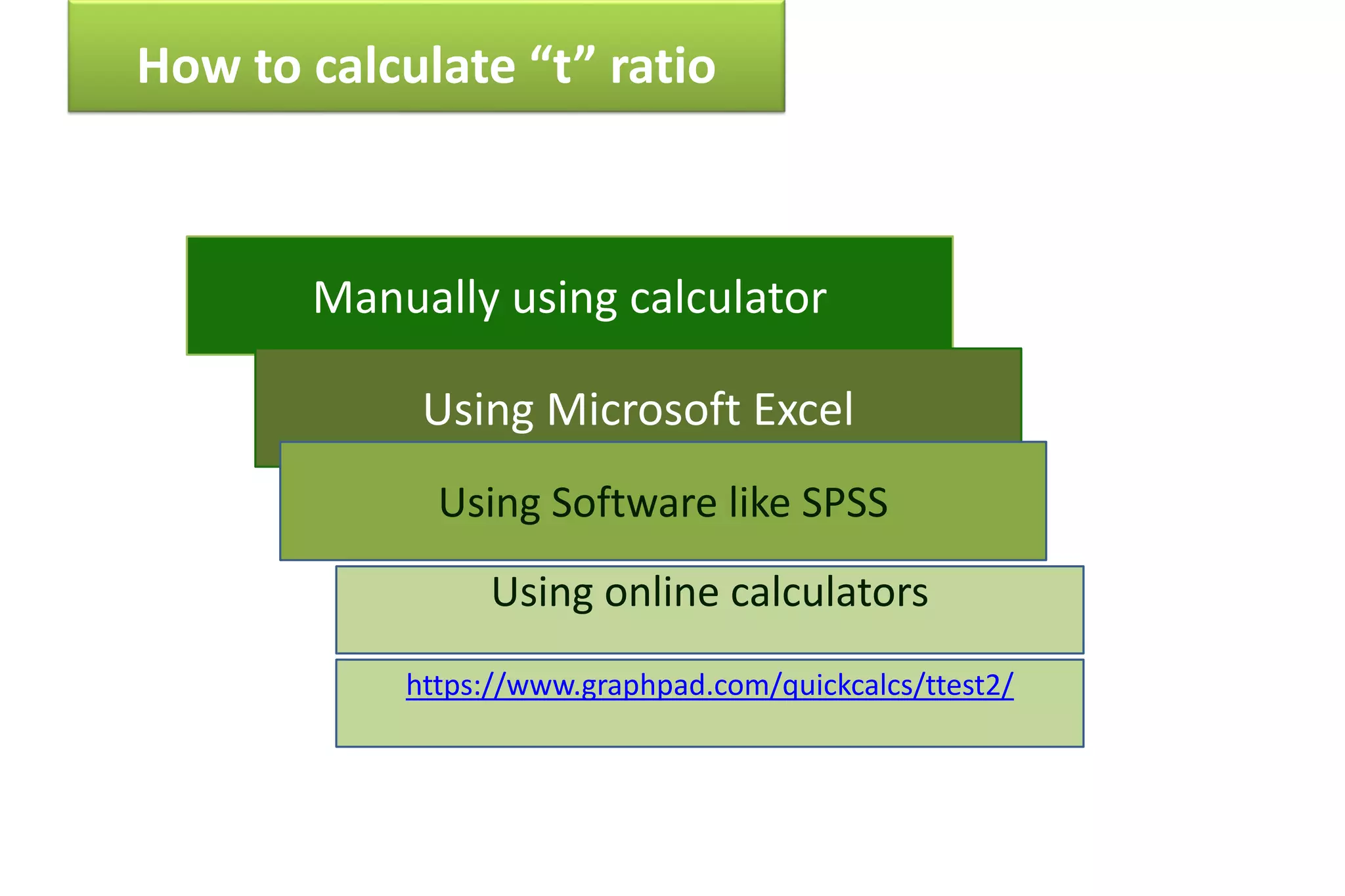
How to calculate “t” ratio
Manually using calculator
Using Microsoft Excel
Using Software like SPSS
https://www.graphpad.com/quickcalcs/ttest2/
Using online calculators
Parametric Test -T test.pptx by Dr. Neha Deo

Parametric Test -T test.pptx by Dr. Neha Deo

  • 1.
  • 2.
  • 3.
    Hypothesis is atentative generalization, the validity of which remains to be tested. Hypothesis is a conjectural statement between two or more variables. The research or scientific hypothesis is a formal affirmative statement predicting a single research outcome, a tentative explanation of the relationship between two or more variables.
  • 4.
    Hypothesis guides thethinking process. Hypothesis is a statement temporarily accepted as true in the light of what is known at that time. Hypo + Thesis So it is a lower level thesis. The thing might be converted in to thesis.
  • 5.
    • In experimentalmethod it is must. • In survey method when significance of difference between two groups is to be tested. • In correlation study to test whether the correlation is significant or not. • Sometimes in historical research also. • But it is not compulsory in each & every research.
  • 6.
    Types of Hypothesis- Hypothesis-types Main Research Positive H1 Statesthat there will be difference Statistical Null H0 States that there will not be any difference or difference will be zero.
  • 7.
  • 8.
    Some basic terms •Parameter-P -Population • Statistics-S-Sample • Sampling Unit-It is one of the units selected for the purpose of sampling. • Sampling Error= (P-S) • Bias- It is a systematic tendency which causes differences between results and facts. • Sampling Distribution- S1, S2,S3, S4, S5,……..SN M1, M2, M3, M4, M5,…….MN 112, 113, 110, 109, 119,………… • Sampling distribution of Mean • Standard Error • Standard error of the mean- • M pop=M+-(SEM×1.98)……….0.05 level • Mpop=M+-(SEM× 2.58)…………0.01 levle
  • 9.
    • M pop=M+-(SEM×1.98)……….0.05 level….95% • M pop=M+-(SEM ×2.58)………0.01 level….99% Confidence intervals SEM=0.5, SEM ×2.58=1.29 Mpop=M+1.29=155+1.29=156.29 Mpop=M-1.29=155-1.29=153.71 153.71……..156.29 M=155, S.D. =10, SEM=0.5, N=400 SEM ×1.98=0.5 ×1.98=0.99 155+0.99=155.99 155-099=154.01
  • 10.
    What does aparameter mean? What does parametric mean? • Parameter-a numerical or other measurable factor forming one of a set that defines a system or sets the conditions of its operation. • Parametric—In STATISTICS • assuming the value of a parameter for the purpose of analysis. • "variables with normal distribution were compared by means of parametric tests"
  • 11.
  • 12.
    Central limit theorem •The central limit theorem (CLT) states that the distribution of sample means approximates a normal distribution as the sample size gets larger, regardless of the population's distribution. • Sample sizes equal to or greater than 30 are often considered sufficient for the CLT to hold. • A key aspect of CLT is that the average of the sample means and standard deviations will equal the population mean and standard deviation. • A sufficiently large sample size can predict the characteristics of a population more accurately. • Standard Deviation of the distribution of means (Standard error) is smaller than the standard deviation of any selected sample.
  • 13.
    Z Test T Test FTest ANOVA ANCOVA
  • 14.
    Student’s t distribution Inprobability and statistics Student's t-distribution (or simply the t distribution) is any member of a family of continuous probability distributions that arise when estimating the mean of a normally distributed population in situations where the sample size is small and the population's standard deviation is unknown. It was developed by English statistician William Sealy Gosset under the pseudonym "Student".
  • 15.
  • 16.
    Standard Error ofMean • Standard Error of Mean: As per the central limit theorem, Standard deviation of the distribution of means is always smaller than the standard deviation of one samples' standard deviation • Formula of standard error of mean σ • SEM= √N
  • 17.
    ‘ ‘t’ Non correlate d groups Small groups. df=N1+N2- 1 large groups Correlated groups Two groups matchedfor mean & standard deviation. df=N1+N2-3 Single group pre test post test design. df=N-1 Two equivalent groups’ matched by pairs. df=N-1
  • 19.
    Degrees of Freedom •Degrees of freedom refers to the maximum number of logically independent values. • For Mean: degrees of freedom df= N • For Standard Deviation, degrees of freedom df=N-1 • For Coefficient of correlation, df=N-2
  • 20.
    Level of Significance •Significance Levels. The significance level for a given hypothesis test is a value for which a P- value less than or equal to is considered statistically significant. Typical values for levels of significance are are 0.1, 0.05, and 0.01. These values correspond to the probability of observing such an extreme value by chance.
  • 21.
    Steps of t-test 1. Find the difference between the two Means 2. Find the standard error of the two Means 3.Find the standard error of the difference between the two means (Use appropriate formula) 4. Find out t ratio.
  • 22.
    Steps of t-test 5. Find out degrees of freedom 6.Decide the level of significance: o.o1 or 0.05 7. Compare the obtained t-value with the table value –D table 8.Take the Decision.(Reject or not to reject the null hypothesis) 9.Write down the findings as per the decision taken..
  • 23.
    t- testing. • M1=47,Sigma1=6, N1=N2=50 • M2=52, Sigma2=5 • DM=5 • SEDM=0.707 • df=49 • t=DM/SEDM=7.07 • The table value at 0.01 level of significance & for 49 degrees of freedom=2.68. • obtained t value is 7.07 which is greater than the table value. So null hypothesis is to be rejected. So Research hypothesis is to be accepted. Hence there found a significant increase in the post test mean as compared to the pre test mean. Hence the programme was found to be effective.
  • 25.
    Examples Two equivalent groupsExperimental design Sr. No. Controlled Experimental A B 1 23 24 2 35 37 3 21 25 4 43 47 5 35 35 6 37 39 7 27 29 8 40 40 9 25 27 10 31 33 11 29 28 12 38 39 13 39 43 14 18 25 15 26 28 One group pre post test experimental design Sr. No. Pre Test Post Test 1 39 41 2 50 52 3 40 43 4 32 33 5 60 63 6 51 57 7 35 36 8 29 32 9 58 61 10 41 49 11 38 40 12 53 58 13 54 53 14 37 38 15 41 41 Two independent groups Sr. No Aided Sr. No. Unaided 1 123 1 139 2 120 2 141 3 110 3 124 4 100 4 123 5 111 5 137 6 137 6 95 7 127 7 89 8 134 8 132 9 99 9 117 10 133 10 128 11 113 11 135 12 134 12 100 13 127 13 101 14 128 14 128 15 127 16 141 Q.Find out whether the difference between the means is significant or not
  • 26.
    How to calculate“t” ratio Manually using calculator Using Microsoft Excel Using Software like SPSS https://www.graphpad.com/quickcalcs/ttest2/ Using online calculators