
POLYMER - SUPPORTED SYNTHESIS
Presented by -
Minal
Roll no.-
180000701047
M.Sc. chemistry
3rd semester
1
Chadhuary bansilal University ,
Bhiwani
CONTENTS
Introduction
Properties of polymer support
Choice of polymers
Reactions involving polymer support
Type1
Type2
Type3
Conclusion
References
2.
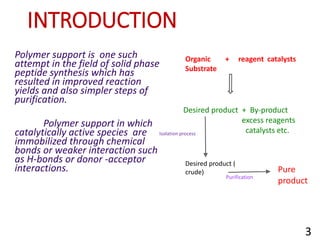
INTRODUCTION
Polymer support is one such
attempt in the field of solid phase
peptide synthesis which has
resulted in improved reaction
yields and also simpler steps of
purification.
Polymer support in which
catalytically active species are
immobilized through chemical
bonds or weaker interaction such
as H-bonds or donor -acceptor
interactions.
Organic + reagent catalysts
Substrate
Desired product + By-product
excess reagents
catalysts etc.Isolation process
Desired product (
crude)
Purification
Pure
product
3
PROPERTIES OF POLYMER SUPPORT
 Insoluble in common solvents.
 Reusable.
 Undergo straight forward reaction and be free
from any side reactions.
 Easy to handle and should not undergo mechanical
fracturing during synthetic operations.
 Functional group should be uniformly distributed
in the polymer.
 Either of relatively rigid (nonswellable) or of quite
flexible (swelling) type.
4.
CHOICE OF POLYMERS
A range of polymers which are used in organic
synthesis are poly vinyl alcohol, polyethylene glycol,
polyethylene imine, polamino acids, polyvinyl
chloride and various phenol- formaldehyde resins
etc.
The selection of a polymer support
depends on the type of the reaction to be
performed.The most abundantly used polymer
support is the styrene based polymers.
5.
Continue...
Reason for using polystyrene as supported catalyst:
1. Aromatic ring can be easily functionalised.
2. Being hydrocarbon like,These polymers are
compatible with organic solvents.
3. These polymers are not degraded by most
chemical reagents under ordinary conditions.
4. The type and degree of cross-linking can be
easily be controlled.
6.
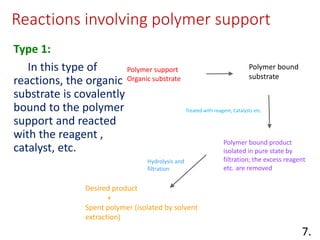
Reactions involving polymer support
Type 1:
In this type of
reactions, the organic
substrate is covalently
bound to the polymer
support and reacted
with the reagent ,
catalyst, etc.
7.
Polymer support
Organic substrate
Polymer bound
substrate
Polymer bound product
isolated in pure state by
filtration; the excess reagent
etc. are removed
Desired product
+
Spent polymer (isolated by solvent
extraction)
Hydrolysis and
filtration
Treated with reagent, Catalysts etc.
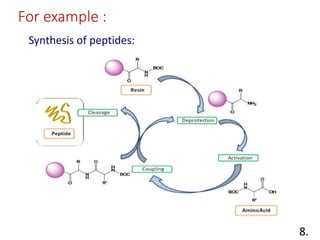
For example :
Synthesis of peptides:
8.
Type 2:
In this type of synthesis ,the reagent is linked to
a polymeric material to form a functionalised
polymer supported reagent.
Special advantage of such
reagent is the ease of separation of the product
from spent reagent, an increased selectively of
the reagent due to steric hindrance and in some
cases the spent reagent may be regenerated.
9.
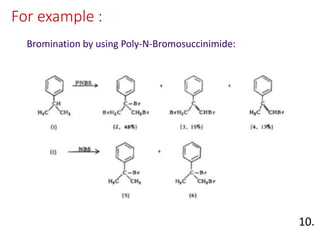
For example :
Bromination by using Poly-N-Bromosuccinimide:
10.
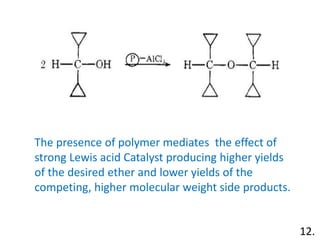
Preparation of Ethers from Alcohols by
using polymeric AlCl as a catalyst:
Type 3:
Polymer supported catalytic reactions :
In this type of reaction, conventional catalyst
which is usually used in the homogeneous phase, is
linked to a polymer backbone and used in this form to
catalyze reactions.
For example:
3
11.
12.
The presence of polymer mediates the effect of
strong Lewis acid Catalyst producing higher yields
of the desired ether and lower yields of the
competing, higher molecular weight side products.
Conclusion
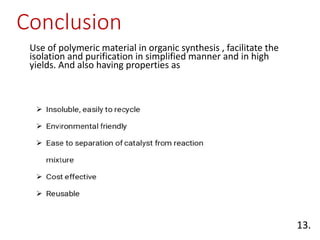
Use of polymeric material in organic synthesis , facilitate the
isolation and purification in simplified manner and in high
yields. And also having properties as
13.
References
1. V.K.Ahuluwalia,Renu Aggarwal; Organic Synthesis Special
Techniques; Narosa Publishing House; 2nd Ed. ; 2006; 150-
191.
2. Maurizio Benaglia , Alessandra Puglisi, and Franco Cozz;
polymer -supported Organic Catalysts; American chem.
Society; 2003; vol.103; no.9.
3. Tor E. kristensen, Kristian Vestli,Martin G.Jakobsen,Finn
k.Hansen,and Tore Hansen; AGeneral Approach for
Preparation of Polymer-supported choral organocatalysts
via Acrylic Copolymerization; J. Org. Chem. 2010; 75; 1620-
1629.
14.
Polymer   supported Synthesis

Polymer supported Synthesis

  • 1.
    POLYMER - SUPPORTEDSYNTHESIS Presented by - Minal Roll no.- 180000701047 M.Sc. chemistry 3rd semester 1 Chadhuary bansilal University , Bhiwani
  • 2.
    CONTENTS Introduction Properties of polymersupport Choice of polymers Reactions involving polymer support Type1 Type2 Type3 Conclusion References 2.
  • 3.
    INTRODUCTION Polymer support isone such attempt in the field of solid phase peptide synthesis which has resulted in improved reaction yields and also simpler steps of purification. Polymer support in which catalytically active species are immobilized through chemical bonds or weaker interaction such as H-bonds or donor -acceptor interactions. Organic + reagent catalysts Substrate Desired product + By-product excess reagents catalysts etc.Isolation process Desired product ( crude) Purification Pure product 3
  • 4.
    PROPERTIES OF POLYMERSUPPORT  Insoluble in common solvents.  Reusable.  Undergo straight forward reaction and be free from any side reactions.  Easy to handle and should not undergo mechanical fracturing during synthetic operations.  Functional group should be uniformly distributed in the polymer.  Either of relatively rigid (nonswellable) or of quite flexible (swelling) type. 4.
  • 5.
    CHOICE OF POLYMERS Arange of polymers which are used in organic synthesis are poly vinyl alcohol, polyethylene glycol, polyethylene imine, polamino acids, polyvinyl chloride and various phenol- formaldehyde resins etc. The selection of a polymer support depends on the type of the reaction to be performed.The most abundantly used polymer support is the styrene based polymers. 5.
  • 6.
    Continue... Reason for usingpolystyrene as supported catalyst: 1. Aromatic ring can be easily functionalised. 2. Being hydrocarbon like,These polymers are compatible with organic solvents. 3. These polymers are not degraded by most chemical reagents under ordinary conditions. 4. The type and degree of cross-linking can be easily be controlled. 6.
  • 7.
    Reactions involving polymersupport Type 1: In this type of reactions, the organic substrate is covalently bound to the polymer support and reacted with the reagent , catalyst, etc. 7. Polymer support Organic substrate Polymer bound substrate Polymer bound product isolated in pure state by filtration; the excess reagent etc. are removed Desired product + Spent polymer (isolated by solvent extraction) Hydrolysis and filtration Treated with reagent, Catalysts etc.
  • 8.
    For example : Synthesisof peptides: 8.
  • 9.
    Type 2: In thistype of synthesis ,the reagent is linked to a polymeric material to form a functionalised polymer supported reagent. Special advantage of such reagent is the ease of separation of the product from spent reagent, an increased selectively of the reagent due to steric hindrance and in some cases the spent reagent may be regenerated. 9.
  • 10.
    For example : Brominationby using Poly-N-Bromosuccinimide: 10.
  • 11.
    Preparation of Ethersfrom Alcohols by using polymeric AlCl as a catalyst: Type 3: Polymer supported catalytic reactions : In this type of reaction, conventional catalyst which is usually used in the homogeneous phase, is linked to a polymer backbone and used in this form to catalyze reactions. For example: 3 11.
  • 12.
    12. The presence ofpolymer mediates the effect of strong Lewis acid Catalyst producing higher yields of the desired ether and lower yields of the competing, higher molecular weight side products.
  • 13.
    Conclusion Use of polymericmaterial in organic synthesis , facilitate the isolation and purification in simplified manner and in high yields. And also having properties as 13.
  • 14.
    References 1. V.K.Ahuluwalia,Renu Aggarwal;Organic Synthesis Special Techniques; Narosa Publishing House; 2nd Ed. ; 2006; 150- 191. 2. Maurizio Benaglia , Alessandra Puglisi, and Franco Cozz; polymer -supported Organic Catalysts; American chem. Society; 2003; vol.103; no.9. 3. Tor E. kristensen, Kristian Vestli,Martin G.Jakobsen,Finn k.Hansen,and Tore Hansen; AGeneral Approach for Preparation of Polymer-supported choral organocatalysts via Acrylic Copolymerization; J. Org. Chem. 2010; 75; 1620- 1629. 14.