1
B.Sc. Final year
MEB Students
for
Today’s
Chemistry Lecture
by
Dr Pramod R Padole
2
LOGO
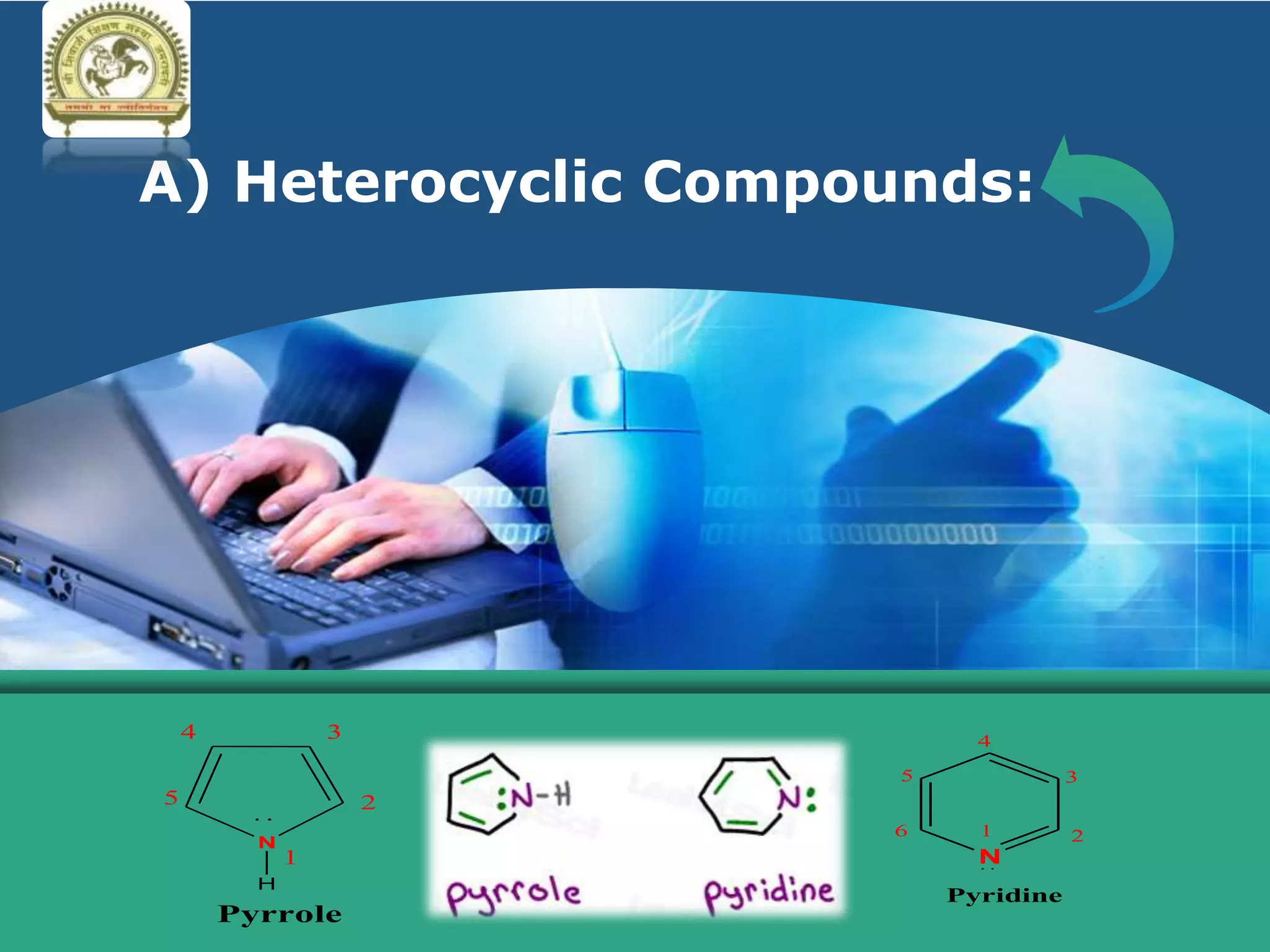
A) Heterocyclic Compounds:
N
H
2
34
5
1
Pyrrole
N
1 2
3
4
5
6
Pyridine
LOGO
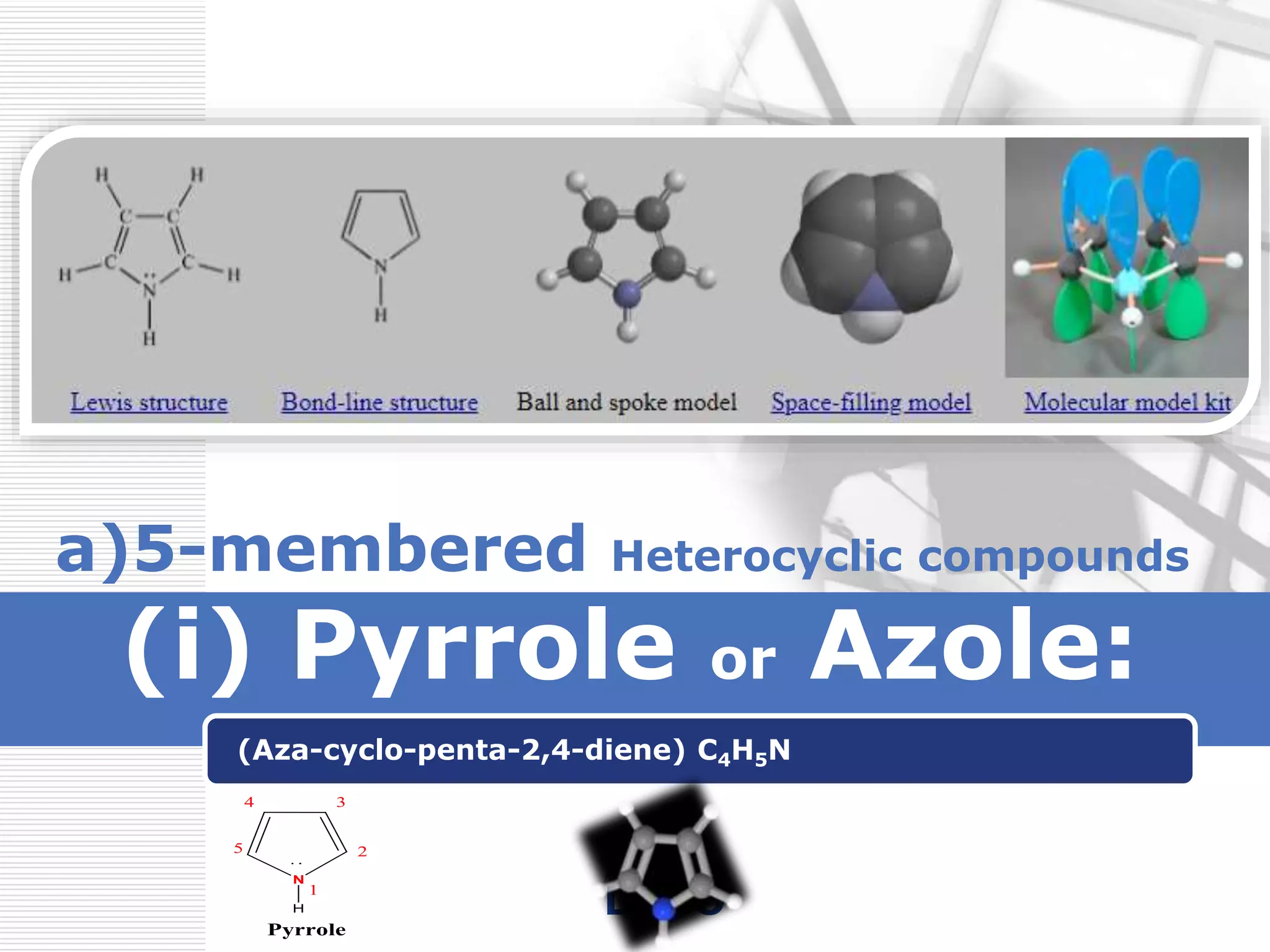
a)5-membered Heterocyclic compounds
(i) Pyrrole or Azole:
(Aza-cyclo-penta-2,4-diene) C4H5N
N
H
2
34
5
1
Pyrrole
LOGO
Resonance:
The double bond keep on changing their
positions and this is called Resonance.
Resonance is also called mesomerism.
I II
Resonance structure of Benzene Resonance hybrid
LOGO
Note that:
I) Bond length of C-C bond = 1.54 Ao
II) Bond length of C=C bond = 1.34 Ao
III) Bond length of all C-C bonds in Benzene = 1.39 Ao
LOGOwww.themegallery.com
of Pyrrole
Resonance structure
pramodpadole@gmail.com By Dr Pramod R Padole
How do you know when to draw
resonance structures?
Directing ( or orienting) influence:
A molecule can have resonance structures when it has a lone pair or a double bond on the atom next to a double bond.
LOGO
Resonance Structure of Pyrrole:
According to the resonance theory,
pyrrole is a resonance hybrid of the
following resonating structures.
Q.1) Discuss the resonance in Pyrrole. (S-16, 4 Mark)
LOGO
N
H
Pyrrole
1
2
34
5
Resonance Structure of Pyrrole:
 According to the resonance theory, pyrrole is a resonance hybrid of the following
resonating structures.
 In the resonating structures, Nitrogen donates electrons (Lone pair) to the
pyrrole ring.
 Therefore, electron density on Carbon atom (position-3) increases, i.e., they have
become negatively charged at C-3 positon .
Q.1) Discuss the resonance in Pyrrole. (S-16, 4 Mark)
Resonating Structures
of Pyrrole
N
H
I
3
1
2
4
5
LOGO
Resonating Structures
of Pyrrole
N
H
I
3
1
2
4
5
Resonance Structure of Pyrrole:
 According to the defination of resonance, therefore, electron density on Carbon atom
(position-5) increases, i.e., they have become negatively charged at C-5 positon .
Resonating Structures
of Pyrrole
N
H
II
5
1
2
LOGO
N
H
III
2
1
34
Resonating Structures of Pyrrole
Resonating Structures
of Pyrrole
N
H
II
5
1
2
Resonance Structure of Pyrrole:
 According to the defination of resonance, therefore, electron density on Carbon atom
(position-2) increases, i.e., they have become negatively charged at C-2 positon .
LOGO
Resonating Structures of Pyrrole
N
H
IV
4
1
5 2
3
N
H
III
2
1
34
Resonating Structures of Pyrrole
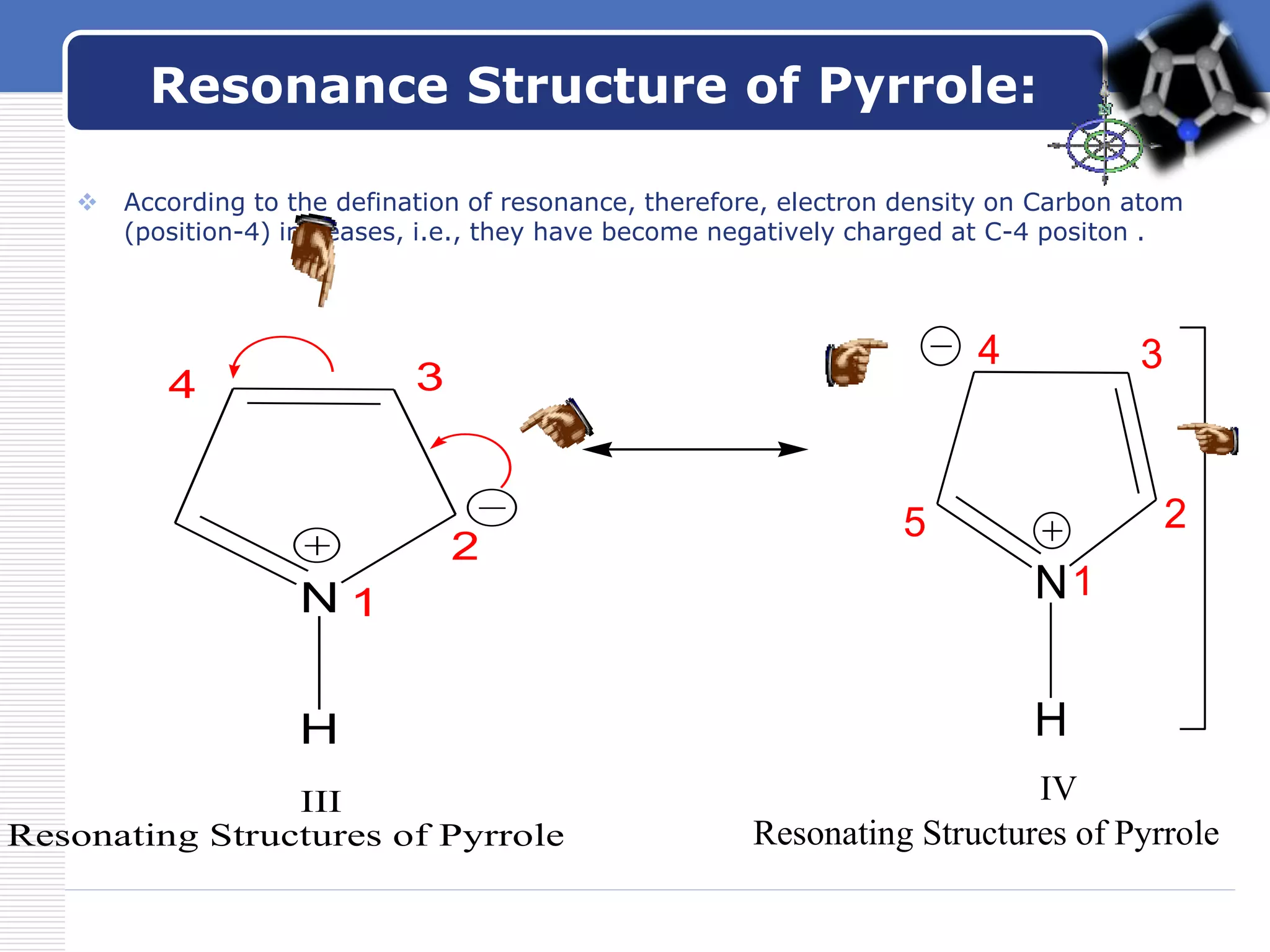
Resonance Structure of Pyrrole:
 According to the defination of resonance, therefore, electron density on Carbon atom
(position-4) increases, i.e., they have become negatively charged at C-4 positon .
LOGO
Resonance Structure of Pyrrole:
 In the resonating structures, Nitrogen donates electrons
(Lone pair) to the pyrrole ring.
 Therefore, electron density on Carbon atom increases, i.e.,
they have become negatively charged.
 The resonance energy of pyrrole is 21 Kcal/mole.
 It is less than pyridine (31 Kcal/mole) and benzene (36 Kcal/mole).
 So, pyrrole is more reactive than pyridine and benzene
(towards the electrophilic substitution reaction).
N
H
N
H
N
H
N
H
N
H
I II III IVPyrrole
3
5 2
4
1
1 1 11
2
34
5 2
4
5
2
34
5 2
3
Resonating Structures of Pyrrole
Company
LOGO
Q.1) Explain, why, pyrrole is weak base. (S-11 & W-15, 2 Mark)
Q.2) Explain the basic character of pyrrole.
Q.3) Explain, why? Pyrrole acts as a very weak base.
Q.4) Explain the basicity of Pyrrole. (W-16, 2 Mark)
Q.5) Compare the basic nature of pyrrole with pyridine. (S-17, 4 Mark)
Q.6) Describe basic nature of pyrrole. (S-19 & W-19, 2-4 Mark)
Basic Nature or
Basic Character of Pyrrole:
Basic Nature (or Character) of Pyrrole:
 When pyrrole is reacted with dil. HCl in absence of
oxygen (O2); to form crystalline salt, called as pyrrole
hydrochloride.
 This reaction indicates pyrrole is a base.
C4H4NH + HCl [C4H4NH2] Cl
O2
N
H
O2
H Cl
N
H H
.. in absence of
Base Acid Pyrrole hydrochloride salt (Stable)
(Crystalline salt)
Or
+ in absence of
Acid
Pyrrole hydrochloride salt
Pyrrole
Base
....
Cl
Note:
Pyrrole hydrochloride is stable in absence of Oxygen, otherwise polymerization
rapidly occurs to produce a brown resin.
Any species that donates a pair of electrons to a Lewis acid
Basic Nature or Basic Character of Pyrrole:
The reason for the weakly basic character
of pyrrole are -
(1) The lone pair of electrons present on
nitrogen atom of pyrrole is available for
donation / protonation / co-ordination.
So, pyrrole is basic in nature.
N
H
Pyrrole
..
Lone pair of electrons
available for protonation / donation /
coordination.
Basic Nature or Basic Character of Pyrrole:
(2) The lone pair of electrons present on nitrogen atom
of pyrrole is involved in the formation of delocalized
π-molecular orbital or involved in resonance.
Because of this involvement, the availability of the lone pair
of electrons of the nitrogen atom for protonation is very much
decreased ( i.e., lone pair of electrons is not available
easily for donation / protonation / co-ordination).
So, pyrrole is very weak basic. (pKb= 8.4).
Lone pair Lone pair involed in the formation of -M.ON
H
N
H
Basic Nature or Basic Character of Pyrrole:
According to the resonance theory, pyrrole is
a resonance hybrid of the following
resonating structures.
Basic Nature or Basic Character of Pyrrole:
(3) Further if, a proton is added to the nitrogen by reaction
with acid.
So, resulting product (structure) is obtained, which lost their
aromaticity (aromatic character) and resonance energy.
So, pyrrole cation is very unstable.
Hence, pyrrole is very weak base.
N
H
H
N
H H
+
Pyrrole
aromatic in nature
Proton
from acid
..
Lost their aromatic character
Pyrrole cation
Unstable
LOGO
Q.1) Explain / Discuss the acidic nature of pyrrole.
(S-14 & W-14, 4 Mark)
Q.2) Explain why, pyrrole can also act as a weak acid.
Q.3) Explain the acidity of Pyrrole. (W-16, 2 Mark)
Q.4) Describe acidic nature of pyrrole. (S-19, 2 Mark)
Acidic Nature of Pyrrole:
Pyrrole is not only acts as a weak base but also act as
a very weak acid (pKa=15).
 The acidity of pyrrole is about same as that of acetylene.
e.g. 1) When pyrrole is reacted with solid KOH; to form
a salt called as potassio pyrrole or pyrryl potassium.
So, pyrrole is acidic in nature.
N
H
K OH
N
H2 O
+
Pyrrole
solid
Base
Acid
+.. ..
Potassio pyrrole /
pyrryl potassium (salt)
K
Acidic Nature of Pyrrole:
e.g. 2)
Pyrrole is also reacted with Grignard reagent; to form
hydrocarbon (Alkane) and N-pyrrole magnesium halide.
(Because pyrrole contain active hydrogen atom.
Active H-atom is that H-atom, which is more acidic than the H of
an alkanes, R-H).
N
H
N
R-Mg X
CH3
-
MgBr
R-H+
Pyrrole
+.. ..
or
G.R.
dry Ether
Mg-X
Alkane
N-pyrrole magnesium halide
Acidic Nature of Pyrrole:
 The reason for the weakly acidic character of pyrrole is that –
 The N-H bond in pyrrole is a weak bond as the lone pair of
electrons present on N-atom is involved in resonance
(i.e., delocalization of π-molecular orbital), makes it positively
charged and increases the possibility of abstraction of bonding pair
of electron from Hydrogen (removal proton); to form pyrryl anion.
 Furthermore, pyrryl anion is more stabilized than pyrrole by the
delocalization of negative charge over the ring on the basis of
resonance structures. (As phenol and phenoxide ion)
So, pyrrole is acidic in nature.
N
H
- H N
III
N N N
III IV V
N
Stabilization of pyrryl anion
Weak bond
1 1 1 1 1 1
2
3
3
4
5
5
2
4 3
2
4
Acidic Nature of Pyrrole:
 The reason for the weakly acidic character of pyrrole is that –
 The N-H bond in pyrrole is a weak bond as the lone pair of
electrons present on N-atom is involved in resonance
(i.e., delocalization of π-molecular orbital), makes it positively
charged and increases the possibility of abstraction of bonding pair
of electron from Hydrogen (removal proton); to form pyrryl anion.
 Furthermore, pyrryl anion is more stabilized than pyrrole by the
delocalization of negative charge over the ring on the basis of
resonance structures. (As phenol and phenoxide ion)
So, pyrrole is acidic in nature.
N
H
- H N
III
N N N
III IV V
N
Stabilization of pyrryl anion
Weak bond
1 1 1 1 1 1
2
3
3
4
5
5
2
4 3
2
4
Acidic Nature of Pyrrole:
 The reason for the weakly acidic character of pyrrole is that –
 The N-H bond in pyrrole is a weak bond as the lone pair of
electrons present on N-atom is involved in resonance
(i.e., delocalization of π-molecular orbital), makes it positively
charged and increases the possibility of abstraction of bonding pair
of electron from Hydrogen (removal proton); to form pyrryl anion.
 Furthermore, pyrryl anion is more stabilized than pyrrole by the
delocalization of negative charge over the ring on the basis of
resonance structures. (As phenol and phenoxide ion)
So, pyrrole is acidic in nature.
N
H
- H N
III
N N N
III IV V
N
Stabilization of pyrryl anion
Weak bond
1 1 1 1 1 1
2
3
3
4
5
5
2
4 3
2
4
LOGO
LOGO
www.themegallery.com
Heterocyclic Compounds by Dr Pramod R. Padole
Stay Home. Take Care

Heterocyclic compounds part- III(Pyrrole)

  • 1.
    1 B.Sc. Final year MEBStudents for Today’s Chemistry Lecture by Dr Pramod R Padole
  • 2.
  • 4.
  • 5.
    LOGO a)5-membered Heterocyclic compounds (i)Pyrrole or Azole: (Aza-cyclo-penta-2,4-diene) C4H5N N H 2 34 5 1 Pyrrole
  • 6.
    LOGO Resonance: The double bondkeep on changing their positions and this is called Resonance. Resonance is also called mesomerism. I II Resonance structure of Benzene Resonance hybrid
  • 7.
    LOGO Note that: I) Bondlength of C-C bond = 1.54 Ao II) Bond length of C=C bond = 1.34 Ao III) Bond length of all C-C bonds in Benzene = 1.39 Ao
  • 8.
  • 9.
    pramodpadole@gmail.com By DrPramod R Padole How do you know when to draw resonance structures?
  • 10.
    Directing ( ororienting) influence: A molecule can have resonance structures when it has a lone pair or a double bond on the atom next to a double bond.
  • 11.
    LOGO Resonance Structure ofPyrrole: According to the resonance theory, pyrrole is a resonance hybrid of the following resonating structures. Q.1) Discuss the resonance in Pyrrole. (S-16, 4 Mark)
  • 12.
    LOGO N H Pyrrole 1 2 34 5 Resonance Structure ofPyrrole:  According to the resonance theory, pyrrole is a resonance hybrid of the following resonating structures.  In the resonating structures, Nitrogen donates electrons (Lone pair) to the pyrrole ring.  Therefore, electron density on Carbon atom (position-3) increases, i.e., they have become negatively charged at C-3 positon . Q.1) Discuss the resonance in Pyrrole. (S-16, 4 Mark) Resonating Structures of Pyrrole N H I 3 1 2 4 5
  • 13.
    LOGO Resonating Structures of Pyrrole N H I 3 1 2 4 5 ResonanceStructure of Pyrrole:  According to the defination of resonance, therefore, electron density on Carbon atom (position-5) increases, i.e., they have become negatively charged at C-5 positon . Resonating Structures of Pyrrole N H II 5 1 2
  • 14.
    LOGO N H III 2 1 34 Resonating Structures ofPyrrole Resonating Structures of Pyrrole N H II 5 1 2 Resonance Structure of Pyrrole:  According to the defination of resonance, therefore, electron density on Carbon atom (position-2) increases, i.e., they have become negatively charged at C-2 positon .
  • 15.
    LOGO Resonating Structures ofPyrrole N H IV 4 1 5 2 3 N H III 2 1 34 Resonating Structures of Pyrrole Resonance Structure of Pyrrole:  According to the defination of resonance, therefore, electron density on Carbon atom (position-4) increases, i.e., they have become negatively charged at C-4 positon .
  • 16.
    LOGO Resonance Structure ofPyrrole:  In the resonating structures, Nitrogen donates electrons (Lone pair) to the pyrrole ring.  Therefore, electron density on Carbon atom increases, i.e., they have become negatively charged.  The resonance energy of pyrrole is 21 Kcal/mole.  It is less than pyridine (31 Kcal/mole) and benzene (36 Kcal/mole).  So, pyrrole is more reactive than pyridine and benzene (towards the electrophilic substitution reaction). N H N H N H N H N H I II III IVPyrrole 3 5 2 4 1 1 1 11 2 34 5 2 4 5 2 34 5 2 3 Resonating Structures of Pyrrole
  • 17.
    Company LOGO Q.1) Explain, why,pyrrole is weak base. (S-11 & W-15, 2 Mark) Q.2) Explain the basic character of pyrrole. Q.3) Explain, why? Pyrrole acts as a very weak base. Q.4) Explain the basicity of Pyrrole. (W-16, 2 Mark) Q.5) Compare the basic nature of pyrrole with pyridine. (S-17, 4 Mark) Q.6) Describe basic nature of pyrrole. (S-19 & W-19, 2-4 Mark) Basic Nature or Basic Character of Pyrrole:
  • 18.
    Basic Nature (orCharacter) of Pyrrole:  When pyrrole is reacted with dil. HCl in absence of oxygen (O2); to form crystalline salt, called as pyrrole hydrochloride.  This reaction indicates pyrrole is a base. C4H4NH + HCl [C4H4NH2] Cl O2 N H O2 H Cl N H H .. in absence of Base Acid Pyrrole hydrochloride salt (Stable) (Crystalline salt) Or + in absence of Acid Pyrrole hydrochloride salt Pyrrole Base .... Cl Note: Pyrrole hydrochloride is stable in absence of Oxygen, otherwise polymerization rapidly occurs to produce a brown resin. Any species that donates a pair of electrons to a Lewis acid
  • 19.
    Basic Nature orBasic Character of Pyrrole: The reason for the weakly basic character of pyrrole are - (1) The lone pair of electrons present on nitrogen atom of pyrrole is available for donation / protonation / co-ordination. So, pyrrole is basic in nature. N H Pyrrole .. Lone pair of electrons available for protonation / donation / coordination.
  • 20.
    Basic Nature orBasic Character of Pyrrole: (2) The lone pair of electrons present on nitrogen atom of pyrrole is involved in the formation of delocalized π-molecular orbital or involved in resonance. Because of this involvement, the availability of the lone pair of electrons of the nitrogen atom for protonation is very much decreased ( i.e., lone pair of electrons is not available easily for donation / protonation / co-ordination). So, pyrrole is very weak basic. (pKb= 8.4). Lone pair Lone pair involed in the formation of -M.ON H N H
  • 21.
    Basic Nature orBasic Character of Pyrrole: According to the resonance theory, pyrrole is a resonance hybrid of the following resonating structures.
  • 22.
    Basic Nature orBasic Character of Pyrrole: (3) Further if, a proton is added to the nitrogen by reaction with acid. So, resulting product (structure) is obtained, which lost their aromaticity (aromatic character) and resonance energy. So, pyrrole cation is very unstable. Hence, pyrrole is very weak base. N H H N H H + Pyrrole aromatic in nature Proton from acid .. Lost their aromatic character Pyrrole cation Unstable
  • 23.
    LOGO Q.1) Explain /Discuss the acidic nature of pyrrole. (S-14 & W-14, 4 Mark) Q.2) Explain why, pyrrole can also act as a weak acid. Q.3) Explain the acidity of Pyrrole. (W-16, 2 Mark) Q.4) Describe acidic nature of pyrrole. (S-19, 2 Mark) Acidic Nature of Pyrrole:
  • 24.
    Acidic Nature ofPyrrole: Pyrrole is not only acts as a weak base but also act as a very weak acid (pKa=15).  The acidity of pyrrole is about same as that of acetylene. e.g. 1) When pyrrole is reacted with solid KOH; to form a salt called as potassio pyrrole or pyrryl potassium. So, pyrrole is acidic in nature. N H K OH N H2 O + Pyrrole solid Base Acid +.. .. Potassio pyrrole / pyrryl potassium (salt) K
  • 25.
    Acidic Nature ofPyrrole: e.g. 2) Pyrrole is also reacted with Grignard reagent; to form hydrocarbon (Alkane) and N-pyrrole magnesium halide. (Because pyrrole contain active hydrogen atom. Active H-atom is that H-atom, which is more acidic than the H of an alkanes, R-H). N H N R-Mg X CH3 - MgBr R-H+ Pyrrole +.. .. or G.R. dry Ether Mg-X Alkane N-pyrrole magnesium halide
  • 26.
    Acidic Nature ofPyrrole:  The reason for the weakly acidic character of pyrrole is that –  The N-H bond in pyrrole is a weak bond as the lone pair of electrons present on N-atom is involved in resonance (i.e., delocalization of π-molecular orbital), makes it positively charged and increases the possibility of abstraction of bonding pair of electron from Hydrogen (removal proton); to form pyrryl anion.  Furthermore, pyrryl anion is more stabilized than pyrrole by the delocalization of negative charge over the ring on the basis of resonance structures. (As phenol and phenoxide ion) So, pyrrole is acidic in nature. N H - H N III N N N III IV V N Stabilization of pyrryl anion Weak bond 1 1 1 1 1 1 2 3 3 4 5 5 2 4 3 2 4
  • 27.
    Acidic Nature ofPyrrole:  The reason for the weakly acidic character of pyrrole is that –  The N-H bond in pyrrole is a weak bond as the lone pair of electrons present on N-atom is involved in resonance (i.e., delocalization of π-molecular orbital), makes it positively charged and increases the possibility of abstraction of bonding pair of electron from Hydrogen (removal proton); to form pyrryl anion.  Furthermore, pyrryl anion is more stabilized than pyrrole by the delocalization of negative charge over the ring on the basis of resonance structures. (As phenol and phenoxide ion) So, pyrrole is acidic in nature. N H - H N III N N N III IV V N Stabilization of pyrryl anion Weak bond 1 1 1 1 1 1 2 3 3 4 5 5 2 4 3 2 4
  • 28.
    Acidic Nature ofPyrrole:  The reason for the weakly acidic character of pyrrole is that –  The N-H bond in pyrrole is a weak bond as the lone pair of electrons present on N-atom is involved in resonance (i.e., delocalization of π-molecular orbital), makes it positively charged and increases the possibility of abstraction of bonding pair of electron from Hydrogen (removal proton); to form pyrryl anion.  Furthermore, pyrryl anion is more stabilized than pyrrole by the delocalization of negative charge over the ring on the basis of resonance structures. (As phenol and phenoxide ion) So, pyrrole is acidic in nature. N H - H N III N N N III IV V N Stabilization of pyrryl anion Weak bond 1 1 1 1 1 1 2 3 3 4 5 5 2 4 3 2 4
  • 29.
  • 30.
    LOGO www.themegallery.com Heterocyclic Compounds byDr Pramod R. Padole Stay Home. Take Care