
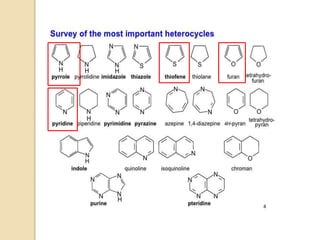
HETEROCYCLIC COMPOUNDS
SYNTHESIS
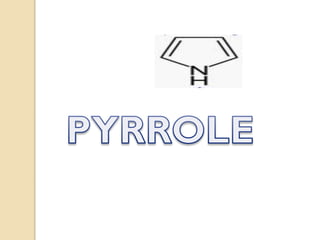
Pyrrole:
 INTRODUCTION:
 PYRROLE is a heterocyclic aromatic
organic compound, a five-membered ring
with the formula ( C4H4NH ). It is a
colourless volatile liquid that darkens
readily upon exposure to air. Substituted
derivatives are also called pyrroles.
Resonance structure :
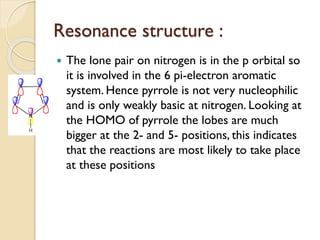
 The lone pair on nitrogen is in the p orbital so
it is involved in the 6 pi-electron aromatic
system. Hence pyrrole is not very nucleophilic
and is only weakly basic at nitrogen. Looking at
the HOMO of pyrrole the lobes are much
bigger at the 2- and 5- positions, this indicates
that the reactions are most likely to take place
at these positions
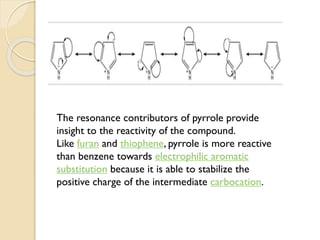
The resonance contributors of pyrrole provide
insight to the reactivity of the compound.
Like furan and thiophene, pyrrole is more reactive
than benzene towards electrophilic aromatic
substitution because it is able to stabilize the
positive charge of the intermediate carbocation.
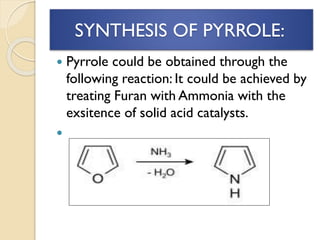
SYNTHESIS OF PYRROLE:
 Pyrrole could be obtained through the
following reaction: It could be achieved by
treating Furan with Ammonia with the
exsitence of solid acid catalysts.

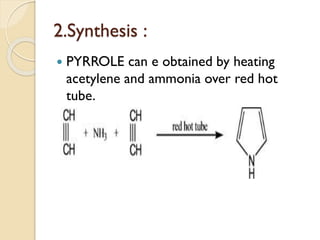
2.Synthesis :
 PYRROLE can e obtained by heating
acetylene and ammonia over red hot
tube.
Acidic property of pyrrole:
 Due to participation of N’s lone pair in
resonance/aromaticity pyrrole has
exceptional strong acidic property.
 (that is,it can loss the hydrogen attached
with NITROGEN when reacting with any
base)
Acidic property of pyrrole:
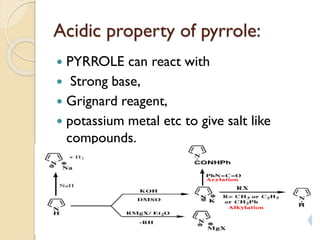
 PYRROLE can react with
 Strong base,
 Grignard reagent,
 potassium metal etc to give salt like
compounds.
Sensitivity towards strong acids:
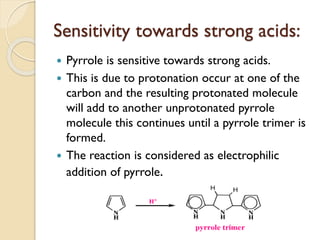
 Pyrrole is sensitive towards strong acids.
 This is due to protonation occur at one of the
carbon and the resulting protonated molecule
will add to another unprotonated pyrrole
molecule this continues until a pyrrole trimer is
formed.
 The reaction is considered as electrophilic
addition of pyrrole.
ELECTROPHILIC SUBSITUTION
IN PYRROLE:
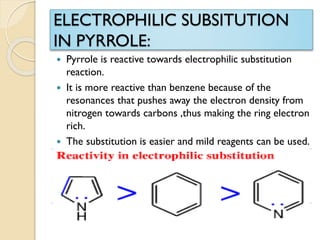
 Pyrrole is reactive towards electrophilic substitution
reaction.
 It is more reactive than benzene because of the
resonances that pushes away the electron density from
nitrogen towards carbons ,thus making the ring electron
rich.
 The substitution is easier and mild reagents can be used.
 ELECTROPHILIC SUBSTITUTION
OCCURS AT CARBONS(THE RING)
NOT NITROGEN.
(obviously)
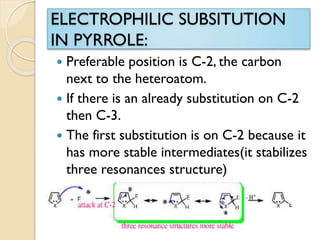
 Preferable position is C-2, the carbon
next to the heteroatom.
 If there is an already substitution on C-2
then C-3.
 The first substitution is on C-2 because it
has more stable intermediates(it stabilizes
three resonances structure)
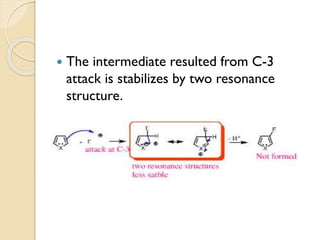
 The intermediate resulted from C-3
attack is stabilizes by two resonance
structure.
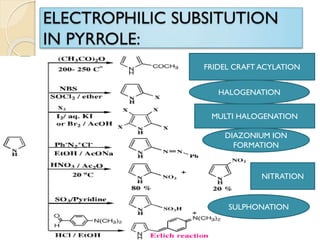
FRIDEL CRAFT ACYLATION
HALOGENATION
MULTI HALOGENATION
DIAZONIUM ION
FORMATION
NITRATION
SULPHONATION
Introduction:
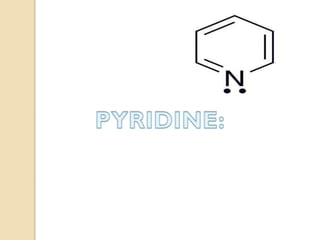
 Pyridine is a basic heterocyclic organic
compound with the chemical formula C5H5N.
It is structurally related to benzene, with one
methine group (=CH-) replaced by a nitrogen
atom. Pyridine have 5 carbon atoms and one
nitrogen atom. All are sp² hybridized.The p-
orbital of nitrogen and all carbon atoms lie in
the same plane. Overlapping of p-orbitals result
in delocalization of six π-electrons in the cyclic
ring, following Hückel rule, imparts aromatic
character to pyridine
History
 Impure pyridine was undoubtedly prepared by
early alchemists by heating animal bones and
other organic matter, but the earliest
documented reference is attributed to the
Scottish scientistThomas Anderson. In 1849,
Anderson examined the contents of the oil
obtained through high-temperature heating of
animal bones.Among other substances, he
separated from the oil a colorless liquid with
unpleasant odor, from which he isolated pure
pyridine two years later. He described it as highly
soluble in water, readily soluble in concentrated
acids and salts upon heating, and only slightly
soluble in oils.
Occurrance
 Pyridine is not abundant in nature. In daily life,
trace amounts of pyridine are components of
the volatile organic compounds that are
produced in roasting and canning processes,
roasted coffee, potato chips, sunflower honey
etc
SYNTHESIS
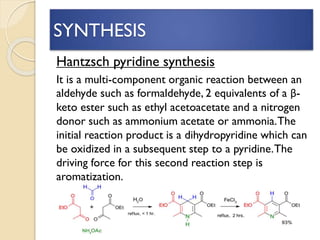
Hantzsch pyridine synthesis
It is a multi-component organic reaction between an
aldehyde such as formaldehyde, 2 equivalents of a β-
keto ester such as ethyl acetoacetate and a nitrogen
donor such as ammonium acetate or ammonia.The
initial reaction product is a dihydropyridine which can
be oxidized in a subsequent step to a pyridine.The
driving force for this second reaction step is
aromatization.
Chemical properties
 Pyridine is miscible with water and
virtually all organic solvents
 It is weakly basic
 pyridine behaves both as a tertiary amine
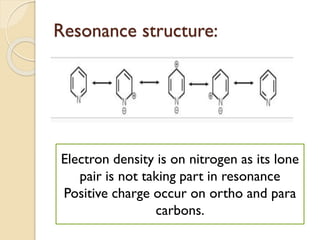
Resonance structure:
Electron density is on nitrogen as its lone
pair is not taking part in resonance
Positive charge occur on ortho and para
carbons.
Basic property:
 The nitrogen center of pyridine features a
basic lone pair of electrons. Because this
lone pair is not part of the aromatic ring,
pyridine is a base, having chemical
properties similar to those of tertiary
amines.
 Pyridine can act as Lewis base, donating
its pair of electron to a Lewis acid as in
the sulfur trioxide pyridine complex.
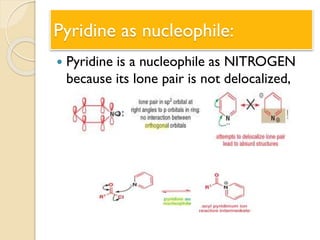
Pyridine as nucleophile:
 Pyridine is a nucleophile as NITROGEN
because its lone pair is not delocalized,
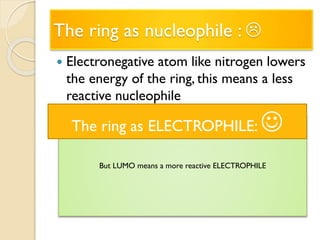
The ring as nucleophile : 
 Electronegative atom like nitrogen lowers
the energy of the ring, this means a less
reactive nucleophile
.
But LUMO means a more reactive ELECTROPHILE
The ring as ELECTROPHILE: 
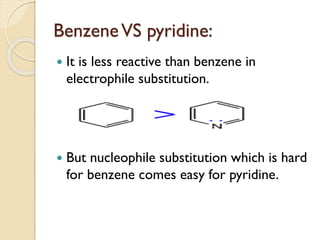
BenzeneVS pyridine:
 It is less reactive than benzene in
electrophile substitution.
 But nucleophile substitution which is hard
for benzene comes easy for pyridine.
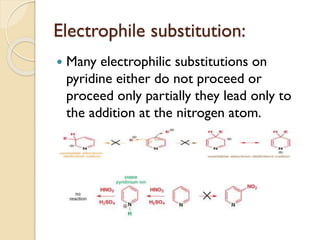
Electrophile substitution:
 Many electrophilic substitutions on
pyridine either do not proceed or
proceed only partially they lead only to
the addition at the nitrogen atom.
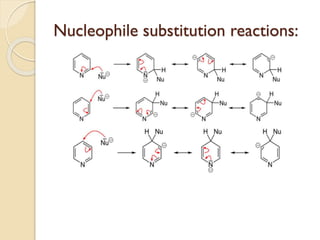
Nucleophile substitution reactions:
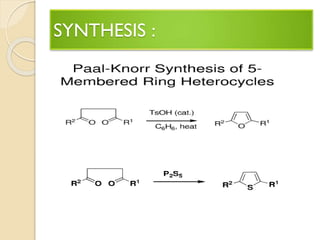
SYNTHESIS :
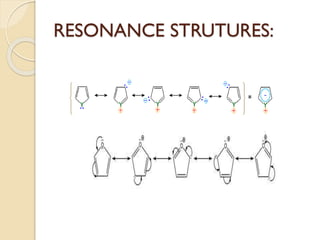
RESONANCE STRUTURES:
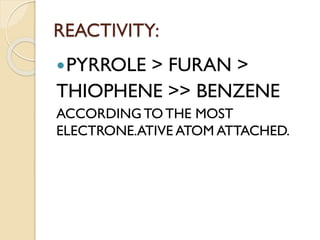
REACTIVITY:
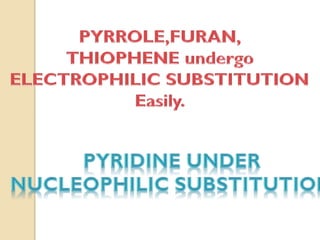
PYRROLE > FURAN >
THIOPHENE >> BENZENE
ACCORDINGTO THE MOST
ELECTRONE.ATIVE ATOM ATTACHED.
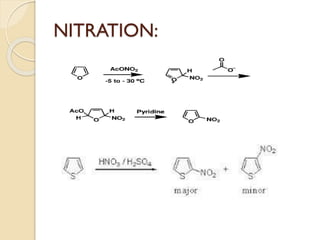
NITRATION:
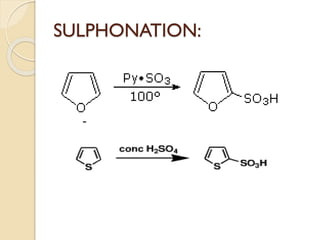
SULPHONATION:
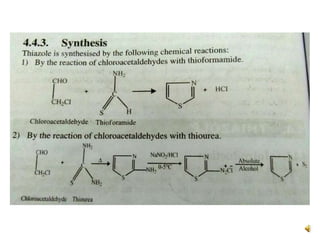
Thiazole
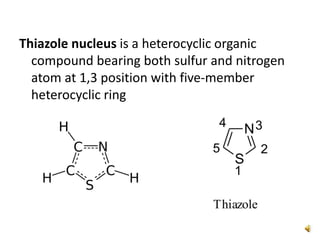
Thiazole nucleus is a heterocyclic organic
compound bearing both sulfur and nitrogen
atom at 1,3 position with five-member
heterocyclic ring
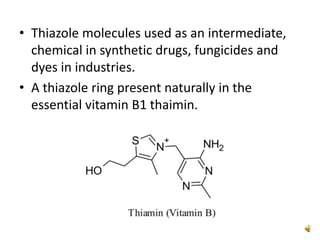
• Thiazole molecules used as an intermediate,
chemical in synthetic drugs, fungicides and
dyes in industries.
• A thiazole ring present naturally in the
essential vitamin B1 thaimin.
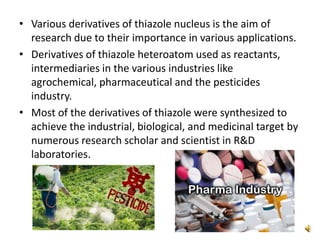
• Various derivatives of thiazole nucleus is the aim of
research due to their importance in various applications.
• Derivatives of thiazole heteroatom used as reactants,
intermediaries in the various industries like
agrochemical, pharmaceutical and the pesticides
industry.
• Most of the derivatives of thiazole were synthesized to
achieve the industrial, biological, and medicinal target by
numerous research scholar and scientist in R&D
laboratories.
Molecular and electronic structure
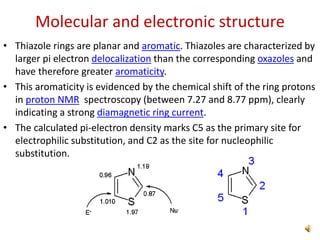
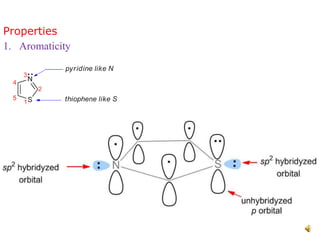
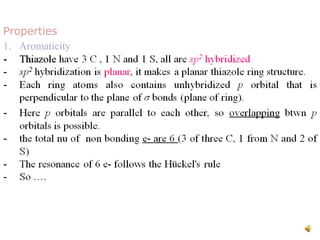
• Thiazole rings are planar and aromatic. Thiazoles are characterized by
larger pi electron delocalization than the corresponding oxazoles and
have therefore greater aromaticity.
• This aromaticity is evidenced by the chemical shift of the ring protons
in proton NMR spectroscopy (between 7.27 and 8.77 ppm), clearly
indicating a strong diamagnetic ring current.
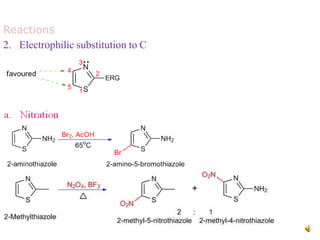
• The calculated pi-electron density marks C5 as the primary site for
electrophilic substitution, and C2 as the site for nucleophilic
substitution.
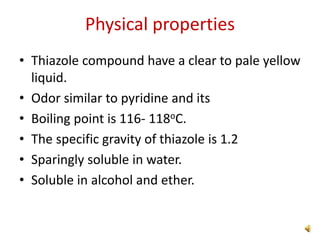
Physical properties
• Thiazole compound have a clear to pale yellow
liquid.
• Odor similar to pyridine and its
• Boiling point is 116- 118oC.
• The specific gravity of thiazole is 1.2
• Sparingly soluble in water.
• Soluble in alcohol and ether.
Properties
1. Aromaticity
Properties
1. Aromaticity
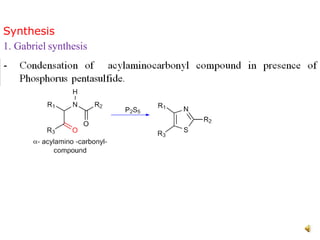
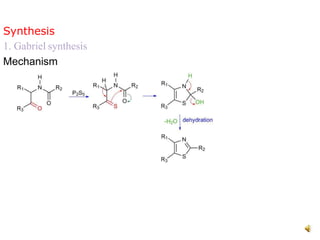
Synthesis
1. Gabriel synthesis
Synthesis
1. Gabriel synthesis
Mechanism
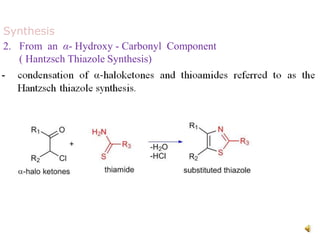
Synthesis
2. From an α- Hydroxy - Carbonyl Component
( Hantzsch Thiazole Synthesis)
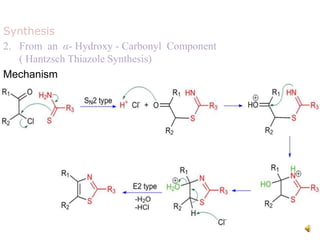
Synthesis
2. From an α- Hydroxy - Carbonyl Component
( Hantzsch Thiazole Synthesis)
Mechanism
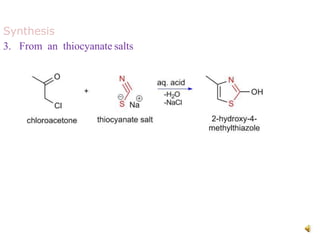
Synthesis
3. From an thiocyanate salts
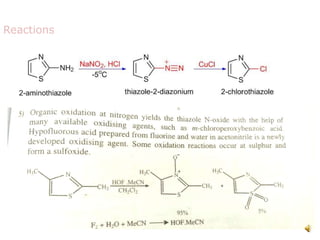
Reactions
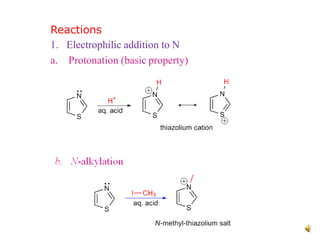
1. Electrophilic addition to N
a. Protonation (basic property)
Reactions
2. Electrophilic substitution to C
Reactions
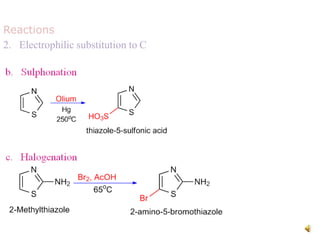
2. Electrophilic substitution to C
Reactions
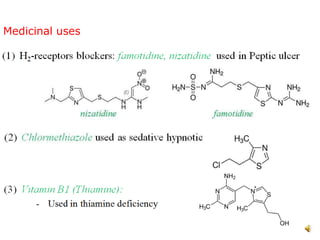
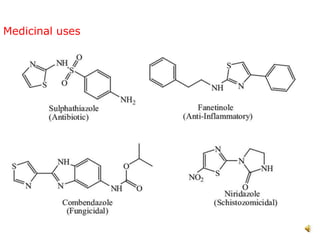
Medicinal uses
Medicinal uses

Heterocyclic synthesis

  • 1.
  • 4.
    Pyrrole:  INTRODUCTION:  PYRROLEis a heterocyclic aromatic organic compound, a five-membered ring with the formula ( C4H4NH ). It is a colourless volatile liquid that darkens readily upon exposure to air. Substituted derivatives are also called pyrroles.
  • 5.
    Resonance structure : The lone pair on nitrogen is in the p orbital so it is involved in the 6 pi-electron aromatic system. Hence pyrrole is not very nucleophilic and is only weakly basic at nitrogen. Looking at the HOMO of pyrrole the lobes are much bigger at the 2- and 5- positions, this indicates that the reactions are most likely to take place at these positions
  • 6.
    The resonance contributorsof pyrrole provide insight to the reactivity of the compound. Like furan and thiophene, pyrrole is more reactive than benzene towards electrophilic aromatic substitution because it is able to stabilize the positive charge of the intermediate carbocation.
  • 7.
    SYNTHESIS OF PYRROLE: Pyrrole could be obtained through the following reaction: It could be achieved by treating Furan with Ammonia with the exsitence of solid acid catalysts. 
  • 8.
    2.Synthesis :  PYRROLEcan e obtained by heating acetylene and ammonia over red hot tube.
  • 9.
    Acidic property ofpyrrole:  Due to participation of N’s lone pair in resonance/aromaticity pyrrole has exceptional strong acidic property.  (that is,it can loss the hydrogen attached with NITROGEN when reacting with any base)
  • 10.
    Acidic property ofpyrrole:  PYRROLE can react with  Strong base,  Grignard reagent,  potassium metal etc to give salt like compounds.
  • 11.
    Sensitivity towards strongacids:  Pyrrole is sensitive towards strong acids.  This is due to protonation occur at one of the carbon and the resulting protonated molecule will add to another unprotonated pyrrole molecule this continues until a pyrrole trimer is formed.  The reaction is considered as electrophilic addition of pyrrole.
  • 12.
    ELECTROPHILIC SUBSITUTION IN PYRROLE: Pyrrole is reactive towards electrophilic substitution reaction.  It is more reactive than benzene because of the resonances that pushes away the electron density from nitrogen towards carbons ,thus making the ring electron rich.  The substitution is easier and mild reagents can be used.
  • 13.
     ELECTROPHILIC SUBSTITUTION OCCURSAT CARBONS(THE RING) NOT NITROGEN. (obviously)
  • 14.
     Preferable positionis C-2, the carbon next to the heteroatom.  If there is an already substitution on C-2 then C-3.  The first substitution is on C-2 because it has more stable intermediates(it stabilizes three resonances structure)
  • 15.
     The intermediateresulted from C-3 attack is stabilizes by two resonance structure.
  • 16.
    FRIDEL CRAFT ACYLATION HALOGENATION MULTIHALOGENATION DIAZONIUM ION FORMATION NITRATION SULPHONATION
  • 18.
    Introduction:  Pyridine isa basic heterocyclic organic compound with the chemical formula C5H5N. It is structurally related to benzene, with one methine group (=CH-) replaced by a nitrogen atom. Pyridine have 5 carbon atoms and one nitrogen atom. All are sp² hybridized.The p- orbital of nitrogen and all carbon atoms lie in the same plane. Overlapping of p-orbitals result in delocalization of six π-electrons in the cyclic ring, following Hückel rule, imparts aromatic character to pyridine
  • 19.
    History  Impure pyridinewas undoubtedly prepared by early alchemists by heating animal bones and other organic matter, but the earliest documented reference is attributed to the Scottish scientistThomas Anderson. In 1849, Anderson examined the contents of the oil obtained through high-temperature heating of animal bones.Among other substances, he separated from the oil a colorless liquid with unpleasant odor, from which he isolated pure pyridine two years later. He described it as highly soluble in water, readily soluble in concentrated acids and salts upon heating, and only slightly soluble in oils.
  • 20.
    Occurrance  Pyridine isnot abundant in nature. In daily life, trace amounts of pyridine are components of the volatile organic compounds that are produced in roasting and canning processes, roasted coffee, potato chips, sunflower honey etc
  • 21.
    SYNTHESIS Hantzsch pyridine synthesis Itis a multi-component organic reaction between an aldehyde such as formaldehyde, 2 equivalents of a β- keto ester such as ethyl acetoacetate and a nitrogen donor such as ammonium acetate or ammonia.The initial reaction product is a dihydropyridine which can be oxidized in a subsequent step to a pyridine.The driving force for this second reaction step is aromatization.
  • 22.
    Chemical properties  Pyridineis miscible with water and virtually all organic solvents  It is weakly basic  pyridine behaves both as a tertiary amine
  • 23.
    Resonance structure: Electron densityis on nitrogen as its lone pair is not taking part in resonance Positive charge occur on ortho and para carbons.
  • 24.
    Basic property:  Thenitrogen center of pyridine features a basic lone pair of electrons. Because this lone pair is not part of the aromatic ring, pyridine is a base, having chemical properties similar to those of tertiary amines.  Pyridine can act as Lewis base, donating its pair of electron to a Lewis acid as in the sulfur trioxide pyridine complex.
  • 25.
    Pyridine as nucleophile: Pyridine is a nucleophile as NITROGEN because its lone pair is not delocalized,
  • 26.
    The ring asnucleophile :   Electronegative atom like nitrogen lowers the energy of the ring, this means a less reactive nucleophile . But LUMO means a more reactive ELECTROPHILE The ring as ELECTROPHILE: 
  • 27.
    BenzeneVS pyridine:  Itis less reactive than benzene in electrophile substitution.  But nucleophile substitution which is hard for benzene comes easy for pyridine.
  • 28.
    Electrophile substitution:  Manyelectrophilic substitutions on pyridine either do not proceed or proceed only partially they lead only to the addition at the nitrogen atom.
  • 29.
  • 31.
  • 32.
  • 33.
    REACTIVITY: PYRROLE > FURAN> THIOPHENE >> BENZENE ACCORDINGTO THE MOST ELECTRONE.ATIVE ATOM ATTACHED.
  • 34.
  • 35.
  • 37.
  • 38.
    Thiazole nucleus isa heterocyclic organic compound bearing both sulfur and nitrogen atom at 1,3 position with five-member heterocyclic ring
  • 39.
    • Thiazole moleculesused as an intermediate, chemical in synthetic drugs, fungicides and dyes in industries. • A thiazole ring present naturally in the essential vitamin B1 thaimin.
  • 40.
    • Various derivativesof thiazole nucleus is the aim of research due to their importance in various applications. • Derivatives of thiazole heteroatom used as reactants, intermediaries in the various industries like agrochemical, pharmaceutical and the pesticides industry. • Most of the derivatives of thiazole were synthesized to achieve the industrial, biological, and medicinal target by numerous research scholar and scientist in R&D laboratories.
  • 41.
    Molecular and electronicstructure • Thiazole rings are planar and aromatic. Thiazoles are characterized by larger pi electron delocalization than the corresponding oxazoles and have therefore greater aromaticity. • This aromaticity is evidenced by the chemical shift of the ring protons in proton NMR spectroscopy (between 7.27 and 8.77 ppm), clearly indicating a strong diamagnetic ring current. • The calculated pi-electron density marks C5 as the primary site for electrophilic substitution, and C2 as the site for nucleophilic substitution.
  • 42.
    Physical properties • Thiazolecompound have a clear to pale yellow liquid. • Odor similar to pyridine and its • Boiling point is 116- 118oC. • The specific gravity of thiazole is 1.2 • Sparingly soluble in water. • Soluble in alcohol and ether.
  • 43.
  • 44.
  • 45.
  • 46.
  • 47.
    Synthesis 2. From anα- Hydroxy - Carbonyl Component ( Hantzsch Thiazole Synthesis)
  • 48.
    Synthesis 2. From anα- Hydroxy - Carbonyl Component ( Hantzsch Thiazole Synthesis) Mechanism
  • 49.
    Synthesis 3. From anthiocyanate salts
  • 51.
    Reactions 1. Electrophilic additionto N a. Protonation (basic property)
  • 52.
  • 53.
  • 54.
  • 55.
  • 56.