Energy:
Resources
ppt. by Robin D. Seamon
1HOOK VIDEO: Gasland
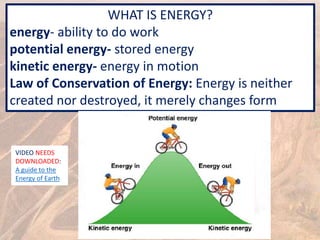
WHAT IS ENERGY?
energy- ability to do work
potential energy- stored energy
kinetic energy- energy in motion
Law of Conservation of Energy: Energy is neither
created nor destroyed, it merely changes form
VIDEO NEEDS
DOWNLOADED:
A guide to the
Energy of Earth
Nonrenewable resource- an energy source that
cannot be readily replaced naturally in
comparison to its consumption
Renewable resource- an energy source that
can be reused or readily replaced naturally
3
VIDEO: How we make and use Energy
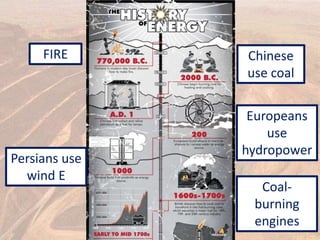
FIRE Chinese
use coal
Europeans
use
hydropower
Persians use
wind E
Coal-
burning
engines
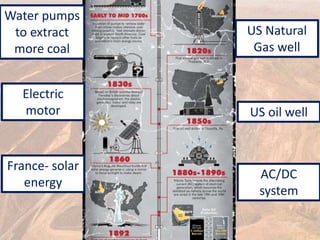
Water pumps
to extract
more coal
US Natural
Gas well
Electric
motor US oil well
France- solar
energy
AC/DC
system
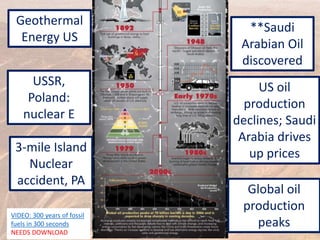
Geothermal
Energy US
**Saudi
Arabian Oil
discovered
USSR,
Poland:
nuclear E
US oil
production
declines; Saudi
Arabia drives
up prices3-mile Island
Nuclear
accident, PA
Global oil
production
peaks
VIDEO: 300 years of fossil
fuels in 300 seconds
NEEDS DOWNLOAD
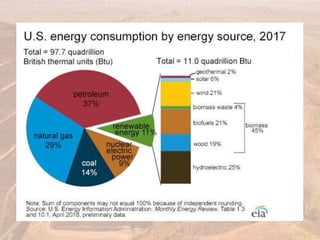
OUR ENERGY FOUNDATION TODAY
ELECTRICITY: Coal
TRANSPORTATION: petroleum (gas)
HEAT
VIDEO: Our Energy Foundation
VIDEO: Energy Choices
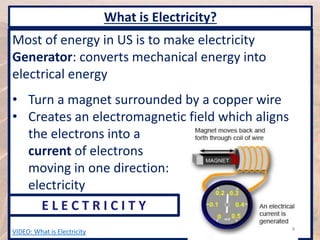
Most of energy in US is to make electricity
Generator: converts mechanical energy into
electrical energy
• Turn a magnet surrounded by a copper wire
• Creates an electromagnetic field which aligns
the electrons into a
current of electrons
moving in one direction:
electricity
VIDEO: What is Electricity
E L E C T R I C I T Y
8
What is Electricity?
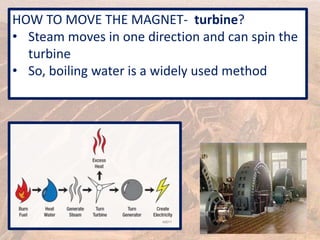
HOW TO MOVE THE MAGNET- turbine?
• Steam moves in one direction and can spin the
turbine
• So, boiling water is a widely used method
9
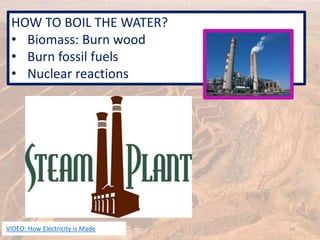
HOW TO BOIL THE WATER?
• Biomass: Burn wood
• Burn fossil fuels
• Nuclear reactions
10VIDEO: How Electricity is Made
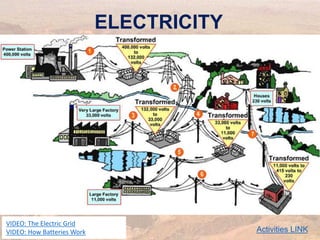
ELECTRICITY
Activities LINK
VIDEO: The Electric Grid
VIDEO: How Batteries Work
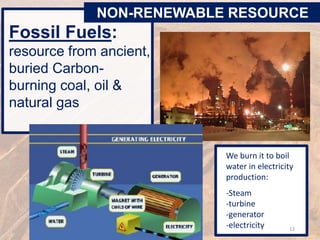
Fossil Fuels:
resource from ancient,
buried Carbon-
burning coal, oil &
natural gas
NON-RENEWABLE RESOURCE
We burn it to boil
water in electricity
production:
-Steam
-turbine
-generator
-electricity 12
13
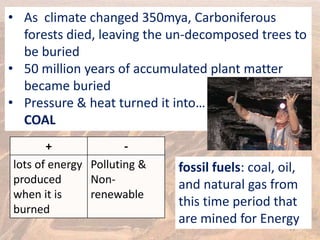
• As climate changed 350mya, Carboniferous
forests died, leaving the un-decomposed trees to
be buried
• 50 million years of accumulated plant matter
became buried
• Pressure & heat turned it into…
COAL
fossil fuels: coal, oil,
and natural gas from
this time period that
are mined for Energy
+ -
lots of energy
produced
when it is
burned
Polluting &
Non-
renewable
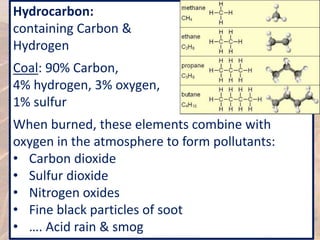
Hydrocarbon:
containing Carbon &
Hydrogen
Coal: 90% Carbon,
4% hydrogen, 3% oxygen,
1% sulfur
When burned, these elements combine with
oxygen in the atmosphere to form pollutants:
• Carbon dioxide
• Sulfur dioxide
• Nitrogen oxides
• Fine black particles of soot
• …. Acid rain & smog
FOSSIL FUELS: COAL
VIDEO: What is Coal?
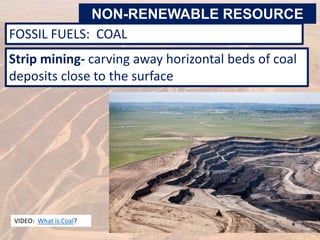
Strip mining- carving away horizontal beds of coal
deposits close to the surface
NON-RENEWABLE RESOURCE
FOSSIL FUELS: COAL
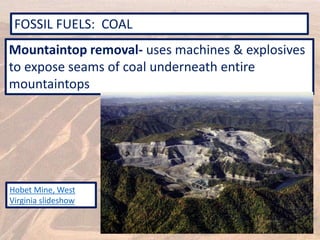
Mountaintop removal- uses machines & explosives
to expose seams of coal underneath entire
mountaintops
Hobet Mine, West
Virginia slideshow
FOSSIL FUELS: COAL
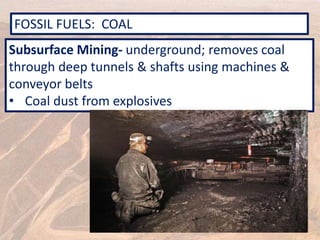
Subsurface Mining- underground; removes coal
through deep tunnels & shafts using machines &
conveyor belts
• Coal dust from explosives
FOSSIL FUELS: COAL
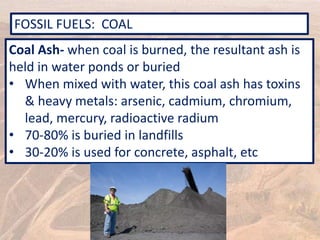
Coal Ash- when coal is burned, the resultant ash is
held in water ponds or buried
• When mixed with water, this coal ash has toxins
& heavy metals: arsenic, cadmium, chromium,
lead, mercury, radioactive radium
• 70-80% is buried in landfills
• 30-20% is used for concrete, asphalt, etc
FOSSIL FUELS: COAL
VIDEO: Clean Coal
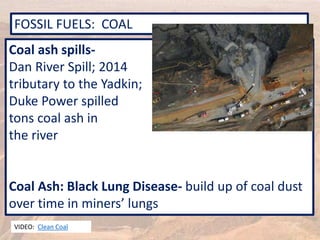
Coal ash spills-
Dan River Spill; 2014
tributary to the Yadkin;
Duke Power spilled
tons coal ash in
the river
Coal Ash: Black Lung Disease- build up of coal dust
over time in miners’ lungs
FOSSIL FUELS: OIL
VIDEO How Oil is Made
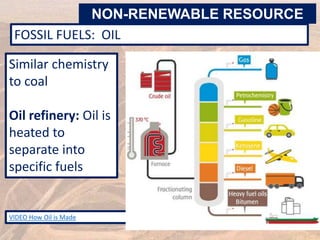
Similar chemistry
to coal
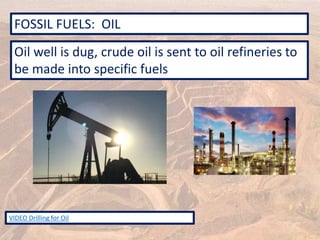
Oil refinery: Oil is
heated to
separate into
specific fuels
NON-RENEWABLE RESOURCE
FOSSIL FUELS: OIL
VIDEO Drilling for Oil
Oil well is dug, crude oil is sent to oil refineries to
be made into specific fuels
FOSSIL FUELS: OIL
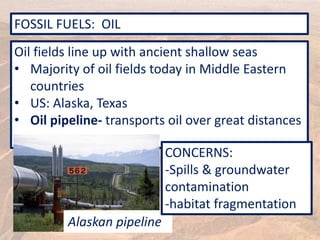
Oil fields line up with ancient shallow seas
• Majority of oil fields today in Middle Eastern
countries
• US: Alaska, Texas
• Oil pipeline- transports oil over great distances
Alaskan pipeline
CONCERNS:
-Spills & groundwater
contamination
-habitat fragmentation
FOSSIL FUELS: OIL
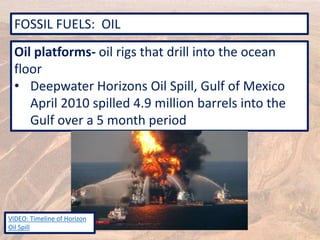
Oil platforms- oil rigs that drill into the ocean
floor
• Deepwater Horizons Oil Spill, Gulf of Mexico
April 2010 spilled 4.9 million barrels into the
Gulf over a 5 month period
VIDEO: Timeline of Horizon
Oil Spill
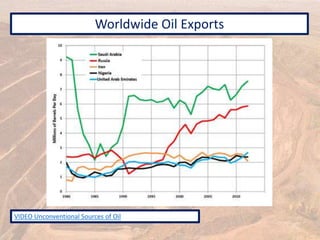
Worldwide Oil Exports
VIDEO Unconventional Sources of Oil
VIDEO Oil & Transportation Alternatives
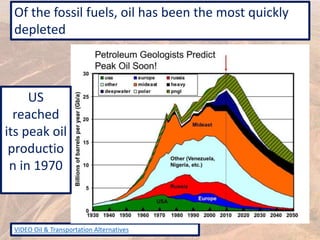
Of the fossil fuels, oil has been the most quickly
depleted
US
reached
its peak oil
productio
n in 1970
FOSSIL FUELS: NATURAL GAS
VDEO What is Natural Gas
VIDEO: Uses of Natural Gas
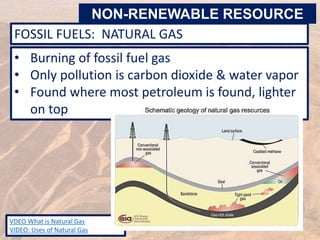
• Burning of fossil fuel gas
• Only pollution is carbon dioxide & water vapor
• Found where most petroleum is found, lighter
on top
NON-RENEWABLE RESOURCE
FOSSIL FUELS: NATURAL GAS- FRACKING
from SWITCH ENERGY PROJECT
VIDEO Benefits of Fracking
VDEO Risks of Fracking: Water
VIDEO Risks of Fracking: Methane
hydraulic fracturing
(fracking)
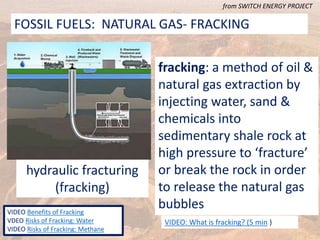
fracking: a method of oil &
natural gas extraction by
injecting water, sand &
chemicals into
sedimentary shale rock at
high pressure to ‘fracture’
or break the rock in order
to release the natural gas
bubbles
VIDEO: What is fracking? (5 min )
29
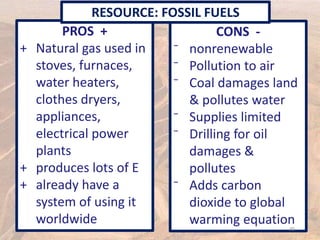
PROS +
+ Natural gas used in
stoves, furnaces,
water heaters,
clothes dryers,
appliances,
electrical power
plants
+ produces lots of E
+ already have a
system of using it
worldwide
CONS -
⁻ nonrenewable
⁻ Pollution to air
⁻ Coal damages land
& pollutes water
⁻ Supplies limited
⁻ Drilling for oil
damages &
pollutes
⁻ Adds carbon
dioxide to global
warming equation
RESOURCE: FOSSIL FUELS
30
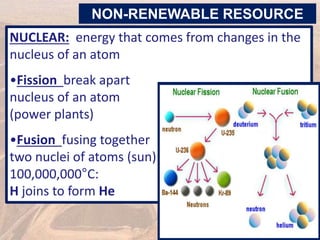
NUCLEAR: energy that comes from changes in the
nucleus of an atom
•Fission break apart
nucleus of an atom
(power plants)
•Fusion fusing together
two nuclei of atoms (sun)
100,000,000°C:
H joins to form He
31
NON-RENEWABLE RESOURCE
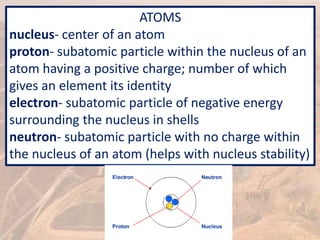
ATOMS
nucleus- center of an atom
proton- subatomic particle within the nucleus of an
atom having a positive charge; number of which
gives an element its identity
electron- subatomic particle of negative energy
surrounding the nucleus in shells
neutron- subatomic particle with no charge within
the nucleus of an atom (helps with nucleus stability)
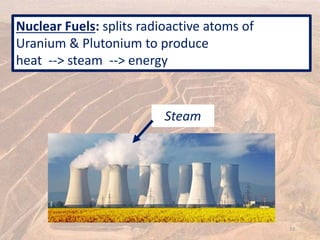
Nuclear Fuels: splits radioactive atoms of
Uranium & Plutonium to produce
heat --> steam --> energy
33
Steam
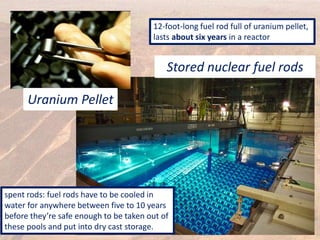
Uranium Pellet
Stored nuclear fuel rods
12-foot-long fuel rod full of uranium pellet,
lasts about six years in a reactor
spent rods: fuel rods have to be cooled in
water for anywhere between five to 10 years
before they’re safe enough to be taken out of
these pools and put into dry cast storage.
The power of nuclear…
Nuclear bomb:
• Uranium -235 has a very large nucleus which
when hit with a high-speed neutron , will split it
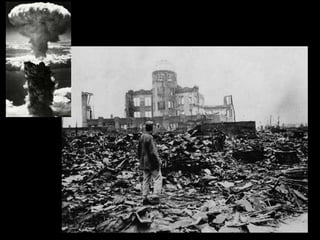
• In WWII two atomic bombs were dropped on
Hiroshima & Nagasaki, Japan, ending the war
• Intense heat & radiation
• Nuclear fallout- dust & ash
Radiation poison- causes immediate effects on
human tissue & reproductive genes
• 200-300 rems: nausea & vomiting
• 400-600 rems: 50% mortality rate
• 600-1000 rems: death
The power of nuclear…
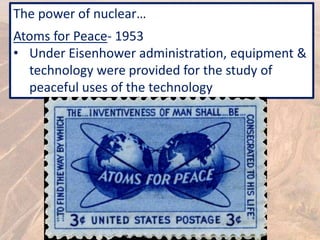
Atoms for Peace- 1953
• Under Eisenhower administration, equipment &
technology were provided for the study of
peaceful uses of the technology
The power of nuclear…
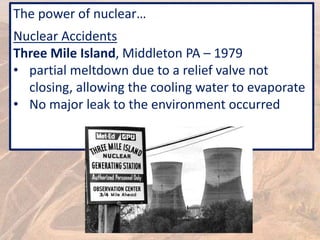
Nuclear Accidents
Three Mile Island, Middleton PA – 1979
• partial meltdown due to a relief valve not
closing, allowing the cooling water to evaporate
• No major leak to the environment occurred
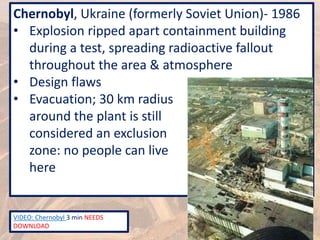
Chernobyl, Ukraine (formerly Soviet Union)- 1986
• Explosion ripped apart containment building
during a test, spreading radioactive fallout
throughout the area & atmosphere
• Design flaws
• Evacuation; 30 km radius
around the plant is still
considered an exclusion
zone: no people can live
here
VIDEO: Chernobyl 3 min NEEDS
DOWNLOAD
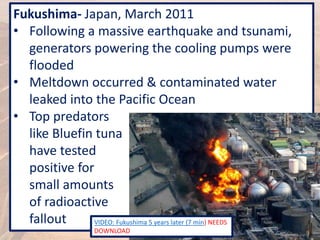
Fukushima- Japan, March 2011
• Following a massive earthquake and tsunami,
generators powering the cooling pumps were
flooded
• Meltdown occurred & contaminated water
leaked into the Pacific Ocean
• Top predators
like Bluefin tuna
have tested
positive for
small amounts
of radioactive
fallout VIDEO: Fukushima 5 years later (7 min) NEEDS
DOWNLOAD
PROS +
+ No air pollution
+ Lots of Energy is
released
CONS -
⁻ Non-renewable
⁻ Produces radioactive
waste that must be
safely stored for long
time
⁻ Nuclear accident
could release
radioactive materials
into environment
(Chernobyl, 3-mile
Island, Fukushima)
RESOURCE: NUCLEAR ENERGY
u41
VIDEO: How Nuclear Works
VIDEO Nuclear Risks, Potential Solutions
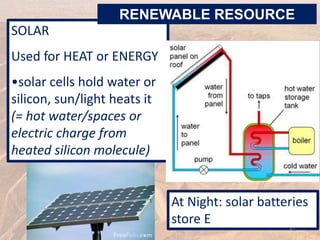
SOLAR
Used for HEAT or ENERGY
•solar cells hold water or
silicon, sun/light heats it
(= hot water/spaces or
electric charge from
heated silicon molecule)
RENEWABLE RESOURCE
At Night: solar batteries
store E
42
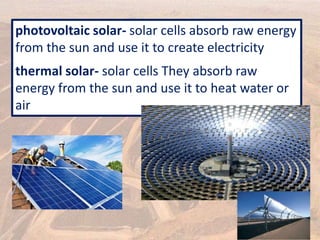
photovoltaic solar- solar cells absorb raw energy
from the sun and use it to create electricity
thermal solar- solar cells They absorb raw
energy from the sun and use it to heat water or
air
PROS +
+ Renewable- lots of it
+ Free
+ No air pollution
+ No environmental
pollution
CONS -
⁻ Can’t produce
electricity at night so
must be stored in
solar batteries
⁻ Expensive right now
RESOURCE: SOLAR ENERGY
44
VIDEO How Solar Works
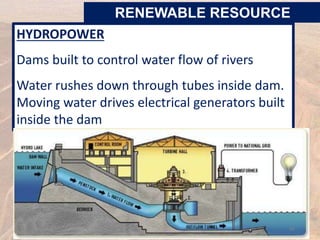
HYDROPOWER
Dams built to control water flow of rivers
Water rushes down through tubes inside dam.
Moving water drives electrical generators built
inside the dam
RENEWABLE RESOURCE
45
PROS +
+ Renewable- lots of it
+ Free
+ No air pollution
+ No environmental
pollution
CONS -
⁻ Can’t be used
everywhere; need
large river
⁻ Making a dam
requires building of
reservoir (man-made
lake)
RESOURCE: HYDROPOWER
46
VIDEO How Hydro Works
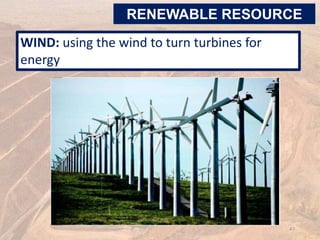
WIND: using the wind to turn turbines for
energy
RENEWABLE RESOURCE
47
PROS +
+ Renewable- lots of it
+ Free
+ No air pollution
+ No environmental
pollution
CONS -
⁻ Need a reliably windy
place
⁻ Turbines are noisy
⁻ Birds and bats have
been killed
RESOURCE: WIND ENERGY
48
VIDEO Making Wind Work
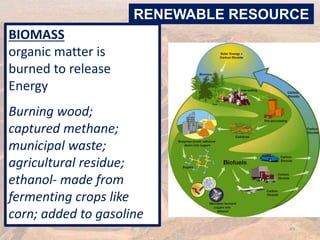
BIOMASS
organic matter is
burned to release
Energy
Burning wood;
captured methane;
municipal waste;
agricultural residue;
ethanol- made from
fermenting crops like
corn; added to gasoline
RENEWABLE RESOURCE
49
PROS +
+ Gets rid of a waste
+ Reduces amount of
gasoline being used
CONS -
⁻ Releases carbon
dioxide
⁻ Could affect food
availability since it’s
made from crops
⁻ Clearing trees to grow
corn: rainforest
RESOURCE: BIOMASS
50
VIDEO Biofuels Basics
VIDEO Biomass Pros & Cons
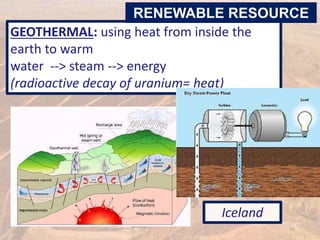
GEOTHERMAL: using heat from inside the
earth to warm
water --> steam --> energy
(radioactive decay of uranium= heat)
RENEWABLE RESOURCE
Iceland
51
PROS +
+ Renewable- lots of it
+ Free
+ No air pollution
+ Natural hot
springs/geysers
CONS -
⁻ Need to be located
over volcanically
active ground
RESOURCE: GEOTHEMAL ENERGY
52
VIDEO Geothermal Options
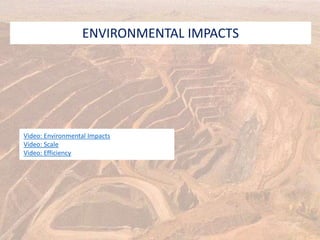
ENVIRONMENTAL IMPACTS
Video: Environmental Impacts
Video: Scale
Video: Efficiency
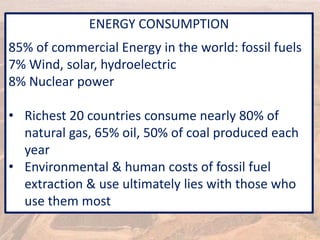
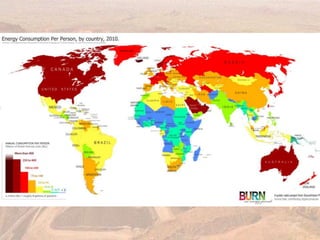
ENERGY CONSUMPTION
85% of commercial Energy in the world: fossil fuels
7% Wind, solar, hydroelectric
8% Nuclear power
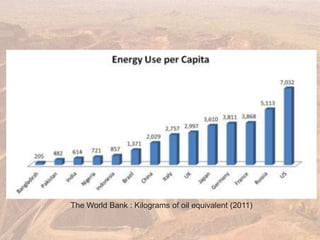
• Richest 20 countries consume nearly 80% of
natural gas, 65% oil, 50% of coal produced each
year
• Environmental & human costs of fossil fuel
extraction & use ultimately lies with those who
use them most
The World Bank : Kilograms of oil equivalent (2011)
58
Why is it important?
Sustainability- avoidance of the depletion
of natural resources in order to maintain an
ecological balance.
• conservation- preserving, protecting,
restoring
• stewardship- job of taking care of
something
VIDEO: Can 100% Renewable power the world?
NEEDS DOWNLOAD NEEDS DOWNLOAD

Energy Resources

  • 1.
    Energy: Resources ppt. by RobinD. Seamon 1HOOK VIDEO: Gasland
  • 2.
    WHAT IS ENERGY? energy-ability to do work potential energy- stored energy kinetic energy- energy in motion Law of Conservation of Energy: Energy is neither created nor destroyed, it merely changes form VIDEO NEEDS DOWNLOADED: A guide to the Energy of Earth
  • 3.
    Nonrenewable resource- anenergy source that cannot be readily replaced naturally in comparison to its consumption Renewable resource- an energy source that can be reused or readily replaced naturally 3 VIDEO: How we make and use Energy
  • 4.
  • 5.
    Water pumps to extract morecoal US Natural Gas well Electric motor US oil well France- solar energy AC/DC system
  • 6.
    Geothermal Energy US **Saudi Arabian Oil discovered USSR, Poland: nuclearE US oil production declines; Saudi Arabia drives up prices3-mile Island Nuclear accident, PA Global oil production peaks VIDEO: 300 years of fossil fuels in 300 seconds NEEDS DOWNLOAD
  • 7.
    OUR ENERGY FOUNDATIONTODAY ELECTRICITY: Coal TRANSPORTATION: petroleum (gas) HEAT VIDEO: Our Energy Foundation VIDEO: Energy Choices
  • 8.
    Most of energyin US is to make electricity Generator: converts mechanical energy into electrical energy • Turn a magnet surrounded by a copper wire • Creates an electromagnetic field which aligns the electrons into a current of electrons moving in one direction: electricity VIDEO: What is Electricity E L E C T R I C I T Y 8 What is Electricity?
  • 9.
    HOW TO MOVETHE MAGNET- turbine? • Steam moves in one direction and can spin the turbine • So, boiling water is a widely used method 9
  • 10.
    HOW TO BOILTHE WATER? • Biomass: Burn wood • Burn fossil fuels • Nuclear reactions 10VIDEO: How Electricity is Made
  • 11.
    ELECTRICITY Activities LINK VIDEO: TheElectric Grid VIDEO: How Batteries Work
  • 12.
    Fossil Fuels: resource fromancient, buried Carbon- burning coal, oil & natural gas NON-RENEWABLE RESOURCE We burn it to boil water in electricity production: -Steam -turbine -generator -electricity 12
  • 13.
    13 • As climatechanged 350mya, Carboniferous forests died, leaving the un-decomposed trees to be buried • 50 million years of accumulated plant matter became buried • Pressure & heat turned it into… COAL fossil fuels: coal, oil, and natural gas from this time period that are mined for Energy + - lots of energy produced when it is burned Polluting & Non- renewable
  • 14.
    Hydrocarbon: containing Carbon & Hydrogen Coal:90% Carbon, 4% hydrogen, 3% oxygen, 1% sulfur When burned, these elements combine with oxygen in the atmosphere to form pollutants: • Carbon dioxide • Sulfur dioxide • Nitrogen oxides • Fine black particles of soot • …. Acid rain & smog
  • 15.
    FOSSIL FUELS: COAL VIDEO:What is Coal? Strip mining- carving away horizontal beds of coal deposits close to the surface NON-RENEWABLE RESOURCE
  • 16.
    FOSSIL FUELS: COAL Mountaintopremoval- uses machines & explosives to expose seams of coal underneath entire mountaintops Hobet Mine, West Virginia slideshow
  • 17.
    FOSSIL FUELS: COAL SubsurfaceMining- underground; removes coal through deep tunnels & shafts using machines & conveyor belts • Coal dust from explosives
  • 18.
    FOSSIL FUELS: COAL CoalAsh- when coal is burned, the resultant ash is held in water ponds or buried • When mixed with water, this coal ash has toxins & heavy metals: arsenic, cadmium, chromium, lead, mercury, radioactive radium • 70-80% is buried in landfills • 30-20% is used for concrete, asphalt, etc
  • 19.
    FOSSIL FUELS: COAL VIDEO:Clean Coal Coal ash spills- Dan River Spill; 2014 tributary to the Yadkin; Duke Power spilled tons coal ash in the river Coal Ash: Black Lung Disease- build up of coal dust over time in miners’ lungs
  • 20.
    FOSSIL FUELS: OIL VIDEOHow Oil is Made Similar chemistry to coal Oil refinery: Oil is heated to separate into specific fuels NON-RENEWABLE RESOURCE
  • 21.
    FOSSIL FUELS: OIL VIDEODrilling for Oil Oil well is dug, crude oil is sent to oil refineries to be made into specific fuels
  • 22.
    FOSSIL FUELS: OIL Oilfields line up with ancient shallow seas • Majority of oil fields today in Middle Eastern countries • US: Alaska, Texas • Oil pipeline- transports oil over great distances Alaskan pipeline CONCERNS: -Spills & groundwater contamination -habitat fragmentation
  • 23.
    FOSSIL FUELS: OIL Oilplatforms- oil rigs that drill into the ocean floor • Deepwater Horizons Oil Spill, Gulf of Mexico April 2010 spilled 4.9 million barrels into the Gulf over a 5 month period VIDEO: Timeline of Horizon Oil Spill
  • 24.
    Worldwide Oil Exports VIDEOUnconventional Sources of Oil
  • 25.
    VIDEO Oil &Transportation Alternatives Of the fossil fuels, oil has been the most quickly depleted US reached its peak oil productio n in 1970
  • 26.
    FOSSIL FUELS: NATURALGAS VDEO What is Natural Gas VIDEO: Uses of Natural Gas • Burning of fossil fuel gas • Only pollution is carbon dioxide & water vapor • Found where most petroleum is found, lighter on top NON-RENEWABLE RESOURCE
  • 27.
    FOSSIL FUELS: NATURALGAS- FRACKING from SWITCH ENERGY PROJECT VIDEO Benefits of Fracking VDEO Risks of Fracking: Water VIDEO Risks of Fracking: Methane hydraulic fracturing (fracking) fracking: a method of oil & natural gas extraction by injecting water, sand & chemicals into sedimentary shale rock at high pressure to ‘fracture’ or break the rock in order to release the natural gas bubbles VIDEO: What is fracking? (5 min )
  • 29.
  • 30.
    PROS + + Naturalgas used in stoves, furnaces, water heaters, clothes dryers, appliances, electrical power plants + produces lots of E + already have a system of using it worldwide CONS - ⁻ nonrenewable ⁻ Pollution to air ⁻ Coal damages land & pollutes water ⁻ Supplies limited ⁻ Drilling for oil damages & pollutes ⁻ Adds carbon dioxide to global warming equation RESOURCE: FOSSIL FUELS 30
  • 31.
    NUCLEAR: energy thatcomes from changes in the nucleus of an atom •Fission break apart nucleus of an atom (power plants) •Fusion fusing together two nuclei of atoms (sun) 100,000,000°C: H joins to form He 31 NON-RENEWABLE RESOURCE
  • 32.
    ATOMS nucleus- center ofan atom proton- subatomic particle within the nucleus of an atom having a positive charge; number of which gives an element its identity electron- subatomic particle of negative energy surrounding the nucleus in shells neutron- subatomic particle with no charge within the nucleus of an atom (helps with nucleus stability)
  • 33.
    Nuclear Fuels: splitsradioactive atoms of Uranium & Plutonium to produce heat --> steam --> energy 33 Steam
  • 34.
    Uranium Pellet Stored nuclearfuel rods 12-foot-long fuel rod full of uranium pellet, lasts about six years in a reactor spent rods: fuel rods have to be cooled in water for anywhere between five to 10 years before they’re safe enough to be taken out of these pools and put into dry cast storage.
  • 35.
    The power ofnuclear… Nuclear bomb: • Uranium -235 has a very large nucleus which when hit with a high-speed neutron , will split it • In WWII two atomic bombs were dropped on Hiroshima & Nagasaki, Japan, ending the war • Intense heat & radiation • Nuclear fallout- dust & ash Radiation poison- causes immediate effects on human tissue & reproductive genes • 200-300 rems: nausea & vomiting • 400-600 rems: 50% mortality rate • 600-1000 rems: death
  • 37.
    The power ofnuclear… Atoms for Peace- 1953 • Under Eisenhower administration, equipment & technology were provided for the study of peaceful uses of the technology
  • 38.
    The power ofnuclear… Nuclear Accidents Three Mile Island, Middleton PA – 1979 • partial meltdown due to a relief valve not closing, allowing the cooling water to evaporate • No major leak to the environment occurred
  • 39.
    Chernobyl, Ukraine (formerlySoviet Union)- 1986 • Explosion ripped apart containment building during a test, spreading radioactive fallout throughout the area & atmosphere • Design flaws • Evacuation; 30 km radius around the plant is still considered an exclusion zone: no people can live here VIDEO: Chernobyl 3 min NEEDS DOWNLOAD
  • 40.
    Fukushima- Japan, March2011 • Following a massive earthquake and tsunami, generators powering the cooling pumps were flooded • Meltdown occurred & contaminated water leaked into the Pacific Ocean • Top predators like Bluefin tuna have tested positive for small amounts of radioactive fallout VIDEO: Fukushima 5 years later (7 min) NEEDS DOWNLOAD
  • 41.
    PROS + + Noair pollution + Lots of Energy is released CONS - ⁻ Non-renewable ⁻ Produces radioactive waste that must be safely stored for long time ⁻ Nuclear accident could release radioactive materials into environment (Chernobyl, 3-mile Island, Fukushima) RESOURCE: NUCLEAR ENERGY u41 VIDEO: How Nuclear Works VIDEO Nuclear Risks, Potential Solutions
  • 42.
    SOLAR Used for HEATor ENERGY •solar cells hold water or silicon, sun/light heats it (= hot water/spaces or electric charge from heated silicon molecule) RENEWABLE RESOURCE At Night: solar batteries store E 42
  • 43.
    photovoltaic solar- solarcells absorb raw energy from the sun and use it to create electricity thermal solar- solar cells They absorb raw energy from the sun and use it to heat water or air
  • 44.
    PROS + + Renewable-lots of it + Free + No air pollution + No environmental pollution CONS - ⁻ Can’t produce electricity at night so must be stored in solar batteries ⁻ Expensive right now RESOURCE: SOLAR ENERGY 44 VIDEO How Solar Works
  • 45.
    HYDROPOWER Dams built tocontrol water flow of rivers Water rushes down through tubes inside dam. Moving water drives electrical generators built inside the dam RENEWABLE RESOURCE 45
  • 46.
    PROS + + Renewable-lots of it + Free + No air pollution + No environmental pollution CONS - ⁻ Can’t be used everywhere; need large river ⁻ Making a dam requires building of reservoir (man-made lake) RESOURCE: HYDROPOWER 46 VIDEO How Hydro Works
  • 47.
    WIND: using thewind to turn turbines for energy RENEWABLE RESOURCE 47
  • 48.
    PROS + + Renewable-lots of it + Free + No air pollution + No environmental pollution CONS - ⁻ Need a reliably windy place ⁻ Turbines are noisy ⁻ Birds and bats have been killed RESOURCE: WIND ENERGY 48 VIDEO Making Wind Work
  • 49.
    BIOMASS organic matter is burnedto release Energy Burning wood; captured methane; municipal waste; agricultural residue; ethanol- made from fermenting crops like corn; added to gasoline RENEWABLE RESOURCE 49
  • 50.
    PROS + + Getsrid of a waste + Reduces amount of gasoline being used CONS - ⁻ Releases carbon dioxide ⁻ Could affect food availability since it’s made from crops ⁻ Clearing trees to grow corn: rainforest RESOURCE: BIOMASS 50 VIDEO Biofuels Basics VIDEO Biomass Pros & Cons
  • 51.
    GEOTHERMAL: using heatfrom inside the earth to warm water --> steam --> energy (radioactive decay of uranium= heat) RENEWABLE RESOURCE Iceland 51
  • 52.
    PROS + + Renewable-lots of it + Free + No air pollution + Natural hot springs/geysers CONS - ⁻ Need to be located over volcanically active ground RESOURCE: GEOTHEMAL ENERGY 52 VIDEO Geothermal Options
  • 53.
    ENVIRONMENTAL IMPACTS Video: EnvironmentalImpacts Video: Scale Video: Efficiency
  • 54.
    ENERGY CONSUMPTION 85% ofcommercial Energy in the world: fossil fuels 7% Wind, solar, hydroelectric 8% Nuclear power • Richest 20 countries consume nearly 80% of natural gas, 65% oil, 50% of coal produced each year • Environmental & human costs of fossil fuel extraction & use ultimately lies with those who use them most
  • 56.
    The World Bank: Kilograms of oil equivalent (2011)
  • 58.
    58 Why is itimportant? Sustainability- avoidance of the depletion of natural resources in order to maintain an ecological balance. • conservation- preserving, protecting, restoring • stewardship- job of taking care of something VIDEO: Can 100% Renewable power the world? NEEDS DOWNLOAD NEEDS DOWNLOAD