What is matter?
• Matter
– Has mass and volume
– Made up of atoms
– Examples:
• Not Matter
– No mass, no volume
– Examples: Light, Sound, Electricity
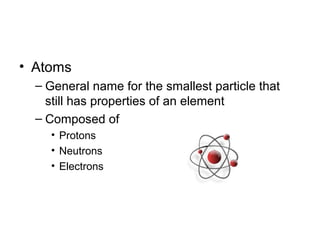
• Atoms
– General name for the smallest particle that
still has properties of an element
– Composed of
• Protons
• Neutrons
• Electrons
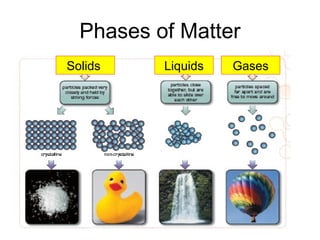
Phases of Matter
Solids

Liquids

Gases
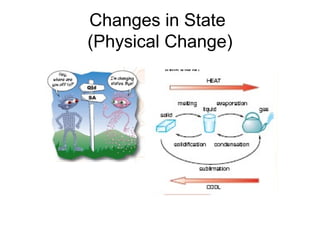
Changes in State
(Physical Change)
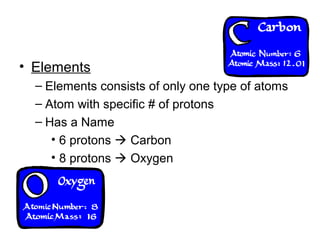
• Elements
– Elements consists of only one type of atoms
– Atom with specific # of protons
– Has a Name
• 6 protons  Carbon
• 8 protons  Oxygen
• Each element has its own properties
– Carbon

 melting point

3550°C

– Oxygen

 melting point

-218°C

– Hydrogen  melting point

-259°C
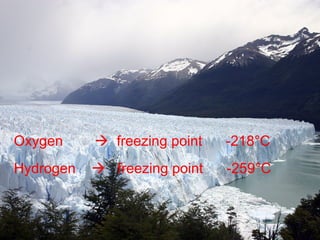
Oxygen

 freezing point

-218°C

Hydrogen

 freezing point

-259°C
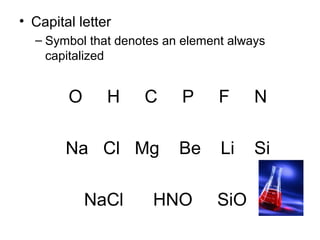
• Capital letter
– Symbol that denotes an element always
capitalized

O

H

C

Na Cl Mg
NaCl

P

F

N

Be

Li

Si

HNO

SiO
ds

al

i
lo

t
Me
nNo

l
ta
Me

Metals

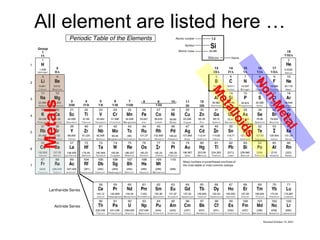
All element are listed here …
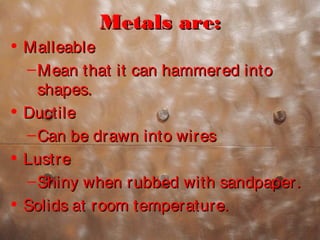
Metals are:
• Malleable
– Mean that it can hammered into
shapes.
• Ductile
– Can be drawn into wires
• Lustre
– Shiny when rubbed with sandpaper.
• Solids at room temperature.
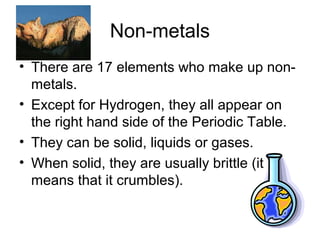
Non-metals
• There are 17 elements who make up nonmetals.
• Except for Hydrogen, they all appear on
the right hand side of the Periodic Table.
• They can be solid, liquids or gases.
• When solid, they are usually brittle (it
means that it crumbles).
Metalloids
• Metalloids have both metal and non metal
qualities.
• There are 8 element.
• They are often used in semiconductors
and therefore extensively used in
electronics and computers.
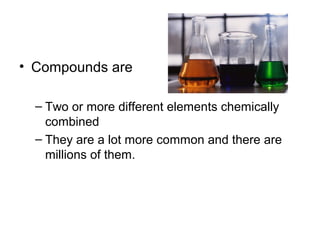
• Compounds are
– Two or more different elements chemically
combined
– They are a lot more common and there are
millions of them.
• Subscript
– Number of atoms of the element
– Always after the symbol

O2

H2

H2O HNO3
C6H12O6

CO2
Do you want to make some
compounds?
8E Making marvellous molecules!
Compounds are a result of a
chemical change or reaction.
A chemical change happened
when:
1.
2.
3.
4.
5.

A gas gets formed.
Energy is given off.
Apparent change of mass.
Permanent colour change.
Formation of a precipitate.
Reaction Rates are increased by:
•
•
•
•

An increase in temperature.
Smaller particle size.
The more concentrated the reactant.
Using a catalyst.
– A catalyst is a chemical that are not
consumed in the reaction but caused the
reaction rate to increase.
pure
substances
or
mixtures
• Pure substances
–
–
–
–
–

Fixed composition
Definite properties
Cannot by separated by physical actions
Elements
Compounds
• Pure substance examples

O

H

C

H2O HNO3
C6H12O6

CO2
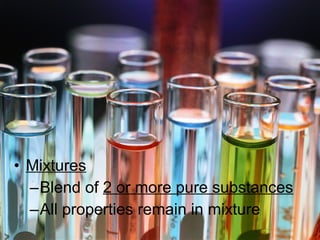
• Mixtures
–Blend of 2 or more pure substances
–All properties remain in mixture
ts
en
lv
o
S

• It a liquid in which you dissolve something
• Water is the most common solvent
Solutions

• Is a liquid with which has a
substance completely dissolved
in it.
Suspensions
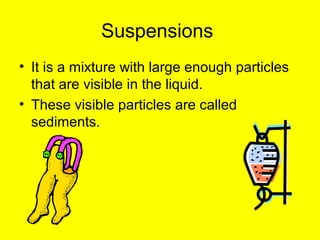
• It is a mixture with large enough particles
that are visible in the liquid.
• These visible particles are called
sediments.
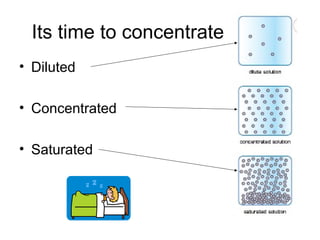
Its time to concentrate
• Diluted
• Concentrated
• Saturated
Colloids
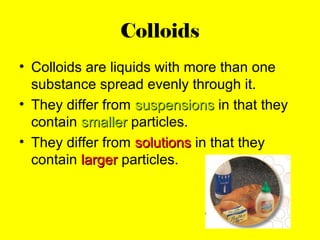
• Colloids are liquids with more than one
substance spread evenly through it.
• They differ from suspensions in that they
contain smaller particles.
• They differ from solutions in that they
contain larger particles.
Emulsions
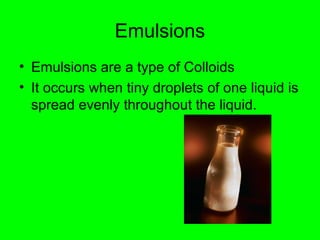
• Emulsions are a type of Colloids
• It occurs when tiny droplets of one liquid is
spread evenly throughout the liquid.
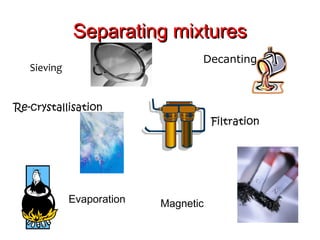
Separating mixtures
Decanting

Sieving
Re-crystallisation

Evaporation

Filtration

Magnetic
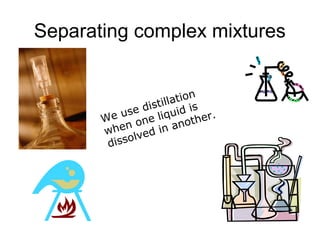
Separating complex mixtures
n
latio
l
disti id is
e
e us ne liqu ther.
W
o
o
hen ed in an
w
lv
isso
d
Acids & Bases
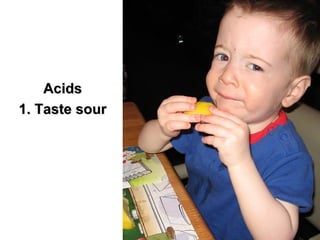
Acids
1. Taste sour
4. Turns Blue litmus paper
to RED
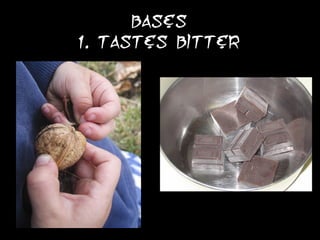
bases
1. tastes bitter
3. Turns Red litmus paper
to BLUE
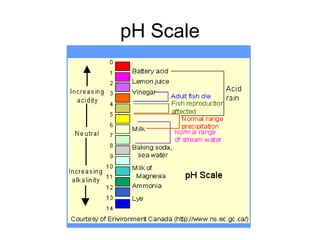
pH Scale