Chemistry 4:
Change in Matter
ppt. by Robin D. Seamon
M ATT E R
Matter: anything that has mass and takes up
space
• Mass: measure of how much matter is in an
object
• Law of conservation of mass- mass is
conserved- the amount of atoms cannot
change; nothing is created or destroyed
• Melting point
• Boiling point
• Electrical
conductivity
• Color
• Density
• Thermal
conductivity
• Ductility
• Malleability
• shape
• smell
Physical properties- anything that can be
observed without changing the identity of the
substance
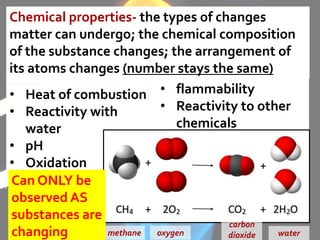
methane oxygen water
• Heat of combustion
• Reactivity with
water
• pH
• Oxidation
• flammability
• Reactivity to other
chemicals
Chemical properties- the types of changes
matter can undergo; the chemical composition
of the substance changes; the arrangement of
its atoms changes (number stays the same)
Can ONLY be
observed AS
substances are
changing
carbon
dioxide
M ATT E R C A N C H A N G E
Physically
• Physical reaction
• Physical change
Chemically
• Chemical reaction
• Chemical change
Change in mass,
volume, density, state,
color, shape
A new substance is
made as a result of the
reaction; cannot be
undone
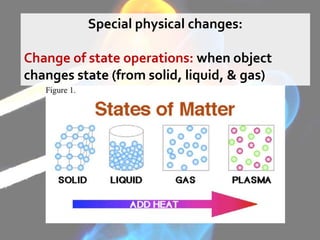
Special physical changes:
Change of state operations: when object
changes state (from solid, liquid, & gas)
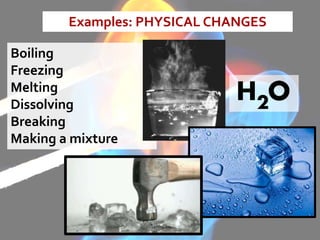
Examples: PHYSICAL CHANGES
Boiling
Freezing
Melting
Dissolving
Breaking
Making a mixture
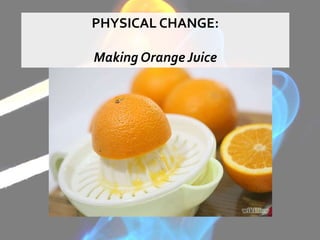
PHYSICAL CHANGE:
Making Orange Juice
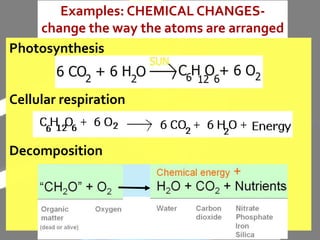
Photosynthesis
Cellular respiration
Decomposition
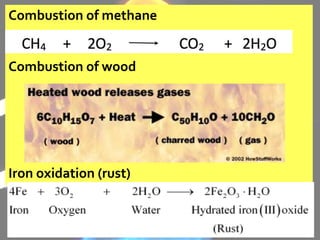
Examples: CHEMICAL CHANGES-
change the way the atoms are arranged
Combustion of methane
Combustion of wood
Iron oxidation (rust)
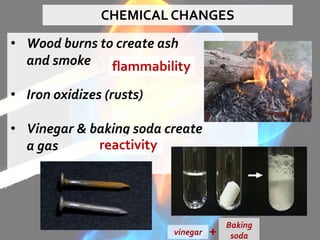
CHEMICAL CHANGES
• Wood burns to create ash
and smoke
• Iron oxidizes (rusts)
• Vinegar & baking soda create
a gas
Baking
sodavinegar +
flammability
reactivity
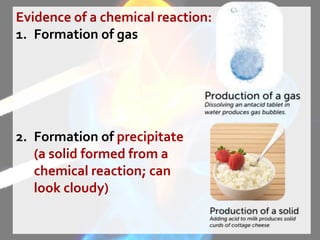
Evidence of a chemical reaction:
1. Formation of gas
2. Formation of precipitate
(a solid formed from a
chemical reaction; can
look cloudy)
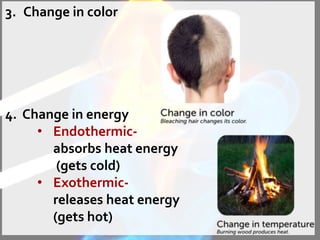
3. Change in color
4. Change in energy
• Endothermic-
absorbs heat energy
(gets cold)
• Exothermic-
releases heat energy
(gets hot)
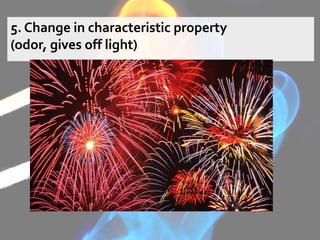
5. Change in characteristic property
(odor, gives off light)
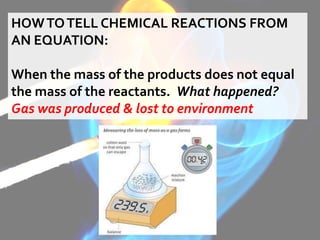
HOWTOTELL CHEMICAL REACTIONS FROM
AN EQUATION:
When the mass of the products does not equal
the mass of the reactants. What happened?
Gas was produced & lost to environment
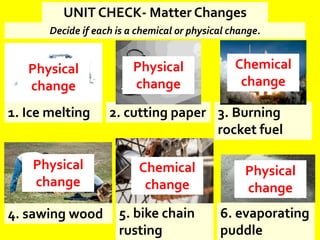
UNIT CHECK- Matter Changes
Decide if each is a chemical or physical change.
1. Ice melting 2. cutting paper 3. Burning
rocket fuel
6. evaporating
puddle
5. bike chain
rusting
4. sawing wood
Physical
change
Physical
change
Physical
change
Physical
change
Chemical
change
Chemical
change
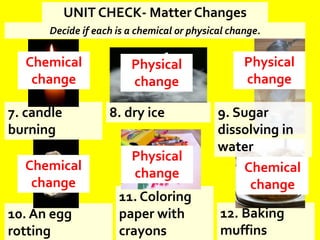
UNIT CHECK- Matter Changes
Decide if each is a chemical or physical change.
8. dry ice
12. Baking
muffins
11. Coloring
paper with
crayons
10. An egg
rotting
7. candle
burning
Physical
change
Physical
change
Physical
change
Chemical
change
Chemical
change
9. Sugar
dissolving in
water
Chemical
change
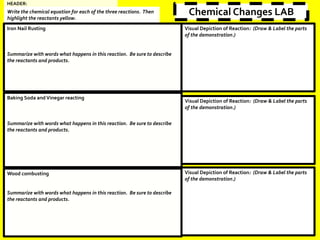
Chemical Changes LABWrite the chemical equation for each of the three reactions. Then
highlight the reactants yellow.
Iron Nail Rusting
Summarize with words what happens in this reaction. Be sure to describe
the reactants and products.
Baking Soda and Vinegar reacting
Summarize with words what happens in this reaction. Be sure to describe
the reactants and products.
Wood combusting
Summarize with words what happens in this reaction. Be sure to describe
the reactants and products.
Visual Depiction of Reaction: (Draw & Label the parts
of the demonstration.)
Visual Depiction of Reaction: (Draw & Label the parts
of the demonstration.)
Visual Depiction of Reaction: (Draw & Label the parts
of the demonstration.)
HEADER:
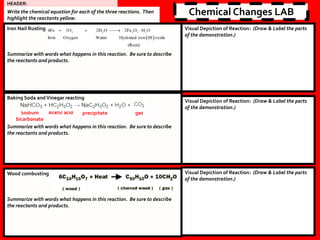
Chemical Changes LABWrite the chemical equation for each of the three reactions. Then
highlight the reactants yellow.
Iron Nail Rusting
Summarize with words what happens in this reaction. Be sure to describe
the reactants and products.
Baking Soda and Vinegar reacting
Summarize with words what happens in this reaction. Be sure to describe
the reactants and products.
Wood combusting
Summarize with words what happens in this reaction. Be sure to describe
the reactants and products.
Visual Depiction of Reaction: (Draw & Label the parts
of the demonstration.)
Visual Depiction of Reaction: (Draw & Label the parts
of the demonstration.)
Visual Depiction of Reaction: (Draw & Label the parts
of the demonstration.)
HEADER:
Sodium
bicarbonate
Acetic acid precipitate gas
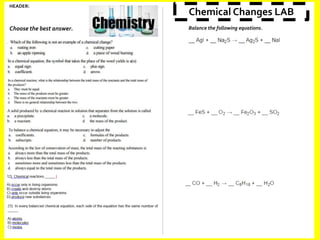
Balance the following equations.Choose the best answer.
HEADER:
Chemical Changes LAB

Chemistry 4 Changes in Matter

  • 1.
    Chemistry 4: Change inMatter ppt. by Robin D. Seamon
  • 2.
    M ATT ER Matter: anything that has mass and takes up space • Mass: measure of how much matter is in an object • Law of conservation of mass- mass is conserved- the amount of atoms cannot change; nothing is created or destroyed
  • 3.
    • Melting point •Boiling point • Electrical conductivity • Color • Density • Thermal conductivity • Ductility • Malleability • shape • smell Physical properties- anything that can be observed without changing the identity of the substance
  • 4.
    methane oxygen water •Heat of combustion • Reactivity with water • pH • Oxidation • flammability • Reactivity to other chemicals Chemical properties- the types of changes matter can undergo; the chemical composition of the substance changes; the arrangement of its atoms changes (number stays the same) Can ONLY be observed AS substances are changing carbon dioxide
  • 5.
    M ATT ER C A N C H A N G E Physically • Physical reaction • Physical change Chemically • Chemical reaction • Chemical change Change in mass, volume, density, state, color, shape A new substance is made as a result of the reaction; cannot be undone
  • 6.
    Special physical changes: Changeof state operations: when object changes state (from solid, liquid, & gas)
  • 7.
  • 8.
  • 9.
    Photosynthesis Cellular respiration Decomposition Examples: CHEMICALCHANGES- change the way the atoms are arranged
  • 10.
    Combustion of methane Combustionof wood Iron oxidation (rust)
  • 11.
    CHEMICAL CHANGES • Woodburns to create ash and smoke • Iron oxidizes (rusts) • Vinegar & baking soda create a gas Baking sodavinegar + flammability reactivity
  • 12.
    Evidence of achemical reaction: 1. Formation of gas 2. Formation of precipitate (a solid formed from a chemical reaction; can look cloudy)
  • 13.
    3. Change incolor 4. Change in energy • Endothermic- absorbs heat energy (gets cold) • Exothermic- releases heat energy (gets hot)
  • 14.
    5. Change incharacteristic property (odor, gives off light)
  • 15.
    HOWTOTELL CHEMICAL REACTIONSFROM AN EQUATION: When the mass of the products does not equal the mass of the reactants. What happened? Gas was produced & lost to environment
  • 16.
    UNIT CHECK- MatterChanges Decide if each is a chemical or physical change. 1. Ice melting 2. cutting paper 3. Burning rocket fuel 6. evaporating puddle 5. bike chain rusting 4. sawing wood Physical change Physical change Physical change Physical change Chemical change Chemical change
  • 17.
    UNIT CHECK- MatterChanges Decide if each is a chemical or physical change. 8. dry ice 12. Baking muffins 11. Coloring paper with crayons 10. An egg rotting 7. candle burning Physical change Physical change Physical change Chemical change Chemical change 9. Sugar dissolving in water Chemical change
  • 18.
    Chemical Changes LABWritethe chemical equation for each of the three reactions. Then highlight the reactants yellow. Iron Nail Rusting Summarize with words what happens in this reaction. Be sure to describe the reactants and products. Baking Soda and Vinegar reacting Summarize with words what happens in this reaction. Be sure to describe the reactants and products. Wood combusting Summarize with words what happens in this reaction. Be sure to describe the reactants and products. Visual Depiction of Reaction: (Draw & Label the parts of the demonstration.) Visual Depiction of Reaction: (Draw & Label the parts of the demonstration.) Visual Depiction of Reaction: (Draw & Label the parts of the demonstration.) HEADER:
  • 19.
    Chemical Changes LABWritethe chemical equation for each of the three reactions. Then highlight the reactants yellow. Iron Nail Rusting Summarize with words what happens in this reaction. Be sure to describe the reactants and products. Baking Soda and Vinegar reacting Summarize with words what happens in this reaction. Be sure to describe the reactants and products. Wood combusting Summarize with words what happens in this reaction. Be sure to describe the reactants and products. Visual Depiction of Reaction: (Draw & Label the parts of the demonstration.) Visual Depiction of Reaction: (Draw & Label the parts of the demonstration.) Visual Depiction of Reaction: (Draw & Label the parts of the demonstration.) HEADER: Sodium bicarbonate Acetic acid precipitate gas
  • 20.
    Balance the followingequations.Choose the best answer. HEADER: Chemical Changes LAB