Chapter 6: Chemical Bonding6.2 – Covalent Bonding and Molecular Compounds
Molecule – neutral group of atoms that are held together by covalent bondsMolecular Compound – chemical compound whose simplest units are molecules
Chemical Formula – indicates the relative numbers of atoms of each kind in a chemical compound by using atomic symbols and numerical scriptsMolecular Formula – shows the types and numbers of atoms combined in a single molecule of a molecular compound.
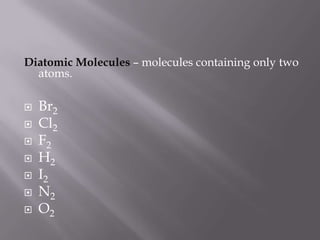
Diatomic Molecules – molecules containing only two atoms.Br2Cl2F2H2I2N2O2
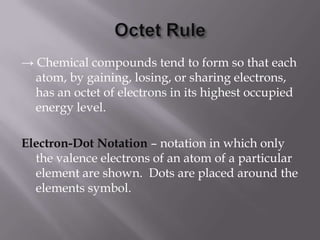
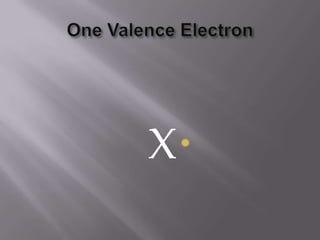
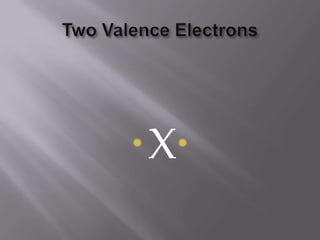
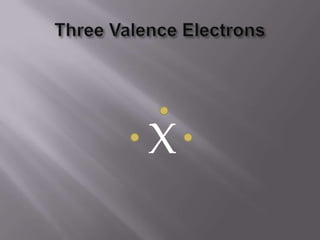
Octet Rule-> Chemical compounds tend to form so that each atom, by gaining, losing, or sharing electrons, has an octet of electrons in its highest occupied energy level.Electron-Dot Notation – notation in which only the valence electrons of an atom of a particular element are shown.  Dots are placed around the elements symbol.
One Valence ElectronX
Two Valence ElectronsX
Three Valence ElectronsX
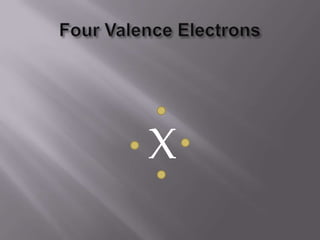
Four Valence ElectronsX
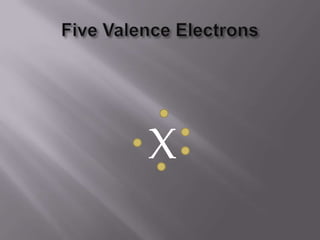
Five Valence ElectronsX
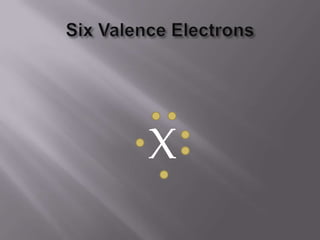
Six Valence ElectronsX
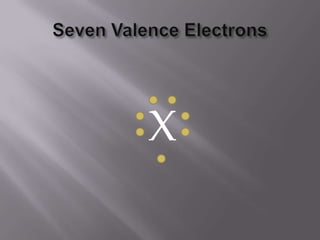
Seven Valence ElectronsX
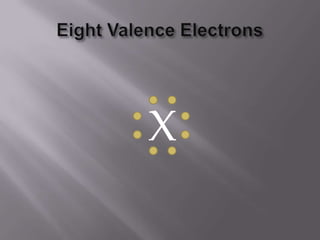
Eight Valence ElectronsX
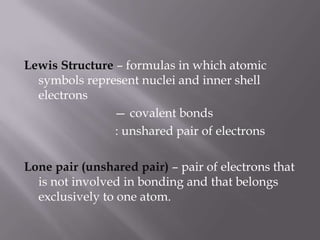
Lewis Structure – formulas in which atomic symbols represent nuclei and inner shell electrons			          — covalent bonds				: unshared pair of electronsLone pair (unshared pair) – pair of electrons that is not involved in bonding and that belongs exclusively to one atom.
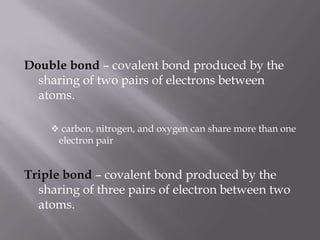
Double bond – covalent bond produced by the sharing of two pairs of electrons between atoms. carbon, nitrogen, and oxygen can share more than one electron pairTriple bond – covalent bond produced by the sharing of three pairs of electron between two atoms.

Chemical Compounds

  • 1.
    Chapter 6: ChemicalBonding6.2 – Covalent Bonding and Molecular Compounds
  • 2.
    Molecule – neutralgroup of atoms that are held together by covalent bondsMolecular Compound – chemical compound whose simplest units are molecules
  • 3.
    Chemical Formula –indicates the relative numbers of atoms of each kind in a chemical compound by using atomic symbols and numerical scriptsMolecular Formula – shows the types and numbers of atoms combined in a single molecule of a molecular compound.
  • 4.
    Diatomic Molecules –molecules containing only two atoms.Br2Cl2F2H2I2N2O2
  • 5.
    Octet Rule-> Chemicalcompounds tend to form so that each atom, by gaining, losing, or sharing electrons, has an octet of electrons in its highest occupied energy level.Electron-Dot Notation – notation in which only the valence electrons of an atom of a particular element are shown. Dots are placed around the elements symbol.
  • 6.
  • 7.
  • 8.
  • 9.
  • 10.
  • 11.
  • 12.
  • 13.
  • 14.
    Lewis Structure –formulas in which atomic symbols represent nuclei and inner shell electrons — covalent bonds : unshared pair of electronsLone pair (unshared pair) – pair of electrons that is not involved in bonding and that belongs exclusively to one atom.
  • 15.
    Double bond –covalent bond produced by the sharing of two pairs of electrons between atoms. carbon, nitrogen, and oxygen can share more than one electron pairTriple bond – covalent bond produced by the sharing of three pairs of electron between two atoms.