GENETICS 2:
BIOTECHNOLOGY
ppt by Robin D. Seamon
1
HOOK VIDEO: BBC “Visions of the Future 2007”
DNA
2
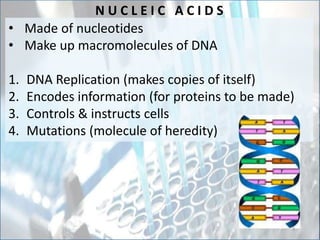
N U C L E I C A C I D S
• Made of nucleotides
• Make up macromolecules of DNA
1. DNA Replication (makes copies of itself)
2. Encodes information (for proteins to be made)
3. Controls & instructs cells
4. Mutations (molecule of heredity)
3
D N A
4
Mutations: a change in the coding of a gene
-can occur through:
1. Deletion: cell accidentally omits a piece of the
DNA
2. Duplication: cell accidentally makes an extra
copy of the DNA piece
3. Insertion: cell accidentally adds a piece of
DNA
4. Translocation: cell accidentally puts a piece of
genetic sequence in the wrong place.
5
ACTIVITY
• THE OLD RED DOG WAS TOO BIG FOR HIS BED
• Deletion that would delete the D in OLD…
• THE OLR EDD OGW AST OOB IGF ORH ISB ED
• Inversion of the word DOG...
• THE OLD RED GOD WAS TOO BIG FOR HIS BED
6
• Every cell in a living organism’s body (except red
blood cells) have a copy of their species genome
written in the code.
• Different genes (pieces of DNA) are turned on or
off where they are needed
• Therefore, evolutionary relatedness can be
determined from genetics.
7
• All living things use the same 4 nucleotide
bases of DNA (A-T, C-G) & ribosomes
• THEREFORE, DNA from different organisms can
be joined or ‘spliced’ together… GENETIC
ENGINEERING
8
HUMANS
• April 14, 2003: Human Genome Project
completed (USA)
• Each human cell has 3 billion base pairs of A-T
& C-G
• There are 7 trillion cells in a body
• Humans have about 30,000 genes encoded on
the DNA
VIDEO How to
sequence the human
genome (5min) 9
Forensic science:
Catching criminals based upon DNA left at the
crime-scene
Paternity testing:
Determining the father of a
child
While every human shares the same code for the
human genome, each person has slightly different
marker alleles coded into their DNA-
10
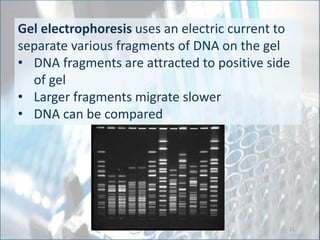
Gel electrophoresis uses an electric current to
separate various fragments of DNA on the gel
• DNA fragments are attracted to positive side
of gel
• Larger fragments migrate slower
• DNA can be compared
11
CC VIDEO: #17:
Evolution,
Development
Chicken Teeth
Genomes can change over time… HOW?
Modifications in gene sequence can happen through…
1. Natural selection: nature ‘selects’ for the strongest
to survive, passing on those genes
EXAMPLE: antibiotic resistance
2. Cross-breeding: (selective breeding) humans
choose specimens of a species, mating them in
order to ‘pick’ the characteristics we want in the
offspring EXAMPLE: dog breeding
3. Genetic modification: humans combine or alter
pieces of DNA in order to produce offspring with a
specific characteristics. 12
BIOTECHNOLOGY
13
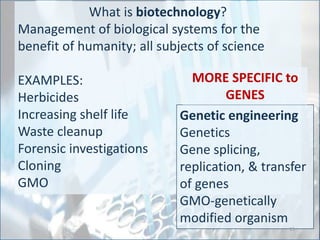
What is biotechnology?
Management of biological systems for the
benefit of humanity; all subjects of science
EXAMPLES:
Herbicides
Increasing shelf life
Waste cleanup
Forensic investigations
Cloning
GMO
Genetic engineering
Genetics
Gene splicing,
replication, & transfer
of genes
GMO-genetically
modified organism
MORE SPECIFIC to
GENES
14
BIOTECHNOLOGY-
ECONOMICS & HUMAN BENEFIT
Increase in production:
• Develop new forms of plants & animals
• Modify plants & animals to improve their life
processes
• Improve quality of food
• Longer shelf life for perishables
15
• food cheese, yogurt, buttermilk, sour cream:
• Breaks down milk
sugar (lactose) into
lactic acid- preserves
& flavors
• Decomposers: recyclers
BACTERIA & ITS ROLES FOR US
16
• Nitrogen fixation: take N from air & turn it into
a form plants can use; animals get N from
plants- farmers can purchase plants whose
roots have been dipped into extra bacteria
17
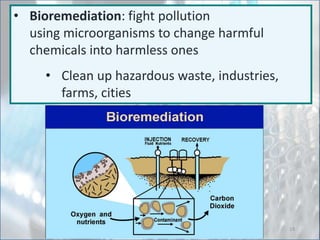
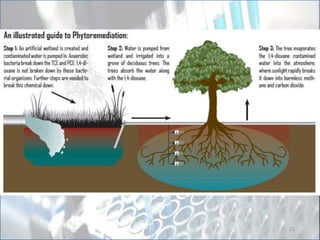
• Bioremediation: fight pollution
using microorganisms to change harmful
chemicals into harmless ones
• Clean up hazardous waste, industries,
farms, cities
18
19
20
PLANTS
Polyploidy- doubling a genome- gives rise to
organisms with multiple sets of chromosomes
-common in nature, creating new variations or even
speciation (30-80% angiosperms)
-scientists can also induce
21
-Crops:
used to overcome sterility in hybrid cross-breeding
EXAMPLE: Triticale is the hybrid offspring of
wheat & rye. This hybrid is sterile so scientists
chemically treat it to become polyploid, making the
hybrid fertile!
wheat rye triticale 22
For some crops, polyploidy crops are preferred &
are propagated using asexual grafting
EXAMPLES: apples, bananas, citrus,
watermelon, oat, wheat, strawberry, sugarcane
23
ANIMALS
Epistasis- having one or more genes that mask
the effect of the dominant gene
Labrador Retrievers:
BB/Bb = black fur
bb = brown fur
EE/Ee = normal fur
ee = yellow fur
Breeders selectively
breed for desired fur
color (we don’t mess with
the genes physically) 24
Selective breeding: mate/cross organisms with
desirable traits to produce offspring that have
traits from both parents
Large green
tomato
Small red
tomato
BIG RED
TOMATO
+ =
VIDEO: How Mendel’s pea plants helped us understand
genetics (3 min)
25
Brahman
cattle: good
heat
resistance,
poor beef
English
shorthorn:
good beef,
poor heat
resistance
Santa
Gertrudis
cattle
good beef,
heat resistant
+ =
26
Selective Breeding:
(+)might get improved
organisms
(+) don’t need special
tools or lab
(+) can be performed
easily by farmers &
breeders
(-) undesirable traits from
both parents may appear in
offspring
(-) disease can accumulate in
the population (deaf dalmations,
boxers with heart disease, labs with
hip problems)
27
GENETIC
ENGINEERING
28
G E N E T I C E N G I N E E R I N G
• Recombinant DNA technology
• Gene manipulation
1. genes are engineered by scientists into
organisms such as microbes or bacteria, for
mass-production
2. insertion of select genes into organisms
to improve their genotype
29
HOW?
1. Isolate the genes
2. Recombination
3. Transformation
4. Screening
5. induction
30
MEDICINE: 1970’s we learned to put genes into
bacteria that would make human insulin; Insulin
separated from bacteria & given to diabetics
Desired human gene
(like insulin production)
31
AGRICULTURE
32
Gene Gun
Alternative Method of Gene Insertion – Gene Gun
33
Glowing plants
VIDEO: Kickstarter
Replaces lights with
Growing plants! (5:50) 34
How are GMO’s tested & approved?
EPA- (Environmental Protection Agency) evaluates
environmental safety
USDA- (US Department of Agriculture) evaluates
whether plant is safe to grow
FDA- (Food & Drug Administration) evaluates
whether the plant is safe to eat
35
How are GMO’s tested & approved?
1. Scientists have to perform studies on the new
product & determine it safe
2. Scientists present the data to the EPA, USDA,
FDA
3. EPA, USDA, FDA approves product
VIDEO: Eyes of Nye GM
foods (8 min) 36
QUESTIONS: Who are the scientists?
Is their data transparent to the public?
TRUTH:
37
GMO’s & FOOD
Two major categories of GMO crops:
1. Crops to resist pests= turning plant into its
own pesticide
2. Crops resistant to herbicide, Roundup=
farmers spray crops with Roundup & all
plants/weeds are killed except the crop
G M C R O P S
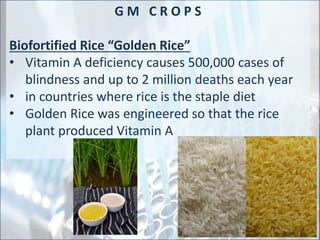
Biofortified Rice “Golden Rice”
• Vitamin A deficiency causes 500,000 cases of
blindness and up to 2 million deaths each year
• in countries where rice is the staple diet
• Golden Rice was engineered so that the rice
plant produced Vitamin A
38
Scientists engineered a tomato that won’t
freeze by placing “anti-freeze” gene from a
fish into tomato genome
39
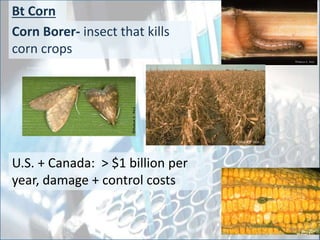
European Corn Borer
Corn Borer- insect that kills
corn crops
U.S. + Canada: > $1 billion per
year, damage + control costs
Bt Corn
40
Bt – Bacillus thuringiensis – common soilborne
bacterium- produces crystals that kill insects when
eaten.
• Scientists insert Bt
genes into corn
genome
• Corn plant produces
Bt in every cell
KnockOut (Novartis)
YieldGard (Monsanto)
BT-Xtra (DeKalb)
StarLink (Aventis) 41
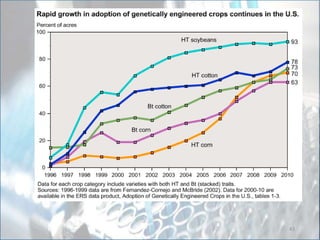
U.S. – Leading the
Way in GM Crops
VIDEO: How are GMO’s created?
(5:30) 42
43
What’s the Debate?
VIDEO: “What’s the Deal with Genetically Modified Food? (3min)
AgBioTech
Aventis (Hoechst + Rhone Poulenc)
Monsanto (Monsanto + Pharmacia+ Upjohn)
Dupont (Dupont + Pioneer Hybrid)
Syngenta (Novartis + AstraZeneca)
Dow Chemical (Dow + Elanco)
5 Firms – each Multinational:
68% of agrochemical market
worldwide
20% of commercial seed worldwide
44
ANSWERS: The
scientists supplying
the safety data are
hired by these
companies.
The data is NOT
transparent to the
public.
TRUTH:
GM Pesticide resistant crops:
genetically alter plant to contain a pesticide toxin that will
prevent pests
(+) More crops & less
damage
(+) More money for NC
business & economy
(+) No current health
concern (passed by the
FDA)
(+) No current
environmental concern
(passed by the EPA)
(-) possible creation of
pesticide resistant insects &
pathogens
(-) uncertain long-term effects
of natural ecosystems
(-) uncertain long-term effects
on human body
(-) kills other beneficial insects
including Monarch butterfly
(-) labelling?
(-) who’s doing the research?
VIDEO: GM Food- The Truth: GMO myths & Truths
(5:45)
VIDEO: What is a Genetically Mod Food?
(3:15)
45
GM Crops- Other Issues
• Threat to small farmers
• Some say that GM technology benefits big
business not the poor
• Cross-pollination of GM crops with organic
farms
• Patenting life forms
• Bio-piracy
• Terminator technology
• Politics: Frankenfoods
http://web.bio.utk.edu/schilling/EEB304/EEB304
_LECT25_transgenics_spring11.ppt. 46
A N I M A L S :
Scientists engineer
featherless chicken by
removing feather gene
Scientists engineer
‘glowing’ mice from
bioluminescent gene in
a jellyfish
47
Cloning: produces an organism that is an exact
genetic copy of another
EXAMPLE: Dolly the sheep July 1996
• Scientists took nucleus from adult sheep &
implanted that into sheep egg cell
• Then placed modified cell into female sheep
and when offspring was born, it had identical
DNA of adult sheep
48
Organ engineering
49
Stem Cells: cells that are part of the embryo
during early development- before they become
specific body cells
• These cells are useful in science because they
can be used to perform desired medical
functions- we can direct them
VIDEO: What are
stem cells? TED Ed
(4 min) 50
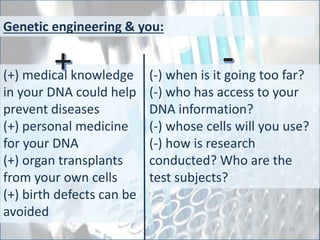
Genetic engineering & you:
(+) medical knowledge
in your DNA could help
prevent diseases
(+) personal medicine
for your DNA
(+) organ transplants
from your own cells
(+) birth defects can be
avoided
(-) when is it going too far?
(-) who has access to your
DNA information?
(-) whose cells will you use?
(-) how is research
conducted? Who are the
test subjects?
51
Genetic Engineering Other Issues
• What is going too far?
• STEM cells- when is a human ‘alive?’
• What if insurance companies could know
about your DNA?
• Should DNA information be kept in databases
or is it your personal information? Who will
regulate this?
http://web.bio.utk.edu/schilling/EEB304/EEB304
_LECT25_transgenics_spring11.ppt. 52
Before 1600-
• Animals are domesticated
• Crops are cultivated
• Yeast & bacteria used to ferment
cheese, wine, bread
1800-1850-
• Schleiden & Schawnn state the cell
theory, “All living things are made of
cells”
1850-1900-
• Pasteur creates pasteurization;
discovers Rabies vaccine
• Mendel studies genetics
• Darwin writes “Origin of Species”
1900-1950-
• First use of term ‘biotechnology’
• DNA is discovered to be hereditary
material
• Flemming Discovers penicillin
1950-1970-
• Watson & Crick describe DNA as double
helix
Biotechnology Timeline
1970-1980-
• Nanotechnology is coined (10 )
• Cohen & Boyer cut & splice DNA
• Restriction enzymes discovered
1980-1990-
• Diabetes is treated with genetically
engineered insulin
• First genetically modified vaccine:
Hepatitis B
1990-2000-
• Human Genome Project is funded by
Congress
• Flavr Savr tomato, resistant to rotting, is
approved by FDA
• Dolly the sheep is cloned
2000-present-
• CC (Carbon Copy) the cat is cloned
• Mapping of the Human Genome is
completed
• Vaccine to prevent Cervical Cancer
-9
53
54
R r
R
r
R
Y
r
y
Dominant Recessive
R = Round Y = Yellow r = wrinkled y = green
R R
R r
R r
R r
RESOURCES:
‘Biotechnology’ presentation by Christina M. Spears, Georgia Ag Education Curriculum Office 2003
Edward Schilling presentation:
http://web.bio.utk.edu/schilling/EEB304/EEB304_LECT25_transgenics_spring11.ppt.
LABS: Beyond Benign
http://www.beyondbenign.org/K12education/biotech_ms.html
55

Biotechnology

  • 1.
    GENETICS 2: BIOTECHNOLOGY ppt byRobin D. Seamon 1 HOOK VIDEO: BBC “Visions of the Future 2007”
  • 2.
  • 3.
    N U CL E I C A C I D S • Made of nucleotides • Make up macromolecules of DNA 1. DNA Replication (makes copies of itself) 2. Encodes information (for proteins to be made) 3. Controls & instructs cells 4. Mutations (molecule of heredity) 3
  • 4.
  • 5.
    Mutations: a changein the coding of a gene -can occur through: 1. Deletion: cell accidentally omits a piece of the DNA 2. Duplication: cell accidentally makes an extra copy of the DNA piece 3. Insertion: cell accidentally adds a piece of DNA 4. Translocation: cell accidentally puts a piece of genetic sequence in the wrong place. 5
  • 6.
    ACTIVITY • THE OLDRED DOG WAS TOO BIG FOR HIS BED • Deletion that would delete the D in OLD… • THE OLR EDD OGW AST OOB IGF ORH ISB ED • Inversion of the word DOG... • THE OLD RED GOD WAS TOO BIG FOR HIS BED 6
  • 7.
    • Every cellin a living organism’s body (except red blood cells) have a copy of their species genome written in the code. • Different genes (pieces of DNA) are turned on or off where they are needed • Therefore, evolutionary relatedness can be determined from genetics. 7
  • 8.
    • All livingthings use the same 4 nucleotide bases of DNA (A-T, C-G) & ribosomes • THEREFORE, DNA from different organisms can be joined or ‘spliced’ together… GENETIC ENGINEERING 8
  • 9.
    HUMANS • April 14,2003: Human Genome Project completed (USA) • Each human cell has 3 billion base pairs of A-T & C-G • There are 7 trillion cells in a body • Humans have about 30,000 genes encoded on the DNA VIDEO How to sequence the human genome (5min) 9
  • 10.
    Forensic science: Catching criminalsbased upon DNA left at the crime-scene Paternity testing: Determining the father of a child While every human shares the same code for the human genome, each person has slightly different marker alleles coded into their DNA- 10
  • 11.
    Gel electrophoresis usesan electric current to separate various fragments of DNA on the gel • DNA fragments are attracted to positive side of gel • Larger fragments migrate slower • DNA can be compared 11 CC VIDEO: #17: Evolution, Development Chicken Teeth
  • 12.
    Genomes can changeover time… HOW? Modifications in gene sequence can happen through… 1. Natural selection: nature ‘selects’ for the strongest to survive, passing on those genes EXAMPLE: antibiotic resistance 2. Cross-breeding: (selective breeding) humans choose specimens of a species, mating them in order to ‘pick’ the characteristics we want in the offspring EXAMPLE: dog breeding 3. Genetic modification: humans combine or alter pieces of DNA in order to produce offspring with a specific characteristics. 12
  • 13.
  • 14.
    What is biotechnology? Managementof biological systems for the benefit of humanity; all subjects of science EXAMPLES: Herbicides Increasing shelf life Waste cleanup Forensic investigations Cloning GMO Genetic engineering Genetics Gene splicing, replication, & transfer of genes GMO-genetically modified organism MORE SPECIFIC to GENES 14
  • 15.
    BIOTECHNOLOGY- ECONOMICS & HUMANBENEFIT Increase in production: • Develop new forms of plants & animals • Modify plants & animals to improve their life processes • Improve quality of food • Longer shelf life for perishables 15
  • 16.
    • food cheese,yogurt, buttermilk, sour cream: • Breaks down milk sugar (lactose) into lactic acid- preserves & flavors • Decomposers: recyclers BACTERIA & ITS ROLES FOR US 16
  • 17.
    • Nitrogen fixation:take N from air & turn it into a form plants can use; animals get N from plants- farmers can purchase plants whose roots have been dipped into extra bacteria 17
  • 18.
    • Bioremediation: fightpollution using microorganisms to change harmful chemicals into harmless ones • Clean up hazardous waste, industries, farms, cities 18
  • 19.
  • 20.
  • 21.
    PLANTS Polyploidy- doubling agenome- gives rise to organisms with multiple sets of chromosomes -common in nature, creating new variations or even speciation (30-80% angiosperms) -scientists can also induce 21
  • 22.
    -Crops: used to overcomesterility in hybrid cross-breeding EXAMPLE: Triticale is the hybrid offspring of wheat & rye. This hybrid is sterile so scientists chemically treat it to become polyploid, making the hybrid fertile! wheat rye triticale 22
  • 23.
    For some crops,polyploidy crops are preferred & are propagated using asexual grafting EXAMPLES: apples, bananas, citrus, watermelon, oat, wheat, strawberry, sugarcane 23
  • 24.
    ANIMALS Epistasis- having oneor more genes that mask the effect of the dominant gene Labrador Retrievers: BB/Bb = black fur bb = brown fur EE/Ee = normal fur ee = yellow fur Breeders selectively breed for desired fur color (we don’t mess with the genes physically) 24
  • 25.
    Selective breeding: mate/crossorganisms with desirable traits to produce offspring that have traits from both parents Large green tomato Small red tomato BIG RED TOMATO + = VIDEO: How Mendel’s pea plants helped us understand genetics (3 min) 25
  • 26.
    Brahman cattle: good heat resistance, poor beef English shorthorn: goodbeef, poor heat resistance Santa Gertrudis cattle good beef, heat resistant + = 26
  • 27.
    Selective Breeding: (+)might getimproved organisms (+) don’t need special tools or lab (+) can be performed easily by farmers & breeders (-) undesirable traits from both parents may appear in offspring (-) disease can accumulate in the population (deaf dalmations, boxers with heart disease, labs with hip problems) 27
  • 28.
  • 29.
    G E NE T I C E N G I N E E R I N G • Recombinant DNA technology • Gene manipulation 1. genes are engineered by scientists into organisms such as microbes or bacteria, for mass-production 2. insertion of select genes into organisms to improve their genotype 29
  • 30.
    HOW? 1. Isolate thegenes 2. Recombination 3. Transformation 4. Screening 5. induction 30
  • 31.
    MEDICINE: 1970’s welearned to put genes into bacteria that would make human insulin; Insulin separated from bacteria & given to diabetics Desired human gene (like insulin production) 31
  • 32.
  • 33.
    Gene Gun Alternative Methodof Gene Insertion – Gene Gun 33
  • 34.
    Glowing plants VIDEO: Kickstarter Replaceslights with Growing plants! (5:50) 34
  • 35.
    How are GMO’stested & approved? EPA- (Environmental Protection Agency) evaluates environmental safety USDA- (US Department of Agriculture) evaluates whether plant is safe to grow FDA- (Food & Drug Administration) evaluates whether the plant is safe to eat 35
  • 36.
    How are GMO’stested & approved? 1. Scientists have to perform studies on the new product & determine it safe 2. Scientists present the data to the EPA, USDA, FDA 3. EPA, USDA, FDA approves product VIDEO: Eyes of Nye GM foods (8 min) 36 QUESTIONS: Who are the scientists? Is their data transparent to the public? TRUTH:
  • 37.
    37 GMO’s & FOOD Twomajor categories of GMO crops: 1. Crops to resist pests= turning plant into its own pesticide 2. Crops resistant to herbicide, Roundup= farmers spray crops with Roundup & all plants/weeds are killed except the crop
  • 38.
    G M CR O P S Biofortified Rice “Golden Rice” • Vitamin A deficiency causes 500,000 cases of blindness and up to 2 million deaths each year • in countries where rice is the staple diet • Golden Rice was engineered so that the rice plant produced Vitamin A 38
  • 39.
    Scientists engineered atomato that won’t freeze by placing “anti-freeze” gene from a fish into tomato genome 39
  • 40.
    European Corn Borer CornBorer- insect that kills corn crops U.S. + Canada: > $1 billion per year, damage + control costs Bt Corn 40
  • 41.
    Bt – Bacillusthuringiensis – common soilborne bacterium- produces crystals that kill insects when eaten. • Scientists insert Bt genes into corn genome • Corn plant produces Bt in every cell KnockOut (Novartis) YieldGard (Monsanto) BT-Xtra (DeKalb) StarLink (Aventis) 41
  • 42.
    U.S. – Leadingthe Way in GM Crops VIDEO: How are GMO’s created? (5:30) 42
  • 43.
  • 44.
    What’s the Debate? VIDEO:“What’s the Deal with Genetically Modified Food? (3min) AgBioTech Aventis (Hoechst + Rhone Poulenc) Monsanto (Monsanto + Pharmacia+ Upjohn) Dupont (Dupont + Pioneer Hybrid) Syngenta (Novartis + AstraZeneca) Dow Chemical (Dow + Elanco) 5 Firms – each Multinational: 68% of agrochemical market worldwide 20% of commercial seed worldwide 44 ANSWERS: The scientists supplying the safety data are hired by these companies. The data is NOT transparent to the public. TRUTH:
  • 45.
    GM Pesticide resistantcrops: genetically alter plant to contain a pesticide toxin that will prevent pests (+) More crops & less damage (+) More money for NC business & economy (+) No current health concern (passed by the FDA) (+) No current environmental concern (passed by the EPA) (-) possible creation of pesticide resistant insects & pathogens (-) uncertain long-term effects of natural ecosystems (-) uncertain long-term effects on human body (-) kills other beneficial insects including Monarch butterfly (-) labelling? (-) who’s doing the research? VIDEO: GM Food- The Truth: GMO myths & Truths (5:45) VIDEO: What is a Genetically Mod Food? (3:15) 45
  • 46.
    GM Crops- OtherIssues • Threat to small farmers • Some say that GM technology benefits big business not the poor • Cross-pollination of GM crops with organic farms • Patenting life forms • Bio-piracy • Terminator technology • Politics: Frankenfoods http://web.bio.utk.edu/schilling/EEB304/EEB304 _LECT25_transgenics_spring11.ppt. 46
  • 47.
    A N IM A L S : Scientists engineer featherless chicken by removing feather gene Scientists engineer ‘glowing’ mice from bioluminescent gene in a jellyfish 47
  • 48.
    Cloning: produces anorganism that is an exact genetic copy of another EXAMPLE: Dolly the sheep July 1996 • Scientists took nucleus from adult sheep & implanted that into sheep egg cell • Then placed modified cell into female sheep and when offspring was born, it had identical DNA of adult sheep 48
  • 49.
  • 50.
    Stem Cells: cellsthat are part of the embryo during early development- before they become specific body cells • These cells are useful in science because they can be used to perform desired medical functions- we can direct them VIDEO: What are stem cells? TED Ed (4 min) 50
  • 51.
    Genetic engineering &you: (+) medical knowledge in your DNA could help prevent diseases (+) personal medicine for your DNA (+) organ transplants from your own cells (+) birth defects can be avoided (-) when is it going too far? (-) who has access to your DNA information? (-) whose cells will you use? (-) how is research conducted? Who are the test subjects? 51
  • 52.
    Genetic Engineering OtherIssues • What is going too far? • STEM cells- when is a human ‘alive?’ • What if insurance companies could know about your DNA? • Should DNA information be kept in databases or is it your personal information? Who will regulate this? http://web.bio.utk.edu/schilling/EEB304/EEB304 _LECT25_transgenics_spring11.ppt. 52
  • 53.
    Before 1600- • Animalsare domesticated • Crops are cultivated • Yeast & bacteria used to ferment cheese, wine, bread 1800-1850- • Schleiden & Schawnn state the cell theory, “All living things are made of cells” 1850-1900- • Pasteur creates pasteurization; discovers Rabies vaccine • Mendel studies genetics • Darwin writes “Origin of Species” 1900-1950- • First use of term ‘biotechnology’ • DNA is discovered to be hereditary material • Flemming Discovers penicillin 1950-1970- • Watson & Crick describe DNA as double helix Biotechnology Timeline 1970-1980- • Nanotechnology is coined (10 ) • Cohen & Boyer cut & splice DNA • Restriction enzymes discovered 1980-1990- • Diabetes is treated with genetically engineered insulin • First genetically modified vaccine: Hepatitis B 1990-2000- • Human Genome Project is funded by Congress • Flavr Savr tomato, resistant to rotting, is approved by FDA • Dolly the sheep is cloned 2000-present- • CC (Carbon Copy) the cat is cloned • Mapping of the Human Genome is completed • Vaccine to prevent Cervical Cancer -9 53
  • 54.
    54 R r R r R Y r y Dominant Recessive R= Round Y = Yellow r = wrinkled y = green R R R r R r R r
  • 55.
    RESOURCES: ‘Biotechnology’ presentation byChristina M. Spears, Georgia Ag Education Curriculum Office 2003 Edward Schilling presentation: http://web.bio.utk.edu/schilling/EEB304/EEB304_LECT25_transgenics_spring11.ppt. LABS: Beyond Benign http://www.beyondbenign.org/K12education/biotech_ms.html 55