Genetics 1:
Classification of
Life
ppt. by Robin D. Seamon
1
HOOK VIDEO: COSMOS-
“Some Things Molecules do”
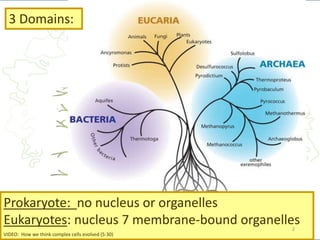
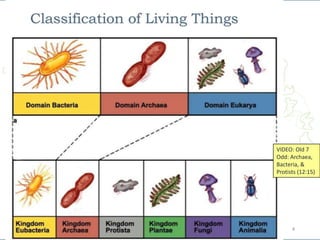
3 Domains:
Prokaryote: no nucleus or organelles
Eukaryotes: nucleus 7 membrane-bound organelles
VIDEO: How we think complex cells evolved (5:30)
2
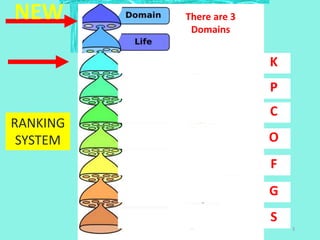
NEW There are 3
Domains
K
C
O
F
S
G
P
RANKING
SYSTEM
3
4
CC video: comparative
anatomy (10 min)
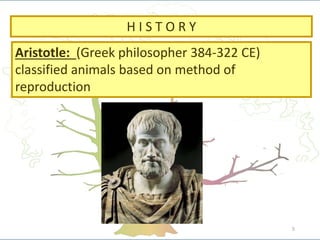
H I S T O R Y
Aristotle: (Greek philosopher 384-322 CE)
classified animals based on method of
reproduction
5
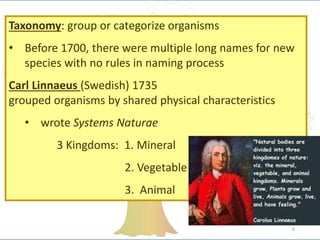
Taxonomy: group or categorize organisms
• Before 1700, there were multiple long names for new
species with no rules in naming process
Carl Linnaeus (Swedish) 1735
grouped organisms by shared physical characteristics
• wrote Systems Naturae
3 Kingdoms: 1. Mineral
2. Vegetable
3. Animal
6
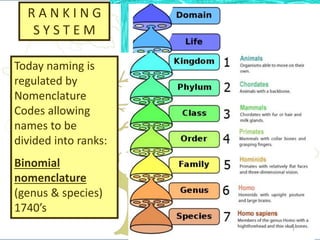
Today naming is
regulated by
Nomenclature
Codes allowing
names to be
divided into ranks:
Binomial
nomenclature
(genus & species)
1740’s
R A N K I N G
S Y S T E M
7CC Video: #19 Taxonomy(12 min)
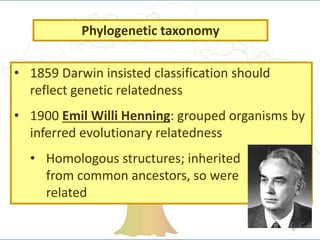
• 1859 Darwin insisted classification should
reflect genetic relatedness
• 1900 Emil Willi Henning: grouped organisms by
inferred evolutionary relatedness
• Homologous structures; inherited
from common ancestors, so were
related
Phylogenetic taxonomy
8
• Cladistic system: 1960’s scientists started using
DNA sequences to determine common ancestry
IGNORING RANKS
• This new field is making changes & revisions in
classification everyday.
• International Code of Phylogenetic
Nomenclature (PhyloCode) is currently under
development
Molecular Phylogenetics
C L A D E S Y S T E M
9
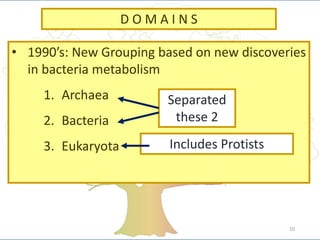
• 1990’s: New Grouping based on new discoveries
in bacteria metabolism
1. Archaea
2. Bacteria
3. Eukaryota
D O M A I N S
Separated
these 2
Includes Protists
10
CC Video: #35 Archaea, Bacteria, Protists (12 min)
11
Archaea- ancient group of prokaryotic
organisms that are still present today --
Extremphiles- types of archaea that live in very
extreme places
Some examples:
• Halophile: live in extreme salty
conditions
• Thermophile: live in extremely hot
conditions
• Methanogen: metabolize such that they
use acidic conditions (sulfur) and
release methane
12
Hiller Lake, Australia
Halophilic archaea & bacteria live in this salty
lake BACK
Under-ocean
hot vent
13
Yellowstone hot vent, Wyoming
thermophilic archaea & bacteria live in this
hot vent BACK
14
Methanogenic archaea
BACK
15
Bacteria- ancient group of prokaryotic
organisms that are still present today
16
Eukaryota- group of organisms whose cells
contain a nucleus and membrane-bound
organelles
ALL THE REST
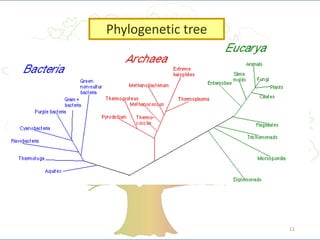
Phylogenetic tree
17
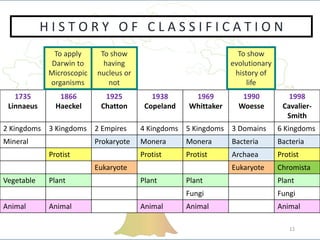
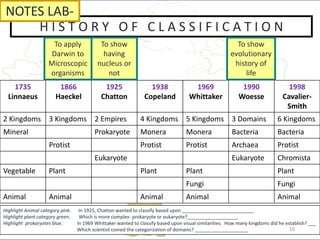
H I S T O R Y O F C L A S S I F I C A T I O N
1735
Linnaeus
1866
Haeckel
1925
Chatton
1938
Copeland
1969
Whittaker
1990
Woesse
1998
Cavalier-
Smith
2 Kingdoms 3 Kingdoms 2 Empires 4 Kingdoms 5 Kingdoms 3 Domains 6 Kingdoms
Mineral Prokaryote Monera Monera Bacteria Bacteria
Protist Protist Protist Archaea Protist
Eukaryote Eukaryote Chromista
Vegetable Plant Plant Plant Plant
Fungi Fungi
Animal Animal Animal Animal Animal
To apply
Darwin to
Microscopic
organisms
To show
having
nucleus or
not
To show
evolutionary
history of
life
18
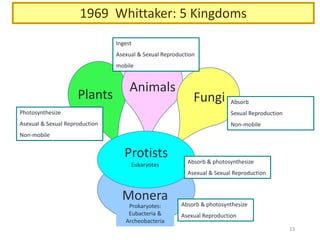
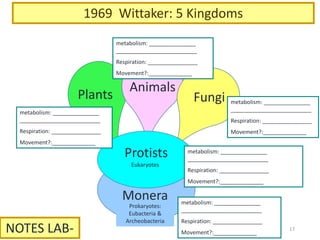
1969 Whittaker: 5 Kingdoms
Protists
Monera
Plants
Animals
Fungi
Prokaryotes:
Eubacteria &
Archeobacteria
Eukaryotes
Absorb & photosynthesize
Asexual Reproduction
Absorb & photosynthesize
Asexual & Sexual Reproduction
Photosynthesize
Asexual & Sexual Reproduction
Non-mobile
Ingest
Asexual & Sexual Reproduction
mobile
Absorb
Sexual Reproduction
Non-mobile
19
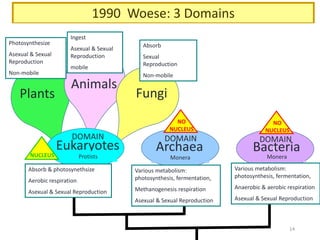
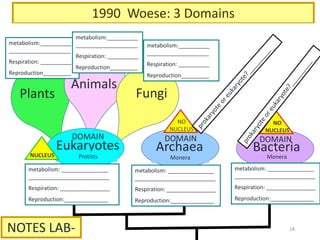
1990 Woese: 3 Domains
Eukaryotes
Plants
Animals
Fungi
Protists
Photosynthesize
Asexual & Sexual
Reproduction
Non-mobile
Absorb
Sexual
Reproduction
Non-mobile
Archaea CBacteria
Monera Monera
Absorb & photosynethsize
Aerobic respiration
Asexual & Sexual Reproduction
Various metabolism:
photosynthesis, fermentation,
Methanogenesis respiration
Asexual & Sexual Reproduction
Various metabolism:
photosynthesis, fermentation,
Anaerobic & aerobic respiration
Asexual & Sexual Reproduction
Ingest
Asexual & Sexual
Reproduction
mobile
NO
NUCLEUS
NO
NUCLEUS
NUCLEUS
DOMAIN DOMAIN DOMAIN
20
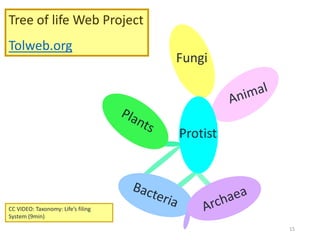
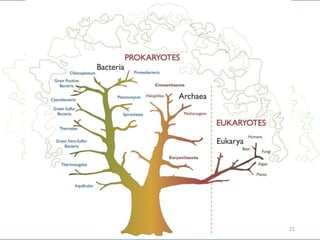
Protist
Fungi
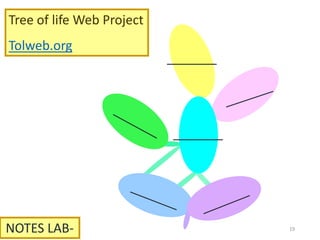
Tree of life Web Project
Tolweb.org
21
22

Genetics 1: Classification- Kingdoms & Cladograms

  • 1.
    Genetics 1: Classification of Life ppt.by Robin D. Seamon 1 HOOK VIDEO: COSMOS- “Some Things Molecules do”
  • 2.
    3 Domains: Prokaryote: nonucleus or organelles Eukaryotes: nucleus 7 membrane-bound organelles VIDEO: How we think complex cells evolved (5:30) 2
  • 3.
    NEW There are3 Domains K C O F S G P RANKING SYSTEM 3
  • 4.
  • 5.
    H I ST O R Y Aristotle: (Greek philosopher 384-322 CE) classified animals based on method of reproduction 5
  • 6.
    Taxonomy: group orcategorize organisms • Before 1700, there were multiple long names for new species with no rules in naming process Carl Linnaeus (Swedish) 1735 grouped organisms by shared physical characteristics • wrote Systems Naturae 3 Kingdoms: 1. Mineral 2. Vegetable 3. Animal 6
  • 7.
    Today naming is regulatedby Nomenclature Codes allowing names to be divided into ranks: Binomial nomenclature (genus & species) 1740’s R A N K I N G S Y S T E M 7CC Video: #19 Taxonomy(12 min)
  • 8.
    • 1859 Darwininsisted classification should reflect genetic relatedness • 1900 Emil Willi Henning: grouped organisms by inferred evolutionary relatedness • Homologous structures; inherited from common ancestors, so were related Phylogenetic taxonomy 8
  • 9.
    • Cladistic system:1960’s scientists started using DNA sequences to determine common ancestry IGNORING RANKS • This new field is making changes & revisions in classification everyday. • International Code of Phylogenetic Nomenclature (PhyloCode) is currently under development Molecular Phylogenetics C L A D E S Y S T E M 9
  • 10.
    • 1990’s: NewGrouping based on new discoveries in bacteria metabolism 1. Archaea 2. Bacteria 3. Eukaryota D O M A I N S Separated these 2 Includes Protists 10 CC Video: #35 Archaea, Bacteria, Protists (12 min)
  • 11.
    11 Archaea- ancient groupof prokaryotic organisms that are still present today -- Extremphiles- types of archaea that live in very extreme places Some examples: • Halophile: live in extreme salty conditions • Thermophile: live in extremely hot conditions • Methanogen: metabolize such that they use acidic conditions (sulfur) and release methane
  • 12.
    12 Hiller Lake, Australia Halophilicarchaea & bacteria live in this salty lake BACK
  • 13.
    Under-ocean hot vent 13 Yellowstone hotvent, Wyoming thermophilic archaea & bacteria live in this hot vent BACK
  • 14.
  • 15.
    15 Bacteria- ancient groupof prokaryotic organisms that are still present today
  • 16.
    16 Eukaryota- group oforganisms whose cells contain a nucleus and membrane-bound organelles ALL THE REST
  • 17.
  • 18.
    H I ST O R Y O F C L A S S I F I C A T I O N 1735 Linnaeus 1866 Haeckel 1925 Chatton 1938 Copeland 1969 Whittaker 1990 Woesse 1998 Cavalier- Smith 2 Kingdoms 3 Kingdoms 2 Empires 4 Kingdoms 5 Kingdoms 3 Domains 6 Kingdoms Mineral Prokaryote Monera Monera Bacteria Bacteria Protist Protist Protist Archaea Protist Eukaryote Eukaryote Chromista Vegetable Plant Plant Plant Plant Fungi Fungi Animal Animal Animal Animal Animal To apply Darwin to Microscopic organisms To show having nucleus or not To show evolutionary history of life 18
  • 19.
    1969 Whittaker: 5Kingdoms Protists Monera Plants Animals Fungi Prokaryotes: Eubacteria & Archeobacteria Eukaryotes Absorb & photosynthesize Asexual Reproduction Absorb & photosynthesize Asexual & Sexual Reproduction Photosynthesize Asexual & Sexual Reproduction Non-mobile Ingest Asexual & Sexual Reproduction mobile Absorb Sexual Reproduction Non-mobile 19
  • 20.
    1990 Woese: 3Domains Eukaryotes Plants Animals Fungi Protists Photosynthesize Asexual & Sexual Reproduction Non-mobile Absorb Sexual Reproduction Non-mobile Archaea CBacteria Monera Monera Absorb & photosynethsize Aerobic respiration Asexual & Sexual Reproduction Various metabolism: photosynthesis, fermentation, Methanogenesis respiration Asexual & Sexual Reproduction Various metabolism: photosynthesis, fermentation, Anaerobic & aerobic respiration Asexual & Sexual Reproduction Ingest Asexual & Sexual Reproduction mobile NO NUCLEUS NO NUCLEUS NUCLEUS DOMAIN DOMAIN DOMAIN 20
  • 21.
    Protist Fungi Tree of lifeWeb Project Tolweb.org 21
  • 22.