Scientific Notation
Scientific Notation A number written as a product of two numbers: a coefficient and a power of 10  Designed for the expression of very big and very small numbers 3.6 x 10 4 1 gram of hydrogen contains 301,000,000,000,000,000,000,000 molecules 3.01 x 10 23  molecules 0.00081 = 8.1 x 10 -4 Decimal moves 4 place to the right 34,000 = 3.4 x 10 4 Decimal move 4 places to the left
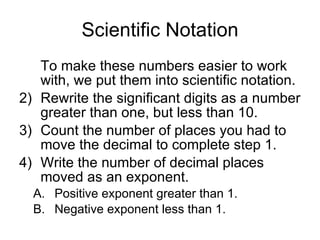
Scientific Notation To make these numbers easier to work with, we put them into scientific notation. Rewrite the significant digits as a number greater than one, but less than 10. Count the number of places you had to move the decimal to complete step 1. Write the number of decimal places moved as an exponent. Positive exponent greater than 1. Negative exponent less than 1.
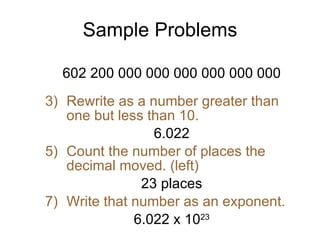
Sample Problems 602 200 000 000 000 000 000 000 Rewrite as a number greater than one but less than 10. 6.022 Count the number of places the decimal moved. (left) 23 places Write that number as an exponent. 6.022 x 10 23
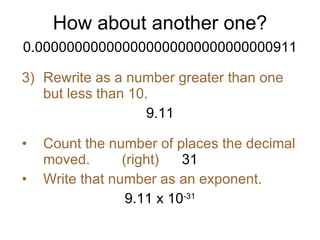
How about another one? 0.000000000000000000000000000000911 Rewrite as a number greater than one but less than 10. 9.11 Count the number of places the decimal moved.  (right) 31 Write that number as an exponent. 9.11 x 10 -31
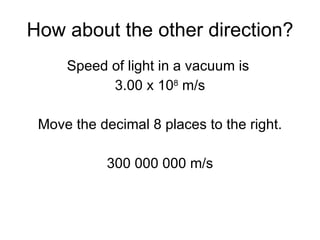
How about the other direction? Speed of light in a vacuum is  3.00 x 10 8  m/s Move the decimal 8 places to the right. 300 000 000 m/s
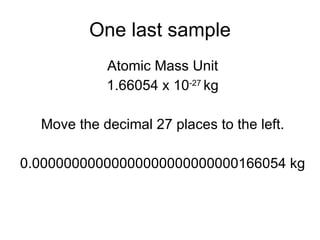
One last sample Atomic Mass Unit 1.66054 x 10 -27  kg Move the decimal 27 places to the left. 0.00000000000000000000000000166054 kg
Significant Figures a.k.a.- sig figs
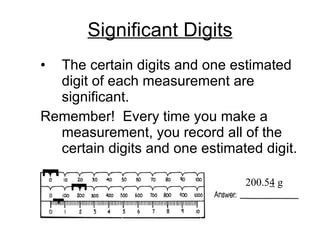
Significant Digits The certain digits and one estimated digit of each measurement are significant. Remember!  Every time you make a measurement, you record all of the certain digits and one estimated digit. 200.5 4  g
Rules for Sig Figs Non zeros are always significant. Zeros between non zeros are significant. Zeros at the end of significant digits following a decimal point are significant. *They show precision in measurement. 4) Place keeper zeros are NOT significant. Zeros preceding significant digits. Zeros following significant digits without a decimal point.
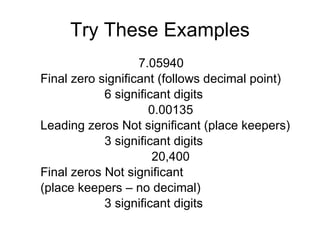
Try These Examples 7.05940 Final zero significant (follows decimal point) 6 significant digits 0.00135 Leading zeros Not significant (place keepers) 3 significant digits 20,400 Final zeros Not significant  (place keepers – no decimal) 3 significant digits
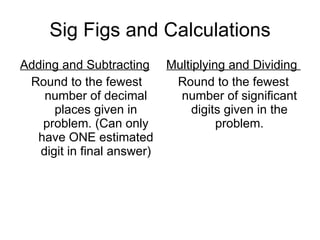
Sig Figs and Calculations Adding and Subtracting   Round to the fewest number of decimal places given in problem. (Can only have ONE estimated digit in final answer) Multiplying and Dividing  Round to the fewest number of significant digits given in the problem.
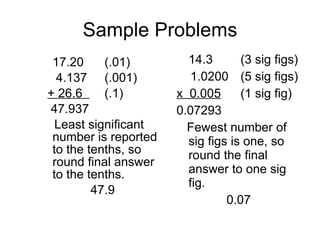
Sample Problems 17.20 (.01)   4.137 (.001) + 26.6  (.1) 47.937 Least significant number is reported to the tenths, so round final answer to the tenths. 47.9 14.3 (3 sig figs) 1.0200 (5 sig figs) x  0.005 (1 sig fig) 0.07293 Fewest number of sig figs is one, so round the final answer to one sig fig. 0.07
Methylene Blue

Sig fig and sci note

  • 1.
  • 2.
    Scientific Notation Anumber written as a product of two numbers: a coefficient and a power of 10 Designed for the expression of very big and very small numbers 3.6 x 10 4 1 gram of hydrogen contains 301,000,000,000,000,000,000,000 molecules 3.01 x 10 23 molecules 0.00081 = 8.1 x 10 -4 Decimal moves 4 place to the right 34,000 = 3.4 x 10 4 Decimal move 4 places to the left
  • 3.
    Scientific Notation Tomake these numbers easier to work with, we put them into scientific notation. Rewrite the significant digits as a number greater than one, but less than 10. Count the number of places you had to move the decimal to complete step 1. Write the number of decimal places moved as an exponent. Positive exponent greater than 1. Negative exponent less than 1.
  • 4.
    Sample Problems 602200 000 000 000 000 000 000 Rewrite as a number greater than one but less than 10. 6.022 Count the number of places the decimal moved. (left) 23 places Write that number as an exponent. 6.022 x 10 23
  • 5.
    How about anotherone? 0.000000000000000000000000000000911 Rewrite as a number greater than one but less than 10. 9.11 Count the number of places the decimal moved. (right) 31 Write that number as an exponent. 9.11 x 10 -31
  • 6.
    How about theother direction? Speed of light in a vacuum is 3.00 x 10 8 m/s Move the decimal 8 places to the right. 300 000 000 m/s
  • 7.
    One last sampleAtomic Mass Unit 1.66054 x 10 -27 kg Move the decimal 27 places to the left. 0.00000000000000000000000000166054 kg
  • 8.
  • 9.
    Significant Digits Thecertain digits and one estimated digit of each measurement are significant. Remember! Every time you make a measurement, you record all of the certain digits and one estimated digit. 200.5 4 g
  • 10.
    Rules for SigFigs Non zeros are always significant. Zeros between non zeros are significant. Zeros at the end of significant digits following a decimal point are significant. *They show precision in measurement. 4) Place keeper zeros are NOT significant. Zeros preceding significant digits. Zeros following significant digits without a decimal point.
  • 11.
    Try These Examples7.05940 Final zero significant (follows decimal point) 6 significant digits 0.00135 Leading zeros Not significant (place keepers) 3 significant digits 20,400 Final zeros Not significant (place keepers – no decimal) 3 significant digits
  • 12.
    Sig Figs andCalculations Adding and Subtracting Round to the fewest number of decimal places given in problem. (Can only have ONE estimated digit in final answer) Multiplying and Dividing Round to the fewest number of significant digits given in the problem.
  • 13.
    Sample Problems 17.20(.01) 4.137 (.001) + 26.6 (.1) 47.937 Least significant number is reported to the tenths, so round final answer to the tenths. 47.9 14.3 (3 sig figs) 1.0200 (5 sig figs) x 0.005 (1 sig fig) 0.07293 Fewest number of sig figs is one, so round the final answer to one sig fig. 0.07
  • 14.