1D Motion Review
Motion Graphs
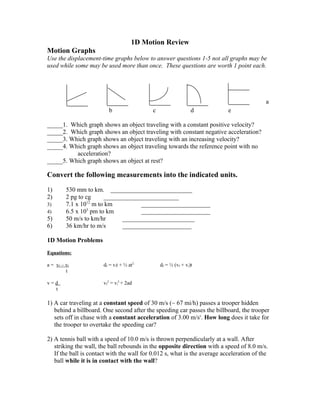
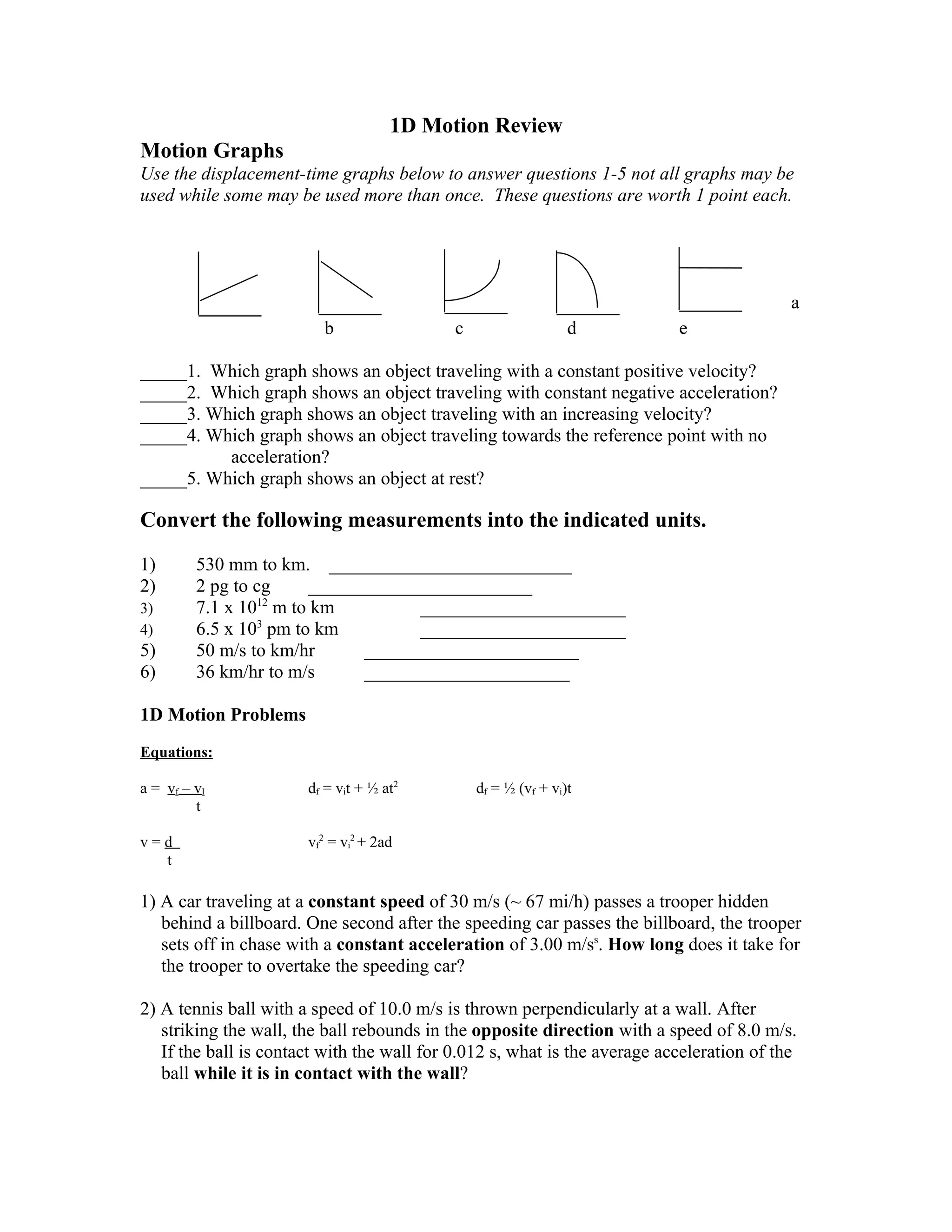
Use the displacement-time graphs below to answer questions 1-5 not all graphs may be
used while some may be used more than once. These questions are worth 1 point each.


                                                                                           a
                         b                  c                   d          e

_____1. Which graph shows an object traveling with a constant positive velocity?
_____2. Which graph shows an object traveling with constant negative acceleration?
_____3. Which graph shows an object traveling with an increasing velocity?
_____4. Which graph shows an object traveling towards the reference point with no
          acceleration?
_____5. Which graph shows an object at rest?

Convert the following measurements into the indicated units.

1)       530 mm to km. __________________________
2)       2 pg to cg     ________________________
3)       7.1 x 10¹² m to km         ______________________
                 3
4)       6.5 x 10 pm to km          ______________________
5)       50 m/s to km/hr      _______________________
6)       36 km/hr to m/s      ______________________

1D Motion Problems
Equations:

a = vf – vI            df = vit + ½ at2         df = ½ (vf + vi)t
         t

v=d                    vf2 = vi2 + 2ad
  t

1) A car traveling at a constant speed of 30 m/s (~ 67 mi/h) passes a trooper hidden
   behind a billboard. One second after the speeding car passes the billboard, the trooper
   sets off in chase with a constant acceleration of 3.00 m/ss. How long does it take for
   the trooper to overtake the speeding car?

2) A tennis ball with a speed of 10.0 m/s is thrown perpendicularly at a wall. After
   striking the wall, the ball rebounds in the opposite direction with a speed of 8.0 m/s.
   If the ball is contact with the wall for 0.012 s, what is the average acceleration of the
   ball while it is in contact with the wall?
3) A racing car reaches a speed of 40 m/s. At this instant it begins a uniform negative
   acceleration, using a parachute and a braking system, and comes to rest 5.0 s later. a)
   Determine the acceleration of the car. b) How far does the car travel after the
   acceleration starts?

4) A jet airplane lands with a velocity of +100 m/s and can accelerate with a maximum
   rate of –5.0m/s2 as it comes to rest. a) From the instant it touches the runway, what
   is the minimum time needed before it can come to rest? b) Can this plane land on a
   small island airport where the runway is 0.80 km long?

5) A truck on a straight road starts from rest accelerating at 2.0 m/s2 until it reaches a
   speed of 20 m/s. Then the truck travels for 20 s at constant speed until the brakes are
   applied, stopping the truck in a uniform manner in an additional 5.0 s. a) How long is
   the truck in motion? b) What is the average velocity of the truck for the motion
   described?

6) A small mailbag is released from a helicopter that is descending steadily at 1.50 m/s.
   After 2.00 seconds a) what is the velocity of the mailbag, and b) how far is it below
   the helicopter? c) What are your answers to part a & b if the helicopter is rising
   steadily at 1.50 m/s?

7) A car starts from rest and travels for 5.0 s with uniform acceleration of +1.5 m/s2. The
   driver then applies the brakes causing a uniform acceleration of –2.0 m/s2. If the
   brakes are applied for 3.0 s, how fast is the car going at the end of the braking period,
   and how far has it gone?

1 d motion review 2011

  • 1.
    1D Motion Review MotionGraphs Use the displacement-time graphs below to answer questions 1-5 not all graphs may be used while some may be used more than once. These questions are worth 1 point each. a b c d e _____1. Which graph shows an object traveling with a constant positive velocity? _____2. Which graph shows an object traveling with constant negative acceleration? _____3. Which graph shows an object traveling with an increasing velocity? _____4. Which graph shows an object traveling towards the reference point with no acceleration? _____5. Which graph shows an object at rest? Convert the following measurements into the indicated units. 1) 530 mm to km. __________________________ 2) 2 pg to cg ________________________ 3) 7.1 x 10¹² m to km ______________________ 3 4) 6.5 x 10 pm to km ______________________ 5) 50 m/s to km/hr _______________________ 6) 36 km/hr to m/s ______________________ 1D Motion Problems Equations: a = vf – vI df = vit + ½ at2 df = ½ (vf + vi)t t v=d vf2 = vi2 + 2ad t 1) A car traveling at a constant speed of 30 m/s (~ 67 mi/h) passes a trooper hidden behind a billboard. One second after the speeding car passes the billboard, the trooper sets off in chase with a constant acceleration of 3.00 m/ss. How long does it take for the trooper to overtake the speeding car? 2) A tennis ball with a speed of 10.0 m/s is thrown perpendicularly at a wall. After striking the wall, the ball rebounds in the opposite direction with a speed of 8.0 m/s. If the ball is contact with the wall for 0.012 s, what is the average acceleration of the ball while it is in contact with the wall?
  • 2.
    3) A racingcar reaches a speed of 40 m/s. At this instant it begins a uniform negative acceleration, using a parachute and a braking system, and comes to rest 5.0 s later. a) Determine the acceleration of the car. b) How far does the car travel after the acceleration starts? 4) A jet airplane lands with a velocity of +100 m/s and can accelerate with a maximum rate of –5.0m/s2 as it comes to rest. a) From the instant it touches the runway, what is the minimum time needed before it can come to rest? b) Can this plane land on a small island airport where the runway is 0.80 km long? 5) A truck on a straight road starts from rest accelerating at 2.0 m/s2 until it reaches a speed of 20 m/s. Then the truck travels for 20 s at constant speed until the brakes are applied, stopping the truck in a uniform manner in an additional 5.0 s. a) How long is the truck in motion? b) What is the average velocity of the truck for the motion described? 6) A small mailbag is released from a helicopter that is descending steadily at 1.50 m/s. After 2.00 seconds a) what is the velocity of the mailbag, and b) how far is it below the helicopter? c) What are your answers to part a & b if the helicopter is rising steadily at 1.50 m/s? 7) A car starts from rest and travels for 5.0 s with uniform acceleration of +1.5 m/s2. The driver then applies the brakes causing a uniform acceleration of –2.0 m/s2. If the brakes are applied for 3.0 s, how fast is the car going at the end of the braking period, and how far has it gone?