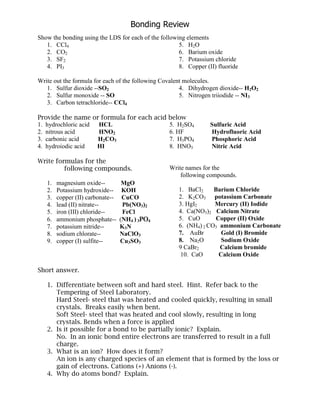
Show the bonding using the LDS for each of the following elements<br />CCl4<br />CO2<br />SF2<br />PI3<br />H2O<br />Barium oxide<br />Potassium chloride<br />Copper (II) fluoride<br />Write out the formula for each of the following Covalent molecules.<br />Sulfur dioxide --SO2<br />Sulfur monoxide -- SO<br />Carbon tetrachloride-- CCl4<br />Dihydrogen dioxide-- H2O2<br />Nitrogen triiodide -- NI3<br />Provide the name or formula for each acid below<br />1.  hydrochloric acid   HCL                          5.  H2SO4  Sulfuric Acid              <br />2.  nitrous acid   HNO26. HF   Hydrofluoric Acid<br />3.  carbonic acid            H2CO37.  H3PO4   Phosphoric Acid<br />4.  hydroiodic acid  HI8.  HNO3   Nitric Acid  <br />Write formulas for the     <br />         following compounds.<br />magnesium oxide--          MgO<br />Potassium hydroxide--     KOH<br />copper (II) carbonate--     CuCO<br />lead (II) nitrate--               Pb(NO3)2<br />iron (III) chloride--           FeCl<br />ammonium phosphate--  (NH4 ) 3PO4 <br />potassium nitride--          K3N<br />sodium chlorate--            NaClO3<br />9.   copper (I) sulfite--           Cu3SO3<br />Write names for the   <br />       following compounds.<br />BaCl2          Barium Chloride  <br />K2CO3      potassium Carbonate<br />      3. HgI2       Mercury (II) Iodide<br />      4.  Ca(NO3)2     Calcium Nitrate <br />      5.   CuO          Copper (II) Oxide<br />6.  (NH4) 2 CO3  ammonium Carbonate<br /> AuBr           Gold (I) Bromide<br /> Na2O           Sodium Oxide  <br />      9 CaBr2                    Calcium bromide <br />       10.  CaO          Calcium Oxide<br />    <br />Short answer. <br />Differentiate between soft and hard steel.  Hint.  Refer back to the Tempering of Steel Laboratory.<br />Hard Steel- steel that was heated and cooled quickly, resulting in small crystals.  Breaks easily when bent.<br />Soft Steel- steel that was heated and cool slowly, resulting in long crystals. Bends when a force is applied<br />Is it possible for a bond to be partially ionic?  Explain.<br />No.  In an ionic bond entire electrons are transferred to result in a full charge.<br />What is an ion?  How does it form?<br />An ion is any charged species of an element that is formed by the loss or gain of electrons. Cations (+) Anions (-).<br />Why do atoms bond?  Explain.<br />Atoms bond to become more stable.  The action of bonding is carried out by the transferring or sharing of electrons to arrive at a full outside shell, 8 valence electrons.<br />What is a polyatomic ion?  What kind of bond holds the atoms in a polyatomic ion together?<br />A polyatomic ion is a covalently bound molecule whose atoms collectively form a charge due to the unequal sharing of electrons.<br />What is the sea of electrons and how does that allow for conductivity, malleability, and ductility?<br />The sea of electrons describes how metallic compounds are structured.  The ions float while being surrounded by electrons that are available to form new bonds (malleability/ductility) or migrate in the same direction (conductivity).<br />What are alloys?  What is the benefit of an alloy?<br />An alloy is a mixture of metals that result in the retention of original physical and chemical properties.<br />
Review 10

Review 10

  • 1.
    Show the bondingusing the LDS for each of the following elements<br />CCl4<br />CO2<br />SF2<br />PI3<br />H2O<br />Barium oxide<br />Potassium chloride<br />Copper (II) fluoride<br />Write out the formula for each of the following Covalent molecules.<br />Sulfur dioxide --SO2<br />Sulfur monoxide -- SO<br />Carbon tetrachloride-- CCl4<br />Dihydrogen dioxide-- H2O2<br />Nitrogen triiodide -- NI3<br />Provide the name or formula for each acid below<br />1. hydrochloric acid HCL 5. H2SO4 Sulfuric Acid <br />2. nitrous acid HNO26. HF Hydrofluoric Acid<br />3. carbonic acid H2CO37. H3PO4 Phosphoric Acid<br />4. hydroiodic acid HI8. HNO3 Nitric Acid <br />Write formulas for the <br /> following compounds.<br />magnesium oxide-- MgO<br />Potassium hydroxide-- KOH<br />copper (II) carbonate-- CuCO<br />lead (II) nitrate-- Pb(NO3)2<br />iron (III) chloride-- FeCl<br />ammonium phosphate-- (NH4 ) 3PO4 <br />potassium nitride-- K3N<br />sodium chlorate-- NaClO3<br />9. copper (I) sulfite-- Cu3SO3<br />Write names for the <br /> following compounds.<br />BaCl2 Barium Chloride <br />K2CO3 potassium Carbonate<br /> 3. HgI2 Mercury (II) Iodide<br /> 4. Ca(NO3)2 Calcium Nitrate <br /> 5. CuO Copper (II) Oxide<br />6. (NH4) 2 CO3 ammonium Carbonate<br /> AuBr Gold (I) Bromide<br /> Na2O Sodium Oxide <br /> 9 CaBr2 Calcium bromide <br /> 10. CaO Calcium Oxide<br /> <br />Short answer. <br />Differentiate between soft and hard steel. Hint. Refer back to the Tempering of Steel Laboratory.<br />Hard Steel- steel that was heated and cooled quickly, resulting in small crystals. Breaks easily when bent.<br />Soft Steel- steel that was heated and cool slowly, resulting in long crystals. Bends when a force is applied<br />Is it possible for a bond to be partially ionic? Explain.<br />No. In an ionic bond entire electrons are transferred to result in a full charge.<br />What is an ion? How does it form?<br />An ion is any charged species of an element that is formed by the loss or gain of electrons. Cations (+) Anions (-).<br />Why do atoms bond? Explain.<br />Atoms bond to become more stable. The action of bonding is carried out by the transferring or sharing of electrons to arrive at a full outside shell, 8 valence electrons.<br />What is a polyatomic ion? What kind of bond holds the atoms in a polyatomic ion together?<br />A polyatomic ion is a covalently bound molecule whose atoms collectively form a charge due to the unequal sharing of electrons.<br />What is the sea of electrons and how does that allow for conductivity, malleability, and ductility?<br />The sea of electrons describes how metallic compounds are structured. The ions float while being surrounded by electrons that are available to form new bonds (malleability/ductility) or migrate in the same direction (conductivity).<br />What are alloys? What is the benefit of an alloy?<br />An alloy is a mixture of metals that result in the retention of original physical and chemical properties.<br />