To View the presentation as a slideshow with effects  select   “View”   on the menu bar and click on   “Slide Show.” To advance through the presentation, click the right-arrow key or the space bar . From the resources slide, click on any resource to see a presentation for that resource. From the Chapter menu screen click on any lesson to go directly to that lesson’s presentation. You may exit the slide show at any time by pressing  the   Esc  key . How to Use This Presentation
Resources Chapter Presentation Image Bank Math Focus Bellringers Standards Assessment Visual Concepts
Table of Contents Section 1  Forming New Substances Section 2  Chemical Formulas and Equations Chapter 9 Chemical Reactions
Bellringer The formation of water from its elements may be represented as follows: 2H 2  + O 2     2H 2 O What elements are present in water? How many atoms of each element are shown in the reactants? How many atoms of each element are shown in the products? The representation 2H 2  + O 2     2H 2 O is called a chemical equation. Why do you think that the numbers of atoms do not change?  Write your answers in your  Science Journal. Section 1  Forming New Substances Chapter 9
What You Will Learn Four signs that indicate that a chemical reaction may be taking place are a change in color, the formation of a gas, the formation of a precipitate, and a change in energy. Chemical reactions produce new substances whose chemical and physical properties differ from the properties of the original substances. In a chemical reaction, chemical bonds break and atoms rearrange. Chemical reactions absorb or release energy. Chapter 9 Section 1  Forming New Substances
Combining Atoms Through Chemical Bonding Chemical bonding  is the joining of atoms to form new substances. An interaction that holds two atoms together is called a  chemical bond. When chemical bonds form when electrons are shared ( covalent and metallic bonds ), or when electrons are gained, or lost ( ionic bonds ). Section 1  Electrons and Chemical Bonding Chapter 8
Chemical Reactions A  chemical reaction  is a process in which one or more substances change to make one or more new substances. The chemical and physical properties of the new substances that form in a chemical reaction differ from those of the original substances. Chapter 9 Section 1  Forming New Substances
Chemical Reactions , continued Signs that indicate a chemical reaction may be taking place are a color change, formation of a gas or a solid, and the release or absorption of energy. A solid that is produced as a result of a chemical reaction in solution is called a  precipitate.   Chapter 9 Section 1  Forming New Substances
Precipitate Chemical Reactions Chapter 9
Chemical Reactions , continued Even though the signs that indicate a chemical reaction is taking place are good signals of chemical reactions, they do not always guarantee that a reaction is happening. The most important sign that a chemical reaction has taken place is the formation of new substances that have new properties. Chapter 9 Section 1  Forming New Substances
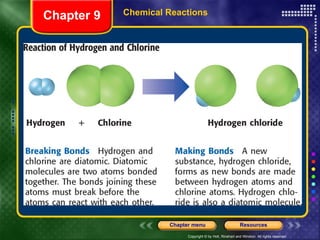
Bonds: Holding Molecules Together A  chemical bond  is a force that holds two atoms together in a molecule. For a chemical reaction to take place, the chemical bonds in the starting substances must break. The atoms then rearrange, and new bonds form to make new substances.  Chapter 9 Section 1  Forming New Substances
Chemical Reactions Chapter 9
Reactions and Energy Energy is needed to break chemical bonds in the starting substances. (atoms bump into each other with enough force to break the bond). As new bonds form in the final substances, energy is released. A chemical reaction in which energy is released is called an  exothermic reaction.  Exothermic reactions can give off energy in several forms. Chapter 9 Section 1  Forming New Substances
Reactions and Energy , continued A chemical reaction in which energy is taken in is called an  endothermic reaction. The energy taken in during an endothermic reaction is absorbed from the surroundings. Photosynthesis is an example of an endothermic process. Chapter 9 Section 1  Forming New Substances
Reactions and Energy , continued Neither mass nor energy can be created or destroyed in chemical reactions.  The  law of conservation of energy  states that energy cannot be created or destroyed but can change from one form to another. Chapter 9 Section 1  Forming New Substances
Law of Conservation of Energy Chemical Reactions Chapter 9
Bellringer Look at the following formulas for chemical compounds, and identify the elements in each formula. NaCl  KBr  C 12 H 22 O 11 NH 3   SiF 4   Fe(NO 3 ) 3 H 2 O 2   MgSO 4 What is the name and symbol of each element? How many atom of each element are present in each compound?  Write your answers in your  Science Journal. Section 2  Chemical Formulas and Equations Chapter 9
What You Will Learn Chemical formulas are a simple way to describe which elements are in a chemical substance. Chemical equations are a concise way to write how atoms are rearranged in a chemical reaction. A balanced chemical equation shows the law of conservation of mass. Section 2  Chemical Formulas and Equations Chapter 9
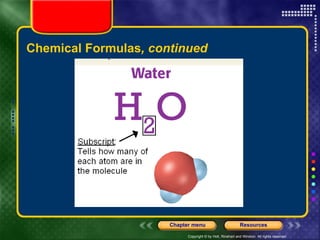
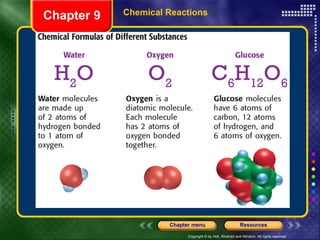
Chemical Formulas A  chemical formula  is a combination of chemical symbols and numbers to represent a substance. A chemical formula shows how many  atoms  of each kind of element are present in a  molecule . Examples: NaCl, H 2 O, NH 3 Section 2  Chemical Formulas and Equations Chapter 9
Chemical Formulas , continued
Chemical Reactions Chapter 9
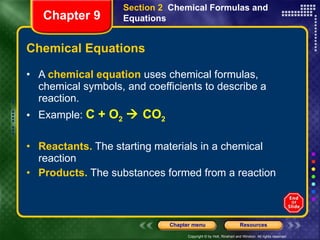
Chemical Equations A  chemical equation  uses chemical formulas, chemical symbols, and coefficients to describe a reaction.  Example:  C + O 2     CO 2 Reactants.  The starting materials in a chemical reaction Products.  The substances formed from a reaction Section 2  Chemical Formulas and Equations Chapter 9
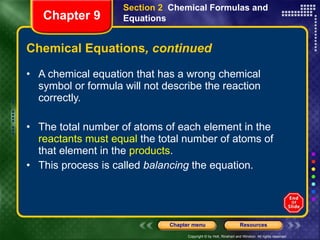
Chemical Equations , continued A chemical equation that has a wrong chemical symbol or formula will not describe the reaction correctly. The total number of atoms of each element in the  reactants must equal  the total number of atoms of that element in the  products .  This process is called  balancing  the equation. Section 2  Chemical Formulas and Equations Chapter 9
Chemical Equation Chemical Reactions Chapter 9
Chemical Equations , continued The  law of conservation of mass  states that mass cannot be created or destroyed in ordinary chemical and physical changes. This law means that the total mass of the reactants is the same as the total mass of the products. Section 2  Chemical Formulas and Equations Chapter 9
Law of Conservation of Mass Chemical Reactions Chapter 9
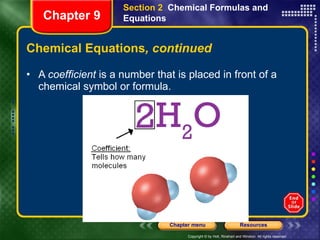
Chemical Equations , continued A  coefficient  is a number that is placed in front of a chemical symbol or formula.  Section 2  Chemical Formulas and Equations Chapter 9
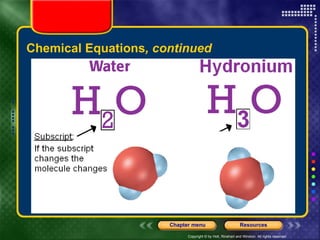
Chemical Equations , continued To balance an equation, change the coefficients—not the subscripts. Changing the subscripts in the formula of a compound changes the compound. Section 2  Chemical Formulas and Equations Chapter 9
Chemical Equations , continued
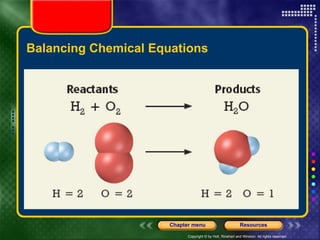
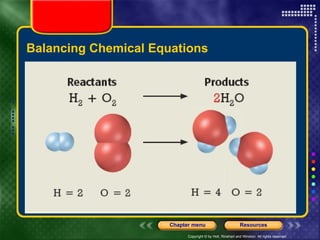
Balancing Chemical Equations 1. Count  the atoms of each element in the reactants and in the products.  If the number of atoms of each element do not match, the equation must be balanced
Balancing Chemical Equations
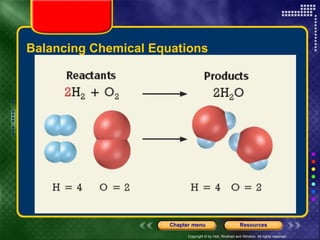
Balancing Chemical Equations 2.  Place the needed  coefficient  in front of the molecule so that it gives the same amount of atoms in the reactants and products.  3. Recount  the atoms to check if the equation is balanced. If it is not continue to add coefficients and keep counting until the equation is balanced.
Balancing Chemical Equations
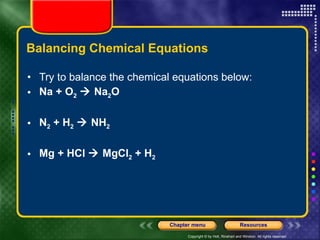
Balancing Chemical Equations Try to balance the chemical equations below:  Na + O 2     Na 2 O   N 2  + H 2     NH 2   Mg + HCl    MgCl 2  + H 2
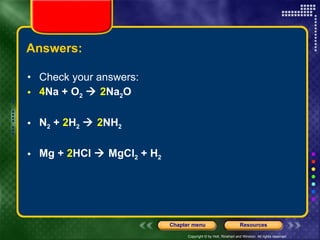
Answers:  Check your answers:  4 Na + O 2      2 Na 2 O   N 2  +  2 H 2      2 NH 2   Mg +  2 HCl    MgCl 2  + H 2
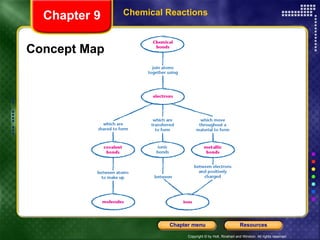
Concept Map Chapter 9 Chemical Reactions Use the terms below to complete the concept map on the next slide. products reactants chemical equations coefficients chemical reactions chemical formulas
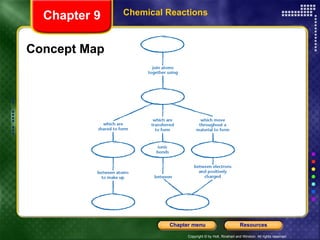
Chemical Reactions Chapter 9 Concept Map
End of Chapter 9 Show Chemical Reactions  Chapter 9
1. In the sentence “She wrote a chemical formula that showed the parts of the compound,” what does the word  compound  mean? A. a group of buildings set off and enclosed by a barrier B. a word that consists of two or more elements or parts C. a substance made up of two or more elements that are joined by chemical bonds D. a leaf whose blade is divided into at least two leaflets Chapter 9 Standards Assessment
2. Choose the appropriate form of the word  react  for the following sentence: “When an atom has one electron in its outer energy level, it _____easily with other atoms.” A. reacting B. reactive C. reaction D. reacts Chapter 9 Standards Assessment
3. Which of the following phrases means “a process that changes a substance into another substance”? A. chemical reaction B. physical process C. atomic structure D. buoyant force Chapter 9 Standards Assessment
4. Which of the following words or phrases is the closest in meaning to the word  identify ?  A. observe  B. pick out C. acquire D. ask Chapter 9 Standards Assessment
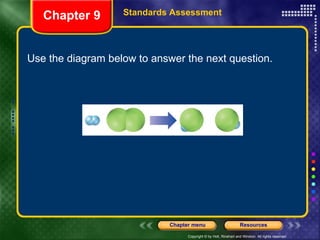
Use the diagram below to answer the next question. Chapter 9 Standards Assessment
5. The model above shows the reaction of hydrogen and chlorine. Which of the following best describes the result of the reaction shown in the model? A. Four new diatomic molecules form. B. Bonds are formed between two hydrogen atoms. C. The properties of the new molecules are the same as those of the original molecules. D. Two molecules of a new compound are formed. Chapter 9 Standards Assessment
6. Which of the following contains one oxygen atom? A. H 2 O B. CO 2 C. 2N 2 O D. Co Chapter 9 Standards Assessment
7. Atoms are never lost or gained during a chemical reaction. They are just A. rearranged. B. changed into other atoms. C. corrected. D. converted. Chapter 9 Standards Assessment
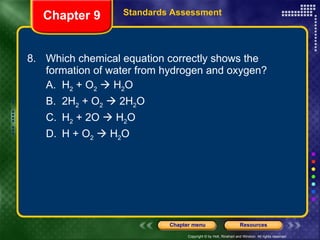
8. Which chemical equation correctly shows the formation of water from hydrogen and oxygen? A. H 2  + O 2     H 2 O B. 2H 2  + O 2     2H 2 O C. H 2  + 2O    H 2 O D. H + O 2     H 2 O Chapter 9 Standards Assessment
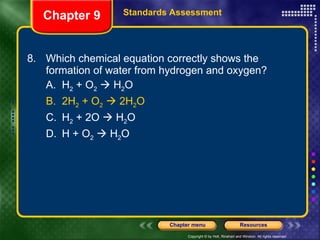
8.  Which chemical equation correctly shows the formation of water from hydrogen and oxygen? A. H 2  + O 2     H 2 O B. 2H 2  + O 2     2H 2 O C. H 2  + 2O    H 2 O D. H + O 2     H 2 O Chapter 9 Standards Assessment
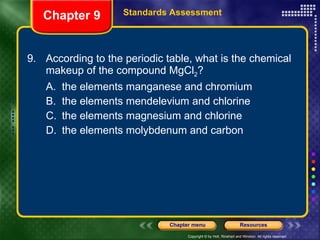
9.  According to the periodic table, what is the chemical makeup of the compound MgCl 2 ? A. the elements manganese and chromium B. the elements mendelevium and chlorine C. the elements magnesium and chlorine D. the elements molybdenum and carbon Chapter 9 Standards Assessment
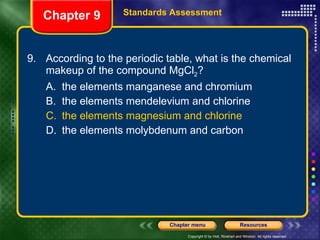
9. According to the periodic table, what is the chemical makeup of the compound MgCl 2 ? A. the elements manganese and chromium B. the elements mendelevium and chlorine C. the elements magnesium and chlorine D. the elements molybdenum and carbon Chapter 9 Standards Assessment
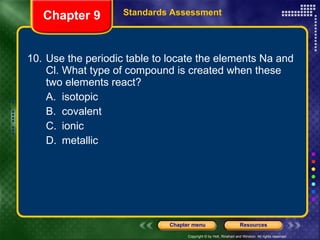
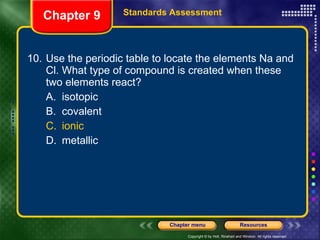
10. Use the periodic table to locate the elements Na and Cl. What type of compound is created when these two elements react? A. isotopic B. covalent C. ionic D. metallic Chapter 9 Standards Assessment
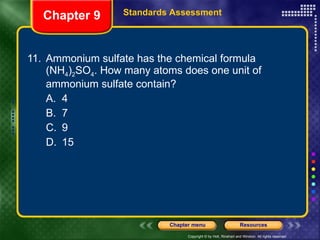
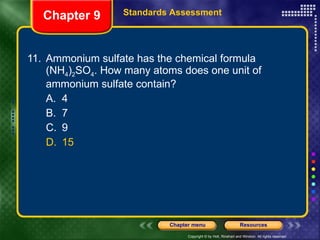
11. Ammonium sulfate has the chemical formula (NH 4 ) 2 SO 4 . How many atoms does one unit of ammonium sulfate contain? A. 4 B. 7 C. 9 D. 15 Chapter 9 Standards Assessment
12. Chemical reactions are endothermic or exothermic. Which of the following is an example of an endothermic reaction? A. Ice absorbs energy and melts to form liquid water. B. Wood burns and releases light and heat. C. Fireworks explode and release light. D. Water absorbs energy and decomposes to form hydrogen and oxygen. Chapter 9 Standards Assessment
13. According to the periodic table, what is the atomic number of zinc, Zn? A. 2.018 B. 30 C. 65.4 D. 19,620 Chapter 9 Standards Assessment
14. A cake is an example of a A. solution. B. compound. C. mixture. D. nonmetal. Chapter 9 Standards Assessment
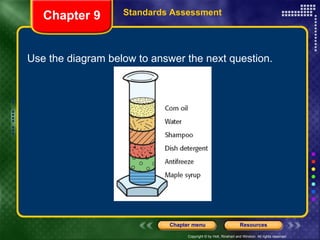
Use the diagram below to answer the next question.  Chapter 9 Standards Assessment
15. Which of the following best describes the liquids in the graduated cylinder? A. Of the six liquids, corn oil is the least dense. B. The density of the liquids increases from maple syrup to corn oil. C. The density of the top layers holds down less-dense liquids. D. Of the six liquids, maple syrup is the least dense. Chapter 9 Standards Assessment
Chapter 9

Physical Science Ch09

  • 1.
    To View thepresentation as a slideshow with effects select “View” on the menu bar and click on “Slide Show.” To advance through the presentation, click the right-arrow key or the space bar . From the resources slide, click on any resource to see a presentation for that resource. From the Chapter menu screen click on any lesson to go directly to that lesson’s presentation. You may exit the slide show at any time by pressing the Esc key . How to Use This Presentation
  • 2.
    Resources Chapter PresentationImage Bank Math Focus Bellringers Standards Assessment Visual Concepts
  • 3.
    Table of ContentsSection 1 Forming New Substances Section 2 Chemical Formulas and Equations Chapter 9 Chemical Reactions
  • 4.
    Bellringer The formationof water from its elements may be represented as follows: 2H 2 + O 2  2H 2 O What elements are present in water? How many atoms of each element are shown in the reactants? How many atoms of each element are shown in the products? The representation 2H 2 + O 2  2H 2 O is called a chemical equation. Why do you think that the numbers of atoms do not change? Write your answers in your Science Journal. Section 1 Forming New Substances Chapter 9
  • 5.
    What You WillLearn Four signs that indicate that a chemical reaction may be taking place are a change in color, the formation of a gas, the formation of a precipitate, and a change in energy. Chemical reactions produce new substances whose chemical and physical properties differ from the properties of the original substances. In a chemical reaction, chemical bonds break and atoms rearrange. Chemical reactions absorb or release energy. Chapter 9 Section 1 Forming New Substances
  • 6.
    Combining Atoms ThroughChemical Bonding Chemical bonding is the joining of atoms to form new substances. An interaction that holds two atoms together is called a chemical bond. When chemical bonds form when electrons are shared ( covalent and metallic bonds ), or when electrons are gained, or lost ( ionic bonds ). Section 1 Electrons and Chemical Bonding Chapter 8
  • 7.
    Chemical Reactions A chemical reaction is a process in which one or more substances change to make one or more new substances. The chemical and physical properties of the new substances that form in a chemical reaction differ from those of the original substances. Chapter 9 Section 1 Forming New Substances
  • 8.
    Chemical Reactions ,continued Signs that indicate a chemical reaction may be taking place are a color change, formation of a gas or a solid, and the release or absorption of energy. A solid that is produced as a result of a chemical reaction in solution is called a precipitate. Chapter 9 Section 1 Forming New Substances
  • 9.
  • 10.
    Chemical Reactions ,continued Even though the signs that indicate a chemical reaction is taking place are good signals of chemical reactions, they do not always guarantee that a reaction is happening. The most important sign that a chemical reaction has taken place is the formation of new substances that have new properties. Chapter 9 Section 1 Forming New Substances
  • 11.
    Bonds: Holding MoleculesTogether A chemical bond is a force that holds two atoms together in a molecule. For a chemical reaction to take place, the chemical bonds in the starting substances must break. The atoms then rearrange, and new bonds form to make new substances. Chapter 9 Section 1 Forming New Substances
  • 12.
  • 13.
    Reactions and EnergyEnergy is needed to break chemical bonds in the starting substances. (atoms bump into each other with enough force to break the bond). As new bonds form in the final substances, energy is released. A chemical reaction in which energy is released is called an exothermic reaction. Exothermic reactions can give off energy in several forms. Chapter 9 Section 1 Forming New Substances
  • 14.
    Reactions and Energy, continued A chemical reaction in which energy is taken in is called an endothermic reaction. The energy taken in during an endothermic reaction is absorbed from the surroundings. Photosynthesis is an example of an endothermic process. Chapter 9 Section 1 Forming New Substances
  • 15.
    Reactions and Energy, continued Neither mass nor energy can be created or destroyed in chemical reactions. The law of conservation of energy states that energy cannot be created or destroyed but can change from one form to another. Chapter 9 Section 1 Forming New Substances
  • 16.
    Law of Conservationof Energy Chemical Reactions Chapter 9
  • 17.
    Bellringer Look atthe following formulas for chemical compounds, and identify the elements in each formula. NaCl KBr C 12 H 22 O 11 NH 3 SiF 4 Fe(NO 3 ) 3 H 2 O 2 MgSO 4 What is the name and symbol of each element? How many atom of each element are present in each compound? Write your answers in your Science Journal. Section 2 Chemical Formulas and Equations Chapter 9
  • 18.
    What You WillLearn Chemical formulas are a simple way to describe which elements are in a chemical substance. Chemical equations are a concise way to write how atoms are rearranged in a chemical reaction. A balanced chemical equation shows the law of conservation of mass. Section 2 Chemical Formulas and Equations Chapter 9
  • 19.
    Chemical Formulas A chemical formula is a combination of chemical symbols and numbers to represent a substance. A chemical formula shows how many atoms of each kind of element are present in a molecule . Examples: NaCl, H 2 O, NH 3 Section 2 Chemical Formulas and Equations Chapter 9
  • 20.
  • 21.
  • 22.
    Chemical Equations A chemical equation uses chemical formulas, chemical symbols, and coefficients to describe a reaction. Example: C + O 2  CO 2 Reactants. The starting materials in a chemical reaction Products. The substances formed from a reaction Section 2 Chemical Formulas and Equations Chapter 9
  • 23.
    Chemical Equations ,continued A chemical equation that has a wrong chemical symbol or formula will not describe the reaction correctly. The total number of atoms of each element in the reactants must equal the total number of atoms of that element in the products . This process is called balancing the equation. Section 2 Chemical Formulas and Equations Chapter 9
  • 24.
    Chemical Equation ChemicalReactions Chapter 9
  • 25.
    Chemical Equations ,continued The law of conservation of mass states that mass cannot be created or destroyed in ordinary chemical and physical changes. This law means that the total mass of the reactants is the same as the total mass of the products. Section 2 Chemical Formulas and Equations Chapter 9
  • 26.
    Law of Conservationof Mass Chemical Reactions Chapter 9
  • 27.
    Chemical Equations ,continued A coefficient is a number that is placed in front of a chemical symbol or formula. Section 2 Chemical Formulas and Equations Chapter 9
  • 28.
    Chemical Equations ,continued To balance an equation, change the coefficients—not the subscripts. Changing the subscripts in the formula of a compound changes the compound. Section 2 Chemical Formulas and Equations Chapter 9
  • 29.
  • 30.
    Balancing Chemical Equations1. Count the atoms of each element in the reactants and in the products. If the number of atoms of each element do not match, the equation must be balanced
  • 31.
  • 32.
    Balancing Chemical Equations2. Place the needed coefficient in front of the molecule so that it gives the same amount of atoms in the reactants and products. 3. Recount the atoms to check if the equation is balanced. If it is not continue to add coefficients and keep counting until the equation is balanced.
  • 33.
  • 34.
  • 35.
    Balancing Chemical EquationsTry to balance the chemical equations below: Na + O 2    Na 2 O N 2  + H 2    NH 2 Mg + HCl  MgCl 2 + H 2
  • 36.
    Answers: Checkyour answers: 4 Na + O 2    2 Na 2 O N 2  + 2 H 2    2 NH 2 Mg + 2 HCl  MgCl 2 + H 2
  • 37.
    Concept Map Chapter9 Chemical Reactions Use the terms below to complete the concept map on the next slide. products reactants chemical equations coefficients chemical reactions chemical formulas
  • 38.
  • 39.
  • 40.
    End of Chapter9 Show Chemical Reactions Chapter 9
  • 41.
    1. In thesentence “She wrote a chemical formula that showed the parts of the compound,” what does the word compound mean? A. a group of buildings set off and enclosed by a barrier B. a word that consists of two or more elements or parts C. a substance made up of two or more elements that are joined by chemical bonds D. a leaf whose blade is divided into at least two leaflets Chapter 9 Standards Assessment
  • 42.
    1. In thesentence “She wrote a chemical formula that showed the parts of the compound,” what does the word compound mean? A. a group of buildings set off and enclosed by a barrier B. a word that consists of two or more elements or parts C. a substance made up of two or more elements that are joined by chemical bonds D. a leaf whose blade is divided into at least two leaflets Chapter 9 Standards Assessment
  • 43.
    2. Choose theappropriate form of the word react for the following sentence: “When an atom has one electron in its outer energy level, it _____easily with other atoms.” A. reacting B. reactive C. reaction D. reacts Chapter 9 Standards Assessment
  • 44.
    2. Choose theappropriate form of the word react for the following sentence: “When an atom has one electron in its outer energy level, it _____easily with other atoms.” A. reacting B. reactive C. reaction D. reacts Chapter 9 Standards Assessment
  • 45.
    3. Which ofthe following phrases means “a process that changes a substance into another substance”? A. chemical reaction B. physical process C. atomic structure D. buoyant force Chapter 9 Standards Assessment
  • 46.
    3. Which ofthe following phrases means “a process that changes a substance into another substance”? A. chemical reaction B. physical process C. atomic structure D. buoyant force Chapter 9 Standards Assessment
  • 47.
    4. Which ofthe following words or phrases is the closest in meaning to the word identify ? A. observe B. pick out C. acquire D. ask Chapter 9 Standards Assessment
  • 48.
    4. Which ofthe following words or phrases is the closest in meaning to the word identify ? A. observe B. pick out C. acquire D. ask Chapter 9 Standards Assessment
  • 49.
    Use the diagrambelow to answer the next question. Chapter 9 Standards Assessment
  • 50.
    5. The modelabove shows the reaction of hydrogen and chlorine. Which of the following best describes the result of the reaction shown in the model? A. Four new diatomic molecules form. B. Bonds are formed between two hydrogen atoms. C. The properties of the new molecules are the same as those of the original molecules. D. Two molecules of a new compound are formed. Chapter 9 Standards Assessment
  • 51.
    5. The modelabove shows the reaction of hydrogen and chlorine. Which of the following best describes the result of the reaction shown in the model? A. Four new diatomic molecules form. B. Bonds are formed between two hydrogen atoms. C. The properties of the new molecules are the same as those of the original molecules. D. Two molecules of a new compound are formed. Chapter 9 Standards Assessment
  • 52.
    6. Which ofthe following contains one oxygen atom? A. H 2 O B. CO 2 C. 2N 2 O D. Co Chapter 9 Standards Assessment
  • 53.
    6. Which ofthe following contains one oxygen atom? A. H 2 O B. CO 2 C. 2N 2 O D. Co Chapter 9 Standards Assessment
  • 54.
    7. Atoms arenever lost or gained during a chemical reaction. They are just A. rearranged. B. changed into other atoms. C. corrected. D. converted. Chapter 9 Standards Assessment
  • 55.
    7. Atoms arenever lost or gained during a chemical reaction. They are just A. rearranged. B. changed into other atoms. C. corrected. D. converted. Chapter 9 Standards Assessment
  • 56.
    8. Which chemicalequation correctly shows the formation of water from hydrogen and oxygen? A. H 2 + O 2  H 2 O B. 2H 2 + O 2  2H 2 O C. H 2 + 2O  H 2 O D. H + O 2  H 2 O Chapter 9 Standards Assessment
  • 57.
    8. Whichchemical equation correctly shows the formation of water from hydrogen and oxygen? A. H 2 + O 2  H 2 O B. 2H 2 + O 2  2H 2 O C. H 2 + 2O  H 2 O D. H + O 2  H 2 O Chapter 9 Standards Assessment
  • 58.
    9. Accordingto the periodic table, what is the chemical makeup of the compound MgCl 2 ? A. the elements manganese and chromium B. the elements mendelevium and chlorine C. the elements magnesium and chlorine D. the elements molybdenum and carbon Chapter 9 Standards Assessment
  • 59.
    9. According tothe periodic table, what is the chemical makeup of the compound MgCl 2 ? A. the elements manganese and chromium B. the elements mendelevium and chlorine C. the elements magnesium and chlorine D. the elements molybdenum and carbon Chapter 9 Standards Assessment
  • 60.
    10. Use theperiodic table to locate the elements Na and Cl. What type of compound is created when these two elements react? A. isotopic B. covalent C. ionic D. metallic Chapter 9 Standards Assessment
  • 61.
    10. Use theperiodic table to locate the elements Na and Cl. What type of compound is created when these two elements react? A. isotopic B. covalent C. ionic D. metallic Chapter 9 Standards Assessment
  • 62.
    11. Ammonium sulfatehas the chemical formula (NH 4 ) 2 SO 4 . How many atoms does one unit of ammonium sulfate contain? A. 4 B. 7 C. 9 D. 15 Chapter 9 Standards Assessment
  • 63.
    11. Ammonium sulfatehas the chemical formula (NH 4 ) 2 SO 4 . How many atoms does one unit of ammonium sulfate contain? A. 4 B. 7 C. 9 D. 15 Chapter 9 Standards Assessment
  • 64.
    12. Chemical reactionsare endothermic or exothermic. Which of the following is an example of an endothermic reaction? A. Ice absorbs energy and melts to form liquid water. B. Wood burns and releases light and heat. C. Fireworks explode and release light. D. Water absorbs energy and decomposes to form hydrogen and oxygen. Chapter 9 Standards Assessment
  • 65.
    12. Chemical reactionsare endothermic or exothermic. Which of the following is an example of an endothermic reaction? A. Ice absorbs energy and melts to form liquid water. B. Wood burns and releases light and heat. C. Fireworks explode and release light. D. Water absorbs energy and decomposes to form hydrogen and oxygen. Chapter 9 Standards Assessment
  • 66.
    13. According tothe periodic table, what is the atomic number of zinc, Zn? A. 2.018 B. 30 C. 65.4 D. 19,620 Chapter 9 Standards Assessment
  • 67.
    13. According tothe periodic table, what is the atomic number of zinc, Zn? A. 2.018 B. 30 C. 65.4 D. 19,620 Chapter 9 Standards Assessment
  • 68.
    14. A cakeis an example of a A. solution. B. compound. C. mixture. D. nonmetal. Chapter 9 Standards Assessment
  • 69.
    14. A cakeis an example of a A. solution. B. compound. C. mixture. D. nonmetal. Chapter 9 Standards Assessment
  • 70.
    Use the diagrambelow to answer the next question. Chapter 9 Standards Assessment
  • 71.
    15. Which ofthe following best describes the liquids in the graduated cylinder? A. Of the six liquids, corn oil is the least dense. B. The density of the liquids increases from maple syrup to corn oil. C. The density of the top layers holds down less-dense liquids. D. Of the six liquids, maple syrup is the least dense. Chapter 9 Standards Assessment
  • 72.
    15. Which ofthe following best describes the liquids in the graduated cylinder? A. Of the six liquids, corn oil is the least dense. B. The density of the liquids increases from maple syrup to corn oil. C. The density of the top layers holds down less-dense liquids. D. Of the six liquids, maple syrup is the least dense. Chapter 9 Standards Assessment
  • 73.