PHYSICAL AND
CHEMICAL
CHANGES
PHYSICAL PROPERTIES
■ Appearance
■ Texture
■ Color
■ Odor
■ Melting / Boiling
Point
■ Density
■ Conductivity
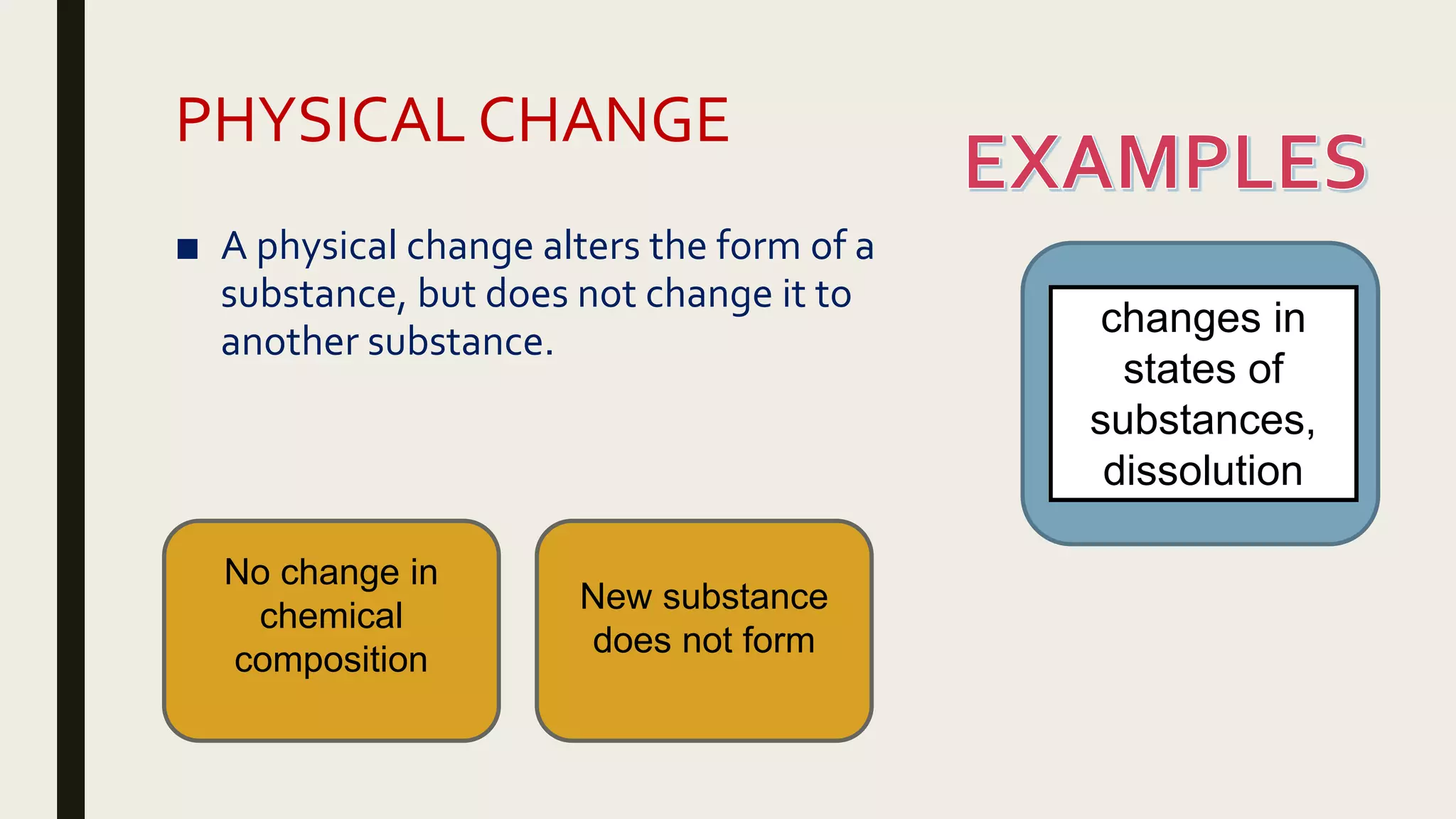
PHYSICAL CHANGE
■ A physical change alters the form of a
substance, but does not change it to
another substance.
No change in
chemical
composition
New substance
does not form
changes in
states of
substances,
dissolution
! Phase changes are physical processes.
CHEMICAL PROPERTIES
■ Flammability
Tendency to undergo a reaction
with other substances
(reactivity)
CHEMICAL CHANGES
■ When a substance undergoes a chemical change, it is changed
into a different substance with different properties.
Example:
Baking a Cake
• Chemical bonds
(strong bonds)
between the atoms are
broken and formed.
• New substance is
formed.
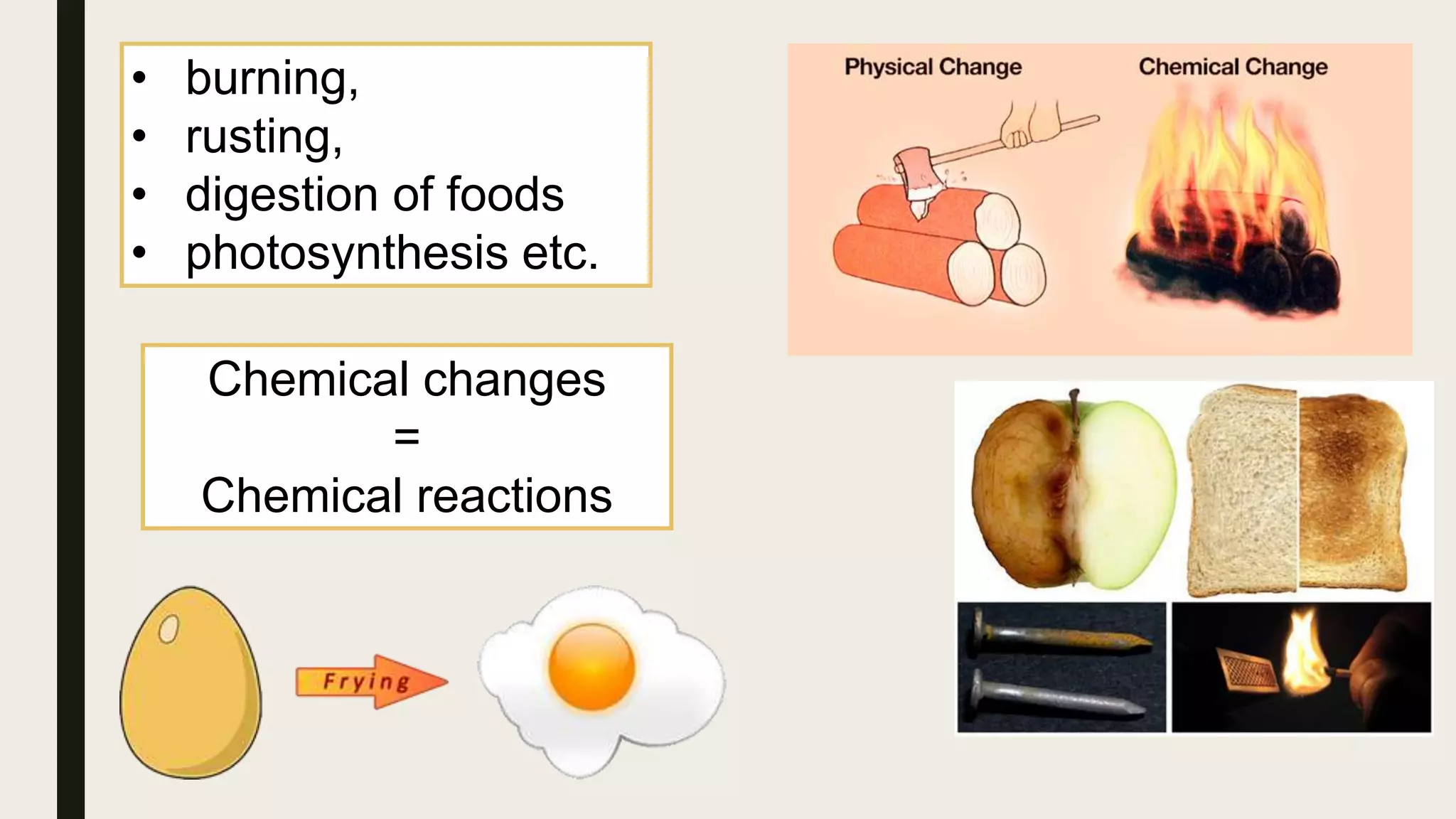
• burning,
• rusting,
• digestion of foods
• photosynthesis etc.
Chemical changes
=
Chemical reactions
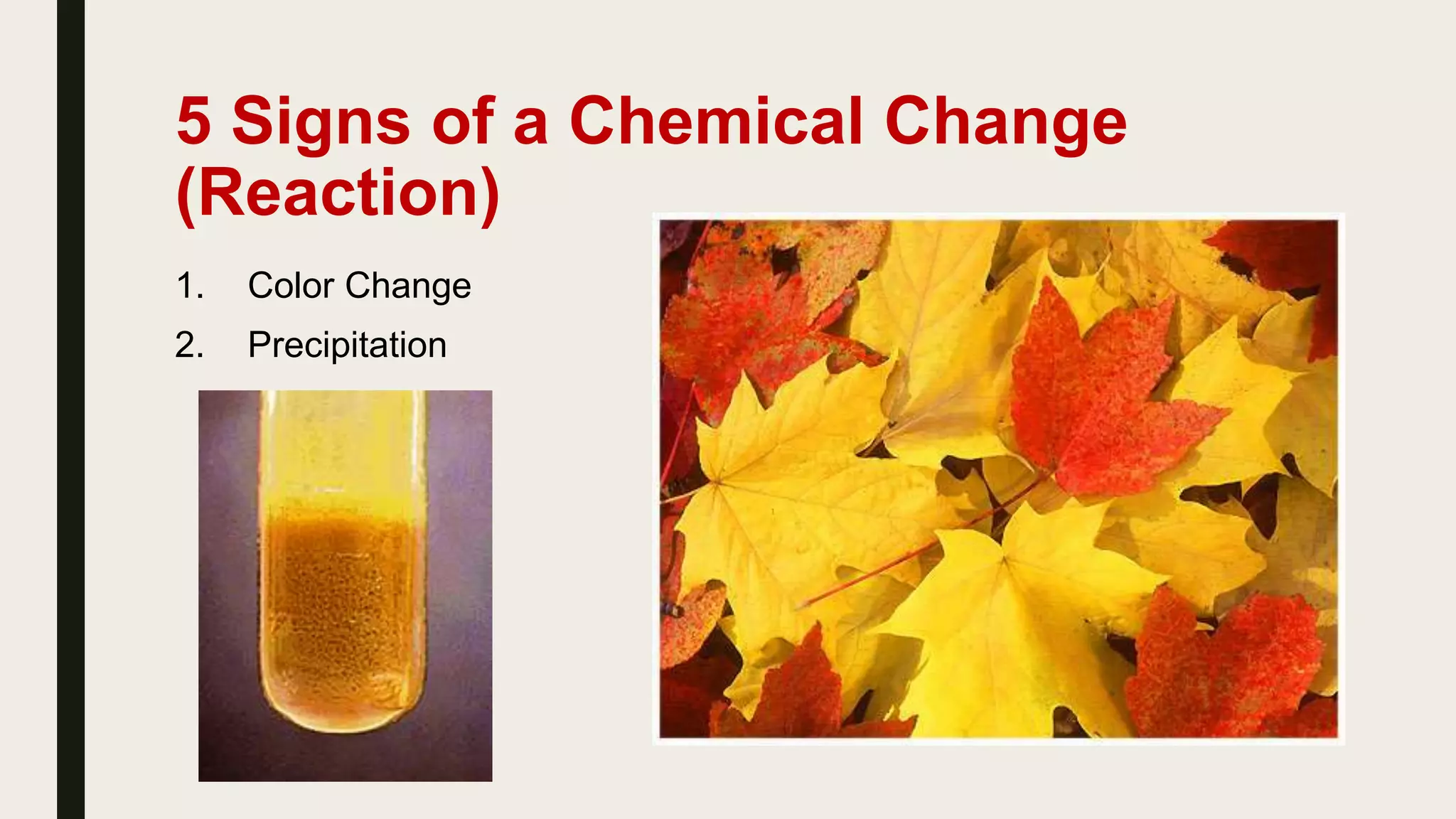
5 Signs of a Chemical Change
(Reaction)
1. Color Change
2. Precipitation
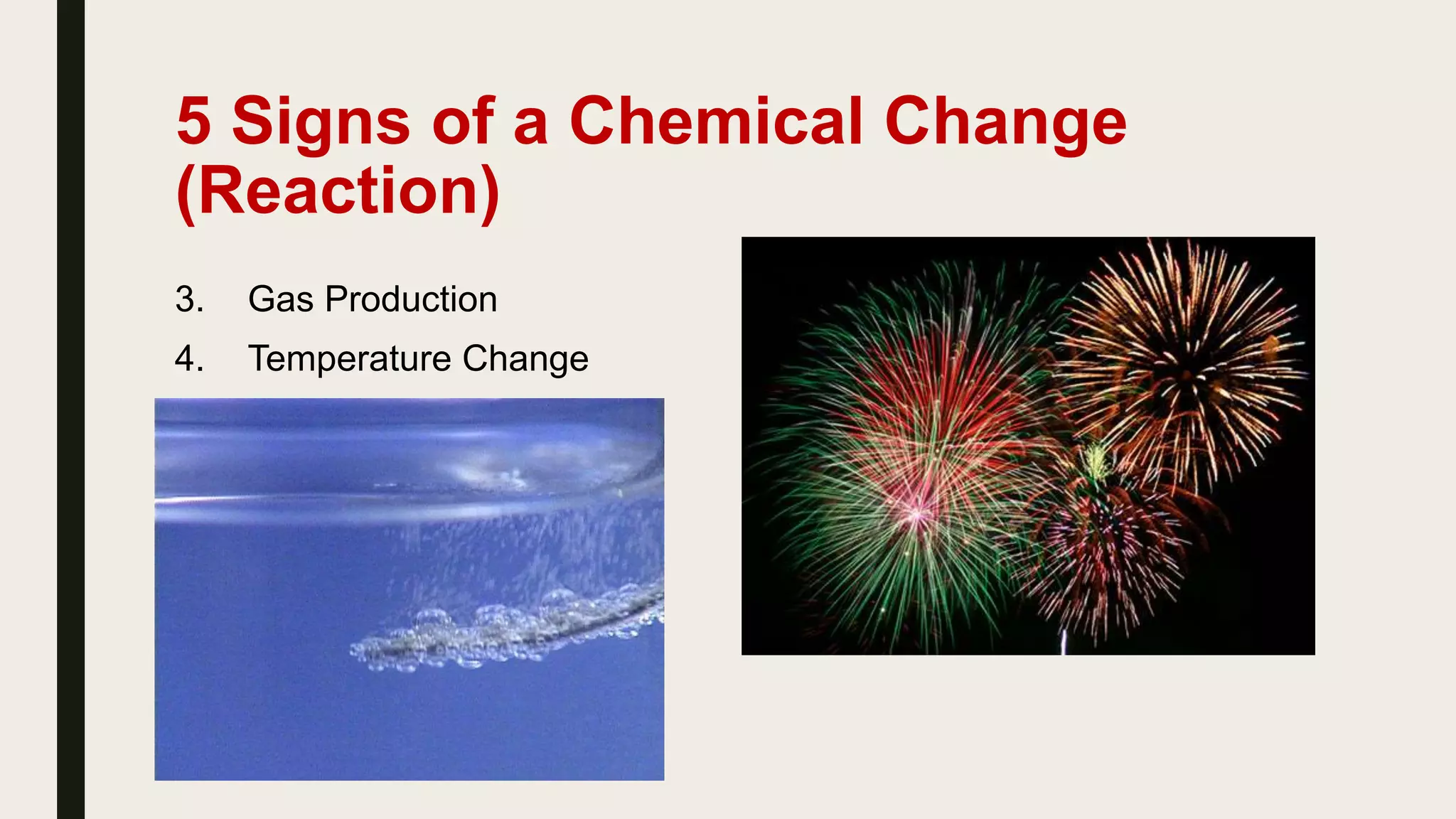
5 Signs of a Chemical Change
(Reaction)
3. Gas Production
4. Temperature Change
5 Signs of a Chemical Change
(Reaction)
5. Changes in
Characteristic
Properties (odor, light
given off)
Chemical or Physical Change?
■ Cutting paper?
■ Physical
■ Ice melting?
■ Physical
■ Toast burning?
■ Chemical
Chemical or Physical Change?
■ Rocket fuel burning?
■ Chemical
■ Sawing wood?
■ Physical
■ Disappearing puddle?
■ Physical
Chemical or Physical Change?
■ Metal rusting?
■ Chemical
■ Candle burning?
■ Chemical
CHEMICAL REACTIONS
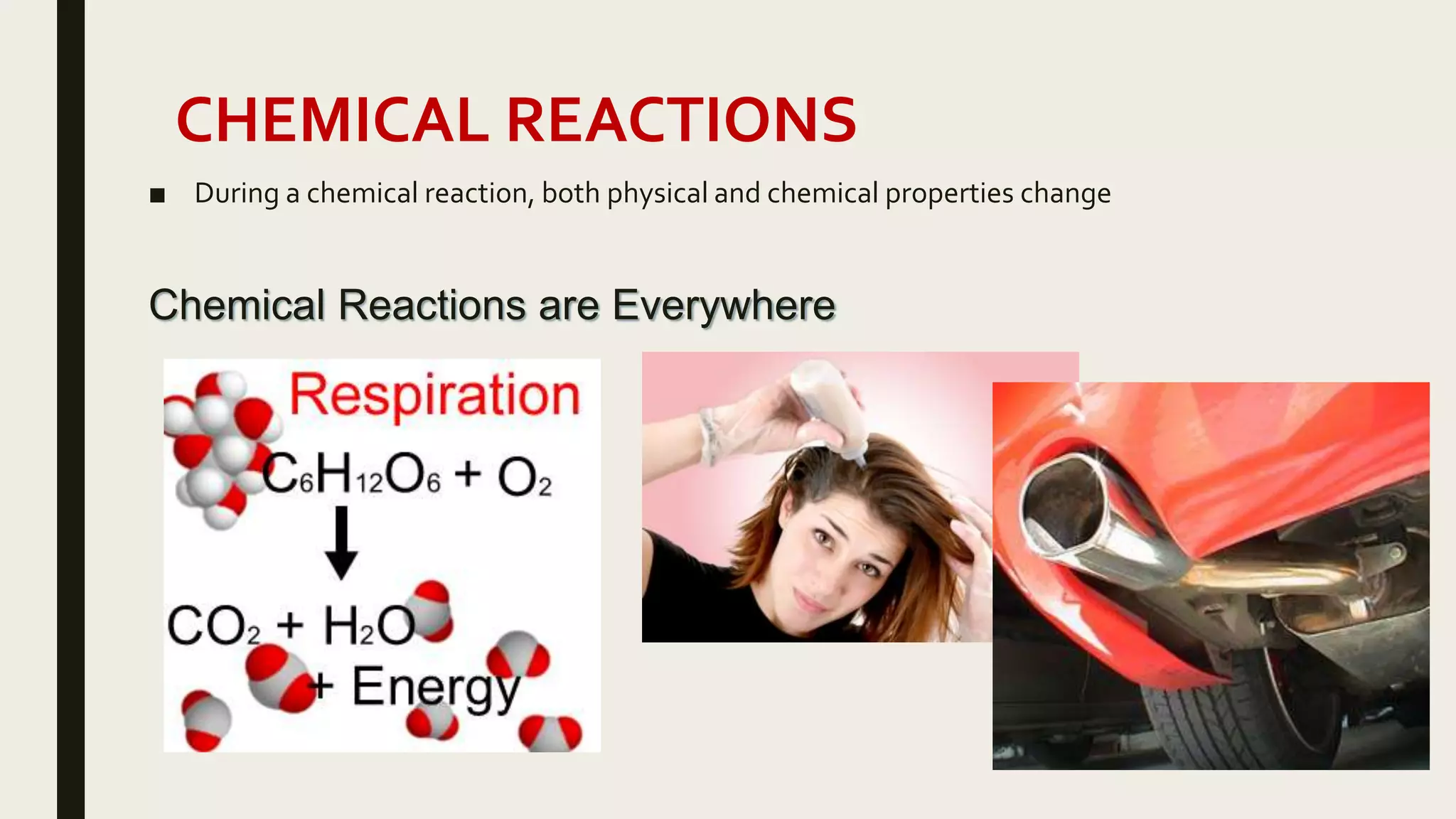
■ During a chemical reaction, both physical and chemical properties change
Chemical Reactions are Everywhere
CHEMICAL REACTIONS
■ Chemical Reactions are represented by Chemical Equations.
A + B  C (chemical equation)
■ Solid Sodium combines with Chlorine gas to make solid Sodium
Chloride:
2Na (s) + Cl2 (g)  2NaCl
■ Chemical Equations are different from Numerical Equations:
Numerical Equation: 3x + 2y = 47
Chemical Equation 2Na + Cl2  2NaCl
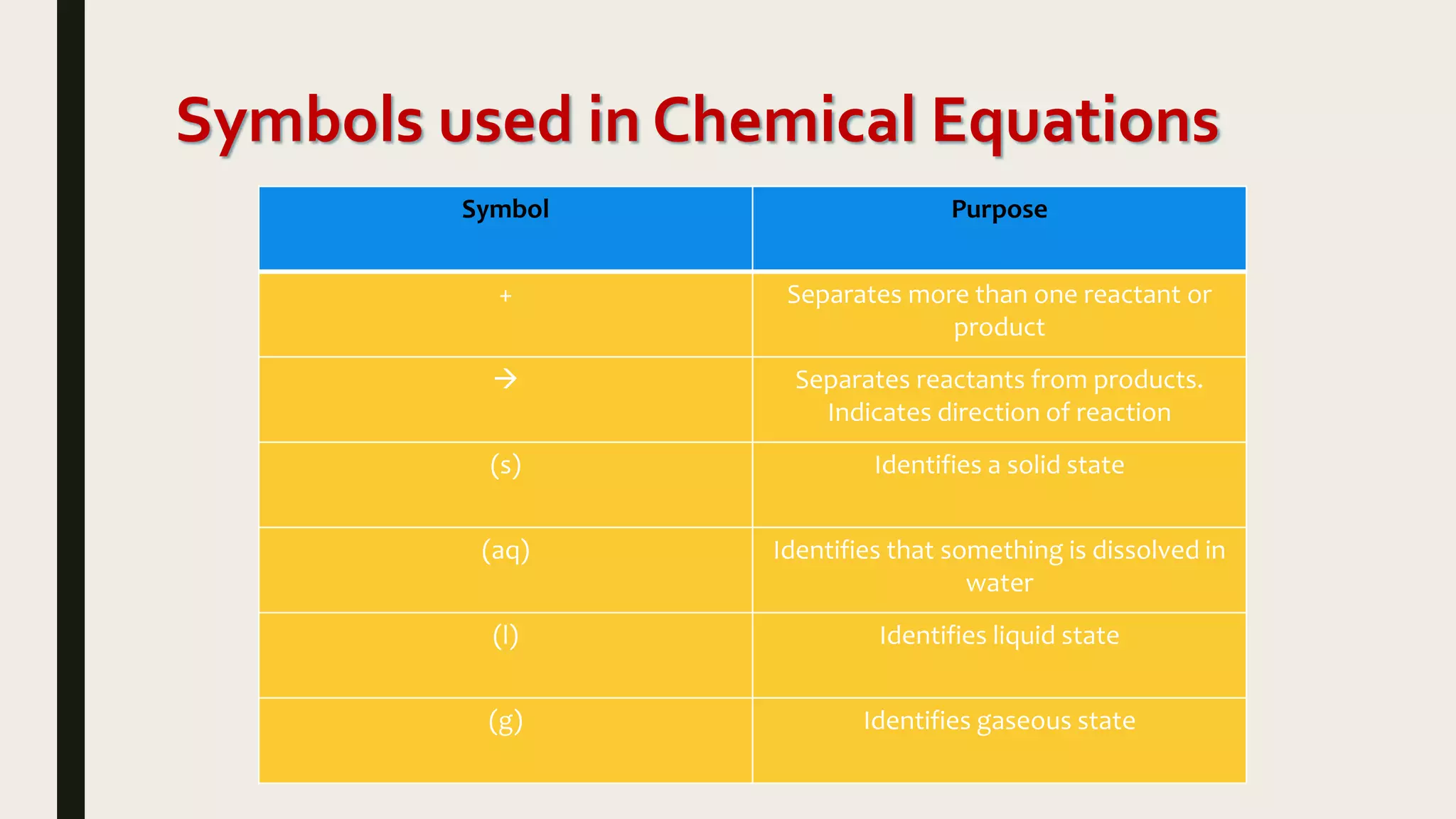
Symbols used in Chemical Equations
Symbol Purpose
+ Separates more than one reactant or
product
 Separates reactants from products.
Indicates direction of reaction
(s) Identifies a solid state
(aq) Identifies that something is dissolved in
water
(l) Identifies liquid state
(g) Identifies gaseous state
CHEMICAL REACTIONS
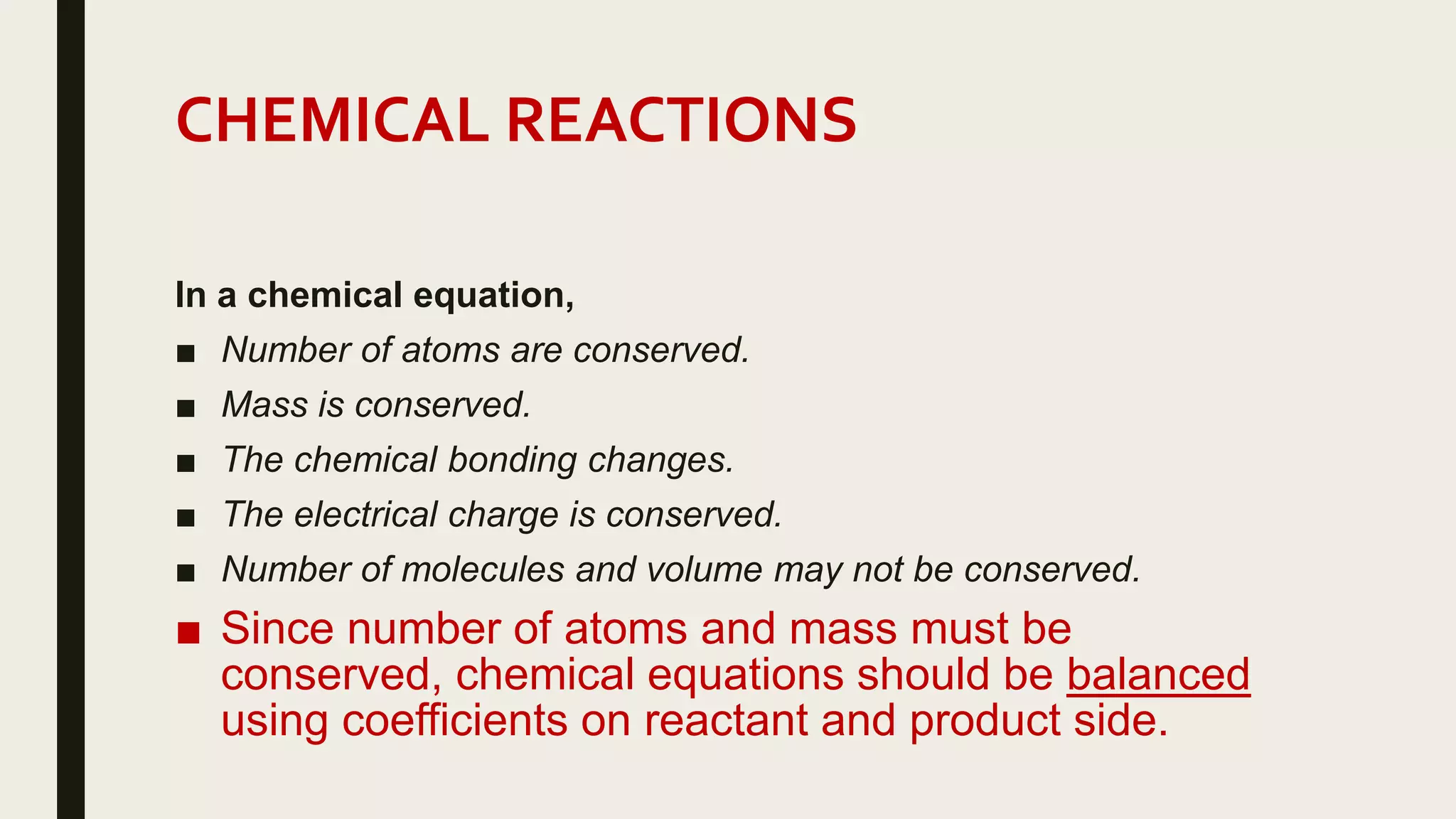
In a chemical equation,
■ Number of atoms are conserved.
■ Mass is conserved.
■ The chemical bonding changes.
■ The electrical charge is conserved.
■ Number of molecules and volume may not be conserved.
■ Since number of atoms and mass must be
conserved, chemical equations should be balanced
using coefficients on reactant and product side.
Steps to Balancing a Chemical
Equation
6. Check your work
5. Write the Coefficients in their lowest possible ratio
4. Change to Coefficients to make the number of atoms of each element equal on both sides of arrow
2Li(s) + 2 H2O  H2(g) + 2LiOH(aq)
3. Count the atoms of the elements in the products
1 atom Li, 3 atoms H, 1 atomO
2. Count the atoms of the elements in the reactants
1 atom Li, 2 atoms H, 1 atomO
1. Write the Skeleton Equation
Li(s) + H2O(l)  H2 (g) + LiOH (aq)
BALANCING CHEMICAL EQUATIONS:
Another Example
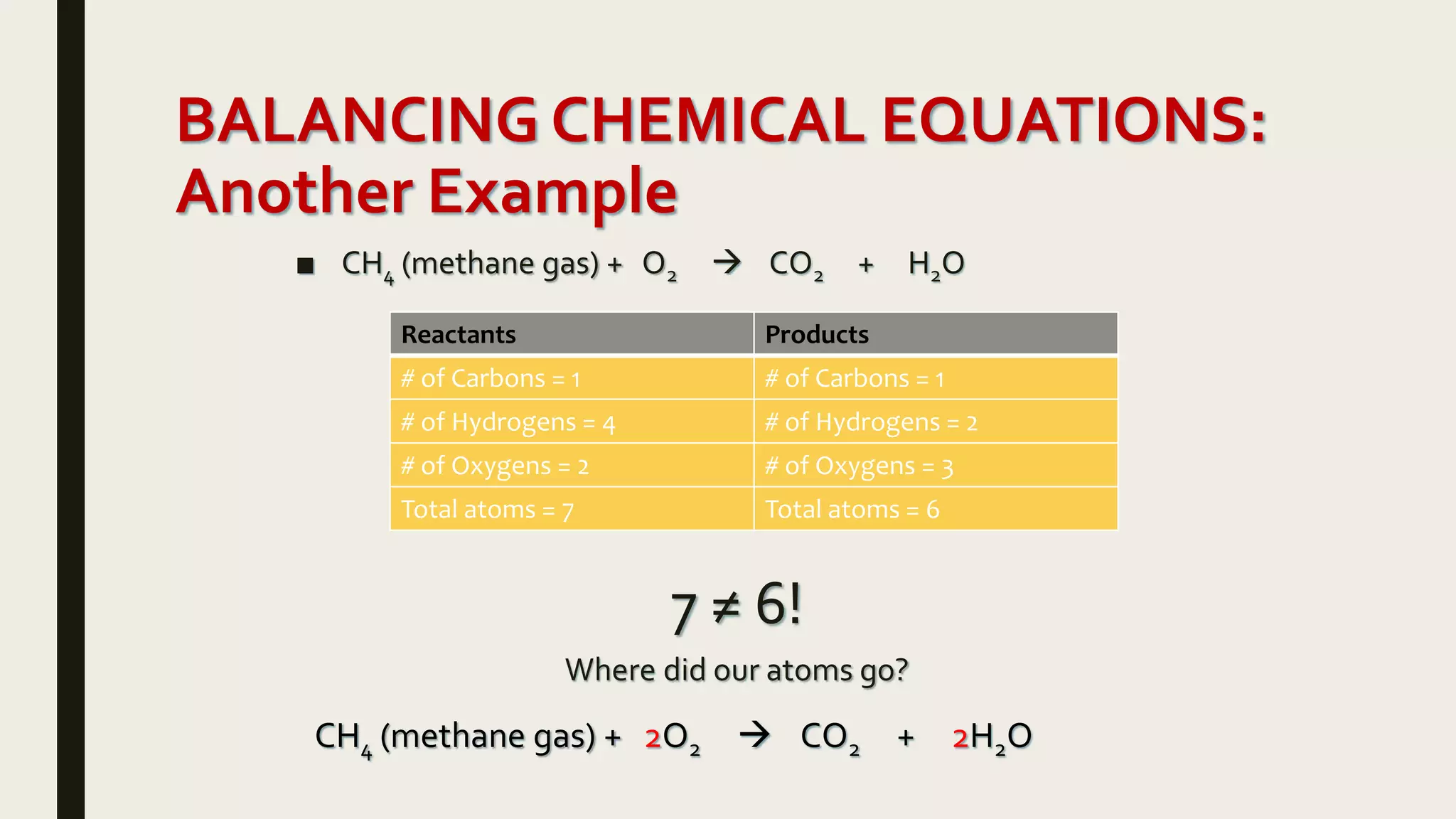
■ CH4 (methane gas) + O2  CO2 + H2O
7 ≠ 6!
Where did our atoms go?
Reactants Products
# of Carbons = 1 # of Carbons = 1
# of Hydrogens = 4 # of Hydrogens = 2
# of Oxygens = 2 # of Oxygens = 3
Total atoms = 7 Total atoms = 6
CH4 (methane gas) + 2O2  CO2 + 2H2O
BALANCING CHEMICAL EQUATIONS:
Another Example
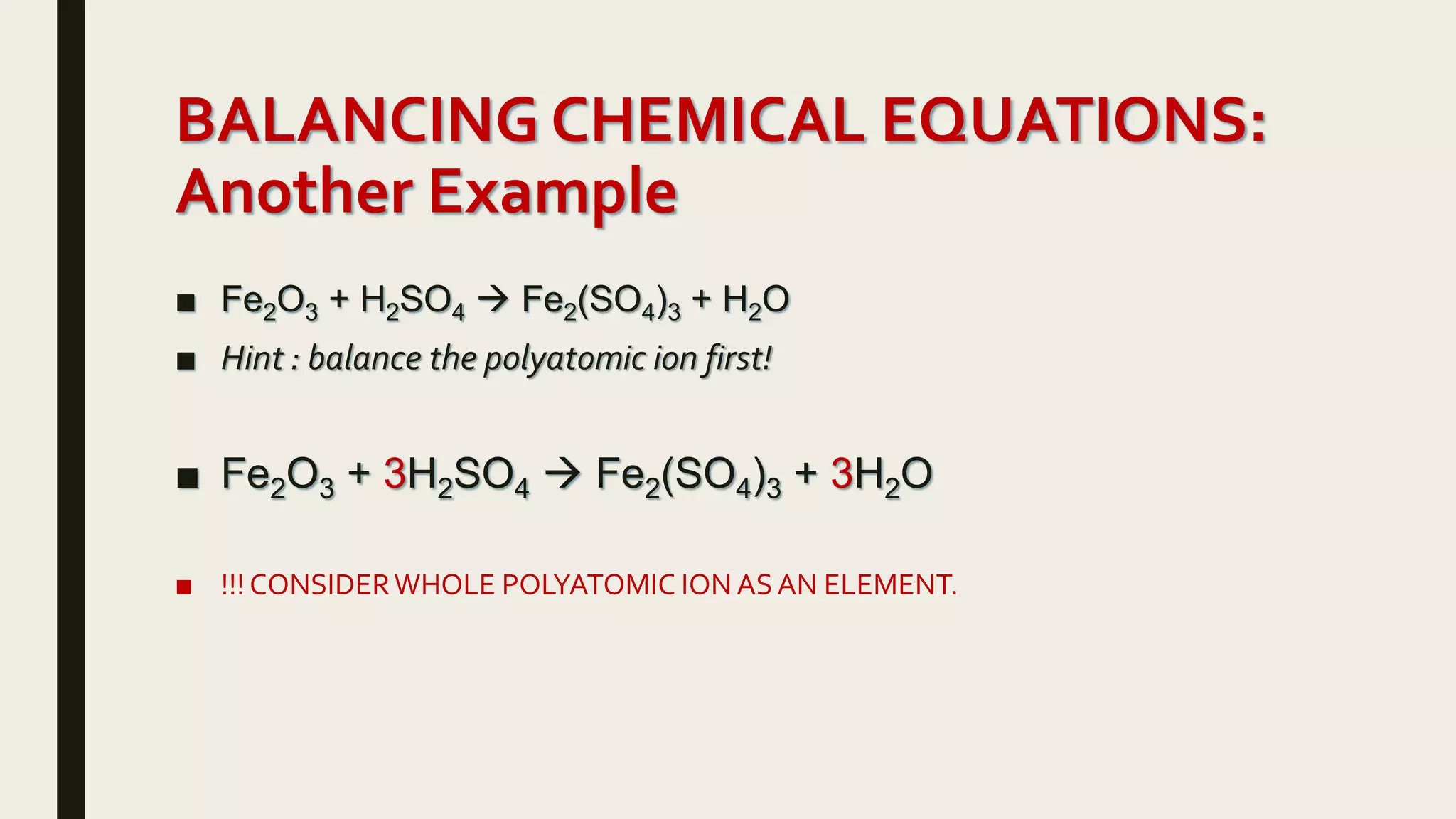
■ Fe2O3 + H2SO4  Fe2(SO4)3 + H2O
■ Hint : balance the polyatomic ion first!
■ Fe2O3 + 3H2SO4  Fe2(SO4)3 + 3H2O
■ !!! CONSIDERWHOLE POLYATOMIC ION ASAN ELEMENT.
REVIEW
■ Matter is not destroyed or
created
■ Atoms are rearranged in
chemical reactions
■ Chemical equations
represent chemical
reactions
■ You have to have the
same number of each
type of atom on the left
and right hand side of a
chemical equation
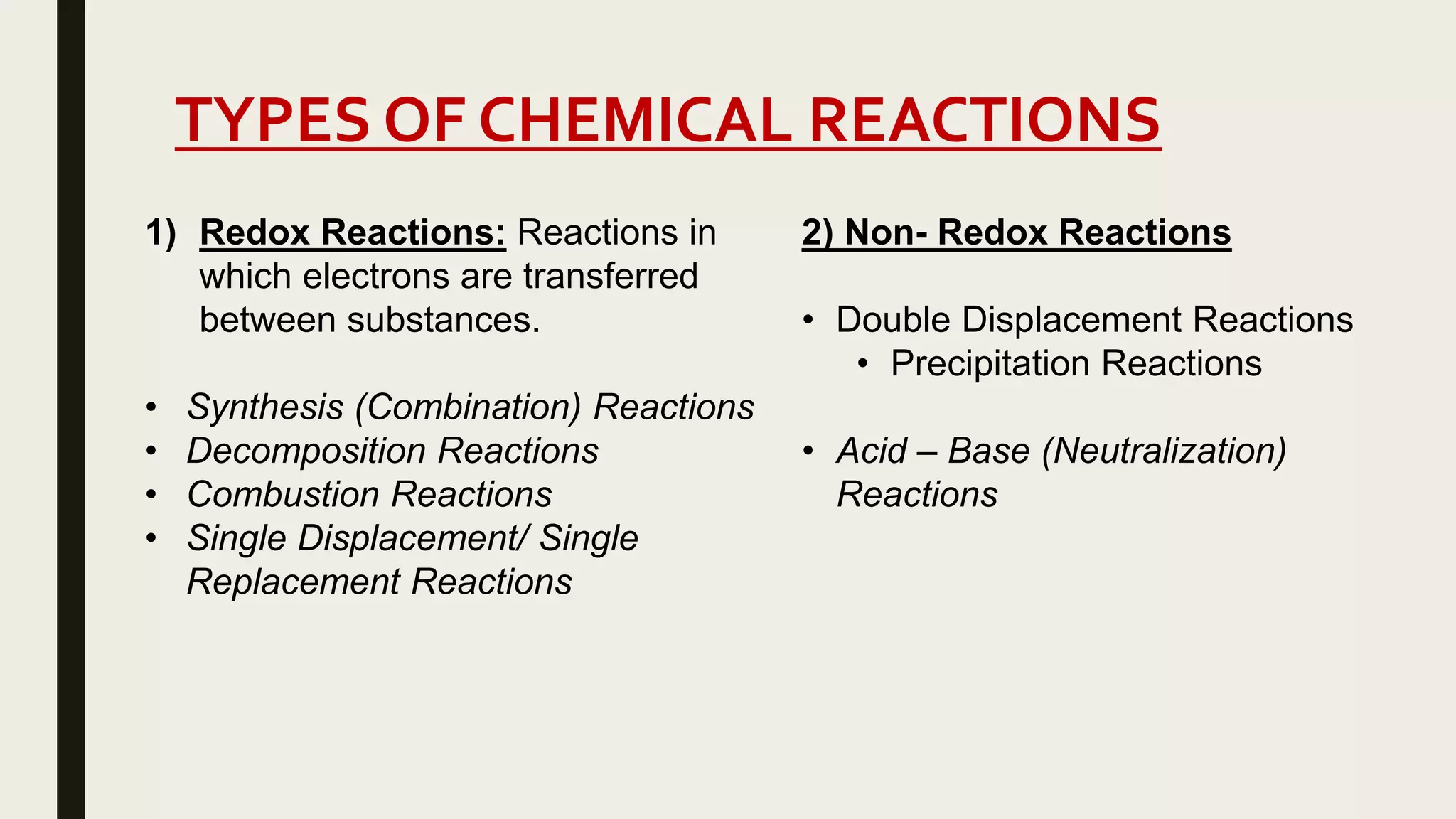
TYPES OF CHEMICAL REACTIONS
1) Redox Reactions: Reactions in
which electrons are transferred
between substances.
• Synthesis (Combination) Reactions
• Decomposition Reactions
• Combustion Reactions
• Single Displacement/ Single
Replacement Reactions
2) Non- Redox Reactions
• Double Displacement Reactions
• Precipitation Reactions
• Acid – Base (Neutralization)
Reactions
SYNTHESIS (COMBINATION)
REACTIONS■ Two or more substances (either element or compounds) react to
form a more complex substance.
General: A + B  AB
Example C(s) + O2(g)  CO2(g)
Ex. Synthesis Reaction
DECOMPOSITION REACTIONS
■ A complex substance is broken down into two or more simpler substances.
General: AB  A + B
Example 2HgO(s) 2Hg(l) O2(g)
Ex. Decomposition Reaction
COMBUSTION REACTIONS
■ Reactions in which substances react with oxygen in the air producing
heat energy.
CH4(g) + 2O2(g)  CO2(g) + 2H2O(l)
2Mg(s) + O2(g)  2MgO
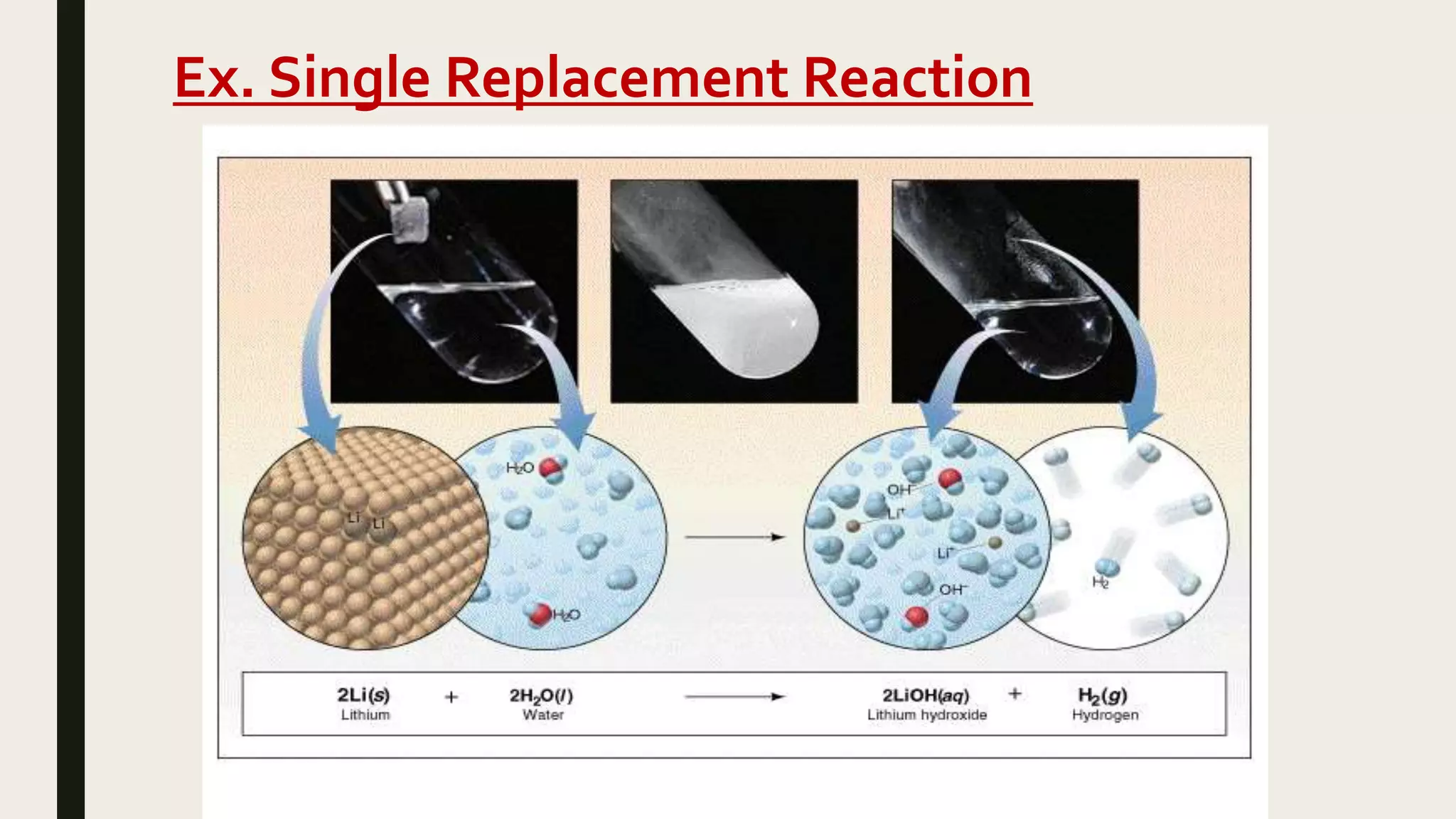
SINGLE DISPLACEMENT or SINGLE
REPLACEMENT REACTIONS
■ Reactions in which one element replaces another element in a compound.
■ One reactant is always an element, the other one is a compound.
General: AB + C  AC + B
Example: Zn + CuCl2  ZnCl2 + Cu
Ex. Single Replacement Reaction
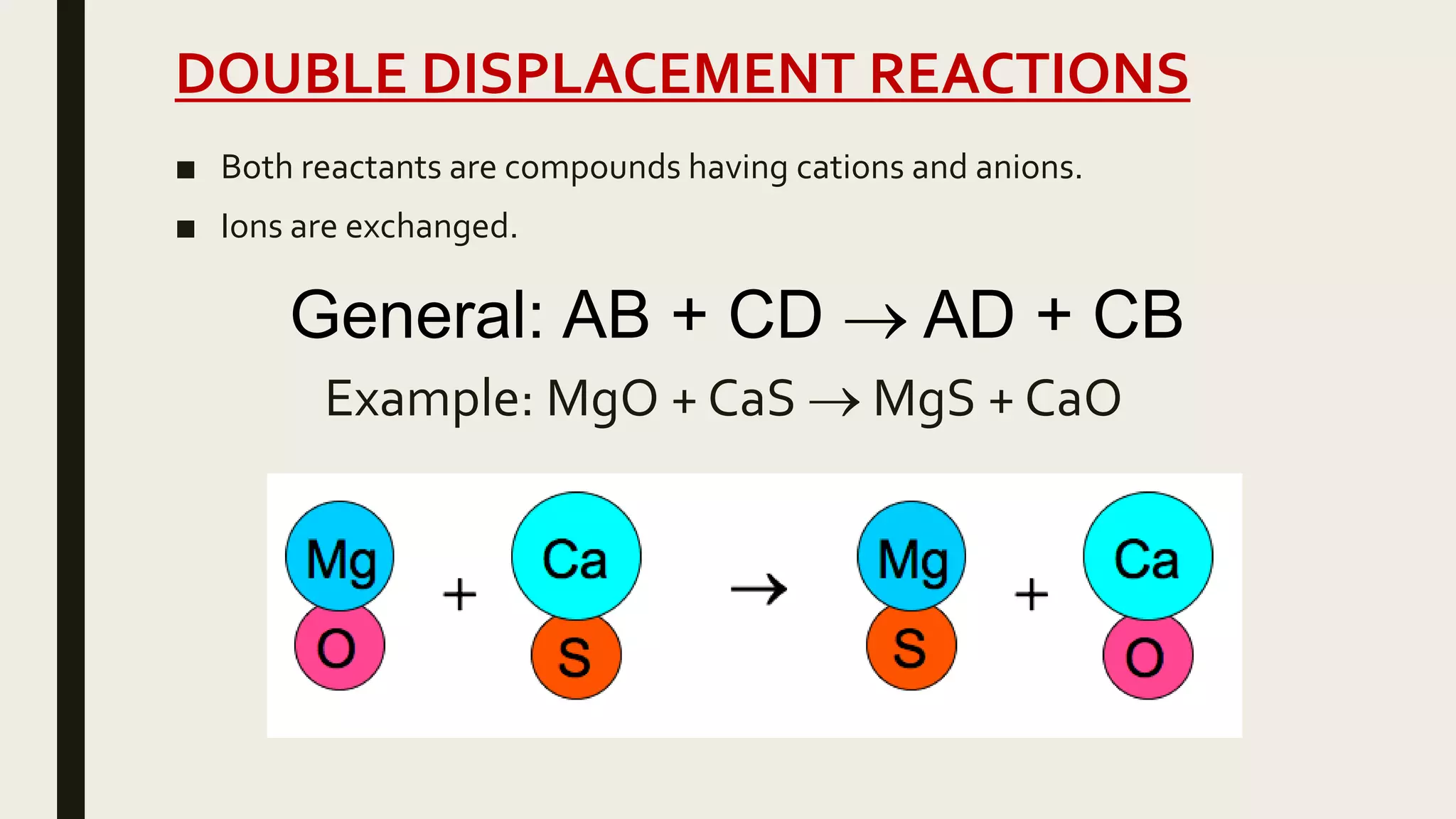
DOUBLE DISPLACEMENT REACTIONS
■ Both reactants are compounds having cations and anions.
■ Ions are exchanged.
General: AB + CD  AD + CB
Example: MgO + CaS  MgS + CaO
Ex. Double Replacement Reaction

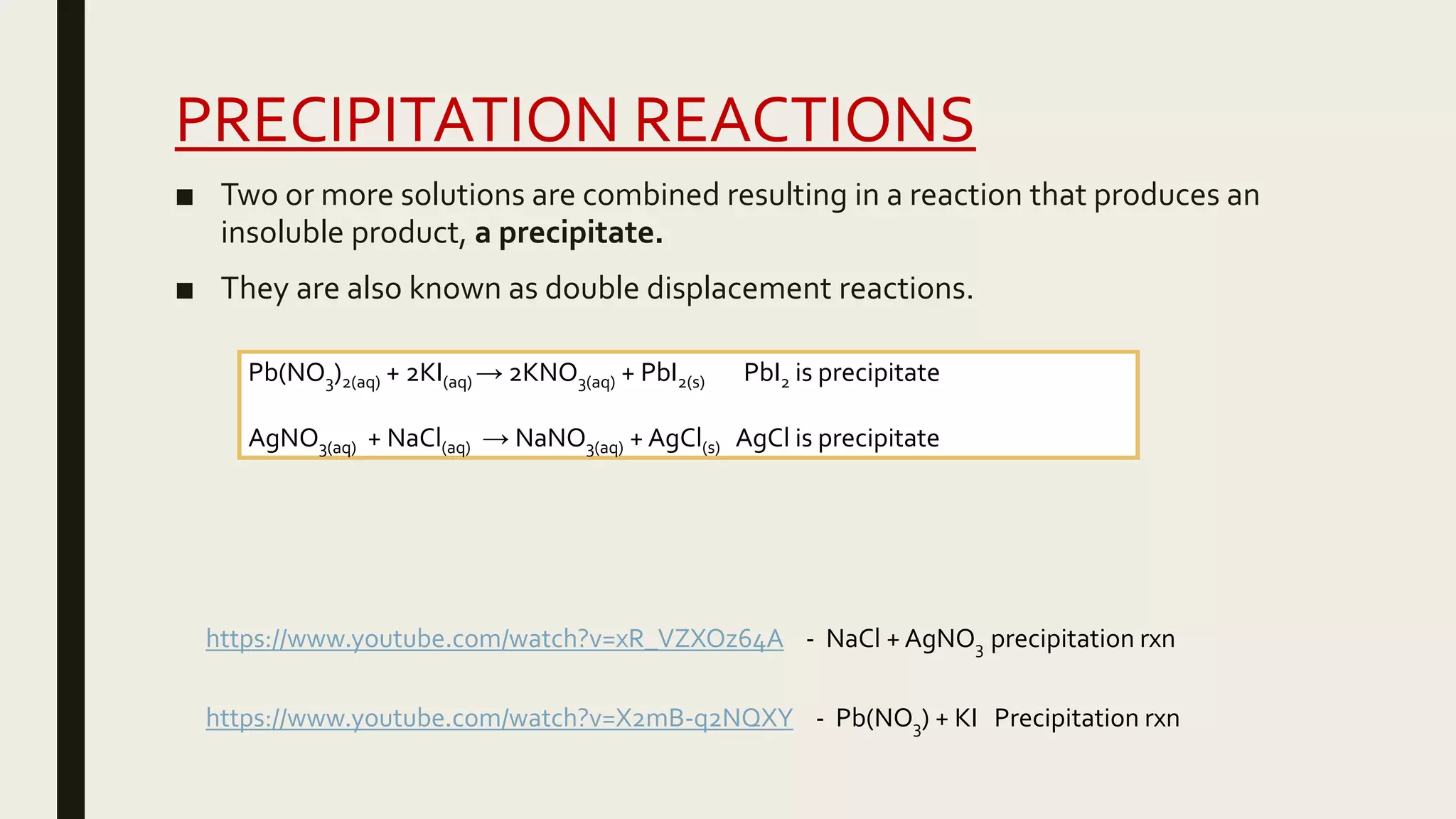
PRECIPITATION REACTIONS
■ Two or more solutions are combined resulting in a reaction that produces an
insoluble product, a precipitate.
■ They are also known as double displacement reactions.
https://www.youtube.com/watch?v=xR_VZXOz64A - NaCl + AgNO3 precipitation rxn
https://www.youtube.com/watch?v=X2mB-q2NQXY - Pb(NO3) + KI Precipitation rxn
Pb(NO3)2(aq) + 2KI(aq) → 2KNO3(aq) + PbI2(s) PbI2 is precipitate
AgNO3(aq) + NaCl(aq) → NaNO3(aq) + AgCl(s) AgCl is precipitate
ACID- BASE (Neutralization)
REACTIONS
2HNO3(aq) + Ba(OH)2 → Ba(NO3)2(aq) + 2H2O(l)
HCl(aq) +NaOH(aq) → NaCl(aq) + H2O(l)
CLOSE- UP CHEMICAL REACTIONS
■ https://www.youtube.com/watch?v=dQGreQyoXxI
■ https://www.youtube.com/watch?v=W1Elzy2Uyi8
■ Golden Rain - Growing crystals of lead iodide. Chemical reaction.
■ https://www.youtube.com/watch?v=TRq9hnOGvaE

Physical and chemical change

  • 1.
  • 2.
    PHYSICAL PROPERTIES ■ Appearance ■Texture ■ Color ■ Odor ■ Melting / Boiling Point ■ Density ■ Conductivity
  • 3.
    PHYSICAL CHANGE ■ Aphysical change alters the form of a substance, but does not change it to another substance. No change in chemical composition New substance does not form changes in states of substances, dissolution
  • 4.
    ! Phase changesare physical processes.
  • 5.
    CHEMICAL PROPERTIES ■ Flammability Tendencyto undergo a reaction with other substances (reactivity)
  • 6.
    CHEMICAL CHANGES ■ Whena substance undergoes a chemical change, it is changed into a different substance with different properties. Example: Baking a Cake • Chemical bonds (strong bonds) between the atoms are broken and formed. • New substance is formed.
  • 8.
    • burning, • rusting, •digestion of foods • photosynthesis etc. Chemical changes = Chemical reactions
  • 9.
    5 Signs ofa Chemical Change (Reaction) 1. Color Change 2. Precipitation
  • 10.
    5 Signs ofa Chemical Change (Reaction) 3. Gas Production 4. Temperature Change
  • 11.
    5 Signs ofa Chemical Change (Reaction) 5. Changes in Characteristic Properties (odor, light given off)
  • 12.
    Chemical or PhysicalChange? ■ Cutting paper? ■ Physical ■ Ice melting? ■ Physical ■ Toast burning? ■ Chemical
  • 13.
    Chemical or PhysicalChange? ■ Rocket fuel burning? ■ Chemical ■ Sawing wood? ■ Physical ■ Disappearing puddle? ■ Physical
  • 14.
    Chemical or PhysicalChange? ■ Metal rusting? ■ Chemical ■ Candle burning? ■ Chemical
  • 15.
    CHEMICAL REACTIONS ■ Duringa chemical reaction, both physical and chemical properties change Chemical Reactions are Everywhere
  • 16.
    CHEMICAL REACTIONS ■ ChemicalReactions are represented by Chemical Equations. A + B  C (chemical equation) ■ Solid Sodium combines with Chlorine gas to make solid Sodium Chloride: 2Na (s) + Cl2 (g)  2NaCl ■ Chemical Equations are different from Numerical Equations: Numerical Equation: 3x + 2y = 47 Chemical Equation 2Na + Cl2  2NaCl
  • 17.
    Symbols used inChemical Equations Symbol Purpose + Separates more than one reactant or product  Separates reactants from products. Indicates direction of reaction (s) Identifies a solid state (aq) Identifies that something is dissolved in water (l) Identifies liquid state (g) Identifies gaseous state
  • 18.
    CHEMICAL REACTIONS In achemical equation, ■ Number of atoms are conserved. ■ Mass is conserved. ■ The chemical bonding changes. ■ The electrical charge is conserved. ■ Number of molecules and volume may not be conserved. ■ Since number of atoms and mass must be conserved, chemical equations should be balanced using coefficients on reactant and product side.
  • 19.
    Steps to Balancinga Chemical Equation 6. Check your work 5. Write the Coefficients in their lowest possible ratio 4. Change to Coefficients to make the number of atoms of each element equal on both sides of arrow 2Li(s) + 2 H2O  H2(g) + 2LiOH(aq) 3. Count the atoms of the elements in the products 1 atom Li, 3 atoms H, 1 atomO 2. Count the atoms of the elements in the reactants 1 atom Li, 2 atoms H, 1 atomO 1. Write the Skeleton Equation Li(s) + H2O(l)  H2 (g) + LiOH (aq)
  • 20.
    BALANCING CHEMICAL EQUATIONS: AnotherExample ■ CH4 (methane gas) + O2  CO2 + H2O 7 ≠ 6! Where did our atoms go? Reactants Products # of Carbons = 1 # of Carbons = 1 # of Hydrogens = 4 # of Hydrogens = 2 # of Oxygens = 2 # of Oxygens = 3 Total atoms = 7 Total atoms = 6 CH4 (methane gas) + 2O2  CO2 + 2H2O
  • 21.
    BALANCING CHEMICAL EQUATIONS: AnotherExample ■ Fe2O3 + H2SO4  Fe2(SO4)3 + H2O ■ Hint : balance the polyatomic ion first! ■ Fe2O3 + 3H2SO4  Fe2(SO4)3 + 3H2O ■ !!! CONSIDERWHOLE POLYATOMIC ION ASAN ELEMENT.
  • 22.
    REVIEW ■ Matter isnot destroyed or created ■ Atoms are rearranged in chemical reactions ■ Chemical equations represent chemical reactions ■ You have to have the same number of each type of atom on the left and right hand side of a chemical equation
  • 23.
    TYPES OF CHEMICALREACTIONS 1) Redox Reactions: Reactions in which electrons are transferred between substances. • Synthesis (Combination) Reactions • Decomposition Reactions • Combustion Reactions • Single Displacement/ Single Replacement Reactions 2) Non- Redox Reactions • Double Displacement Reactions • Precipitation Reactions • Acid – Base (Neutralization) Reactions
  • 24.
    SYNTHESIS (COMBINATION) REACTIONS■ Twoor more substances (either element or compounds) react to form a more complex substance. General: A + B  AB Example C(s) + O2(g)  CO2(g)
  • 25.
  • 26.
    DECOMPOSITION REACTIONS ■ Acomplex substance is broken down into two or more simpler substances. General: AB  A + B Example 2HgO(s) 2Hg(l) O2(g)
  • 27.
  • 28.
    COMBUSTION REACTIONS ■ Reactionsin which substances react with oxygen in the air producing heat energy. CH4(g) + 2O2(g)  CO2(g) + 2H2O(l) 2Mg(s) + O2(g)  2MgO
  • 29.
    SINGLE DISPLACEMENT orSINGLE REPLACEMENT REACTIONS ■ Reactions in which one element replaces another element in a compound. ■ One reactant is always an element, the other one is a compound. General: AB + C  AC + B Example: Zn + CuCl2  ZnCl2 + Cu
  • 30.
  • 31.
    DOUBLE DISPLACEMENT REACTIONS ■Both reactants are compounds having cations and anions. ■ Ions are exchanged. General: AB + CD  AD + CB Example: MgO + CaS  MgS + CaO
  • 32.
  • 33.
    PRECIPITATION REACTIONS ■ Twoor more solutions are combined resulting in a reaction that produces an insoluble product, a precipitate. ■ They are also known as double displacement reactions. https://www.youtube.com/watch?v=xR_VZXOz64A - NaCl + AgNO3 precipitation rxn https://www.youtube.com/watch?v=X2mB-q2NQXY - Pb(NO3) + KI Precipitation rxn Pb(NO3)2(aq) + 2KI(aq) → 2KNO3(aq) + PbI2(s) PbI2 is precipitate AgNO3(aq) + NaCl(aq) → NaNO3(aq) + AgCl(s) AgCl is precipitate
  • 34.
    ACID- BASE (Neutralization) REACTIONS 2HNO3(aq)+ Ba(OH)2 → Ba(NO3)2(aq) + 2H2O(l) HCl(aq) +NaOH(aq) → NaCl(aq) + H2O(l)
  • 35.
    CLOSE- UP CHEMICALREACTIONS ■ https://www.youtube.com/watch?v=dQGreQyoXxI ■ https://www.youtube.com/watch?v=W1Elzy2Uyi8 ■ Golden Rain - Growing crystals of lead iodide. Chemical reaction. ■ https://www.youtube.com/watch?v=TRq9hnOGvaE