http://www.unit5.org/chemistry/Equations.html
   Chemical Reactions are associated with chemical
    change.
   Whenever a chemical change occurs chemical
    reaction is said to take place.
   Chemical reactions are usually irreversible and a
    new product is formed.
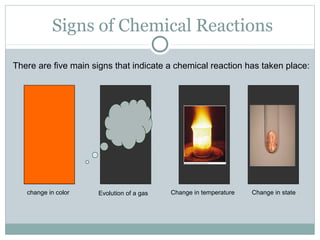
Signs of Chemical Reactions

There are five main signs that indicate a chemical reaction has taken place:


   change in color   Evolution of a gas   Change in temperature   Change in state
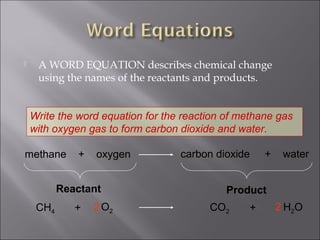
    A WORD EQUATION describes chemical change
     using the names of the reactants and products.


    Write the word equation for the reaction of methane gas
    with oxygen gas to form carbon dioxide and water.

methane       +   oxygen           carbon dioxide     +    water


           Reactant                          Product
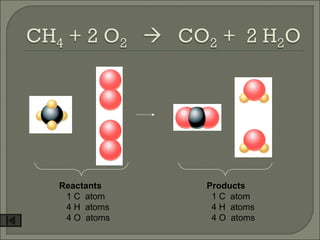
     CH4      +   2 O2                   CO2      +       2 H2O
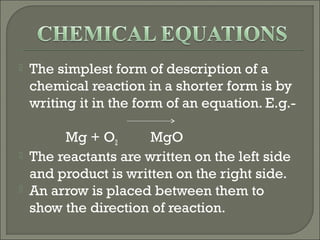
   The simplest form of description of a
    chemical reaction in a shorter form is by
    writing it in the form of an equation. E.g.-

         Mg + O2       MgO
   The reactants are written on the left side
    and product is written on the right side.
   An arrow is placed between them to
    show the direction of reaction.
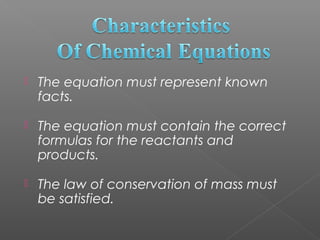
   The equation must represent known
    facts.

   The equation must contain the correct
    formulas for the reactants and
    products.

   The law of conservation of mass must
    be satisfied.
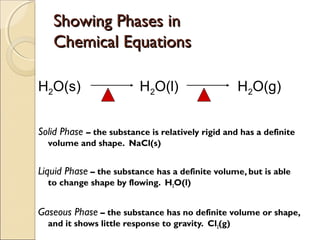
Showing Phases in
   Chemical Equations

H2O(s)                    H2O(l)                    H2O(g)


Solid Phase – the substance is relatively rigid and has a definite
  volume and shape. NaCl(s)


Liquid Phase – the substance has a definite volume, but is able
  to change shape by flowing. H2O(l)


Gaseous Phase – the substance has no definite volume or shape,
  and it shows little response to gravity. Cl2(g)
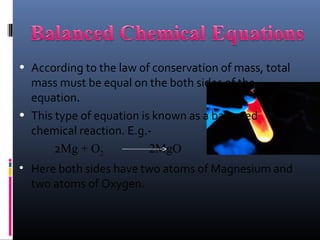
• According to the law of conservation of mass, total
  mass must be equal on the both sides of the
  equation.
• This type of equation is known as a balanced
  chemical reaction. E.g.-
       2Mg + O2           2MgO
• Here both sides have two atoms of Magnesium and
  two atoms of Oxygen.
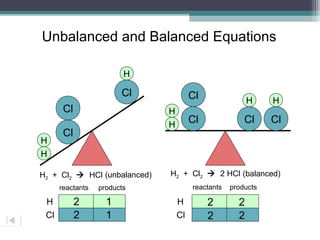
Unbalanced and Balanced Equations

                         H

                        Cl             Cl                H    H
       Cl                     H
                              H
                                       Cl              Cl     Cl
       Cl
H
H

H2 + Cl2  HCl (unbalanced)   H2 + Cl2  2 HCl (balanced)
      reactants   products             reactants   products

 H          2       1             H         2        2
 Cl         2       1             Cl        2        2
Reactants    Products
 1 C atom     1 C atom
 4 H atoms    4 H atoms
 4 O atoms    4 O atoms
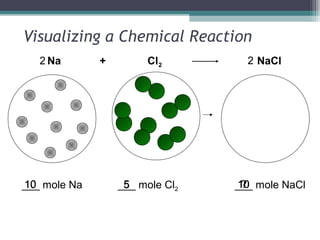
Visualizing a Chemical Reaction
   2 Na       +        Cl 2        2 NaCl


10
___ mole Na        5
                  ___ mole Cl2   10
                                  ?
                                 ___ mole NaCl
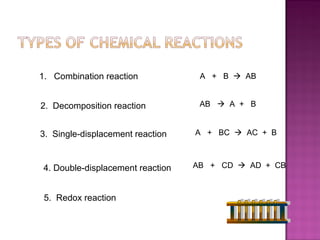
1. Combination reaction             A + B  AB


2. Decomposition reaction           AB  A + B


3. Single-displacement reaction    A + BC  AC + B


 4. Double-displacement reaction   AB + CD  AD + CB


 5. Redox reaction
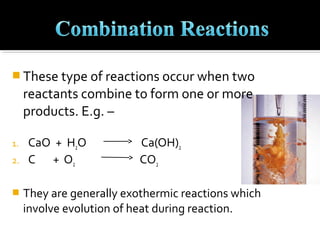
 These type of reactions occur when two
     reactants combine to form one or more
     products. E.g. –

1.   CaO + H2O             Ca(OH)2
2.   C + O2                CO2

    They are generally exothermic reactions which
     involve evolution of heat during reaction.
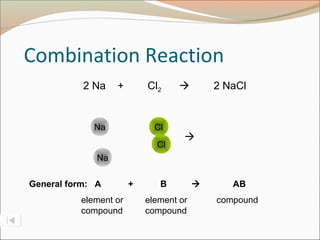
Combination Reaction
           2 Na    +       Cl2             2 NaCl


             Na              Cl
                                    
                             Cl
              Na

General form: A        +      B               AB
          element or       element or       compound
          compound         compound
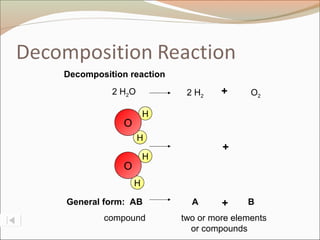
Decomposition Reaction
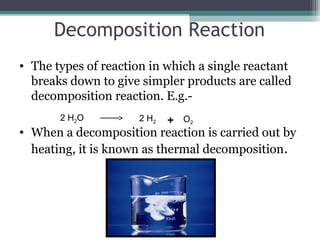
• The types of reaction in which a single reactant
  breaks down to give simpler products are called
  decomposition reaction. E.g.-
       2 H 2O         2 H2   + O2
• When a decomposition reaction is carried out by
  heating, it is known as thermal decomposition.
Decomposition reaction
          2 H 2O          2 H2    +      O2

                     H
             O
                   H
                                  +
                     H
             O
                 H

General form: AB           A      +     B
        compound         two or more elements
                           or compounds
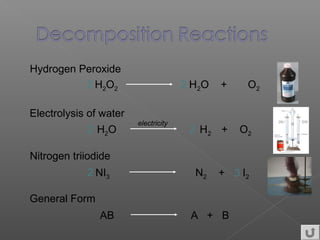
Hydrogen Peroxide
          2 H2O2                      2 H 2O   +    O2

Electrolysis of water
                        electricity
            2 H2O                      2 H2 +      O2

Nitrogen triiodide
            2 NI3                        N2    + 3 I2

General Form
               AB                       A + B
• The reaction in which a more reactive
   element displaces a less reactive element
   from its solution is known as displacement
   reaction.
• They are of two types:-
1. Single Displacement Reaction
2.Double Displacement Reaction
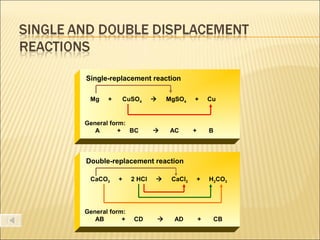
Single-replacement reaction

 Mg    +       CuSO4            MgSO4    +       Cu


General form:
   A       + BC                 AC       +       B


Double-replacement reaction

 CaCO3     +     2 HCl           CaCl2       +   H2CO3


General form:
   AB       +     CD              AD         +    CB
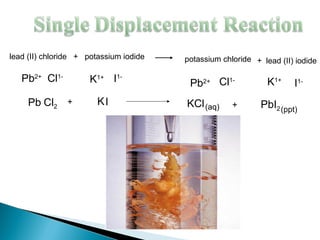
lead (II) chloride + potassium iodide   potassium chloride + lead (II) iodide

   Pb2+ Cl1-         K1+ I1-             Pb2+ Cl1-             K1+    I1-
     Pb Cl2 +           KI              KCl (aq)     +       PbI2 (ppt)
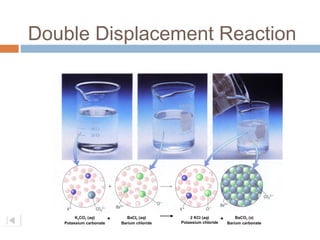
Double Displacement Reaction


        K2CO3 (aq)       +     BaCl2 (aq)          2 KCl (aq)       +       BaCO3 (s)
   Potassium carbonate       Barium chloride   Potassium chloride       Barium carbonate
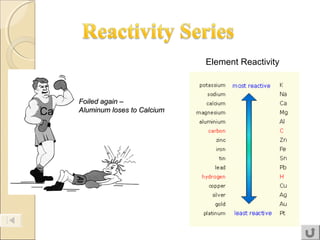
Element Reactivity


     Foiled again –
Ca   Aluminum loses to Calcium
• If a substance gains oxygen during a reaction, it is
  said to be oxidised.
• If a substance loses oxygen during a reaction, it is
  said to be reduced.
• Reactions in which this type of change occurs is
  known as Oxidation and Reduction reactions or
  Redox reactions. E.g. –
          CuO + H2           Cu +H2O
chemical equation and reaction

chemical equation and reaction

  • 1.
  • 2.
    Chemical Reactions are associated with chemical change.  Whenever a chemical change occurs chemical reaction is said to take place.  Chemical reactions are usually irreversible and a new product is formed.
  • 3.
    Signs of ChemicalReactions There are five main signs that indicate a chemical reaction has taken place: change in color Evolution of a gas Change in temperature Change in state
  • 4.
    A WORD EQUATION describes chemical change using the names of the reactants and products. Write the word equation for the reaction of methane gas with oxygen gas to form carbon dioxide and water. methane + oxygen carbon dioxide + water Reactant Product CH4 + 2 O2 CO2 + 2 H2O
  • 5.
    The simplest form of description of a chemical reaction in a shorter form is by writing it in the form of an equation. E.g.- Mg + O2 MgO  The reactants are written on the left side and product is written on the right side.  An arrow is placed between them to show the direction of reaction.
  • 6.
    The equation must represent known facts.  The equation must contain the correct formulas for the reactants and products.  The law of conservation of mass must be satisfied.
  • 7.
    Showing Phases in Chemical Equations H2O(s) H2O(l) H2O(g) Solid Phase – the substance is relatively rigid and has a definite volume and shape. NaCl(s) Liquid Phase – the substance has a definite volume, but is able to change shape by flowing. H2O(l) Gaseous Phase – the substance has no definite volume or shape, and it shows little response to gravity. Cl2(g)
  • 8.
    • According tothe law of conservation of mass, total mass must be equal on the both sides of the equation. • This type of equation is known as a balanced chemical reaction. E.g.- 2Mg + O2 2MgO • Here both sides have two atoms of Magnesium and two atoms of Oxygen.
  • 9.
    Unbalanced and BalancedEquations H Cl Cl H H Cl H H Cl Cl Cl Cl H H H2 + Cl2  HCl (unbalanced) H2 + Cl2  2 HCl (balanced) reactants products reactants products H 2 1 H 2 2 Cl 2 1 Cl 2 2
  • 10.
    Reactants Products 1 C atom 1 C atom 4 H atoms 4 H atoms 4 O atoms 4 O atoms
  • 11.
    Visualizing a ChemicalReaction 2 Na + Cl 2 2 NaCl 10 ___ mole Na 5 ___ mole Cl2 10 ? ___ mole NaCl
  • 12.
    1. Combination reaction A + B  AB 2. Decomposition reaction AB  A + B 3. Single-displacement reaction A + BC  AC + B 4. Double-displacement reaction AB + CD  AD + CB 5. Redox reaction
  • 13.
     These typeof reactions occur when two reactants combine to form one or more products. E.g. – 1. CaO + H2O Ca(OH)2 2. C + O2 CO2  They are generally exothermic reactions which involve evolution of heat during reaction.
  • 14.
    Combination Reaction 2 Na + Cl2  2 NaCl Na Cl  Cl Na General form: A + B  AB element or element or compound compound compound
  • 15.
    Decomposition Reaction • Thetypes of reaction in which a single reactant breaks down to give simpler products are called decomposition reaction. E.g.- 2 H 2O 2 H2 + O2 • When a decomposition reaction is carried out by heating, it is known as thermal decomposition.
  • 16.
    Decomposition reaction 2 H 2O 2 H2 + O2 H O H + H O H General form: AB A + B compound two or more elements or compounds
  • 17.
    Hydrogen Peroxide 2 H2O2 2 H 2O + O2 Electrolysis of water electricity 2 H2O 2 H2 + O2 Nitrogen triiodide 2 NI3 N2 + 3 I2 General Form AB A + B
  • 18.
    • The reactionin which a more reactive element displaces a less reactive element from its solution is known as displacement reaction. • They are of two types:- 1. Single Displacement Reaction 2.Double Displacement Reaction
  • 19.
    Single-replacement reaction Mg + CuSO4  MgSO4 + Cu General form: A + BC  AC + B Double-replacement reaction CaCO3 + 2 HCl  CaCl2 + H2CO3 General form: AB + CD  AD + CB
  • 20.
    lead (II) chloride+ potassium iodide potassium chloride + lead (II) iodide Pb2+ Cl1- K1+ I1- Pb2+ Cl1- K1+ I1- Pb Cl2 + KI KCl (aq) + PbI2 (ppt)
  • 21.
    Double Displacement Reaction K2CO3 (aq) + BaCl2 (aq) 2 KCl (aq) + BaCO3 (s) Potassium carbonate Barium chloride Potassium chloride Barium carbonate
  • 22.
    Element Reactivity Foiled again – Ca Aluminum loses to Calcium
  • 23.
    • If asubstance gains oxygen during a reaction, it is said to be oxidised. • If a substance loses oxygen during a reaction, it is said to be reduced. • Reactions in which this type of change occurs is known as Oxidation and Reduction reactions or Redox reactions. E.g. – CuO + H2 Cu +H2O

Editor's Notes

  • #2 Chemical Reaction - Study Questions 1. What is a chemical reaction? 2. What is evidence a reaction has occurred? 3. What is a chemical equation? 4. Define reactants. 5. Define products. 6. Define catalyst. 7. What information is found in an equation? 8. What symbols are used to represent the states of matter? 9. What is the meaning of “aq”? 10. How do you indicate a catalyst is being used in a reaction? 11. What is activation energy? 12. What the three things does conservation of matter require of chemical equations? 13. What is the procedure for balancing a chemical equation? 14. Balance the equation for the reaction of magnesium chloride and silver nitrate to form magnesium nitrate and silver chloride. 15. What is a synthesis reaction? 16. How is a combustion reaction related to a synthesis reaction? 17. What type of reaction is an explosion? 18. Compare decomposition and dissociation. 19. What determines whether one metal will replace another in a single displacement reaction? 20. What is the general form of a double displacement reaction? 21. What type of reaction is each of these? 2Na(s) + Cl 2 (g)  2NaCl(s) PCl 5 (s)  PCl 3 (s) + Cl 2 (g) 2Al(s) + Fe 2 O 3 (s)  2Fe(s) + Al 2 O 3 (s) C 6 H 12 O 6 (s) + 6O 2 (g)  6CO 2 (g) + 6H 2 O(l) BaCl 2 (aq) + H 2 SO 4 (aq)  2HCl(aq) + BaSO 4 (s) 22. What is the oxidation number of an element? 23. What is the oxidation number of the fluorine ion? 24. What is the sum of the oxidation numbers in a compound? 31. Can a redox reaction form a molecule? Explain your answer .
  • #9 A chemical equation is an expression that gives the identities and quantities of the substances in a chemical reaction Chemical formulas and other symbols are used to indicate the starting material(s) or reactant(s), which are written on the left side of the equation, and the final compound(s) or product(s), which are written on the right side. An arrow, read as yields or reacts to form, points from the reactants to the products. Abbreviations are added in parentheses as subscripts to indicate the physical state of each species: — ( s ) for solid, ( l ) for liquid, ( g ) for gas, and ( aq ) for an aqueous solution. A balanced chemical equation is when both the numbers of each type of atom and the total charge are the same on both sides. A chemical reaction represents a change in the distribution of atoms but not in the number of atoms. http://img.alibaba.com/photo/10784694/Aluminum_Oxide_Abrasive_Fine_Grit_120_220_.jpg http://upload.wikimedia.org/wikipedia/commons/thumb/f/f2/Corundum_Aluminum_Oxide_Gallantin_Co_MontanaDSC03201.jpg/600px-Corundum_Aluminum_Oxide_Gallantin_Co_MontanaDSC03201.jpg http://www.germes-online.com/direct/dbimage/50327532/Aluminum_Alloy_Pipe.jpg
  • #13 Objective: To classify a chemical reaction as one of the following types: combination (synthesis), decomposition, single replacement, double replacement, or neutralization.
  • #21 A reaction that yields an insoluble product, a precipitate, when two solutions are mixed Are a subclass of exchange reactions that occur between ionic compounds when one of the products is insoluble Used to isolate metals that have been extracted from their ores and to recover precious metals for recycling
  • #23 Objectives: To explain the concept of an activity series for metals. To predict whether a single-replacement reaction occurs by referring to the activity series. The Activity Series – Predicts the outcome of the single-displacement reactions – Arranges metal and hydrogen in decreasing order of their tendency to be oxidized – Active metals at the top of the series have the greatest tendency to lose electrons; these including alkali metals (Group 1), alkaline earths (Group 2), and Al (Group 13). – Inert metals at the bottom of the series have the lowest tendency to be oxidized; these include precious metals or coinage metals located in the lower-right portion of the metals in the periodic table. – Any element will reduce compounds of the elements below it in the series. – Only those metals that lie above hydrogen in the activity series dissolve in acids to produce H 2 .