Lab 5 Single Replacement Reactions
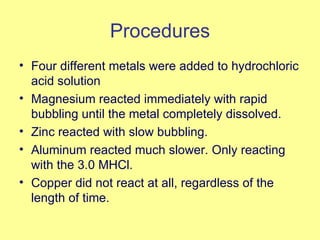
Procedures Four different metals were added to hydrochloric acid solution Magnesium reacted immediately with rapid bubbling until the metal completely dissolved. Zinc reacted with slow bubbling. Aluminum reacted much slower. Only reacting with the 3.0 MHCl. Copper did not react at all, regardless of the length of time.
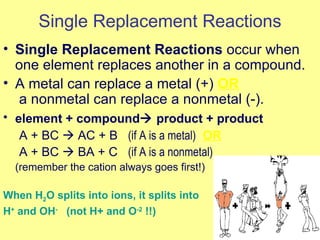
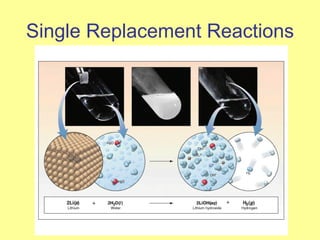
Single Replacement Reactions Single Replacement Reactions  occur when one element replaces another in a compound. A metal can replace a metal (+)  OR  a nonmetal can replace a nonmetal (-). element + compound   product + product   A + BC    AC + B  (if A is a metal)   OR A + BC    BA + C  (if A is a nonmetal)   (remember the cation always goes first!) When H 2 O splits into ions, it splits into H +  and OH -   (not H+ and O -2  !!)
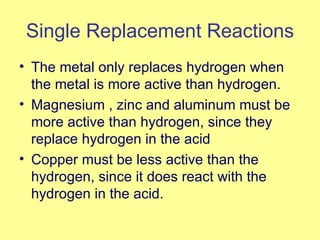
Single Replacement Reactions The metal only replaces hydrogen when the metal is more active than hydrogen. Magnesium , zinc and aluminum must be more active than hydrogen, since they replace hydrogen in the acid Copper must be less active than the hydrogen, since it does react with the hydrogen in the acid.
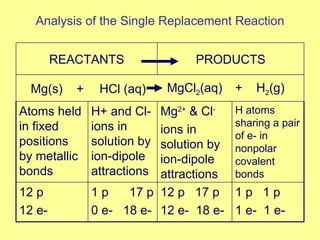
Analysis of the Single Replacement Reaction 1 p  1 p 1 e-  1 e- 12 p  17 p 12 e-  18 e- 1 p  17 p 0 e-  18 e- 12 p 12 e- H atoms sharing a pair of e- in nonpolar covalent bonds Mg 2+  & Cl - ions in solution by ion-dipole attractions H+ and Cl- ions in solution by ion-dipole attractions Atoms held in fixed positions by metallic bonds +  H 2 (g) MgCl 2 (aq) HCl (aq) Mg(s)  + PRODUCTS REACTANTS
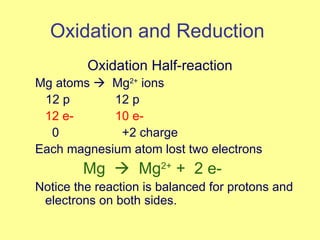
Oxidation and Reduction  Oxidation Half-reaction Mg atoms     Mg 2+  ions 12 p 12 p 12 e- 10 e-   0   +2 charge Each magnesium atom lost two electrons  Mg     Mg 2+  +  2 e- Notice the reaction is balanced for protons and electrons on both sides.
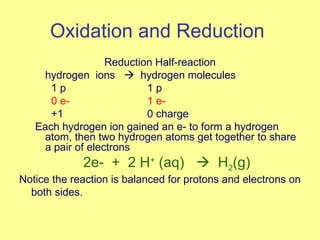
Oxidation and Reduction  Reduction Half-reaction hydrogen  ions     hydrogen molecules 1 p 1 p 0 e- 1 e-   +1   0 charge Each hydrogen ion gained an e- to form a hydrogen atom, then two hydrogen atoms get together to share a pair of electrons 2e-  +  2 H +  (aq)     H 2 (g)   Notice the reaction is balanced for protons and electrons on both sides.
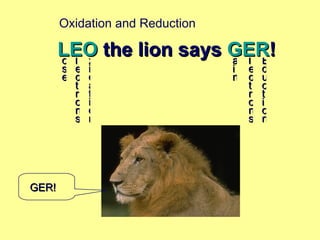
LEO  the lion says  GER ! ose lectrons xidation ain lectrons Eduction GER! Oxidation and Reduction
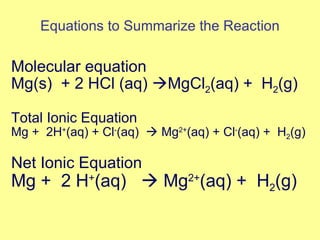
Equations to Summarize the Reaction Molecular equation Mg(s)  + 2 HCl (aq)   MgCl 2 (aq) +  H 2 (g)   Total Ionic Equation Mg +  2H + (aq) + Cl - (aq)    Mg 2+ (aq) + Cl - (aq) +  H 2 (g)  Net Ionic Equation Mg +  2 H + (aq)    Mg 2+ (aq) +  H 2 (g)
Single Replacement Reactions
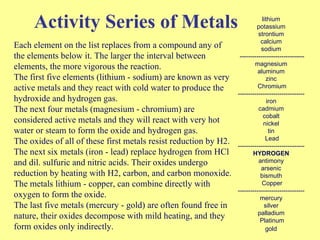
Activity Series of Metals   Each element on the list replaces from a compound any of the elements below it. The larger the interval between elements, the more vigorous the reaction.  The first five elements (lithium - sodium) are known as very active metals and they react with cold water to produce the hydroxide and hydrogen gas.  The next four metals (magnesium - chromium) are considered active metals and they will react with very hot water or steam to form the oxide and hydrogen gas.  The oxides of all of these first metals resist reduction by H2.  The next six metals (iron - lead) replace hydrogen from HCl and dil. sulfuric and nitric acids. Their oxides undergo reduction by heating with H2, carbon, and carbon monoxide.  The metals lithium - copper, can combine directly with oxygen to form the oxide.  The last five metals (mercury - gold) are often found free in nature, their oxides decompose with mild heating, and they form oxides only indirectly.  lithium  potassium  strontium  calcium  sodium  ------------------------------- magnesium  aluminum  zinc  Chromium --------------------------------  iron  cadmium  cobalt  nickel  tin  Lead --------------------------------  HYDROGEN   antimony  arsenic  bismuth  Copper --------------------------------  mercury  silver  palladium  Platinum gold

chem Lab 5

  • 1.
    Lab 5 SingleReplacement Reactions
  • 2.
    Procedures Four differentmetals were added to hydrochloric acid solution Magnesium reacted immediately with rapid bubbling until the metal completely dissolved. Zinc reacted with slow bubbling. Aluminum reacted much slower. Only reacting with the 3.0 MHCl. Copper did not react at all, regardless of the length of time.
  • 3.
    Single Replacement ReactionsSingle Replacement Reactions occur when one element replaces another in a compound. A metal can replace a metal (+) OR a nonmetal can replace a nonmetal (-). element + compound  product + product A + BC  AC + B (if A is a metal) OR A + BC  BA + C (if A is a nonmetal) (remember the cation always goes first!) When H 2 O splits into ions, it splits into H + and OH - (not H+ and O -2 !!)
  • 4.
    Single Replacement ReactionsThe metal only replaces hydrogen when the metal is more active than hydrogen. Magnesium , zinc and aluminum must be more active than hydrogen, since they replace hydrogen in the acid Copper must be less active than the hydrogen, since it does react with the hydrogen in the acid.
  • 5.
    Analysis of theSingle Replacement Reaction 1 p 1 p 1 e- 1 e- 12 p 17 p 12 e- 18 e- 1 p 17 p 0 e- 18 e- 12 p 12 e- H atoms sharing a pair of e- in nonpolar covalent bonds Mg 2+ & Cl - ions in solution by ion-dipole attractions H+ and Cl- ions in solution by ion-dipole attractions Atoms held in fixed positions by metallic bonds + H 2 (g) MgCl 2 (aq) HCl (aq) Mg(s) + PRODUCTS REACTANTS
  • 6.
    Oxidation and Reduction Oxidation Half-reaction Mg atoms  Mg 2+ ions 12 p 12 p 12 e- 10 e- 0 +2 charge Each magnesium atom lost two electrons Mg  Mg 2+ + 2 e- Notice the reaction is balanced for protons and electrons on both sides.
  • 7.
    Oxidation and Reduction Reduction Half-reaction hydrogen ions  hydrogen molecules 1 p 1 p 0 e- 1 e- +1 0 charge Each hydrogen ion gained an e- to form a hydrogen atom, then two hydrogen atoms get together to share a pair of electrons 2e- + 2 H + (aq)  H 2 (g) Notice the reaction is balanced for protons and electrons on both sides.
  • 8.
    LEO thelion says GER ! ose lectrons xidation ain lectrons Eduction GER! Oxidation and Reduction
  • 9.
    Equations to Summarizethe Reaction Molecular equation Mg(s) + 2 HCl (aq)  MgCl 2 (aq) + H 2 (g) Total Ionic Equation Mg + 2H + (aq) + Cl - (aq)  Mg 2+ (aq) + Cl - (aq) + H 2 (g) Net Ionic Equation Mg + 2 H + (aq)  Mg 2+ (aq) + H 2 (g)
  • 10.
  • 11.
    Activity Series ofMetals Each element on the list replaces from a compound any of the elements below it. The larger the interval between elements, the more vigorous the reaction. The first five elements (lithium - sodium) are known as very active metals and they react with cold water to produce the hydroxide and hydrogen gas. The next four metals (magnesium - chromium) are considered active metals and they will react with very hot water or steam to form the oxide and hydrogen gas. The oxides of all of these first metals resist reduction by H2. The next six metals (iron - lead) replace hydrogen from HCl and dil. sulfuric and nitric acids. Their oxides undergo reduction by heating with H2, carbon, and carbon monoxide. The metals lithium - copper, can combine directly with oxygen to form the oxide. The last five metals (mercury - gold) are often found free in nature, their oxides decompose with mild heating, and they form oxides only indirectly. lithium potassium strontium calcium sodium ------------------------------- magnesium aluminum zinc Chromium -------------------------------- iron cadmium cobalt nickel tin Lead -------------------------------- HYDROGEN antimony arsenic bismuth Copper -------------------------------- mercury silver palladium Platinum gold