CHARACTERISTICS
OF RESEARCH
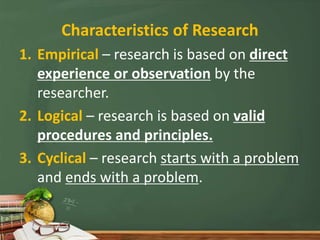
Characteristics of Research
1. Empirical – research is based on direct
experience or observation by the
researcher.
2. Logical – research is based on valid
procedures and principles.
3. Cyclical – research starts with a problem
and ends with a problem.
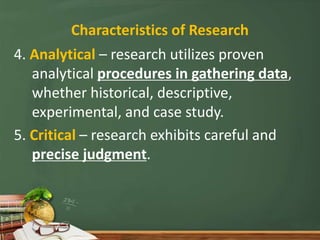
Characteristics of Research
4. Analytical – research utilizes proven
analytical procedures in gathering data,
whether historical, descriptive,
experimental, and case study.
5. Critical – research exhibits careful and
precise judgment.
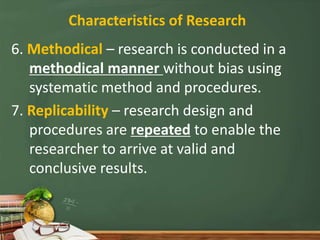
Characteristics of Research
6. Methodical – research is conducted in a
methodical manner without bias using
systematic method and procedures.
7. Replicability – research design and
procedures are repeated to enable the
researcher to arrive at valid and
conclusive results.
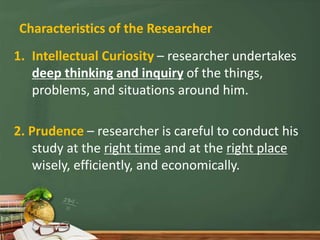
Characteristics of the Researcher
1. Intellectual Curiosity – researcher undertakes
deep thinking and inquiry of the things,
problems, and situations around him.
2. Prudence – researcher is careful to conduct his
study at the right time and at the right place
wisely, efficiently, and economically.
Characteristics of the Researcher
3. Healthy Criticism – the researcher is always
doubtful as to the truthfulness of the results.
4. Intellectual Honesty – researcher is honest to
collect or gather the data or facts in order to
arrive at honest results.
Characteristics of the Researcher
5. Intellectual creativity – a resourceful
investigator always creates new researches.
Qualities of a Good Researcher
Research Oriented
Efficient
Scientific
Effective
Active
Resourceful
Creative
Honest
Economical
Religious
Man’s Major Needs and Problems Demand
Research
It includes:
• how to reduce his burden of work;
• how to relieve suffering;
• how to increase satisfaction in fulfilling his
needs, cravings and aspirations.
CLASSIFICATION OF RESEARCH
1. Library Research – this is done in the library
where answers to specific questions or
problems of the study are available.
2. Field research – research is conducted in a
natural setting.
CLASSIFICATION OF RESEARCH
3. Laboratory research – this is conducted in
artificial or controlled conditions by isolating
the study in a thoroughly specified and
equipped area.
The Variable
----- is a parameter that can
exist in differing amounts of
types.
Types of Variable
1. Independent Variable – this is the
stimulus variable which is chosen by
the researcher to determine its
relationship to an observed
phenomenon.
Types of Variable
2. Dependent Variable – this is the
response variable which is observed
and measured to determine the
effect of the independent variable. It
changes when independent variable
changes.
Types of Variable
3. Control Variable – a variable controlled by
the investigator in which the effects can
be neutralized by eliminating or removing
the variable.
4. Intervening Variable – a variable which
interferes with the independent and
dependent variables, but its effects can
either strengthen or weaken the
independent and dependent variables.
Types of Variable
5. Moderator Variable – this is a secondary
or special type of independent variable
chosen by the researcher to determine if
it changes or modifies the relationships
between the independent and dependent
variables.
REF: CALMORIN, MELCHOR &
LAURENTINA. 2012; RESEARCH
METHODS AND THESIS WRITNG; 2ND
EDITION

Characteristics ofresearch

  • 1.
  • 2.
    Characteristics of Research 1.Empirical – research is based on direct experience or observation by the researcher. 2. Logical – research is based on valid procedures and principles. 3. Cyclical – research starts with a problem and ends with a problem.
  • 3.
    Characteristics of Research 4.Analytical – research utilizes proven analytical procedures in gathering data, whether historical, descriptive, experimental, and case study. 5. Critical – research exhibits careful and precise judgment.
  • 4.
    Characteristics of Research 6.Methodical – research is conducted in a methodical manner without bias using systematic method and procedures. 7. Replicability – research design and procedures are repeated to enable the researcher to arrive at valid and conclusive results.
  • 5.
    Characteristics of theResearcher 1. Intellectual Curiosity – researcher undertakes deep thinking and inquiry of the things, problems, and situations around him. 2. Prudence – researcher is careful to conduct his study at the right time and at the right place wisely, efficiently, and economically.
  • 6.
    Characteristics of theResearcher 3. Healthy Criticism – the researcher is always doubtful as to the truthfulness of the results. 4. Intellectual Honesty – researcher is honest to collect or gather the data or facts in order to arrive at honest results.
  • 7.
    Characteristics of theResearcher 5. Intellectual creativity – a resourceful investigator always creates new researches.
  • 8.
    Qualities of aGood Researcher Research Oriented Efficient Scientific Effective Active Resourceful Creative Honest Economical Religious
  • 9.
    Man’s Major Needsand Problems Demand Research It includes: • how to reduce his burden of work; • how to relieve suffering; • how to increase satisfaction in fulfilling his needs, cravings and aspirations.
  • 10.
    CLASSIFICATION OF RESEARCH 1.Library Research – this is done in the library where answers to specific questions or problems of the study are available. 2. Field research – research is conducted in a natural setting.
  • 11.
    CLASSIFICATION OF RESEARCH 3.Laboratory research – this is conducted in artificial or controlled conditions by isolating the study in a thoroughly specified and equipped area.
  • 12.
    The Variable ----- isa parameter that can exist in differing amounts of types.
  • 13.
    Types of Variable 1.Independent Variable – this is the stimulus variable which is chosen by the researcher to determine its relationship to an observed phenomenon.
  • 14.
    Types of Variable 2.Dependent Variable – this is the response variable which is observed and measured to determine the effect of the independent variable. It changes when independent variable changes.
  • 15.
    Types of Variable 3.Control Variable – a variable controlled by the investigator in which the effects can be neutralized by eliminating or removing the variable. 4. Intervening Variable – a variable which interferes with the independent and dependent variables, but its effects can either strengthen or weaken the independent and dependent variables.
  • 16.
    Types of Variable 5.Moderator Variable – this is a secondary or special type of independent variable chosen by the researcher to determine if it changes or modifies the relationships between the independent and dependent variables.
  • 17.
    REF: CALMORIN, MELCHOR& LAURENTINA. 2012; RESEARCH METHODS AND THESIS WRITNG; 2ND EDITION