Prepared by Md. Mamunur Rashid
M.S. in Agricultural Extension & Rural Development
Patuakhali Science & Technology University
Session 2014-2015
Research
 The systematic, rigorous investigation of a
situation or problem in order to generate
new knowledge or validate existing
knowledge.
Types of Research
There are many types of research. These are
1) Applied Research
2) Basic Research
3) Co relational Research
4) Descriptive Research
5) Ethnographic Research
6) Experimental Research
7) Exploratory Research
8) Grounded Theory Research
9) Historical Research
10)Phenomenological Research
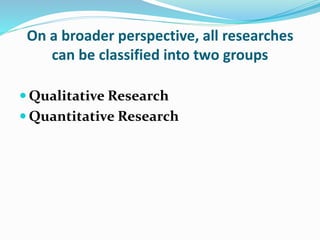
On a broader perspective, all researches
can be classified into two groups
1) Qualitative Research
2) Quantitative Research
Applied Research
Applied research refers to scientific study &
research that seeks to solve practical
problems.
 For example,
Improve agricultural production
Treat or cure a specific disease
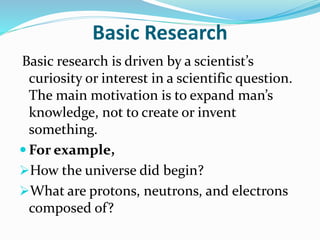
Basic Research
Basic research is driven by a scientist’s
curiosity or interest in a scientific question.
The main motivation is to expand man’s
knowledge, not to create or invent
something.
 For example,
How the universe did begin?
What are protons, neutrons, and electrons
composed of?
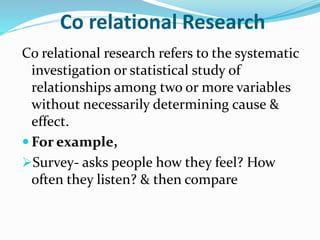
Co relational Research
Co relational research refers to the systematic
investigation or statistical study of
relationships among two or more variables
without necessarily determining cause &
effect.
 For example,
Survey- asks people how they feel? How
often they listen? & then compare
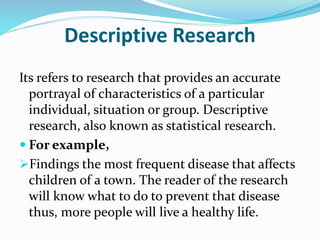
Descriptive Research
Its refers to research that provides an accurate
portrayal of characteristics of a particular
individual, situation or group. Descriptive
research, also known as statistical research.
 For example,
Findings the most frequent disease that affects
children of a town. The reader of the research
will know what to do to prevent that disease
thus, more people will live a healthy life.
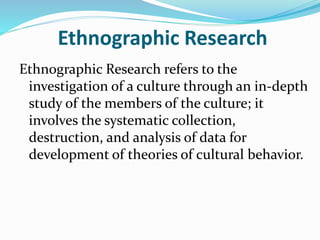
Ethnographic Research
Ethnographic Research refers to the
investigation of a culture through an in-depth
study of the members of the culture; it
involves the systematic collection,
destruction, and analysis of data for
development of theories of cultural behavior.
Experimental Research
 Experimental Research is an objective,
systematic, controlled investigation for the
purpose of predicting and controlling
phenomena and examining probability and
causality among selected variables.
Exploratory Research
 Exploratory Research is a type of research
conducted for a problem that has not been
clearly defined. Exploratory research helps
determine the best research design, data
collection method and selection of subjects.
Grounded Theory Research
 Grounded Theory Research is a research
approach designed to discover what
problems exist in a given social environment
and how the persons involved handle them;
it involves formulation, testing, and
reformulation of propositions until a theory
is developed.
Historical Research
 Historical Research is research involving
analysis of events that occurred in the
remote or recent past.
Phenomenological Research
 Phenomenological Research an inductive
descriptive research approach developed
from phenomenological philosophy; its aim
is to describe an experience as it is actually
lived by the person.
On a broader perspective, all researches
can be classified into two groups
 Qualitative Research
 Quantitative Research
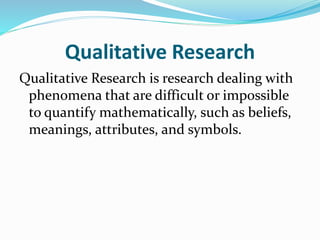
Qualitative Research
Qualitative Research is research dealing with
phenomena that are difficult or impossible
to quantify mathematically, such as beliefs,
meanings, attributes, and symbols.
Quantitative Research
Quantitative Research refers to the systematic
empirical investigation of any phenomena
via statistical, mathematical or
computational techniques.
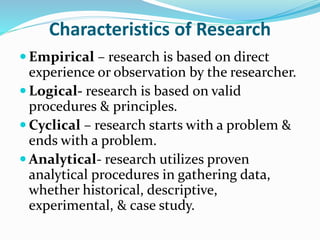
Characteristics of Research
 Empirical – research is based on direct
experience or observation by the researcher.
 Logical- research is based on valid
procedures & principles.
 Cyclical – research starts with a problem &
ends with a problem.
 Analytical- research utilizes proven
analytical procedures in gathering data,
whether historical, descriptive,
experimental, & case study.
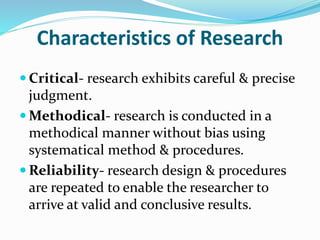
Characteristics of Research
 Critical- research exhibits careful & precise
judgment.
 Methodical- research is conducted in a
methodical manner without bias using
systematical method & procedures.
 Reliability- research design & procedures
are repeated to enable the researcher to
arrive at valid and conclusive results.
Thanks to All

Research Types & Characteristicsch types & characteristics

  • 1.
    Prepared by Md.Mamunur Rashid M.S. in Agricultural Extension & Rural Development Patuakhali Science & Technology University Session 2014-2015
  • 2.
    Research  The systematic,rigorous investigation of a situation or problem in order to generate new knowledge or validate existing knowledge.
  • 3.
    Types of Research Thereare many types of research. These are 1) Applied Research 2) Basic Research 3) Co relational Research 4) Descriptive Research 5) Ethnographic Research 6) Experimental Research 7) Exploratory Research 8) Grounded Theory Research 9) Historical Research 10)Phenomenological Research
  • 4.
    On a broaderperspective, all researches can be classified into two groups 1) Qualitative Research 2) Quantitative Research
  • 5.
    Applied Research Applied researchrefers to scientific study & research that seeks to solve practical problems.  For example, Improve agricultural production Treat or cure a specific disease
  • 6.
    Basic Research Basic researchis driven by a scientist’s curiosity or interest in a scientific question. The main motivation is to expand man’s knowledge, not to create or invent something.  For example, How the universe did begin? What are protons, neutrons, and electrons composed of?
  • 7.
    Co relational Research Corelational research refers to the systematic investigation or statistical study of relationships among two or more variables without necessarily determining cause & effect.  For example, Survey- asks people how they feel? How often they listen? & then compare
  • 8.
    Descriptive Research Its refersto research that provides an accurate portrayal of characteristics of a particular individual, situation or group. Descriptive research, also known as statistical research.  For example, Findings the most frequent disease that affects children of a town. The reader of the research will know what to do to prevent that disease thus, more people will live a healthy life.
  • 9.
    Ethnographic Research Ethnographic Researchrefers to the investigation of a culture through an in-depth study of the members of the culture; it involves the systematic collection, destruction, and analysis of data for development of theories of cultural behavior.
  • 10.
    Experimental Research  ExperimentalResearch is an objective, systematic, controlled investigation for the purpose of predicting and controlling phenomena and examining probability and causality among selected variables.
  • 11.
    Exploratory Research  ExploratoryResearch is a type of research conducted for a problem that has not been clearly defined. Exploratory research helps determine the best research design, data collection method and selection of subjects.
  • 12.
    Grounded Theory Research Grounded Theory Research is a research approach designed to discover what problems exist in a given social environment and how the persons involved handle them; it involves formulation, testing, and reformulation of propositions until a theory is developed.
  • 13.
    Historical Research  HistoricalResearch is research involving analysis of events that occurred in the remote or recent past.
  • 14.
    Phenomenological Research  PhenomenologicalResearch an inductive descriptive research approach developed from phenomenological philosophy; its aim is to describe an experience as it is actually lived by the person.
  • 15.
    On a broaderperspective, all researches can be classified into two groups  Qualitative Research  Quantitative Research
  • 16.
    Qualitative Research Qualitative Researchis research dealing with phenomena that are difficult or impossible to quantify mathematically, such as beliefs, meanings, attributes, and symbols.
  • 17.
    Quantitative Research Quantitative Researchrefers to the systematic empirical investigation of any phenomena via statistical, mathematical or computational techniques.
  • 18.
    Characteristics of Research Empirical – research is based on direct experience or observation by the researcher.  Logical- research is based on valid procedures & principles.  Cyclical – research starts with a problem & ends with a problem.  Analytical- research utilizes proven analytical procedures in gathering data, whether historical, descriptive, experimental, & case study.
  • 19.
    Characteristics of Research Critical- research exhibits careful & precise judgment.  Methodical- research is conducted in a methodical manner without bias using systematical method & procedures.  Reliability- research design & procedures are repeated to enable the researcher to arrive at valid and conclusive results.
  • 20.