Research Aptitude
Kiruba Nagini R
Assistant Professor- PGDM
ITM Business School
Chennai
Research:
Definition: A Careful investigation or
enquiry, especially through search of
new facts in any branch of knowledge
Three important points – investigation or
enquiry, search of new facts, any branch
of knowledge
Aptitude:
Definition: Ability or skill
to do something
Research Aptitude:
Definition: The ability or skill to systematically, carefully and closely examine a
situation, procedure or an activity for the formulation of generalizations and
theories.
ANSWER TO 5Ws AND 1H-WHO, WHAT, WHERE, WHY, WHEN, HOW
Role of Research in Different fields:
1. Inculcates the habit of logical thinking
2. Helps in problem-solving
3. Govt. policy formulation
4. Avoid nation’s resources being wasted
5. Good career path for researchers
6. Reach higher positions as researcher
7. Create and develop new styles of work
8. Formulation of new theories
Objectives of research
• Understand a particular phenomenon or a problem
• Analyze the cause and effect of a problem
• Study the frequency of the problem
• Verify social facts, generalizations and values
• Suggest remedial measures and solutions to the problems
• Examine different aspects of daily life
• Develop principles and formulate a new procedure
• Formulate new theories and help further advancement
• To test a hypothesis depicting the relationship between variables
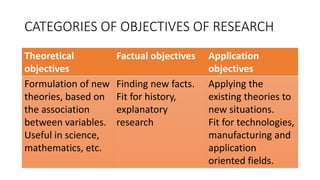
CATEGORIES OF OBJECTIVES OF RESEARCH
Theoretical
objectives
Factual objectives Application
objectives
Formulation of new
theories, based on
the association
between variables.
Useful in science,
mathematics, etc.
Finding new facts.
Fit for history,
explanatory
research
Applying the
existing theories to
new situations.
Fit for technologies,
manufacturing and
application
oriented fields.
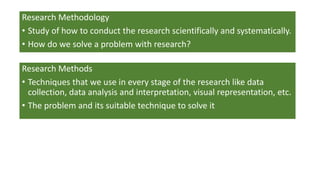
Research Methodology
• Study of how to conduct the research scientifically and systematically.
• How do we solve a problem with research?
Research Methods
• Techniques that we use in every stage of the research like data
collection, data analysis and interpretation, visual representation, etc.
• The problem and its suitable technique to solve it
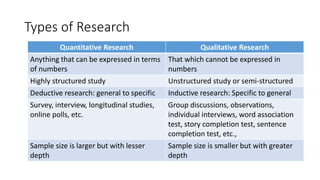
Types of Research
Quantitative Research Qualitative Research
Anything that can be expressed in terms
of numbers
That which cannot be expressed in
numbers
Highly structured study Unstructured study or semi-structured
Deductive research: general to specific Inductive research: Specific to general
Survey, interview, longitudinal studies,
online polls, etc.
Group discussions, observations,
individual interviews, word association
test, story completion test, sentence
completion test, etc.,
Sample size is larger but with lesser
depth
Sample size is smaller but with greater
depth
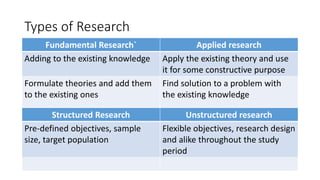
Fundamental Research` Applied research
Adding to the existing knowledge Apply the existing theory and use
it for some constructive purpose
Formulate theories and add them
to the existing ones
Find solution to a problem with
the existing knowledge
Types of Research
Structured Research Unstructured research
Pre-defined objectives, sample
size, target population
Flexible objectives, research design
and alike throughout the study
period
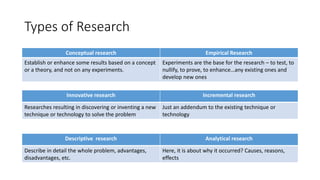
Types of Research
Conceptual research Empirical Research
Establish or enhance some results based on a concept
or a theory, and not on any experiments.
Experiments are the base for the research – to test, to
nullify, to prove, to enhance…any existing ones and
develop new ones
Innovative research Incremental research
Researches resulting in discovering or inventing a new
technique or technology to solve the problem
Just an addendum to the existing technique or
technology
Descriptive research Analytical research
Describe in detail the whole problem, advantages,
disadvantages, etc.
Here, it is about why it occurred? Causes, reasons,
effects
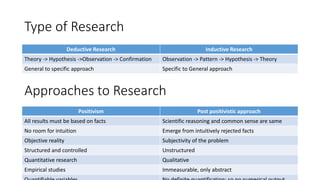
Type of Research
Deductive Research Inductive Research
Theory -> Hypothesis ->Observation -> Confirmation Observation -> Pattern -> Hypothesis -> Theory
General to specific approach Specific to General approach
Positivism Post positivistic approach
All results must be based on facts Scientific reasoning and common sense are same
No room for intuition Emerge from intuitively rejected facts
Objective reality Subjectivity of the problem
Structured and controlled Unstructured
Quantitative research Qualitative
Empirical studies Immeasurable, only abstract
Approaches to Research
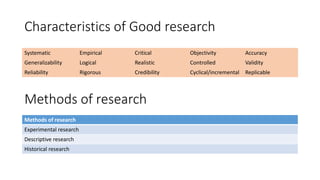
Characteristics of Good research
Systematic Empirical Critical Objectivity Accuracy
Generalizability Logical Realistic Controlled Validity
Reliability Rigorous Credibility Cyclical/incremental Replicable
Methods of research
Experimental research
Descriptive research
Historical research
Methods of research
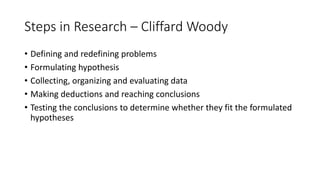
Steps in Research – Cliffard Woody
• Defining and redefining problems
• Formulating hypothesis
• Collecting, organizing and evaluating data
• Making deductions and reaching conclusions
• Testing the conclusions to determine whether they fit the formulated
hypotheses
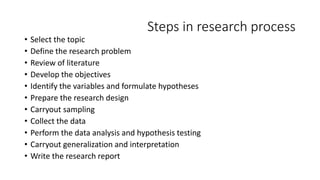
Steps in research process
• Select the topic
• Define the research problem
• Review of literature
• Develop the objectives
• Identify the variables and formulate hypotheses
• Prepare the research design
• Carryout sampling
• Collect the data
• Perform the data analysis and hypothesis testing
• Carryout generalization and interpretation
• Write the research report
Selection of topic
• Feasibility study
• Scope of discovery
• Primary study availability for new topics
• Estimated cost of study
• Skill requirements for conducting the study
• Time consumption
• Interest area of the researcher
Define the research problem
• Problem statement
• Introduce the topic of research
• Explains the problem/situation/ an activity for which solution is
needed
• Problem, parameters to examine, interpreting framework, and results
• Importance of the study, benefits and justification needed
Comprehensive literature review
• Analysis of books, journals, articles, documentaries, etc
• Previous works
• Properly organized, summarized and narrated
• Three steps:
• List out what is known
• List out what is unknown from the collected details
• Decide on how to solve the problem with the available sources, or extending
them, or applying them
Develop objectives
• Is it theoretical, factual or application-oriented?
• Develop the Primary and secondary objectives
Variable Identification and Hypothesis Formulation
• Continuous or discrete variable – weight/ number of students
• Dependent – the variable under the influence of another variable
• Independent variable – the variable which influences the other variable
• Extraneous variables – influence the dependent variable, but not in the system
• Confounding variables – strongly influencing the dependent variables, but not in system;
highly influential than extraneous variables
• Categorical variables – classified or categorized into groups, options, etc.,
• Demographic variables – the set of variables that define the study group
• Active variables – changed under the control of researcher
• Attributed variables – cannot be changed under the control of researcher
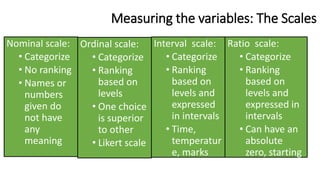
Measuring the variables: The Scales
Nominal scale:
• Categorize
• No ranking
• Names or
numbers
given do
not have
any
meaning
Ordinal scale:
• Categorize
• Ranking
based on
levels
• One choice
is superior
to other
• Likert scale
Interval scale:
• Categorize
• Ranking
based on
levels and
expressed
in intervals
• Time,
temperatur
e, marks
etc.
Ratio scale:
• Categorize
• Ranking
based on
levels and
expressed in
intervals
• Can have an
absolute
zero, starting
point of scale
Hypothesis
• A testable proposition in testable form and predicts a particular
relationship between two or more variables
• Types:
• Null
• Alternate
• Other categories
• Hypothesis of no difference – between groups, situations, actions, etc.
• Declarative hypothesis – Global warming is caused by pollution
• Directional hypothesis – Palm sugar is sweeter than sugar, but not sweeter
than jaggery
• Non-directional hypothesis – There is no difference in the qualities of brand A
and B
Research design
• Sampling design – selecting the samples
• Observational design – conditions for observations
• Statistical design – sample size, tools for data analysis
• Operational design – selection of sample, sample size for recording
observations, data analysis, report design, etc.
Types of research design: Exploratory research
design/ formulative research design
• Explore a problem
• The whole research process may change
• Result in development of new ideas, or theory
• Qualitative/ unstructured researches
• Hard to interpret, generalize
• Difficult to test validity and reliability
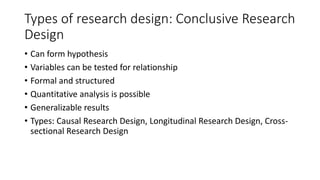
Types of research design: Conclusive Research
Design
• Can form hypothesis
• Variables can be tested for relationship
• Formal and structured
• Quantitative analysis is possible
• Generalizable results
• Types: Causal Research Design, Longitudinal Research Design, Cross-
sectional Research Design
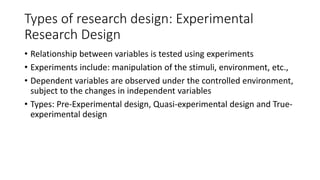
Types of research design: Experimental
Research Design
• Relationship between variables is tested using experiments
• Experiments include: manipulation of the stimuli, environment, etc.,
• Dependent variables are observed under the controlled environment,
subject to the changes in independent variables
• Types: Pre-Experimental design, Quasi-experimental design and True-
experimental design
Sampling
• Systematic bias /sampling error
• Types:
• Probability sampling
• Quasi-probability sampling
• Non-probability sampling
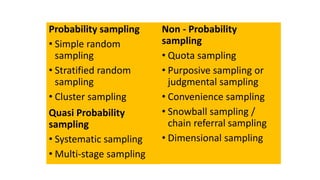
Probability sampling
• Simple random
sampling
• Stratified random
sampling
• Cluster sampling
Quasi Probability
sampling
• Systematic sampling
• Multi-stage sampling
Non - Probability
sampling
• Quota sampling
• Purposive sampling or
judgmental sampling
• Convenience sampling
• Snowball sampling /
chain referral sampling
• Dimensional sampling
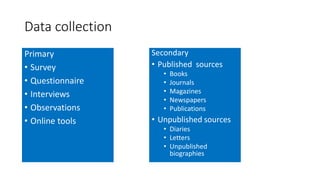
Data collection
Primary
• Survey
• Questionnaire
• Interviews
• Observations
• Online tools
Secondary
• Published sources
• Books
• Journals
• Magazines
• Newspapers
• Publications
• Unpublished sources
• Diaries
• Letters
• Unpublished
biographies
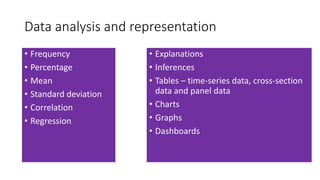
Data analysis and representation
• Frequency
• Percentage
• Mean
• Standard deviation
• Correlation
• Regression
• Explanations
• Inferences
• Tables – time-series data, cross-section
data and panel data
• Charts
• Graphs
• Dashboards
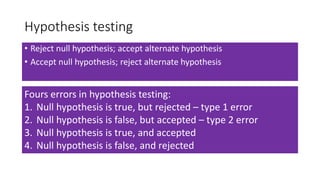
Hypothesis testing
• Reject null hypothesis; accept alternate hypothesis
• Accept null hypothesis; reject alternate hypothesis
Fours errors in hypothesis testing:
1. Null hypothesis is true, but rejected – type 1 error
2. Null hypothesis is false, but accepted – type 2 error
3. Null hypothesis is true, and accepted
4. Null hypothesis is false, and rejected
Thank you

Research aptitude

  • 1.
    Research Aptitude Kiruba NaginiR Assistant Professor- PGDM ITM Business School Chennai
  • 2.
    Research: Definition: A Carefulinvestigation or enquiry, especially through search of new facts in any branch of knowledge Three important points – investigation or enquiry, search of new facts, any branch of knowledge Aptitude: Definition: Ability or skill to do something Research Aptitude: Definition: The ability or skill to systematically, carefully and closely examine a situation, procedure or an activity for the formulation of generalizations and theories. ANSWER TO 5Ws AND 1H-WHO, WHAT, WHERE, WHY, WHEN, HOW
  • 3.
    Role of Researchin Different fields: 1. Inculcates the habit of logical thinking 2. Helps in problem-solving 3. Govt. policy formulation 4. Avoid nation’s resources being wasted 5. Good career path for researchers 6. Reach higher positions as researcher 7. Create and develop new styles of work 8. Formulation of new theories
  • 4.
    Objectives of research •Understand a particular phenomenon or a problem • Analyze the cause and effect of a problem • Study the frequency of the problem • Verify social facts, generalizations and values • Suggest remedial measures and solutions to the problems • Examine different aspects of daily life • Develop principles and formulate a new procedure • Formulate new theories and help further advancement • To test a hypothesis depicting the relationship between variables
  • 5.
    CATEGORIES OF OBJECTIVESOF RESEARCH Theoretical objectives Factual objectives Application objectives Formulation of new theories, based on the association between variables. Useful in science, mathematics, etc. Finding new facts. Fit for history, explanatory research Applying the existing theories to new situations. Fit for technologies, manufacturing and application oriented fields.
  • 6.
    Research Methodology • Studyof how to conduct the research scientifically and systematically. • How do we solve a problem with research? Research Methods • Techniques that we use in every stage of the research like data collection, data analysis and interpretation, visual representation, etc. • The problem and its suitable technique to solve it
  • 7.
    Types of Research QuantitativeResearch Qualitative Research Anything that can be expressed in terms of numbers That which cannot be expressed in numbers Highly structured study Unstructured study or semi-structured Deductive research: general to specific Inductive research: Specific to general Survey, interview, longitudinal studies, online polls, etc. Group discussions, observations, individual interviews, word association test, story completion test, sentence completion test, etc., Sample size is larger but with lesser depth Sample size is smaller but with greater depth
  • 8.
    Fundamental Research` Appliedresearch Adding to the existing knowledge Apply the existing theory and use it for some constructive purpose Formulate theories and add them to the existing ones Find solution to a problem with the existing knowledge Types of Research Structured Research Unstructured research Pre-defined objectives, sample size, target population Flexible objectives, research design and alike throughout the study period
  • 9.
    Types of Research Conceptualresearch Empirical Research Establish or enhance some results based on a concept or a theory, and not on any experiments. Experiments are the base for the research – to test, to nullify, to prove, to enhance…any existing ones and develop new ones Innovative research Incremental research Researches resulting in discovering or inventing a new technique or technology to solve the problem Just an addendum to the existing technique or technology Descriptive research Analytical research Describe in detail the whole problem, advantages, disadvantages, etc. Here, it is about why it occurred? Causes, reasons, effects
  • 10.
    Type of Research DeductiveResearch Inductive Research Theory -> Hypothesis ->Observation -> Confirmation Observation -> Pattern -> Hypothesis -> Theory General to specific approach Specific to General approach Positivism Post positivistic approach All results must be based on facts Scientific reasoning and common sense are same No room for intuition Emerge from intuitively rejected facts Objective reality Subjectivity of the problem Structured and controlled Unstructured Quantitative research Qualitative Empirical studies Immeasurable, only abstract Approaches to Research
  • 11.
    Characteristics of Goodresearch Systematic Empirical Critical Objectivity Accuracy Generalizability Logical Realistic Controlled Validity Reliability Rigorous Credibility Cyclical/incremental Replicable Methods of research Experimental research Descriptive research Historical research Methods of research
  • 12.
    Steps in Research– Cliffard Woody • Defining and redefining problems • Formulating hypothesis • Collecting, organizing and evaluating data • Making deductions and reaching conclusions • Testing the conclusions to determine whether they fit the formulated hypotheses
  • 13.
    Steps in researchprocess • Select the topic • Define the research problem • Review of literature • Develop the objectives • Identify the variables and formulate hypotheses • Prepare the research design • Carryout sampling • Collect the data • Perform the data analysis and hypothesis testing • Carryout generalization and interpretation • Write the research report
  • 14.
    Selection of topic •Feasibility study • Scope of discovery • Primary study availability for new topics • Estimated cost of study • Skill requirements for conducting the study • Time consumption • Interest area of the researcher
  • 15.
    Define the researchproblem • Problem statement • Introduce the topic of research • Explains the problem/situation/ an activity for which solution is needed • Problem, parameters to examine, interpreting framework, and results • Importance of the study, benefits and justification needed
  • 16.
    Comprehensive literature review •Analysis of books, journals, articles, documentaries, etc • Previous works • Properly organized, summarized and narrated • Three steps: • List out what is known • List out what is unknown from the collected details • Decide on how to solve the problem with the available sources, or extending them, or applying them
  • 17.
    Develop objectives • Isit theoretical, factual or application-oriented? • Develop the Primary and secondary objectives Variable Identification and Hypothesis Formulation • Continuous or discrete variable – weight/ number of students • Dependent – the variable under the influence of another variable • Independent variable – the variable which influences the other variable • Extraneous variables – influence the dependent variable, but not in the system • Confounding variables – strongly influencing the dependent variables, but not in system; highly influential than extraneous variables • Categorical variables – classified or categorized into groups, options, etc., • Demographic variables – the set of variables that define the study group • Active variables – changed under the control of researcher • Attributed variables – cannot be changed under the control of researcher
  • 18.
    Measuring the variables:The Scales Nominal scale: • Categorize • No ranking • Names or numbers given do not have any meaning Ordinal scale: • Categorize • Ranking based on levels • One choice is superior to other • Likert scale Interval scale: • Categorize • Ranking based on levels and expressed in intervals • Time, temperatur e, marks etc. Ratio scale: • Categorize • Ranking based on levels and expressed in intervals • Can have an absolute zero, starting point of scale
  • 19.
    Hypothesis • A testableproposition in testable form and predicts a particular relationship between two or more variables • Types: • Null • Alternate • Other categories • Hypothesis of no difference – between groups, situations, actions, etc. • Declarative hypothesis – Global warming is caused by pollution • Directional hypothesis – Palm sugar is sweeter than sugar, but not sweeter than jaggery • Non-directional hypothesis – There is no difference in the qualities of brand A and B
  • 20.
    Research design • Samplingdesign – selecting the samples • Observational design – conditions for observations • Statistical design – sample size, tools for data analysis • Operational design – selection of sample, sample size for recording observations, data analysis, report design, etc.
  • 21.
    Types of researchdesign: Exploratory research design/ formulative research design • Explore a problem • The whole research process may change • Result in development of new ideas, or theory • Qualitative/ unstructured researches • Hard to interpret, generalize • Difficult to test validity and reliability
  • 22.
    Types of researchdesign: Conclusive Research Design • Can form hypothesis • Variables can be tested for relationship • Formal and structured • Quantitative analysis is possible • Generalizable results • Types: Causal Research Design, Longitudinal Research Design, Cross- sectional Research Design
  • 23.
    Types of researchdesign: Experimental Research Design • Relationship between variables is tested using experiments • Experiments include: manipulation of the stimuli, environment, etc., • Dependent variables are observed under the controlled environment, subject to the changes in independent variables • Types: Pre-Experimental design, Quasi-experimental design and True- experimental design
  • 24.
    Sampling • Systematic bias/sampling error • Types: • Probability sampling • Quasi-probability sampling • Non-probability sampling
  • 25.
    Probability sampling • Simplerandom sampling • Stratified random sampling • Cluster sampling Quasi Probability sampling • Systematic sampling • Multi-stage sampling Non - Probability sampling • Quota sampling • Purposive sampling or judgmental sampling • Convenience sampling • Snowball sampling / chain referral sampling • Dimensional sampling
  • 26.
    Data collection Primary • Survey •Questionnaire • Interviews • Observations • Online tools Secondary • Published sources • Books • Journals • Magazines • Newspapers • Publications • Unpublished sources • Diaries • Letters • Unpublished biographies
  • 27.
    Data analysis andrepresentation • Frequency • Percentage • Mean • Standard deviation • Correlation • Regression • Explanations • Inferences • Tables – time-series data, cross-section data and panel data • Charts • Graphs • Dashboards
  • 28.
    Hypothesis testing • Rejectnull hypothesis; accept alternate hypothesis • Accept null hypothesis; reject alternate hypothesis Fours errors in hypothesis testing: 1. Null hypothesis is true, but rejected – type 1 error 2. Null hypothesis is false, but accepted – type 2 error 3. Null hypothesis is true, and accepted 4. Null hypothesis is false, and rejected
  • 29.