CHAPTER 4

                          Presentation, Analysis and Interpretation of Data

     The sequence of the content is the same with that of the STATEMENT OF THE
PROBLEM.

       Normally, it features the following contents in chronological order:
    1. Statistical Tables and Graphs
    2. Textual Presentation
    3. Inferences or Interpretation

Presentation of Data

       Presentation is a way of arranging data into logical, chronological and significant
categories and classifications. There are three ways of presenting data: textual, tabular and
graphical.

        A. Tabular Presentation

               Tables organize and compress data into standardized forms. They facilitate the
           study and interpretation.

               Most researchers use tables in their textual presentation of data. This is because
           (1) researchers need to give little explanation only since data in tables are arranged
           and grouped systematically; (2) readers can comprehend and interpret information
           easily because they can see relationships of data at once, and (3) tables can present
           ideas that are understood even without reading the textual presentation.

Constructing a Table


        Tables include a title, a number, heading, a body and if necessary, notes.

Title

       The title should identify the table briefly. It need not give background information or
describe the results. The modern way of writing titles omits the words Frequency and Percentage
Distribution of / Distribution of / According to.

Example:


                                              Table 1

                                      Effects of Mass Media
Table title must be written two spaces below the table number. Table title, which is
normally written in inverted pyramid format, has content (principal) words in upper case initials
and non-content words (articles, coordinate conjunctions, prepositions and infinitive to) in lower
case letters except those with more than 5 letters. One should single-space captions with two or
more lines. Table titles should not be in question form. Aside from the inverted pyramid format,
table titles may also be written in paragraph form or block style. In the paragraph form, the first
word of the table title is indented five spaces and the succeeding lines are flushed with the left
margin, while in the block style, the title is flushed with the left margin of the table.
         You should be consistent in your choice of table format through out the paper.

Number

      Each table in the research paper must be numbered using Arabic numerals. Tables must
be numbered and continuously through all the chapters. Tables in the appendix must be
numbered separately from the text. If the paper contains only one table, the number is
unnecessary. Only the initial letter of the word “Table” is capitalized.

Heading

       Table heading is generally expressed in phrase or clause form. The heading contains the
stub and the box head. The stub contains the stub head and the row labels. The stub head tells
what the stub contains while the row labels describe the data written in that row. The box head
contains the master caption, column caption and column sub caption. Master caption describes
the column captions; column captions describe sub column captions. In the table on the next
page, Degrees is the stub head; AB, BSCE, BSE and MA are the row labels; Specializations
(Majors) is the master caption; English, History, Mathematics, Science and Totals are the
column captions; and F and % are the sub captions.


                                               Table 1

                           Degrees and Specializations of the Teachers


                                        Specializations (Majors)
                                                                                     Totals
 Degrees Earned
                      English            History     Mathematics      Science
                      F     %           F      %      F     %       F      %        F         %

       AB             1    1.69     2       3.39      6    10.17    12    20.34    21   35.59
      BSCE                                             4    6.78                    4    6.78
       BSE            2    3.39     2       3.39      14   23.73    13    22.03    31   52.54
       MA                                              1    1.69     2     3.39     3    5.08

      Totals          3    5.08      4       6.78     25   42.37    27    45.76    59    99.99

                                                                    (Calderon & Gonzales, 1993)
Table Data Spacing

          The following are the guidelines in constructing tables for a research paper:

                1.    A double line written 2 spaces below the title separates the title from the table.
                2.    Horizontal lines separate the stub head and the column caption.
                3.    Lines do not separate rows and columns. Rows are double-spaced.
                4.    Side ends of tables are unruled.
                5.    A line from the last row of information separates bottom total.
                6.    Table is separated from the textual presentation by two spaces. If the table
                      succeeds the textual presentation, there should be 3 spaces in between the last line
                      of the text and the table number.
     Tables

     (If placed after text, observe 4 spaces from text to table number.)


                                                       Table 2 (Arabic number, numbered consecutively
                                                                           throughout the paper)
     (Double space)
             Job Market Requirements for BS Industrial Education (Upper-lowercase)                                     (Double space)

                         Competencies                                              Mean                 Rank             Verbal
(Capitalize only the first word of column headings unless proper            (Leave a space before                    interpretation
noun/ adjective; observe parallelism in constructing the headings.)         and after headings)
1. Positive attitude, perseverance, self-discipline                              4.52                      1           Very highly
and personal hygiene ( No period for words or phrases)                                                                  important
2. Personal discipline skills                                                    4.48                     2.5            Highly
                                                                                                                        important
3. Ability to understand and convey visual                                       4.48                     2.5            Highly
communication                                                                                                           important
1. Ability to recognize, formulate and solve                                     4.36                      4             Highly
problems                                                                                                                important
2. Ability to engage in lifelong learning and                                    4.32                      5             Highly
acceptance of the need to keep current of the                                                                           important
development in the field of specialization
     (Align all items listed in a table within and between entries.)
     (Capitalize only the first word of items in rows if expressed in phrases or sentences; use upper-lowercase for proper nouns or adjectives.)

     (If text follows table, observe 4 spaces before typing the first line of the text. Never break your tables; fit them in a page. You may adjust
     the font size to fit in.)


          B. Graphical Presentation of Data

    A graph is a chart representing the quantitative variations of a variable itself or in comparison
with those of another variable. Graphing presents variations, changes and relationships of data in
a very attractive, appealing, effective and convincing way.

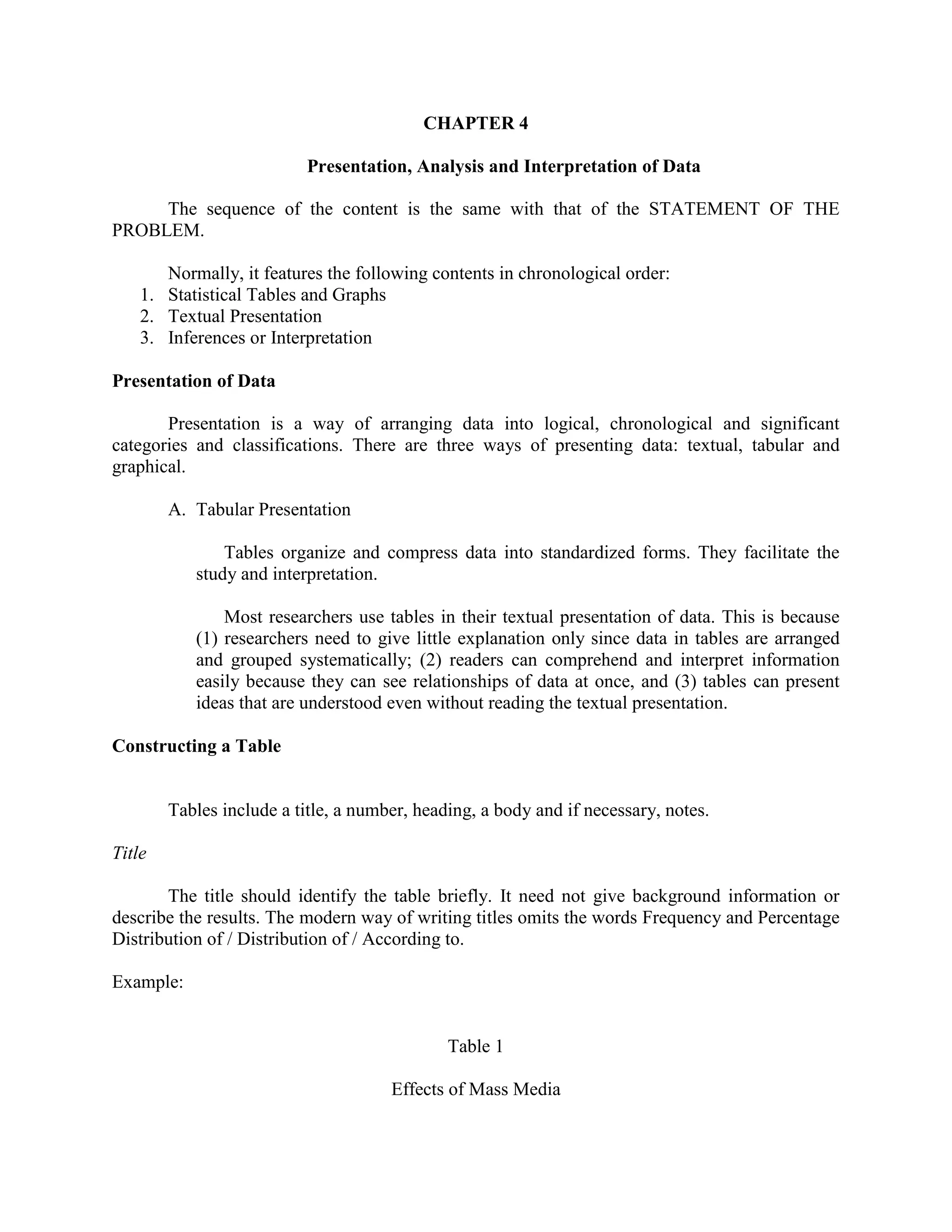
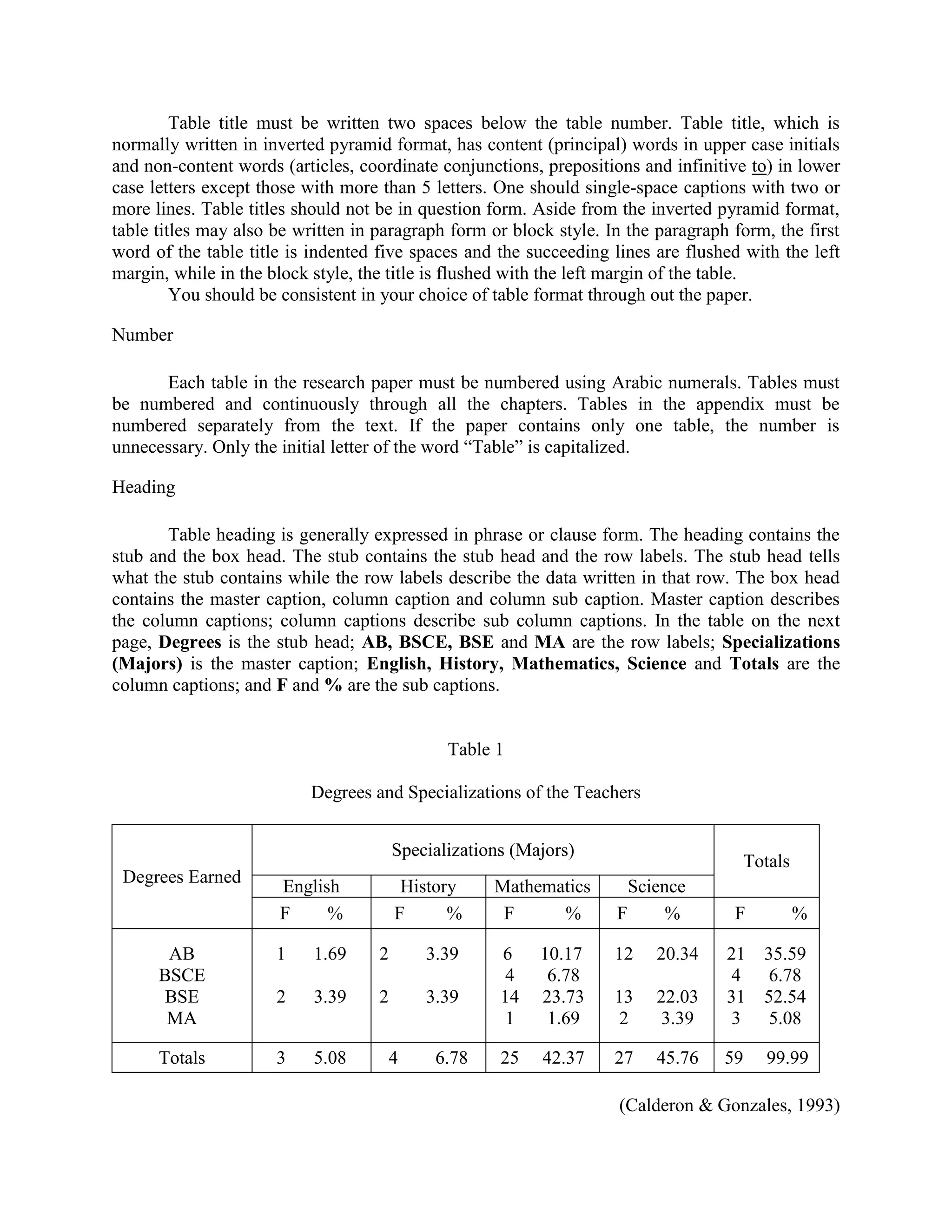
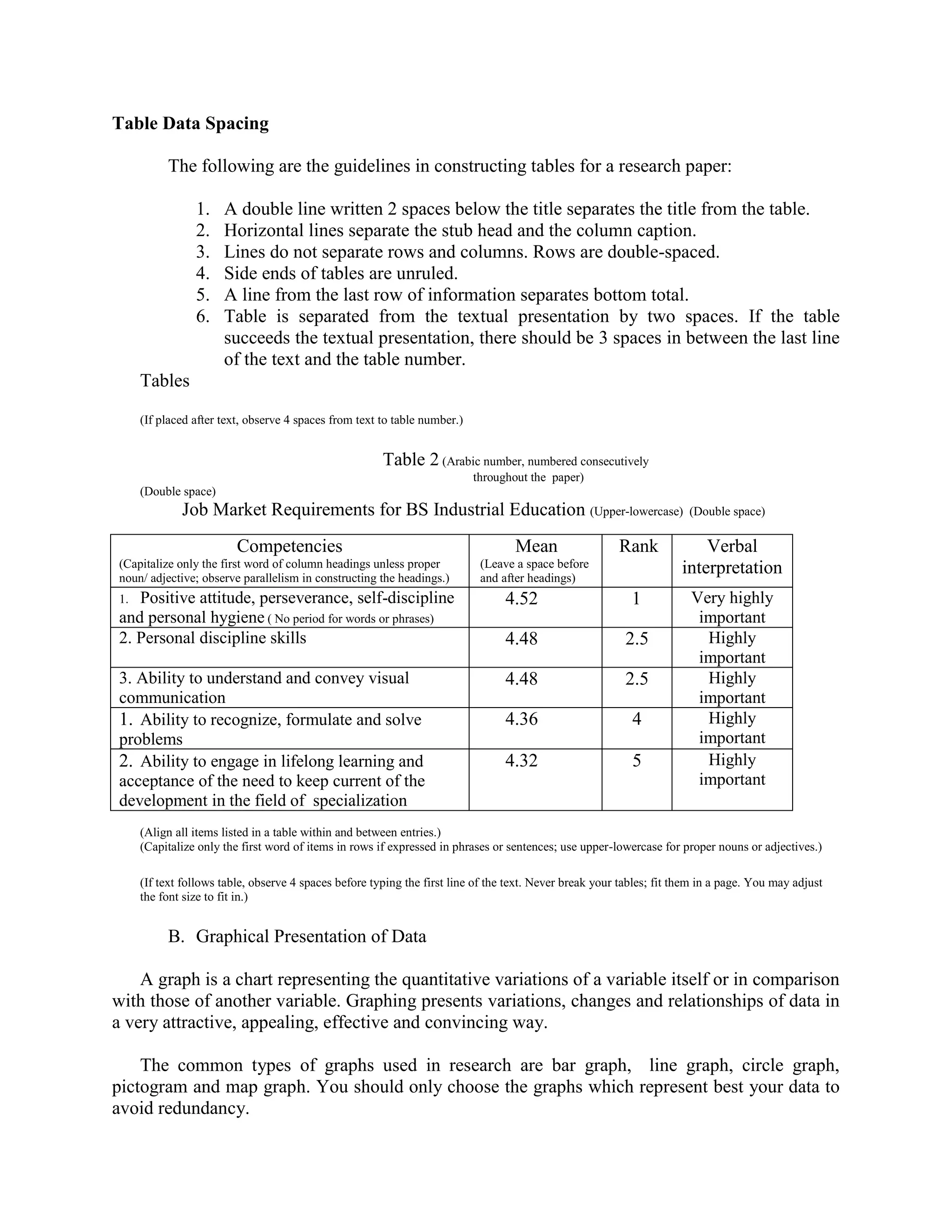
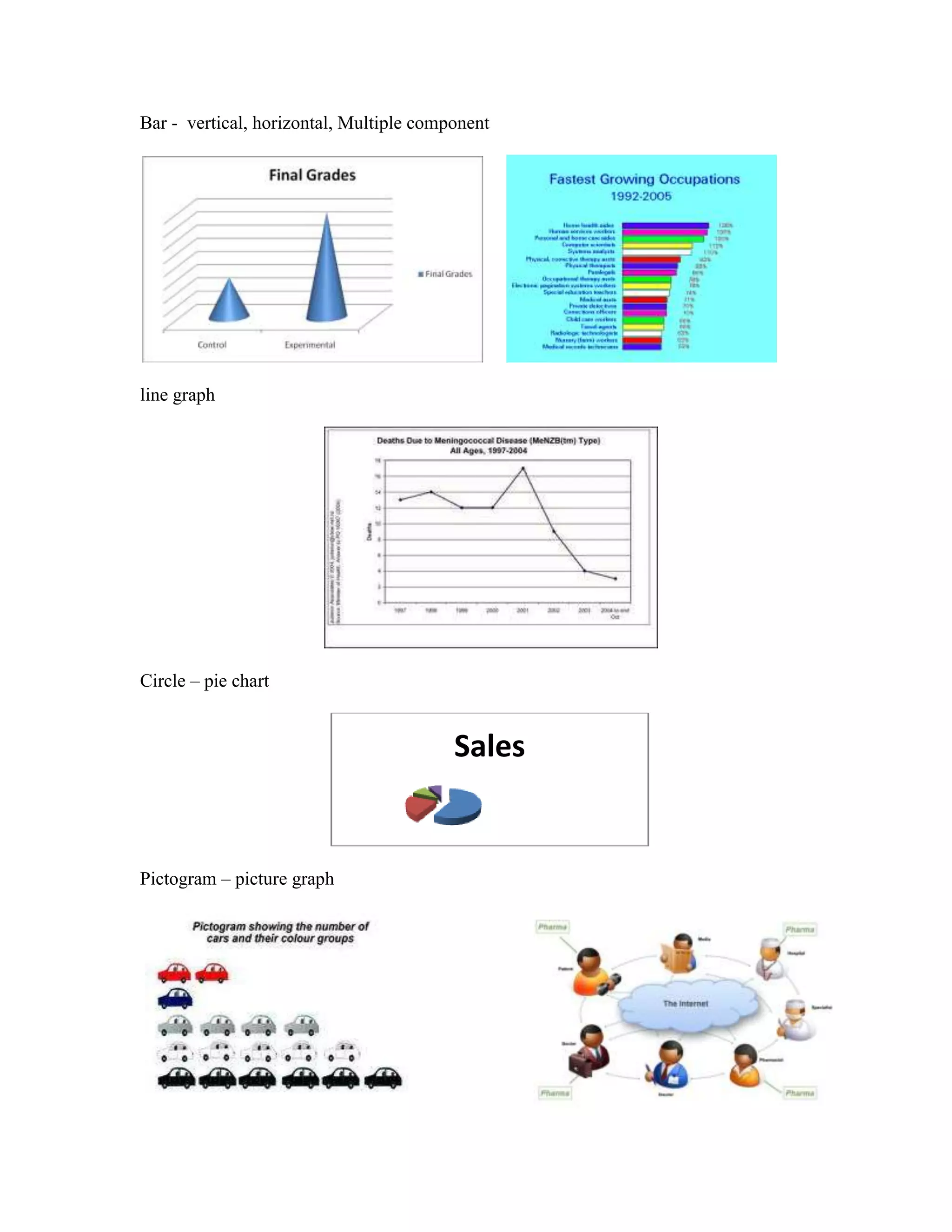
    The common types of graphs used in research are bar graph, line graph, circle graph,
pictogram and map graph. You should only choose the graphs which represent best your data to
avoid redundancy.
Bar - vertical, horizontal, Multiple component


line graph


Circle – pie chart


                                         Sales


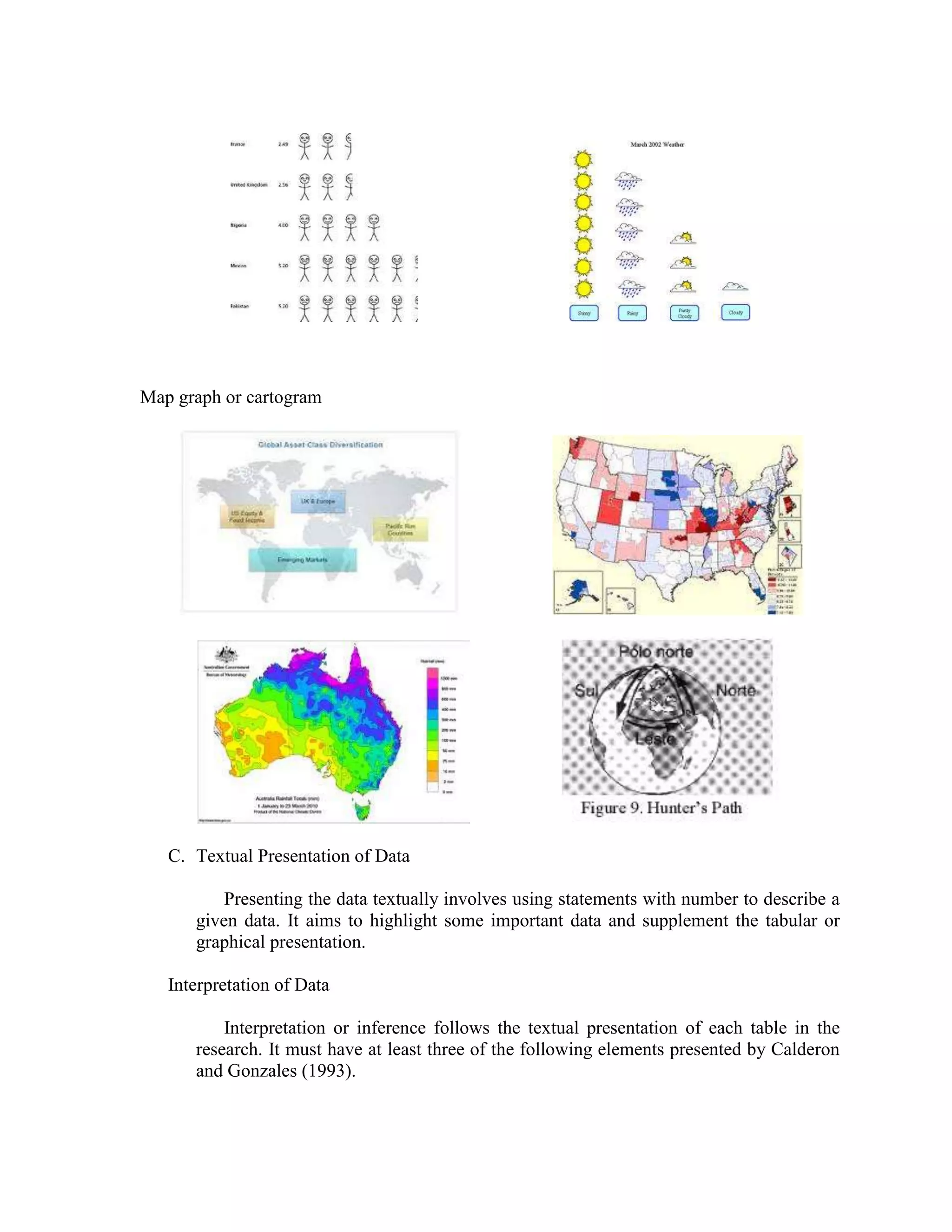
Pictogram – picture graph
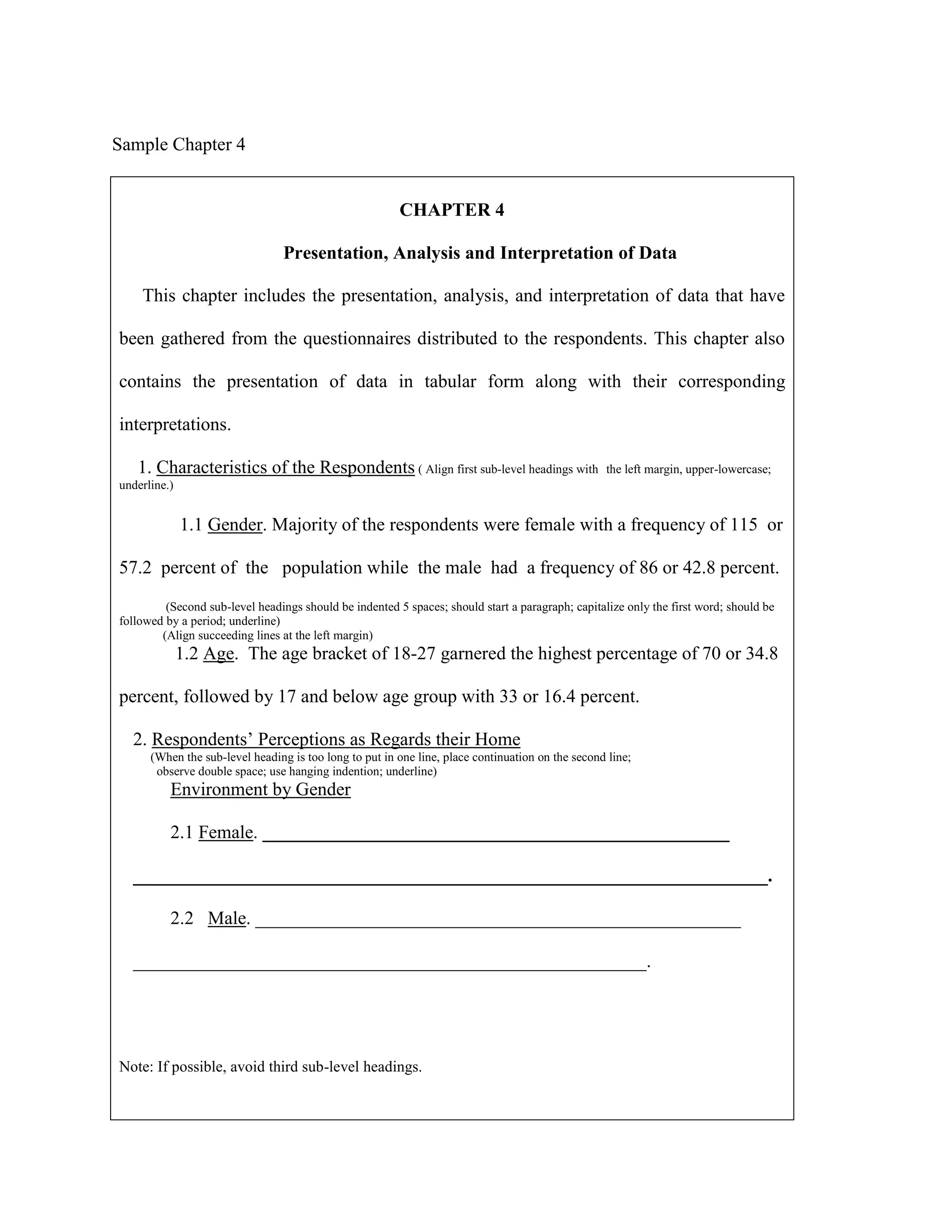
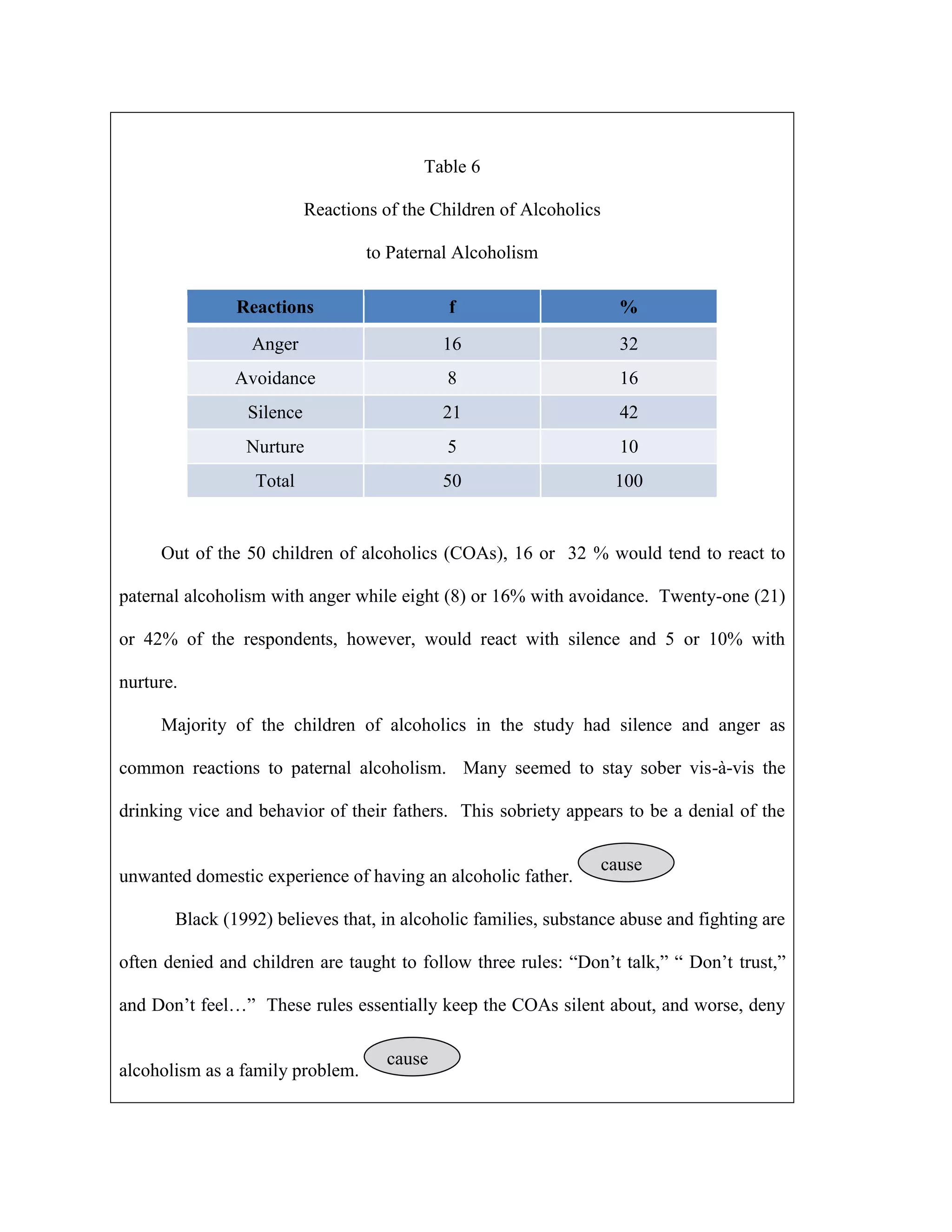
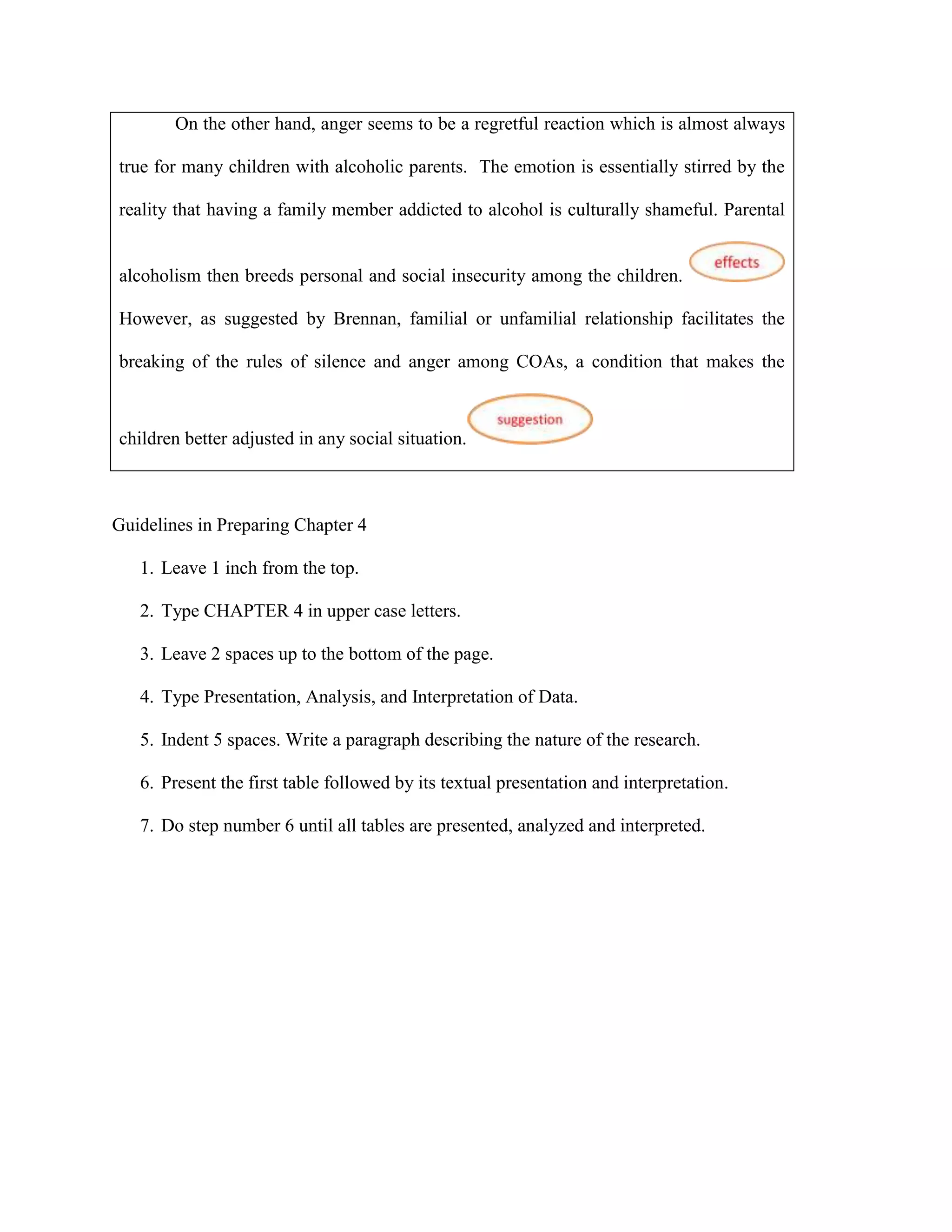
Map graph or cartogram


   C. Textual Presentation of Data

          Presenting the data textually involves using statements with number to describe a
      given data. It aims to highlight some important data and supplement the tabular or
      graphical presentation.

   Interpretation of Data

          Interpretation or inference follows the textual presentation of each table in the
      research. It must have at least three of the following elements presented by Calderon
      and Gonzales (1993).
1. Condition. This refers to the findings discovered in the research.

2. Possible cause of the condition. This refers to the reason for the existence
   of the condition discovered.

3. Possible effect of the condition. This refers to the result of the existence of
   the condition discovered.

4. The measures to remedy the unsatisfactory condition or to strengthen the
   favorable one. These are actions or suggestions to be undertaken in
   response to the existing condition.

5. Comparison of findings with those of previous studies. This is the similar
   finding confirming the result of previous researches, or theory of an expert
   in the field.
Sample Chapter 4


                                                        CHAPTER 4

                                 Presentation, Analysis and Interpretation of Data

    This chapter includes the presentation, analysis, and interpretation of data that have

been gathered from the questionnaires distributed to the respondents. This chapter also

contains the presentation of data in tabular form along with their corresponding

interpretations.

   1. Characteristics of the Respondents ( Align first sub-level headings with                    the left margin, upper-lowercase;
underline.)


              1.1 Gender. Majority of the respondents were female with a frequency of 115 or

57.2 percent of the population while the male had a frequency of 86 or 42.8 percent.

         (Second sub-level headings should be indented 5 spaces; should start a paragraph; capitalize only the first word; should be
followed by a period; underline)
        (Align succeeding lines at the left margin)
              1.2 Age. The age bracket of 18-27 garnered the highest percentage of 70 or 34.8

percent, followed by 17 and below age group with 33 or 16.4 percent.

  2. Respondents’ Perceptions as Regards their Home
      (When the sub-level heading is too long to put in one line, place continuation on the second line;
       observe double space; use hanging indention; underline)
          Environment by Gender

          2.1 Female. __________________________________________________

  ____________________________________________________________________.

          2.2 Male. ____________________________________________________

  _______________________________________________________.


Note: If possible, avoid third sub-level headings.
Table 6

                           Reactions of the Children of Alcoholics

                                   to Paternal Alcoholism

               Reactions                      f                        %
                 Anger                       16                        32
               Avoidance                     8                         16
                 Silence                     21                        42
                Nurture                      5                         10
                  Total                      50                       100


     Out of the 50 children of alcoholics (COAs), 16 or 32 % would tend to react to

paternal alcoholism with anger while eight (8) or 16% with avoidance. Twenty-one (21)

or 42% of the respondents, however, would react with silence and 5 or 10% with

nurture.

     Majority of the children of alcoholics in the study had silence and anger as

common reactions to paternal alcoholism. Many seemed to stay sober vis-à-vis the

drinking vice and behavior of their fathers. This sobriety appears to be a denial of the

                                                                     cause
unwanted domestic experience of having an alcoholic father.

       Black (1992) believes that, in alcoholic families, substance abuse and fighting are

often denied and children are taught to follow three rules: “Don’t talk,” “ Don’t trust,”

and Don’t feel…” These rules essentially keep the COAs silent about, and worse, deny

                                     cause
alcoholism as a family problem.
On the other hand, anger seems to be a regretful reaction which is almost always

true for many children with alcoholic parents. The emotion is essentially stirred by the

reality that having a family member addicted to alcohol is culturally shameful. Parental


alcoholism then breeds personal and social insecurity among the children.

However, as suggested by Brennan, familial or unfamilial relationship facilitates the

breaking of the rules of silence and anger among COAs, a condition that makes the


children better adjusted in any social situation.


Guidelines in Preparing Chapter 4

   1. Leave 1 inch from the top.

   2. Type CHAPTER 4 in upper case letters.

   3. Leave 2 spaces up to the bottom of the page.

   4. Type Presentation, Analysis, and Interpretation of Data.

   5. Indent 5 spaces. Write a paragraph describing the nature of the research.

   6. Present the first table followed by its textual presentation and interpretation.

   7. Do step number 6 until all tables are presented, analyzed and interpreted.

Chapter 4

  • 1.
    CHAPTER 4 Presentation, Analysis and Interpretation of Data The sequence of the content is the same with that of the STATEMENT OF THE PROBLEM. Normally, it features the following contents in chronological order: 1. Statistical Tables and Graphs 2. Textual Presentation 3. Inferences or Interpretation Presentation of Data Presentation is a way of arranging data into logical, chronological and significant categories and classifications. There are three ways of presenting data: textual, tabular and graphical. A. Tabular Presentation Tables organize and compress data into standardized forms. They facilitate the study and interpretation. Most researchers use tables in their textual presentation of data. This is because (1) researchers need to give little explanation only since data in tables are arranged and grouped systematically; (2) readers can comprehend and interpret information easily because they can see relationships of data at once, and (3) tables can present ideas that are understood even without reading the textual presentation. Constructing a Table Tables include a title, a number, heading, a body and if necessary, notes. Title The title should identify the table briefly. It need not give background information or describe the results. The modern way of writing titles omits the words Frequency and Percentage Distribution of / Distribution of / According to. Example: Table 1 Effects of Mass Media
  • 2.
    Table title mustbe written two spaces below the table number. Table title, which is normally written in inverted pyramid format, has content (principal) words in upper case initials and non-content words (articles, coordinate conjunctions, prepositions and infinitive to) in lower case letters except those with more than 5 letters. One should single-space captions with two or more lines. Table titles should not be in question form. Aside from the inverted pyramid format, table titles may also be written in paragraph form or block style. In the paragraph form, the first word of the table title is indented five spaces and the succeeding lines are flushed with the left margin, while in the block style, the title is flushed with the left margin of the table. You should be consistent in your choice of table format through out the paper. Number Each table in the research paper must be numbered using Arabic numerals. Tables must be numbered and continuously through all the chapters. Tables in the appendix must be numbered separately from the text. If the paper contains only one table, the number is unnecessary. Only the initial letter of the word “Table” is capitalized. Heading Table heading is generally expressed in phrase or clause form. The heading contains the stub and the box head. The stub contains the stub head and the row labels. The stub head tells what the stub contains while the row labels describe the data written in that row. The box head contains the master caption, column caption and column sub caption. Master caption describes the column captions; column captions describe sub column captions. In the table on the next page, Degrees is the stub head; AB, BSCE, BSE and MA are the row labels; Specializations (Majors) is the master caption; English, History, Mathematics, Science and Totals are the column captions; and F and % are the sub captions. Table 1 Degrees and Specializations of the Teachers Specializations (Majors) Totals Degrees Earned English History Mathematics Science F % F % F % F % F % AB 1 1.69 2 3.39 6 10.17 12 20.34 21 35.59 BSCE 4 6.78 4 6.78 BSE 2 3.39 2 3.39 14 23.73 13 22.03 31 52.54 MA 1 1.69 2 3.39 3 5.08 Totals 3 5.08 4 6.78 25 42.37 27 45.76 59 99.99 (Calderon & Gonzales, 1993)
  • 3.
    Table Data Spacing The following are the guidelines in constructing tables for a research paper: 1. A double line written 2 spaces below the title separates the title from the table. 2. Horizontal lines separate the stub head and the column caption. 3. Lines do not separate rows and columns. Rows are double-spaced. 4. Side ends of tables are unruled. 5. A line from the last row of information separates bottom total. 6. Table is separated from the textual presentation by two spaces. If the table succeeds the textual presentation, there should be 3 spaces in between the last line of the text and the table number. Tables (If placed after text, observe 4 spaces from text to table number.) Table 2 (Arabic number, numbered consecutively throughout the paper) (Double space) Job Market Requirements for BS Industrial Education (Upper-lowercase) (Double space) Competencies Mean Rank Verbal (Capitalize only the first word of column headings unless proper (Leave a space before interpretation noun/ adjective; observe parallelism in constructing the headings.) and after headings) 1. Positive attitude, perseverance, self-discipline 4.52 1 Very highly and personal hygiene ( No period for words or phrases) important 2. Personal discipline skills 4.48 2.5 Highly important 3. Ability to understand and convey visual 4.48 2.5 Highly communication important 1. Ability to recognize, formulate and solve 4.36 4 Highly problems important 2. Ability to engage in lifelong learning and 4.32 5 Highly acceptance of the need to keep current of the important development in the field of specialization (Align all items listed in a table within and between entries.) (Capitalize only the first word of items in rows if expressed in phrases or sentences; use upper-lowercase for proper nouns or adjectives.) (If text follows table, observe 4 spaces before typing the first line of the text. Never break your tables; fit them in a page. You may adjust the font size to fit in.) B. Graphical Presentation of Data A graph is a chart representing the quantitative variations of a variable itself or in comparison with those of another variable. Graphing presents variations, changes and relationships of data in a very attractive, appealing, effective and convincing way. The common types of graphs used in research are bar graph, line graph, circle graph, pictogram and map graph. You should only choose the graphs which represent best your data to avoid redundancy.
  • 4.
    Bar - vertical,horizontal, Multiple component line graph Circle – pie chart Sales Pictogram – picture graph
  • 5.
    Map graph orcartogram C. Textual Presentation of Data Presenting the data textually involves using statements with number to describe a given data. It aims to highlight some important data and supplement the tabular or graphical presentation. Interpretation of Data Interpretation or inference follows the textual presentation of each table in the research. It must have at least three of the following elements presented by Calderon and Gonzales (1993).
  • 6.
    1. Condition. Thisrefers to the findings discovered in the research. 2. Possible cause of the condition. This refers to the reason for the existence of the condition discovered. 3. Possible effect of the condition. This refers to the result of the existence of the condition discovered. 4. The measures to remedy the unsatisfactory condition or to strengthen the favorable one. These are actions or suggestions to be undertaken in response to the existing condition. 5. Comparison of findings with those of previous studies. This is the similar finding confirming the result of previous researches, or theory of an expert in the field.
  • 7.
    Sample Chapter 4 CHAPTER 4 Presentation, Analysis and Interpretation of Data This chapter includes the presentation, analysis, and interpretation of data that have been gathered from the questionnaires distributed to the respondents. This chapter also contains the presentation of data in tabular form along with their corresponding interpretations. 1. Characteristics of the Respondents ( Align first sub-level headings with the left margin, upper-lowercase; underline.) 1.1 Gender. Majority of the respondents were female with a frequency of 115 or 57.2 percent of the population while the male had a frequency of 86 or 42.8 percent. (Second sub-level headings should be indented 5 spaces; should start a paragraph; capitalize only the first word; should be followed by a period; underline) (Align succeeding lines at the left margin) 1.2 Age. The age bracket of 18-27 garnered the highest percentage of 70 or 34.8 percent, followed by 17 and below age group with 33 or 16.4 percent. 2. Respondents’ Perceptions as Regards their Home (When the sub-level heading is too long to put in one line, place continuation on the second line; observe double space; use hanging indention; underline) Environment by Gender 2.1 Female. __________________________________________________ ____________________________________________________________________. 2.2 Male. ____________________________________________________ _______________________________________________________. Note: If possible, avoid third sub-level headings.
  • 8.
    Table 6 Reactions of the Children of Alcoholics to Paternal Alcoholism Reactions f % Anger 16 32 Avoidance 8 16 Silence 21 42 Nurture 5 10 Total 50 100 Out of the 50 children of alcoholics (COAs), 16 or 32 % would tend to react to paternal alcoholism with anger while eight (8) or 16% with avoidance. Twenty-one (21) or 42% of the respondents, however, would react with silence and 5 or 10% with nurture. Majority of the children of alcoholics in the study had silence and anger as common reactions to paternal alcoholism. Many seemed to stay sober vis-à-vis the drinking vice and behavior of their fathers. This sobriety appears to be a denial of the cause unwanted domestic experience of having an alcoholic father. Black (1992) believes that, in alcoholic families, substance abuse and fighting are often denied and children are taught to follow three rules: “Don’t talk,” “ Don’t trust,” and Don’t feel…” These rules essentially keep the COAs silent about, and worse, deny cause alcoholism as a family problem.
  • 9.
    On the otherhand, anger seems to be a regretful reaction which is almost always true for many children with alcoholic parents. The emotion is essentially stirred by the reality that having a family member addicted to alcohol is culturally shameful. Parental alcoholism then breeds personal and social insecurity among the children. However, as suggested by Brennan, familial or unfamilial relationship facilitates the breaking of the rules of silence and anger among COAs, a condition that makes the children better adjusted in any social situation. Guidelines in Preparing Chapter 4 1. Leave 1 inch from the top. 2. Type CHAPTER 4 in upper case letters. 3. Leave 2 spaces up to the bottom of the page. 4. Type Presentation, Analysis, and Interpretation of Data. 5. Indent 5 spaces. Write a paragraph describing the nature of the research. 6. Present the first table followed by its textual presentation and interpretation. 7. Do step number 6 until all tables are presented, analyzed and interpreted.