CHAPTER 5
Kahsu Mebrahtu (Asst. Prof.)
Mekelle University
College of Business and Economics
Department of Management
Postgraduate Program (MBA)
Process Planning
 Process
 a group of related tasks with specific inputs and
outputs
 Process design
 tasks need to be done and coordinated among
functions, people, and organizations
 Process planning
 converts designs into workable instructions for
manufacture or delivery
 Process strategy
 an organization’s overall approach for physically
producing goods and services
Copyright 2006 John Wiley &
Sons, Inc. 6-2
Process Strategy
 Capital intensity
 mix of capital (i.e., equipment, automation) and labor resources
used in production process
 Process flexibility
 ease with which resources can be adjusted in response to changes in
demand, technology, products or services, and resource availability
 Vertical integration
 extent to which firm will produce inputs and control outputs of
each stage of production process
 Customer involvement
 role of customer in production process
Copyright 2006 John Wiley &
Sons, Inc. 6-3
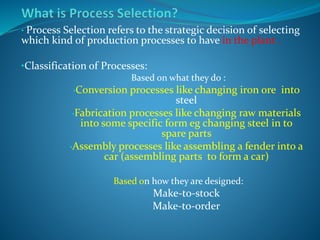
• Process Selection refers to the strategic decision of selecting
which kind of production processes to have in the plant .
•Classification of Processes:
Based on what they do :
•Conversion processes like changing iron ore into
steel
•Fabrication processes like changing raw materials
into some specific form eg changing steel in to
spare parts
•Assembly processes like assembling a fender into a
car (assembling parts to form a car)
Based on how they are designed:
Make-to-stock
Make-to-order
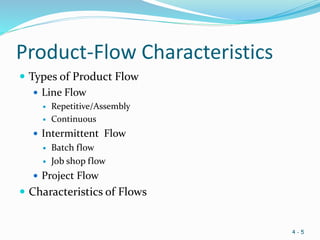
Product-Flow Characteristics
 Types of Product Flow
 Line Flow
 Repetitive/Assembly
 Continuous
 Intermittent Flow
 Batch flow
 Job shop flow
 Project Flow
 Characteristics of Flows
4 - 5
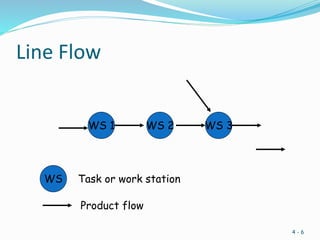
Line Flow
4 - 6
WS 1 WS 2 WS 3
WS Task or work station
Product flow
Intermittent Flow
4 - 7
WS 1 WS 3 WS 5
WS Task or work station
Product flows
WS 2 WS 4
Project Flow
4 - 8
Start
Task 1 Task 3
Task Task or activity
Precedence relationship
Task 2 Task 4
End
Process Types
 Job shop
 Small scale
 Batch
 Moderate volume
 systems process many different jobs through the system
in groups or batches
 Repetitive/assembly line
 High volumes of standardized goods or services
 Continuous
 Very high volumes of non-discrete goods
 used for very-high volume commodity products
4-9
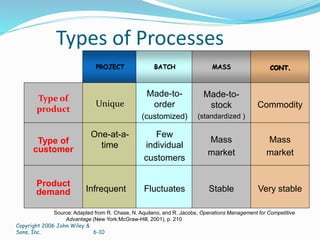
Types of Processes
Type of
product
Unique
Copyright 2006 John Wiley &
Sons, Inc. 6-10
PROJECT BATCH
Made-to-
order
(customized)
Source: Adapted from R. Chase, N. Aquilano, and R. Jacobs, Operations Management for Competitive
Advantage (New York:McGraw-Hill, 2001), p. 210
Type of
customer
One-at-a-
time
Few
individual
customers
MASS
Made-to-
stock
(standardized )
Mass
market
CONT.
Commodity
Mass
market
Product
demand Infrequent Fluctuates Stable Very stable
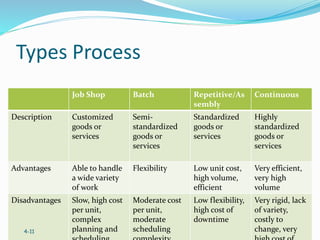
Types Process
Job Shop Batch Repetitive/As
sembly
Continuous
Description Customized
goods or
services
Semi-
standardized
goods or
services
Standardized
goods or
services
Highly
standardized
goods or
services
Advantages Able to handle
a wide variety
of work
Flexibility Low unit cost,
high volume,
efficient
Very efficient,
very high
volume
Disadvantages Slow, high cost
per unit,
complex
planning and
Moderate cost
per unit,
moderate
scheduling
Low flexibility,
high cost of
downtime
Very rigid, lack
of variety,
costly to
change, very
4-11
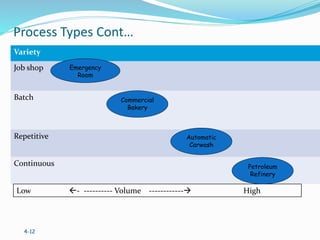
Process Types Cont…
Variety
Job shop
Batch
Repetitive
Continuous
4-12
Low - ---------- Volume ------------ High
Emergency
Room
Commercial
Bakery
Petroleum
Refinery
Automatic
Carwash
Examples
 A. Continuous flow: paper, chemicals, petroleum,
metals and water
 B. Repetitive or assembly or discrete flow: computers,
automobiles, cafeteria-style meals
 C. Batch process: books, toys, canned vegetables
 D. Job-shop: hair style, courses, furniture, retail-sales
Factors Affecting Process Choice
 Market conditions and competition
 Capital requirements
 Labor supply and cost
 Management skills
 Materials supply and cost
 State of technology
4 - 14
 The expected volume and demand pattern for the
products
 The number of different products (product
variety)to be made by the system and the types of
processing each requires
 The customer order type: make-to-stock and make-
to-order
 The physical characteristics of the products
 Reading Assignment:
1. Cellular Processes
2. Group technology
3. Computer assisted Manufacturing

Chapter-5 Process Selection New.pptx

  • 1.
    CHAPTER 5 Kahsu Mebrahtu(Asst. Prof.) Mekelle University College of Business and Economics Department of Management Postgraduate Program (MBA)
  • 2.
    Process Planning  Process a group of related tasks with specific inputs and outputs  Process design  tasks need to be done and coordinated among functions, people, and organizations  Process planning  converts designs into workable instructions for manufacture or delivery  Process strategy  an organization’s overall approach for physically producing goods and services Copyright 2006 John Wiley & Sons, Inc. 6-2
  • 3.
    Process Strategy  Capitalintensity  mix of capital (i.e., equipment, automation) and labor resources used in production process  Process flexibility  ease with which resources can be adjusted in response to changes in demand, technology, products or services, and resource availability  Vertical integration  extent to which firm will produce inputs and control outputs of each stage of production process  Customer involvement  role of customer in production process Copyright 2006 John Wiley & Sons, Inc. 6-3
  • 4.
    • Process Selectionrefers to the strategic decision of selecting which kind of production processes to have in the plant . •Classification of Processes: Based on what they do : •Conversion processes like changing iron ore into steel •Fabrication processes like changing raw materials into some specific form eg changing steel in to spare parts •Assembly processes like assembling a fender into a car (assembling parts to form a car) Based on how they are designed: Make-to-stock Make-to-order
  • 5.
    Product-Flow Characteristics  Typesof Product Flow  Line Flow  Repetitive/Assembly  Continuous  Intermittent Flow  Batch flow  Job shop flow  Project Flow  Characteristics of Flows 4 - 5
  • 6.
    Line Flow 4 -6 WS 1 WS 2 WS 3 WS Task or work station Product flow
  • 7.
    Intermittent Flow 4 -7 WS 1 WS 3 WS 5 WS Task or work station Product flows WS 2 WS 4
  • 8.
    Project Flow 4 -8 Start Task 1 Task 3 Task Task or activity Precedence relationship Task 2 Task 4 End
  • 9.
    Process Types  Jobshop  Small scale  Batch  Moderate volume  systems process many different jobs through the system in groups or batches  Repetitive/assembly line  High volumes of standardized goods or services  Continuous  Very high volumes of non-discrete goods  used for very-high volume commodity products 4-9
  • 10.
    Types of Processes Typeof product Unique Copyright 2006 John Wiley & Sons, Inc. 6-10 PROJECT BATCH Made-to- order (customized) Source: Adapted from R. Chase, N. Aquilano, and R. Jacobs, Operations Management for Competitive Advantage (New York:McGraw-Hill, 2001), p. 210 Type of customer One-at-a- time Few individual customers MASS Made-to- stock (standardized ) Mass market CONT. Commodity Mass market Product demand Infrequent Fluctuates Stable Very stable
  • 11.
    Types Process Job ShopBatch Repetitive/As sembly Continuous Description Customized goods or services Semi- standardized goods or services Standardized goods or services Highly standardized goods or services Advantages Able to handle a wide variety of work Flexibility Low unit cost, high volume, efficient Very efficient, very high volume Disadvantages Slow, high cost per unit, complex planning and Moderate cost per unit, moderate scheduling Low flexibility, high cost of downtime Very rigid, lack of variety, costly to change, very 4-11
  • 12.
    Process Types Cont… Variety Jobshop Batch Repetitive Continuous 4-12 Low - ---------- Volume ------------ High Emergency Room Commercial Bakery Petroleum Refinery Automatic Carwash
  • 13.
    Examples  A. Continuousflow: paper, chemicals, petroleum, metals and water  B. Repetitive or assembly or discrete flow: computers, automobiles, cafeteria-style meals  C. Batch process: books, toys, canned vegetables  D. Job-shop: hair style, courses, furniture, retail-sales
  • 14.
    Factors Affecting ProcessChoice  Market conditions and competition  Capital requirements  Labor supply and cost  Management skills  Materials supply and cost  State of technology 4 - 14
  • 15.
     The expectedvolume and demand pattern for the products  The number of different products (product variety)to be made by the system and the types of processing each requires  The customer order type: make-to-stock and make- to-order  The physical characteristics of the products
  • 16.
     Reading Assignment: 1.Cellular Processes 2. Group technology 3. Computer assisted Manufacturing