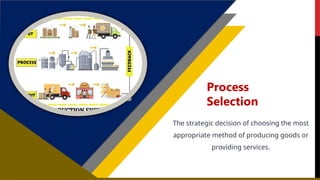
The strategic decisionof choosing the most
appropriate method of producing goods or
providing services.
Process
Selection
4.
It's a crucial
strategicdecision
impacting cost,
quality, flexibility,
and customer
satisfaction.
It involves analysing
various process options
and selecting the one
that best aligns with
the organization's goals
and competitive
strategy.
Process selection
affects long-term
competitiveness.
Key concepts
5.
Strategic Alignment
Process selectiondirectly impacts a company's ability to achieve its
strategic goals (e.g., cost leadership, differentiation, responsiveness).
.
Competitive Advantage
Choosing the right process can create a significant competitive edge in
terms of cost, quality, speed, and flexibility.
.
Cost Implications
Process choices have major capital investment and operating cost
consequences.
Customer Satisfaction
Impacts the ability to meet customer expectations regarding product
variety, delivery speed, and customization
Why process selection
is critical
6.
Factors Influencing
Process Selection
Product/service characteristics: Volume, variety, complexity,
customization required.
Demand: Stable vs. Fluctuating, predictable vs. Unpredictable.
Technology: Availability, cost, and maturity of relevant
technologies.
Resource availability: Labour skills, capital, materials.
Cost: Initial investment, operating costs, maintenance.
Regulations: Environmental and safety regulations.
Strategic goals: Long-term vision and competitive priorities.
7.
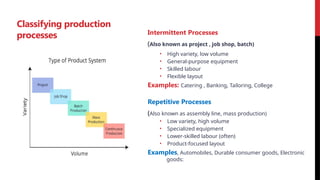
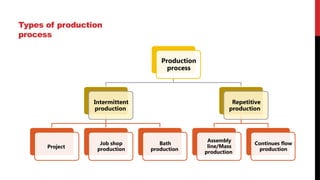
Classifying production
processes IntermittentProcesses
(Also known as project , job shop, batch)
• High variety, low volume
• General-purpose equipment
• Skilled labour
• Flexible layout
Examples: Catering , Banking, Tailoring, College
Repetitive Processes
(Also known as assembly line, mass production)
• Low variety, high volume
• Specialized equipment
• Lower-skilled labour (often)
• Product-focused layout
Examples, Automobiles, Durable consumer goods, Electronic
goods:
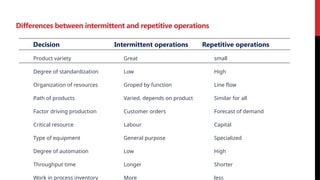
Decision Intermittent operationsRepetitive operations
Product variety Great small
Degree of standardization Low High
Organization of resources Groped by function Line flow
Path of products Varied, depends on product Similar for all
Factor driving production Customer orders Forecast of demand
Critical resource Labour Capital
Type of equipment General purpose Specialized
Degree of automation Low High
Throughput time Longer Shorter
Work in process inventory More less
Differences between intermittent and repetitive operations
10.
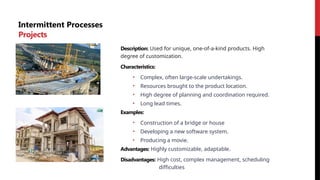
Intermittent Processes
Projects
Description: Usedfor unique, one-of-a-kind products. High
degree of customization.
Characteristics:
• Complex, often large-scale undertakings.
• Resources brought to the product location.
• High degree of planning and coordination required.
• Long lead times.
Examples:
• Construction of a bridge or house
• Developing a new software system.
• Producing a movie.
Advantages: Highly customizable, adaptable.
Disadvantages: High cost, complex management, scheduling
difficulties
11.
Intermittent Processes
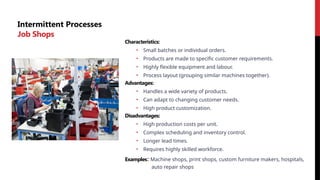
Job Shops
Characteristics:
•Small batches or individual orders.
• Products are made to specific customer requirements.
• Highly flexible equipment and labour.
• Process layout (grouping similar machines together).
Advantages:
• Handles a wide variety of products.
• Can adapt to changing customer needs.
• High product customization.
Disadvantages:
• High production costs per unit.
• Complex scheduling and inventory control.
• Longer lead times.
• Requires highly skilled workforce.
Examples: Machine shops, print shops, custom furniture makers, hospitals,
auto repair shops
12.
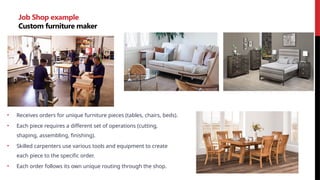
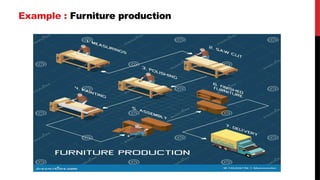
Job Shop example
Customfurniture maker
• Receives orders for unique furniture pieces (tables, chairs, beds).
• Each piece requires a different set of operations (cutting,
shaping, assembling, finishing).
• Skilled carpenters use various tools and equipment to create
each piece to the specific order.
• Each order follows its own unique routing through the shop.
13.
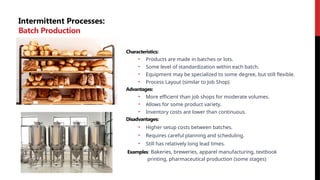
Intermittent Processes:
Batch Production
Characteristics:
•Products are made in batches or lots.
• Some level of standardization within each batch.
• Equipment may be specialized to some degree, but still flexible.
• Process Layout (similar to Job Shop)
Advantages:
• More efficient than job shops for moderate volumes.
• Allows for some product variety.
• Inventory costs are lower than continuous.
Disadvantages:
• Higher setup costs between batches.
• Requires careful planning and scheduling.
• Still has relatively long lead times.
Examples: Bakeries, breweries, apparel manufacturing, textbook
printing, pharmaceutical production (some stages)
14.
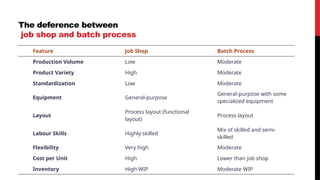
The deference between
jobshop and batch process
Feature Job Shop Batch Process
Production Volume Low Moderate
Product Variety High Moderate
Standardization Low Moderate
Equipment General-purpose
General-purpose with some
specialized equipment
Layout
Process layout (functional
layout)
Process layout
Labour Skills Highly skilled
Mix of skilled and semi-
skilled
Flexibility Very high Moderate
Cost per Unit High Lower than job shop
Inventory High WIP Moderate WIP
15.
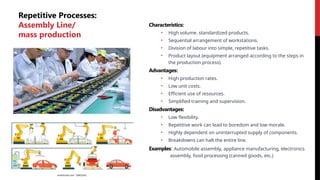
Repetitive Processes:
Assembly Line/
massproduction
Characteristics:
• High volume, standardized products.
• Sequential arrangement of workstations.
• Division of labour into simple, repetitive tasks.
• Product layout (equipment arranged according to the steps in
the production process).
Advantages:
• High production rates.
• Low unit costs.
• Efficient use of resources.
• Simplified training and supervision.
Disadvantages:
• Low flexibility.
• Repetitive work can lead to boredom and low morale.
• Highly dependent on uninterrupted supply of components.
• Breakdowns can halt the entire line.
Examples: Automobile assembly, appliance manufacturing, electronics
assembly, food processing (canned goods, etc.)
16.
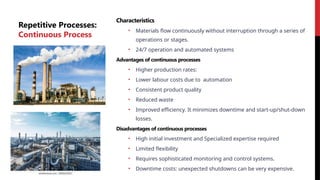
Repetitive Processes:
Continuous Process
Characteristics
•Materials flow continuously without interruption through a series of
operations or stages.
• 24/7 operation and automated systems
Advantages of continuous processes
• Higher production rates:
• Lower labour costs due to automation
• Consistent product quality
• Reduced waste
• Improved efficiency. It minimizes downtime and start-up/shut-down
losses.
Disadvantages of continuous processes
• High initial investment and Specialized expertise required
• Limited flexibility
• Requires sophisticated monitoring and control systems.
• Downtime costs: unexpected shutdowns can be very expensive.
17.
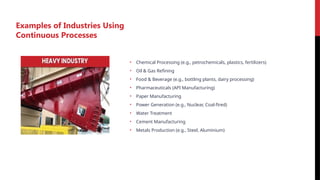
Examples of IndustriesUsing
Continuous Processes
• Chemical Processing (e.g., petrochemicals, plastics, fertilizers)
• Oil & Gas Refining
• Food & Beverage (e.g., bottling plants, dairy processing)
• Pharmaceuticals (API Manufacturing)
• Paper Manufacturing
• Power Generation (e.g., Nuclear, Coal-fired)
• Water Treatment
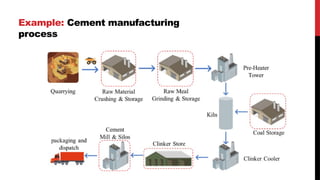
• Cement Manufacturing
• Metals Production (e.g., Steel, Aluminium)
18.
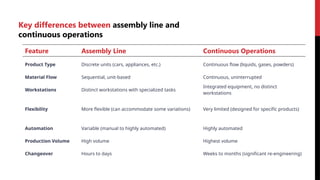
Key differences betweenassembly line and
continuous operations
Feature Assembly Line Continuous Operations
Product Type Discrete units (cars, appliances, etc.) Continuous flow (liquids, gases, powders)
Material Flow Sequential, unit-based Continuous, uninterrupted
Workstations Distinct workstations with specialized tasks
Integrated equipment, no distinct
workstations
Flexibility More flexible (can accommodate some variations) Very limited (designed for specific products)
Automation Variable (manual to highly automated) Highly automated
Production Volume High volume Highest volume
Changeover Hours to days Weeks to months (significant re-engineering)
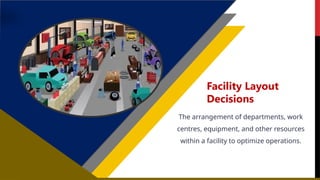
The arrangement ofdepartments, work
centres, equipment, and other resources
within a facility to optimize operations.
Facility Layout
Decisions
21.
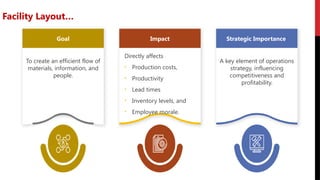
Facility Layout…
Goal ImpactStrategic Importance:
A key element of operations
strategy, influencing
competitiveness and
profitability.
To create an efficient flow of
materials, information, and
people.
Directly affects
• Production costs,
• Productivity
• Lead times
• Inventory levels, and
• Employee morale.
22.
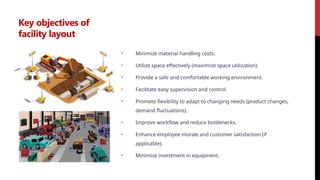
Key objectives of
facilitylayout
• Minimize material handling costs.
• Utilize space effectively (maximize space utilization).
• Provide a safe and comfortable working environment.
• Facilitate easy supervision and control.
• Promote flexibility to adapt to changing needs (product changes,
demand fluctuations).
• Improve workflow and reduce bottlenecks.
• Enhance employee morale and customer satisfaction (if
applicable).
• Minimize investment in equipment.
23.
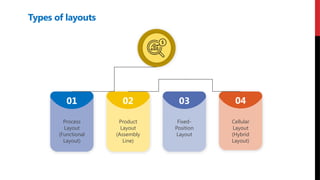
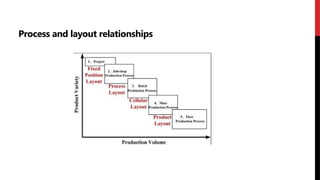
01 02 0304
Process
Layout
(Functional
Layout)
Product
Layout
(Assembly
Line)
Fixed-
Position
Layout
Cellular
Layout
(Hybrid
Layout)
Types of layouts
24.
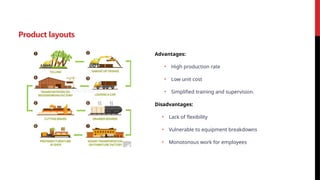
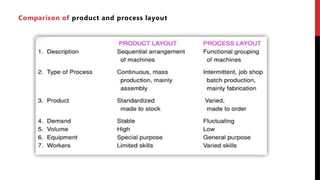
Product layouts
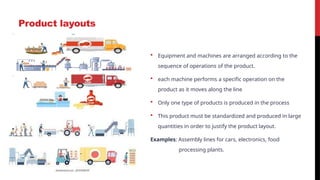
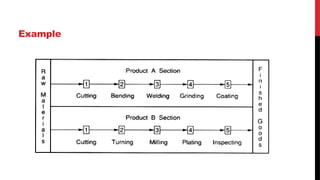
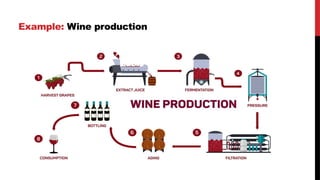
Equipmentand machines are arranged according to the
sequence of operations of the product.
each machine performs a specific operation on the
product as it moves along the line
Only one type of products is produced in the process
This product must be standardized and produced in large
quantities in order to justify the product layout.
Examples: Assembly lines for cars, electronics, food
processing plants.
Product layouts
Advantages:
• Highproduction rate
• Low unit cost
• Simplified training and supervision.
Disadvantages:
• Lack of flexibility
• Vulnerable to equipment breakdowns
• Monotonous work for employees
30.
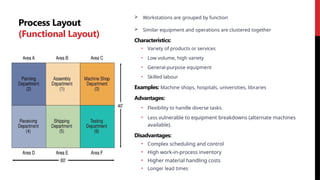
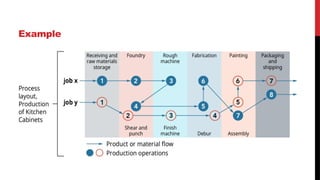
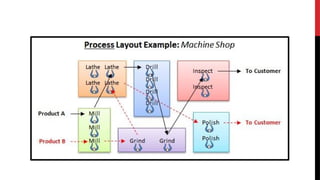
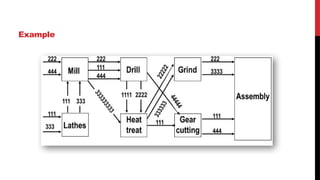
Process Layout
(Functional Layout)
Workstations are grouped by function
Similar equipment and operations are clustered together
Characteristics:
• Variety of products or services
• Low volume, high variety
• General-purpose equipment
• Skilled labour
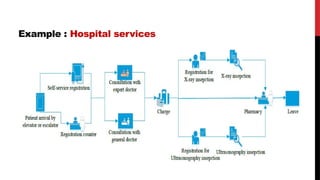
Examples: Machine shops, hospitals, universities, libraries
Advantages:
• Flexibility to handle diverse tasks.
• Less vulnerable to equipment breakdowns (alternate machines
available).
Disadvantages:
• Complex scheduling and control
• High work-in-process inventory
• Higher material handling costs
• Longer lead times
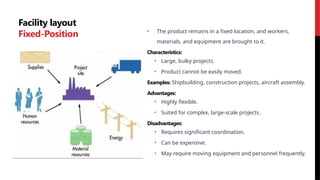
Facility layout
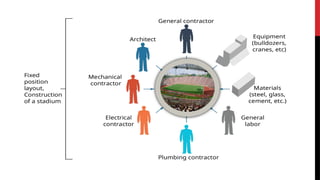
Fixed-Position •The product remains in a fixed location, and workers,
materials, and equipment are brought to it.
Characteristics:
• Large, bulky projects.
• Product cannot be easily moved.
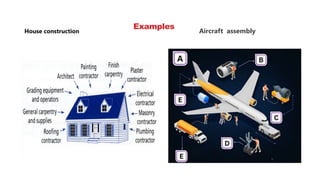
Examples: Shipbuilding, construction projects, aircraft assembly.
Advantages:
• Highly flexible.
• Suited for complex, large-scale projects.
Disadvantages:
• Requires significant coordination.
• Can be expensive.
• May require moving equipment and personnel frequently.
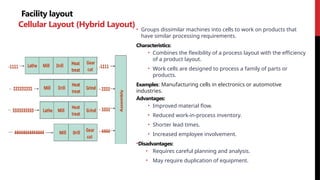
Facility layout
Cellular Layout(Hybrid Layout)• Groups dissimilar machines into cells to work on products that
have similar processing requirements.
Characteristics:
• Combines the flexibility of a process layout with the efficiency
of a product layout.
• Work cells are designed to process a family of parts or
products.
Examples: Manufacturing cells in electronics or automotive
industries.
Advantages:
• Improved material flow.
• Reduced work-in-process inventory.
• Shorter lead times.
• Increased employee involvement.
•Disadvantages:
• Requires careful planning and analysis.
• May require duplication of equipment.