1
2.1 Conceptualizing and Initializing The IT Project
Chapter 2:
Phases of Information Systems Project
Management
2
Content
 An IT Project Methodology
 IT Project Management Phases
 IT Project Management Foundation
 Relationships Among Process Groups and
Knowledge Areas
 Business Case
 Process for Developing the Business Case
 Steps to develop MOV
 Business Case Template
 Project Selection and Approval
 Balanced Scorecard Approach
 MOV supports the Organization’s Scorecard
 Summary
3
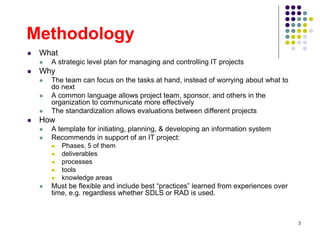
Methodology
 What
 A strategic level plan for managing and controlling IT projects
 Why
 The team can focus on the tasks at hand, instead of worrying about what to
do next
 A common language allows project team, sponsor, and others in the
organization to communicate more effectively
 The standardization allows evaluations between different projects
 How
 A template for initiating, planning, & developing an information system
 Recommends in support of an IT project:
 Phases, 5 of them
 deliverables
 processes
 tools
 knowledge areas
 Must be flexible and include best “practices” learned from experiences over
time, e.g. regardless whether SDLS or RAD is used.
4
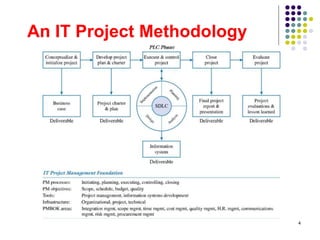
An IT Project Methodology
5
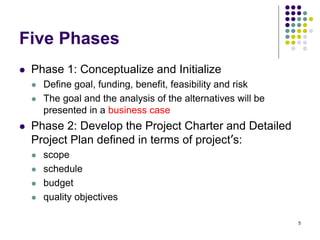
Five Phases
 Phase 1: Conceptualize and Initialize
 Define goal, funding, benefit, feasibility and risk
 The goal and the analysis of the alternatives will be
presented in a business case
 Phase 2: Develop the Project Charter and Detailed
Project Plan defined in terms of project’s:
 scope
 schedule
 budget
 quality objectives
6
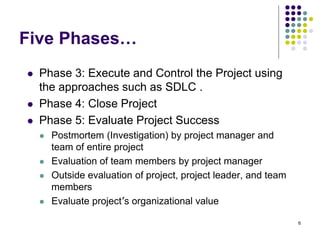
Five Phases…
 Phase 3: Execute and Control the Project using
the approaches such as SDLC .
 Phase 4: Close Project
 Phase 5: Evaluate Project Success
 Postmortem (Investigation) by project manager and
team of entire project
 Evaluation of team members by project manager
 Outside evaluation of project, project leader, and team
members
 Evaluate project’s organizational value
7
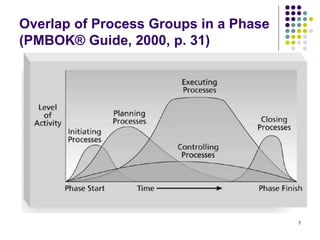
Overlap of Process Groups in a Phase
(PMBOK® Guide, 2000, p. 31)
8
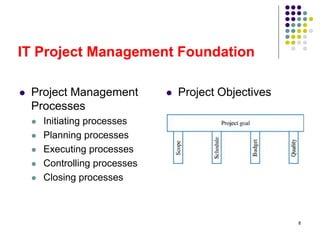
IT Project Management Foundation
 Project Management
Processes
 Initiating processes
 Planning processes
 Executing processes
 Controlling processes
 Closing processes
 Project Objectives
9
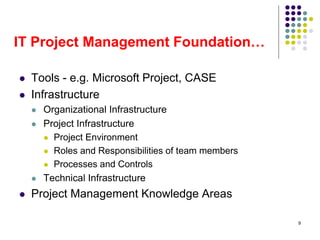
 Tools - e.g. Microsoft Project, CASE
 Infrastructure
 Organizational Infrastructure
 Project Infrastructure
 Project Environment
 Roles and Responsibilities of team members
 Processes and Controls
 Technical Infrastructure
 Project Management Knowledge Areas
IT Project Management Foundation…
10
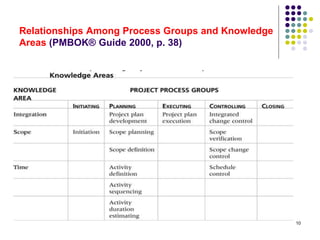
Relationships Among Process Groups and Knowledge
Areas (PMBOK® Guide 2000, p. 38)
11
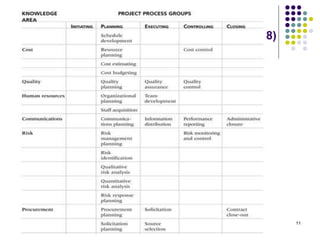
Relationships Among Process Groups and
Knowledge Areas (PMBOK® Guide 2000, p. 38)
12
Business Case
13
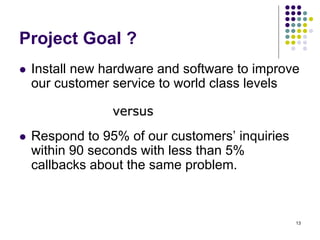
Project Goal ?
 Install new hardware and software to improve
our customer service to world class levels
 Respond to 95% of our customers’ inquiries
within 90 seconds with less than 5%
callbacks about the same problem.
versus
14
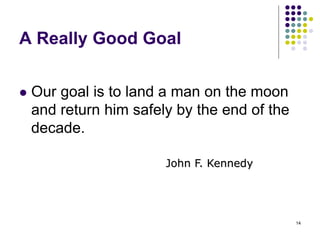
A Really Good Goal
 Our goal is to land a man on the moon
and return him safely by the end of the
decade.
John F. Kennedy
15
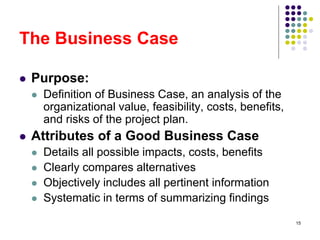
The Business Case
 Purpose:
 Definition of Business Case, an analysis of the
organizational value, feasibility, costs, benefits,
and risks of the project plan.
 Attributes of a Good Business Case
 Details all possible impacts, costs, benefits
 Clearly compares alternatives
 Objectively includes all pertinent information
 Systematic in terms of summarizing findings
16
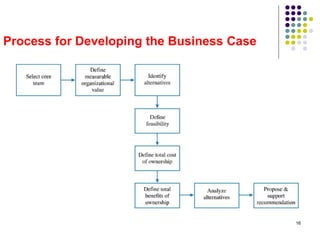
Process for Developing the Business Case
17
Developing the Business Case…
Step 1: Select the Core Team with a goal of
providing the following advantages:
 Credibility
 Alignment with organizational goals
 Access to the real costs
 Ownership
 Agreement
18
Developing the Business Case…
Step 2: Define Measurable Organizational
Value (MOV) the project’s overall goal
 MOV must:
 be measurable
 provide value to the organization
 be agreed upon
 be verifiable
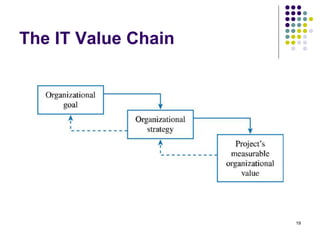
 Aligning the MOV with the organizational strategy
and goals.
19
The IT Value Chain
20
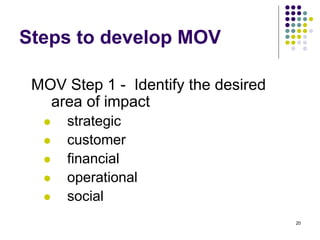
Steps to develop MOV
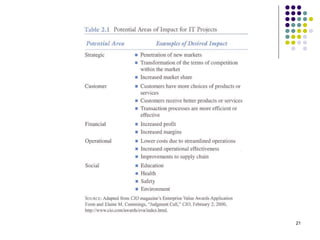
MOV Step 1 - Identify the desired
area of impact
 strategic
 customer
 financial
 operational
 social
21
22
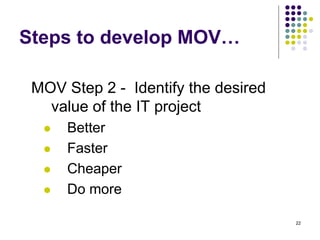
Steps to develop MOV…
MOV Step 2 - Identify the desired
value of the IT project
 Better
 Faster
 Cheaper
 Do more
23
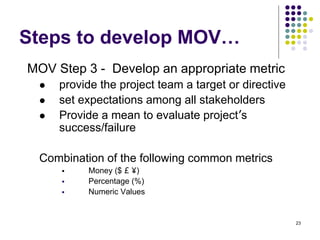
Steps to develop MOV…
MOV Step 3 - Develop an appropriate metric
 provide the project team a target or directive
 set expectations among all stakeholders
 Provide a mean to evaluate project’s
success/failure
Combination of the following common metrics
 Money ($ £ ¥)
 Percentage (%)
 Numeric Values
24
Steps to develop MOV…
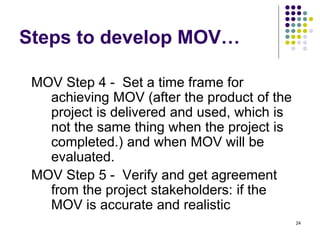
MOV Step 4 - Set a time frame for
achieving MOV (after the product of the
project is delivered and used, which is
not the same thing when the project is
completed.) and when MOV will be
evaluated.
MOV Step 5 - Verify and get agreement
from the project stakeholders: if the
MOV is accurate and realistic
25
Steps to develop MOV…
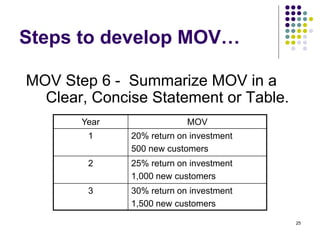
MOV Step 6 - Summarize MOV in a
Clear, Concise Statement or Table.
Year MOV
1 20% return on investment
500 new customers
2 25% return on investment
1,000 new customers
3 30% return on investment
1,500 new customers
26
Developing the Business Case…
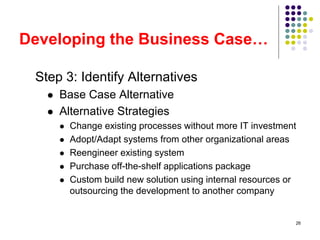
Step 3: Identify Alternatives
 Base Case Alternative
 Alternative Strategies
 Change existing processes without more IT investment
 Adopt/Adapt systems from other organizational areas
 Reengineer existing system
 Purchase off-the-shelf applications package
 Custom build new solution using internal resources or
outsourcing the development to another company
27
Developing the Business Case…
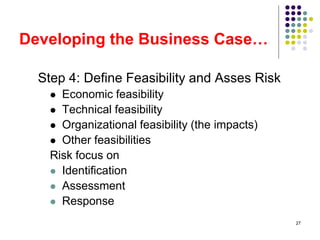
Step 4: Define Feasibility and Asses Risk
 Economic feasibility
 Technical feasibility
 Organizational feasibility (the impacts)
 Other feasibilities
Risk focus on
 Identification
 Assessment
 Response
28
Developing the Business Case…
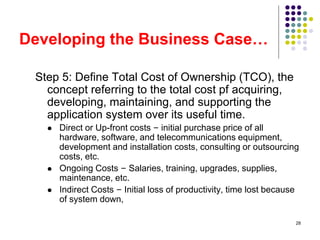
Step 5: Define Total Cost of Ownership (TCO), the
concept referring to the total cost pf acquiring,
developing, maintaining, and supporting the
application system over its useful time.
 Direct or Up-front costs – initial purchase price of all
hardware, software, and telecommunications equipment,
development and installation costs, consulting or outsourcing
costs, etc.
 Ongoing Costs – Salaries, training, upgrades, supplies,
maintenance, etc.
 Indirect Costs – Initial loss of productivity, time lost because
of system down,
29
Developing the Business Case…
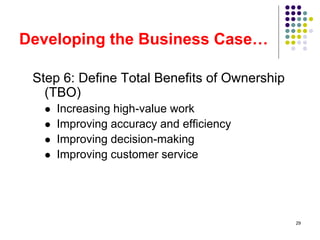
Step 6: Define Total Benefits of Ownership
(TBO)
 Increasing high-value work
 Improving accuracy and efficiency
 Improving decision-making
 Improving customer service
30
Developing the Business Case…
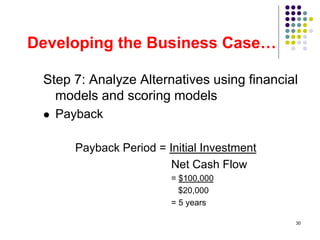
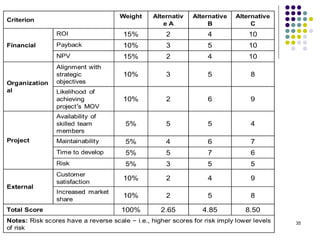
Step 7: Analyze Alternatives using financial
models and scoring models
 Payback
Payback Period = Initial Investment
Net Cash Flow
= $100,000
$20,000
= 5 years
31
Developing the Business Case…
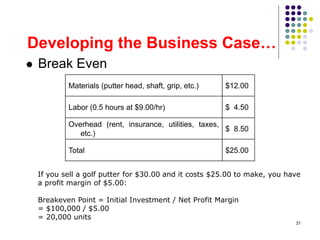
 Break Even
Materials (putter head, shaft, grip, etc.) $12.00
Labor (0.5 hours at $9.00/hr) $ 4.50
Overhead (rent, insurance, utilities, taxes,
etc.)
$ 8.50
Total $25.00
If you sell a golf putter for $30.00 and it costs $25.00 to make, you have
a profit margin of $5.00:
Breakeven Point = Initial Investment / Net Profit Margin
= $100,000 / $5.00
= 20,000 units
32
Developing the Business Case…
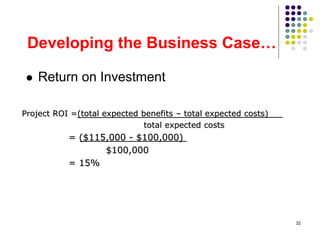
 Return on Investment
Project ROI =(total expected benefits – total expected costs)
total expected costs
= ($115,000 - $100,000)
$100,000
= 15%
33
Developing the Business Case…
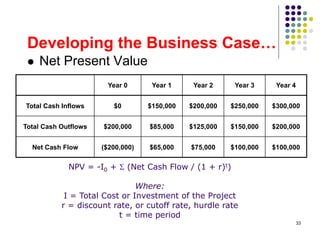
 Net Present Value
Year 0 Year 1 Year 2 Year 3 Year 4
Total Cash Inflows $0 $150,000 $200,000 $250,000 $300,000
Total Cash Outflows $200,000 $85,000 $125,000 $150,000 $200,000
Net Cash Flow ($200,000) $65,000 $75,000 $100,000 $100,000
NPV = -I0 +  (Net Cash Flow / (1 + r)t)
Where:
I = Total Cost or Investment of the Project
r = discount rate, or cutoff rate, hurdle rate
t = time period
34
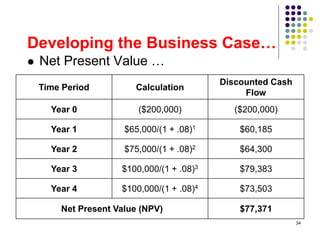
 Net Present Value …
Time Period Calculation
Discounted Cash
Flow
Year 0 ($200,000) ($200,000)
Year 1 $65,000/(1 + .08)1 $60,185
Year 2 $75,000/(1 + .08)2 $64,300
Year 3 $100,000/(1 + .08)3 $79,383
Year 4 $100,000/(1 + .08)4 $73,503
Net Present Value (NPV) $77,371
Developing the Business Case…
35
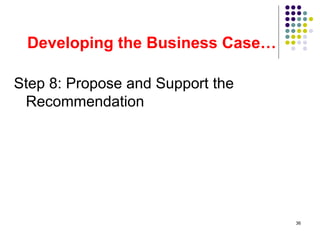
36
Step 8: Propose and Support the
Recommendation
Developing the Business Case…
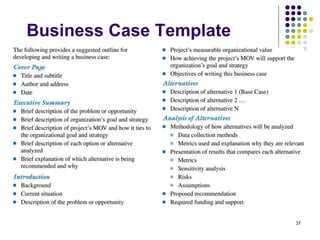
37
Business Case Template
38
Project Selection and Approval
 Previous procedure for the business case
preparation is for project managers. This portion
contains suggestions for executives of the
organization.
 It includes:
 The IT Project Selection Process
 The Project Selection Decision
 IT project must map to organization goals
 IT project must provide verifiable MOV
 Selection should be based on diverse measures such as
 tangible and intangible costs and benefits
 various levels throughout the organization
39
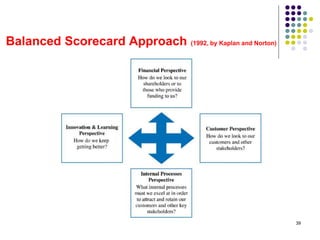
Balanced Scorecard Approach (1992, by Kaplan and Norton)
40
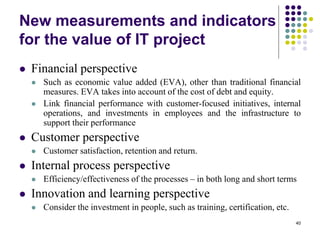
New measurements and indicators
for the value of IT project
 Financial perspective
 Such as economic value added (EVA), other than traditional financial
measures. EVA takes into account of the cost of debt and equity.
 Link financial performance with customer-focused initiatives, internal
operations, and investments in employees and the infrastructure to
support their performance
 Customer perspective
 Customer satisfaction, retention and return.
 Internal process perspective
 Efficiency/effectiveness of the processes – in both long and short terms
 Innovation and learning perspective
 Consider the investment in people, such as training, certification, etc.
41
Reasons Balanced Scorecard Approach
Might Fail (Schneiderman 1999)
 Nonfinancial variables incorrectly identified as primary
drivers
 Metrics not properly defined
 Goals for improvements negotiated not based on
requirements
 No systematic way to map high-level goals
 Reliance on trial and error as a methodology
 No quantitative linkage between nonfinanacial and
expected financial results
42
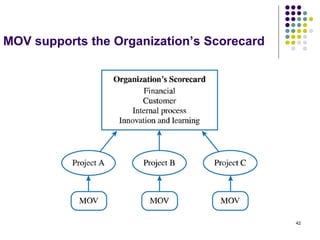
MOV supports the Organization’s Scorecard
43
Summary
 Define what a methodology is and describe the role it
serves in IT projects.
 Identify the phases and infrastructure that makes up
the IT project methodology introduced in this chapter.
 Develop and apply the concept of a project’s
measurable organizational value (MOV).
 Describe and be able to prepare a business case.
 Distinguish between financial models and scoring
models.
 Describe the project selection process as well as the
Balanced Scorecard approach.
44
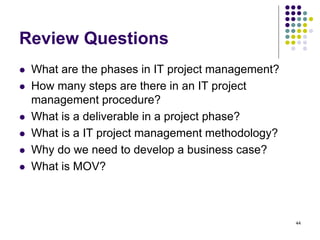
Review Questions
 What are the phases in IT project management?
 How many steps are there in an IT project
management procedure?
 What is a deliverable in a project phase?
 What is a IT project management methodology?
 Why do we need to develop a business case?
 What is MOV?

CH-2.1 Conceptualizing and Initializing the IT Project.ppt

  • 1.
    1 2.1 Conceptualizing andInitializing The IT Project Chapter 2: Phases of Information Systems Project Management
  • 2.
    2 Content  An ITProject Methodology  IT Project Management Phases  IT Project Management Foundation  Relationships Among Process Groups and Knowledge Areas  Business Case  Process for Developing the Business Case  Steps to develop MOV  Business Case Template  Project Selection and Approval  Balanced Scorecard Approach  MOV supports the Organization’s Scorecard  Summary
  • 3.
    3 Methodology  What  Astrategic level plan for managing and controlling IT projects  Why  The team can focus on the tasks at hand, instead of worrying about what to do next  A common language allows project team, sponsor, and others in the organization to communicate more effectively  The standardization allows evaluations between different projects  How  A template for initiating, planning, & developing an information system  Recommends in support of an IT project:  Phases, 5 of them  deliverables  processes  tools  knowledge areas  Must be flexible and include best “practices” learned from experiences over time, e.g. regardless whether SDLS or RAD is used.
  • 4.
    4 An IT ProjectMethodology
  • 5.
    5 Five Phases  Phase1: Conceptualize and Initialize  Define goal, funding, benefit, feasibility and risk  The goal and the analysis of the alternatives will be presented in a business case  Phase 2: Develop the Project Charter and Detailed Project Plan defined in terms of project’s:  scope  schedule  budget  quality objectives
  • 6.
    6 Five Phases…  Phase3: Execute and Control the Project using the approaches such as SDLC .  Phase 4: Close Project  Phase 5: Evaluate Project Success  Postmortem (Investigation) by project manager and team of entire project  Evaluation of team members by project manager  Outside evaluation of project, project leader, and team members  Evaluate project’s organizational value
  • 7.
    7 Overlap of ProcessGroups in a Phase (PMBOK® Guide, 2000, p. 31)
  • 8.
    8 IT Project ManagementFoundation  Project Management Processes  Initiating processes  Planning processes  Executing processes  Controlling processes  Closing processes  Project Objectives
  • 9.
    9  Tools -e.g. Microsoft Project, CASE  Infrastructure  Organizational Infrastructure  Project Infrastructure  Project Environment  Roles and Responsibilities of team members  Processes and Controls  Technical Infrastructure  Project Management Knowledge Areas IT Project Management Foundation…
  • 10.
    10 Relationships Among ProcessGroups and Knowledge Areas (PMBOK® Guide 2000, p. 38)
  • 11.
    11 Relationships Among ProcessGroups and Knowledge Areas (PMBOK® Guide 2000, p. 38)
  • 12.
  • 13.
    13 Project Goal ? Install new hardware and software to improve our customer service to world class levels  Respond to 95% of our customers’ inquiries within 90 seconds with less than 5% callbacks about the same problem. versus
  • 14.
    14 A Really GoodGoal  Our goal is to land a man on the moon and return him safely by the end of the decade. John F. Kennedy
  • 15.
    15 The Business Case Purpose:  Definition of Business Case, an analysis of the organizational value, feasibility, costs, benefits, and risks of the project plan.  Attributes of a Good Business Case  Details all possible impacts, costs, benefits  Clearly compares alternatives  Objectively includes all pertinent information  Systematic in terms of summarizing findings
  • 16.
    16 Process for Developingthe Business Case
  • 17.
    17 Developing the BusinessCase… Step 1: Select the Core Team with a goal of providing the following advantages:  Credibility  Alignment with organizational goals  Access to the real costs  Ownership  Agreement
  • 18.
    18 Developing the BusinessCase… Step 2: Define Measurable Organizational Value (MOV) the project’s overall goal  MOV must:  be measurable  provide value to the organization  be agreed upon  be verifiable  Aligning the MOV with the organizational strategy and goals.
  • 19.
  • 20.
    20 Steps to developMOV MOV Step 1 - Identify the desired area of impact  strategic  customer  financial  operational  social
  • 21.
  • 22.
    22 Steps to developMOV… MOV Step 2 - Identify the desired value of the IT project  Better  Faster  Cheaper  Do more
  • 23.
    23 Steps to developMOV… MOV Step 3 - Develop an appropriate metric  provide the project team a target or directive  set expectations among all stakeholders  Provide a mean to evaluate project’s success/failure Combination of the following common metrics  Money ($ £ ¥)  Percentage (%)  Numeric Values
  • 24.
    24 Steps to developMOV… MOV Step 4 - Set a time frame for achieving MOV (after the product of the project is delivered and used, which is not the same thing when the project is completed.) and when MOV will be evaluated. MOV Step 5 - Verify and get agreement from the project stakeholders: if the MOV is accurate and realistic
  • 25.
    25 Steps to developMOV… MOV Step 6 - Summarize MOV in a Clear, Concise Statement or Table. Year MOV 1 20% return on investment 500 new customers 2 25% return on investment 1,000 new customers 3 30% return on investment 1,500 new customers
  • 26.
    26 Developing the BusinessCase… Step 3: Identify Alternatives  Base Case Alternative  Alternative Strategies  Change existing processes without more IT investment  Adopt/Adapt systems from other organizational areas  Reengineer existing system  Purchase off-the-shelf applications package  Custom build new solution using internal resources or outsourcing the development to another company
  • 27.
    27 Developing the BusinessCase… Step 4: Define Feasibility and Asses Risk  Economic feasibility  Technical feasibility  Organizational feasibility (the impacts)  Other feasibilities Risk focus on  Identification  Assessment  Response
  • 28.
    28 Developing the BusinessCase… Step 5: Define Total Cost of Ownership (TCO), the concept referring to the total cost pf acquiring, developing, maintaining, and supporting the application system over its useful time.  Direct or Up-front costs – initial purchase price of all hardware, software, and telecommunications equipment, development and installation costs, consulting or outsourcing costs, etc.  Ongoing Costs – Salaries, training, upgrades, supplies, maintenance, etc.  Indirect Costs – Initial loss of productivity, time lost because of system down,
  • 29.
    29 Developing the BusinessCase… Step 6: Define Total Benefits of Ownership (TBO)  Increasing high-value work  Improving accuracy and efficiency  Improving decision-making  Improving customer service
  • 30.
    30 Developing the BusinessCase… Step 7: Analyze Alternatives using financial models and scoring models  Payback Payback Period = Initial Investment Net Cash Flow = $100,000 $20,000 = 5 years
  • 31.
    31 Developing the BusinessCase…  Break Even Materials (putter head, shaft, grip, etc.) $12.00 Labor (0.5 hours at $9.00/hr) $ 4.50 Overhead (rent, insurance, utilities, taxes, etc.) $ 8.50 Total $25.00 If you sell a golf putter for $30.00 and it costs $25.00 to make, you have a profit margin of $5.00: Breakeven Point = Initial Investment / Net Profit Margin = $100,000 / $5.00 = 20,000 units
  • 32.
    32 Developing the BusinessCase…  Return on Investment Project ROI =(total expected benefits – total expected costs) total expected costs = ($115,000 - $100,000) $100,000 = 15%
  • 33.
    33 Developing the BusinessCase…  Net Present Value Year 0 Year 1 Year 2 Year 3 Year 4 Total Cash Inflows $0 $150,000 $200,000 $250,000 $300,000 Total Cash Outflows $200,000 $85,000 $125,000 $150,000 $200,000 Net Cash Flow ($200,000) $65,000 $75,000 $100,000 $100,000 NPV = -I0 +  (Net Cash Flow / (1 + r)t) Where: I = Total Cost or Investment of the Project r = discount rate, or cutoff rate, hurdle rate t = time period
  • 34.
    34  Net PresentValue … Time Period Calculation Discounted Cash Flow Year 0 ($200,000) ($200,000) Year 1 $65,000/(1 + .08)1 $60,185 Year 2 $75,000/(1 + .08)2 $64,300 Year 3 $100,000/(1 + .08)3 $79,383 Year 4 $100,000/(1 + .08)4 $73,503 Net Present Value (NPV) $77,371 Developing the Business Case…
  • 35.
  • 36.
    36 Step 8: Proposeand Support the Recommendation Developing the Business Case…
  • 37.
  • 38.
    38 Project Selection andApproval  Previous procedure for the business case preparation is for project managers. This portion contains suggestions for executives of the organization.  It includes:  The IT Project Selection Process  The Project Selection Decision  IT project must map to organization goals  IT project must provide verifiable MOV  Selection should be based on diverse measures such as  tangible and intangible costs and benefits  various levels throughout the organization
  • 39.
    39 Balanced Scorecard Approach(1992, by Kaplan and Norton)
  • 40.
    40 New measurements andindicators for the value of IT project  Financial perspective  Such as economic value added (EVA), other than traditional financial measures. EVA takes into account of the cost of debt and equity.  Link financial performance with customer-focused initiatives, internal operations, and investments in employees and the infrastructure to support their performance  Customer perspective  Customer satisfaction, retention and return.  Internal process perspective  Efficiency/effectiveness of the processes – in both long and short terms  Innovation and learning perspective  Consider the investment in people, such as training, certification, etc.
  • 41.
    41 Reasons Balanced ScorecardApproach Might Fail (Schneiderman 1999)  Nonfinancial variables incorrectly identified as primary drivers  Metrics not properly defined  Goals for improvements negotiated not based on requirements  No systematic way to map high-level goals  Reliance on trial and error as a methodology  No quantitative linkage between nonfinanacial and expected financial results
  • 42.
    42 MOV supports theOrganization’s Scorecard
  • 43.
    43 Summary  Define whata methodology is and describe the role it serves in IT projects.  Identify the phases and infrastructure that makes up the IT project methodology introduced in this chapter.  Develop and apply the concept of a project’s measurable organizational value (MOV).  Describe and be able to prepare a business case.  Distinguish between financial models and scoring models.  Describe the project selection process as well as the Balanced Scorecard approach.
  • 44.
    44 Review Questions  Whatare the phases in IT project management?  How many steps are there in an IT project management procedure?  What is a deliverable in a project phase?  What is a IT project management methodology?  Why do we need to develop a business case?  What is MOV?