Process Analysis
2
Overview
• Process: Introduction
• Process Types: Project, Job, Batch, Line and Continuous
• Process Analysis
– Processes Flow Chart
– Process and Flows – Important Concepts
Cycle Time Throughput WIP Lead
Time
Process Capacity Bottleneck Batch Process Little’s
Formula
Rework, Parallel Path
– Effect of Variability on Performance of Process
What is a process?
The basic building block of operations is the process.
Operations as a
Transformation
Process
The
Transformation
process
Input transformed
resources
Material
Information
Customers
Input transforming
resources
Facilities
Staff
Environment
Environment
OUTPUT
INPUT
Goods
Services
A process is a series or set of activities that interact to produce a result;
it may occur once-only or be recurrent or periodic (Source: Wikipedia).
Example: Let’s say you want to get a book from your book shelf. There
are many small tasks involved such as getting up from your desk,
walking to the shelf, opening the shelf door, identifying the book,
picking it up, closing the shelf and going back to your desk. Each
step described above is called a task.
Processes exist to create value for the customers.
Processes in Value Chain
A value chain stage
such as,
manufacturing is
comprises of
processes designed to
add value by
transforming relevant
inputs into useful
outputs.
Processes
involve tasks
and associated
resources.
Resource Sets
R1.1 R1.2
P1 P2 P3
Processes
Supplier Mfg DC
Value Chain
R1.3
T1.1 T1.2 T1.3
Task Set,
T1
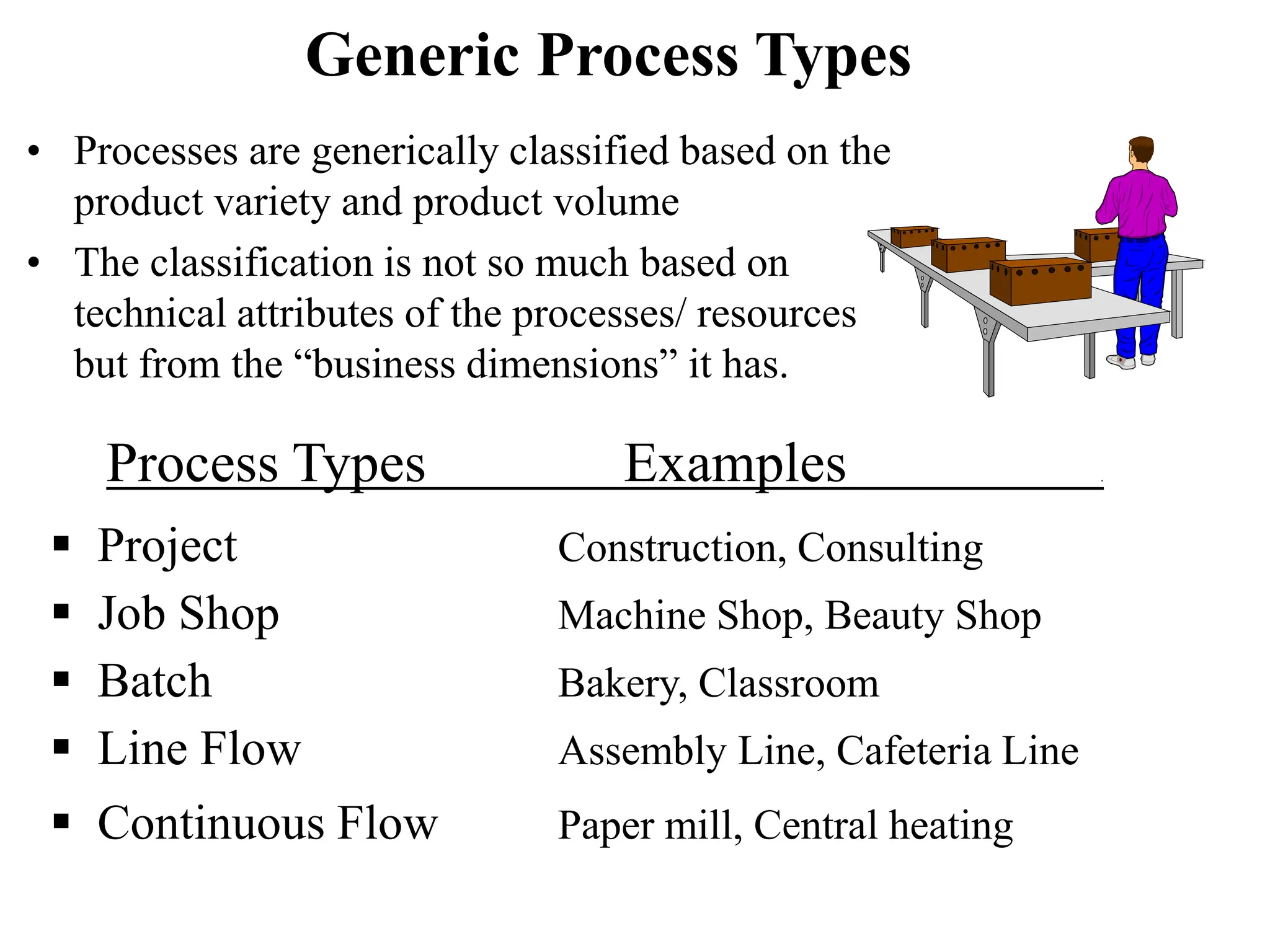
Process Types Examples .
 Project Construction, Consulting
 Job Shop Machine Shop, Beauty Shop
 Batch Bakery, Classroom
 Line Flow Assembly Line, Cafeteria Line
 Continuous Flow Paper mill, Central heating
Generic Process Types
• Processes are generically classified based on the
product variety and product volume
• The classification is not so much based on
technical attributes of the processes/ resources
but from the “business dimensions” it has.
6
Project Process
Production of a large-scale, complex product. If a project
produces physical goods then the product typically
cannot be moved.
Examples: construction projects such as a dam/building,
software projects
Features -
– Unique products built on site (products like s/w are exception)
– Coordination of large scale resources
– Processes are highly flexible
– Resources dedicated for the project and released at the
completion of the project
– Firm sells capability and experience
7
Jobbing Process
A process designed to produce a series of small, single unit
products. The same product may not be required in future or
orders for the product are infrequent.
Examples: Optometric glass making, Specialty machine shops
Features -
- Makes unique products like project but if involves physical
goods then they are small and can be moved
- Skilled worker is responsible
- Wide product range, flexible process
-Usually low investment in automated plant equipment (mfg
example)
-material usually purchased only when order is received
8
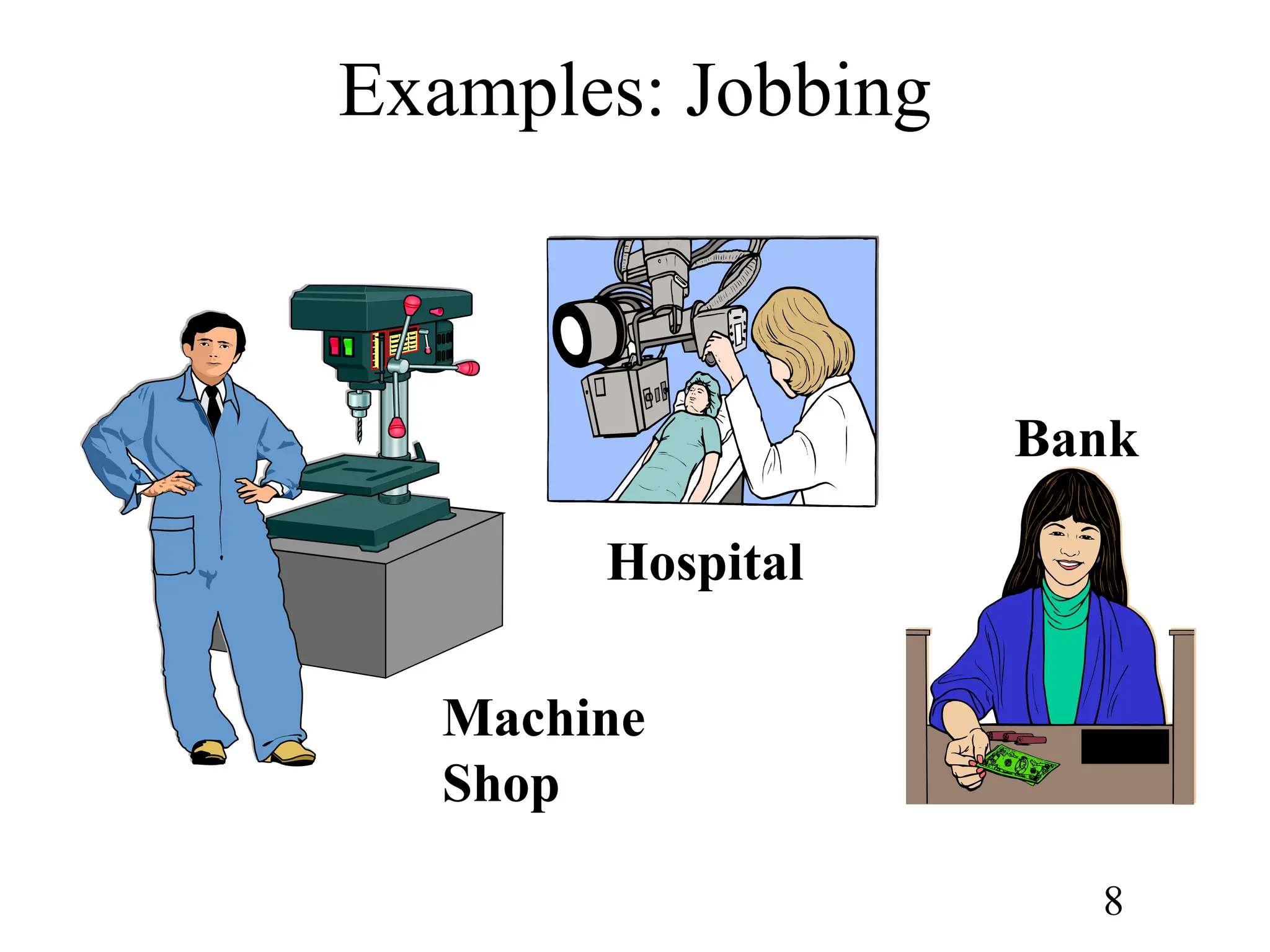
Examples: Jobbing
Bank
Machine
Shop
Hospital
9
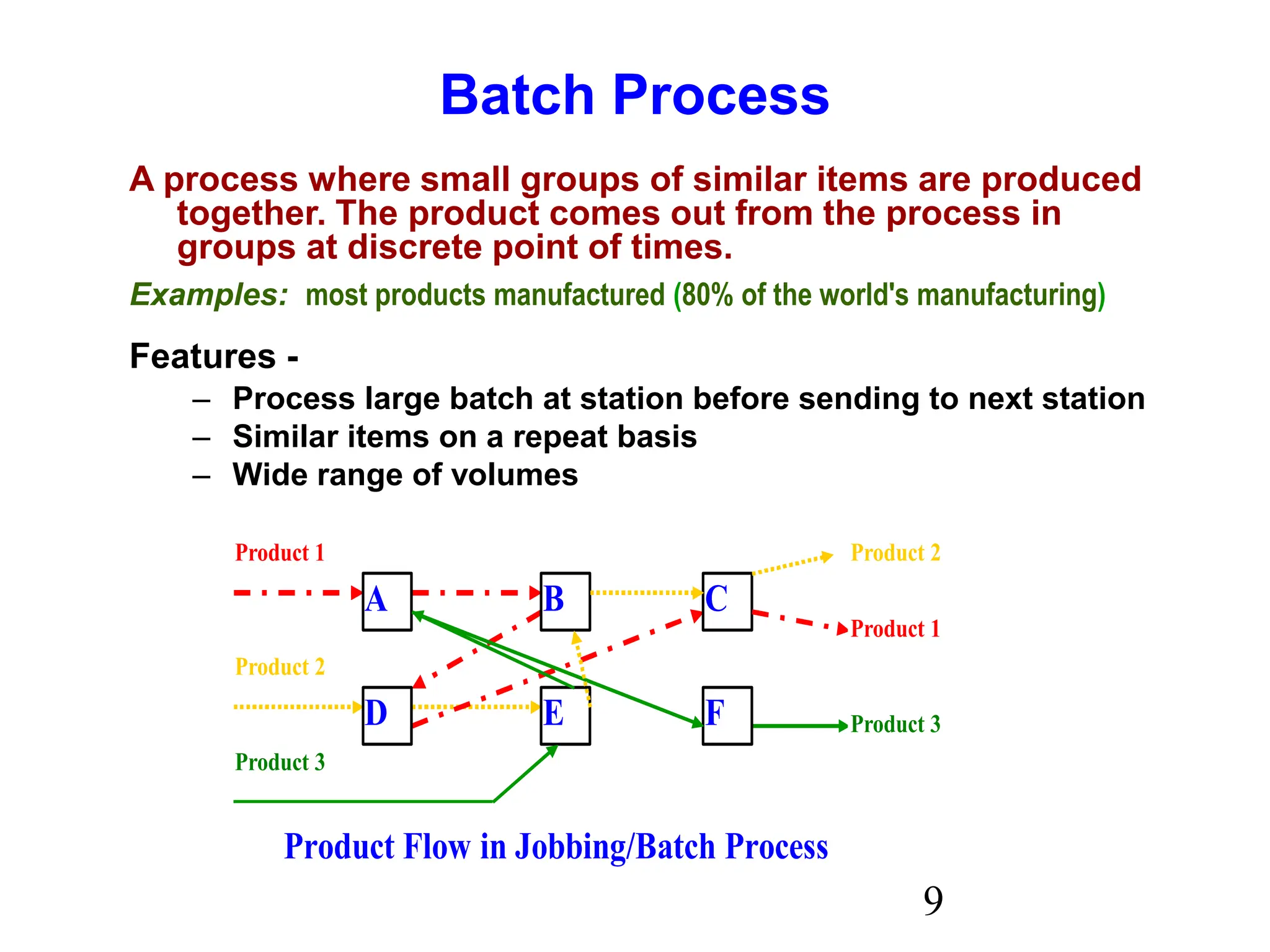
Batch Process
A process where small groups of similar items are produced
together. The product comes out from the process in
groups at discrete point of times.
Examples: most products manufactured (80% of the world's manufacturing)
Features -
– Process large batch at station before sending to next station
– Similar items on a repeat basis
– Wide range of volumes
A B C
D E F
Product 1
Product 1
Product 2
Product 2
Product 3
Product 3
Product Flow in Jobbing/Batch Process
10
Examples: Batch Process
Batch processing
of chemical
Garment
11
(Connected) Line Processes
A high-volume, high investment form of
manufacturing designed to produce similar
discrete products cheaply.
Examples: Car production, Pharmaceuticals and Computers.
Features -
– Dedicated to one product or family
– Standard products, high volumes
– Units processed & transferred in synchronized manner
– Processing can be broken into discrete steps and the
stages balanced to synchronize flow
12
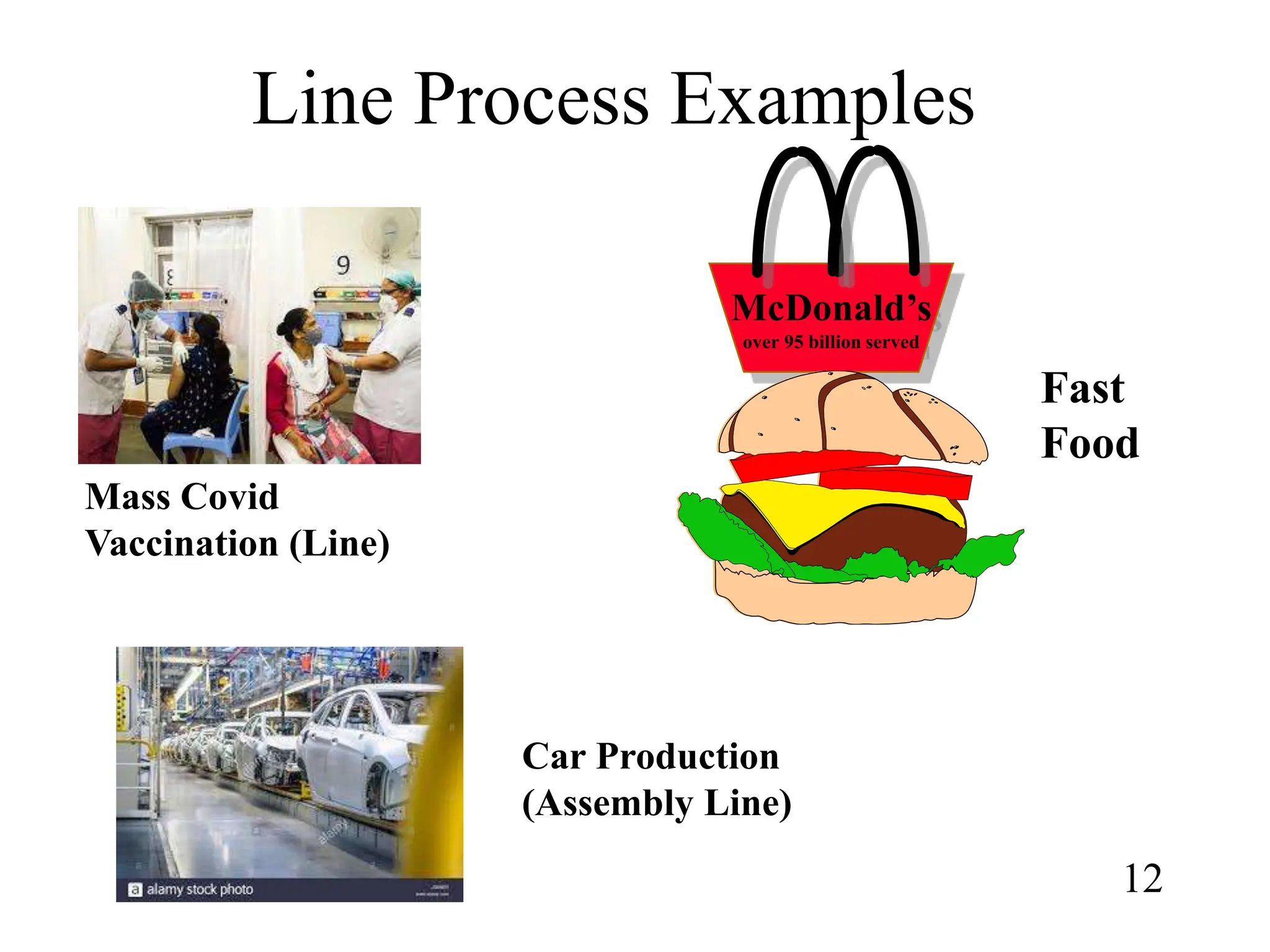
Line Process Examples
Car Production
(Assembly Line)
Mass Covid
Vaccination (Line)
Fast
Food
McDonald’s
over 95 billion served
13
Continuous (Flow) Processes
A never-ending form of production
Examples: Process industries- Paper, Chemicals, Petroleum.
Features
– Material continuous & processing continuous (no discrete
steps)
– Large volumes of uniform products
– Narrow range of standard products
– Highly interconnected
– Basic material processed in stages into one or more products
A D C
D E C
Product 1
Product 1
Product 2
Product 2
Product 3
Product 3
Product-flow in Line/Continuous Process
E A F
B
14
Continuous Process Examples
Paper
(Continuous)
Glass Making
(Continuous)
15
Exercise: Identify the process type used
Example Process type
Assembly of appliances and cars
Running a political event
Clothing Mfg.
Toys Mfg.
Developing a new product
Specialist tool maker
Furniture restores
Processing student applications
Installing an ERP package
Manufacturer of Component parts
Beer bottling plant
Electricity utilities
Steel making
16
Continuum of Process Structures in Mfg.
Type
Stage
connectivity
Product
flow
Variety of
products
Product
volume
Process/
transfer unit
Line Process
Batch Process
Jobbing Process
Project
Continuous
process
Unique One
Unique One
Tightly
connected
Fixed
pattern Few Large
Continuous
repetitive
Loosely
connected
or
disconnected
Moderate
Moderate
Batch
Flexible
pattern
Many Small
Process
17
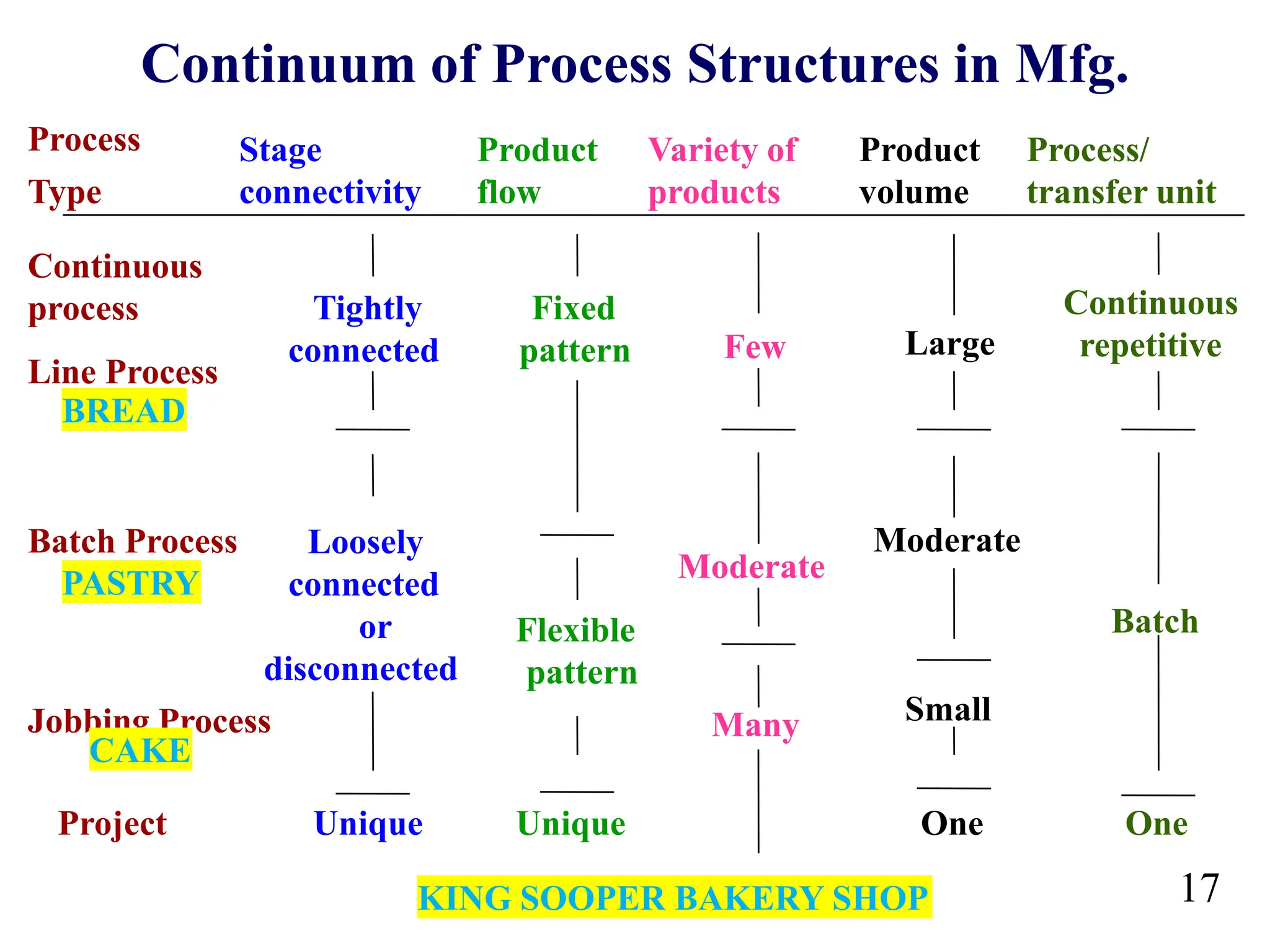
Continuum of Process Structures in Mfg.
Type
Stage
connectivity
Product
flow
Variety of
products
Product
volume
Process/
transfer unit
Line Process
Batch Process
Jobbing Process
Project
Continuous
process
Unique One
Unique One
Tightly
connected
Fixed
pattern Few Large
Continuous
repetitive
Loosely
connected
or
disconnected
Moderate
Moderate
Batch
Flexible
pattern
Many Small
Process
CAKE
BREAD
PASTRY
KING SOOPER BAKERY SHOP
-Project -Job Shop -Batch
-Line Flow -Continuous Flow
Summary: Classification of Processes by Process
Architecture
These process structures differ in several respects such as:
•Volume - ranging from a quantity of one to large scale mass production.
•Number of products - ranging from the capability of producing a multitude of
different products to producing only one specific product.
•Flow - ranging from a large number of possible sequences of activities to only one
possible sequence.
•Flexibility - Changes may be changes in production volume or changes in the
product mix.
•Capital investment - ranging from using lower cost general purpose equipment to
expensive specialized equipment.
•Variable cost - ranging from a high unit cost to a low unit cost.
•Labor content and skill - ranging from high labor content with high skill to low
content and low skill.
19
Process Types vs Layout Types
• ‘The process type does not refer to the same things
as the layout (or physical arrangement)’ type.
• For example, consider a process comprising of three
task sets represented by, T1, T2, T3 carried out
using resources R1, R2 and R3 respectively.
• Is there a unique way of physically placing them in
a facility?
R1 R2 R3
T1 T2 T3
R1
R2
R3
T1
T2
T3
R1 R2
R3
T1 T2
T3
All these 3 systems are capable of making the same set of products
occupying the same volume & variety positions.
20
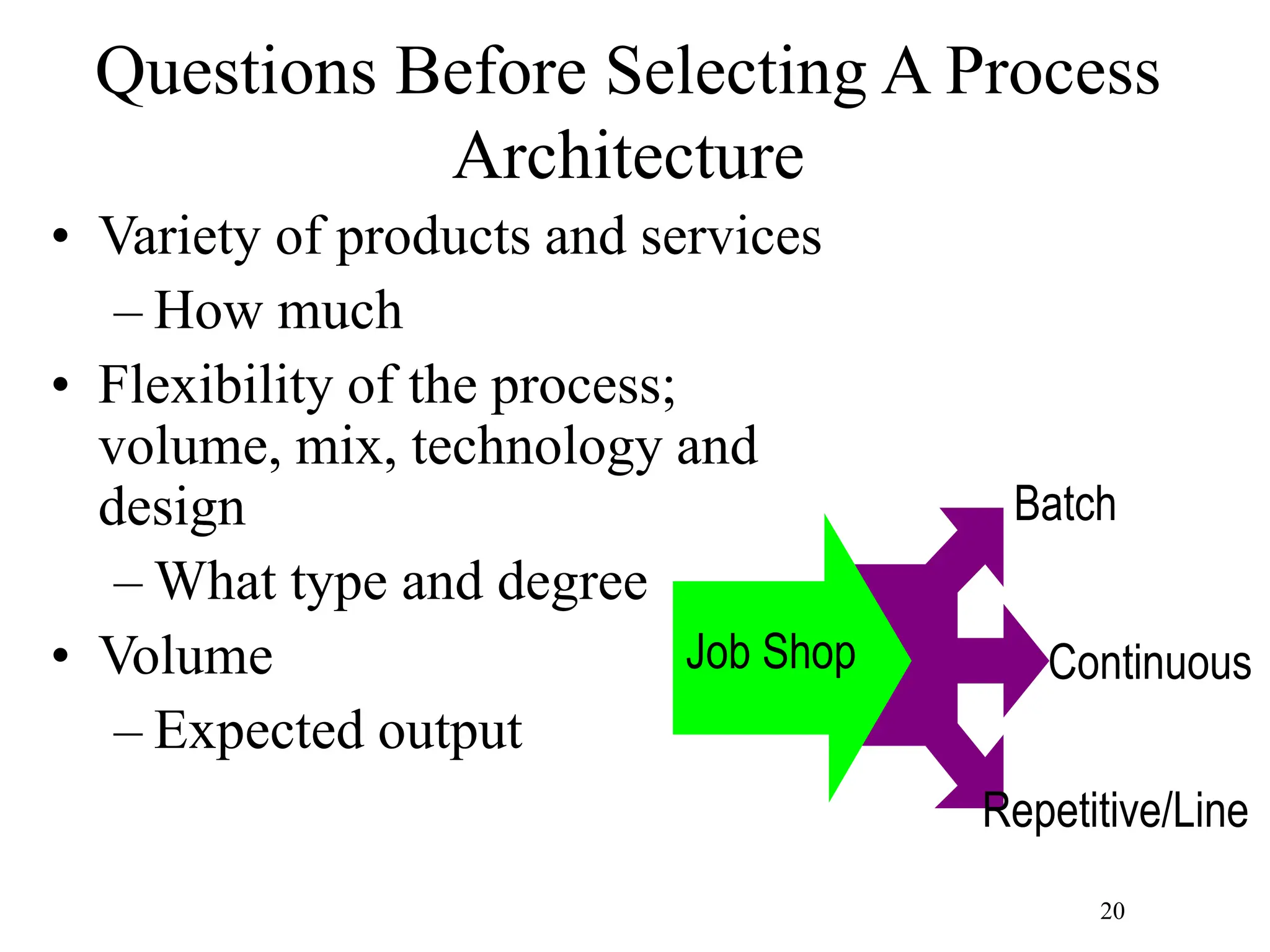
• Variety of products and services
– How much
• Flexibility of the process;
volume, mix, technology and
design
– What type and degree
• Volume
– Expected output
Job Shop
Batch
Repetitive/Line
Continuous
Questions Before Selecting A Process
Architecture
21
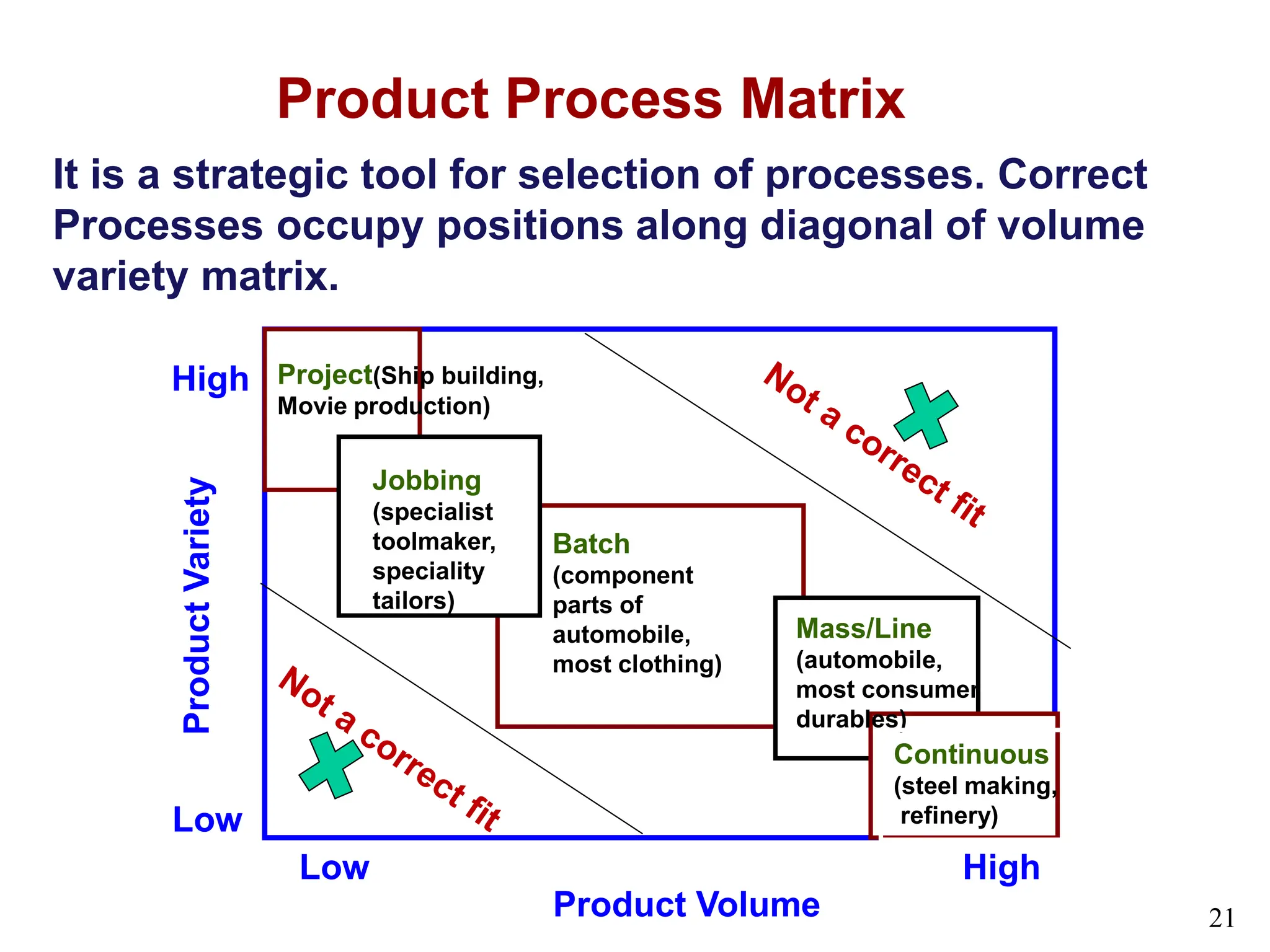
Product
Variety
Product Process Matrix
High
Low
Product Volume
Low High
Project(Ship building,
Movie production)
Mass/Line
(automobile,
most consumer
durables)
Continuous
(steel making,
refinery)
Jobbing
(specialist
toolmaker,
speciality
tailors)
Batch
(component
parts of
automobile,
most clothing)
It is a strategic tool for selection of processes. Correct
Processes occupy positions along diagonal of volume
variety matrix.
Process Analysis
“If you cannot describe what you are doing as a
process, you do not know what you are doing.”
W.E. Deming
Process Analysis
• An operation is composed of processes designed to add
value by transforming relevant inputs into useful
outputs.
• The first step to improving a process is to map and
analyse it:
- To understand the activities & their relationships
- To identify inefficient tasks to eliminate/improve
- To assess against the relevant performance measures.
Map a process!
Assess its elements
against the relevant
performance measures.
Cost
Flow Time
Inventory
Quality
Etc.
Process Analysis: Broad Steps
• Define the process boundaries that mark the entry
points of the process inputs and the exit points of the
process outputs.
• Construct a process flow diagram that illustrates the
various process activities and their interrelationships.
• Determine the capacity of each step in the process.
Calculate other measures of interest.
• Identify the bottleneck, that is, the step having the
lowest capacity.
• Evaluate further limitations in order to quantify the
impact of the bottleneck.
• Use the analysis to make operating decisions and to
improve the process.
Process Flow Charts
Process flow diagram (or process flowchart) is a valuable
tool for understanding the process using graphic elements to
represent tasks, flows, and storage.
Rectangles: represent tasks
Arrows: Represent flows of material and information.
Material flow usually is represented by a solid line and
information flow by a dashed line.
Inverted triangles: represent storage (inventory). Storage
bins commonly are used to represent raw material inventory,
work in process inventory, and finished goods inventory.
Diamond: Represents decision points.
Example of a Two-Stage Serial System
A A A A
B B B B
5 10 15 20
7 12
Gantt Chart
A B
5 min 2 min
Raw
material
Sub
assembly
Step-1 Step-2
to
assembly
Simultaneous
activities
Different products
produced
Alternate Paths
30%
70%
Examples: Non-Serial Tasks
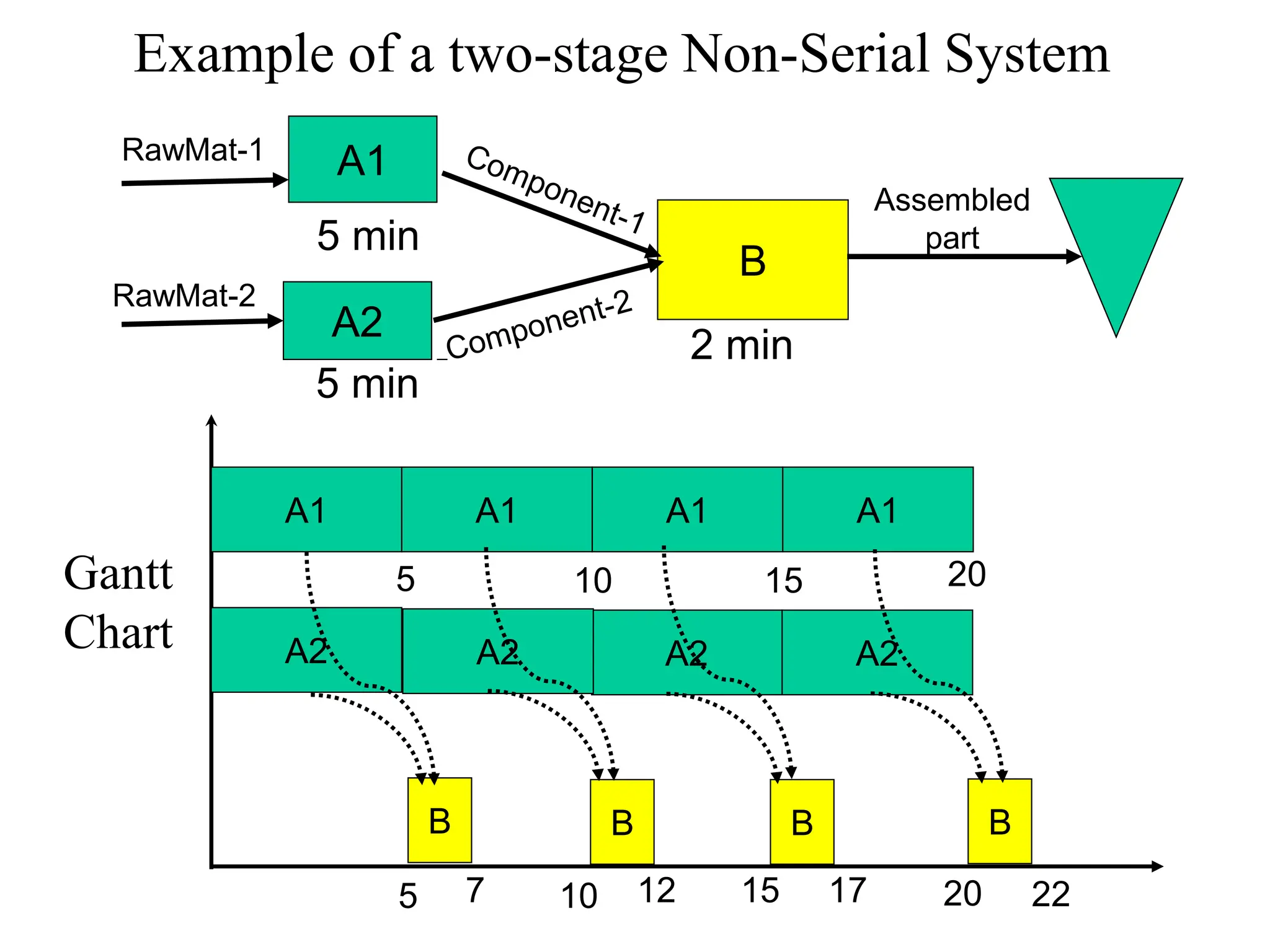
Example of a two-stage Non-Serial System
A1
B
2 min
A2
5 min
5 min
RawMat-1
RawMat-2
Assembled
part
A1 A1 A1 A1
5 10 15 20
7 12
A2
A2
A2
A2
5 10 15 20
B B B
17
B
22
Gantt
Chart
How to Draw a Process Flow
Diagram
• Focus on one or two types of flow units.
• Define the process boundaries and choose an
appropriate level of detail.
• Include only those steps that are likely to affect
the process flow or the economics of the process.
• Sizes and exact locations of arrows, boxes, and
triangles do not carry any special meaning.
• Use different colors for different routes for clarity.
Case: Kristen's Cookie Co.
(A)
Task: Perform a process analysis to answer some
questions related to making important business
decisions in setting up facility, buying
resources/equipment, pricing, order policy etc.
1.Process Capacity: The capacity is defined as the maximum output
from the process or resource (e.g., worker, machine, factory,
organization), measured in units produced per unit of time. Thus
capacity can be found by dividing total available time by the processing
time per unit.
Example of Capacity of a Single Stage Process: If a welder can do a job in 1 minute,
then his/her hourly capacity will be [1hr *60 (minutes/hr) ]/ (1 minute) = 60 units/hr
Note: Effective capacity (in long term) refers to the output that the manager is most
likely to attend in actual setting and this can be less than the maximum output rate due
to factors such as maintenance, scheduling difficulties and worker availability. To
account for this in setting long term capacity the time availability may be reduced by a
factor. For instance, welder’s weekly capacity in above example (1-8 hr shift x 5
working day) may be say 60*40*0.9 =2160 units/week (instead of 60*40=2400
units/week).
Process Performance Measures
What do we need to measure in order to understand how the
designed process will perform?
Task 1 Task 2 Task 3
Capacity of multi-stage process: concept of bottleneck
Q1. Which task is the bottleneck for line with given task times?
20 minutes 36 minutes 30 minutes
The bottleneck is defined as the process step (station) in the flow
diagram with the lowest capacity (the “weakest link”). Although
the bottleneck is often the process step with the longest
processing time, it is important to always look at the capacities
for making a judgement (why?).
Q3. What is the capacity of this process?
The capacity of the multi-stage process is bottleneck
capacity, hence, 2 units/hr
3 units/hr 5 units/hr 2 units/hr
# workers used
Q2. What is the capacity of different stage?
2. Throughput or throughput rate or flow rate– It is the actual
total volume of production through a facility (e.g., worker,
machine, factory, organization) per unit time or the average rate at
which units flow past a specific point in the process.
3. Capacity utilization – It is a measure how intensely a process is
being used to produce goods/services.
Method 1 (Based on time activation). If a worker is busy 45
minutes every hour has a utilization of 75% (=45/60*100).
Utilization =Time worked/ Time Available
Method 2 (Based on output quanitity). Alternatively, utilization can
be calculated as the actual throughput divided by capacity.
Utilization =Throughput or Flow Rate / Capacity
A worker capable of producing 60 units per hr who only produces 30 hrs per
hr has utilization = 30/60*100 = 50%.
Process Performance Measures
Remark: Realised Capacity is throughput, hence at maximum capacity
realisation or throughput rate, utilization is 100%.
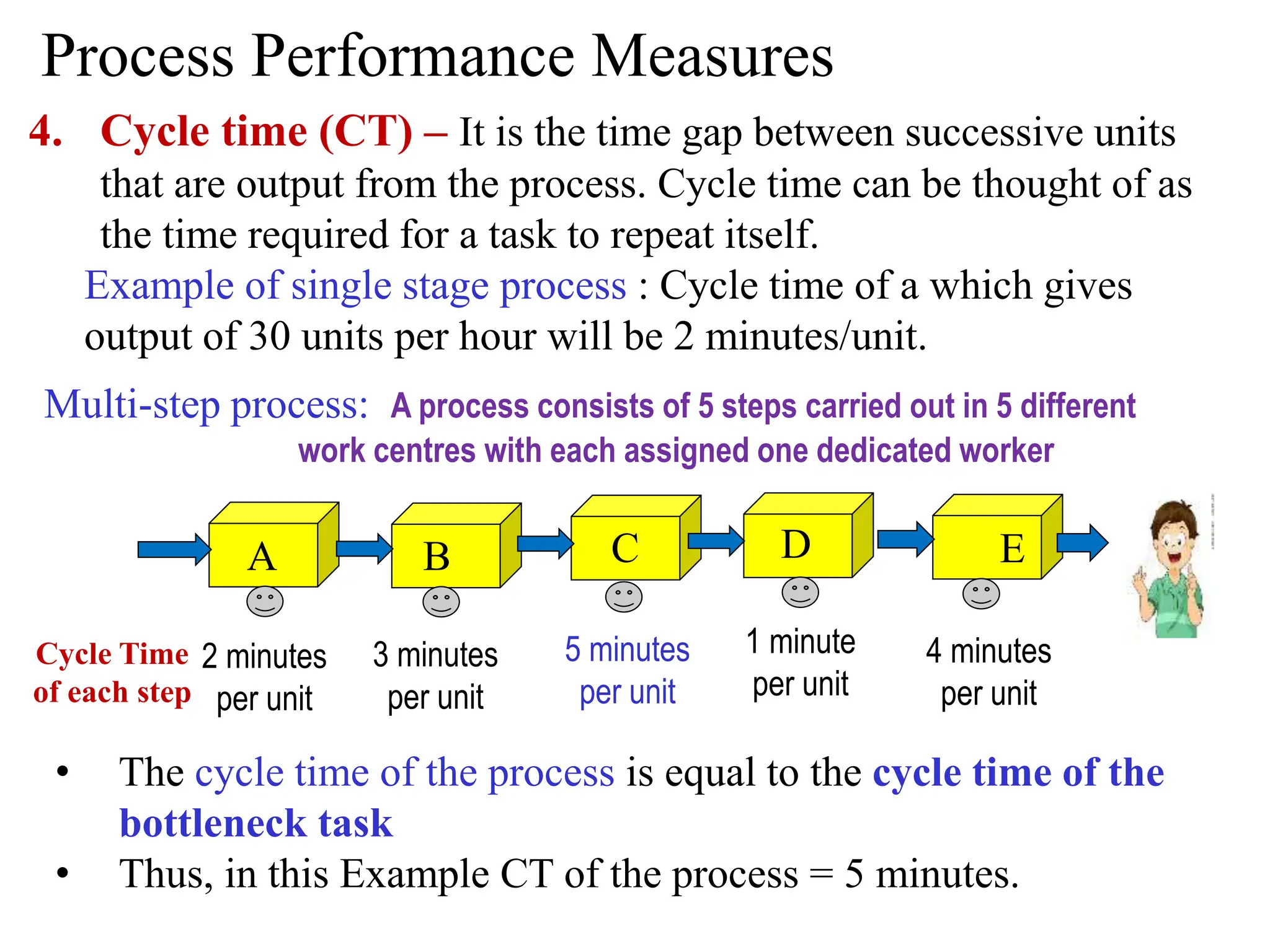
4. Cycle time (CT) – It is the time gap between successive units
that are output from the process. Cycle time can be thought of as
the time required for a task to repeat itself.
Example of single stage process : Cycle time of a which gives
output of 30 units per hour will be 2 minutes/unit.
Process Performance Measures
2 minutes
per unit
3 minutes
per unit
5 minutes
per unit
1 minute
per unit
4 minutes
per unit
Multi-step process: A process consists of 5 steps carried out in 5 different
work centres with each assigned one dedicated worker
A B C D E
Cycle Time
of each step
• The cycle time of the process is equal to the cycle time of the
bottleneck task
• Thus, in this Example CT of the process = 5 minutes.
Cycle Time & Throughput Relation
Cycle Time: Average time for completion of a unit at a production
step or process. Measured as time/unit. [Note: different kinds
of products require different processing, hence averaging]
Throughput Rate: Average number of units processed over a unit
time interval. Measured as units/time
1
Cycle Time
Throughput rate =
Key
relationship Capacity = (maximum possible) throughput rate
= throughput rate at minimum possible Cycle Time)
[Note: 1) computed this way, the maximum possible throughput
rate or Minimum possible Cycle Time through a process stage
measures its capacity]
2) Takt Time = target cycle time to meet throughput demand of
usually a day (say, 480 units production demand in an 8-hr shift
will give a takt time = 8*60/480= 1 min)
Cycle Time & Capacity of Each Step
2 minutes
per unit
3 minutes
per unit
5 minutes
per unit
1 minute
per unit
4 minutes
per unit
30 units
per hour
20 units
per hour
12 units
per hour
60 units
per hour
15 units
per hour
Capacities for Each Step (work Centre) of the Process
A process consists of 5 steps carried out in 5 different work centres with each
assigned one dedicated worker
A B C D E
Capacity
Minimum
Cycle Time
Note: Realised Capacity is throughput. How much capacity is likely to be
realised? For process? At each step?
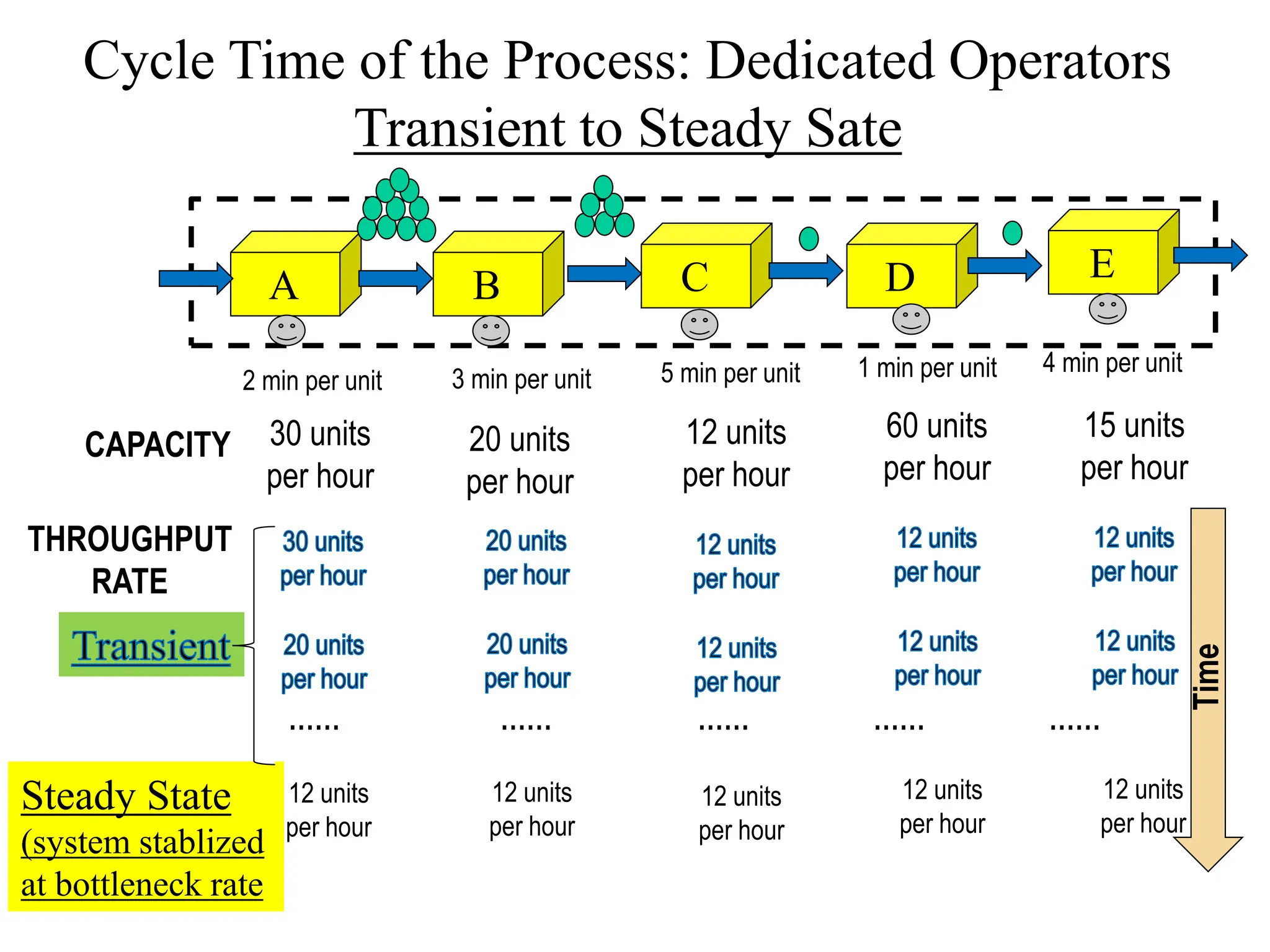
Cycle Time of the Process: Dedicated Operators
Transient to Steady Sate
2 min per unit 3 min per unit 5 min per unit 1 min per unit 4 min per unit
30 units
per hour
20 units
per hour
12 units
per hour
60 units
per hour
15 units
per hour
A B C D E
CAPACITY
THROUGHPUT
RATE
12 units
per hour
12 units
per hour
12 units
per hour
12 units
per hour
12 units
per hour
Steady State
(system stablized
at bottleneck rate
…… …… …… …… ……
Time
Capacity and cycle time with Multiple
Resources/Servers
• Suppose for a step, the Best (minimum
possible) Cycle Time = T time per unit
• Capacity of a single server = 1/T units
per time unit
• If this step has “m” identical
servers in parallel
– Capacity = m/T units per time unit
– Output 1 unit every T/m time units
Cycle Time = T
Cycle Time = T for each booth
5. Flow time or throughput time: the average time that a unit
requires to flow through the process from the entry point to the exit
point. The flow time is the length of the longest path through the
process. Flow time includes both processing time and any time the
unit spends between steps.
6. Process time – This is the value added time i.e., the average time
that a unit is worked on. Process time is flow time less idle time.
7. Idle time - time when no activity is being performed, for
example, when an activity is waiting for work to arrive from the
previous activity. The term can be used to describe both machine
idle time and worker idle time.
Flow time, Process Time and Idle Time
A B C D
t=10 t=10
t=0 t=20 t=40 t=50
t=30 t=40
t=30
t=20
Flow time, Process Time and Idle Time
A B
5 min 2 min
Raw
material
Finished
product
Step-1 Step-2
A Two Step Process
Product thru
Step A
Thru B
5 10
Idle Time
3 min
8
Gantt Chart of Processing of a Product
Flow Time (10 min)
Process Time or
Value Added Time
5 + 2 = 7 min
5 min
2 min
Waiting
to move
2 min per unit 3 min per unit 5 min per unit 1 min per unit 4 min per unit
30 units
per hour
20 units
per hour
12 units
per hour
60 units
per hour
15 units
per hour
A B C D E
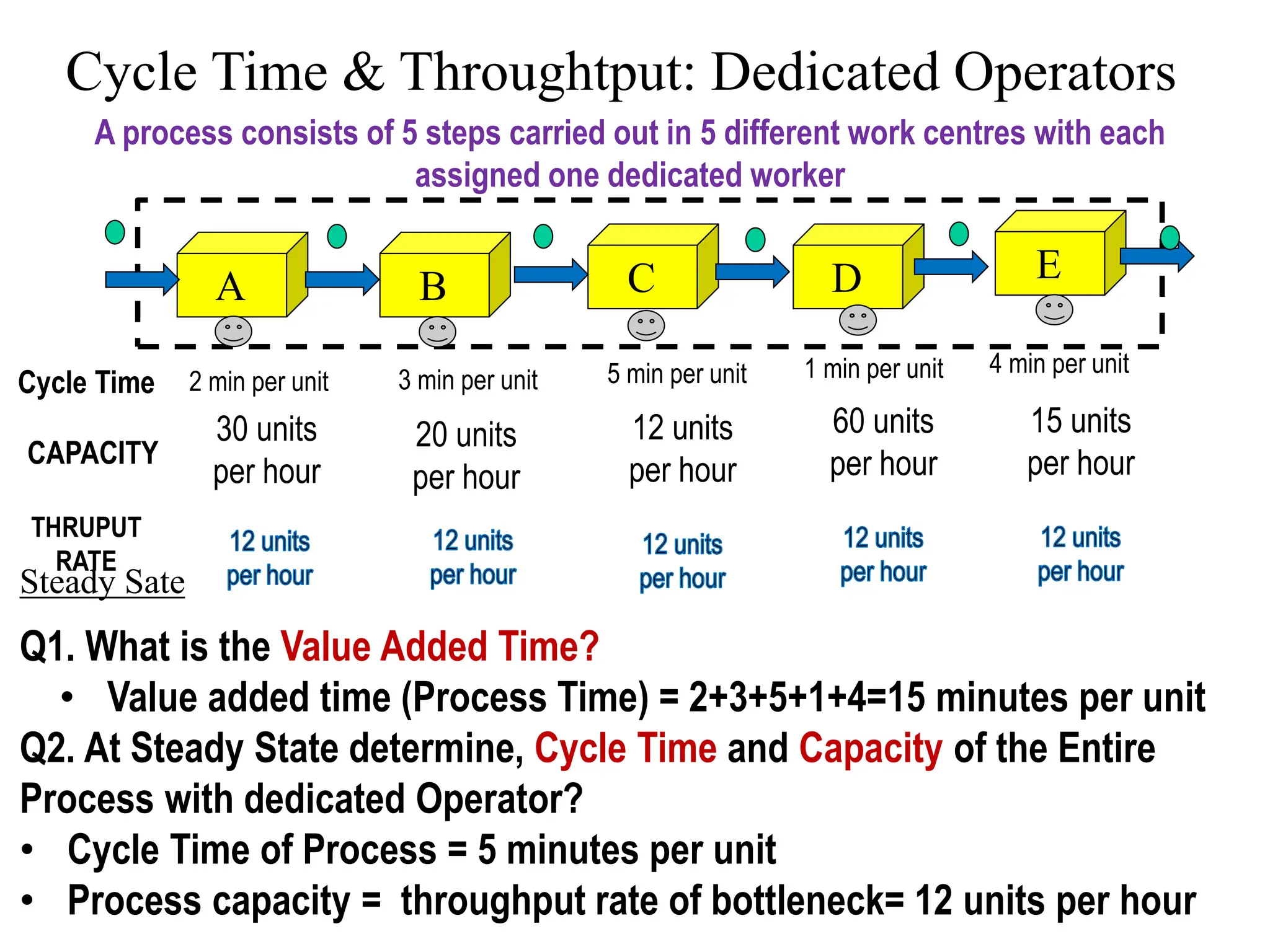
Cycle Time & Throughtput: Dedicated Operators
CAPACITY
THRUPUT
RATE
Steady Sate
Q1. What is the Value Added Time?
• Value added time (Process Time) = 2+3+5+1+4=15 minutes per unit
Q2. At Steady State determine, Cycle Time and Capacity of the Entire
Process with dedicated Operator?
• Cycle Time of Process = 5 minutes per unit
• Process capacity = throughput rate of bottleneck= 12 units per hour
Cycle Time
A process consists of 5 steps carried out in 5 different work centres with each
assigned one dedicated worker
Cycle Time & Throughput of the Process:
Single Operator
2 minutes
per unit
3 minutes
per unit
5 minutes
per unit
1 minute
per unit
4 minutes
per unit
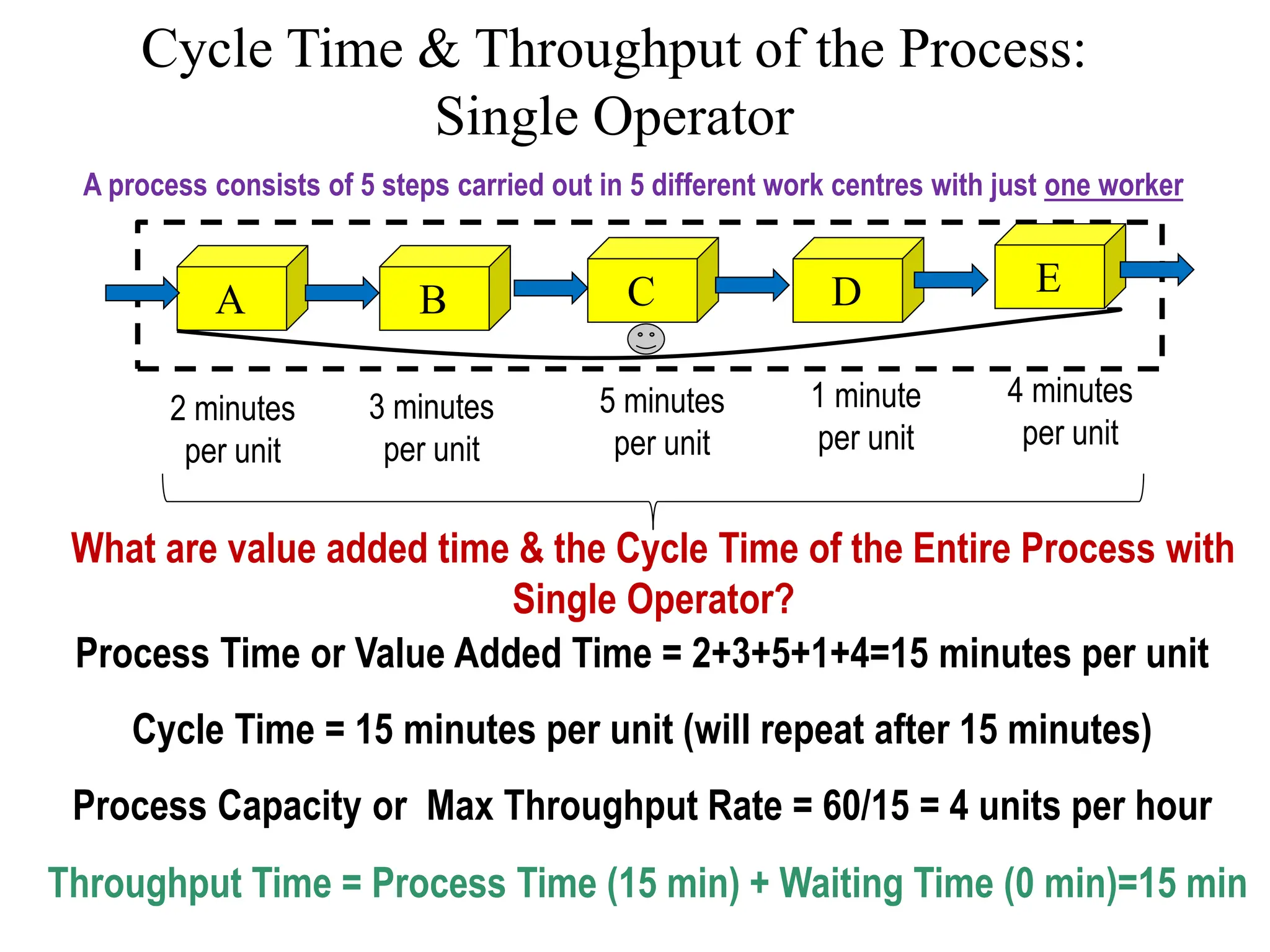
What are value added time & the Cycle Time of the Entire Process with
Single Operator?
A process consists of 5 steps carried out in 5 different work centres with just one worker
A B C D E
Throughput Time = Process Time (15 min) + Waiting Time (0 min)=15 min
Process Time or Value Added Time = 2+3+5+1+4=15 minutes per unit
Cycle Time = 15 minutes per unit (will repeat after 15 minutes)
Process Capacity or Max Throughput Rate = 60/15 = 4 units per hour
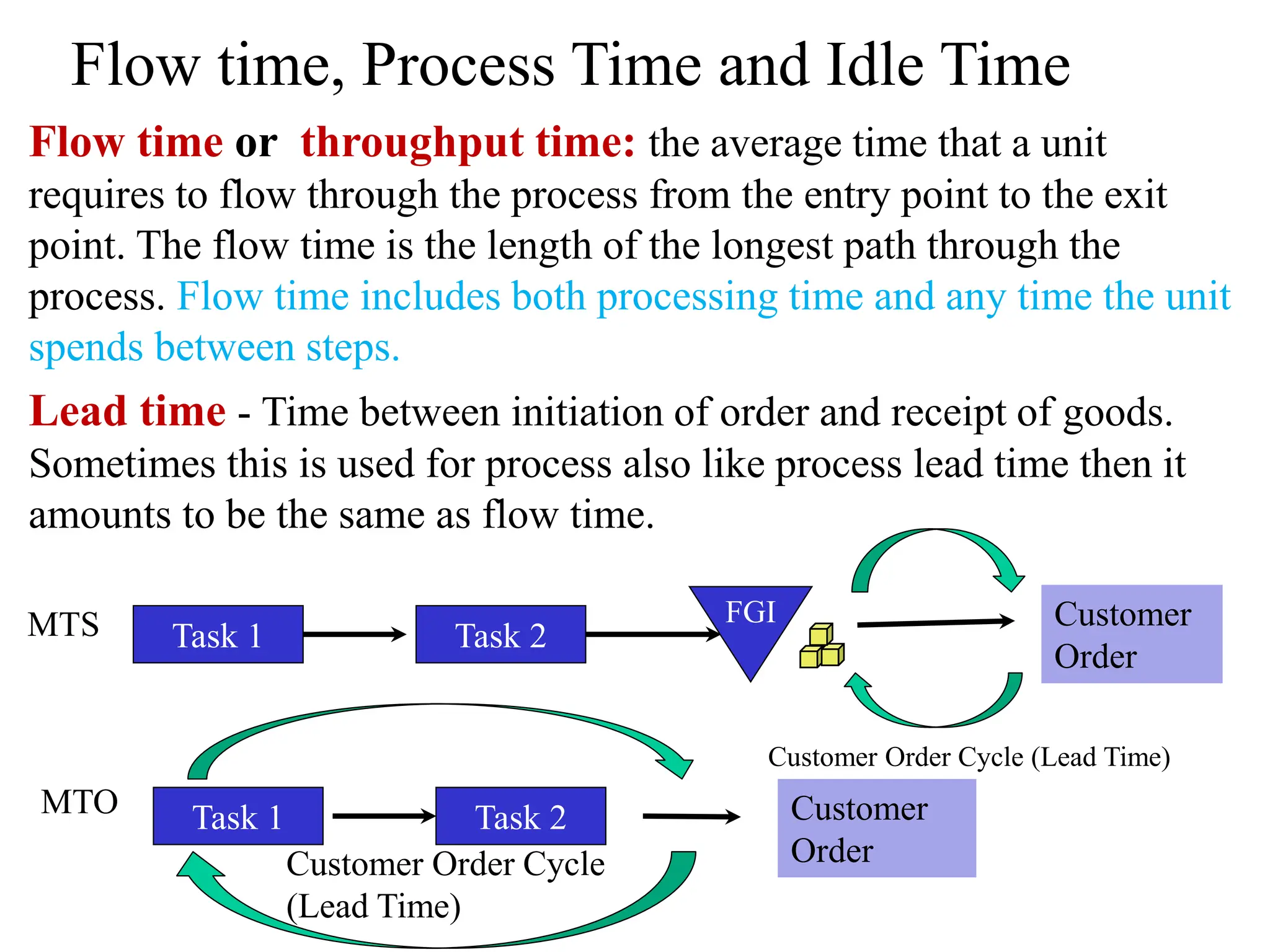
Flow time or throughput time: the average time that a unit
requires to flow through the process from the entry point to the exit
point. The flow time is the length of the longest path through the
process. Flow time includes both processing time and any time the unit
spends between steps.
Lead time - Time between initiation of order and receipt of goods.
Sometimes this is used for process also like process lead time then it
amounts to be the same as flow time.
Flow time, Process Time and Idle Time
Task 1 Task 2
FGI
Task 1 Task 2
Customer
Order
MTO
MTS
Customer
Order
Customer Order Cycle
(Lead Time)
Customer Order Cycle (Lead Time)
Direct Labor Capacity Utilization
• Idle time - time when no activity is being performed, for
example, when an activity is waiting for work to arrive
from the previous activity. The term can be used to
describe both machine idle time and worker idle time.
• Direct labor content (value added time) - the amount of
labor (in units of time) actually contained in the
product. Excludes idle time when workers are not
working directly on the product. Also excludes time
spent maintaining machines, transporting materials, etc.
• Direct labor utilization - the fraction of labor capacity
that actually is utilized as direct labor.
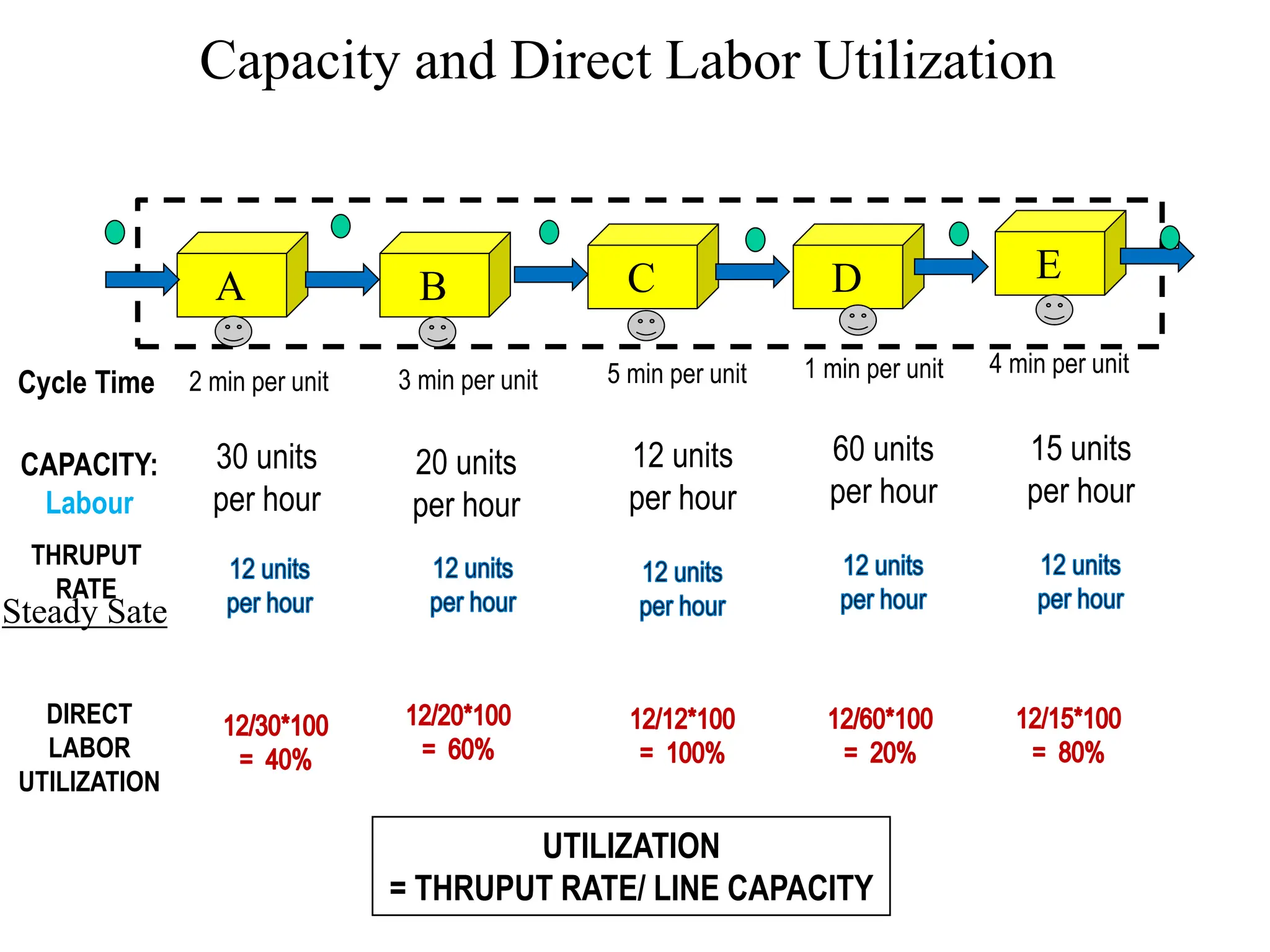
2 min per unit 3 min per unit 5 min per unit 1 min per unit 4 min per unit
30 units
per hour
20 units
per hour
12 units
per hour
60 units
per hour
15 units
per hour
A B C D E
Capacity and Direct Labor Utilization
CAPACITY:
Labour
THRUPUT
RATE
Steady Sate
Cycle Time
DIRECT
LABOR
UTILIZATION
UTILIZATION
= THRUPUT RATE/ LINE CAPACITY
2 min per unit 3 min per unit 5 min per unit 1 min per unit 4 min per unit
A B C D E
Capacity and Direct Labor Utilization
Process
Cycle Time
Cycle Time
(each stage)
DIRECT
LABOR
UTILIZATION
UTILIZATION
= STAGE CYCLE TIME/ LINE CYCLE TIME
5 min per unit 5 min per unit 5 min per unit 5 min per unit 5 min per unit
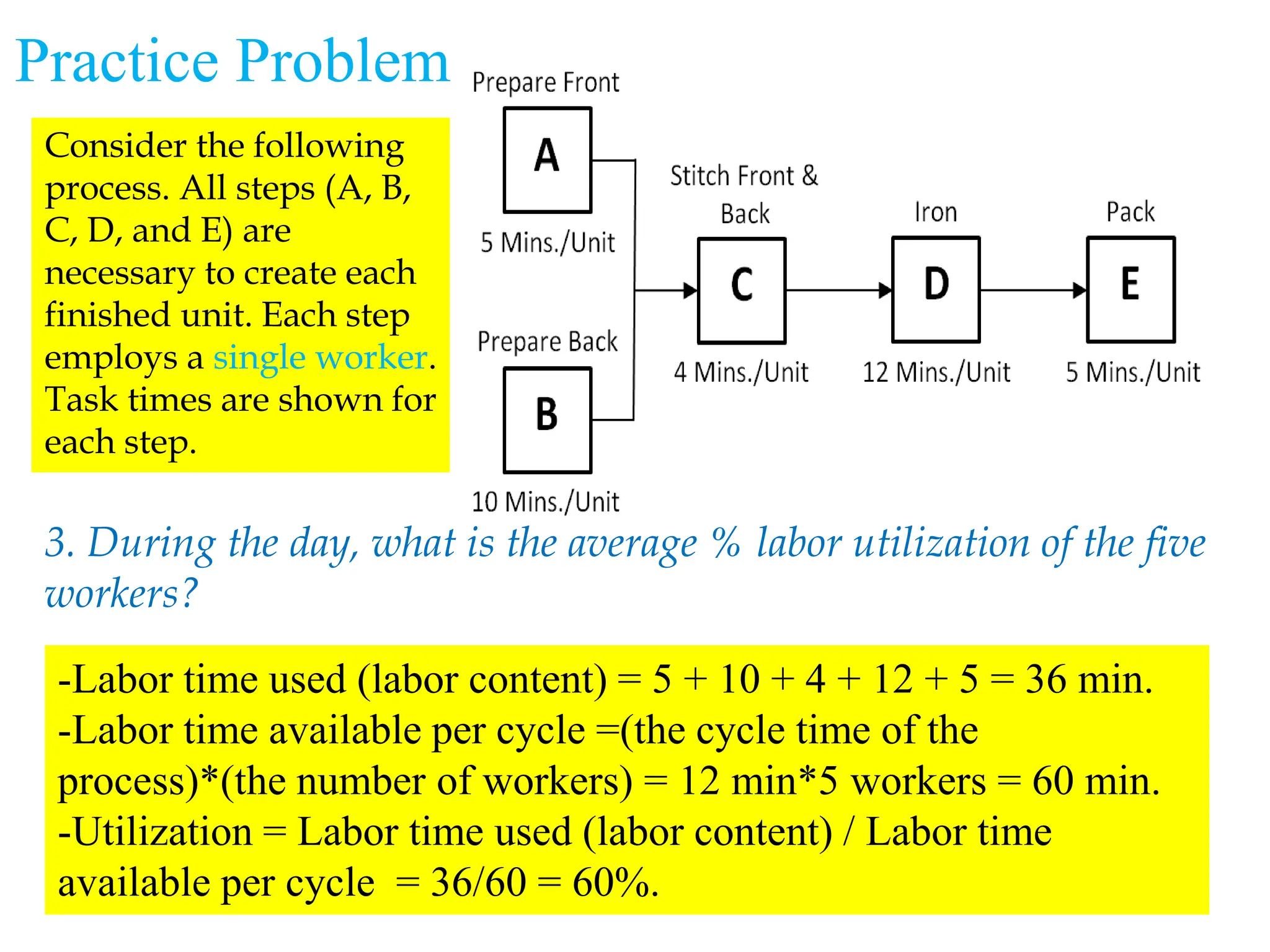
Practice Problem
Consider the following
process. All steps (A, B,
C, D, and E) are
necessary to create each
finished unit. Each step
employs a single worker.
Task times are shown for
each step.
1. What is the fastest a rush order for one unit can go through the
process?
10 min + 4 min + 12 min + 5 min = 31 min.
2. Working eight hours a day, what is the daily capacity of the
process?
(8 hrs/day*60 min/hr)/12 min/unit = 40 units/day.
Practice Problem
Consider the following
process. All steps (A, B,
C, D, and E) are
necessary to create each
finished unit. Each step
employs a single worker.
Task times are shown for
each step.
3. During the day, what is the average % labor utilization of the five
workers?
-Labor time used (labor content) = 5 + 10 + 4 + 12 + 5 = 36 min.
-Labor time available per cycle =(the cycle time of the
process)*(the number of workers) = 12 min*5 workers = 60 min.
-Utilization = Labor time used (labor content) / Labor time
available per cycle = 36/60 = 60%.
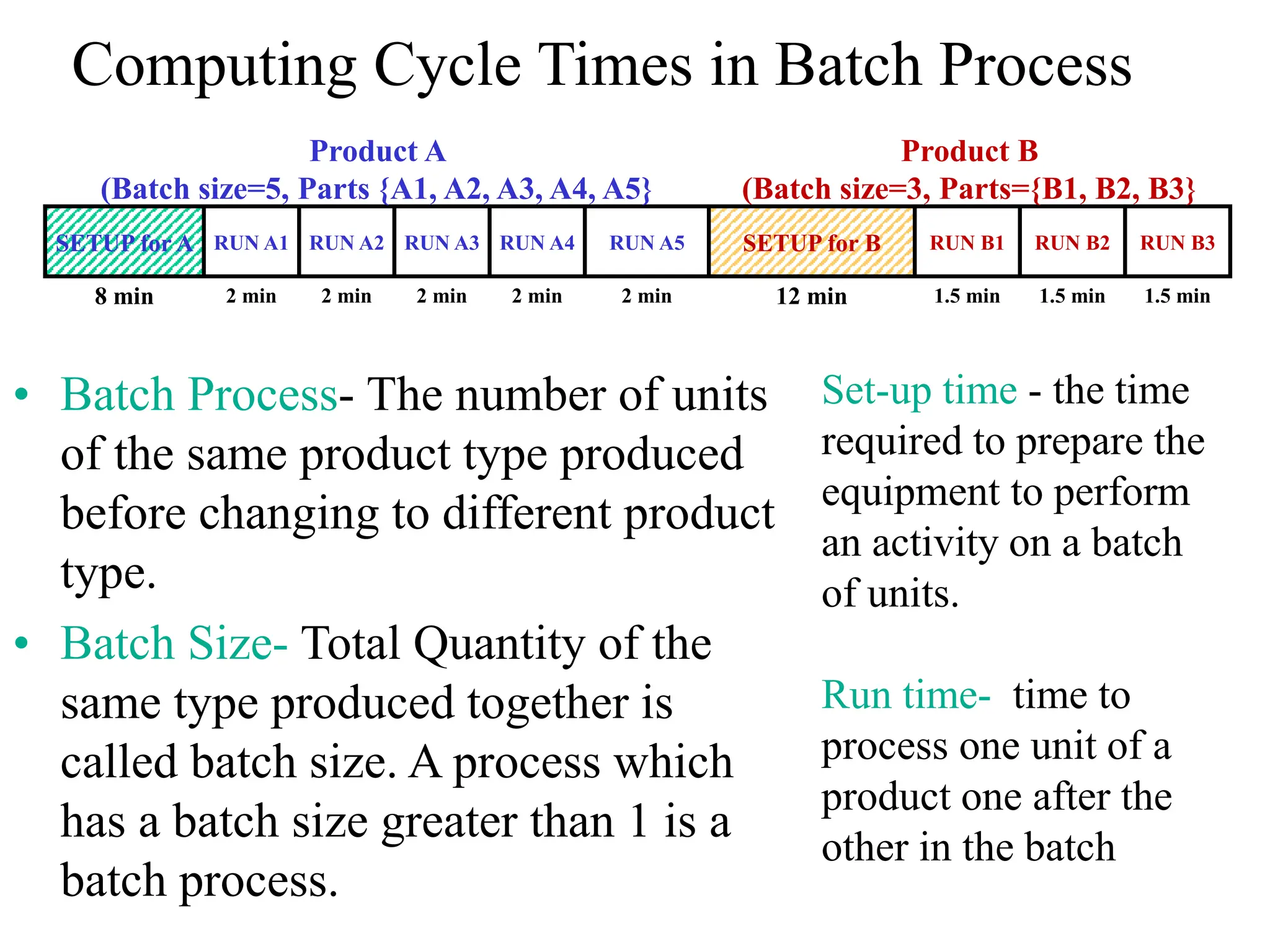
Computing Cycle Times in Batch Process
• Batch Process- The number of units
of the same product type produced
before changing to different product
type.
• Batch Size- Total Quantity of the
same type produced together is
called batch size. A process which
has a batch size greater than 1 is a
batch process.
Set-up time - the time
required to prepare the
equipment to perform
an activity on a batch
of units.
Run time- time to
process one unit of a
product one after the
other in the batch
Product A
(Batch size=5, Parts {A1, A2, A3, A4, A5}
Product B
(Batch size=3, Parts={B1, B2, B3}
SETUP for A RUN A1 RUN A2 RUN A3 RUN A4 RUN A5 SETUP for B RUN B1 RUN B2 RUN B3
8 min 2 min 2 min 2 min 2 min 2 min 12 min 1.5 min 1.5 min 1.5 min
Computing Cycle Times in Batch Process
Processing a Batch of Car
Cycle Time =
Set-up Time + (Batch size) x (Time per unit)
Batch size
Example: Producing 100 cars. It takes 50 hours to set up the
production line. On average, production takes 5 hours per car.
Cycle Time = Avg. Time to Process One Unit of Product
Car (Batch size=100 Parts)
SETUP RUN P1 RUN P2 RUN P3 RUN P4 RUN P5 ….. RUN P98 RUN P99 RUN P100
50 hr 5 hr 5 hr 5 hr 5 hr 5 hr ….. 5 hr 5 hr 5 hr
Cycle Time = (50+100*5)/100 = 550/100= 5.5 hr
50+100*5= 550
Setup time:
15 min
A B
Question: What is the cycle time between points A and B of the
process, if we work in batches of 10? And for batches of
30?
Production Time:
2 min/unit
Computing Cycle Times in Batch Process
Cycle Time for Batch of 10 = (15+10*2)/10 = 35/10= 3.5 min
Cycle Time for Batch of 30 = (15+30*2)/30 = 75/30= 2.5 min
How do we analyze a complex process…
1. Look at the process step by step
2. Determine maximum throughput rate (i.e.
capacity) of each step
3. Identify the process bottleneck (smallest
capacity).
4. The capacity of the process is equal to the
capacity of the bottleneck
Example : hammer production process
Description
1. Work begins at the machining center. Here two lines form
the heads of the hammers and place them in a buffer.
2. Handles are attached at the assembly step.
3. Finished hammers are sent to the next stage, where they
are packed and shipped.
assembly
pack and
ship
machining
machining
Process Data:
• Machining (each line): Set up 80 min. 4 min per unit
processing. Batch size 200. Two identical lines.
• Assembly: Manual by team of two workers (NO set up). Each
hammer requires 40 min processing. 34 workers available.
• Pack and ship: 30 min set up, 2 min per unit processing. Lot
sizes of 100.
assembly
pack and
ship
machining
machining
Let’s analyze the hammer process…
Step 1: Machining
• Look at any one line. 200 units require:
80 + 200  4 = 880 minutes per 200 units
• The throughput rate is:
200 / 880 = 0.227 units/minute
= 13.63 units/hour
• But we have two identical lines, so for the machining step
capacity is 2  13.63 = 27.26 units/hour.
Step 2: Assembly
• 1 unit requires 40 min processing time, so the throughput
rate is per team of two worker:
1 unit / 40 min = (1/40)*60 units/hr per team
= 1.5 units/hr
• 34 workers available, but 2 workers are required for each
unit, so they can form 17 teams and thus assembly
capacity is:
17  1.5 = 25.5 units/hr
Step 3: Pack and ship
• Similar to machining:
30 + 100  2 = 230 min per 100 units
• Pack & ship capacity is:
100 / 230 = 0.43 units/min
= 26.09 units /hr
Hammer process: what is the capacity?
Process Step Capacity (units/hr)
Machining 27.26
Assembly 25.50
Pack & Ship 26.09
Assembly is the
bottleneck!
Case: Circuit Board
Fabricators, Inc.
Throughput, Throughput time and Work in Process
Inventory: Little’s Law
Throughput Time (THT): Average time that a unit takes to go
through the entire (single/multi-stage) process including waiting
time. Measured as time. This measure concerns the product
delivery time promising.
Work in Process (WIP) Inventory: Average number of units in
system (or part of the system) over a time interval. Measured as units.
This measure concerns planning of waiting area and inventory
budget.
Throughput /flow rate (TH)– Actual output through a facility per
unit time or the average rate at which units flow past a specific
point in the process. This measure concerns the product delivery
quantity promising.
Key
relationship Little’s Law
W.I.P. Inventory = Throughput Rate x Throughput Time
Little’s Law
TH TH
Queue Processing Job
Throughput Time, THT
Number of jobs in the system,
WIP =TH x THT
Input Output
Input Rate= Input Rate = Throughput, TH
W.I.P. Inventory = Throughput Rate x Flow Time
WIP = TH x THT or L = λ x W (in queuing notation)
This relation is known as Little's Law, named after John D.C. Little who proved it
mathematically in 1961.
Little’s Law
TH TH
Queue Processing Job
Queue Time Job Time
Throughput Time, THT
Number of jobs in the system,
WIP =TH x THT
Input Output
Input Rate= Input Rate = Throughput, TH
WIPqueue= TH x Queue Time WIPjob= TH x Job Time
Assumption: A Stable Process
• In a Stable Process
– Average inflow rate is the same as average outflow rate, say
TH.
– For the above to happen, process capacity must be greater than
average inflow rate, while average inventory is not zero.
– Ideally, TH should be equal to the customer demand.
Average inflow rate
is 600 passengers/hr,
or 10 passengers/min
Process Capacity
Scanner can handle 12
passengers per minute
It can handle inflow
Is the Security Checkpoint a stable Process?
Can we have Process Capacity 9 instead of 12 in a stable process?
If we have Process Capacity 20 instead of 12, could we still have people
waiting in the line?
7
A fast food restaurant processes on the average 5000
lbs. of hamburger per week. The observed inventory
level of raw meat, over a long period of time,
averages 2500 lbs. Determine inventory turnover
ratio.
Average inventory level, WIP= 2500 lbs
Throughput, TH = 5000 lbs/week
-Average time spent by a pound of meat in inventory,
THT=WIP/TH= 2500/5000 = 1/2 week;
-1/THT= 2 times per week = 2*52/yr =104 /yr is the
inventory turnover ratio
Little’s Law Example: Inventory Management
7
Little’s Law Example: Services Management
A restaurant processes on average
1500 customers per day (=15 hours).
On average, there are 50 customers
waiting to place an order, waiting for
an order to arrive or eating.
TH=1500 customers/day=100
customers/hour; WIP= 50
customers;
Counter Eating
Time in Counter Eating Time
Time in Restaurant, THT
Number of customers in the system,
(WIP =TH x THT=50 customers)
Input Output
Input Rate= Input Rate = Throughput, TH=150/day= 100/hr
WIPc= TH x Queue Time WIPe= TH x Job Time
b) Out of the 50 customers, 40 customers on the average are eating.
Find avg. wait time at counter.
a) Find average time spent in the restaurant.
THT=WIP/TH= 50/100 = 1/2 hours, average time in the restaurant.
TH= 100, WIPc= 50−40 = 10 customers at the service counter;
THTc=WIPc/TH= 10/100 hours = 6 minutes average wait at the
counter
7
Little’s Law Example: Workforce Management
Thus, the company hires an average of 194.6 + 144 = 338.6 new
employees per month, TH=338.6×12 = 4063.2 new employees / year.
OR
4063.2/36,000×100% = 11.28% labor turnover during a year
A certain Japanese company has 36,000 employees, 20% of whom are
women. The average term of employment for a woman is 37 months, whereas
for men it is 200 months. Assume that the total employment level and the mix
of men and women are stable over time. Determine employee turnover.
WIPw= average no of women in
system = 36,000×0.2 = 7,200
woman
THw = 7200/37= 194.6 women/
month is the average number of
new women employees hired per
month.
WIPm= average
number of men in
system = 36,000×0.8
= 28,800 men,
THm=28,800/200=
144 men/month.
Little’s Law Example: Monetary Flow.
• For the new euro introduction in 2002, Wim Duisenberg had to
decide how many new Euro coins to stamp by 2002. Euroland’s
central banks’ cash-in-coins handling was estimated at €300 billion
per year. The average cash-in-coins holding time by consumers
and businesses was estimated at 2 months. How many Euro coins
were to be made?
– TH= €300 billion per year ;
– THT = 2 months
– WIP = THxTHT= 300/yr * 2mo = 300/yr * 1/6 yr = 50
– Euro’s: NYT 2001: “As of Jan. 1, some 50 billion new coins
and 14.5 billion euro notes are to be pumped into circulation.”
9
Little’s Law -- Caveats
 Applies to the long run average of a stable
system
– In any given time period (sample) the average
may be different (especially for small samples)
– In an unstable, or dynamic system, the average
may not be very useful
 In systems with variance, we often need to
know about more than the average
Practice Problem: Process of Car Repair in a Garage
Car
Checks
in
Inspection
and
Estimates
Work
Order
Preparation
Repair
Process
Wait
Wait
4 cars
per hr
5 min
2 cars
25% quit
75% stay
5 min
12 min
1 car
30 min
Question1. What is the average flow time for: (a) customers quitting the process?
(b) customers staying & getting car repaired? (c) an average customer
Question2. Show Little’s Law can be applied to parts of the system as well as at the
whole system level.
Question1.
Car
Checks
in
Inspection
and
Estimates
Work
Order
Preparation
Repair
Process
Wait
Wait
TH=4 cars
per hr
5 min
2 cars
25% quit
75% stay
5 min
12 min
1 car
30 min
TH= 4 cars/hr
WIP= 2 cars
THT= WIP /TH = 2/4
=0.5 hrs = 30 min
TH= 3 cars/hr
WIP= 1 car
THT= WIP/TH = 1/3
=0.33 hrs = 20 min
THquit= 1 car/hr
THstay= 3 car/hr
THTquit= 5 + 30 + 12 = 47 minutes THTstay= 47+5+20+30 =103 minutes
THTavg= 0.25 *47+ 0.75*103 = 88.25 minutes
Practice Problem: Process of Car Repair in a Garage
Question1. What is the average flow time for: (a) customers quitting the process?
(b) customers staying & getting car repaired? (c) an average customer
Question2. Show Little’s Law can be applied at component level (for parts) as well as
at the systems level (whole).
Question2.
Car
Checks
in
Inspection
and
Estimates
Work
Order
Preparation
Repair
Process
Wait
Wait
TH=4 cars
per hr
5 min
2 cars
25% quit
75% stay
5 min
12 min
1 car
30 min
TH= 4 cars/hrs
THT= 5/60 hrs
WIP= THT*TH = 1/3 cars
THq= 1 car/hr
THs= 3 car/hr
TH= 4 cars/hrs
THT= 12/60 hrs
WIP= THT*TH = 4/5 cars
TH= 3 cars/hrs
THT= 5/60 hrs
WIP= THT*TH = 1/4 cars
TH= 3 cars/hrs
THT= 30/60 hrs
WIP= THT*TH = 3/2 cars
Method 2: TH= 4 cars/hrs (inbound rate) = 1 cars/hrs + 3 cars/hrs
(outbound rate)
THTaverage= 88.25 minutes (from previous slide) = 1.4708 hrs
WIP =THT x TH ?
Method 1): WIP= 1/3 + 2 + 4/5 + 1/4+ 1 + 3/2 = 5.8833
WIP =THTaverage x TH = 1.4708 hrs * 4 cars / hr = 5.8833 Cars
Make-to-order (MTO) vs. make-to-stock (MTS)
Task 1 Task 2
FGI
Task 1 Task 2
Customer
Order
Make-to-Stock: Demand is satisfied by FGI (finished goods
inventory). Highly standardized products made for finished
goods inventory. Important metric for customer service?
Make-to-Order: Process for making customized products to meet
individual customer requirements. Important metric for
customer service?
MTO
MTS
Customer
Order
Other Process Terminology
Customer Order Cycle
Buffering: Keep some inventory between stages
0 1
1/2
Starving: Stoppage of activity because of lack of material
Blocking: Stoppage of flow because there is no storage place
1 0
0/2
0 1
2/2
0 1
Other Process Terminology: (relevant for unbalanced flow)
Current/Maximum
Resource working (1)
/not working (0)
Resource working (1)
/not working (0)
Examples..
CT = 3s CT = 1s
FGI
Task 1 Task 2
Let’s study this make-to-stock system.
What is the capacity of the process?
What is the throughput time?
What is the average WIP?
Is any task starved or blocked?
Note: No buffer space between stations, so upstream
station has to wait if downstream station is busy
Other Process Terminology: (relevant for unbalanced flow)
Examples..
CT = 3s CT = 1s
FGI
Task 1 Task 2
Task 2 starved for 2s. each time.
Throughput rate = 20 units/min at Task 1, 60 units/min at Task 2
Capacity (throughput rate) of process = 20 units/min
Throughput time = 4 seconds (3s Task 1+ 0 wait + 1s Task 2) = 1/15
min
WIP = Throughput rate x Throughput time
= 20 units/min x 1/15 min
= 1.33 units
Other Process Terminology : (relevant for unbalanced flow)
Examples..
CT = 1s CT = 3s
FGI
Task 1 Task 2
What is the capacity of the process?
What is the throughput time?
What is the average WIP?
Is any task starved or blocked?
Let’s study this make-to-stock system:
Note: No buffer space between stations, so upstream
station has to wait if downstream station is busy
Other Process Terminology: (relevant for unbalanced flow)
Examples..
CT = 1s CT = 3s
FGI
Task 1 Task 2
Task 1 blocked for 2s. each time.
Throughput rate = 60 units/min at Task 1, 20units/min at Task 2
Capacity of process = 20 units/min
Throughput time = 6 seconds (1s Task 1+ 2s wait + 3s Task 2) = 0.1 min
WIP = Throughput rate x Throughput time
= 20 units/min x 0.1 min
= 2 units
Other Process Terminology: (relevant for unbalanced flow)
Examples..
CT = 3s CT = 3s
FGI
Task 1 Task 2
What is the capacity of the process?
Is any task starved or blocked?
Let’s study this make-to-stock assembly system:
Note: No buffer space between stations
CT = 4s
Task 3
CT = 2s
Task 4
Other Process Terminology: (relevant for unbalanced flow)
Example..
CT = 3s¸ CT = 3s
FGI
Task 1 Task 2
CT = 4s
Task 3
CT = 2s
Task 4
Tasks 1 and 2 are blocked by Task 3 for 1 second per product.
Task 4 is starved for 2 seconds per product.
The capacity of the process is 15 units/hour (limited by Task 3).
Other Process Terminology: (relevant for unbalanced flow)
79
• The task is to calculate the average cycle time for an
entire process or process segment
– Assume that the average activity times for all involved
activities are available
• In the simplest case a process consists of a sequence of
activities on a single path
– The average cycle time is just the sum of the average activity
times involved
• … but in general we must be able to account for
– Rework
– Multiple paths
– Parallel activities
Rework, Multiple Paths
80
• Many processes include control or inspection points where if the job
does not conform it will be sent back for rework
– The rework will directly affect the average cycle time!
• Definitions
– T = sum of activity times in the rework loop
– r = fraction of jobs requiring rework (rejection rate)
• Assuming a job is never reworked more than once (one pass)
• Assuming a reworked job is no different than a regular job (infinite
pass)
Rework
CT = (1+r)T
CT = T/(1-r)
Hint: In infinite geometric series
with first term 1, Sum = 1/(1-r)
1-r
= 0.8
r=0.2
A
T=10
B
(20)
1 unit
81
Example – Rework effects on the
average cycle time
• Consider a process consisting of
– Three activities, A, B & C taking on average 10 min. each
– One inspection activity (I) taking 4 minutes to complete.
– X% of the jobs are rejected at inspection and sent for rework
 What is the average cycle time?
a) If no jobs are rejected and sent for rework.
b) If 25% of the jobs need rework but never more than once.
c) If 25% of the jobs need rework but reworked jobs are no different in
quality than ordinary jobs.
0.75
0.25
A
(10)
B
(10)
C
(10)
I
(4)
82
Multiple Paths (alternatives)
M1 (2 min/part)
M2a (5 min/part)
M2b (4 mi/part)
M1
(12 mins)
M2a
(12 mins)
M2b
(12 mins)
Processing individual parts (consider 12 minutes time interval)
2.4 parts
3 parts
6 parts
CT =? CT=12/5.4 =2.22 min/part
(if both are evenly used)
83
• It is common that there are alternative routes
through the process
– For example: jobs can be split in “fast track”and normal
jobs
• Assume that m different paths originate from a
decision point
– pi = The probability that a job is routed to path i
– Ti = The time to go down path i
Multiple Paths
CT = p1T1+p2T2+…+pmTm= 

m
1
i
i
iT
p
84
Example – Processes with Multiple
Paths
• Consider a process segment consisting of 3 activities A, B & C
with activity times 10,15 & 20 minutes respectively
• On average 20% of the jobs are routed via B and 80% go
straight to activity C.
 What is the average cycle time?
0.8
0.2
A
(10)
B
(15)
C
(20)
85
Parallel Operation (work shared by resources)
M1 (2 min/part)
M2a (5 min/part)
M2b (4 mi/part)
M1
(10 mins)
M2a
(10 mins)
M2b
(12 mins)
Batch Processing (Batch size= 5 parts)
2 parts
3 parts
5 parts
CT = 12 minutes per batch = 12/5 = 2.4 min /part
CT = Max (10, 12) =
12 minutes per batch
CT= 10 min/batch
86
• If two activities related to the same job are done in parallel
the contribution to the cycle time for the job is the
maximum of the two activity times.
• Assuming
– M process segments in parallel
– Ti = Average process time for process segment i to be completed
Processes with Parallel Activities
CTparallel = Max{T1, T2,…, TM}
87
• Consider a process segment with 5 activities A, B, C, D & E
with average activity times: 12, 14, 20, 18 & 15 minutes
 What is the average cycle time for the process segment?
Example – Cycle Time Analysis of Parallel
Activities
A
(12)
B
(14)
C
(20)
D
(18)
E
(15)
X-Ray Service Process
1. Patient walks to x-ray lab
2. X-ray request travels to lab by messenger
3. X-ray technician fills out standard form based on info. From
physician
4. Receptionist receives insurance information, prepares and
signs form, sends to insurer
5. Patient undresses in preparation of x-ray
6. Lab technician takes x-ray
7. Darkroom technician develops x-ray
8. Lab technician checks for clarity-rework if necessary
9. Patient puts on clothes, gets ready to leave lab
10. Patient walks back to physicians office
11. X-rays transferred to physician by messenger
Example: X-Ray Service Process
3
2
1
4 7
6
5
11
10
9
start end
25%
75%
7
20 6
5 3
6 12 2
20
3 7
transport
support
Value added
decision
Data: Measured actual flow time: 154 minutes
8
1. Patient walks to x-ray lab
2. X-ray request travels to lab by Messenger
3. X-ray lab technician fills out standard form
4. Receptionist processes insurance information
5. Patient undresses in preparation of x-ray in Changing room
6. Lab technician takes x-ray
7. Darkroom technician develops x-ray in dark room
8. Lab technician checks for clarity-rework if necessary
9. Patient puts on clothes, gets ready to leave lab
10. Patient walks back to physicians office
11. X-rays transferred to physician by messenger
(6+12+2)*1.25=25
Max(7,20+6)=26 path 2-3
Max(3+7,20)=20 path 11
Path: 2-3-4-5-6-7-8-11:
Time: 26+5+3+25+20
=79 minutes
Most time inefficiency comes from waiting:
E.g.: Flow Times in White Collar Processes
Industry Process Average
Flow
Time
Theoretic
al Flow
Time
Flow Time
Efficiency
Life Insurance New Policy
Application
72 hrs. 7 min. 0.16%
Consumer
Packaging
New
Graphic
Design
18 days 2 hrs. 0.14%
Commercial
Bank
Consumer
Loan
24 hrs. 34 min. 2.36%
Hospital Patient
Billing
10 days 3 hrs. 3.75%
Automobile
Manufacture
Financial
Closing
11 days 5 hrs 5.60%
X-Ray Service Process
Resource
Pool
Resource Time
Consumed /
Unit Load
Load
Batch
Theoretical
Capacity of
Res. unit
No of
units in
pool
Theoretical
capacity of
pool
Messenger 20+20
min/patient
1 60/40=1.5
patients/hr
6 1.5(6)=9
Patient/hr
Receptionist 5 1 60/5=12 1 12
X-ray
technician
6+7.5+2.5 1 60/16=3.75 4 15
X-ray lab 6+0.25(6)=7.5 1 60/7.5=8 2 16
Darkroom
technician
12+0.25(12)=15 1 60/15=4 3 12
Darkroom 12+0.25(12)=15 1 60/15=4 2 8
Changing
room
3+3 1 60/6=10 2 20
Utilizations
Data: actual observed throughput of 5.5 patients/hr
Resource pool Theoretical capacity
Patients/hr
Capacity utilization
Messenger 9 61.11
Receptionist 12 45.83
X-ray technician 15 36.67
X-ray lab 16 34.38
Darkroom technician 12 45.83
Darkroom 8 68.75
Changing room 20 27.50
Effect of Variability on
Performance of Process
Understand Variability: using Queueing Formula
Queueing Parameters
lra = the rate of arrivals in customers (jobs) per
unit time (ta = 1/ra = the average time between
arrivals).
ca = the coefficient of variation (CV) of inter-
arrival times.
m = the number of machines.
re = the rate of the station in jobs per unit time =
m/te. (te = the average processing time).
ce = the CV of processing times.
u = utilization of station = la/re.
Note: a station
can be
described
with 5
parameters.
Queueing Measures
Measures:
Wq = the expected waiting time spent in queue.
W = the expected time spent at the process center, i.e., queue time
plus process time.
L = the average WIP level (in jobs) at the station.
Lq = the expected WIP (in jobs) in queue.
Relationships:
W = Wq + te
L = ra  W
L q = ra  Wq
Result: If we know Wq, we can compute L, Lq, W.
The G/G/1 Queue
Formula:
Observations:
• Useful model of single machine workstations
• Separate terms for variability, utilization, process time.
• Wq (and other measures) increase with ca
2 and ce
2
• Flow variability, process variability, or both can combine to inflate
queue time.
• Variability causes congestion!
2 2
W
2 1
q
a e
e
V U t
c c u
t
u
  
 
  
   

 
 
The G/G/m Queue
Formula:
Observations:
• Useful model of multi-machine workstations
• Extremely general.
• Fast and accurate.
• Easily implemented in a spreadsheet
2( 1) 1
2 2
W
2 (1 )
q
m
a e
e
V U t
c c u
t
m u
 
  
 
 

  
  

  
Lead Time vs. Utilization
0
2
4
6
8
10
12
14
16
18
20
22
24
0 0.1 0.2 0.3 0.4 0.5 0.6 0.7 0.8 0.9 1 1.1 1.2
Release Rate (entities/hr)
Cycle
Time
(hrs)
Capacity
High
Variability
Low
Variability
Lead
Time
(hrs)
Thanks

3.Process AnalysisNew diagram a (1).pptx

  • 1.
  • 2.
    2 Overview • Process: Introduction •Process Types: Project, Job, Batch, Line and Continuous • Process Analysis – Processes Flow Chart – Process and Flows – Important Concepts Cycle Time Throughput WIP Lead Time Process Capacity Bottleneck Batch Process Little’s Formula Rework, Parallel Path – Effect of Variability on Performance of Process
  • 3.
    What is aprocess? The basic building block of operations is the process. Operations as a Transformation Process The Transformation process Input transformed resources Material Information Customers Input transforming resources Facilities Staff Environment Environment OUTPUT INPUT Goods Services A process is a series or set of activities that interact to produce a result; it may occur once-only or be recurrent or periodic (Source: Wikipedia). Example: Let’s say you want to get a book from your book shelf. There are many small tasks involved such as getting up from your desk, walking to the shelf, opening the shelf door, identifying the book, picking it up, closing the shelf and going back to your desk. Each step described above is called a task. Processes exist to create value for the customers.
  • 4.
    Processes in ValueChain A value chain stage such as, manufacturing is comprises of processes designed to add value by transforming relevant inputs into useful outputs. Processes involve tasks and associated resources. Resource Sets R1.1 R1.2 P1 P2 P3 Processes Supplier Mfg DC Value Chain R1.3 T1.1 T1.2 T1.3 Task Set, T1
  • 5.
    Process Types Examples.  Project Construction, Consulting  Job Shop Machine Shop, Beauty Shop  Batch Bakery, Classroom  Line Flow Assembly Line, Cafeteria Line  Continuous Flow Paper mill, Central heating Generic Process Types • Processes are generically classified based on the product variety and product volume • The classification is not so much based on technical attributes of the processes/ resources but from the “business dimensions” it has.
  • 6.
    6 Project Process Production ofa large-scale, complex product. If a project produces physical goods then the product typically cannot be moved. Examples: construction projects such as a dam/building, software projects Features - – Unique products built on site (products like s/w are exception) – Coordination of large scale resources – Processes are highly flexible – Resources dedicated for the project and released at the completion of the project – Firm sells capability and experience
  • 7.
    7 Jobbing Process A processdesigned to produce a series of small, single unit products. The same product may not be required in future or orders for the product are infrequent. Examples: Optometric glass making, Specialty machine shops Features - - Makes unique products like project but if involves physical goods then they are small and can be moved - Skilled worker is responsible - Wide product range, flexible process -Usually low investment in automated plant equipment (mfg example) -material usually purchased only when order is received
  • 8.
  • 9.
    9 Batch Process A processwhere small groups of similar items are produced together. The product comes out from the process in groups at discrete point of times. Examples: most products manufactured (80% of the world's manufacturing) Features - – Process large batch at station before sending to next station – Similar items on a repeat basis – Wide range of volumes A B C D E F Product 1 Product 1 Product 2 Product 2 Product 3 Product 3 Product Flow in Jobbing/Batch Process
  • 10.
    10 Examples: Batch Process Batchprocessing of chemical Garment
  • 11.
    11 (Connected) Line Processes Ahigh-volume, high investment form of manufacturing designed to produce similar discrete products cheaply. Examples: Car production, Pharmaceuticals and Computers. Features - – Dedicated to one product or family – Standard products, high volumes – Units processed & transferred in synchronized manner – Processing can be broken into discrete steps and the stages balanced to synchronize flow
  • 12.
    12 Line Process Examples CarProduction (Assembly Line) Mass Covid Vaccination (Line) Fast Food McDonald’s over 95 billion served
  • 13.
    13 Continuous (Flow) Processes Anever-ending form of production Examples: Process industries- Paper, Chemicals, Petroleum. Features – Material continuous & processing continuous (no discrete steps) – Large volumes of uniform products – Narrow range of standard products – Highly interconnected – Basic material processed in stages into one or more products A D C D E C Product 1 Product 1 Product 2 Product 2 Product 3 Product 3 Product-flow in Line/Continuous Process E A F B
  • 14.
  • 15.
    15 Exercise: Identify theprocess type used Example Process type Assembly of appliances and cars Running a political event Clothing Mfg. Toys Mfg. Developing a new product Specialist tool maker Furniture restores Processing student applications Installing an ERP package Manufacturer of Component parts Beer bottling plant Electricity utilities Steel making
  • 16.
    16 Continuum of ProcessStructures in Mfg. Type Stage connectivity Product flow Variety of products Product volume Process/ transfer unit Line Process Batch Process Jobbing Process Project Continuous process Unique One Unique One Tightly connected Fixed pattern Few Large Continuous repetitive Loosely connected or disconnected Moderate Moderate Batch Flexible pattern Many Small Process
  • 17.
    17 Continuum of ProcessStructures in Mfg. Type Stage connectivity Product flow Variety of products Product volume Process/ transfer unit Line Process Batch Process Jobbing Process Project Continuous process Unique One Unique One Tightly connected Fixed pattern Few Large Continuous repetitive Loosely connected or disconnected Moderate Moderate Batch Flexible pattern Many Small Process CAKE BREAD PASTRY KING SOOPER BAKERY SHOP
  • 18.
    -Project -Job Shop-Batch -Line Flow -Continuous Flow Summary: Classification of Processes by Process Architecture These process structures differ in several respects such as: •Volume - ranging from a quantity of one to large scale mass production. •Number of products - ranging from the capability of producing a multitude of different products to producing only one specific product. •Flow - ranging from a large number of possible sequences of activities to only one possible sequence. •Flexibility - Changes may be changes in production volume or changes in the product mix. •Capital investment - ranging from using lower cost general purpose equipment to expensive specialized equipment. •Variable cost - ranging from a high unit cost to a low unit cost. •Labor content and skill - ranging from high labor content with high skill to low content and low skill.
  • 19.
    19 Process Types vsLayout Types • ‘The process type does not refer to the same things as the layout (or physical arrangement)’ type. • For example, consider a process comprising of three task sets represented by, T1, T2, T3 carried out using resources R1, R2 and R3 respectively. • Is there a unique way of physically placing them in a facility? R1 R2 R3 T1 T2 T3 R1 R2 R3 T1 T2 T3 R1 R2 R3 T1 T2 T3 All these 3 systems are capable of making the same set of products occupying the same volume & variety positions.
  • 20.
    20 • Variety ofproducts and services – How much • Flexibility of the process; volume, mix, technology and design – What type and degree • Volume – Expected output Job Shop Batch Repetitive/Line Continuous Questions Before Selecting A Process Architecture
  • 21.
    21 Product Variety Product Process Matrix High Low ProductVolume Low High Project(Ship building, Movie production) Mass/Line (automobile, most consumer durables) Continuous (steel making, refinery) Jobbing (specialist toolmaker, speciality tailors) Batch (component parts of automobile, most clothing) It is a strategic tool for selection of processes. Correct Processes occupy positions along diagonal of volume variety matrix.
  • 22.
    Process Analysis “If youcannot describe what you are doing as a process, you do not know what you are doing.” W.E. Deming
  • 23.
    Process Analysis • Anoperation is composed of processes designed to add value by transforming relevant inputs into useful outputs. • The first step to improving a process is to map and analyse it: - To understand the activities & their relationships - To identify inefficient tasks to eliminate/improve - To assess against the relevant performance measures. Map a process! Assess its elements against the relevant performance measures. Cost Flow Time Inventory Quality Etc.
  • 24.
    Process Analysis: BroadSteps • Define the process boundaries that mark the entry points of the process inputs and the exit points of the process outputs. • Construct a process flow diagram that illustrates the various process activities and their interrelationships. • Determine the capacity of each step in the process. Calculate other measures of interest. • Identify the bottleneck, that is, the step having the lowest capacity. • Evaluate further limitations in order to quantify the impact of the bottleneck. • Use the analysis to make operating decisions and to improve the process.
  • 25.
    Process Flow Charts Processflow diagram (or process flowchart) is a valuable tool for understanding the process using graphic elements to represent tasks, flows, and storage. Rectangles: represent tasks Arrows: Represent flows of material and information. Material flow usually is represented by a solid line and information flow by a dashed line. Inverted triangles: represent storage (inventory). Storage bins commonly are used to represent raw material inventory, work in process inventory, and finished goods inventory. Diamond: Represents decision points.
  • 26.
    Example of aTwo-Stage Serial System A A A A B B B B 5 10 15 20 7 12 Gantt Chart A B 5 min 2 min Raw material Sub assembly Step-1 Step-2 to assembly
  • 27.
  • 28.
    Example of atwo-stage Non-Serial System A1 B 2 min A2 5 min 5 min RawMat-1 RawMat-2 Assembled part A1 A1 A1 A1 5 10 15 20 7 12 A2 A2 A2 A2 5 10 15 20 B B B 17 B 22 Gantt Chart
  • 29.
    How to Drawa Process Flow Diagram • Focus on one or two types of flow units. • Define the process boundaries and choose an appropriate level of detail. • Include only those steps that are likely to affect the process flow or the economics of the process. • Sizes and exact locations of arrows, boxes, and triangles do not carry any special meaning. • Use different colors for different routes for clarity.
  • 30.
    Case: Kristen's CookieCo. (A) Task: Perform a process analysis to answer some questions related to making important business decisions in setting up facility, buying resources/equipment, pricing, order policy etc.
  • 31.
    1.Process Capacity: Thecapacity is defined as the maximum output from the process or resource (e.g., worker, machine, factory, organization), measured in units produced per unit of time. Thus capacity can be found by dividing total available time by the processing time per unit. Example of Capacity of a Single Stage Process: If a welder can do a job in 1 minute, then his/her hourly capacity will be [1hr *60 (minutes/hr) ]/ (1 minute) = 60 units/hr Note: Effective capacity (in long term) refers to the output that the manager is most likely to attend in actual setting and this can be less than the maximum output rate due to factors such as maintenance, scheduling difficulties and worker availability. To account for this in setting long term capacity the time availability may be reduced by a factor. For instance, welder’s weekly capacity in above example (1-8 hr shift x 5 working day) may be say 60*40*0.9 =2160 units/week (instead of 60*40=2400 units/week). Process Performance Measures What do we need to measure in order to understand how the designed process will perform? Task 1 Task 2 Task 3
  • 32.
    Capacity of multi-stageprocess: concept of bottleneck Q1. Which task is the bottleneck for line with given task times? 20 minutes 36 minutes 30 minutes The bottleneck is defined as the process step (station) in the flow diagram with the lowest capacity (the “weakest link”). Although the bottleneck is often the process step with the longest processing time, it is important to always look at the capacities for making a judgement (why?). Q3. What is the capacity of this process? The capacity of the multi-stage process is bottleneck capacity, hence, 2 units/hr 3 units/hr 5 units/hr 2 units/hr # workers used Q2. What is the capacity of different stage?
  • 33.
    2. Throughput orthroughput rate or flow rate– It is the actual total volume of production through a facility (e.g., worker, machine, factory, organization) per unit time or the average rate at which units flow past a specific point in the process. 3. Capacity utilization – It is a measure how intensely a process is being used to produce goods/services. Method 1 (Based on time activation). If a worker is busy 45 minutes every hour has a utilization of 75% (=45/60*100). Utilization =Time worked/ Time Available Method 2 (Based on output quanitity). Alternatively, utilization can be calculated as the actual throughput divided by capacity. Utilization =Throughput or Flow Rate / Capacity A worker capable of producing 60 units per hr who only produces 30 hrs per hr has utilization = 30/60*100 = 50%. Process Performance Measures Remark: Realised Capacity is throughput, hence at maximum capacity realisation or throughput rate, utilization is 100%.
  • 34.
    4. Cycle time(CT) – It is the time gap between successive units that are output from the process. Cycle time can be thought of as the time required for a task to repeat itself. Example of single stage process : Cycle time of a which gives output of 30 units per hour will be 2 minutes/unit. Process Performance Measures 2 minutes per unit 3 minutes per unit 5 minutes per unit 1 minute per unit 4 minutes per unit Multi-step process: A process consists of 5 steps carried out in 5 different work centres with each assigned one dedicated worker A B C D E Cycle Time of each step • The cycle time of the process is equal to the cycle time of the bottleneck task • Thus, in this Example CT of the process = 5 minutes.
  • 35.
    Cycle Time &Throughput Relation Cycle Time: Average time for completion of a unit at a production step or process. Measured as time/unit. [Note: different kinds of products require different processing, hence averaging] Throughput Rate: Average number of units processed over a unit time interval. Measured as units/time 1 Cycle Time Throughput rate = Key relationship Capacity = (maximum possible) throughput rate = throughput rate at minimum possible Cycle Time) [Note: 1) computed this way, the maximum possible throughput rate or Minimum possible Cycle Time through a process stage measures its capacity] 2) Takt Time = target cycle time to meet throughput demand of usually a day (say, 480 units production demand in an 8-hr shift will give a takt time = 8*60/480= 1 min)
  • 36.
    Cycle Time &Capacity of Each Step 2 minutes per unit 3 minutes per unit 5 minutes per unit 1 minute per unit 4 minutes per unit 30 units per hour 20 units per hour 12 units per hour 60 units per hour 15 units per hour Capacities for Each Step (work Centre) of the Process A process consists of 5 steps carried out in 5 different work centres with each assigned one dedicated worker A B C D E Capacity Minimum Cycle Time Note: Realised Capacity is throughput. How much capacity is likely to be realised? For process? At each step?
  • 37.
    Cycle Time ofthe Process: Dedicated Operators Transient to Steady Sate 2 min per unit 3 min per unit 5 min per unit 1 min per unit 4 min per unit 30 units per hour 20 units per hour 12 units per hour 60 units per hour 15 units per hour A B C D E CAPACITY THROUGHPUT RATE 12 units per hour 12 units per hour 12 units per hour 12 units per hour 12 units per hour Steady State (system stablized at bottleneck rate …… …… …… …… …… Time
  • 38.
    Capacity and cycletime with Multiple Resources/Servers • Suppose for a step, the Best (minimum possible) Cycle Time = T time per unit • Capacity of a single server = 1/T units per time unit • If this step has “m” identical servers in parallel – Capacity = m/T units per time unit – Output 1 unit every T/m time units Cycle Time = T Cycle Time = T for each booth
  • 39.
    5. Flow timeor throughput time: the average time that a unit requires to flow through the process from the entry point to the exit point. The flow time is the length of the longest path through the process. Flow time includes both processing time and any time the unit spends between steps. 6. Process time – This is the value added time i.e., the average time that a unit is worked on. Process time is flow time less idle time. 7. Idle time - time when no activity is being performed, for example, when an activity is waiting for work to arrive from the previous activity. The term can be used to describe both machine idle time and worker idle time. Flow time, Process Time and Idle Time A B C D t=10 t=10 t=0 t=20 t=40 t=50 t=30 t=40 t=30 t=20
  • 40.
    Flow time, ProcessTime and Idle Time A B 5 min 2 min Raw material Finished product Step-1 Step-2 A Two Step Process Product thru Step A Thru B 5 10 Idle Time 3 min 8 Gantt Chart of Processing of a Product Flow Time (10 min) Process Time or Value Added Time 5 + 2 = 7 min 5 min 2 min Waiting to move
  • 41.
    2 min perunit 3 min per unit 5 min per unit 1 min per unit 4 min per unit 30 units per hour 20 units per hour 12 units per hour 60 units per hour 15 units per hour A B C D E Cycle Time & Throughtput: Dedicated Operators CAPACITY THRUPUT RATE Steady Sate Q1. What is the Value Added Time? • Value added time (Process Time) = 2+3+5+1+4=15 minutes per unit Q2. At Steady State determine, Cycle Time and Capacity of the Entire Process with dedicated Operator? • Cycle Time of Process = 5 minutes per unit • Process capacity = throughput rate of bottleneck= 12 units per hour Cycle Time A process consists of 5 steps carried out in 5 different work centres with each assigned one dedicated worker
  • 42.
    Cycle Time &Throughput of the Process: Single Operator 2 minutes per unit 3 minutes per unit 5 minutes per unit 1 minute per unit 4 minutes per unit What are value added time & the Cycle Time of the Entire Process with Single Operator? A process consists of 5 steps carried out in 5 different work centres with just one worker A B C D E Throughput Time = Process Time (15 min) + Waiting Time (0 min)=15 min Process Time or Value Added Time = 2+3+5+1+4=15 minutes per unit Cycle Time = 15 minutes per unit (will repeat after 15 minutes) Process Capacity or Max Throughput Rate = 60/15 = 4 units per hour
  • 43.
    Flow time orthroughput time: the average time that a unit requires to flow through the process from the entry point to the exit point. The flow time is the length of the longest path through the process. Flow time includes both processing time and any time the unit spends between steps. Lead time - Time between initiation of order and receipt of goods. Sometimes this is used for process also like process lead time then it amounts to be the same as flow time. Flow time, Process Time and Idle Time Task 1 Task 2 FGI Task 1 Task 2 Customer Order MTO MTS Customer Order Customer Order Cycle (Lead Time) Customer Order Cycle (Lead Time)
  • 44.
    Direct Labor CapacityUtilization • Idle time - time when no activity is being performed, for example, when an activity is waiting for work to arrive from the previous activity. The term can be used to describe both machine idle time and worker idle time. • Direct labor content (value added time) - the amount of labor (in units of time) actually contained in the product. Excludes idle time when workers are not working directly on the product. Also excludes time spent maintaining machines, transporting materials, etc. • Direct labor utilization - the fraction of labor capacity that actually is utilized as direct labor.
  • 45.
    2 min perunit 3 min per unit 5 min per unit 1 min per unit 4 min per unit 30 units per hour 20 units per hour 12 units per hour 60 units per hour 15 units per hour A B C D E Capacity and Direct Labor Utilization CAPACITY: Labour THRUPUT RATE Steady Sate Cycle Time DIRECT LABOR UTILIZATION UTILIZATION = THRUPUT RATE/ LINE CAPACITY
  • 46.
    2 min perunit 3 min per unit 5 min per unit 1 min per unit 4 min per unit A B C D E Capacity and Direct Labor Utilization Process Cycle Time Cycle Time (each stage) DIRECT LABOR UTILIZATION UTILIZATION = STAGE CYCLE TIME/ LINE CYCLE TIME 5 min per unit 5 min per unit 5 min per unit 5 min per unit 5 min per unit
  • 47.
    Practice Problem Consider thefollowing process. All steps (A, B, C, D, and E) are necessary to create each finished unit. Each step employs a single worker. Task times are shown for each step. 1. What is the fastest a rush order for one unit can go through the process? 10 min + 4 min + 12 min + 5 min = 31 min. 2. Working eight hours a day, what is the daily capacity of the process? (8 hrs/day*60 min/hr)/12 min/unit = 40 units/day.
  • 48.
    Practice Problem Consider thefollowing process. All steps (A, B, C, D, and E) are necessary to create each finished unit. Each step employs a single worker. Task times are shown for each step. 3. During the day, what is the average % labor utilization of the five workers? -Labor time used (labor content) = 5 + 10 + 4 + 12 + 5 = 36 min. -Labor time available per cycle =(the cycle time of the process)*(the number of workers) = 12 min*5 workers = 60 min. -Utilization = Labor time used (labor content) / Labor time available per cycle = 36/60 = 60%.
  • 49.
    Computing Cycle Timesin Batch Process • Batch Process- The number of units of the same product type produced before changing to different product type. • Batch Size- Total Quantity of the same type produced together is called batch size. A process which has a batch size greater than 1 is a batch process. Set-up time - the time required to prepare the equipment to perform an activity on a batch of units. Run time- time to process one unit of a product one after the other in the batch Product A (Batch size=5, Parts {A1, A2, A3, A4, A5} Product B (Batch size=3, Parts={B1, B2, B3} SETUP for A RUN A1 RUN A2 RUN A3 RUN A4 RUN A5 SETUP for B RUN B1 RUN B2 RUN B3 8 min 2 min 2 min 2 min 2 min 2 min 12 min 1.5 min 1.5 min 1.5 min
  • 50.
    Computing Cycle Timesin Batch Process Processing a Batch of Car Cycle Time = Set-up Time + (Batch size) x (Time per unit) Batch size Example: Producing 100 cars. It takes 50 hours to set up the production line. On average, production takes 5 hours per car. Cycle Time = Avg. Time to Process One Unit of Product Car (Batch size=100 Parts) SETUP RUN P1 RUN P2 RUN P3 RUN P4 RUN P5 ….. RUN P98 RUN P99 RUN P100 50 hr 5 hr 5 hr 5 hr 5 hr 5 hr ….. 5 hr 5 hr 5 hr Cycle Time = (50+100*5)/100 = 550/100= 5.5 hr 50+100*5= 550
  • 51.
    Setup time: 15 min AB Question: What is the cycle time between points A and B of the process, if we work in batches of 10? And for batches of 30? Production Time: 2 min/unit Computing Cycle Times in Batch Process Cycle Time for Batch of 10 = (15+10*2)/10 = 35/10= 3.5 min Cycle Time for Batch of 30 = (15+30*2)/30 = 75/30= 2.5 min
  • 52.
    How do weanalyze a complex process… 1. Look at the process step by step 2. Determine maximum throughput rate (i.e. capacity) of each step 3. Identify the process bottleneck (smallest capacity). 4. The capacity of the process is equal to the capacity of the bottleneck
  • 53.
    Example : hammerproduction process Description 1. Work begins at the machining center. Here two lines form the heads of the hammers and place them in a buffer. 2. Handles are attached at the assembly step. 3. Finished hammers are sent to the next stage, where they are packed and shipped. assembly pack and ship machining machining
  • 54.
    Process Data: • Machining(each line): Set up 80 min. 4 min per unit processing. Batch size 200. Two identical lines. • Assembly: Manual by team of two workers (NO set up). Each hammer requires 40 min processing. 34 workers available. • Pack and ship: 30 min set up, 2 min per unit processing. Lot sizes of 100. assembly pack and ship machining machining Let’s analyze the hammer process…
  • 55.
    Step 1: Machining •Look at any one line. 200 units require: 80 + 200  4 = 880 minutes per 200 units • The throughput rate is: 200 / 880 = 0.227 units/minute = 13.63 units/hour • But we have two identical lines, so for the machining step capacity is 2  13.63 = 27.26 units/hour.
  • 56.
    Step 2: Assembly •1 unit requires 40 min processing time, so the throughput rate is per team of two worker: 1 unit / 40 min = (1/40)*60 units/hr per team = 1.5 units/hr • 34 workers available, but 2 workers are required for each unit, so they can form 17 teams and thus assembly capacity is: 17  1.5 = 25.5 units/hr
  • 57.
    Step 3: Packand ship • Similar to machining: 30 + 100  2 = 230 min per 100 units • Pack & ship capacity is: 100 / 230 = 0.43 units/min = 26.09 units /hr
  • 58.
    Hammer process: whatis the capacity? Process Step Capacity (units/hr) Machining 27.26 Assembly 25.50 Pack & Ship 26.09 Assembly is the bottleneck!
  • 59.
  • 60.
    Throughput, Throughput timeand Work in Process Inventory: Little’s Law Throughput Time (THT): Average time that a unit takes to go through the entire (single/multi-stage) process including waiting time. Measured as time. This measure concerns the product delivery time promising. Work in Process (WIP) Inventory: Average number of units in system (or part of the system) over a time interval. Measured as units. This measure concerns planning of waiting area and inventory budget. Throughput /flow rate (TH)– Actual output through a facility per unit time or the average rate at which units flow past a specific point in the process. This measure concerns the product delivery quantity promising. Key relationship Little’s Law W.I.P. Inventory = Throughput Rate x Throughput Time
  • 61.
    Little’s Law TH TH QueueProcessing Job Throughput Time, THT Number of jobs in the system, WIP =TH x THT Input Output Input Rate= Input Rate = Throughput, TH W.I.P. Inventory = Throughput Rate x Flow Time WIP = TH x THT or L = λ x W (in queuing notation) This relation is known as Little's Law, named after John D.C. Little who proved it mathematically in 1961.
  • 62.
    Little’s Law TH TH QueueProcessing Job Queue Time Job Time Throughput Time, THT Number of jobs in the system, WIP =TH x THT Input Output Input Rate= Input Rate = Throughput, TH WIPqueue= TH x Queue Time WIPjob= TH x Job Time
  • 63.
    Assumption: A StableProcess • In a Stable Process – Average inflow rate is the same as average outflow rate, say TH. – For the above to happen, process capacity must be greater than average inflow rate, while average inventory is not zero. – Ideally, TH should be equal to the customer demand. Average inflow rate is 600 passengers/hr, or 10 passengers/min Process Capacity Scanner can handle 12 passengers per minute It can handle inflow Is the Security Checkpoint a stable Process? Can we have Process Capacity 9 instead of 12 in a stable process? If we have Process Capacity 20 instead of 12, could we still have people waiting in the line?
  • 64.
    7 A fast foodrestaurant processes on the average 5000 lbs. of hamburger per week. The observed inventory level of raw meat, over a long period of time, averages 2500 lbs. Determine inventory turnover ratio. Average inventory level, WIP= 2500 lbs Throughput, TH = 5000 lbs/week -Average time spent by a pound of meat in inventory, THT=WIP/TH= 2500/5000 = 1/2 week; -1/THT= 2 times per week = 2*52/yr =104 /yr is the inventory turnover ratio Little’s Law Example: Inventory Management
  • 65.
    7 Little’s Law Example:Services Management A restaurant processes on average 1500 customers per day (=15 hours). On average, there are 50 customers waiting to place an order, waiting for an order to arrive or eating. TH=1500 customers/day=100 customers/hour; WIP= 50 customers; Counter Eating Time in Counter Eating Time Time in Restaurant, THT Number of customers in the system, (WIP =TH x THT=50 customers) Input Output Input Rate= Input Rate = Throughput, TH=150/day= 100/hr WIPc= TH x Queue Time WIPe= TH x Job Time b) Out of the 50 customers, 40 customers on the average are eating. Find avg. wait time at counter. a) Find average time spent in the restaurant. THT=WIP/TH= 50/100 = 1/2 hours, average time in the restaurant. TH= 100, WIPc= 50−40 = 10 customers at the service counter; THTc=WIPc/TH= 10/100 hours = 6 minutes average wait at the counter
  • 66.
    7 Little’s Law Example:Workforce Management Thus, the company hires an average of 194.6 + 144 = 338.6 new employees per month, TH=338.6×12 = 4063.2 new employees / year. OR 4063.2/36,000×100% = 11.28% labor turnover during a year A certain Japanese company has 36,000 employees, 20% of whom are women. The average term of employment for a woman is 37 months, whereas for men it is 200 months. Assume that the total employment level and the mix of men and women are stable over time. Determine employee turnover. WIPw= average no of women in system = 36,000×0.2 = 7,200 woman THw = 7200/37= 194.6 women/ month is the average number of new women employees hired per month. WIPm= average number of men in system = 36,000×0.8 = 28,800 men, THm=28,800/200= 144 men/month.
  • 67.
    Little’s Law Example:Monetary Flow. • For the new euro introduction in 2002, Wim Duisenberg had to decide how many new Euro coins to stamp by 2002. Euroland’s central banks’ cash-in-coins handling was estimated at €300 billion per year. The average cash-in-coins holding time by consumers and businesses was estimated at 2 months. How many Euro coins were to be made? – TH= €300 billion per year ; – THT = 2 months – WIP = THxTHT= 300/yr * 2mo = 300/yr * 1/6 yr = 50 – Euro’s: NYT 2001: “As of Jan. 1, some 50 billion new coins and 14.5 billion euro notes are to be pumped into circulation.” 9
  • 68.
    Little’s Law --Caveats  Applies to the long run average of a stable system – In any given time period (sample) the average may be different (especially for small samples) – In an unstable, or dynamic system, the average may not be very useful  In systems with variance, we often need to know about more than the average
  • 69.
    Practice Problem: Processof Car Repair in a Garage Car Checks in Inspection and Estimates Work Order Preparation Repair Process Wait Wait 4 cars per hr 5 min 2 cars 25% quit 75% stay 5 min 12 min 1 car 30 min Question1. What is the average flow time for: (a) customers quitting the process? (b) customers staying & getting car repaired? (c) an average customer Question2. Show Little’s Law can be applied to parts of the system as well as at the whole system level. Question1. Car Checks in Inspection and Estimates Work Order Preparation Repair Process Wait Wait TH=4 cars per hr 5 min 2 cars 25% quit 75% stay 5 min 12 min 1 car 30 min TH= 4 cars/hr WIP= 2 cars THT= WIP /TH = 2/4 =0.5 hrs = 30 min TH= 3 cars/hr WIP= 1 car THT= WIP/TH = 1/3 =0.33 hrs = 20 min THquit= 1 car/hr THstay= 3 car/hr THTquit= 5 + 30 + 12 = 47 minutes THTstay= 47+5+20+30 =103 minutes THTavg= 0.25 *47+ 0.75*103 = 88.25 minutes
  • 70.
    Practice Problem: Processof Car Repair in a Garage Question1. What is the average flow time for: (a) customers quitting the process? (b) customers staying & getting car repaired? (c) an average customer Question2. Show Little’s Law can be applied at component level (for parts) as well as at the systems level (whole). Question2. Car Checks in Inspection and Estimates Work Order Preparation Repair Process Wait Wait TH=4 cars per hr 5 min 2 cars 25% quit 75% stay 5 min 12 min 1 car 30 min TH= 4 cars/hrs THT= 5/60 hrs WIP= THT*TH = 1/3 cars THq= 1 car/hr THs= 3 car/hr TH= 4 cars/hrs THT= 12/60 hrs WIP= THT*TH = 4/5 cars TH= 3 cars/hrs THT= 5/60 hrs WIP= THT*TH = 1/4 cars TH= 3 cars/hrs THT= 30/60 hrs WIP= THT*TH = 3/2 cars Method 2: TH= 4 cars/hrs (inbound rate) = 1 cars/hrs + 3 cars/hrs (outbound rate) THTaverage= 88.25 minutes (from previous slide) = 1.4708 hrs WIP =THT x TH ? Method 1): WIP= 1/3 + 2 + 4/5 + 1/4+ 1 + 3/2 = 5.8833 WIP =THTaverage x TH = 1.4708 hrs * 4 cars / hr = 5.8833 Cars
  • 71.
    Make-to-order (MTO) vs.make-to-stock (MTS) Task 1 Task 2 FGI Task 1 Task 2 Customer Order Make-to-Stock: Demand is satisfied by FGI (finished goods inventory). Highly standardized products made for finished goods inventory. Important metric for customer service? Make-to-Order: Process for making customized products to meet individual customer requirements. Important metric for customer service? MTO MTS Customer Order Other Process Terminology Customer Order Cycle Customer Order Cycle
  • 72.
    Buffering: Keep someinventory between stages 0 1 1/2 Starving: Stoppage of activity because of lack of material Blocking: Stoppage of flow because there is no storage place 1 0 0/2 0 1 2/2 0 1 Other Process Terminology: (relevant for unbalanced flow) Current/Maximum Resource working (1) /not working (0) Resource working (1) /not working (0)
  • 73.
    Examples.. CT = 3sCT = 1s FGI Task 1 Task 2 Let’s study this make-to-stock system. What is the capacity of the process? What is the throughput time? What is the average WIP? Is any task starved or blocked? Note: No buffer space between stations, so upstream station has to wait if downstream station is busy Other Process Terminology: (relevant for unbalanced flow)
  • 74.
    Examples.. CT = 3sCT = 1s FGI Task 1 Task 2 Task 2 starved for 2s. each time. Throughput rate = 20 units/min at Task 1, 60 units/min at Task 2 Capacity (throughput rate) of process = 20 units/min Throughput time = 4 seconds (3s Task 1+ 0 wait + 1s Task 2) = 1/15 min WIP = Throughput rate x Throughput time = 20 units/min x 1/15 min = 1.33 units Other Process Terminology : (relevant for unbalanced flow)
  • 75.
    Examples.. CT = 1sCT = 3s FGI Task 1 Task 2 What is the capacity of the process? What is the throughput time? What is the average WIP? Is any task starved or blocked? Let’s study this make-to-stock system: Note: No buffer space between stations, so upstream station has to wait if downstream station is busy Other Process Terminology: (relevant for unbalanced flow)
  • 76.
    Examples.. CT = 1sCT = 3s FGI Task 1 Task 2 Task 1 blocked for 2s. each time. Throughput rate = 60 units/min at Task 1, 20units/min at Task 2 Capacity of process = 20 units/min Throughput time = 6 seconds (1s Task 1+ 2s wait + 3s Task 2) = 0.1 min WIP = Throughput rate x Throughput time = 20 units/min x 0.1 min = 2 units Other Process Terminology: (relevant for unbalanced flow)
  • 77.
    Examples.. CT = 3sCT = 3s FGI Task 1 Task 2 What is the capacity of the process? Is any task starved or blocked? Let’s study this make-to-stock assembly system: Note: No buffer space between stations CT = 4s Task 3 CT = 2s Task 4 Other Process Terminology: (relevant for unbalanced flow)
  • 78.
    Example.. CT = 3s¸CT = 3s FGI Task 1 Task 2 CT = 4s Task 3 CT = 2s Task 4 Tasks 1 and 2 are blocked by Task 3 for 1 second per product. Task 4 is starved for 2 seconds per product. The capacity of the process is 15 units/hour (limited by Task 3). Other Process Terminology: (relevant for unbalanced flow)
  • 79.
    79 • The taskis to calculate the average cycle time for an entire process or process segment – Assume that the average activity times for all involved activities are available • In the simplest case a process consists of a sequence of activities on a single path – The average cycle time is just the sum of the average activity times involved • … but in general we must be able to account for – Rework – Multiple paths – Parallel activities Rework, Multiple Paths
  • 80.
    80 • Many processesinclude control or inspection points where if the job does not conform it will be sent back for rework – The rework will directly affect the average cycle time! • Definitions – T = sum of activity times in the rework loop – r = fraction of jobs requiring rework (rejection rate) • Assuming a job is never reworked more than once (one pass) • Assuming a reworked job is no different than a regular job (infinite pass) Rework CT = (1+r)T CT = T/(1-r) Hint: In infinite geometric series with first term 1, Sum = 1/(1-r) 1-r = 0.8 r=0.2 A T=10 B (20) 1 unit
  • 81.
    81 Example – Reworkeffects on the average cycle time • Consider a process consisting of – Three activities, A, B & C taking on average 10 min. each – One inspection activity (I) taking 4 minutes to complete. – X% of the jobs are rejected at inspection and sent for rework  What is the average cycle time? a) If no jobs are rejected and sent for rework. b) If 25% of the jobs need rework but never more than once. c) If 25% of the jobs need rework but reworked jobs are no different in quality than ordinary jobs. 0.75 0.25 A (10) B (10) C (10) I (4)
  • 82.
    82 Multiple Paths (alternatives) M1(2 min/part) M2a (5 min/part) M2b (4 mi/part) M1 (12 mins) M2a (12 mins) M2b (12 mins) Processing individual parts (consider 12 minutes time interval) 2.4 parts 3 parts 6 parts CT =? CT=12/5.4 =2.22 min/part (if both are evenly used)
  • 83.
    83 • It iscommon that there are alternative routes through the process – For example: jobs can be split in “fast track”and normal jobs • Assume that m different paths originate from a decision point – pi = The probability that a job is routed to path i – Ti = The time to go down path i Multiple Paths CT = p1T1+p2T2+…+pmTm=   m 1 i i iT p
  • 84.
    84 Example – Processeswith Multiple Paths • Consider a process segment consisting of 3 activities A, B & C with activity times 10,15 & 20 minutes respectively • On average 20% of the jobs are routed via B and 80% go straight to activity C.  What is the average cycle time? 0.8 0.2 A (10) B (15) C (20)
  • 85.
    85 Parallel Operation (workshared by resources) M1 (2 min/part) M2a (5 min/part) M2b (4 mi/part) M1 (10 mins) M2a (10 mins) M2b (12 mins) Batch Processing (Batch size= 5 parts) 2 parts 3 parts 5 parts CT = 12 minutes per batch = 12/5 = 2.4 min /part CT = Max (10, 12) = 12 minutes per batch CT= 10 min/batch
  • 86.
    86 • If twoactivities related to the same job are done in parallel the contribution to the cycle time for the job is the maximum of the two activity times. • Assuming – M process segments in parallel – Ti = Average process time for process segment i to be completed Processes with Parallel Activities CTparallel = Max{T1, T2,…, TM}
  • 87.
    87 • Consider aprocess segment with 5 activities A, B, C, D & E with average activity times: 12, 14, 20, 18 & 15 minutes  What is the average cycle time for the process segment? Example – Cycle Time Analysis of Parallel Activities A (12) B (14) C (20) D (18) E (15)
  • 88.
    X-Ray Service Process 1.Patient walks to x-ray lab 2. X-ray request travels to lab by messenger 3. X-ray technician fills out standard form based on info. From physician 4. Receptionist receives insurance information, prepares and signs form, sends to insurer 5. Patient undresses in preparation of x-ray 6. Lab technician takes x-ray 7. Darkroom technician develops x-ray 8. Lab technician checks for clarity-rework if necessary 9. Patient puts on clothes, gets ready to leave lab 10. Patient walks back to physicians office 11. X-rays transferred to physician by messenger
  • 89.
    Example: X-Ray ServiceProcess 3 2 1 4 7 6 5 11 10 9 start end 25% 75% 7 20 6 5 3 6 12 2 20 3 7 transport support Value added decision Data: Measured actual flow time: 154 minutes 8 1. Patient walks to x-ray lab 2. X-ray request travels to lab by Messenger 3. X-ray lab technician fills out standard form 4. Receptionist processes insurance information 5. Patient undresses in preparation of x-ray in Changing room 6. Lab technician takes x-ray 7. Darkroom technician develops x-ray in dark room 8. Lab technician checks for clarity-rework if necessary 9. Patient puts on clothes, gets ready to leave lab 10. Patient walks back to physicians office 11. X-rays transferred to physician by messenger (6+12+2)*1.25=25 Max(7,20+6)=26 path 2-3 Max(3+7,20)=20 path 11 Path: 2-3-4-5-6-7-8-11: Time: 26+5+3+25+20 =79 minutes
  • 90.
    Most time inefficiencycomes from waiting: E.g.: Flow Times in White Collar Processes Industry Process Average Flow Time Theoretic al Flow Time Flow Time Efficiency Life Insurance New Policy Application 72 hrs. 7 min. 0.16% Consumer Packaging New Graphic Design 18 days 2 hrs. 0.14% Commercial Bank Consumer Loan 24 hrs. 34 min. 2.36% Hospital Patient Billing 10 days 3 hrs. 3.75% Automobile Manufacture Financial Closing 11 days 5 hrs 5.60%
  • 91.
    X-Ray Service Process Resource Pool ResourceTime Consumed / Unit Load Load Batch Theoretical Capacity of Res. unit No of units in pool Theoretical capacity of pool Messenger 20+20 min/patient 1 60/40=1.5 patients/hr 6 1.5(6)=9 Patient/hr Receptionist 5 1 60/5=12 1 12 X-ray technician 6+7.5+2.5 1 60/16=3.75 4 15 X-ray lab 6+0.25(6)=7.5 1 60/7.5=8 2 16 Darkroom technician 12+0.25(12)=15 1 60/15=4 3 12 Darkroom 12+0.25(12)=15 1 60/15=4 2 8 Changing room 3+3 1 60/6=10 2 20
  • 92.
    Utilizations Data: actual observedthroughput of 5.5 patients/hr Resource pool Theoretical capacity Patients/hr Capacity utilization Messenger 9 61.11 Receptionist 12 45.83 X-ray technician 15 36.67 X-ray lab 16 34.38 Darkroom technician 12 45.83 Darkroom 8 68.75 Changing room 20 27.50
  • 93.
    Effect of Variabilityon Performance of Process
  • 94.
    Understand Variability: usingQueueing Formula Queueing Parameters lra = the rate of arrivals in customers (jobs) per unit time (ta = 1/ra = the average time between arrivals). ca = the coefficient of variation (CV) of inter- arrival times. m = the number of machines. re = the rate of the station in jobs per unit time = m/te. (te = the average processing time). ce = the CV of processing times. u = utilization of station = la/re. Note: a station can be described with 5 parameters.
  • 95.
    Queueing Measures Measures: Wq =the expected waiting time spent in queue. W = the expected time spent at the process center, i.e., queue time plus process time. L = the average WIP level (in jobs) at the station. Lq = the expected WIP (in jobs) in queue. Relationships: W = Wq + te L = ra  W L q = ra  Wq Result: If we know Wq, we can compute L, Lq, W.
  • 96.
    The G/G/1 Queue Formula: Observations: •Useful model of single machine workstations • Separate terms for variability, utilization, process time. • Wq (and other measures) increase with ca 2 and ce 2 • Flow variability, process variability, or both can combine to inflate queue time. • Variability causes congestion! 2 2 W 2 1 q a e e V U t c c u t u                 
  • 97.
    The G/G/m Queue Formula: Observations: •Useful model of multi-machine workstations • Extremely general. • Fast and accurate. • Easily implemented in a spreadsheet 2( 1) 1 2 2 W 2 (1 ) q m a e e V U t c c u t m u                    
  • 98.
    Lead Time vs.Utilization 0 2 4 6 8 10 12 14 16 18 20 22 24 0 0.1 0.2 0.3 0.4 0.5 0.6 0.7 0.8 0.9 1 1.1 1.2 Release Rate (entities/hr) Cycle Time (hrs) Capacity High Variability Low Variability Lead Time (hrs)
  • 99.