Facility Location and Facility Layout
Kahsu Mebrahtu Areaya(Assistant Professor),
MU, CBE , MBA Program
Part I. Facility Location
 Issues in Facility Location
 Plant Location Methods
Competitive Imperatives Impacting
Location
 The need to produce close to the customer due to
time-based competition, trade agreements, and
shipping costs.
 The need to locate near the appropriate labor pool to
take advantage of low wage costs and/or high technical
skills.
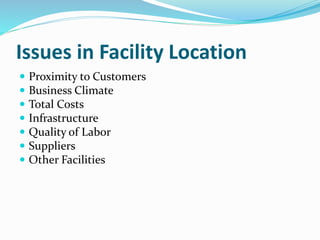
Issues in Facility Location
 Proximity to Customers
 Business Climate
 Total Costs
 Infrastructure
 Quality of Labor
 Suppliers
 Other Facilities
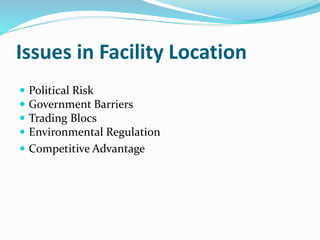
Issues in Facility Location
 Political Risk
 Government Barriers
 Trading Blocs
 Environmental Regulation
 Competitive Advantage
The Location Decision Stages and factors
Affecting Facility Location
 Facility location decisions are commonly made in
three stages:
o The Regional Decision
o The Local Decision and
o The Site Decision
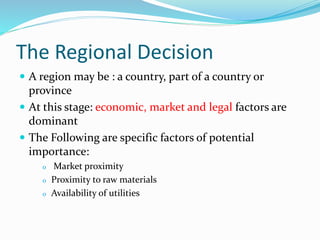
The Regional Decision
 A region may be : a country, part of a country or
province
 At this stage: economic, market and legal factors are
dominant
 The Following are specific factors of potential
importance:
o Market proximity
o Proximity to raw materials
o Availability of utilities
Cont…
o labour supply and unionization
And
Additional factors for international location decision:
o National taxes –profit taxes vs value added taxes
o Legal restrictions
The Local Decision
 This involves selecting among cities , metropolitan
areas etc.
 For example a company may decide to locate within
Zone One of Afar Region. Within this zone, the
possible local alternatives might be :Samara, Logia,
Chifra, Dubti etc.
 At this point , the following additional location factors
are relevant for consideration:
Cont…
 1. Taxes
 2. Economic incentives
free land, low-cost loans or tax abatements ,
employee training
3. Attractiveness of the community
Quality of housing, rate of crime , quality of schools,
recreational areas, etc.
4. Compatible Industry
Cont…
 5. Transportation Network
 6. Government policy and Attitude
 7. Environmental Regulations
The Site Decision
 At this stage , we need to have detail information
about the factors discussed in stage I and II
 This involves : comparing the relative availability and
costs of the needed resources such as transport ,power,
water ,land, labour, raw materials in alternative sites .
Global Location Factors
 Government stability
 Government regulations
 Political and economic systems
 Economic stability and growth
 Exchange rates
 Culture
 Climate
 Export import regulations,
duties and tariffs
 Raw material availability
 Number and proximity of
suppliers
 Transportation and
distribution system
 Labor cost and education
 Available technology
 Commercial travel
 Technical expertise
 Cross-border trade regulations
 Group trade agreements
Copyright 2006 John Wiley & Sons, Inc. Supplement 7-13
Regional Location
Factors(Summary)
 Labor (availability,
education, cost, and
unions)
 Proximity of customers
 Number of customers
 Construction/leasing
costs
 Land cost
 Modes and quality of
transportation
 Transportation costs
 Community government
Local business
regulations
 Government services
(e.g., Chamber of
Commerce)
Copyright 2006 John Wiley & Sons, Inc. Supplement 7-14
Regional Location Factors (cont.)
 Business climate
 Community services
 Incentive packages
 Government regulations
 Environmental
regulations
 Raw material availability
 Commercial travel
 Climate
 Infrastructure (e.g., roads,
water, sewers)
 Quality of life
 Taxes
 Availability of sites
 Financial services
 Community inducements
 Proximity of suppliers
 Education system
Copyright 2006 John Wiley & Sons, Inc. Supplement 7-15
Location Incentives
Copyright 2006 John Wiley & Sons, Inc. Supplement 7-16
 Tax credits
 Relaxed government regulation
 Job training
 Infrastructure improvement
 Money
Location Analysis Techniques
Copyright 2006 John Wiley & Sons, Inc. Supplement 7-17
 Location rating factor
 Center-of-gravity
 Load-distance
Location Rating Factor
Copyright 2006 John Wiley & Sons, Inc. Supplement 7-18
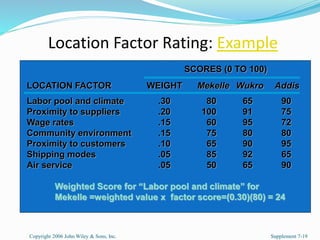
 Identify important factors
 Weight factors (0.00 - 1.00)
 Subjectively score each factor (0
- 100)
 Sum weighted scores
Location Factor Rating: Example
Copyright 2006 John Wiley & Sons, Inc. Supplement 7-19
Labor pool and climate
Proximity to suppliers
Wage rates
Community environment
Proximity to customers
Shipping modes
Air service
LOCATION FACTOR
.30
.20
.15
.15
.10
.05
.05
WEIGHT
80
100
60
75
65
85
50
Mekelle
65
91
95
80
90
92
65
Wukro
90
75
72
80
95
65
90
Addis
SCORES (0 TO 100)
Weighted Score for “Labor pool and climate” for
Mekelle =weighted value x factor score=(0.30)(80) = 24
Location Factor Rating
Copyright 2006 John Wiley & Sons, Inc. Supplement 7-20
24.00
20.00
9.00
11.25
6.50
4.25
2.50
77.50
Mekelle
19.50
18.20
14.25
12.00
9.00
4.60
3.25
80.80
Wukro
27.00
15.00
10.80
12.00
9.50
3.25
4.50
82.05
Addis
WEIGHTED SCORES
Addis has the
highest factor rating
Center-of-Gravity
Technique
Copyright 2006 John Wiley & Sons, Inc. Supplement 7-21
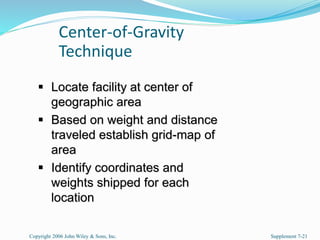
 Locate facility at center of
geographic area
 Based on weight and distance
traveled establish grid-map of
area
 Identify coordinates and
weights shipped for each
location
Plant Location Methodology: Center
of Gravity Method
 The center of gravity method is used for locating single
facilities that considers existing facilities, the distances
between them, and the volumes of goods to be shipped
between them.
 This methodology involves formulas used to compute
the coordinates of the two-dimensional point that
meets the distance and volume criteria stated above.
Plant Location Methodology: Center
of Gravity Method Formulas
C =
d V
V
x
ix i
i


Cx = X coordinate of center of gravity
Cy = Y coordinate of center of gravity
dix = X coordinate of the ith location
diy = Y coordinate of the ith location
Vi = volume of goods moved to or from ith
location
C =
d V
V
y
iy i
i


Grid-Map Coordinates
Copyright 2006 John Wiley & Sons, Inc. Supplement 7-24
where,
x, y = coordinates of new facility
at center of gravity
xi, yi = coordinates of existing
facility i
Wi = annual weight shipped from
facility i

n
Wi
i = 1
 xiWi
i = 1
n
x =

n
Wi
i = 1
 yiWi
i = 1
n
y =
x1 x2 x3 x
y2
y
y1
y3
1 (x1, y1), W1
2 (x2, y2), W2
3 (x3, y3), W3
Center-of-Gravity Technique:
Example
Copyright 2006 John Wiley & Sons, Inc. Supplement 7-25
A B C D
x 200 100 250 500
y 200 500 600 300
Wt 75 105 135 60
y
700
500
600
400
300
200
100
0 x
700
500 600
400
300
200
100
A
B
C
D
(135)
(105)
(75)
(60)
Miles
Miles
Center-of-Gravity Technique: Example
(cont.)
Copyright 2006 John Wiley & Sons, Inc. Supplement 7-26
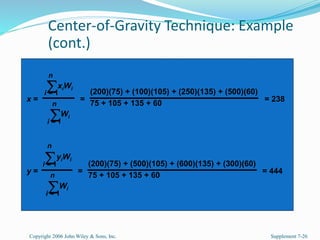
x = = = 238
n
Wi
i = 1
xiWi
i = 1
n

n
Wi
i = 1
yiWi
i = 1
n
y = = = 444
(200)(75) + (500)(105) + (600)(135) + (300)(60)
75 + 105 + 135 + 60
(200)(75) + (100)(105) + (250)(135) + (500)(60)
75 + 105 + 135 + 60
Center-of-Gravity Technique: Example
(cont.)
A B C D
x 200 100 250 500
y 200 500 600 300
Wt 75 105 135 60
y
700
500
600
400
300
200
100
0 x
700
500 600
400
300
200
100
A
B
C
D
(135)
(105)
(75)
(60)
Miles
Miles
Center of gravity (238, 444)
Load-Distance Technique
 Compute (Load x Distance) for each site
 Choose site with lowest (Load x Distance)
 Distance can be actual or straight-line
Copyright 2006 John Wiley & Sons, Inc. Supplement 7-28
Load-Distance Calculations
Copyright 2006 John Wiley & Sons, Inc. Supplement 7-29
 li di
i = 1
n
LD =
LD = load-distance value
li = load expressed as a weight, number of trips or units
being shipped from proposed site and location i
di = distance between proposed site and location i
di = (xi - x)2 + (yi - y)2
(x,y) = coordinates of proposed site
(xi , yi) = coordinates of existing facility
where,
where,
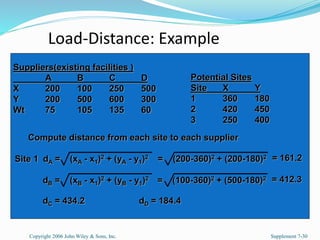
Load-Distance: Example
Copyright 2006 John Wiley & Sons, Inc. Supplement 7-30
Potential Sites
Site X Y
1 360 180
2 420 450
3 250 400
Suppliers(existing facilities )
A B C D
X 200 100 250 500
Y 200 500 600 300
Wt 75 105 135 60
Compute distance from each site to each supplier
= (200-360)2 + (200-180)2
dA = (xA - x1)2 + (yA - y1)2
Site 1 = 161.2
= (100-360)2 + (500-180)2
dB = (xB - x1)2 + (yB - y1)2 = 412.3
dC = 434.2 dD = 184.4
Load-Distance: Example (cont.)
Copyright 2006 John Wiley & Sons, Inc. Supplement 7-31
Site 2 dA = 333 dC = 226.7
dB = 323.9 dD = 170
Site 3 dA = 206.2 dC = 200
dB = 180.4 dD = 269.3
Compute load-
distance
i = 1
n
 li di
LD =
Site 1 = (75)(161.2) + (105)(412.3) + (135)(434.2) + (60)(434.4) = 125,063
Site 2 = (75)(333) + (105)(323.9) + (135)(226.7) + (60)(170) = 99,791
Site 3 = (75)(206.2) + (105)(180.3) + (135)(200) + (60)(269.3) = 77,555*
* Choose site 3
PART II: Facility Layout
ninth edition
Facility Layout
 Facility Layout and Basic Formats
 Process Layout
 Layout Planning
 Assembly Line balancing
Facility Layout
Defined
Facility layout can be defined as the process by which the
placement of departments, workgroups within departments,
workstations, machines, and stock-holding points within a
facility are determined.
Facility Layout
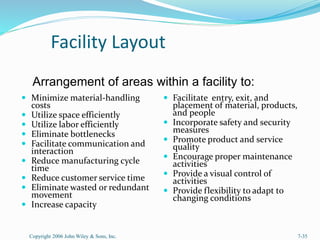
 Minimize material-handling
costs
 Utilize space efficiently
 Utilize labor efficiently
 Eliminate bottlenecks
 Facilitate communication and
interaction
 Reduce manufacturing cycle
time
 Reduce customer service time
 Eliminate wasted or redundant
movement
 Increase capacity
 Facilitate entry, exit, and
placement of material, products,
and people
 Incorporate safety and security
measures
 Promote product and service
quality
 Encourage proper maintenance
activities
 Provide a visual control of
activities
 Provide flexibility to adapt to
changing conditions
Copyright 2006 John Wiley & Sons, Inc. 7-35
Arrangement of areas within a facility to:
BASIC LAYOUTS
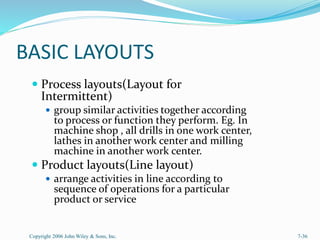
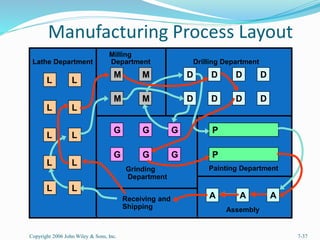
 Process layouts(Layout for
Intermittent)
 group similar activities together according
to process or function they perform. Eg. In
machine shop , all drills in one work center,
lathes in another work center and milling
machine in another work center.
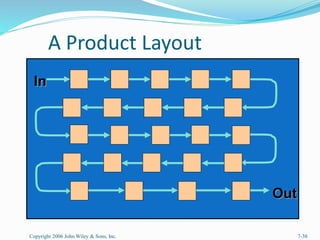
 Product layouts(Line layout)
 arrange activities in line according to
sequence of operations for a particular
product or service
Copyright 2006 John Wiley & Sons, Inc. 7-36
Manufacturing Process Layout
Copyright 2006 John Wiley & Sons, Inc. 7-37
L
L
L
L
L
L
L
L
L
L
M
M
M
M
D
D
D
D
D
D
D
D
G
G
G
G
G
G
A A A
Receiving and
Shipping Assembly
Painting Department
Lathe Department
Milling
Department Drilling Department
Grinding
Department
P
P
A Product Layout
Copyright 2006 John Wiley & Sons, Inc. 7-38
In
Out
Process Layout:
Systematic Layout Planning
 Numerical flow of items between departments
 Can be impractical to obtain
 Does not account for the qualitative factors that may be
crucial to the placement decision
 Systematic Layout Planning
 Accounts for the importance of having each department
located next to every other department
 Is also guided by trial and error
 Switching departments then checking the results of the
“closeness” score
Example of Systematic Layout
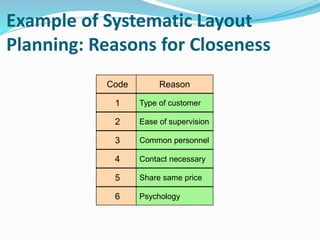
Planning: Reasons for Closeness
Code
1
2
3
4
5
6
Reason
Type of customer
Ease of supervision
Common personnel
Contact necessary
Share same price
Psychology
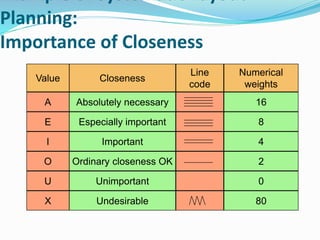
Example of Systematic Layout
Planning:
Importance of Closeness
Value
A
E
I
O
U
X
Closeness
Line
code
Numerical
weights
Absolutely necessary
Especially important
Important
Ordinary closeness OK
Unimportant
Undesirable
16
8
4
2
0
80
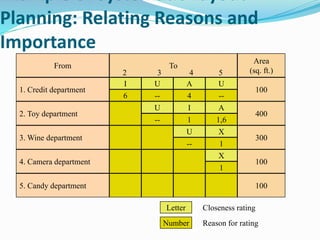
Example of Systematic Layout
Planning: Relating Reasons and
Importance
From
1. Credit department
2. Toy department
3. Wine department
4. Camera department
5. Candy department
6
I
--
U
4
A
--
U
--
U
1
I
1,6
A
--
U
1
X
1
X
To
2 3 4 5
Area
(sq. ft.)
100
400
300
100
100
Letter
Number
Closeness rating
Reason for rating
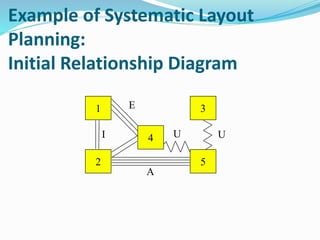
Example of Systematic Layout
Planning:
Initial Relationship Diagram
1
2
4
3
5
U U
E
A
I
Example of Systematic Layout
Planning:
Initial and Final Layouts
1
2 4
3
5
Initial Layout
Ignoring space and
building constraints
2
5 1 4
3
50 ft
20 ft
Final Layout
Adjusted by square
footage and building
size
Product Layout: Assembly
Balancing
 The major concern in a product layout is balancing the
assembly line so that no one workstation becomes a
bottleneck and holds up the flow of work through the
line .
 Assembly –line balancing operates under two
constraints : Precedence requirements and cycle time
restrictions
Station 1
Minutes
per Unit 6
Station 2
7
Station 3
3
Assembly Lines Balancing
Concepts
Question: Suppose you load work into the three work stations
below such that each will take the corresponding number of
minutes as shown. What is the cycle time of this line?
Answer: The cycle time of the line is always determined by
the work station taking the longest time. In this problem,
the cycle time of the line is 7 minutes. There is also going
to be idle time at the other two work stations.
Example of Line Balancing
 You’ve just been assigned the job a setting up an electric
fan assembly line with the following tasks:
Task Time (Mins) Description Predecessors
A 2 Assemble frame None
B 1 Mount switch A
C 3.25 Assemble motor housing None
D 1.2 Mount motor housing in frame A, C
E 0.5 Attach blade D
F 1 Assemble and attach safety grill E
G 1 Attach cord B
H 1.4 Test F, G
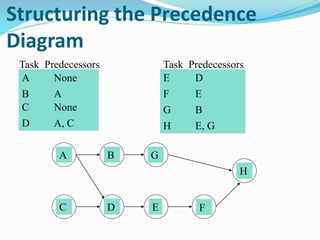
Structuring the Precedence
Diagram
Task Predecessors
A None
A
B A
B
C None
C
D A, C
D
Task Predecessors
E D
E
F E
F
G B
G
H E, G
H
Example of Line Balancing:
Precedence Diagram
Question: Which process step defines the maximum rate of
production?
A
C
B
D E F
G
H
2
3.25
1
1.2 .5
1
1.4
1
Answer: Task C is the cycle time of the line and
therefore, the maximum rate of production.
Example of Line Balancing:
Determine Cycle Time
Question: Suppose we want to assemble 100 fans
per day. What would our cycle time have to be?
Required Cycle Time, C =
Production time per period
Required output per period
C =
420 mins / day
100 units / day
= 4.2 mins / unit
Answer:
Example of Line Balancing: Determine Theoretical
Minimum Number of Workstations
Question: What is the theoretical minimum number of
workstations for this problem?
Answer: Theoretical Min. Number of Workstations, N
N =
Sum of task times (T)
Cycle time (C)
t
t
N =
11.35 mins / unit
4.2 mins / unit
= 2.702, or 3
t
To Follow for Loading
Workstations
 1. Draw the precedence diagram for all tasks
 2.Group the elemental tasks without exceeding the cycle time.
 3.Calculate the efficiency of the line
A
C
B
D E F
G
H
2
3.25
1
1.2 .5
1
1.4
1
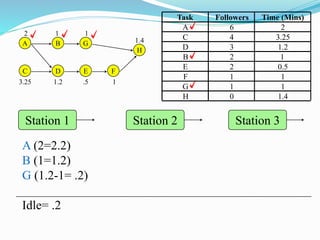
Station 1 Station 2 Station 3
Task Followers Time (Mins)
A 6 2
C 4 3.25
D 3 1.2
B 2 1
E 2 0.5
F 1 1
G 1 1
H 0 1.4
A
C
B
D E F
G
H
2
3.25
1
1.2 .5
1
1.4
1
Station 1 Station 2 Station 3
A (2min)
Task Followers Time (Mins)
A 6 2
C 4 3.25
D 3 1.2
B 2 1
E 2 0.5
F 1 1
G 1 1
H 0 1.4
A
C
B
D E F
G
H
2
3.25
1
1.2 .5
1
1.4
1
A (4.2-2=2.2)
B (2.2-1=1.2)
Task Followers Time (Mins)
A 6 2
C 4 3.25
D 3 1.2
B 2 1
E 2 0.5
F 1 1
G 1 1
H 0 1.4
Station 1 Station 2 Station 3
A
C
B
D E F
G
H
2
3.25
1
1.2 .5
1
1.4
1
A (2=2.2)
B (1=1.2)
G (1.2-1= .2)
Idle= .2
Task Followers Time (Mins)
A 6 2
C 4 3.25
D 3 1.2
B 2 1
E 2 0.5
F 1 1
G 1 1
H 0 1.4
Station 1 Station 2 Station 3
A
C
B
D E F
G
H
2
3.25
1
1.2 .5
1
1.4
1
C (4.2-3.25)=.95
Task Followers Time (Mins)
A 6 2
C 4 3.25
D 3 1.2
B 2 1
E 2 0.5
F 1 1
G 1 1
H 0 1.4
A (4.2-2=2.2)
B (2.2-1=1.2)
G (1.2-1= .2)
Idle= .2
Station 1 Station 2 Station 3
C (4.2-3.25)=.95
Idle = .95
A
C
B
D E F
G
H
2
3.25
1
1.2 .5
1
1.4
1
Task Followers Time (Mins)
A 6 2
C 4 3.25
D 3 1.2
B 2 1
E 2 0.5
F 1 1
G 1 1
H 0 1.4
A (2)
B (1)
G (1)
Idle=4.2-4= .2
Station 1 Station 2 Station 3
C (3.25)
Idle =4.2-3.25= .95
A
C
B
D E F
G
H
2
3.25
1
1.2 .5
1
1.4
1
D (1.2)
Task Followers Time (Mins)
A 6 2
C 4 3.25
D 3 1.2
B 2 1
E 2 0.5
F 1 1
G 1 1
H 0 1.4
A (2)
B (1)
G (1)
Idle=4.2-4= .2
Station 1 Station 2 Station 3
A
C
B
D E F
G
H
2
3.25
1
1.2 .5
1
1.4
1
C (3.25)
Idle =4.2-3.25= .95
D (1.2)
E (.5)
Task Followers Time (Mins)
A 6 2
C 4 3.25
D 3 1.2
B 2 1
E 2 0.5
F 1 1
G 1 1
H 0 1.4
A(2min)
B (1min)
G (1min
Idle=4.2-4=.2
Station 1 Station 2 Station 3
A
C
B
D E F
G
H
2
3.25
1
1.2 .5
1
1.4
1
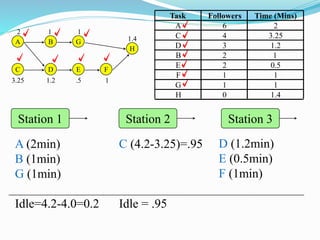
C (4.2-3.25)=.95
Idle = .95
D (1.2min)
E (0.5min)
F (1min)
Task Followers Time (Mins)
A 6 2
C 4 3.25
D 3 1.2
B 2 1
E 2 0.5
F 1 1
G 1 1
H 0 1.4
A (2min)
B (1min)
G (1min)
Idle=4.2-4.0=0.2
Station 1 Station 2 Station 3
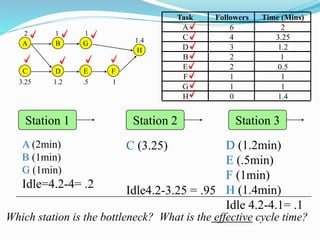
Which station is the bottleneck? What is the effective cycle time?
A
C
B
D E F
G
H
2
3.25
1
1.2 .5
1
1.4
1
C (3.25)
Idle4.2-3.25 = .95
D (1.2min)
E (.5min)
F (1min)
H (1.4min)
Idle 4.2-4.1= .1
Task Followers Time (Mins)
A 6 2
C 4 3.25
D 3 1.2
B 2 1
E 2 0.5
F 1 1
G 1 1
H 0 1.4
A (2min)
B (1min)
G (1min)
Idle=4.2-4= .2
Station 1 Station 2 Station 3
Example of Line Balancing:
Determine the Efficiency of the
Assembly Line
33.78%
=
s/unit)
(8)(4.2min
mins/unit
11.35
=
Efficiency
Efficiency =
Sum of task times (T)
Actual number of workstations (Na) x Cycle time (C)
Cont…
0.1%
9
=
s/unit)
(3)(4.2min
mins/unit
11.35
=
Efficiency
Cont…
 Balanced delay=100-Efficiency
=100-90.1
=9.9%
Reading Assignment
1.Group Technology
2. Fixed position layout
3.Service operations layout
 Exercise
An assembly line with 17 tasks is to be balanced . The longest task is 2.4
minutes , and the total time for all tasks is 18 minutes. The line will
operate for 450 minutes per day.
a. what are the minimum and maximum cycle time?
b. What range of output is theoretically possible for the line ?
c. What is the minimum number of workstations needed if the maximum
output rate is to be sought ?
d. What cycle time will provide an output rate of 125 units per day?
e. What output potential will result if the cycle time is (1) 9 minutes ? (2)
15 minutes ?

CHAPTER-6 Facility Location and Layout 1.pptx

  • 1.
    Facility Location andFacility Layout Kahsu Mebrahtu Areaya(Assistant Professor), MU, CBE , MBA Program
  • 2.
    Part I. FacilityLocation  Issues in Facility Location  Plant Location Methods
  • 3.
    Competitive Imperatives Impacting Location The need to produce close to the customer due to time-based competition, trade agreements, and shipping costs.  The need to locate near the appropriate labor pool to take advantage of low wage costs and/or high technical skills.
  • 4.
    Issues in FacilityLocation  Proximity to Customers  Business Climate  Total Costs  Infrastructure  Quality of Labor  Suppliers  Other Facilities
  • 5.
    Issues in FacilityLocation  Political Risk  Government Barriers  Trading Blocs  Environmental Regulation  Competitive Advantage
  • 6.
    The Location DecisionStages and factors Affecting Facility Location  Facility location decisions are commonly made in three stages: o The Regional Decision o The Local Decision and o The Site Decision
  • 7.
    The Regional Decision A region may be : a country, part of a country or province  At this stage: economic, market and legal factors are dominant  The Following are specific factors of potential importance: o Market proximity o Proximity to raw materials o Availability of utilities
  • 8.
    Cont… o labour supplyand unionization And Additional factors for international location decision: o National taxes –profit taxes vs value added taxes o Legal restrictions
  • 9.
    The Local Decision This involves selecting among cities , metropolitan areas etc.  For example a company may decide to locate within Zone One of Afar Region. Within this zone, the possible local alternatives might be :Samara, Logia, Chifra, Dubti etc.  At this point , the following additional location factors are relevant for consideration:
  • 10.
    Cont…  1. Taxes 2. Economic incentives free land, low-cost loans or tax abatements , employee training 3. Attractiveness of the community Quality of housing, rate of crime , quality of schools, recreational areas, etc. 4. Compatible Industry
  • 11.
    Cont…  5. TransportationNetwork  6. Government policy and Attitude  7. Environmental Regulations
  • 12.
    The Site Decision At this stage , we need to have detail information about the factors discussed in stage I and II  This involves : comparing the relative availability and costs of the needed resources such as transport ,power, water ,land, labour, raw materials in alternative sites .
  • 13.
    Global Location Factors Government stability  Government regulations  Political and economic systems  Economic stability and growth  Exchange rates  Culture  Climate  Export import regulations, duties and tariffs  Raw material availability  Number and proximity of suppliers  Transportation and distribution system  Labor cost and education  Available technology  Commercial travel  Technical expertise  Cross-border trade regulations  Group trade agreements Copyright 2006 John Wiley & Sons, Inc. Supplement 7-13
  • 14.
    Regional Location Factors(Summary)  Labor(availability, education, cost, and unions)  Proximity of customers  Number of customers  Construction/leasing costs  Land cost  Modes and quality of transportation  Transportation costs  Community government Local business regulations  Government services (e.g., Chamber of Commerce) Copyright 2006 John Wiley & Sons, Inc. Supplement 7-14
  • 15.
    Regional Location Factors(cont.)  Business climate  Community services  Incentive packages  Government regulations  Environmental regulations  Raw material availability  Commercial travel  Climate  Infrastructure (e.g., roads, water, sewers)  Quality of life  Taxes  Availability of sites  Financial services  Community inducements  Proximity of suppliers  Education system Copyright 2006 John Wiley & Sons, Inc. Supplement 7-15
  • 16.
    Location Incentives Copyright 2006John Wiley & Sons, Inc. Supplement 7-16  Tax credits  Relaxed government regulation  Job training  Infrastructure improvement  Money
  • 17.
    Location Analysis Techniques Copyright2006 John Wiley & Sons, Inc. Supplement 7-17  Location rating factor  Center-of-gravity  Load-distance
  • 18.
    Location Rating Factor Copyright2006 John Wiley & Sons, Inc. Supplement 7-18  Identify important factors  Weight factors (0.00 - 1.00)  Subjectively score each factor (0 - 100)  Sum weighted scores
  • 19.
    Location Factor Rating:Example Copyright 2006 John Wiley & Sons, Inc. Supplement 7-19 Labor pool and climate Proximity to suppliers Wage rates Community environment Proximity to customers Shipping modes Air service LOCATION FACTOR .30 .20 .15 .15 .10 .05 .05 WEIGHT 80 100 60 75 65 85 50 Mekelle 65 91 95 80 90 92 65 Wukro 90 75 72 80 95 65 90 Addis SCORES (0 TO 100) Weighted Score for “Labor pool and climate” for Mekelle =weighted value x factor score=(0.30)(80) = 24
  • 20.
    Location Factor Rating Copyright2006 John Wiley & Sons, Inc. Supplement 7-20 24.00 20.00 9.00 11.25 6.50 4.25 2.50 77.50 Mekelle 19.50 18.20 14.25 12.00 9.00 4.60 3.25 80.80 Wukro 27.00 15.00 10.80 12.00 9.50 3.25 4.50 82.05 Addis WEIGHTED SCORES Addis has the highest factor rating
  • 21.
    Center-of-Gravity Technique Copyright 2006 JohnWiley & Sons, Inc. Supplement 7-21  Locate facility at center of geographic area  Based on weight and distance traveled establish grid-map of area  Identify coordinates and weights shipped for each location
  • 22.
    Plant Location Methodology:Center of Gravity Method  The center of gravity method is used for locating single facilities that considers existing facilities, the distances between them, and the volumes of goods to be shipped between them.  This methodology involves formulas used to compute the coordinates of the two-dimensional point that meets the distance and volume criteria stated above.
  • 23.
    Plant Location Methodology:Center of Gravity Method Formulas C = d V V x ix i i   Cx = X coordinate of center of gravity Cy = Y coordinate of center of gravity dix = X coordinate of the ith location diy = Y coordinate of the ith location Vi = volume of goods moved to or from ith location C = d V V y iy i i  
  • 24.
    Grid-Map Coordinates Copyright 2006John Wiley & Sons, Inc. Supplement 7-24 where, x, y = coordinates of new facility at center of gravity xi, yi = coordinates of existing facility i Wi = annual weight shipped from facility i  n Wi i = 1  xiWi i = 1 n x =  n Wi i = 1  yiWi i = 1 n y = x1 x2 x3 x y2 y y1 y3 1 (x1, y1), W1 2 (x2, y2), W2 3 (x3, y3), W3
  • 25.
    Center-of-Gravity Technique: Example Copyright 2006John Wiley & Sons, Inc. Supplement 7-25 A B C D x 200 100 250 500 y 200 500 600 300 Wt 75 105 135 60 y 700 500 600 400 300 200 100 0 x 700 500 600 400 300 200 100 A B C D (135) (105) (75) (60) Miles Miles
  • 26.
    Center-of-Gravity Technique: Example (cont.) Copyright2006 John Wiley & Sons, Inc. Supplement 7-26 x = = = 238 n Wi i = 1 xiWi i = 1 n  n Wi i = 1 yiWi i = 1 n y = = = 444 (200)(75) + (500)(105) + (600)(135) + (300)(60) 75 + 105 + 135 + 60 (200)(75) + (100)(105) + (250)(135) + (500)(60) 75 + 105 + 135 + 60
  • 27.
    Center-of-Gravity Technique: Example (cont.) AB C D x 200 100 250 500 y 200 500 600 300 Wt 75 105 135 60 y 700 500 600 400 300 200 100 0 x 700 500 600 400 300 200 100 A B C D (135) (105) (75) (60) Miles Miles Center of gravity (238, 444)
  • 28.
    Load-Distance Technique  Compute(Load x Distance) for each site  Choose site with lowest (Load x Distance)  Distance can be actual or straight-line Copyright 2006 John Wiley & Sons, Inc. Supplement 7-28
  • 29.
    Load-Distance Calculations Copyright 2006John Wiley & Sons, Inc. Supplement 7-29  li di i = 1 n LD = LD = load-distance value li = load expressed as a weight, number of trips or units being shipped from proposed site and location i di = distance between proposed site and location i di = (xi - x)2 + (yi - y)2 (x,y) = coordinates of proposed site (xi , yi) = coordinates of existing facility where, where,
  • 30.
    Load-Distance: Example Copyright 2006John Wiley & Sons, Inc. Supplement 7-30 Potential Sites Site X Y 1 360 180 2 420 450 3 250 400 Suppliers(existing facilities ) A B C D X 200 100 250 500 Y 200 500 600 300 Wt 75 105 135 60 Compute distance from each site to each supplier = (200-360)2 + (200-180)2 dA = (xA - x1)2 + (yA - y1)2 Site 1 = 161.2 = (100-360)2 + (500-180)2 dB = (xB - x1)2 + (yB - y1)2 = 412.3 dC = 434.2 dD = 184.4
  • 31.
    Load-Distance: Example (cont.) Copyright2006 John Wiley & Sons, Inc. Supplement 7-31 Site 2 dA = 333 dC = 226.7 dB = 323.9 dD = 170 Site 3 dA = 206.2 dC = 200 dB = 180.4 dD = 269.3 Compute load- distance i = 1 n  li di LD = Site 1 = (75)(161.2) + (105)(412.3) + (135)(434.2) + (60)(434.4) = 125,063 Site 2 = (75)(333) + (105)(323.9) + (135)(226.7) + (60)(170) = 99,791 Site 3 = (75)(206.2) + (105)(180.3) + (135)(200) + (60)(269.3) = 77,555* * Choose site 3
  • 32.
    PART II: FacilityLayout ninth edition
  • 33.
    Facility Layout  FacilityLayout and Basic Formats  Process Layout  Layout Planning  Assembly Line balancing
  • 34.
    Facility Layout Defined Facility layoutcan be defined as the process by which the placement of departments, workgroups within departments, workstations, machines, and stock-holding points within a facility are determined.
  • 35.
    Facility Layout  Minimizematerial-handling costs  Utilize space efficiently  Utilize labor efficiently  Eliminate bottlenecks  Facilitate communication and interaction  Reduce manufacturing cycle time  Reduce customer service time  Eliminate wasted or redundant movement  Increase capacity  Facilitate entry, exit, and placement of material, products, and people  Incorporate safety and security measures  Promote product and service quality  Encourage proper maintenance activities  Provide a visual control of activities  Provide flexibility to adapt to changing conditions Copyright 2006 John Wiley & Sons, Inc. 7-35 Arrangement of areas within a facility to:
  • 36.
    BASIC LAYOUTS  Processlayouts(Layout for Intermittent)  group similar activities together according to process or function they perform. Eg. In machine shop , all drills in one work center, lathes in another work center and milling machine in another work center.  Product layouts(Line layout)  arrange activities in line according to sequence of operations for a particular product or service Copyright 2006 John Wiley & Sons, Inc. 7-36
  • 37.
    Manufacturing Process Layout Copyright2006 John Wiley & Sons, Inc. 7-37 L L L L L L L L L L M M M M D D D D D D D D G G G G G G A A A Receiving and Shipping Assembly Painting Department Lathe Department Milling Department Drilling Department Grinding Department P P
  • 38.
    A Product Layout Copyright2006 John Wiley & Sons, Inc. 7-38 In Out
  • 39.
    Process Layout: Systematic LayoutPlanning  Numerical flow of items between departments  Can be impractical to obtain  Does not account for the qualitative factors that may be crucial to the placement decision  Systematic Layout Planning  Accounts for the importance of having each department located next to every other department  Is also guided by trial and error  Switching departments then checking the results of the “closeness” score
  • 40.
    Example of SystematicLayout Planning: Reasons for Closeness Code 1 2 3 4 5 6 Reason Type of customer Ease of supervision Common personnel Contact necessary Share same price Psychology
  • 41.
    Example of SystematicLayout Planning: Importance of Closeness Value A E I O U X Closeness Line code Numerical weights Absolutely necessary Especially important Important Ordinary closeness OK Unimportant Undesirable 16 8 4 2 0 80
  • 42.
    Example of SystematicLayout Planning: Relating Reasons and Importance From 1. Credit department 2. Toy department 3. Wine department 4. Camera department 5. Candy department 6 I -- U 4 A -- U -- U 1 I 1,6 A -- U 1 X 1 X To 2 3 4 5 Area (sq. ft.) 100 400 300 100 100 Letter Number Closeness rating Reason for rating
  • 43.
    Example of SystematicLayout Planning: Initial Relationship Diagram 1 2 4 3 5 U U E A I
  • 44.
    Example of SystematicLayout Planning: Initial and Final Layouts 1 2 4 3 5 Initial Layout Ignoring space and building constraints 2 5 1 4 3 50 ft 20 ft Final Layout Adjusted by square footage and building size
  • 45.
    Product Layout: Assembly Balancing The major concern in a product layout is balancing the assembly line so that no one workstation becomes a bottleneck and holds up the flow of work through the line .  Assembly –line balancing operates under two constraints : Precedence requirements and cycle time restrictions
  • 46.
    Station 1 Minutes per Unit6 Station 2 7 Station 3 3 Assembly Lines Balancing Concepts Question: Suppose you load work into the three work stations below such that each will take the corresponding number of minutes as shown. What is the cycle time of this line? Answer: The cycle time of the line is always determined by the work station taking the longest time. In this problem, the cycle time of the line is 7 minutes. There is also going to be idle time at the other two work stations.
  • 47.
    Example of LineBalancing  You’ve just been assigned the job a setting up an electric fan assembly line with the following tasks: Task Time (Mins) Description Predecessors A 2 Assemble frame None B 1 Mount switch A C 3.25 Assemble motor housing None D 1.2 Mount motor housing in frame A, C E 0.5 Attach blade D F 1 Assemble and attach safety grill E G 1 Attach cord B H 1.4 Test F, G
  • 48.
    Structuring the Precedence Diagram TaskPredecessors A None A B A B C None C D A, C D Task Predecessors E D E F E F G B G H E, G H
  • 49.
    Example of LineBalancing: Precedence Diagram Question: Which process step defines the maximum rate of production? A C B D E F G H 2 3.25 1 1.2 .5 1 1.4 1 Answer: Task C is the cycle time of the line and therefore, the maximum rate of production.
  • 50.
    Example of LineBalancing: Determine Cycle Time Question: Suppose we want to assemble 100 fans per day. What would our cycle time have to be? Required Cycle Time, C = Production time per period Required output per period C = 420 mins / day 100 units / day = 4.2 mins / unit Answer:
  • 51.
    Example of LineBalancing: Determine Theoretical Minimum Number of Workstations Question: What is the theoretical minimum number of workstations for this problem? Answer: Theoretical Min. Number of Workstations, N N = Sum of task times (T) Cycle time (C) t t N = 11.35 mins / unit 4.2 mins / unit = 2.702, or 3 t
  • 52.
    To Follow forLoading Workstations  1. Draw the precedence diagram for all tasks  2.Group the elemental tasks without exceeding the cycle time.  3.Calculate the efficiency of the line
  • 53.
    A C B D E F G H 2 3.25 1 1.2.5 1 1.4 1 Station 1 Station 2 Station 3 Task Followers Time (Mins) A 6 2 C 4 3.25 D 3 1.2 B 2 1 E 2 0.5 F 1 1 G 1 1 H 0 1.4
  • 54.
    A C B D E F G H 2 3.25 1 1.2.5 1 1.4 1 Station 1 Station 2 Station 3 A (2min) Task Followers Time (Mins) A 6 2 C 4 3.25 D 3 1.2 B 2 1 E 2 0.5 F 1 1 G 1 1 H 0 1.4
  • 55.
    A C B D E F G H 2 3.25 1 1.2.5 1 1.4 1 A (4.2-2=2.2) B (2.2-1=1.2) Task Followers Time (Mins) A 6 2 C 4 3.25 D 3 1.2 B 2 1 E 2 0.5 F 1 1 G 1 1 H 0 1.4 Station 1 Station 2 Station 3
  • 56.
    A C B D E F G H 2 3.25 1 1.2.5 1 1.4 1 A (2=2.2) B (1=1.2) G (1.2-1= .2) Idle= .2 Task Followers Time (Mins) A 6 2 C 4 3.25 D 3 1.2 B 2 1 E 2 0.5 F 1 1 G 1 1 H 0 1.4 Station 1 Station 2 Station 3
  • 57.
    A C B D E F G H 2 3.25 1 1.2.5 1 1.4 1 C (4.2-3.25)=.95 Task Followers Time (Mins) A 6 2 C 4 3.25 D 3 1.2 B 2 1 E 2 0.5 F 1 1 G 1 1 H 0 1.4 A (4.2-2=2.2) B (2.2-1=1.2) G (1.2-1= .2) Idle= .2 Station 1 Station 2 Station 3
  • 58.
    C (4.2-3.25)=.95 Idle =.95 A C B D E F G H 2 3.25 1 1.2 .5 1 1.4 1 Task Followers Time (Mins) A 6 2 C 4 3.25 D 3 1.2 B 2 1 E 2 0.5 F 1 1 G 1 1 H 0 1.4 A (2) B (1) G (1) Idle=4.2-4= .2 Station 1 Station 2 Station 3
  • 59.
    C (3.25) Idle =4.2-3.25=.95 A C B D E F G H 2 3.25 1 1.2 .5 1 1.4 1 D (1.2) Task Followers Time (Mins) A 6 2 C 4 3.25 D 3 1.2 B 2 1 E 2 0.5 F 1 1 G 1 1 H 0 1.4 A (2) B (1) G (1) Idle=4.2-4= .2 Station 1 Station 2 Station 3
  • 60.
    A C B D E F G H 2 3.25 1 1.2.5 1 1.4 1 C (3.25) Idle =4.2-3.25= .95 D (1.2) E (.5) Task Followers Time (Mins) A 6 2 C 4 3.25 D 3 1.2 B 2 1 E 2 0.5 F 1 1 G 1 1 H 0 1.4 A(2min) B (1min) G (1min Idle=4.2-4=.2 Station 1 Station 2 Station 3
  • 61.
    A C B D E F G H 2 3.25 1 1.2.5 1 1.4 1 C (4.2-3.25)=.95 Idle = .95 D (1.2min) E (0.5min) F (1min) Task Followers Time (Mins) A 6 2 C 4 3.25 D 3 1.2 B 2 1 E 2 0.5 F 1 1 G 1 1 H 0 1.4 A (2min) B (1min) G (1min) Idle=4.2-4.0=0.2 Station 1 Station 2 Station 3
  • 62.
    Which station isthe bottleneck? What is the effective cycle time? A C B D E F G H 2 3.25 1 1.2 .5 1 1.4 1 C (3.25) Idle4.2-3.25 = .95 D (1.2min) E (.5min) F (1min) H (1.4min) Idle 4.2-4.1= .1 Task Followers Time (Mins) A 6 2 C 4 3.25 D 3 1.2 B 2 1 E 2 0.5 F 1 1 G 1 1 H 0 1.4 A (2min) B (1min) G (1min) Idle=4.2-4= .2 Station 1 Station 2 Station 3
  • 63.
    Example of LineBalancing: Determine the Efficiency of the Assembly Line 33.78% = s/unit) (8)(4.2min mins/unit 11.35 = Efficiency Efficiency = Sum of task times (T) Actual number of workstations (Na) x Cycle time (C)
  • 64.
  • 65.
  • 66.
    Reading Assignment 1.Group Technology 2.Fixed position layout 3.Service operations layout
  • 67.
     Exercise An assemblyline with 17 tasks is to be balanced . The longest task is 2.4 minutes , and the total time for all tasks is 18 minutes. The line will operate for 450 minutes per day. a. what are the minimum and maximum cycle time? b. What range of output is theoretically possible for the line ? c. What is the minimum number of workstations needed if the maximum output rate is to be sought ? d. What cycle time will provide an output rate of 125 units per day? e. What output potential will result if the cycle time is (1) 9 minutes ? (2) 15 minutes ?