1
Lecture Objectives
• What is Static Routing?
– Configuring Static Routes
– Configuring Default Routes
• Comparison of Static and Dynamic Routing
• Dynamic Routing Characteristics
– Autonomous Systems Concepts
– Interior Routing Protocols vs. Exterior Routing Protocols
– Metric, Path Selection Criteria
2
IP Routing Learns Destinations
• Three types of routes are there:
– Static routes
– Default routes
– Dynamic routing
3
Static Routing
4
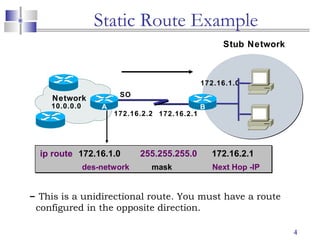
Static Route Example
– This is a unidirectional route. You must have a route
configured in the opposite direction.
Stub Network
172.16.2.1
SO
172.16.1.0
B
172.16.2.2
Network
A B10.0.0.0
ip route 172.16.1.0 255.255.255.0 172.16.2.1
des-network mask Next Hop -IP
5
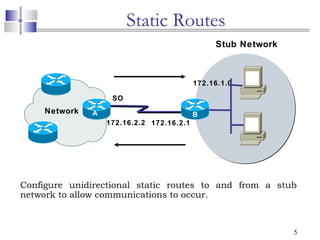
Static Routes
Configure unidirectional static routes to and from a stub
network to allow communications to occur.
172.16.2.1
SO
172.16.1.0
B
172.16.2.2
Network A B
Stub Network
6
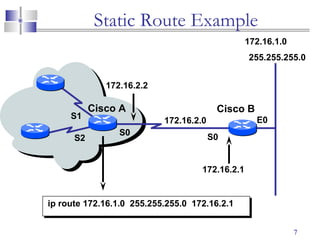
• Defines a path to an IP destination
network or subnet
ip route network [ mask ] { address | interface } [ distance ][ permanent ]
Router (config)#
Static Route Configuration
7
255.255.255.0
172.16.2.0
Cisco A
172.16.1.0
172.16.2.1
Cisco B
E0
S0
S1
S2 S0
ip route 172.16.1.0 255.255.255.0 172.16.2.1
172.16.2.2
Static Route Example
8
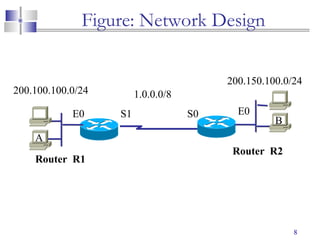
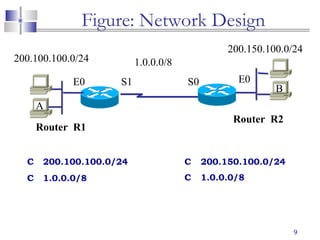
Figure: Network Design
Router R1
Router R2
B
A
E0S0S1E0
200.100.100.0/24 1.0.0.0/8
200.150.100.0/24
9
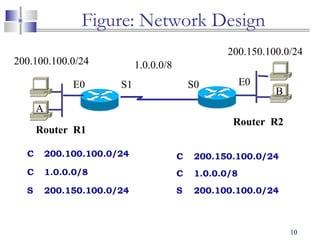
Figure: Network Design
Router R1
Router R2
B
A
E0S0S1E0
200.100.100.0/24 1.0.0.0/8
200.150.100.0/24
C 200.100.100.0/24
C 1.0.0.0/8
C 200.150.100.0/24
C 1.0.0.0/8
10
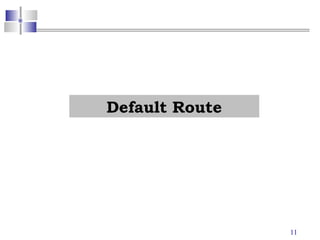
Figure: Network Design
Router R1
Router R2
B
A
E0S0S1E0
200.100.100.0/24 1.0.0.0/8
200.150.100.0/24
C 200.100.100.0/24
C 1.0.0.0/8
S 200.150.100.0/24
C 200.150.100.0/24
C 1.0.0.0/8
S 200.100.100.0/24
11
Default Route
12
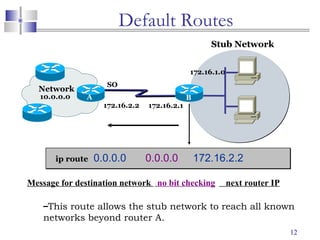
Default Routes
–This route allows the stub network to reach all known
networks beyond router A.
Stub Network
ip route 0.0.0.0 0.0.0.0 172.16.2.2
172.16.2.1
SO
172.16.1.0
B
172.16.2.2
Network
A B10.0.0.0
Message for destination network no bit checking next router IP
13
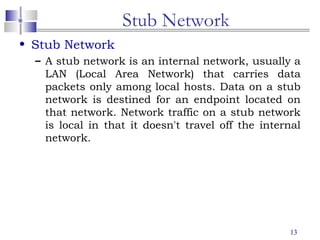
Stub Network
• Stub Network
– A stub network is an internal network, usually a
LAN (Local Area Network) that carries data
packets only among local hosts. Data on a stub
network is destined for an endpoint located on
that network. Network traffic on a stub network
is local in that it doesn't travel off the internal
network.
14
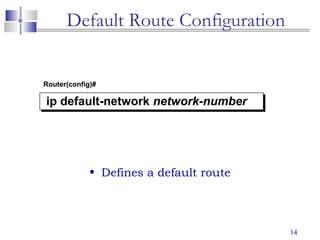
• Defines a default route
ip default-network network-number
Router(config)#
Default Route Configuration
15
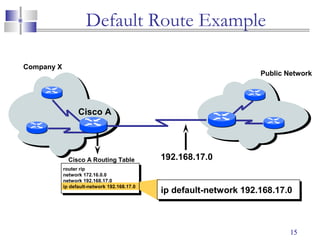
Company X
Public Network
Cisco A
Default Route Example
192.168.17.0Cisco A Routing Table
ip default-network 192.168.17.0ip default-network 192.168.17.0
router rip
network 172.16.0.0
network 192.168.17.0
ip default-network 192.168.17.0
16
Dynamic Routing
17
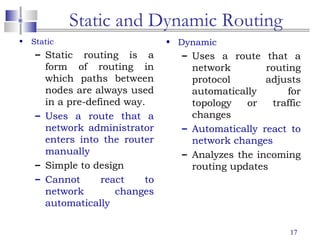
Static and Dynamic Routing
• Static
– Static routing is a
form of routing in
which paths between
nodes are always used
in a pre-defined way.
– Uses a route that a
network administrator
enters into the router
manually
– Simple to design
– Cannot react to
network changes
automatically
• Dynamic
– Uses a route that a
network routing
protocol adjusts
automatically for
topology or traffic
changes
– Automatically react to
network changes
– Analyzes the incoming
routing updates
18
Introduction to Routing Protocols
• Packets pass through many routers from
source to destination
• Dynamic nature of Internet; routes change
and need to be updated
• Routing protocol – combination of rules and
procedures allowing routers to inform one
another of changes
19
Dynamic Routing Protocols
• Running a dynamic routing protocol will
allow our routers to share their network
information with each other and recover
from a network outage automatically.
• If an alternate path exists and all of the
routers are running properly configured
routing protocols, they will eventually locate
the alternate path and use it if the primary
path goes down.
20
Networ
k
Protoco
l
Destinatio
n
Network
Connected
Learned
10.120.2.0
172.16.1.0
Exit
Interface
E0
S0
Routed Protocol: IP
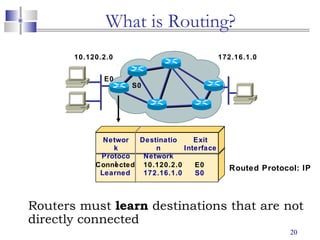
Routers must learn destinations that are not
directly connected
172.16.1.010.120.2.0
E0
S0
What is Routing?
21
What is a Routing Protocol?
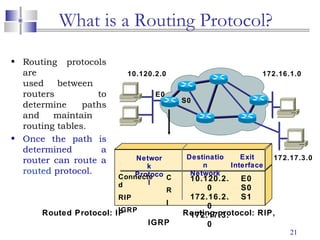
• Routing protocols
are
used between
routers to
determine paths
and maintain
routing tables.
• Once the path is
determined a
router can route a
routed protocol.
Networ
k
Protoco
l
Destinatio
n
Network
Connecte
d
RIP
IGRP
10.120.2.
0
172.16.2.
0
172.17.3.
0
Exit
Interface
E0
S0
S1
Routed Protocol: IP Routing protocol: RIP,
IGRP
172.17.3.0
172.16.1.010.120.2.0
E0
S0
C
R
I
22
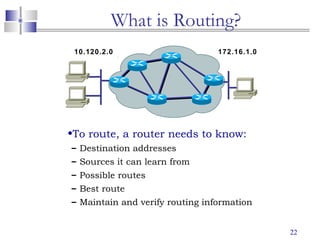
•To route, a router needs to know:
– Destination addresses
– Sources it can learn from
– Possible routes
– Best route
– Maintain and verify routing information
What is Routing?
172.16.1.010.120.2.0
23
Routing
• Routing:
– Selecting the best possible path to reach the
destination
– Occurs at layer 3
– It involves:
• Determining the optimal paths
• Transporting packets through a network, like
packet switching
24
Planning the Configuration
• Network Protocols
– There are two major classes of network protocols
and we need both:
• Routed
– IP, IPX etc.
• Routing
– RIP, IGRP, OSPF, BGP etc.
25
Routed and Routing Protocols
• Routed Protocols:
– Used for communication between routers and
computers e.g. IP etc.
– These are routed over an internetwork
• Routing Protocols:
– Used for communication between routers e.g.
RIP, IGRP, OSPF, BGP etc.
– These protocols implements routing algorithms
26
Path Determination
• Metrics are used by routing protocols
– It is a standard of measurement, e.g. path
bandwidth, number of hops etc.
– Routing tables are maintained
27
Routing Algorithms
• Design Goals
– Optimality
– Simplicity and low overhead
– Robustness and stability
– Rapid convergence
– Flexibility
28
Routing Metrics
• Routing protocols uses different metrics to
select the best route
– Path Length
– Reliability
– Delay
– Bandwidth
– Load
– Communication Cost
29
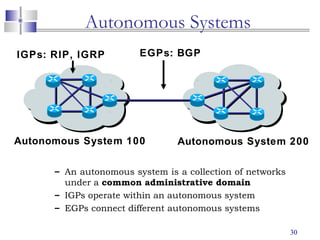
Autonomous Systems
30
Autonomous System 100
Autonomous Systems
– An autonomous system is a collection of networks
under a common administrative domain
– IGPs operate within an autonomous system
– EGPs connect different autonomous systems
Autonomous System 200
IGPs: RIP, IGRP EGPs: BGP
31
Interior Routing Protocols
• The routing protocols e.g. RIP, IGRP, OSPF, are
called interior routing protocols.
• They are meant to be run on routers under a common
administration I.e. within a single Autonomous
System
32
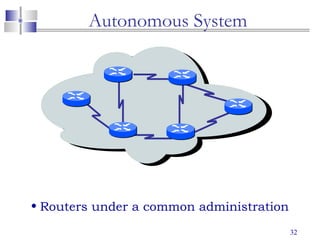
• Routers under a common administration
Autonomous System
33
Some Terminologies
• Hierarchical terminology of OSI
– End Systems (ES)
• Devices without packet forwarding capability
– Intermediate Systems (IS)
• Devices with packet forwarding capability
– Intradomain IS and Interdomain IS
• Autonomous Systems (AS)
– A system under the same administration, i.e.
where same protocol runs.
– Also called routing domains
34
Interior vs. Exterior Protocols
• Interior Gateway Protocols (IGPs)
– Runs within an Autonomous System, e.g RIP,
IGRP
• Exterior Gateway Protocols (EGPs)
– Connects different Autonomous System, e.g.
BGP
35
References
• TCP/IP Protocol Suite
– 2nd
Edition, Behrouz A. Forouzan, McGraw-Hill
Inc.
• Computer Networks
– 4th
Edition, Andrew S. Tananbaum
• Computer Networking; A Top Down
Approach Featuring the Internet
– 3rd
Edition: Jim Kurose and Keith Ross

routing basics - (static-default-dynamic)

  • 1.
    1 Lecture Objectives • Whatis Static Routing? – Configuring Static Routes – Configuring Default Routes • Comparison of Static and Dynamic Routing • Dynamic Routing Characteristics – Autonomous Systems Concepts – Interior Routing Protocols vs. Exterior Routing Protocols – Metric, Path Selection Criteria
  • 2.
    2 IP Routing LearnsDestinations • Three types of routes are there: – Static routes – Default routes – Dynamic routing
  • 3.
  • 4.
    4 Static Route Example –This is a unidirectional route. You must have a route configured in the opposite direction. Stub Network 172.16.2.1 SO 172.16.1.0 B 172.16.2.2 Network A B10.0.0.0 ip route 172.16.1.0 255.255.255.0 172.16.2.1 des-network mask Next Hop -IP
  • 5.
    5 Static Routes Configure unidirectionalstatic routes to and from a stub network to allow communications to occur. 172.16.2.1 SO 172.16.1.0 B 172.16.2.2 Network A B Stub Network
  • 6.
    6 • Defines apath to an IP destination network or subnet ip route network [ mask ] { address | interface } [ distance ][ permanent ] Router (config)# Static Route Configuration
  • 7.
    7 255.255.255.0 172.16.2.0 Cisco A 172.16.1.0 172.16.2.1 Cisco B E0 S0 S1 S2S0 ip route 172.16.1.0 255.255.255.0 172.16.2.1 172.16.2.2 Static Route Example
  • 8.
    8 Figure: Network Design RouterR1 Router R2 B A E0S0S1E0 200.100.100.0/24 1.0.0.0/8 200.150.100.0/24
  • 9.
    9 Figure: Network Design RouterR1 Router R2 B A E0S0S1E0 200.100.100.0/24 1.0.0.0/8 200.150.100.0/24 C 200.100.100.0/24 C 1.0.0.0/8 C 200.150.100.0/24 C 1.0.0.0/8
  • 10.
    10 Figure: Network Design RouterR1 Router R2 B A E0S0S1E0 200.100.100.0/24 1.0.0.0/8 200.150.100.0/24 C 200.100.100.0/24 C 1.0.0.0/8 S 200.150.100.0/24 C 200.150.100.0/24 C 1.0.0.0/8 S 200.100.100.0/24
  • 11.
  • 12.
    12 Default Routes –This routeallows the stub network to reach all known networks beyond router A. Stub Network ip route 0.0.0.0 0.0.0.0 172.16.2.2 172.16.2.1 SO 172.16.1.0 B 172.16.2.2 Network A B10.0.0.0 Message for destination network no bit checking next router IP
  • 13.
    13 Stub Network • StubNetwork – A stub network is an internal network, usually a LAN (Local Area Network) that carries data packets only among local hosts. Data on a stub network is destined for an endpoint located on that network. Network traffic on a stub network is local in that it doesn't travel off the internal network.
  • 14.
    14 • Defines adefault route ip default-network network-number Router(config)# Default Route Configuration
  • 15.
    15 Company X Public Network CiscoA Default Route Example 192.168.17.0Cisco A Routing Table ip default-network 192.168.17.0ip default-network 192.168.17.0 router rip network 172.16.0.0 network 192.168.17.0 ip default-network 192.168.17.0
  • 16.
  • 17.
    17 Static and DynamicRouting • Static – Static routing is a form of routing in which paths between nodes are always used in a pre-defined way. – Uses a route that a network administrator enters into the router manually – Simple to design – Cannot react to network changes automatically • Dynamic – Uses a route that a network routing protocol adjusts automatically for topology or traffic changes – Automatically react to network changes – Analyzes the incoming routing updates
  • 18.
    18 Introduction to RoutingProtocols • Packets pass through many routers from source to destination • Dynamic nature of Internet; routes change and need to be updated • Routing protocol – combination of rules and procedures allowing routers to inform one another of changes
  • 19.
    19 Dynamic Routing Protocols •Running a dynamic routing protocol will allow our routers to share their network information with each other and recover from a network outage automatically. • If an alternate path exists and all of the routers are running properly configured routing protocols, they will eventually locate the alternate path and use it if the primary path goes down.
  • 20.
    20 Networ k Protoco l Destinatio n Network Connected Learned 10.120.2.0 172.16.1.0 Exit Interface E0 S0 Routed Protocol: IP Routersmust learn destinations that are not directly connected 172.16.1.010.120.2.0 E0 S0 What is Routing?
  • 21.
    21 What is aRouting Protocol? • Routing protocols are used between routers to determine paths and maintain routing tables. • Once the path is determined a router can route a routed protocol. Networ k Protoco l Destinatio n Network Connecte d RIP IGRP 10.120.2. 0 172.16.2. 0 172.17.3. 0 Exit Interface E0 S0 S1 Routed Protocol: IP Routing protocol: RIP, IGRP 172.17.3.0 172.16.1.010.120.2.0 E0 S0 C R I
  • 22.
    22 •To route, arouter needs to know: – Destination addresses – Sources it can learn from – Possible routes – Best route – Maintain and verify routing information What is Routing? 172.16.1.010.120.2.0
  • 23.
    23 Routing • Routing: – Selectingthe best possible path to reach the destination – Occurs at layer 3 – It involves: • Determining the optimal paths • Transporting packets through a network, like packet switching
  • 24.
    24 Planning the Configuration •Network Protocols – There are two major classes of network protocols and we need both: • Routed – IP, IPX etc. • Routing – RIP, IGRP, OSPF, BGP etc.
  • 25.
    25 Routed and RoutingProtocols • Routed Protocols: – Used for communication between routers and computers e.g. IP etc. – These are routed over an internetwork • Routing Protocols: – Used for communication between routers e.g. RIP, IGRP, OSPF, BGP etc. – These protocols implements routing algorithms
  • 26.
    26 Path Determination • Metricsare used by routing protocols – It is a standard of measurement, e.g. path bandwidth, number of hops etc. – Routing tables are maintained
  • 27.
    27 Routing Algorithms • DesignGoals – Optimality – Simplicity and low overhead – Robustness and stability – Rapid convergence – Flexibility
  • 28.
    28 Routing Metrics • Routingprotocols uses different metrics to select the best route – Path Length – Reliability – Delay – Bandwidth – Load – Communication Cost
  • 29.
  • 30.
    30 Autonomous System 100 AutonomousSystems – An autonomous system is a collection of networks under a common administrative domain – IGPs operate within an autonomous system – EGPs connect different autonomous systems Autonomous System 200 IGPs: RIP, IGRP EGPs: BGP
  • 31.
    31 Interior Routing Protocols •The routing protocols e.g. RIP, IGRP, OSPF, are called interior routing protocols. • They are meant to be run on routers under a common administration I.e. within a single Autonomous System
  • 32.
    32 • Routers undera common administration Autonomous System
  • 33.
    33 Some Terminologies • Hierarchicalterminology of OSI – End Systems (ES) • Devices without packet forwarding capability – Intermediate Systems (IS) • Devices with packet forwarding capability – Intradomain IS and Interdomain IS • Autonomous Systems (AS) – A system under the same administration, i.e. where same protocol runs. – Also called routing domains
  • 34.
    34 Interior vs. ExteriorProtocols • Interior Gateway Protocols (IGPs) – Runs within an Autonomous System, e.g RIP, IGRP • Exterior Gateway Protocols (EGPs) – Connects different Autonomous System, e.g. BGP
  • 35.
    35 References • TCP/IP ProtocolSuite – 2nd Edition, Behrouz A. Forouzan, McGraw-Hill Inc. • Computer Networks – 4th Edition, Andrew S. Tananbaum • Computer Networking; A Top Down Approach Featuring the Internet – 3rd Edition: Jim Kurose and Keith Ross

Editor's Notes

  • #5 Purpose: This figure gives an example of a static route configuration.
  • #6 Purpose: This figure describes how a static route operates. Emphasize: For intercommunication, static routes must be configured in both directions. Static routes are often used to route traffic to a stub network or other network where only a single route to that network exists.
  • #7 ip route command sets up a static route. ip route field description: network—destination network or subnet mask—subnet mask router—IP address of next hop router interface—name of interface to use to get to destination network A static route allows manual configuration of the routing table. No dynamic changes to this table entry will occur as long as the path is active. Routing updates are not sent on a link if only defined by a static route; hence, conserving bandwidth.
  • #8 The assignment of a static route to reach the stub network 131.108.1.0 is proper for Cisco A. The assignment of a static route from Cisco B to the "cloud" networks is possible, as well. However, a static route assignment would be required for each destination network.
  • #13 Purpose: This figure gives an example of a default route configuration. Emphasize: With an address and subnet mask of 0.0.0.0 0.0.0.0 in the ip route statement, packets for any network not listed in the routing table will be sent to the next hop, 172.16.2.2.
  • #15 ip default-network command establishes a default route. ip default-network field description: network-number—IP network number or subnet number defined as the default When an entry for the destination network does not exist in the routing table, the packet will be sent to the default network. The default network must exist in the routing table. IGRP flags networks as default candidates. Default routes keep routing tables shorter.
  • #21 Purpose: This figure explains that routers must learn about paths not directly connected. Emphasize: The router already knows about directly connected networks. It must learn about those networks not connected. This chapter describes how routers learn about those paths.
  • #22 Purpose: This figure introduces students to routing protocols and compares routing protocols to routed protocols. Emphasize: If network 10.120.2.0 wants to know about network 172.16.2.0, it must learn it from its S0 (or possibly S1) interface. Note: The two routing protocols that will be taught in this course are RIP and IGRP. They are both distance vector routing protocols.
  • #23 Purpose: This figure introduces students to routing. The router must accomplish the items listed in the figure for routing to occur. Emphasize: Path determination occurs at Layer 3, the network layer. The path determination function enables a router to evaluate the available paths to a destination and to establish the best path. Routing services use network topology information when evaluating network paths. This information can be configured by the network administrator (static routes) or collected through dynamic processes (routing protocols) running in the network. Transition: How do you represent the path to the packet’s destination?
  • #31 Purpose: This figure discusses autonomous systems, IGPs. and EGPs. Emphasize: Introduce the interior/exterior distinctions for routing protocols: Interior routing protocols are used within a single autonomous system Exterior routing protocols are used to communicate between autonomous systems. The design criteria for an interior routing protocol require it to find the best path through the network. In other words, the metric and how that metric is used is the most important element in an interior routing protocol. Exterior protocols are used to exchange routing information between networks that do not share a common administration. IP exterior gateway protocols require the following three sets of information before routing can begin: A list of neighbor (or peer) routers or access servers with which to exchange routing information A list of networks to advertise as directly reachable The autonomous system number of the local router
  • #33 An Autonomous System (AS) is composed of routers that share information via the same routing protocol. These routers are usually under the control of a common administration. Each autonomous system is assigned a unique number. AS numbers are administered by the Network Information Center (NIC). AS numbers are used by the following protocols: IGRP EGP BGP