ROUTING PROTOCOLS
Submitted by,
D.SHANMUGAPRIYA
I-MSC(IT)
NADAR SARASWATHI COLLEGE OF ARTS AND
SCIENCE
INTRODUCTION
 Routing Protocols are the set of rules used by the routes
to communication between source and destination.
 They do not move the information to source to
destination only updates the routing table.
 Each protocols has its own algorithm to choose the best
both the metrics by routing protocols.
NETWORK LAYER DEVICES
 Bandwidth
 Delay
 Load
 MTO
 Cost
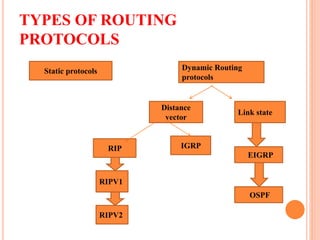
TYPES OF ROUTING
PROTOCOLS
Static protocols Dynamic Routing
protocols
Distance
vector
Link state
EIGRP
OSPF
RIP IGRP
RIPV1
RIPV2
STATIC ROUTING PROTOCOLS
 Static Routing, when an administrator manually
assigns the path from source to destination network.
 It provides more security to network.
 The main drawback of static routing is that when a
link fail in the internetwork all the network goes
down.
 This is feasible in small networks but not in large
networks.
ADVANTAGES
 No overhead on router CPU.
 No bandwidth usage between links.
 Security
DISADVANTAGE:
 Administrator must really understand internetwork
&how each router is connected.
 No practical on large networks as it time intensive.
 Administrator must update all routes.
DYNAMIC ROUTING
PROTOCOLS
o Dynamic routing is the process in which routing
tables are automatically updates by routing table.
 Dynamically discover & maintains routes.
 Calculate routes.
 Distributing routing updates to other routers in the
network.
ADVANTAGE
 Less work in maintaining the configuration when
adding & deleting network.
 Protocols automatically react to the topology changes.
 Configuration is less prone.
 More scalable.
DISADVANTAGE:
 Routers resource are used.
 More administrator knowledge is required for
configuration.
TYPES OF DYNAMIC ROUTING
PROTOCOLS
 The dynamic routing protocols can be categorized on
the basis of various parameters.
 Dynamic Routing protocols are classified into two
protocols
1.DISTANCE VECTOR ROUTING:
It uses simple algorithm that calculate cumulative
distance value between routers based on hop
count.
2.LINK STATE ROUTING PROTOCOLS:
It uses sophisticated algorithms that maintain
complex database of internetwork topology.
ROUTING INFORMATION
PROTOCOLS(RIP)
 RIP allows routers to exchange their routing tables at
a predefined interval.
 RIP is distance vector routing protocols with employs
the hop count as a routing metric.
 RIP router transmitted fall updates in every 30
seconds.
CHARACTERISTICS OF RIP
 Uses hop count metric
 Support 15 hop count limit
 Support six equal cost paths.
 Broadcasting done in RIP & RIPV1.
RIPV2
 It is distance vector protocol AD value is 120.
 Metric is hop count
 Supports classless network
 Supports VLSM/CIDR
 It supports authentication.
IGRP
 IGRP is a distance vector protocol the metrics used
are bandwidth , load , delay , MTU and reliability.
 It is used by routers to exchange routing data within
in autonomous system
CHARACTERISTICS :
 Uses composite metrics
 Support hold downs.
EIGRP
 It is support the features both distance vector & link
state protocols.
 The AD value of EIGRP is 90.
CHARACTERISTICS:
 Communication done via RIP.
 Uses dual algorithm.
 Supports VLSM/CIDR.

Routing protocols

  • 1.
  • 2.
    INTRODUCTION  Routing Protocolsare the set of rules used by the routes to communication between source and destination.  They do not move the information to source to destination only updates the routing table.  Each protocols has its own algorithm to choose the best both the metrics by routing protocols.
  • 3.
    NETWORK LAYER DEVICES Bandwidth  Delay  Load  MTO  Cost
  • 4.
    TYPES OF ROUTING PROTOCOLS Staticprotocols Dynamic Routing protocols Distance vector Link state EIGRP OSPF RIP IGRP RIPV1 RIPV2
  • 5.
    STATIC ROUTING PROTOCOLS Static Routing, when an administrator manually assigns the path from source to destination network.  It provides more security to network.  The main drawback of static routing is that when a link fail in the internetwork all the network goes down.  This is feasible in small networks but not in large networks.
  • 6.
    ADVANTAGES  No overheadon router CPU.  No bandwidth usage between links.  Security DISADVANTAGE:  Administrator must really understand internetwork &how each router is connected.  No practical on large networks as it time intensive.  Administrator must update all routes.
  • 7.
    DYNAMIC ROUTING PROTOCOLS o Dynamicrouting is the process in which routing tables are automatically updates by routing table.  Dynamically discover & maintains routes.  Calculate routes.  Distributing routing updates to other routers in the network.
  • 8.
    ADVANTAGE  Less workin maintaining the configuration when adding & deleting network.  Protocols automatically react to the topology changes.  Configuration is less prone.  More scalable. DISADVANTAGE:  Routers resource are used.  More administrator knowledge is required for configuration.
  • 9.
    TYPES OF DYNAMICROUTING PROTOCOLS  The dynamic routing protocols can be categorized on the basis of various parameters.  Dynamic Routing protocols are classified into two protocols 1.DISTANCE VECTOR ROUTING: It uses simple algorithm that calculate cumulative distance value between routers based on hop count. 2.LINK STATE ROUTING PROTOCOLS: It uses sophisticated algorithms that maintain complex database of internetwork topology.
  • 10.
    ROUTING INFORMATION PROTOCOLS(RIP)  RIPallows routers to exchange their routing tables at a predefined interval.  RIP is distance vector routing protocols with employs the hop count as a routing metric.  RIP router transmitted fall updates in every 30 seconds. CHARACTERISTICS OF RIP  Uses hop count metric  Support 15 hop count limit  Support six equal cost paths.  Broadcasting done in RIP & RIPV1.
  • 11.
    RIPV2  It isdistance vector protocol AD value is 120.  Metric is hop count  Supports classless network  Supports VLSM/CIDR  It supports authentication.
  • 12.
    IGRP  IGRP isa distance vector protocol the metrics used are bandwidth , load , delay , MTU and reliability.  It is used by routers to exchange routing data within in autonomous system CHARACTERISTICS :  Uses composite metrics  Support hold downs.
  • 13.
    EIGRP  It issupport the features both distance vector & link state protocols.  The AD value of EIGRP is 90. CHARACTERISTICS:  Communication done via RIP.  Uses dual algorithm.  Supports VLSM/CIDR.